

The DOI matches its Crossref record; 91 of the 91 references it cites were found in a registry or an index.
Experimental evaluation of the importance of colonization history in early-life gut microbiota assembly
Open accessAbstract
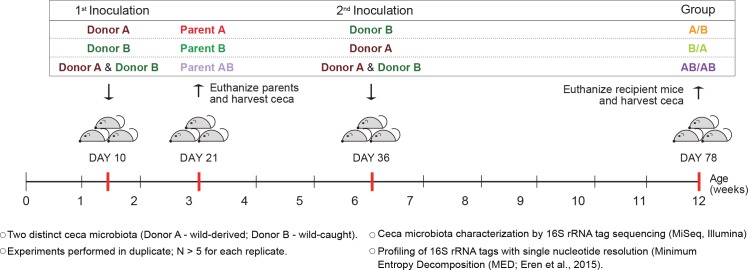
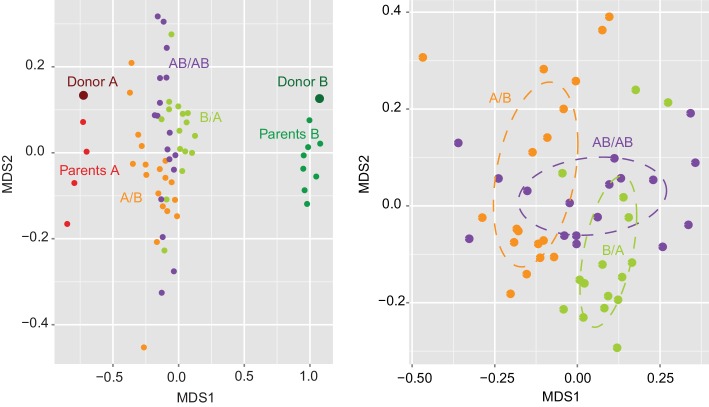
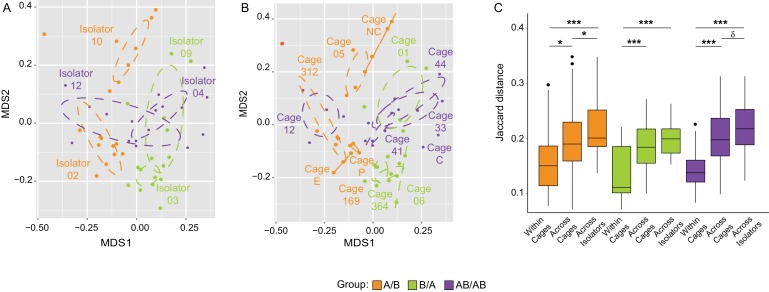
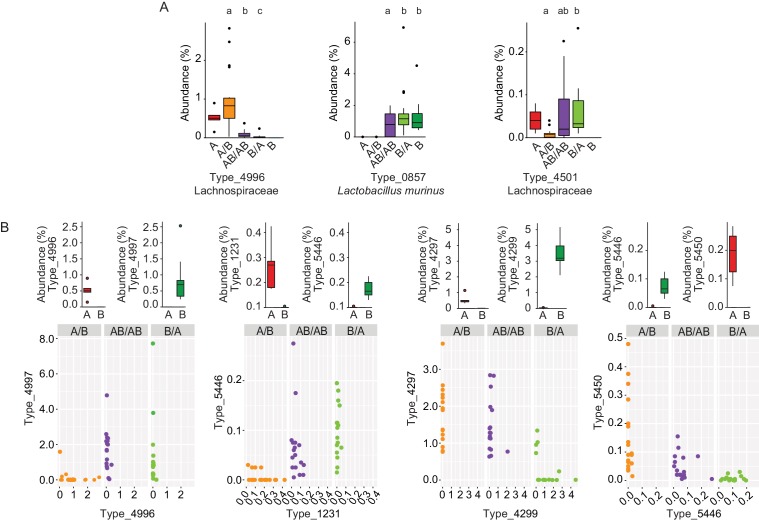
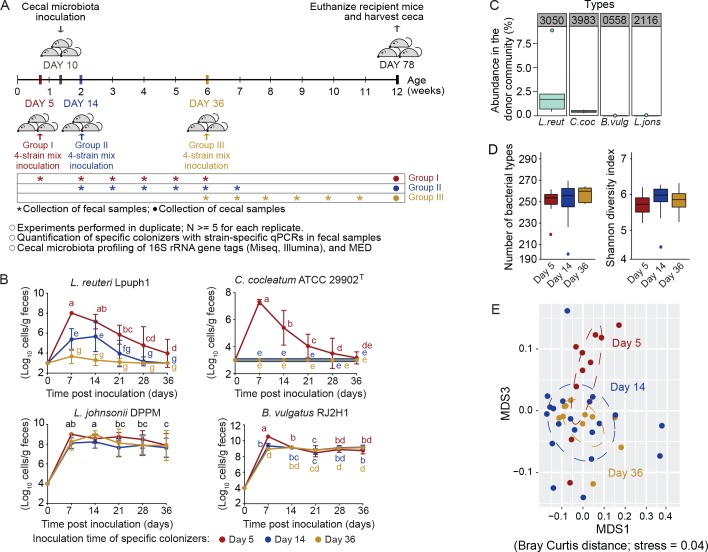
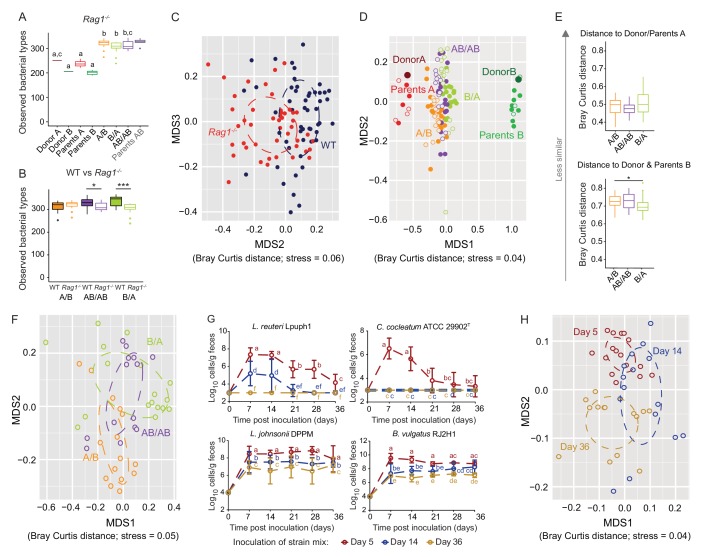
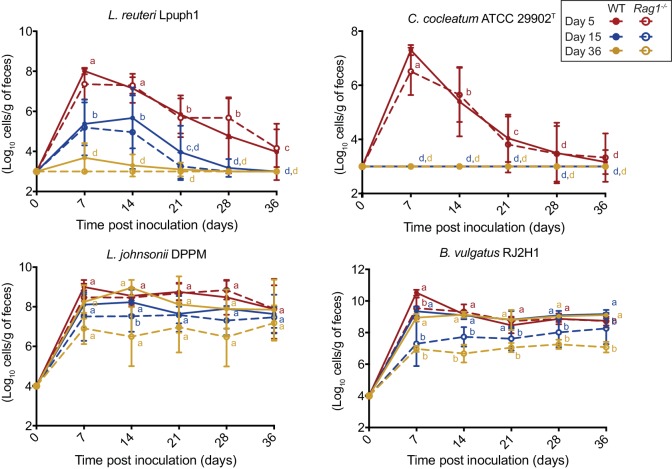
The factors that govern assembly of the gut microbiota are insufficiently understood. Here, we test the hypothesis that inter-individual microbiota variation can arise solely from differences in the order and timing by which the gut is colonized early in life. Experiments in which mice were inoculated in sequence either with two complex seed communities or a cocktail of four bacterial strains and a seed community revealed that colonization order influenced both the outcome of community assembly and the ecological success of individual colonizers. Historical contingency and priority effects also occurred in Rag1-/- mice, suggesting that the adaptive immune system is not a major contributor to these processes. In conclusion, this study established a measurable effect of colonization history on gut microbiota assembly in a model in which host and environmental factors were strictly controlled, illuminating a potential cause for the high levels of unexplained individuality in host-associated microbial communities.
Overview
The claims and statistics of this paper haven’t been checked yet.
Run the check — free, no account needed. It reads the open-access text and checks the sources it cites.
Integrity signals
Registry
Cites
Statistics
Figures
Verification
Claims the paper makes
The claims and statistics of this paper haven’t been checked yet.
Run the check — free, no account needed. It reads the open-access text and checks the sources it cites.
Claims other papers make about this one
Each is checked against this paper’s own text: does it say what the citing paper says it does?
The source backs part of the claim, not all of it — or backs it for a different population, condition or comparison.
In the citing paper
“However, it is known that the microbiota tends to follow one of a few trajectories of development, with early-colonizing species shaping the long-term composition (Martinez et al., 2018).”
From The Microbiota-Gut-Brain Axis (2019) · cites this paper as Martinez et al., 2018
Experimental — accuracy not yet measured
Self-check
Percentages, sums and reported differences re-computed from the paper’s own numbers.
The self-check needs the paper’s full text.
Citations
Cites
R: A Language and Environment for Statistical Computing
R Core Team (2000) · doi:10.32614/r.manuals · Cited by 355,893
Fitting Linear Mixed-Effects Models Using lme4
Bates, D., Mächler, M., Bolker, B., & Walker, S. (2015) · Journal of Statistical Software · doi:10.18637/jss.v067.i01 · Cited by 86,835
QIIME allows analysis of high-throughput community sequencing data
Caporaso, J. G., Kuczynski, J., Stombaugh, J., Bittinger, K., Bushman, F. D., Costello, E. K., Fierer, N., Peña, A. G., Goodrich, J. K., Gordon, J. I., et al. (2010) · Nature Methods · doi:10.1038/nmeth.f.303 · Cited by 34,887
vegan: Community Ecology Package
Oksanen, J., Simpson, G. L., Blanchet, F. G., Kindt, R., Legendre, P., Minchin, P. R., O’Hara, R. B., Sólymos, P., Stevens, M. H. H., Szöcs, E., et al. (2001) · doi:10.32614/cran.package.vegan · Cited by 27,099
Naive Bayesian Classifier for Rapid Assignment of rRNA Sequences into the New Bacterial Taxonomy
Wang, Q., Garrity, G. M., Tiedje, J. M., & Cole, J. R. (2007) · Applied and Environmental Microbiology · doi:10.1128/aem.00062-07 · Cited by 20,145
Simultaneous Inference in General Parametric Models
Hothorn, T., Bretz, F., & Westfall, P. H. (2008) · Biometrical Journal · doi:10.1002/bimj.200810425 · Cited by 14,265
Structure, function and diversity of the healthy human microbiome
The Human Microbiome Project Consortium (2012) · Nature · doi:10.1038/nature11234 · Cited by 11,726
Diet rapidly and reproducibly alters the human gut microbiome
David, L. A., Maurice, C. F., Carmody, R. N., Gootenberg, D. B., Button, J. E., Wolfe, B. E., Ling, A. V., Devlin, A. S., Varma, Y., Fischbach, M. A., et al. (2014) · Nature · doi:10.1038/nature12820 · Cited by 10,100
From Dietary Fiber to Host Physiology: Short-Chain Fatty Acids as Key Bacterial Metabolites
Koh, A., De Vadder, F., Kovatcheva-Datchary, P., & Bäckhed, F. (2016) · Cell · doi:10.1016/j.cell.2016.05.041 · Cited by 7,070
Linking long-term dietary patterns with gut microbial enterotypes
Wu, G. D., Chen, J., Hoffmann, C., Bittinger, K., Chen, Y.-Y., Keilbaugh, S. A., Bewtra, M., Knights, D., Walters, W. A., Knight, R., et al. (2011) · Science · doi:10.1126/science.1208344 · Cited by 6,513
Cited by
Sorted by citations
Cryan, J. F., O'Riordan, K. J., Cowan, C. S. M., Sandhu, K. V., Bastiaanssen, T. F. S., Boehme, M., Codagnone, M. G., Cussotto, S., Fulling, C., Golubeva, A. V., et al. (2019) · Physiological Reviews · doi:10.1152/physrev.00018.2018 · Cited by 5,286
Walter, J., Armet, A. M., Finlay, B. B., & Shanahan, F. (2020) · Cell · doi:10.1016/j.cell.2019.12.025 · Cited by 596
Self-citationPriority effects in microbiome assembly
Debray, R., Herbert, R. A., Jaffe, A. L., Crits‐Christoph, A., Power, M. E., & Koskella, B. (2021) · Nature Reviews Microbiology · doi:10.1038/s41579-021-00604-w · Cited by 620
Adaptive Evolution within Gut Microbiomes of Healthy People
Zhao, S., Lieberman, T. D., Poyet, M., Kauffman, K. M., Gibbons, S. M., Groussin, M., Xavier, R. J., & Alm, E. J. (2019) · Cell Host & Microbe · doi:10.1016/j.chom.2019.03.007 · Cited by 434
Synthetic microbiota reveal priority effects and keystone strains in the Arabidopsis phyllosphere
Carlström, C. I., Field, C. M., Bortfeld‐Miller, M., Müller, B., Sunagawa, S., & Vorholt, J. A. (2019) · Nature Ecology & Evolution · doi:10.1038/s41559-019-0994-z · Cited by 418
Metadata
- Authors
- Martínez, I., Maldonado-Gomez, M. X., Gomes-Neto, J. C., Kittana, H., Ding, H., Schmaltz, R., Joglekar, P., Cardona, R. J., Marsteller, N. L., Kembel, S. W., Benson, A. K., Peterson, D. A., Ramer-Tait, A. E., & Walter, J.
- Affiliations
- University of Nebraska–Lincoln (US)
- Department of Food Science and Technology, University of Nebraska-Lincoln, Lincoln, United States
- Johns Hopkins University (US)
- Université du Québec à Montréal (CA)
- Corresponding author
- Walter, Jens
- ORCID
- Venue
- eLife
- Publisher
- eLife Sciences Publications, Ltd
- Published
- 2018-09-18
- Volume
- 7
- ISSN
- 2050-084X (ISSN-L)
- PMC
- PMC6143339
- OpenAlex
- W2890655424
- Cited by
- 199
- References
- 91
- Citations by year
- 2026: 13 · 2025: 25 · 2024: 29 · 2023: 24 · 2022: 30 · 2021: 27 · 2020: 29 · 2019: 21 · 2018: 1
- FWCI
- 6.94
- Type
- journal article
- Language
- en
- Open access
- gold
- doi.org
- Licence
- Locations
- eLife (publishedVersion, cc-by)
- Europe PMC (PubMed Central) (publishedVersion, cc-by)
- PubMed Central (publishedVersion, cc-by)
- PubMed (publishedVersion)
- Lincoln (University of Nebraska) (submittedVersion, cc-by)
- DOAJ (DOAJ: Directory of Open Access Journals) (submittedVersion, cc-by-sa)
- Funders
- National Institutes of Health (5R01GM099525-02)
- National Institute of General Medical Sciences (1P20GM104320)
- Topics
- Life Sciences › Biochemistry, Genetics and Molecular Biology › Molecular Biology › Gut microbiota and health
- Physical Sciences › Environmental Science › Ecology › Microbial Community Ecology and Physiology
- Health Sciences › Dentistry › Periodontics › Oral microbiology and periodontitis research
- Keywords
- colonization history, priority effects, historical contingency, microbial community assembly, Rag1-deficient mice, adaptive immunity, microbial inoculation, host-associated microbiome
- MeSH terms
- Gastrointestinal Microbiome, Animals, Bacteria, Cecum, Mice, Inbred C57BL, Time Factors, Colony Count, Microbial, Homeodomain Proteins, Models, Animal, Biodiversity, Adaptive Immunity
About these checks
Registry, retraction, Cites and statistics results are computed, not judged, with one exception: a printed reference that no index lists is read once by a model before it counts as a citation error. Claims are extracted by a model and kept only when their quote appears verbatim in the text; each cited source is then checked, with a model’s help, for whether it says what the claim relies on. Those verdicts can be wrong — read the claim’s quote and the cited source before relying on one.
Statistics and arithmetic are recomputed, not judged.
Confidence bands are shown only for fields calibrated on our annotated test set. None is calibrated yet, so no band is shown.
What counts as a claim ›How we measure confidence ›How we check this ›
Are you an author, or do you see a problem with this page? Request a review
