

The DOI matches its Crossref record; 66 of the 66 references it cites were found in a registry or an index.
Multivariable two-sample Mendelian randomization estimates of the effects of intelligence and education on health
Open accessAbstract
Intelligence and education are predictive of better physical and mental health, socioeconomic position (SEP), and longevity. However, these associations are insufficient to prove that intelligence and/or education cause these outcomes. Intelligence and education are phenotypically and genetically correlated, which makes it difficult to elucidate causal relationships. We used univariate and multivariable Mendelian randomization to estimate the total and direct effects of intelligence and educational attainment on mental and physical health, measures of socioeconomic position, and longevity. Both intelligence and education had beneficial total effects. Higher intelligence had positive direct effects on income and alcohol consumption, and negative direct effects on moderate and vigorous physical activity. Higher educational attainment had positive direct effects on income, alcohol consumption, and vigorous physical activity, and negative direct effects on smoking, BMI and sedentary behaviour. If the Mendelian randomization assumptions hold, these findings suggest that both intelligence and education affect health.
Overview
The claims and statistics of this paper haven’t been checked yet.
Run the check — free, no account needed. It reads the open-access text and checks the sources it cites.
Integrity signals
Registry
Cites
Statistics
Figures
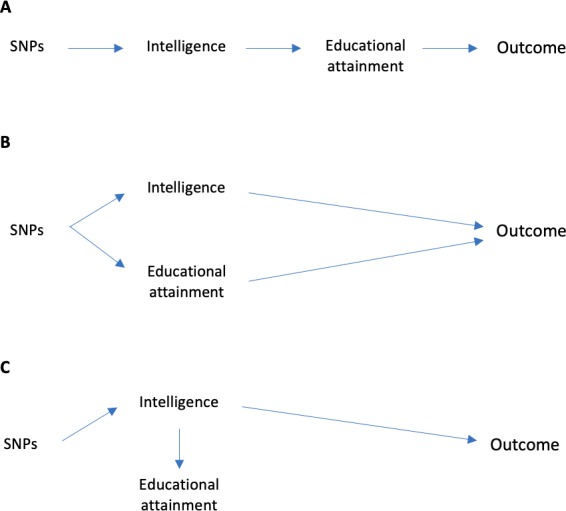
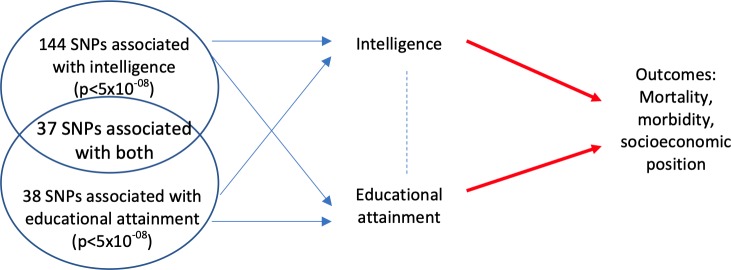
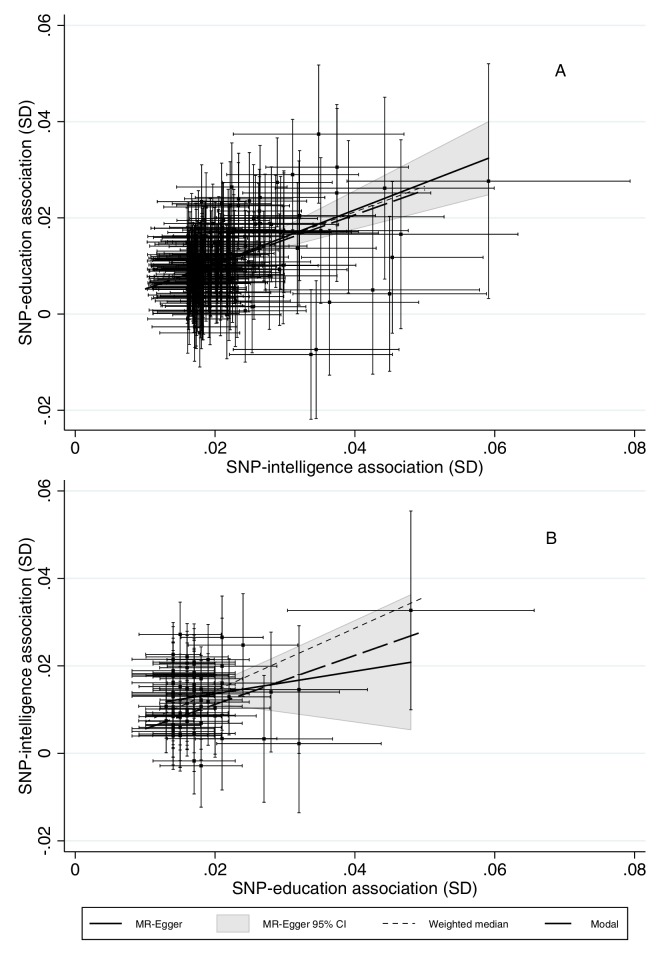
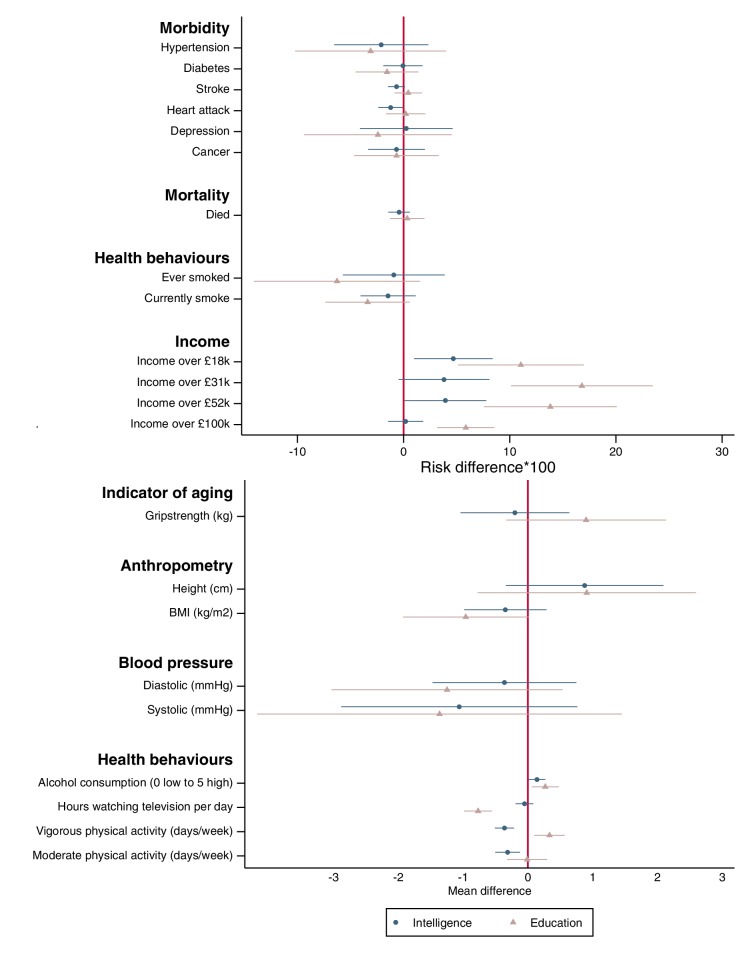
Verification
Claims the paper makes
The claims and statistics of this paper haven’t been checked yet.
Run the check — free, no account needed. It reads the open-access text and checks the sources it cites.
Claims other papers make about this one
Each is checked against this paper’s own text: does it say what the citing paper says it does?
The source backs part of the claim, not all of it — or backs it for a different population, condition or comparison.
In the citing paper
“Triangulation of evidence from multiple methodologies — using different methodologies that are subject to different sources and directions of potential bias — can help to identify bias in MR studies.6,7,155 Alignment of results across these different methodologies can improve confidence in an initial causal interpretation.”
From Mendelian randomization (2022) · cites this paper as [155]
Experimental — accuracy not yet measured
Self-check
Percentages, sums and reported differences re-computed from the paper’s own numbers.
The self-check needs the paper’s full text.
Citations
Cites
Specification Tests in Econometrics
Hausman, J. A. (1978) · Econometrica · doi:10.2307/1913827 · Cited by 18,820
Bowden, J., Davey Smith, G., Haycock, P. C., & Burgess, S. (2016) · Genetic Epidemiology · doi:10.1002/gepi.21965 · Cited by 8,922
The MR-Base platform supports systematic causal inference across the human phenome
Hemani, G., Zheng, J., Elsworth, B., Wade, K. H., Haberland, V., Baird, D., Laurin, C., Burgess, S., Bowden, J., Langdon, R., et al. (2018) · eLife · doi:10.7554/elife.34408 · Cited by 7,959
Davey Smith, G., & Ebrahim, S. (2003) · International Journal of Epidemiology · doi:10.1093/ije/dyg070 · Cited by 5,882
Mendelian randomization: genetic anchors for causal inference in epidemiological studies
Davey Smith, G., & Hemani, G. (2014) · Human Molecular Genetics · doi:10.1093/hmg/ddu328 · Cited by 4,677
Reading Mendelian randomisation studies: a guide, glossary, and checklist for clinicians
Davies, N. M., Holmes, M. V., & Davey Smith, G. (2018) · BMJ · doi:10.1136/bmj.k601 · Cited by 4,404
Self-citationFry, A., Littlejohns, T. J., Sudlow, C., Doherty, N., Adamska, L., Sprosen, T., Collins, R., & Allen, N. E. (2017) · American Journal of Epidemiology · doi:10.1093/aje/kwx246 · Cited by 3,979
Robust inference in summary data Mendelian randomization via the zero modal pleiotropy assumption
Hartwig, F. P., Davey Smith, G., & Bowden, J. (2017) · International Journal of Epidemiology · doi:10.1093/ije/dyx102 · Cited by 3,485
The Estimation of Economic Relationships using Instrumental Variables
Sargan, J. D. (1958) · Econometrica · doi:10.2307/1907619 · Cited by 3,377
23andMe Research Team, Lee, J. J., COGENT (Cognitive Genomics Consortium), Social Science Genetic Association Consortium, Wedow, R., Okbay, A., Kong, E., Maghzian, O., Zacher, M., Nguyen-Viet, T. A., et al. (2018) · Nature Genetics · doi:10.1038/s41588-018-0147-3 · Cited by 2,470
Cited by
Sorted by citations
Sanderson, E., Glymour, M. M., Holmes, M. V., Kang, H., Morrison, J., Munafò, M. R., Palmer, T., Schooling, C. M., Wallace, C., Zhao, Q., et al. (2022) · Nature Reviews Methods Primers · doi:10.1038/s43586-021-00092-5 · Cited by 2,229
Self-citationSanderson, E. C. M., Spiller, W., & Bowden, J. (2021) · Statistics in Medicine · doi:10.1002/sim.9133 · Cited by 603
Self-citationBias correction for inverse variance weighting Mendelian randomization
Mounier, N., & Kutalik, Z. (2023) · Genetic Epidemiology · doi:10.1002/gepi.22522 · Cited by 465
Rosoff, D. B., Smith, G. D., Mehta, N. N., Clarke, T., & Lohoff, F. W. (2020) · PLoS Medicine · doi:10.1371/journal.pmed.1003410 · Cited by 213
Pleiotropy robust methods for multivariable Mendelian randomization
Grant, A. J., & Burgess, S. (2021) · Statistics in Medicine · doi:10.1002/sim.9156 · Cited by 194
Metadata
- Authors
- Davies, N. M., Hill, W. D., Anderson, E. L., Sanderson, E., Deary, I. J., & Davey Smith, G.
- Affiliations
- University of Bristol (GB)
- University of Edinburgh (GB)
- Medical Research Council Integrative Epidemiology Unit, University of Bristol, Bristol, United Kingdom
- Corresponding author
- Davies, Neil Martin
- ORCID
- Venue
- eLife
- Publisher
- eLife Sciences Publications, Ltd
- Published
- 2019-09-17
- Volume
- 8
- ISSN
- 2050-084X (ISSN-L)
- PMC
- PMC6748790
- OpenAlex
- W2974720922
- Cited by
- 135
- References
- 66
- Citations by year
- 2026: 6 · 2025: 19 · 2024: 26 · 2023: 33 · 2022: 18 · 2021: 17 · 2020: 12 · 2019: 4
- FWCI
- 7.68
- Type
- journal article
- Language
- en
- Open access
- gold
- doi.org
- Licence
- Locations
- eLife (publishedVersion, cc-by)
- Europe PMC (PubMed Central) (publishedVersion, cc-by)
- PubMed Central (publishedVersion, cc-by)
- PubMed (publishedVersion)
- DOAJ (DOAJ: Directory of Open Access Journals) (submittedVersion, cc-by-sa)
- Edinburgh Research Explorer (University of Edinburgh) (submittedVersion, cc-by)
- Bristol Research (University of Bristol) (submittedVersion, cc-by)
- Funders
- Economic and Social Research Council (ES/N000757/1)
- Medical Research Council (MC_UU_12013/1, MC_UU_12013/9, MC_UU_00011/1, MR/K026992/1)
- Age UK (Disconnected Mind Grant)
- Topics
- Life Sciences › Biochemistry, Genetics and Molecular Biology › Genetics › Genetic Associations and Epidemiology
- Social Sciences › Psychology › Experimental and Cognitive Psychology › Cognitive Abilities and Testing
- Social Sciences › Sociology and Political Science › Intergenerational and Educational Inequality Studies
- Keywords
- intelligence, educational attainment, mental health, physical health, socioeconomic position, longevity, income, alcohol consumption, physical activity, smoking, body mass index, sedentary behavior, genetic correlation
- MeSH terms
- Adult, Aged, Education, Female, United Kingdom, Health, Humans, Intelligence, Health Knowledge, Attitudes, Practice, Male, Middle Aged, Biostatistics
About these checks
Registry, retraction, Cites and statistics results are computed, not judged, with one exception: a printed reference that no index lists is read once by a model before it counts as a citation error. Claims are extracted by a model and kept only when their quote appears verbatim in the text; each cited source is then checked, with a model’s help, for whether it says what the claim relies on. Those verdicts can be wrong — read the claim’s quote and the cited source before relying on one.
Statistics and arithmetic are recomputed, not judged.
Confidence bands are shown only for fields calibrated on our annotated test set. None is calibrated yet, so no band is shown.
What counts as a claim ›How we measure confidence ›How we check this ›
Are you an author, or do you see a problem with this page? Request a review
