

The DOI matches its Crossref record; 1 of the 1 references it cites were found in a registry or an index.
Relationship among airborne pollen, sensitization, and pollen food allergy syndrome in Asian allergic children
Abstract
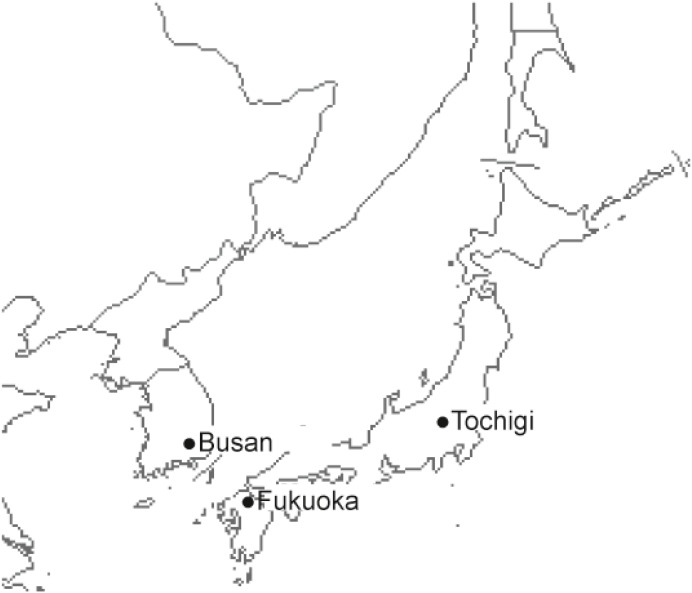
Background: Causes of pediatric pollen food allergy syndrome (PFAS) differ depending on airborne pollen levels in a particular region. We aimed to analyze airborne pollen counts, IgE sensitization rates, and PFAS incidence among children with allergies in South Korea and Japan. Methods: This cross-sectional study included children aged 5–17 years with allergies in 2017. Airborne pollen samples were collected from Busan in South Korea, and Fukuoka and Tochigi in Japan. Questionnaires were used to assess bronchial asthma, seasonal allergic rhinitis, atopic dermatitis, food allergy, and PFAS. The serum IgE specific to Dermatophagoides pteronyssinus, pollen, tomato, and peach were investigated. Results: In total, 57, 56, and 20 patients from Busan, Fukuoka, and Tochigi, respectively, were enrolled. Airborne Japanese cedar and cypress pollen were predominant in Fukuoka and Tochigi, whereas pine and alder pollen were predominant in Busan. Children with allergies in Fukuoka and Tochigi had a significantly higher sensitization rate to Japanese cedar, cypress, juniper, orchard grass, ragweed, Japanese hop, and tomato compared with children in Busan. In Fukuoka and Tochigi, where Japanese cedar and cypress pollen were frequently scattered, high sensitizations among allergic children were observed. The sensitization rate was not affected by the pollen count in alder, grass, ragweed, and Japanese hop. In multivariable analysis, only alder sensitization was found to be associated with PFAS (odds ratio: 6.62, 95% confidence interval: 1.63–26.87, p = 0.008). In patients with PFAS in Busan and Tochigi, peach associated with birch allergen Bet v 1 was a causative food item for PFAS. Moreover, PFAS was associated with ragweed and Japanese hop pollen sensitization in Fukuoka. Conclusion: Regardless of pollen counts, alder pollen sensitization was associated with PFAS in children. Ragweed and Japanese hop pollen sensitization were associated with PFAS, particularly among children in southern Japan.
Overview
The claims and statistics of this paper haven’t been checked yet.
Run the check — free, no account needed. It reads the open-access text and checks the sources it cites.
Integrity signals
Registry
Cites
Statistics
Figures
Verification
Claims the paper makes
The claims and statistics of this paper haven’t been checked yet.
Run the check — free, no account needed. It reads the open-access text and checks the sources it cites.
Claims other papers make about this one
Each is checked against this paper’s own text: does it say what the citing paper says it does?
In the citing paper
“In contrast, ragweed pollen-related PFAS is more dominant in North America, Central and Eastern Europe, and Japan [49].”
From Pollen–Food Allergy Syndrome: Allergens, Clinical Insights, Diagnostic and Therapeutic Challenges (2024) · cites this paper as [49]
Self-check
Percentages, sums and reported differences re-computed from the paper’s own numbers.
The self-check needs the paper’s full text.
Citations
Cites
Epidemiological study of oral allergy syndrome in birch pollen dispersal-free regions
Osawa, Y., Ito, Y., Takahashi, N., Sugimoto, C., Kohno, Y., Mori, S., Morikawa, T., Kato, Y., Okamoto, M., Kanno, M., et al. (2020) · Allergology International · doi:10.1016/j.alit.2019.09.008 · Cited by 31
Research works printed but not linked: 20
- Biedermann, 2019, Birch pollen allergy in Europe, Allergy, 74, 1237, 10.1111/all.13758 · DOI · Paper page
- Carlson, 2019, Pollen food allergy syndrome (PFAS): a review of current available literature, Annals of Allergy, Asthma & Immunology, 123, 359, 10.1016/j.anai.2019.07.022 · DOI · Paper page
- Ebisawa, 2020, Japanese guidelines for food allergy 2020, Allergology International, 69, 370, 10.1016/j.alit.2020.03.004 · DOI
- Frenz, 2000, The effect of windspeed on pollen and spore counts collected with the Rotorod Sampler and Burkard spore trap, Annals of Allergy, Asthma & Immunology, 85, 392, 10.1016/S1081-1206(10)62553-7 · DOI
- Jang, 2021, Allergen homologues, pathogenesis-related 1, polygalacturonase, and pectin methyl esterase from a Japanese Hop, Protein and Peptide Letters, 28, 362, 10.2174/0929866527666200813201924 · DOI
- Kim, 2018, Pollen-food allergy syndrome in Korean pollinosis patients: a nationwide survey, Allergy, Asthma & Immunology Research, 10, 648, 10.4168/aair.2018.10.6.648 · DOI
- Kim, 2015, The prevalence and risk factors of allergic rhinitis from a nationwide study of Korean elementary, middle, and high school students, Allergy, Asthma & Respiratory Disease, 3, 272, 10.4168/aard.2015.3.4.272 · DOI
- Kishikawa, 2019, Long-term results of airborne pollen surveys in the Japanese archipelago from the perspective of pollen antigen, Arerugi, 68, 1221, 10.15036/arerugi.68.1221 · DOI
- Kishikawa, 2017, Longitudinal monitoring of tree airborne pollen in Japan, Arerugi, 66, 97, 10.15036/arerugi.66.97 · DOI
- Kondo, 2002, Assessment of cross-reactivity between Japanese cedar (Cryptomeria japonica) pollen and tomato fruit extracts by RAST inhibition and immunoblot inhibition, Clinical and Experimental Allergy, 32, 590, 10.1046/j.0954-7894.2002.01337.x · DOI
- Lai, 2009, Global variation in the prevalence and severity of asthma symptoms: phase three of the International Study of Asthma and Allergies in Childhood (ISAAC), Thorax, 64, 476, 10.1136/thx.2008.106609 · DOI
- Masumoto, 2018, Pollen food allergy syndrome in a five-year-old boy after moving house at the foot of the mountain: a case report, Arerugi, 67, 1027, 10.15036/arerugi.67.1027 · DOI
- Park, 2001, Are there any links between Hop Japanese pollen and other weed pollens or food allergens on skin prick tests?, Allergy and Asthma Proceedings, 22, 43, 10.2500/108854101778249186 · DOI
- Pedrosa, 2020, Quercus ilex pollen allergen, Que i 1, responsible for pollen food allergy syndrome caused by fruits in Spanish allergic patients, Clinical and Experimental Allergy, 50, 815, 10.1111/cea.13679 · DOI
- Rutter, 2020, Comparison of individual-level and population-level risk factors for rhinoconjunctivitis, asthma, and eczema in the International Study of Asthma and Allergies in Childhood (ISAAC) Phase Three, The World Allergy Organization Journal, 13, 100123, 10.1016/j.waojou.2020.100123 · DOI
- Senna, 2000, Anaphylaxis to pine nuts and immunological cross-reactivity with pine pollen proteins, Journal of Investigational Allergology & Clinical Immunology, 10, 44
- Skypala, 2011, Development and validation of a structured questionnaire for the diagnosis of oral allergy syndrome in subjects with seasonal allergic rhinitis during the UK birch pollen season, Clinical and Experimental Allergy, 41, 1001, 10.1111/j.1365-2222.2011.03759.x · DOI
- Sun, 2017, Species and quantity of airborne pollens in Shanghai as monitored by gravitational and volumetric methods, Asian Pacific Journal of Allergy and Immunology, 35, 38, 10.12932/AP0743 · DOI
- Sung, 2014, The correlation between allergy sensitization rate in pediatric and aerobiological study for airborne pollen in Busan for 15 years, Allergy, Asthma & Respiratory Disease, 2, 38, 10.4168/aard.2014.2.1.38 · DOI
- Takemura, 2020, Association between fruit and vegetable allergies and pollen-food allergy syndrome in Japanese children: a multicenter cross-sectional case series, Asia Pacific Allergy, 10, e9, 10.5415/apallergy.2020.10.e9 · DOI
Cited by
Sorted by citations
Pollen–Food Allergy Syndrome: Allergens, Clinical Insights, Diagnostic and Therapeutic Challenges
Haidar, L., Bănărescu, C. F., Uța, C., Moldovan, S. I., Zimbru, E.-L., Zimbru, R.-I., Ciurariu, E., Georgescu, M., & Panaitescu, C. (2024) · Applied Sciences · doi:10.3390/app15010066 · Cited by 21
Metadata
- Authors
- Hwang, Y., Motomura, C., Fukuda, H., Kishikawa, R., Watanabe, N., & Yoshihara, S.
- Affiliations
- Department of Pediatrics, Busan St. Mary’s Hospital, Busan, South Korea
- Department of Pediatrics, National Hospital Organization Fukuoka National Hospital, Fukuoka, Japan
- Department of Pediatrics, Dokkyo Medical University Hospital, Tochigi, Japan
- Department of Allergy, National Hospital Organization Fukuoka National Hospital, Fukuoka, Japan
- Department of Allergy Internal Medicine, Seirei Yokohama Hospital, Kanagawa, Japan
- Venue
- PeerJ
- Publisher
- PeerJ
- Published
- 2022-11-01
- Volume
- 10
- Pages
- e14243
- ISSN
- 2167-8359
- PMC
- PMC9635357
- Cited by
- 13
- References
- 1
- Language
- en
About these checks
Registry, retraction, Cites and statistics results are computed, not judged, with one exception: a printed reference that no index lists is read once by a model before it counts as a citation error. Claims are extracted by a model and kept only when their quote appears verbatim in the text; each cited source is then checked, with a model’s help, for whether it says what the claim relies on. Those verdicts can be wrong — read the claim’s quote and the cited source before relying on one.
Statistics and arithmetic are recomputed, not judged.
Confidence bands are shown only for fields calibrated on our annotated test set. None is calibrated yet, so no band is shown.
What counts as a claim ›How we measure confidence ›How we check this ›
Are you an author, or do you see a problem with this page? Request a review
