

The DOI matches its Crossref record; 8 of the 8 references it cites were found in a registry or an index.
Trends in ransomware attacks on US hospitals, clinics, and other health care delivery organizations, 2016-2021.
Open accessAbstract
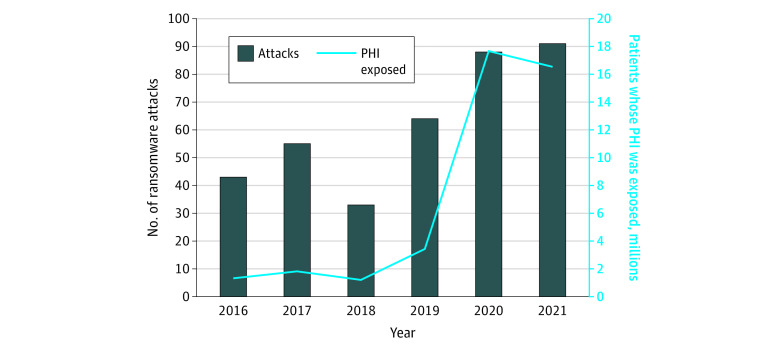
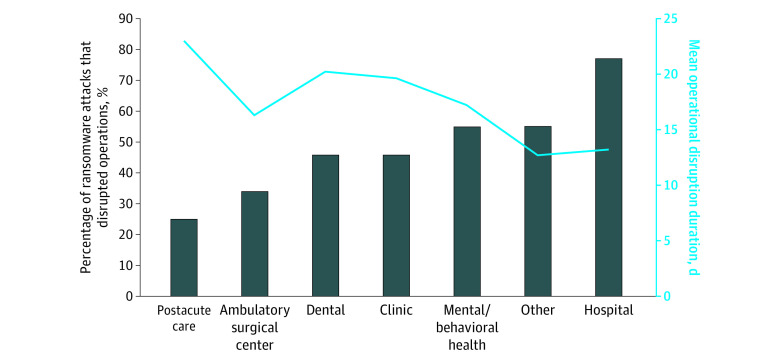
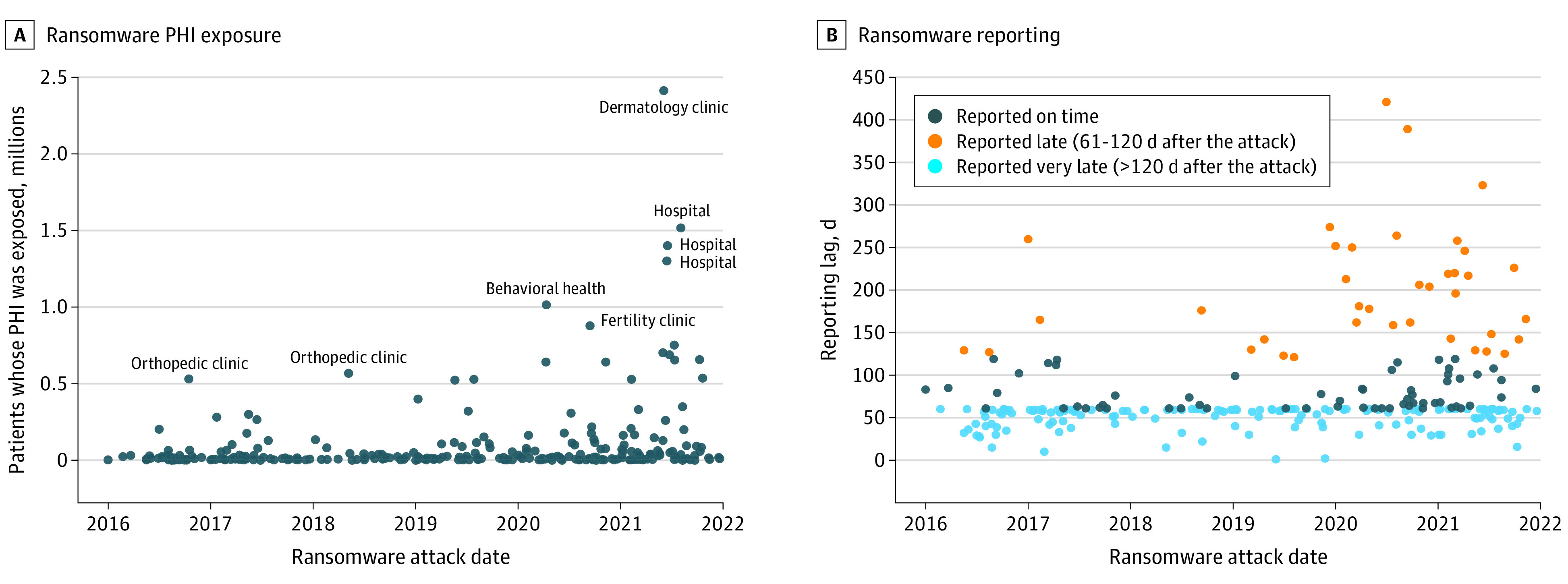
Importance: Anecdotal evidence suggests that health care delivery organizations face a growing threat from ransomware attacks that are designed to disrupt care delivery and may consequently threaten patient outcomes. Objective: To quantify the frequency and characteristics of ransomware attacks on health care delivery organizations. Design, Setting, and Participants: This cohort study used data from the Tracking Healthcare Ransomware Events and Traits database to examine the number and characteristics of ransomware attacks on health care delivery organizations from 2016 to 2021. Logistic and negative binomial regression quantified changes over time in the characteristics of ransomware attacks that affected health care delivery organizations. Main Outcomes and Measures: Date of ransomware attack, public reporting of ransomware attacks, personal health information (PHI) exposure, status of encrypted/stolen data following the attack, type of health care delivery organization affected, and operational disruption during the ransomware attack. Results: From January 2016 to December 2021, 374 ransomware attacks on US health care delivery organizations exposed the PHI of nearly 42 million patients. From 2016 to 2021, the annual number of ransomware attacks more than doubled from 43 to 91. Almost half (166 [44.4%]) of ransomware attacks disrupted the delivery of health care, with common disruptions including electronic system downtime (156 [41.7%]), cancellations of scheduled care (38 [10.2%]), and ambulance diversion (16 [4.3%]). From 2016 to 2021, ransomware attacks on health care delivery organizations increasingly affected large organizations with multiple facilities (annual marginal effect [ME], 0.08; 95% CI, 0.05-0.10; P < .001), exposed the PHI of more patients (ME, 66 385.8; 95% CI, 3400.5-129 371.2; P = .04), were less likely to be restored from data backups (ME, -0.04; 95% CI, -0.06 to -0.01; P = .002), were more likely to exceed mandatory reporting timelines (ME, 0.06; 95% CI, 0.03-0.08; P < .001), and increasingly were associated with delays or cancellations of scheduled care (ME, 0.02; 95% CI, 0-0.05; P = .02). Conclusions and Relevance: This cohort study of ransomware attacks documented growth in their frequency and sophistication. Ransomware attacks disrupt care delivery and jeopardize information integrity. Current monitoring/reporting efforts provide limited information and could be expanded to potentially yield a more complete view of how this growing form of cybercrime affects the delivery of health care.
Overview
The claims and statistics of this paper haven’t been checked yet.
Run the check — free, no account needed. It reads the open-access text and checks the sources it cites.
Integrity signals
Registry
Cites
Statistics
Figures
Verification
Claims the paper makes
The claims and statistics of this paper haven’t been checked yet.
Run the check — free, no account needed. It reads the open-access text and checks the sources it cites.
Claims other papers make about this one
Each is checked against this paper’s own text: does it say what the citing paper says it does?
The source backs part of the claim, not all of it — or backs it for a different population, condition or comparison.
In the citing paper
“Ransomware cyberattacks on healthcare delivery organizations (HDOs) are increasing in frequency and sophistication (1).”
From Ransomware Cyberattack Associated With Cardiac Arrest Incidence and Outcomes at Untargeted, Adjacent Hospitals (2024) · cites this paper as [1]
Experimental — accuracy not yet measured
Self-check
Percentages, sums and reported differences re-computed from the paper’s own numbers.
The self-check needs the paper’s full text.
Citations
Cites
Assessment of Employee Susceptibility to Phishing Attacks at US Health Care Institutions
Gordon, W. J., Wright, A. T., Aiyagari, R. M., Corbo, L., Glynn, R. J., Kadakia, J., Kufahl, J., Mazzone, C., Noga, J., Parkulo, M. A., et al. (2019) · JAMA Network Open · doi:10.1001/jamanetworkopen.2019.0393 · Cited by 81
Temporal trends and characteristics of reportable health data breaches, 2010-2017
McCoy, T. H., & Perlis, R. H. (2018) · JAMA · doi:10.1001/jama.2018.9222 · Cited by 62
Health Information Technology for Economic and Clinical Health Act
(2011) · NASN School Nurse · doi:10.1177/1942602x10390377 · Cited by 52
Hospital risk of data breaches
Bai, G., Jiang, J. (., & Flasher, R. (2017) · JAMA Internal Medicine · doi:10.1001/jamainternmed.2017.0336 · Cited by 51
Data breach locations, types, and associated characteristics among US hospitals.
Gabriel, M. H., Noblin, A. M., Rutherford, A. E., Walden, A., & Cortelyou-Ward, K. H. (2018) · PubMed · Cited by 45
Types of Information Compromised in Breaches of Protected Health Information
Jiang, J. (., & Bai, G. (2020) · Annals of Internal Medicine · doi:10.7326/m19-1759 · Cited by 21
Your Money or Your Patient's Life? Ransomware and Electronic Health Records
Cohen, I. G., Hoffman, S., & Adashi, E. Y. (2017) · Annals of Internal Medicine · doi:10.7326/m17-1312 · Cited by 14
Beyond Security Patches—Fundamental Incentive Problems in Health Care Cybersecurity
Kanter, G. P., Kufahl, J., & Cohen, I. G. (2021) · JAMA Health Forum · doi:10.1001/jamahealthforum.2021.2969 · Cited by 4
Cited by
Sorted by citations
Items 101–154 of 154
Jaffray, D. A., & Berlín, A. (2025) · doi:10.1002/9781394191369.ch5.3
Balancing Innovation and Safety in Digital Healthcare
Sharma, S., Singh, M. P., & Pradhan, K. B. (2025) · Global Clinical Engineering Journal · doi:10.31354/globalce.v7i1.262
Granda, C. M. M., Fernández‐Alemán, J. L., de Gea, J. M. C., & García‐Berná, J. A. (2025) · SSRN Electronic Journal · doi:10.2139/ssrn.5280867
Cybersecure HealthcarePreprint
Kathiresan, G. (2025) · doi:10.31224/4707
Chaieb, M., Bou‐Chaaya, K., & Rais, H. (2025) · SN Computer Science · doi:10.1007/s42979-025-04096-w
“For instance, ransomware attacks have severely disrupted healthcare services, compromising patient safety and privacy [4].”
RENTAKA: Detecting Ransomware at Pre-Attack Stage Using Machine Learning Approach
Zakaria, W. Z. A., Abdollah, M. F., Mohd, O., Aziz, M. N. A., Yassin, S. M. W. M. S. M. M., & Kassim, S. R. M. (2025) · IEEE Symposium on Computer Applications & Industrial Electronics (ISCAIE) · doi:10.1109/iscaie64985.2025.11081161
Raoof, M. M., & Al-Hashemi, R. (2025) · Journal of Information Security · doi:10.4236/jis.2025.163022
Protection of Patients Data in e-Health Applications: Challenges and Abuses
Lakicevic, B., Spalević, Ž., & Ilić, A. S. (2025) · Intelligent systems reference library · doi:10.1007/978-3-031-95044-5_10
Wanta, J. W., Bitterman, M., Pergjika, A., Gonzales, R., & Walkup, J. T. (2025) · Journal of the Academy of Consultation-Liaison Psychiatry · doi:10.1016/j.jaclp.2025.08.011
Velasco, M. T. I. (2025) · Advanced sciences and technologies for security applications · doi:10.1007/978-3-031-96432-9_11
ANALISIS BIBLIOMETRIK PADA PENELITIAN HOSPITAL DISASTER PLAN
Putra, R. S. P., & Pratiwi, R. D. (2024) · JURNAL KEPERAWATAN TROPIS PAPUA · doi:10.47539/jktp.v7i2.475
Egawa, S. (2025) · Springer eBooks · doi:10.1007/978-981-97-4547-0_16-1
Bidoki, M. Z., Heath, M. L., & Silvera, G. A. (2025) · Health Care Management Review · doi:10.1097/hmr.0000000000000463
Lessons From CMS Relief Funding After Cyberattack On Change Healthcare
Neprash, H. T., Beebe, T. J., Yost, G., & Carroll, C. E. (2025) · Health Affairs · doi:10.1377/hlthaff.2025.00990
Onyema, S., Butt, U., & Shaalan, K. F. (2025) · International Conference on Business Analytics for Technology and Security (ICBATS) · doi:10.1109/icbats66542.2025.11258479
Towards Safer E-Healthcare: BWM-Based Cybersecurity Risk Prioritization
Erdoğan, M., Ayyıldız, E., Kesici, B., & Madi, E. N. (2025) · doi:10.1109/incit66780.2025.11276129
Ransomware Resilient Architecture for Healthcare Using Blockchain and IPFS
Alkhajeh, A., Alhashmi, S., Ali, A. A., Alhosani, R., Alshehhi, S., Pavithran, D., & Anajemba, J. H. (2026) · Smart innovation, systems and technologies · doi:10.1007/978-981-95-1361-1_21
Suntwal, S., Kocsis, D., & Shepherd, M. M. (2026) · Information and Computer Security · doi:10.1108/ics-06-2025-0204
The Cyberpsychological Dimensions of Healthcare Cybersecurity Crime Risks
Lundy, A., Burrell, D. N., & Huff, A. J. (2026) · Advances in computational intelligence and robotics book series · doi:10.4018/979-8-3373-9918-8.ch007
Evolving Threats and Adaptive Defenses: A Multi-Sector Analysis of Ransomware in the United States
Nafchi, M. Z., & Miska, K. (2026) · ACC Journal · doi:10.2478/acc-2026-0004
“The healthcare sector is widely regarded as the most vulnerable due to its reliance on uninterrupted data access and the prevalence of outdated legacy systems (Neprash et al., 2022).”
Sreenivas, N. P., Jyoti, J., Lathwal, A., & Yamini (2026) · AIP conference proceedings · doi:10.1063/5.0322608
Burrell, D. N., Lundy, A., Burton, S. L., Nobles, C., Dawson, M. E., Brown-Jackson, K. L., Reed, P., Parker, J., Smith, G. K., Conti, K. L., et al. (2026) · IGI Global eBooks · doi:10.4018/979-8-2600-1021-1.ch009
Securing IoMT: Requirements, challenges, techniques, and future trends
Patil, R., Shinde, R., Patil, Y. H., & Karati, A. (2026) · Elsevier eBooks · doi:10.1016/b978-0-443-27448-0.00012-3
Brantly, A. F., & Mason, R. (2026) · Applied Cybersecurity & Internet Governance · doi:10.60097/acig/219041
Against the Breach: Building a Resilient Learning Environment
Licari, F. W., & Patil, S. (2026) · Journal of Dental Education · doi:10.1002/jdd.70277
Jung, S., & Son, K. (2026) · JMIR Medical Informatics · doi:10.2196/94846
“Thematic analyses of attacks on US hospitals and clinics demonstrate substantial operational and financial impact, even when direct patient harm is difficult to quantify [3,4].”
The evolution of healthcare technology and smart hospitals: definition and scope
Sivakumar, M., Krishnaraj, N., Tyagi, A. K., & Jayaraja, S. (2026) · Elsevier eBooks · doi:10.1016/b978-0-443-45875-0.00004-1
Ostermann, M., Platzbecker, A. S., Welzel, C., Gilbert, S., & Freyer, O. (2026) · npj Health Systems · doi:10.1038/s44401-026-00109-9
Analyzing and Securing Healthcare Against Ransomware
Swetha, Y. J. N. S., & Ramesh, S. (2026) · International Conference on Inventive Computing and Informatics (ICICI) · doi:10.1109/icici68773.2026.11581273
“Empirical studies by [5] and hypothetical studies by [8] have shifted the debate to the aspect of interrupting patient care in case of going offline in hospital systems in addition to being life-threatening.”
Kumar, A. M., Gupta, R., Kumar, S., Dutta, K., & Kumar, R. (2026) · Lecture notes in networks and systems · doi:10.1007/978-3-032-25958-5_6
Rehman, T., Jarrett, P. C., Lesko, J., Augustine, J. J., Shy, B. D., Sangal, R. B., Genes, N. G., Apakama, D. U., Abbott, E. E., Mehrotra, A., et al. (2026) · Journal of the American College of Emergency Physicians Open · doi:10.1016/j.acepjo.2026.100466
“40,41 Because PF-AI tools handle sensitive patient-reported data, explicit safeguards are a precondition for trust, not a downstream assurance.”
Forensics in healthcare cloud environments: Privacy-preserving evidence workflows
Chae, Y. (2026) · Forensic Science International Reports · doi:10.1016/j.fsir.2026.100498
Computational Analysis of Employees Learning from Phishing Simulations
Bouma, D., Hoffmans, C. C. A., van den Hout, N. J., Zwarts, N., Jan Treur, A., & Roelofsma, P. H. M. P. (2026) · Studies in systems, decision and control · doi:10.1007/978-3-032-23886-3_4
AlJohani, N. I. (2026) · Frontiers in Public Health · doi:10.3389/fpubh.2026.1877926
“Cybersecurity resilience is inseparable from digital health strategy: ransomware attacks on healthcare organizations more than doubled between 2016 and 2021 (20), and state-sponsored cyberattacks during active geopolitical conflicts represent a distinct and escalating threat.”
Thin Margins, Thick Threats: Ransomware Pressure on Rural Hospitals
Gulam, S. (2026) · Lecture notes in networks and systems · doi:10.1007/978-3-032-30563-3_42
Hospital Evacuation of Children During Disaster Events
Lin, A., & Henning, A. (2026) · Springer eBooks · doi:10.1007/978-3-032-27013-9_15
Cyber-disasters and Healthcare Cybersecurity in the Pediatric Population
Hata, R. (2026) · Springer eBooks · doi:10.1007/978-3-032-27013-9_23
Intelligent Cybersecurity for Smart Education
Nai, S., Elbaghazaoui, B. E., omari, S. E., Taoussi, C., Rifai, A., & Sadiq, A. (2026) · Advances in computational intelligence and robotics book series · doi:10.4018/979-8-2600-3465-1.ch009
Jahed, F., Rosenzweig, C., Grün, K., Werner, P., Ostermann, M., Akdeniz, E. E., Gilbert, S., & Freyer, O. (2026) · Journal of Medical Internet Research · doi:10.2196/103202
Ojo, A., Yusuff, A., Ogunniran, A. E., Adeniji, Y. J., Matope, E. M., & Olawade, D. B. (2026) · Intelligent Hospital · doi:10.1016/j.inhs.2026.100110
Cavallo, A. U., Midolo, E., D'Anna, G., Fujiwara, M., Arita, Y., Girometti, R., & Cuocolo, R. (2026) · Abdominal Radiology · doi:10.1007/s00261-026-05719-3
Hastane Bilgi Yönetim Sistemleri Güvenlik ve Mahremiyet Gereksinimleri
Kara, M., & Baş, F. (2026) · Journal of Kocaeli Health and Technology University · doi:10.66163/jokohtu.1927358
von der Forst, M., Schaefer, H., Popp, E., Franzen, K. F., Dietrich, M., Ries, M., & Hemmelskamp, J. (2026) · International Journal of Critical Infrastructure Protection · doi:10.1016/j.ijcip.2026.100901
The human factor in hospital cybersecurity: a high-reliability organization-based maturity model
Rapaport, C., Tunalıgil, V., Ashkenazi, M., Ashkenazi, I., & Shamash, E. (2026) · International Journal of Medical Informatics · doi:10.1016/j.ijmedinf.2026.106706
Kari, M. I., Uddin, A. J., Hussain, S. A., Zameer, A., & Garg, D. (2026) · MEC International Conference on Big Data and Smart City (ICBDSC) · doi:10.1109/icadaai64945.2026.11679244
Aleke-Onyibe, F. A., Edegbe, G. N., Samuel, O., & Olayinka, A. S. (2026) · Journal of Electrical Systems and Information Technology · doi:10.1186/s43067-026-00404-3
Cyberattack trends in healthcare: A comparative analysis of publicly available incident databases
Shombot, E. S., Dusserre, G., Bešťák, R., Amakama, N. J., Ogbonoko, J. F., & Ukwuoma, H. C. (2026) · Journal of Emergency Management · doi:10.5055/jem.0968
Modeling Medical Device Workflows for Impact Assessment of Vulnerability Remediations
Alkan, B., Eisele, S., Nagar, N., Barve, Y., & Neema, H. (2026) · IEEE Workshop on Design Automation for CPS and IoT (DESTION) · doi:10.1109/destion71208.2026.00013
“Ransomware attacks on U.S. healthcare organizations more than doubled between 2016 and 2021, exposing 42 million patients’ health information [1].”
Technology and Innovation in Practice Management
Huang, E. C., Huang, J. J., & Huang, J. (2026) · Anesthesiology Clinics · doi:10.1016/j.anclin.2026.09.007
Mushedhe, A., & Ijiga, O. M. (2026) · International Journal of Innovative Science and Research Technology (IJISRT) · doi:10.38124/ijisrt/26oct623
“Neprash et al. (2022) documented 374 ransomware attacks affecting United States healthcare delivery organizations between 2016 and 2021, with approximately 42 million patients' personal health information exposed and substantial disruption to healthcare operations.”
Metadata
- Authors
- Neprash, H. T., McGlave, C. C., Cross, D. A., Virnig, B. A., Puskarich, M. A., Huling, J. D., Rozenshtein, A. Z., & Nikpay, S. S.
- Affiliations
- University of Minnesota (US)
- University of Florida Health (US)
- Corresponding author
- Neprash, Hannah T.
- ORCID
- Venue
- JAMA Health Forum
- Publisher
- American Medical Association (AMA)
- Published
- 2022-12-29
- Volume
- 3
- Issue
- 12
- Pages
- e224873
- ISSN
- 2689-0186 (ISSN-L)
- PMC
- PMC9856685
- OpenAlex
- W4313325293
- Cited by
- 154
- References
- 8
- Citations by year
- 2026: 49 · 2025: 43 · 2024: 43 · 2023: 19
- FWCI
- 25.94
- Type
- journal article
- Language
- en
- Open access
- gold
- doi.org
- Licence
- cc-by
- Locations
- JAMA Health Forum (publishedVersion, cc-by)
- PubMed Central (publishedVersion, cc-by)
- PubMed (publishedVersion)
- Topics
- Health Sciences › Health Professions › Health Information Management › Thoreau and American Literature
- Physical Sciences › Computer Science › Information Systems › Information and Cyber Security
- Physical Sciences › Computer Science › Software › Advanced Malware Detection Techniques
- Keywords
- ransomware, health care delivery organization, hospitals, clinics, operational disruption, mandatory reporting, ransom negotiation, ransom payments, ambulance diversion, patient safety
- MeSH terms
- Delivery of Health Care, Health Facilities, Hospitals, Humans, Organizations, Cohort Studies
About these checks
Registry, retraction, Cites and statistics results are computed, not judged, with one exception: a printed reference that no index lists is read once by a model before it counts as a citation error. Claims are extracted by a model and kept only when their quote appears verbatim in the text; each cited source is then checked, with a model’s help, for whether it says what the claim relies on. Those verdicts can be wrong — read the claim’s quote and the cited source before relying on one.
Statistics and arithmetic are recomputed, not judged.
Confidence bands are shown only for fields calibrated on our annotated test set. None is calibrated yet, so no band is shown.
What counts as a claim ›How we measure confidence ›How we check this ›
Are you an author, or do you see a problem with this page? Request a review
