

The DOI matches its Crossref record; 40 of the 41 references it cites were found in a registry or an index; 6 of the 57 sources its claims cite were checked for support.
Association of Subclinical Hypothyroidism and Cardiovascular Disease With Mortality
Open accessAbstract
Importance: Subclinical hypothyroidism is a common clinical entity among US adults associated in some studies with an increase in the risk of cardiovascular disease (CVD) and mortality. However, the extent to which CVD mediates the association between elevated serum thyrotropin (TSH) and mortality has not yet been well established or sufficiently quantified. Objective: To elucidate the extent to which subclinical hypothyroidism, elevated serum TSH and normal serum free thyroxine, or high-normal TSH concentrations (ie, upper normative-range TSH concentrations) are associated with mortality through CVD among US adults. Design, Setting, and Participants: This cohort study relied on representative samples of US adults enrolled in the National Health and Nutrition Examination Survey in 2001 to 2002, 2007 to 2008, 2009 to 2010, and 2011 to 2012 and their mortality data through 2015. Data were analyzed from January to August 2019. Main Outcomes and Measures: Cox proportional hazards regression models were used to investigate associations between the TSH concentration category (subclinical hypothyroidism or tertiles of serum TSH concentrations within the reference range; low-normal TSH, 0.34-1.19 mIU/L; middle-normal TSH, 1.20-1.95 mIU/L; and high-normal TSH, 1.96-5.60 mIU/L) and all-cause mortality. Mediation analysis was used within the counterfactual framework to estimate natural direct associations (not through CVD) and indirect associations (through CVD). Results: Of 9020 participants, 4658 (51.6%) were men; the mean (SD) age was 49.4 (17.8) years. Throughout follow-up (median [interquartile range], 7.3 [5.4-8.3] years), serum thyroid function test results consistent with subclinical hypothyroidism and high-normal TSH concentrations were both associated with increased all-cause mortality (subclinical hypothyroidism: hazard ratio, 1.90; 95% CI, 1.14-3.19; high-normal TSH: hazard ratio, 1.36; 95% CI, 1.07-1.73) compared with the middle-normal TSH group. Cardiovascular disease mediated 14.3% and 5.9% of the associations of subclinical hypothyroidism and high-normal TSH with all-cause mortality, respectively, with the CVD mediation being most pronounced in women (7.5%-13.7% of the association) and participants aged 60 years and older (6.0%-14.8% of the association). Conclusions and Relevance: In this study, CVD mediated the associations of subclinical hypothyroidism and high-normal TSH concentrations with all-cause mortality in the US general population. Further studies are needed to examine the clinical benefit of thyroid hormone replacement therapy targeted to a middle-normal TSH concentration or active CVD screening for people with elevated TSH concentrations.
Overview
AI snapshot
Written from the paper’s full text.
TL;DR
In a nationally representative NHANES cohort of 9020 US adults, higher thyrotropin (TSH) concentrations—including subclinical hypothyroidism and high-normal TSH—were associated with increased all-cause mortality. Cardiovascular disease mediated 14.3% of the subclinical hypothyroidism association and 5.9% of the high-normal TSH association with all-cause mortality.
Key findings
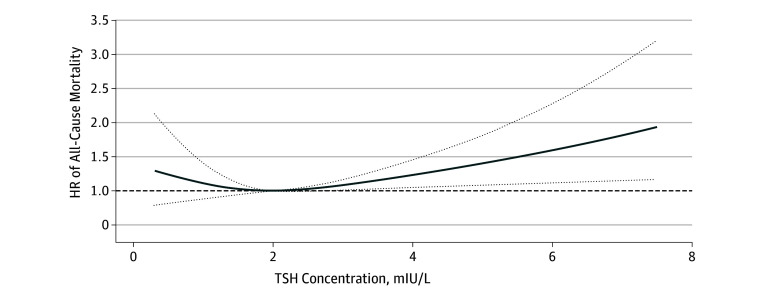
- During a median follow-up of 7.3 years, 435 deaths occurred. Compared with middle-normal TSH, adjusted hazard ratios for all-cause mortality were 1.36 (95% CI, 1.01-1.83) for low-normal TSH, 1.36 (95% CI, 1.07-1.73) for high-normal TSH, and 1.90 (95% CI, 1.14-3.19) for subclinical hypothyroidism; restricted cubic splines showed a U-shaped association between TSH and mortality.
- CVD mediated 14.3% of the association of subclinical hypothyroidism with all-cause mortality and 5.9% of the association of high-normal TSH with all-cause mortality; no evidence of CVD mediation was found for low-normal TSH.
- In sex-stratified analyses, CVD mediated 7.5% to 13.7% of the associations of high-normal TSH or subclinical hypothyroidism with mortality in women, with no or only slight mediation in men. In participants aged 60 years or older, CVD mediated 6.0% of the high-normal TSH association and 14.8% of the subclinical hypothyroidism association, but the indirect effect confidence interval for subclinical hypothyroidism included the null.
Methods
- Secondary analysis of the US National Health and Nutrition Examination Survey (NHANES), including four cycles (2001-2002, 2007-2008, 2009-2010, 2011-2012), among adults aged 20 years or older with serum TSH and free thyroxine data; after exclusions, the final analytical cohort was 9020 participants, followed for mortality through December 2015.
- TSH categories were low-normal (0.34-1.19 mIU/L), middle-normal (1.20-1.95 mIU/L), high-normal (1.96-5.60 mIU/L), and subclinical hypothyroidism (TSH >5.60 mIU/L with normal free thyroxine); CVD was ascertained by self-report at baseline.
- Multivariable Cox proportional hazards models and restricted cubic splines estimated mortality associations; mediation analysis used a marginal structural counterfactual approach, with 1000 bootstrap samples for bias-corrected 95% confidence intervals.
Limitations
- The paper states that it could not account for trends or changes in thyroid function over follow-up; exposure-mediator timing was not well defined, so reverse causation is possible; CVD and other medical histories were self-reported and may be misclassified; mediation analysis assumed no unmeasured confounders and no mediator-outcome confounding affected by exposure; and not all CVD events during follow-up were captured, so CVD mediation may be underestimated.
- Evident from the design: this is an observational cohort, so causal inferences are limited, and thyroid exposure was based on baseline TSH/free thyroxine measurements rather than longitudinal thyroid function.
Model-written summary. Check it against the paper before relying on it.
Integrity signals
Registry
Cites
Statistics
Figures
Verification
Claims the paper makes
24 Not checked yet · 24 Own result · 11 Own method · 4 Own interpretation · 2 Partly supported · 2 No basis given · accuracy not yet measured
The cited sources support only part of this claim — read each source’s verdict below.
In the paper
“Recent individual patient meta-analysis by the Thyroid Studies Collaboration8,9,10,11 did not find higher risk of CVD and all-cause mortality among adults with subclinical hypothyroidism compared with those with euthyroidism”
§ Association of Subclinical Hypothyroidism and Cardiovascular Disease With Mortality > Introduction
What the sources say
- Partly supportedcites [8] Rodondi N, den Elzen WPJ, Bauer DC,; Thyroid Studies Collaboration. Subclinical hypothyroidism and the risk of coronary heart disease and mortality. JAMA. 2010; 304(12): 1365- 1374. doi: 10.1001/jama.2010.1361 20858880 PMC3923470 sourceExperimental — accuracy not yet measured
The Results (page not provided) show no statistically significant increase in overall CHD events, CHD mortality, or total mortality among adults with subclinical hypothyroidism compared with those with euthyroidism. But CHD events and CHD mortality were significantly higher at TSH levels of 10 mIU/L or greater. The claim omits that qualification and says CVD broadly, while this paper assesses CHD outcomes. (LLM, conf=0.88)
- Partly supportedcites [9] Gencer B, Collet T-H, Virgini V,; Thyroid Studies Collaboration. Subclinical thyroid dysfunction and the risk of heart failure events: an individual participant data analysis from 6 prospective cohorts. Circulation. 2012; 126(9): 1040- 1049. doi: 10.1161/CIRCULATIONAHA.112.096024 22821943 PMC3884576 sourceExperimental — accuracy not yet measured
The Results (page unavailable) report no statistically significant increase in heart-failure events for subclinical hypothyroidism overall versus euthyroidism, but a significant increase at TSH 10.0–19.9 mIU/L. This paper examines heart-failure events, not cardiovascular disease broadly or all-cause mortality, so it does not support the full claim. (LLM, conf=0.86)
- Could not verifycites [10] Collet T-H, Gussekloo J, Bauer DC,; Thyroid Studies Collaboration. Subclinical hyperthyroidism and the risk of coronary heart disease and mortality. Arch Intern Med. 2012; 172(10): 799- 809. doi: 10.1001/archinternmed.2012.402 22529182 PMC3872478 sourceExperimental — accuracy not yet measured
The Results report increased total and coronary heart disease mortality for participants with subclinical hyperthyroidism compared with euthyroidism. The copy does not report the claimed finding for subclinical hypothyroidism; a search for that term found only a passing comparison and references, not an analysis of its cardiovascular disease or all-cause mortality risks. (LLM, conf=0.78)
- Partly supportedcites [11] Hyland KA, Arnold AM, Lee JS, Cappola AR. Persistent subclinical hypothyroidism and cardiovascular risk in the elderly: the cardiovascular health study. J Clin Endocrinol Metab. 2013; 98(2): 533- 540. doi: 10.1210/jc.2012-2180 23162099 PMC3565111 sourceExperimental — accuracy not yet measured
The Results report no association between subclinical hypothyroidism and CHD, heart failure, or cardiovascular mortality in this study of adults aged 65 or older. But this paper is a cohort study, not the attributed individual-participant meta-analysis, and it does not report all-cause mortality as an outcome. Its Discussion says the meta-analysis found increased CHD risk at higher TSH levels, so it does not support the unqualified statement about the meta-analysis. (LLM, conf=0.85)
plain- Asserted: passes — The authors put it forward as true.
- Checkable: passes — It can be checked against evidence.
- Load-bearing: passes — The paper’s conclusions depend on it.
- Based: passes — The paper gives a reason why it holds.
- Partly supported
A result the paper reports from its own data — it cites no other source for it, so there is none to check. The quote shows it is in the paper.
In the paper
“We estimated that CVD mediated 14.3% and 5.9% of the association of subclinical hypothyroidism and high-normal TSH with all-cause mortality, respectively (Table 3).”
§ Association of Subclinical Hypothyroidism and Cardiovascular Disease With Mortality > Results > Mediation of TSH and Mortality Associations Through CVD
hedgeddirect- Asserted: passes — The authors put it forward as true.
- Checkable: passes — It can be checked against evidence.
- Load-bearing: passes — The paper’s conclusions depend on it.
- Based: passes — The paper gives a reason why it holds.
- Rests on an assumption: Self-reported coronary artery disease and nonfatal cardiovascular disease events accurately classify prevalent cardiovascular disease.
- Rests on an assumption: Mortality data from death certificates provided by the National Death Index accurately ascertain all-cause mortality.
- Rests on an assumption: The mediation analysis assumes no unmeasured confounding of the exposure-mediator, exposure-outcome, and mediator-outcome relationships.
A result the paper reports from its own data — it cites no other source for it, so there is none to check. The quote shows it is in the paper.
In the paper
“We did not find any evidence for mediation through CVD for low-normal TSH levels and all-cause mortality.”
§ Association of Subclinical Hypothyroidism and Cardiovascular Disease With Mortality > Results > Mediation of TSH and Mortality Associations Through CVD
plain- Asserted: passes — The authors put it forward as true.
- Checkable: passes — It can be checked against evidence.
- Load-bearing: passes — The paper’s conclusions depend on it.
- Based: passes — The paper gives a reason why it holds.
- Rests on an assumption: Self-reported coronary artery disease and nonfatal cardiovascular disease events accurately classify prevalent cardiovascular disease.
- Rests on an assumption: Mortality data from death certificates provided by the National Death Index accurately ascertain all-cause mortality.
- Rests on an assumption: The mediation analysis assumes no unmeasured confounding of the exposure-mediator, exposure-outcome, and mediator-outcome relationships.
A result the paper reports from its own data — it cites no other source for it, so there is none to check. The quote shows it is in the paper.
In the paper
“high-normal TSH group (hazard ratio, 1.36; 95% CI, 1.07-1.73)”
§ Association of Subclinical Hypothyroidism and Cardiovascular Disease With Mortality > Results > TSH and Mortality
plaincorrelational- Asserted: passes — The authors put it forward as true.
- Checkable: passes — It can be checked against evidence.
- Load-bearing: passes — The paper’s conclusions depend on it.
- Based: passes — The paper gives a reason why it holds.
- Rests on an assumption: Mortality data from death certificates provided by the National Death Index accurately ascertain all-cause mortality.
- Rests on an assumption: A single baseline serum TSH measurement adequately represents long-term thyroid function.
A result the paper reports from its own data — it cites no other source for it, so there is none to check. The quote shows it is in the paper.
In the paper
“We did not find evidence for CVD mediation between low-normal TSH and all-cause mortality overall or stratified by sex and age.”
§ Association of Subclinical Hypothyroidism and Cardiovascular Disease With Mortality > Results > Mediation of TSH and Mortality Associations Through CVD
plain- Asserted: passes — The authors put it forward as true.
- Checkable: passes — It can be checked against evidence.
- Load-bearing: passes — The paper’s conclusions depend on it.
- Based: passes — The paper gives a reason why it holds.
- Rests on an assumption: Self-reported coronary artery disease and nonfatal cardiovascular disease events accurately classify prevalent cardiovascular disease.
- Rests on an assumption: Mortality data from death certificates provided by the National Death Index accurately ascertain all-cause mortality.
- Rests on an assumption: The mediation analysis assumes no unmeasured confounding of the exposure-mediator, exposure-outcome, and mediator-outcome relationships.
A result the paper reports from its own data — it cites no other source for it, so there is none to check. The quote shows it is in the paper.
In the paper
“while we found no mediation or only a slight mediation through CVD in men (Table 4).”
§ Association of Subclinical Hypothyroidism and Cardiovascular Disease With Mortality > Results > Mediation of TSH and Mortality Associations Through CVD
plain- Asserted: passes — The authors put it forward as true.
- Checkable: passes — It can be checked against evidence.
- Load-bearing: passes — The paper’s conclusions depend on it.
- Based: passes — The paper gives a reason why it holds.
- Rests on an assumption: Self-reported coronary artery disease and nonfatal cardiovascular disease events accurately classify prevalent cardiovascular disease.
- Rests on an assumption: Mortality data from death certificates provided by the National Death Index accurately ascertain all-cause mortality.
- Rests on an assumption: The mediation analysis assumes no unmeasured confounding of the exposure-mediator, exposure-outcome, and mediator-outcome relationships.
A result the paper reports from its own data — it cites no other source for it, so there is none to check. The quote shows it is in the paper.
In the paper
“We also estimated that CVD mediated 6.0% of the associations of high-normal TSH with all-cause mortality for participants aged 60 years or older (eTable 4 in the Supplement).”
§ Association of Subclinical Hypothyroidism and Cardiovascular Disease With Mortality > Results > Mediation of TSH and Mortality Associations Through CVD
hedgeddirect- Asserted: passes — The authors put it forward as true.
- Checkable: passes — It can be checked against evidence.
- Load-bearing: unclear — It is unclear whether the paper’s conclusions depend on it.
- Based: passes — The paper gives a reason why it holds.
- Rests on an assumption: Self-reported coronary artery disease and nonfatal cardiovascular disease events accurately classify prevalent cardiovascular disease.
- Rests on an assumption: Mortality data from death certificates provided by the National Death Index accurately ascertain all-cause mortality.
- Rests on an assumption: The mediation analysis assumes no unmeasured confounding of the exposure-mediator, exposure-outcome, and mediator-outcome relationships.
A result the paper reports from its own data — it cites no other source for it, so there is none to check. The quote shows it is in the paper.
In the paper
“subclinical hypothyroidism group (hazard ratio, 1.90; 95% CI, 1.14-3.19)”
§ Association of Subclinical Hypothyroidism and Cardiovascular Disease With Mortality > Results > TSH and Mortality
plaincorrelational- Asserted: passes — The authors put it forward as true.
- Checkable: passes — It can be checked against evidence.
- Load-bearing: passes — The paper’s conclusions depend on it.
- Based: passes — The paper gives a reason why it holds.
- Rests on an assumption: Mortality data from death certificates provided by the National Death Index accurately ascertain all-cause mortality.
- Rests on an assumption: A single baseline serum TSH measurement adequately represents long-term thyroid function.
A result the paper reports from its own data — it cites no other source for it, so there is none to check. The quote shows it is in the paper.
In the paper
“In stratified analyses, we estimated that CVD mediated 7.5% to 13.7% of the associations of high-normal TSH or subclinical hypothyroidism with all-cause mortality in women”
§ Association of Subclinical Hypothyroidism and Cardiovascular Disease With Mortality > Results > Mediation of TSH and Mortality Associations Through CVD
hedgeddirect- Asserted: passes — The authors put it forward as true.
- Checkable: passes — It can be checked against evidence.
- Load-bearing: passes — The paper’s conclusions depend on it.
- Based: passes — The paper gives a reason why it holds.
- Rests on an assumption: Self-reported coronary artery disease and nonfatal cardiovascular disease events accurately classify prevalent cardiovascular disease.
- Rests on an assumption: Mortality data from death certificates provided by the National Death Index accurately ascertain all-cause mortality.
- Rests on an assumption: The mediation analysis assumes no unmeasured confounding of the exposure-mediator, exposure-outcome, and mediator-outcome relationships.
A result the paper reports from its own data — it cites no other source for it, so there is none to check. The quote shows it is in the paper.
In the paper
“After adjusting for all potential confounders in model 2, restricted cubic splines showed a U-curved association between TSH and the risk of all-cause mortality (Figure).”
§ Association of Subclinical Hypothyroidism and Cardiovascular Disease With Mortality > Results > TSH and Mortality
plaincorrelational- Asserted: passes — The authors put it forward as true.
- Checkable: passes — It can be checked against evidence.
- Load-bearing: passes — The paper’s conclusions depend on it.
- Based: passes — The paper gives a reason why it holds.
- Rests on an assumption: Mortality data from death certificates provided by the National Death Index accurately ascertain all-cause mortality.
- Rests on an assumption: A single baseline serum TSH measurement adequately represents long-term thyroid function.
- Probably not a substantial claim. 23
- It may state two separate claims as one. 13
The cited sources support only part of this claim — read each source’s verdict below.
In the paper
“Current clinical guidelines from the American Thyroid Association14 and European Thyroid Association13 do not recommend treating subclinical hypothyroidism when TSH is 10 mIU/L or less (and without symptoms in younger individuals).”
§ Association of Subclinical Hypothyroidism and Cardiovascular Disease With Mortality > Discussion
What the sources say
- Could not verifycites [14] Jonklaas J, Bianco AC, Bauer AJ,; American Thyroid Association Task Force on Thyroid Hormone Replacement. Guidelines for the treatment of hypothyroidism: prepared by the American Thyroid Association Task Force on Thyroid Hormone Replacement. Thyroid. 2014; 24(12): 1670- 1751. doi: 10.1089/thy.2014.0028 25266247 PMC4267409 sourceExperimental — accuracy not yet measured
The Discussion of the clinical literature reports that cardiovascular risk was primarily increased at TSH levels above 10 mIU/L, but it does not recommend withholding treatment at or below 10 mIU/L. The Background, Objectives, and Rationale says this guideline focuses on thyroid hormone therapy rather than broader management. Searches for a treatment-initiation recommendation for asymptomatic younger people with subclinical hypothyroidism found no such passage in our copy; page numbers were unavailable. (LLM, conf=0.71)
- Partly supportedcites [13] Pearce SHS, Brabant G, Duntas LH,. 2013 ETA guideline: management of subclinical hypothyroidism. Eur Thyroid J. 2013; 2(4): 215- 228. doi: 10.1159/000356507 24783053 PMC3923601 sourceExperimental — accuracy not yet measured
The Recommendations (p. 7) advise considering a treatment trial for symptomatic younger patients with TSH <10 mU/l, while recommending treatment without symptoms when TSH is >10 mU/l. But the guideline also recommends treatment for persistent subclinical hypothyroidism with goitre or following hemithyroidectomy, so the claim's blanket statement that treatment is not recommended at TSH ≤10 mU/l is too broad. This verdict addresses the European Thyroid Association guideline, not the separately cited American guideline. (LLM, conf=0.88)
plain- Asserted: passes — The authors put it forward as true.
- Checkable: passes — It can be checked against evidence.
- Load-bearing: passes — The paper’s conclusions depend on it.
- Based: passes — The paper gives a reason why it holds.
Probably not a substantial claim.
- Could not verify
A result the paper reports from its own data — it cites no other source for it, so there is none to check. The quote shows it is in the paper.
In the paper
“A mediation through CVD was also estimated at 14.8% for subclinical hypothyroidism, but the 95% confidence interval of the estimated indirect effect size included the null, reflecting the smaller sample size.”
§ Association of Subclinical Hypothyroidism and Cardiovascular Disease With Mortality > Results > Mediation of TSH and Mortality Associations Through CVD
hedgedcorrelational- Asserted: passes — The authors put it forward as true.
- Checkable: passes — It can be checked against evidence.
- Load-bearing: unclear — It is unclear whether the paper’s conclusions depend on it.
- Based: passes — The paper gives a reason why it holds.
It may state two separate claims as one.
- Rests on an assumption: Self-reported coronary artery disease and nonfatal cardiovascular disease events accurately classify prevalent cardiovascular disease.
- Rests on an assumption: Mortality data from death certificates provided by the National Death Index accurately ascertain all-cause mortality.
- Rests on an assumption: The mediation analysis assumes no unmeasured confounding of the exposure-mediator, exposure-outcome, and mediator-outcome relationships.
The paper states this without a source or data behind it here, so there is nothing to check it against. The quote shows it is in the paper.
In the paper
“While the observed estimated indirect effect sizes were small for high-normal TSH, the impact of these associations should be considered, given that participants with high-normal TSH compose almost one-third of the total population (by definition) in the present study.”
§ Association of Subclinical Hypothyroidism and Cardiovascular Disease With Mortality > Discussion
plain- Asserted: passes — The authors put it forward as true.
- Checkable: passes — It can be checked against evidence.
- Load-bearing: passes — The paper’s conclusions depend on it.
- Based: passes — The paper gives a reason why it holds.
Probably not a substantial claim.
A result the paper reports from its own data — it cites no other source for it, so there is none to check. The quote shows it is in the paper.
In the paper
“We also observed an association between low-normal TSH concentrations (ie, high-normal thyroid function) and all-cause mortality, especially in men and in the younger population.”
§ Association of Subclinical Hypothyroidism and Cardiovascular Disease With Mortality > Discussion
plaincorrelational- Asserted: passes — The authors put it forward as true.
- Checkable: passes — It can be checked against evidence.
- Load-bearing: passes — The paper’s conclusions depend on it.
- Based: passes — The paper gives a reason why it holds.
It may state two separate claims as one.
A result the paper reports from its own data — it cites no other source for it, so there is none to check. The quote shows it is in the paper.
In the paper
“We also found that high-normal TSH was associated with increased risk of all-cause mortality both in participants younger than 60 years and in those 60 years or older; however, we had insufficient power to estimate statistically significant effect sizes in younger participants, which will require larger studies with longer follow-up periods.”
§ Association of Subclinical Hypothyroidism and Cardiovascular Disease With Mortality > Discussion
hedgedcorrelational- Asserted: passes — The authors put it forward as true.
- Checkable: passes — It can be checked against evidence.
- Load-bearing: passes — The paper’s conclusions depend on it.
- Based: passes — The paper gives a reason why it holds.
It may state two separate claims as one.
None of the sources cited for this claim have been checked yet.
In the paper
“Other epidemiological studies4,5,6,7 have also found an association between subclinical hypothyroidism or high-normal TSH concentrations (ie, serum TSH concentrations at the upper end of the normal range) and dyslipidemia, increased insulin resistance, and hypertension—components of metabolic syndrome.”
§ Association of Subclinical Hypothyroidism and Cardiovascular Disease With Mortality > Introduction
What the sources say
- Not checked yetcites [4] Cooper DS, Biondi B. Subclinical thyroid disease. Lancet. 2012; 379(9821): 1142- 1154. doi: 10.1016/S0140-6736(11)60276-6 22273398 source
- Not checked yetcites [5] Inoue K, Tsujimoto T, Saito J, Sugiyama T. Association between serum thyrotropin levels and mortality among euthyroid adults in the United States. Thyroid. 2016; 26(10): 1457- 1465. doi: 10.1089/thy.2016.0156 27539006 source
- Not checked yetcites [6] Garduño-Garcia J de J, Alvirde-Garcia U, López-Carrasco G,. TSH and free thyroxine concentrations are associated with differing metabolic markers in euthyroid subjects. Eur J Endocrinol. 2010; 163(2): 273- 278. doi: 10.1530/EJE-10-0312 20516204
- Not checked yetcites [7] Le TN, Celi FS, Wickham EP III. Thyrotropin levels are associated with cardiometabolic risk factors in euthyroid adolescents. Thyroid. 2016; 26(10): 1441- 1449. doi: 10.1089/thy.2016.0055 27599541 PMC5067795
plaincorrelational- Asserted: passes — The authors put it forward as true.
- Checkable: passes — It can be checked against evidence.
- Load-bearing: unclear — It is unclear whether the paper’s conclusions depend on it.
- Based: passes — The paper gives a reason why it holds.
It may state two separate claims as one.
What the paper did — it cites no source for this, so there is none to check. The quote shows it is in the paper.
In the paper
“Additional adjustment for metabolic disorder indicators (ie, diabetes, hypertension, statin prescriptions, and BMI) or using a different definition of the normal range for TSH did not qualitatively alter these results (eTable 2 and eTable 3 in the Supplement).”
§ Association of Subclinical Hypothyroidism and Cardiovascular Disease With Mortality > Results > Mediation of TSH and Mortality Associations Through CVD
plain- Asserted: passes — The authors put it forward as true.
- Checkable: passes — It can be checked against evidence.
- Load-bearing: unclear — It is unclear whether the paper’s conclusions depend on it.
- Based: passes — The paper gives a reason why it holds.
It may state two separate claims as one.
- Rests on an assumption: Self-reported coronary artery disease and nonfatal cardiovascular disease events accurately classify prevalent cardiovascular disease.
- Rests on an assumption: Mortality data from death certificates provided by the National Death Index accurately ascertain all-cause mortality.
- Rests on an assumption: The mediation analysis assumes no unmeasured confounding of the exposure-mediator, exposure-outcome, and mediator-outcome relationships.
In the paper
“A previous review2 has reported cardiovascular abnormalities such as left ventricular dysfunction and impaired vascular relaxation among people with not only overt hypothyroidism but also subclinical hypothyroidism.”
§ Association of Subclinical Hypothyroidism and Cardiovascular Disease With Mortality > Introduction
What the sources say
- Not checked yetcites [2] Biondi B, Palmieri EA, Lombardi G, Fazio S. Effects of subclinical thyroid dysfunction on the heart. Ann Intern Med. 2002; 137(11): 904- 914. doi: 10.7326/0003-4819-137-11-200212030-00011 12458990
plaincorrelational- Asserted: passes — The authors put it forward as true.
- Checkable: passes — It can be checked against evidence.
- Load-bearing: passes — The paper’s conclusions depend on it.
- Based: passes — The paper gives a reason why it holds.
Probably not a substantial claim.
The paper states this without a source or data behind it here, so there is nothing to check it against. The quote shows it is in the paper.
In the paper
“Despite these mechanisms and evidence about the potential burden of elevated TSH on cardiac metabolism, the potentially causal link between subclinical hypothyroidism, cardiovascular disease (CVD), and death remains unclear.”
§ Association of Subclinical Hypothyroidism and Cardiovascular Disease With Mortality > Introduction
hedgedconditional- Asserted: passes — The authors put it forward as true.
- Checkable: passes — It can be checked against evidence.
- Load-bearing: passes — The paper’s conclusions depend on it.
- Based: passes — The paper gives a reason why it holds.
Probably not a substantial claim.
None of the sources cited for this claim have been checked yet.
In the paper
“The thyroid hormone is one of the key regulators of cardiac function and cardiovascular hemodynamics; therefore, inadequate thyroid hormone levels impair the relaxation of vascular smooth muscle cells and decrease cardiac contractility by regulating calcium uptake and the expression of several contractile proteins in cardiomyocytes.37,38”
§ Association of Subclinical Hypothyroidism and Cardiovascular Disease With Mortality > Discussion
What the sources say
- Not checked yetcites [37] Klein I, Danzi S. Thyroid disease and the heart. Circulation. 2007; 116(15): 1725- 1735. doi: 10.1161/CIRCULATIONAHA.106.678326 17923583
- Not checked yetcites [38] Owen PJD, Sabit R, Lazarus JH. Thyroid disease and vascular function. Thyroid. 2007; 17(6): 519- 524. doi: 10.1089/thy.2007.0051 17614771
plaindirect- Asserted: passes — The authors put it forward as true.
- Checkable: passes — It can be checked against evidence.
- Load-bearing: passes — The paper’s conclusions depend on it.
- Based: passes — The paper gives a reason why it holds.
It may state two separate claims as one.
None of the sources cited for this claim have been checked yet.
In the paper
“which is supported by current clinical guidelines proposing that thyroid hormone replacement therapy should not be routinely offered for adults with subclinical hypothyroidism.12,13,14”
§ Association of Subclinical Hypothyroidism and Cardiovascular Disease With Mortality > Introduction
What the sources say
- Not checked yetcites [12] Bekkering GE, Agoritsas T, Lytvyn L,. Thyroid hormones treatment for subclinical hypothyroidism: a clinical practice guideline. BMJ. 2019; 365: l2006. doi: 10.1136/bmj.l2006 31088853 source
- Not checked yetcites [13] Pearce SHS, Brabant G, Duntas LH,. 2013 ETA guideline: management of subclinical hypothyroidism. Eur Thyroid J. 2013; 2(4): 215- 228. doi: 10.1159/000356507 24783053 PMC3923601 source
- Not checked yetcites [14] Jonklaas J, Bianco AC, Bauer AJ,; American Thyroid Association Task Force on Thyroid Hormone Replacement. Guidelines for the treatment of hypothyroidism: prepared by the American Thyroid Association Task Force on Thyroid Hormone Replacement. Thyroid. 2014; 24(12): 1670- 1751. doi: 10.1089/thy.2014.0028 25266247 PMC4267409 source
plain- Asserted: passes — The authors put it forward as true.
- Checkable: passes — It can be checked against evidence.
- Load-bearing: fails — The paper’s conclusions may not depend on it.
- Based: passes — The paper gives a reason why it holds.
Probably not a substantial claim. The paper’s conclusions may not depend on it.
None of the sources cited for this claim have been checked yet.
In the paper
“Results from previous studies5,33,34,35,36 that examined associations of serum thyroid function within the normal range and various long-term adverse outcomes have been inconsistent across different populations.”
§ Association of Subclinical Hypothyroidism and Cardiovascular Disease With Mortality > Discussion
What the sources say
- Not checked yetcites [5] Inoue K, Tsujimoto T, Saito J, Sugiyama T. Association between serum thyrotropin levels and mortality among euthyroid adults in the United States. Thyroid. 2016; 26(10): 1457- 1465. doi: 10.1089/thy.2016.0156 27539006 source
- Not checked yetcites [33] Åsvold BO, Vatten LJ, Bjøro T,; Thyroid Studies Collaboration. Thyroid function within the normal range and risk of coronary heart disease: an individual participant data analysis of 14 cohorts. JAMA Intern Med. 2015; 175(6): 1037- 1047. doi: 10.1001/jamainternmed.2015.0930 25893284 PMC4732559
- Not checked yetcites [34] Cappola AR, Arnold AM, Wulczyn K, Carlson M, Robbins J, Psaty BM. Thyroid function in the euthyroid range and adverse outcomes in older adults. J Clin Endocrinol Metab. 2015; 100(3): 1088- 1096. doi: 10.1210/jc.2014-3586 25514105 PMC4333030
- Not checked yetcites [35] Chaker L, van den Berg ME, Niemeijer MN,. Thyroid function and sudden cardiac death: a prospective population-based cohort study. Circulation. 2016; 134(10): 713- 722. doi: 10.1161/CIRCULATIONAHA.115.020789 27601558
- Not checked yetcites [36] Bano A, Dhana K, Chaker L,. Association of thyroid function with life expectancy with and without cardiovascular disease: the Rotterdam Study. JAMA Intern Med. 2017; 177(11): 1650- 1657. doi: 10.1001/jamainternmed.2017.4836 28975207 PMC5710266
plain- Asserted: passes — The authors put it forward as true.
- Checkable: passes — It can be checked against evidence.
- Load-bearing: fails — The paper’s conclusions may not depend on it.
- Based: passes — The paper gives a reason why it holds.
Probably not a substantial claim. The paper’s conclusions may not depend on it.
None of the sources cited for this claim have been checked yet.
In the paper
“Meanwhile, some recent studies5,15,16 have suggested that even high-normal TSH concentrations are associated with increased risk of CVD and mortality among the US general population or adults with chronic kidney disease”
§ Association of Subclinical Hypothyroidism and Cardiovascular Disease With Mortality > Introduction
What the sources say
- Not checked yetcites [5] Inoue K, Tsujimoto T, Saito J, Sugiyama T. Association between serum thyrotropin levels and mortality among euthyroid adults in the United States. Thyroid. 2016; 26(10): 1457- 1465. doi: 10.1089/thy.2016.0156 27539006 source
- Not checked yetcites [15] Rhee CM, Ravel VA, Streja E,. Thyroid functional disease and mortality in a national peritoneal dialysis cohort. J Clin Endocrinol Metab. 2016; 101(11): 4054- 4061. doi: 10.1210/jc.2016-1691 27525529 PMC5095247
- Not checked yetcites [16] Rhee CM, Kim S, Gillen DL,. Association of thyroid functional disease with mortality in a national cohort of incident hemodialysis patients. J Clin Endocrinol Metab. 2015; 100(4): 1386- 1395. doi: 10.1210/jc.2014-4311 25632971 PMC4399303
hedgedcorrelational- Asserted: passes — The authors put it forward as true.
- Checkable: passes — It can be checked against evidence.
- Load-bearing: passes — The paper’s conclusions depend on it.
- Based: passes — The paper gives a reason why it holds.
Probably not a substantial claim. It may state two separate claims as one.
None of the sources cited for this claim have been checked yet.
In the paper
“We included cross-product terms of exposure and mediator in the model given the previous findings that underlying cardiovascular status can be a modifier of the association between hypothyroidism and the long-term adverse health outcomes.28,29”
§ Association of Subclinical Hypothyroidism and Cardiovascular Disease With Mortality > Methods > Statistical Analysis
What the sources say
- Not checked yetcites [28] Ro K, Yuen AD, Du L,. Impact of hypothyroidism and heart failure on hospitalization risk. Thyroid. 2018; 28(9): 1094- 1100. doi: 10.1089/thy.2017.0362 29897016 PMC6154446 source
- Not checked yetcites [29] Rhee CM, Curhan GC, Alexander EK, Bhan I, Brunelli SM. Subclinical hypothyroidism and survival: the effects of heart failure and race. J Clin Endocrinol Metab. 2013; 98(6): 2326- 2336. doi: 10.1210/jc.2013-1039 23720788 PMC3667266 source
plaincorrelational- Asserted: passes — The authors put it forward as true.
- Checkable: passes — It can be checked against evidence.
- Load-bearing: passes — The paper’s conclusions depend on it.
- Based: passes — The paper gives a reason why it holds.
Probably not a substantial claim.
A conclusion the paper draws from its own results — it cites no other source for it, so there is none to check. The quote shows it is in the paper.
In the paper
“Our findings provide additional support for the importance of considering variations in the normative range of thyroid hormone levels (statistically defined as between percentiles 2.5 and 97.5 in a healthy population) when assessing long-term mortality risks in the general US population.”
§ Association of Subclinical Hypothyroidism and Cardiovascular Disease With Mortality > Discussion
plain- Asserted: passes — The authors put it forward as true.
- Checkable: fails — It may be too vague to check against evidence.
- Load-bearing: passes — The paper’s conclusions depend on it.
- Based: passes — The paper gives a reason why it holds.
Probably not a substantial claim. It may be too vague to check against evidence.
A conclusion the paper draws from its own results — it cites no other source for it, so there is none to check. The quote shows it is in the paper.
In the paper
“Our findings of increased risk of all-cause mortality among participants with subclinical hypothyroidism (defined by TSH >5.6 mIU/L) mediated by CVD, compared with those with middle-normal TSH concentrations, suggest that higher TSH level may be a risk factor for CVD and also mortality, even when TSH levels are only modestly elevated.”
§ Association of Subclinical Hypothyroidism and Cardiovascular Disease With Mortality > Discussion
hedgedconditional- Asserted: passes — The authors put it forward as true.
- Checkable: passes — It can be checked against evidence.
- Load-bearing: passes — The paper’s conclusions depend on it.
- Based: passes — The paper gives a reason why it holds.
It may state two separate claims as one.
In the paper
“Moreover, Collet et al10 reported that the mortality risk at lower TSH concentrations was slightly greater in men than in women.”
§ Association of Subclinical Hypothyroidism and Cardiovascular Disease With Mortality > Discussion
What the sources say
- Not checked yetcites [10] Collet T-H, Gussekloo J, Bauer DC,; Thyroid Studies Collaboration. Subclinical hyperthyroidism and the risk of coronary heart disease and mortality. Arch Intern Med. 2012; 172(10): 799- 809. doi: 10.1001/archinternmed.2012.402 22529182 PMC3872478 source
plaincorrelational- Asserted: passes — The authors put it forward as true.
- Checkable: passes — It can be checked against evidence.
- Load-bearing: fails — The paper’s conclusions may not depend on it.
- Based: passes — The paper gives a reason why it holds.
Probably not a substantial claim. The paper’s conclusions may not depend on it.
In the paper
“In general, it is well established that women are at an increased risk of progression from subclinical to overt hypothyroidism.4”
§ Association of Subclinical Hypothyroidism and Cardiovascular Disease With Mortality > Discussion
What the sources say
- Not checked yetcites [4] Cooper DS, Biondi B. Subclinical thyroid disease. Lancet. 2012; 379(9821): 1142- 1154. doi: 10.1016/S0140-6736(11)60276-6 22273398 source
boosteddirect- Asserted: passes — The authors put it forward as true.
- Checkable: passes — It can be checked against evidence.
- Load-bearing: fails — The paper’s conclusions may not depend on it.
- Based: passes — The paper gives a reason why it holds.
Probably not a substantial claim. The paper’s conclusions may not depend on it.
A conclusion the paper draws from its own results — it cites no other source for it, so there is none to check. The quote shows it is in the paper.
In the paper
“Although thyroid hormone therapy should not be routinely offered to patients with subclinical hypothyroidism, our findings indicate the importance of further investigations regarding clinical effectiveness of medical interventions (such as a CVD prevention program) for specific populations with subclinical hypothyroidism or even low-normal thyroid function.”
§ Association of Subclinical Hypothyroidism and Cardiovascular Disease With Mortality > Discussion
hedged- Asserted: passes — The authors put it forward as true.
- Checkable: fails — It may be too vague to check against evidence.
- Load-bearing: passes — The paper’s conclusions depend on it.
- Based: passes — The paper gives a reason why it holds.
Probably not a substantial claim. It may be too vague to check against evidence.
None of the sources cited for this claim have been checked yet.
In the paper
“Previous studies10,34,36,43 have found an increased risk of CVD and mortality among people with high-normal thyroid function partially mediated by anticoagulant factors.”
§ Association of Subclinical Hypothyroidism and Cardiovascular Disease With Mortality > Discussion
What the sources say
- Not checked yetcites [10] Collet T-H, Gussekloo J, Bauer DC,; Thyroid Studies Collaboration. Subclinical hyperthyroidism and the risk of coronary heart disease and mortality. Arch Intern Med. 2012; 172(10): 799- 809. doi: 10.1001/archinternmed.2012.402 22529182 PMC3872478 source
- Not checked yetcites [34] Cappola AR, Arnold AM, Wulczyn K, Carlson M, Robbins J, Psaty BM. Thyroid function in the euthyroid range and adverse outcomes in older adults. J Clin Endocrinol Metab. 2015; 100(3): 1088- 1096. doi: 10.1210/jc.2014-3586 25514105 PMC4333030
- Not checked yetcites [36] Bano A, Dhana K, Chaker L,. Association of thyroid function with life expectancy with and without cardiovascular disease: the Rotterdam Study. JAMA Intern Med. 2017; 177(11): 1650- 1657. doi: 10.1001/jamainternmed.2017.4836 28975207 PMC5710266
- Not checked yetcites [43] Bano A, Chaker L, de Maat MPM,. Thyroid function and cardiovascular disease: the mediating role of coagulation factors. J Clin Endocrinol Metab. 2019; 104(8): 3203- 3212. doi: 10.1210/jc.2019-00072 30938758
plaincorrelational- Asserted: passes — The authors put it forward as true.
- Checkable: passes — It can be checked against evidence.
- Load-bearing: fails — The paper’s conclusions may not depend on it.
- Based: passes — The paper gives a reason why it holds.
Probably not a substantial claim. The paper’s conclusions may not depend on it.
None of the sources cited for this claim have been checked yet.
In the paper
“Low thyroid hormone levels also increase systemic vascular resistance and induce endothelial dysfunction by reducing nitric oxide availability.37,38,39”
§ Association of Subclinical Hypothyroidism and Cardiovascular Disease With Mortality > Discussion
What the sources say
- Not checked yetcites [37] Klein I, Danzi S. Thyroid disease and the heart. Circulation. 2007; 116(15): 1725- 1735. doi: 10.1161/CIRCULATIONAHA.106.678326 17923583 source
- Not checked yetcites [38] Owen PJD, Sabit R, Lazarus JH. Thyroid disease and vascular function. Thyroid. 2007; 17(6): 519- 524. doi: 10.1089/thy.2007.0051 17614771 source
- Not checked yetcites [39] Galli E, Pingitore A, Iervasi G. The role of thyroid hormone in the pathophysiology of heart failure: clinical evidence. Heart Fail Rev. 2010; 15(2): 155- 169. doi: 10.1007/s10741-008-9126-6 19110971 source
plaindirect- Asserted: passes — The authors put it forward as true.
- Checkable: passes — It can be checked against evidence.
- Load-bearing: passes — The paper’s conclusions depend on it.
- Based: passes — The paper gives a reason why it holds.
It may state two separate claims as one.
In the paper
“A previous study from Norway42 also found an association between high-normal TSH concentrations and CVD in women but not in men, consistent with our results.”
§ Association of Subclinical Hypothyroidism and Cardiovascular Disease With Mortality > Discussion
What the sources say
- Not checked yetcites [42] Asvold BO, Bjøro T, Platou C, Vatten LJ. Thyroid function and the risk of coronary heart disease: 12-year follow-up of the HUNT study in Norway. Clin Endocrinol (Oxf). 2012; 77(6): 911- 917. doi: 10.1111/j.1365-2265.2012.04477.x 22724581
plaincorrelational- Asserted: passes — The authors put it forward as true.
- Checkable: passes — It can be checked against evidence.
- Load-bearing: fails — The paper’s conclusions may not depend on it.
- Based: passes — The paper gives a reason why it holds.
Probably not a substantial claim. The paper’s conclusions may not depend on it. It may state two separate claims as one.
None of the sources cited for this claim have been checked yet.
In the paper
“Previous studies,5,6,7,40 including those using NHANES data,5,7 reported that low thyroid function even within the normal range is associated with metabolic syndrome owing to an increase in insulin resistance and might contribute to the progression of atherosclerosis and CVD risk.41”
§ Association of Subclinical Hypothyroidism and Cardiovascular Disease With Mortality > Discussion
What the sources say
- Not checked yetcites [5] Inoue K, Tsujimoto T, Saito J, Sugiyama T. Association between serum thyrotropin levels and mortality among euthyroid adults in the United States. Thyroid. 2016; 26(10): 1457- 1465. doi: 10.1089/thy.2016.0156 27539006 source
- Not checked yetcites [6] Garduño-Garcia J de J, Alvirde-Garcia U, López-Carrasco G,. TSH and free thyroxine concentrations are associated with differing metabolic markers in euthyroid subjects. Eur J Endocrinol. 2010; 163(2): 273- 278. doi: 10.1530/EJE-10-0312 20516204 source
- Not checked yetcites [7] Le TN, Celi FS, Wickham EP III. Thyrotropin levels are associated with cardiometabolic risk factors in euthyroid adolescents. Thyroid. 2016; 26(10): 1441- 1449. doi: 10.1089/thy.2016.0055 27599541 PMC5067795 source
- Not checked yetcites [40] Roos A, Bakker SJL, Links TP, Gans ROB, Wolffenbuttel BHR. Thyroid function is associated with components of the metabolic syndrome in euthyroid subjects. J Clin Endocrinol Metab. 2007; 92(2): 491- 496. doi: 10.1210/jc.2006-1718 17090642 source
hedgedcorrelational- Asserted: passes — The authors put it forward as true.
- Checkable: passes — It can be checked against evidence.
- Load-bearing: fails — The paper’s conclusions may not depend on it.
- Based: passes — The paper gives a reason why it holds.
Probably not a substantial claim. The paper’s conclusions may not depend on it.
What the paper did — it cites no source for this, so there is none to check. The quote shows it is in the paper.
In the paper
“Thus, the present study does not provide any information regarding the importance of treatment with thyroid hormone replacement if high TSH levels subsequently triggered medication use in NHANES participants.”
§ Association of Subclinical Hypothyroidism and Cardiovascular Disease With Mortality > Discussion > Strengths and Limitations
plain- Asserted: passes — The authors put it forward as true.
- Checkable: passes — It can be checked against evidence.
- Load-bearing: fails — The paper’s conclusions may not depend on it.
- Based: passes — The paper gives a reason why it holds.
Probably not a substantial claim. The paper’s conclusions may not depend on it.
In the paper
“Elevated thyroid hormone levels have been reported to negatively affect quality of life and cognitive function as well as the cardiovascular system in young and middle-aged populations.4”
§ Association of Subclinical Hypothyroidism and Cardiovascular Disease With Mortality > Discussion
What the sources say
- Not checked yetcites [4] Cooper DS, Biondi B. Subclinical thyroid disease. Lancet. 2012; 379(9821): 1142- 1154. doi: 10.1016/S0140-6736(11)60276-6 22273398 source
hedgeddirect- Asserted: passes — The authors put it forward as true.
- Checkable: passes — It can be checked against evidence.
- Load-bearing: fails — The paper’s conclusions may not depend on it.
- Based: passes — The paper gives a reason why it holds.
Probably not a substantial claim. The paper’s conclusions may not depend on it. It may state two separate claims as one.
What the paper did — it cites no source for this, so there is none to check. The quote shows it is in the paper.
In the paper
“A major strength of our study includes estimation of a potential pathway from serum TSH concentrations to mortality through CVD in a large, nationally representative sample of the US general population with individualized linkage to the national mortality database with rigorous capture of death events.”
§ Association of Subclinical Hypothyroidism and Cardiovascular Disease With Mortality > Discussion > Strengths and Limitations
plainconditional- Asserted: passes — The authors put it forward as true.
- Checkable: passes — It can be checked against evidence.
- Load-bearing: passes — The paper’s conclusions depend on it.
- Based: passes — The paper gives a reason why it holds.
Probably not a substantial claim.
In the paper
“Even though these are all likely causing nondifferential misclassifications, the bias this may generate is not always toward the null in mediation analysis.45”
§ Association of Subclinical Hypothyroidism and Cardiovascular Disease With Mortality > Discussion > Strengths and Limitations
What the sources say
- Not checked yetcites [45] VanderWeele TJ. Mediation analysis: a practitioner’s guide. Annu Rev Public Health. 2016; 37: 17- 32. doi: 10.1146/annurev-publhealth-032315-021402 26653405
plain- Asserted: passes — The authors put it forward as true.
- Checkable: passes — It can be checked against evidence.
- Load-bearing: fails — The paper’s conclusions may not depend on it.
- Based: passes — The paper gives a reason why it holds.
Probably not a substantial claim. The paper’s conclusions may not depend on it.
What the paper did — it cites no source for this, so there is none to check. The quote shows it is in the paper.
In the paper
“Second, while it is unlikely that CVD affected serum TSH concentrations, the exposure-mediator association is not well defined temporarily, and we need to consider the possibility of reverse causation (ie, that the participants’ thyroid status prior to CVD was different from their thyroid status at the time of study entry).”
§ Association of Subclinical Hypothyroidism and Cardiovascular Disease With Mortality > Discussion > Strengths and Limitations
hedged- Asserted: passes — The authors put it forward as true.
- Checkable: passes — It can be checked against evidence.
- Load-bearing: unclear — It is unclear whether the paper’s conclusions depend on it.
- Based: passes — The paper gives a reason why it holds.
It may state two separate claims as one.
What the paper did — it cites no source for this, so there is none to check. The quote shows it is in the paper.
In the paper
“In addition, our data did not capture all of the CVD events during the follow-up period; therefore, effect size of the CVD mediation might be underestimated.”
§ Association of Subclinical Hypothyroidism and Cardiovascular Disease With Mortality > Discussion > Strengths and Limitations
hedgedconditional- Asserted: passes — The authors put it forward as true.
- Checkable: passes — It can be checked against evidence.
- Load-bearing: unclear — It is unclear whether the paper’s conclusions depend on it.
- Based: passes — The paper gives a reason why it holds.
It may state two separate claims as one.
None of the sources cited for this claim have been checked yet.
In the paper
“A previous meta-analysis8 reported that subclinical hypothyroidism is associated with higher CVD risk, and thus treatment with levothyroxine is recommended when serum TSH concentrations reach 10 mIU/L or greater.4,31”
§ Association of Subclinical Hypothyroidism and Cardiovascular Disease With Mortality > Discussion
What the sources say
- Not checked yetcites [4] Cooper DS, Biondi B. Subclinical thyroid disease. Lancet. 2012; 379(9821): 1142- 1154. doi: 10.1016/S0140-6736(11)60276-6 22273398 source
- Not checked yetcites [31] Peeters RP. Subclinical hypothyroidism. N Engl J Med. 2017; 376(26): 2556- 2565. doi: 10.1056/NEJMcp1611144 28657873
plain- Asserted: fails — The authors may not put it forward as true.
- Checkable: passes — It can be checked against evidence.
- Load-bearing: fails — The paper’s conclusions may not depend on it.
- Based: passes — The paper gives a reason why it holds.
Probably not a substantial claim. The authors may not put it forward as true. The paper’s conclusions may not depend on it.
In the paper
“However, it remains unclear whether thyroid hormone replacement therapy is effective in mitigating several long-term adverse outcomes, such as CVD and death, in the general population with subclinical hypothyroidism.12”
§ Association of Subclinical Hypothyroidism and Cardiovascular Disease With Mortality > Discussion
What the sources say
- Not checked yetcites [12] Bekkering GE, Agoritsas T, Lytvyn L,. Thyroid hormones treatment for subclinical hypothyroidism: a clinical practice guideline. BMJ. 2019; 365: l2006. doi: 10.1136/bmj.l2006 31088853 source
hedged- Asserted: passes — The authors put it forward as true.
- Checkable: passes — It can be checked against evidence.
- Load-bearing: passes — The paper’s conclusions depend on it.
- Based: passes — The paper gives a reason why it holds.
Probably not a substantial claim.
None of the sources cited for this claim have been checked yet.
In the paper
“This recommendation has been followed by 2 recent comprehensive reviews1,12 that summarized the evidence arguing against clinical benefits of thyroid hormone replacement therapy toward quality of life or hypothyroid symptoms among adults, especially elderly individuals, with subclinical hypothyroidism.”
§ Association of Subclinical Hypothyroidism and Cardiovascular Disease With Mortality > Discussion
What the sources say
- Not checked yetcites [1] Biondi B, Cappola AR, Cooper DS. Subclinical hypothyroidism: a review. JAMA. 2019; 322(2): 153- 160. doi: 10.1001/jama.2019.9052 31287527 source
- Not checked yetcites [12] Bekkering GE, Agoritsas T, Lytvyn L,. Thyroid hormones treatment for subclinical hypothyroidism: a clinical practice guideline. BMJ. 2019; 365: l2006. doi: 10.1136/bmj.l2006 31088853 source
plain- Asserted: passes — The authors put it forward as true.
- Checkable: passes — It can be checked against evidence.
- Load-bearing: fails — The paper’s conclusions may not depend on it.
- Based: passes — The paper gives a reason why it holds.
Probably not a substantial claim. The paper’s conclusions may not depend on it.
In the paper
“A previous meta-analysis8 reported that subclinical hypothyroidism is associated with higher CVD risk, and thus treatment with levothyroxine is recommended when serum TSH concentrations reach 10 mIU/L or greater.4,31”
§ Association of Subclinical Hypothyroidism and Cardiovascular Disease With Mortality > Discussion
What the sources say
- Not checked yetcites [8] Rodondi N, den Elzen WPJ, Bauer DC,; Thyroid Studies Collaboration. Subclinical hypothyroidism and the risk of coronary heart disease and mortality. JAMA. 2010; 304(12): 1365- 1374. doi: 10.1001/jama.2010.1361 20858880 PMC3923470 source
plaincorrelational- Asserted: passes — The authors put it forward as true.
- Checkable: passes — It can be checked against evidence.
- Load-bearing: fails — The paper’s conclusions may not depend on it.
- Based: passes — The paper gives a reason why it holds.
Probably not a substantial claim. The paper’s conclusions may not depend on it.
The paper relies on this without support.
Self-reported coronary artery disease and nonfatal cardiovascular disease events accurately classify prevalent cardiovascular disease.
“Coronary artery diseases and nonfatal CVD events (congestive heart failure, angina, myocardial infarction, or stroke) were ascertained by self-report at baseline.”
The paper relies on this without support.
Mortality data from death certificates provided by the National Death Index accurately ascertain all-cause mortality.
“Mortality data were ascertained by the National Center for Health Statistics from death certificate information provided by the National Death Index after record matching by Social Security number, name, date of birth, race/ethnicity, sex, state of birth, and state of residence.”
The paper relies on this without support.
The mediation analysis assumes no unmeasured confounding of the exposure-mediator, exposure-outcome, and mediator-outcome relationships.
“We used a marginal structural approach within the counterfactual framework.18,26,27”
The paper relies on this without support.
A single baseline serum TSH measurement adequately represents long-term thyroid function.
“Time to event was calculated from the day of TSH measurement to the end of follow-up or the death date.”
The authors state this as an assumption.
There are no other unmeasured confounders and no confounding between the mediator and outcome as affected by exposure.
“our mediation analysis was based on the assumption that there were no other unmeasured confounders and no confounding between the mediator and outcome as affected by exposure.45”
Claims other papers make about this one
Each is checked against this paper’s own text: does it say what the citing paper says it does?
In the citing paper
“with CVD mediating 14.3 and 5.9% of the association, respectively (104).”
From L-T4 therapy in the presence of pharmacological interferents (2020) · cites this paper as [104]
In the citing paper
“SCH (TSH >5.60 mIU/L) and high-normal TSH (1.96–5.60 mIU/L) were associated with increased all-cause mortality (HR = 1.90 and 1.36) vs. the middle-normal TSH group (1.20–1.95 mIU/L) (104)”
From L-T4 therapy in the presence of pharmacological interferents (2020) · cites this paper as [104]
In the citing paper
“High-normal TSH levels impact unfavorably on mortality.”
From L-T4 therapy in the presence of pharmacological interferents (2020) · cites this paper as [104]
Self-check
Percentages, sums and reported differences re-computed from the paper’s own numbers.
Rated minor: it would not touch a result — a value no result rests on, a p-value that stays on the same side of the significance level, or a conflict that is clerical, resolved elsewhere in the paper, or outside its own findings.
In the paper
“Missing or unknown | 20 (0.7) | 10 (0.3) | 20 (0.7) | 3 (0.2)”
§ Association of Subclinical Hypothyroidism and Cardiovascular Disease With Mortality > Results
Reported 0.2 · recomputed 1.818182
Citations
Cites
Hollowell, J. G., Staehling, N. W., Flanders, W. D., Hannon, W. H., Gunter, E. W., Spencer, C. A., & Braverman, L. E. (2002) · The Journal of Clinical Endocrinology & Metabolism · doi:10.1210/jc.87.2.489 · Cited by 4,279
Mediation Analysis: A Practitioner's Guide
VanderWeele, T. J. (2016) · Annual Review of Public Health · doi:10.1146/annurev-publhealth-032315-021402 · Cited by 1,985
Jonklaas, J., Bianco, A. C., Bauer, A. J., Burman, K. D., Cappola, A. R., Celi, F. S., Cooper, D. S., Kim, B. W., Peeters, R. P., Rosenthal, M. S., et al. (2014) · Thyroid® · doi:10.1089/thy.2014.0028 · Cited by 1,928
Klein, I., & Danzi, S. (2007) · Circulation · doi:10.1161/circulationaha.106.678326 · Cited by 1,324
Subclinical Hypothyroidism and the Risk of Coronary Heart Disease and Mortality
Rodondi, N., den Elzen, W. P. J., Bauer, D. C., Cappola, A. R., Razvi, S., Walsh, J. P., Åsvold, B. O., Iervasi, G., Imaizumi, M., Collet, T.-H., et al. (2010) · JAMA · doi:10.1001/jama.2010.1361 · Cited by 1,216
National health and nutrition examination survey: plan and operations, 1999-2010.
Zipf, G., Chiappa, M. M., Porter, K. S., Ostchega, Y., Lewis, B. G., & Dostal, J. (2013) · PubMed · Cited by 1,182
Chaker, L., Bianco, A. C., Jonklaas, J., & Peeters, R. P. (2017) · The Lancet · doi:10.1016/s0140-6736(17)30703-1 · Cited by 1,159
Cooper, D. S., & Biondi, B. (2012) · The Lancet · doi:10.1016/s0140-6736(11)60276-6 · Cited by 1,039
2013 ETA Guideline: Management of Subclinical Hypothyroidism
Pearce, S. H. S., Brabant, G., Duntas, L. H., Monzani, F., Peeters, R. P., Razvi, S., & Wemeau, J.-L. (2013) · European Thyroid Journal · doi:10.1159/000356507 · Cited by 877
Subclinical Hypothyroidism: A Review
Biondi, B., Cappola, A. R., & Cooper, D. S. (2019) · JAMA · doi:10.1001/jama.2019.9052 · Cited by 604
Cited by
Sorted by citations
Items 101–195 of 195
Genome-wide association study and polygenic risk prediction of hypothyroidism
Rand, S. A., Ahlberg, G., Tragante, V., Monfort, L. M., Zheng, C., Feldt‐Rasmussen, U., Klose, M., Teder‐Laving, M., Metspalu, A., Poulsen, H. E., et al. (2025) · Nature Genetics · doi:10.1038/s41588-025-02410-z · Cited by 5
Association between serum TSH levels and all-cause mortality in critically ill patients
Sun, W., Xu, C., Zhang, Y., Zhu, X., Yu, F., Shi, L., & Zhang, H. (2024) · Heliyon · doi:10.1016/j.heliyon.2024.e26168 · Cited by 3
Zhang, C., Liu, A., Teng, W., Yang, W., Li, J., & Shan, Z. (2024) · Journal of Endocrinological Investigation · doi:10.1007/s40618-024-02463-7 · Cited by 3
The association of thyroid stimulating hormone and body fat in adults
Sun, Q., He, Y., & Liang, Y. (2024) · PLoS ONE · doi:10.1371/journal.pone.0314704 · Cited by 6
Zhao, H., Liu, M., Yang, J., Chen, Y., & Fang, M. (2022) · Frontiers of Environmental Science & Engineering · doi:10.1007/s11783-023-1604-5 · Cited by 4
Liu, F., Feng, J., Hao, M., Wang, X., Pan, N., Zhang, G., Jiang, C., Shang, X., Ling, Y., Xiao, Z., et al. (2023) · Annals of Translational Medicine · doi:10.21037/atm-22-6374 · Cited by 3
Oxidative stress in thyroid dysfunction
Eddib, I., Barhoumi, L., Mahmoudi, A., & Ben‐Nasr, H. (2022) · Endocrinology&Metabolism International Journal · doi:10.15406/emij.2022.10.00321 · Cited by 3
Kreimer, F., Schlettert, C., Abumayyaleh, M., Akın, İ., Hijazi, M. M., Hamdani, N., Gotzmann, M., Mügge, A., El‐Battrawy, I., & Aweimer, A. (2024) · IJC Heart & Vasculature · doi:10.1016/j.ijcha.2024.101350 · Cited by 3
Вплив автоімунного тиреоїдиту на органи й системи організму (огляд літератури)
SHIDLOVSKYI, V. O., Shidlovskyi, O. V., & Кравців, В. В. (2021) · INTERNATIONAL JOURNAL OF ENDOCRINOLOGY (Ukraine) · doi:10.22141/2224-0721.17.2.2021.230569 · Cited by 3
Li, S., Wu, L., Li, N., et al. (2025) · Translational Stroke Research · doi:10.1007/s12975-024-01323-z · Cited by 2
Guo, W., Hou, L.-Y., & Yi, X. (2025) · Cardiology · doi:10.1159/000545904 · Cited by 2
Hysaj, O., Efthimiou, O., Collet, T., Cappola, A. R., Alwan, H., Gussekloo, J., Chaker, L., Kavousi, M., Azizi, F., Köttgen, A., et al. (2025) · European Journal of Endocrinology · doi:10.1093/ejendo/lvaf209 · Cited by 2
Ran, X., Wang, N., Zhao, T., Fan, Z., Chen, G., & Ma, X. (2025) · Thyroid · doi:10.1177/10507256251393523 · Cited by 2
Chen, D., Li, Y., Ran, T., Song, F., Yang, Z., Tan, W., Lu, Q., Tang, L., Yang, L., & Bai, D. (2026) · European journal of medical research · doi:10.1186/s40001-026-03905-z · Cited by 2
Xiao-qian, W., Zhang, X., Wu, F., & Qi, X. (2026) · Frontiers in Endocrinology · doi:10.3389/fendo.2026.1750486 · Cited by 3
Xu, Y., Hysaj, O., Qi, X., Feller, M., Pingitore, A., Brown, S. J., Ittermann, T., Iacoviello, M., Trompet, S., Han, J. W., et al. (2026) · The Lancet Diabetes & Endocrinology · doi:10.1016/s2213-8587(26)00009-4 · Cited by 2
Stojković, M., Nedeljković-Beleslin, B., Tesic, M. B., Bukumirić, Z., Ćirić, J., Stojanovic, M. M., Miletić, M., Đorđević-Dikić, A., Giga, V. L., Beleslin, B., et al. (2021) · Journal of Medical Biochemistry · doi:10.5937/jomb0-34545 · Cited by 3
Koc, A. (2023) · Acta Endocrinologica (Bucharest) · doi:10.4183/aeb.2023.286 · Cited by 2
Khan, M. M. H., Yadav, P. P., Arowolo, S., Saidu, A., Olaniyi, S. A., Kaur, P. J., Chandrasekaran, S. H., Varghese, J. J., Omeh, C. K., Vijayakumar, R., et al. (2024) · Cureus · doi:10.7759/cureus.64531 · Cited by 2
Mao, G., Chen, M., Huang, L.-C., Mo, Z., Su, D., Gu, S., Guo, F., Wang, Y., Chen, Z., Zhang, R., et al. (2024) · Nutrients · doi:10.3390/nu16162613 · Cited by 2
Correlation of Hypothyroidism with Age and Comorbidities Among Women: A Cross-Sectional Study
Ifthikhar, M. B., & Dhamotharaswamy, K. (2024) · Journal of Pharmacology and Pharmacotherapeutics · doi:10.1177/0976500x241266077 · Cited by 2
Development, validation, and feasibility of a tele-yoga module for patients with hypothyroidism
Nilkantham, S., Harini, K. N., & Singh, A. (2024) · Advances in Integrative Medicine · doi:10.1016/j.aimed.2024.10.008 · Cited by 2
Tian, P., Zeng, S., Hou, Y., et al. (2025) · Frontiers in Endocrinology · doi:10.3389/fendo.2025.1522928 · Cited by 2
Xu, C., Zhou, H., Lu, X., Xu, S., & Sun, Y. (2025) · Trials · doi:10.1186/s13063-025-08857-z · Cited by 2
dos Reis, K. S. S. C., Vianna, P. D. B. F. A., Sanches, J. P. B., Bregman, R., & Tavares, A. B. W. (2025) · International Urology and Nephrology · doi:10.1007/s11255-025-04646-4 · Cited by 2
Síndrome metabólico en pacientes mexicanos con hipotiroidismo
Medina-Tinoco, A., Reyes-Barbosa, D. L., Escudero-Lourdes, G. V., Ortiz-Nesme, J. F., Fabela-Mendoza, K., Ponce-Muñiz, M. R., & Mendoza-Romo, M. Á. (2021) · Revista Mexicana de Endocrinología Metabolismo y Nutrición · doi:10.24875/rme.20001959 · Cited by 3
¿El tratamiento del hipotiroidismo subclínico tiene efecto sobre la morbimortalidad cardiovascular?
Gavoto, L. (2022) · Evidencia actualizacion en la práctica ambulatoria · doi:10.51987/evidencia.v25i2.7008 · Cited by 2
Correlates of Positive Thyroid Peroxidase Antibodies Among Firefighters: A Cross-Sectional-Study
Ogunsina, K., Koru‐Sengul, T., Rodriguez, V., Caban-Martinez, A. J., Solle, N. S., Ahn, S., Kobetz-Kerman, E. N., & Lee, D. J. (2022) · Journal of the Endocrine Society · doi:10.1210/jendso/bvac125 · Cited by 3
Lu, X., Wang, A., Liu, K., et al. (2024) · Research Square · doi:10.21203/rs.3.rs-4430372/v1 · Cited by 2
Impact of Subclinical Hypothyroidism on Lipid Profile in Jeddah: A Retrospective Cohort Study
Alzahrani, M. A., Baqar, F. S., Alzahrani, B. A., Badri, Z. A., Alshamrani, R., & Aljuhani, J. A. (2024) · Cureus · doi:10.7759/cureus.65433 · Cited by 1
Jin, Z., Li, G., Xue, Z., Li, Y., Yang, W., Yu, Y., & Hou, J. (2024) · Frontiers in Endocrinology · doi:10.3389/fendo.2024.1436713 · Cited by 1
Volkova, A. R., Khalimov, Y. S., Дмитриевна, Д. О., Lukichev, B. G., & Volkova, E. V. (2025) · Meditsinskiy sovet = Medical Council · doi:10.21518/ms2025-160 · Cited by 1
Liu, Z., Li, J., Peng, F., et al. (2025) · Journal of the American Nutrition Association · doi:10.1080/27697061.2025.2509900 · Cited by 1
Su, X., Xie, R., Li, W., Shi, P., Chen, L., & Yang, Y. (2025) · International Journal of Environmental Health Research · doi:10.1080/09603123.2025.2520404 · Cited by 1
Huang, X., & Yu, D. (2025) · Frontiers in Endocrinology · doi:10.3389/fendo.2025.1625843 · Cited by 2
Liu, Y., Wang, R., Yuan, J., et al. (2025) · Frontiers in Systems Biology · doi:10.3389/fsysb.2025.1656683 · Cited by 1
Neural Network-Based Estimation of Sample Mean and Standard Deviation from Some Quartiles
Zhang, Q., & Li, Q. (2026) · Journal of Systems Science and Complexity · doi:10.1007/s11424-026-5481-4 · Cited by 1
Hayashi, S., Fukui, S., Leung, A. M., Noto, H., & Inoue, K. (2026) · The Journal of Clinical Endocrinology & Metabolism · doi:10.1210/clinem/dgag337 · Cited by 3
Self-citationRadchenko, A. O., & Kolesnikova, O. V. (2021) · Zaporozhye Medical Journal · doi:10.14739/2310-1210.2021.6.232495 · Cited by 1
Abnormalities of Thyroid Function in Chronic Dialysis Patients
Rhee, C. M. (2022) · Elsevier eBooks · doi:10.1016/b978-0-323-79135-9.00052-5 · Cited by 2
Self-citation侯, 丽. (2022) · Advances in Clinical Medicine · doi:10.12677/acm.2022.1291177 · Cited by 1
Chaudhary, P. K., Verma, R. K., & Singh, P. K. (2023) · Journal of Clinical Research and Applied Medicine · doi:10.5530/jcram.2.3.13 · Cited by 1
Gu, Y., Song, Z., Li, Q., Wang, J., Song, Y., Meng, G., Wu, H., Zhang, S., Wang, X., Zhang, J., et al. (2023) · The Journal of Clinical Endocrinology & Metabolism · doi:10.1210/clinem/dgad025 · Cited by 2
Ettalhaoui, L., Debreuve‐Theresette, A., Nguyen, T. D., et al. (2023) · Cancer/Radiothérapie · doi:10.1016/j.canrad.2023.04.005 · Cited by 1
Sana, Khan, Z., Babar, B., et al. (2024) · Pakistan Journal of Medical and Health Sciences · doi:10.53350/pjmhs02023171258 · Cited by 1
Wei, B., & He, J. (2024) · Frontiers in Endocrinology · doi:10.3389/fendo.2024.1392326 · Cited by 1
Role of subclinical hypothyroidism on kidney damage in children with obesity
Sessa, A. D., D’Anna, J. A., Melone, R., et al. (2025) · International Journal of Obesity · doi:10.1038/s41366-025-01752-2 · Cited by 1
Macro-TSH — tips and tricks for gynecologists
Pluta, D., Będkowska-Szczepańska, A., Madej, P., et al. (2022) · Ginekologia Polska · doi:10.5603/gp.a2022.0003 · Cited by 1
Souza, D. S., Marques, L. P., Costa, A., et al. (2022) · SSRN Electronic Journal · doi:10.2139/ssrn.4179111 · Cited by 1
Relationship between caffeine intake and thyroid function: results from NHANES 2007-2012Preprint
Zheng, J., Zhu, X., Xu, G., et al. (2023) · Research Square · doi:10.21203/rs.3.rs-2585362/v1 · Cited by 1
Genome-wide association study and polygenic risk prediction of hypothyroidismPreprint
Rand, S. A., Ahlberg, G., Tragante, V., et al. (2024) · Research Square · doi:10.21203/rs.3.rs-3978229/v1 · Cited by 1
Yang, P., Tan, R., Zheng, R., et al. (2021) · Research Square · doi:10.21203/rs.3.rs-768839/v1
ВПЛИВ АВТОІМУННОГО ТИРЕОЇДИТУ НА СЕРЦЕВО-СУДИННУ СИСТЕМУ (огляд літератури та власні дані)
Шідловський, В. О., Шідловський, О. В., Кравців, В. В., Гаплик, Г. П., & Нецюк, О. Г. (2021) · Здобутки клінічної і експериментальної медицини · doi:10.11603/1811-2471.2021.v.i2.12222
Biochemical Changes in Mild Hypothyroidism and its Affiliation with Dyslipidemia in Pakistan
Zubair, A., Fatima, S., Nizami, S. A., Khalil, A., Sattar, R., & Shaheen, B. A. (2021) · Pakistan Journal of Medical and Health Sciences · doi:10.53350/pjmhs211592890
Pathophysiological aspects of development myocardial infarction type 2 in subclinical hypothyroidism
Ivannikov, A. A., Kanibolotskiy, A. A., Алиджанова, Х. Г., & Bratischev, I. V. (2021) · Medical alphabet · doi:10.33667/2078-5631-2021-42-34-41
Cortes, G. A. M. (2022) · Journal of Cardiology & Cardiovascular Therapy · doi:10.19080/jocct.2022.17.555969
The association between dietary magnesium intake and hemoglobin glycation indexPreprint
Chen, J., Lin, S., Wang, X., et al. (2022) · Research Square · doi:10.21203/rs.3.rs-2102579/v1
Alcaraz, J. S., & Lares, R. M. R. (2023) · Revista Medica Sinergia · doi:10.31434/rms.v8i2.962
Chen, J., Lin, S., Wang, X., et al. (2023) · Research Square · doi:10.21203/rs.3.rs-2663074/v1
Kucheriava, M. V., & Mankovskyi, G. B. (2023) · INTERNATIONAL JOURNAL OF ENDOCRINOLOGY (Ukraine) · doi:10.22141/2224-0721.19.3.2023.1266
Risk Factors for Clinically Overt Hypothyroidism in Unselected Population of Adult Epilepsy Patients
Bal, N. Ç. Ç., Doğan, E. A., & Senol, Y. Y. (2023) · Archives of Epilepsy · doi:10.4274/archepilepsy.2023.221021
Nilkantham, S., Singh, A., Majumdar, V., et al. (2023) · doi:10.2196/preprints.54078
The Impact of Subclinical Hypothyroidism on Lipid Profile in JeddahPreprint
Alzahrani, M. A., Baqar, F. S., Alzahrani, B. A., Badri, Z. A., Alshamrani, R. M., & Aljuhani, J. A. (2023) · Research Square · doi:10.21203/rs.3.rs-3682924/v1
EFECTOS CARDIOVASCULARES DEL HIPOTIROIDISMO SUBCLÍNICO EN MUJERES POSTMENOPÁUSICAS
Verdesoto, G. J. L., & Oviedo, G. S. S. (2024) · Revista Científica Arbitrada Multidisciplinaria PENTACIENCIAS · doi:10.59169/pentaciencias.v6i3.1087
A case of subclinical hypothyroidism managed effectively with homoeopathic remedy
Reshma, J. R., Kumar, S., V, Saheena, N. S., & Rukshana Begam, L. (2024) · International Journal of Homoeopathic Sciences · doi:10.33545/26164485.2024.v8.i2h.1183
Segal, O., Khoury, R., Vaisman, A., et al. (2024) · Journal of Clinical Medicine · doi:10.3390/jcm13195838
Research Progress on Normal Range Thyroid Stimulating Hormone and Cardiovascular Disease
王, 娜. (2024) · Advances in Clinical Medicine · doi:10.12677/acm.2024.14112852
Shen, J., Lin, A., Jiang, A., Xie, Z., Cheng, Q., Zhang, J., Zhang, J., & Luo, P. (2025) · Nutrition Research · doi:10.1016/j.nutres.2025.01.007
Xu, C., Zhou, H., Lu, X., et al. (2025) · Research Square · doi:10.21203/rs.3.rs-6031445/v1
Chen, Y., Guan, S., & Zhuang, W. (2025) · British Journal of Hospital Medicine · doi:10.12968/hmed.2024.0492
Wandala, A., Frimpong, N., Khan, M. N., Mamdooh, H., Alshaharli, A. G., Mustafa, S., & Akbar, M. B. (2025) · Indus journal of bioscience research. · doi:10.70749/ijbr.v3i4.1034
Central hypothyroidism and cardiovascular disease: A Spanish cohort observational studyPreprint
Guerrero‐Pérez, F., Iglesias, P., Fano, M. P., et al. (2025) · Research Square · doi:10.21203/rs.3.rs-6440127/v1
Xin, Y., Wang, Y., Shu, Y., Liang, H., & Yang, Y. (2025) · BMC Endocrine Disorders · doi:10.1186/s12902-025-01995-0
Декомпенсированный гипотиреоз под маской хронической сердечной недостаточности: клинический случай
Каленчиц, Т. И., Кабак, С. Л., & Абражевич, Е. К. (2025) · Рецепт · doi:10.34883/pi.2025.28.3.007
Thyrotoxic effects of organophosphate insecticides in adults: a bibliometric and meta-analysis
Diawara, M. O., Pan, G., Yang, X., Alqudaimi, M., Fofana, M., Bafei, S. E. C., Wu, D., Tun, H. M., Liu, Q., Zhang, M., et al. (2025) · International Archives of Occupational and Environmental Health · doi:10.1007/s00420-025-02159-2
Shen, D. H.-Y., Chan, H.-P., Hu, C., WANG, W.-H., Chiu, Y., & Tsai, F.-R. (2025) · In Vivo · doi:10.21873/invivo.14092
Systemic Disease Associations of Oral Lichenoid Disease: A Retrospective Case–Control Study
Vehviläinen, M., Selander, T. A., Salo, T. A., et al. (2025) · Oral Diseases · doi:10.1111/odi.70117
Adam, L. N., & Abbas, A. M. (2025) · Biochemical Genetics · doi:10.1007/s10528-025-11270-5
Ghoweba, D. E. A. A.-R., Abdelhamid, A., Aboulsoud, S. H., et al. (2025) · The Egyptian Journal of Internal Medicine · doi:10.1186/s43162-025-00575-x
Liu, Y., Zhao, J., Yuan, J., Yu, Z., Liu, J., Ning, X., & Sun, S. (2026) · mSphere · doi:10.1128/msphere.00914-25
Minu, T., Varghese, J., Kompithra, R., Sudeep, K., & Abraham, J. (2026) · Journal of Family Medicine and Primary Care · doi:10.4103/jfmpc.jfmpc_456_25
Jin, X., Lu, C., Zhou, N., Han, Y., Li, Y., Liu, N., Wang, X., Li, S., Li, J., & Zhang, X. (2026) · Journal of Neural Transmission · doi:10.1007/s00702-026-03122-2
Lakshmi, M. L. S. N. S., Punithavathi, S., Sowmiya, S., et al. (2025) · doi:10.1109/acoit66109.2025.11436278
The association between the number of chronic diseases and cancer: the mediating role of frailty
He, Y., Song, X., & Zhao, Y. (2026) · European Journal of Cancer Prevention · doi:10.1097/cej.0000000000001023
Sleep Pattern and Structural Damage in Older Adults with Glaucoma: A United States and China Study
Luo, Z., Lin, Z., Yu, Y., Du, Y., Xu, Y., Yang, Y., Huang, S., Han, Y., & Huang, J. (2026) · Ophthalmology Science · doi:10.1016/j.xops.2026.101237
Shimizu, Y., Oyama, A., Noguchi, Y., Matsuu‐Matsuyama, M., Hamada, K., Kawashiri, S., Yamanashi, H., Nakamichi, S., Nagata, Y., Maeda, T., et al. (2026) · Journal of Vascular Diseases · doi:10.3390/jvd5030027
Pan, X., Xu, W., Lu, Z., Deng, X., & Luo, D. (2026) · Medicine · doi:10.1097/md.0000000000049598
Jamatia, M., Sharma, A. K., & Charak, R. (2026) · International Journal of Research in Medical Sciences · doi:10.18203/2320-6012.ijrms20262625
Thyroid-stimulating hormone enhances platelet activation and arterial thrombosis
Zhang, P., Zhou, L., Xu, H., Zhong, H., Zhou, W., Zhao, X., Liu, X., Zhu, X., Wu, H., Qi, Z., et al. (2026) · Cardiovascular Research · doi:10.1093/cvr/cvag187
Prevalence of Subclinical Hypothyroidism in Elderly Patients at Hospital
Niaz, M., Ahmed, A., Hussain, A., Hussain, M., & Shaukat, W. (2025) · Biological and Clinical Sciences Research Journal · doi:10.54112/bcsrj.v6i9.2408
Yin, Z., Guo, Y., You, Y., Guan, X., Zhong, G., Jia, C., Wang, W., Jiang, Q., Wen, Y., Li, W., et al. (2026) · Science Advances · doi:10.1126/sciadv.aec1001
Yang, X., Jiang, T., Bao, Z., Xu, F., Zhang, K., Chen, R., Chen, L., Wang, W., Jin, L., Sun, D., et al. (2026) · The FASEB Journal · doi:10.1096/fj.202602520r
An overview of the consequences of subclinical hypothyroidism
Mach, T., & Yu, O. H. Y. (2026) · Elsevier eBooks · doi:10.1016/b978-0-443-30261-9.00004-8
Neves, C., Neves, J. S., Sokhatska, O., & Delgado, L. (2026) · Frontiers in Endocrinology · doi:10.3389/fendo.2026.1865915
Metadata
- Authors
- Inoue, K., Ritz, B., Brent, G. A., Ebrahimi, R., Rhee, C. M., & Leung, A. M.
- Affiliations
- University of California, Los Angeles (US)
- University of California, Irvine (US)
- Corresponding author
- Inoue, Kosuke
- Venue
- JAMA Network Open
- Publisher
- American Medical Association (AMA)
- Published
- 2020-02-07
- Volume
- 3
- Issue
- 2
- Pages
- e1920745
- ISSN
- 2574-3805 (ISSN-L)
- PMC
- PMC12064075
- OpenAlex
- W3005006611
- Semantic Scholar
- 3f19a13e8db57a3ff39575d0c47927ac5942739c
- Cited by
- 191
- References
- 41
- Citations by year
- 2026: 19 · 2025: 39 · 2024: 42 · 2023: 41 · 2022: 31 · 2021: 13 · 2020: 6
- FWCI
- 17.16
- Type
- journal article
- Language
- en
- Open access
- gold
- doi.org
- Licence
- cc-by
- Locations
- JAMA Network Open (publishedVersion, cc-by)
- PubMed Central (publishedVersion, cc-by)
- PubMed (publishedVersion)
- Funders
- Eunice Kennedy Shriver National Institute of Child Health and Human Development (P2CHD041022)
- Topics
- Health Sciences › Medicine › Endocrinology, Diabetes and Metabolism › Thyroid Disorders and Treatments
- Health Sciences › Medicine › Surgery › Thyroid and Parathyroid Surgery
- Health Sciences › Medicine › Endocrinology, Diabetes and Metabolism › Hormonal and reproductive studies
- Keywords
- subclinical hypothyroidism, cardiovascular disease, all-cause mortality, thyroid-stimulating hormone, mediation analysis, natural direct and indirect effects, free thyroxine, thyroid function
- MeSH terms
- Adult, Aged, Cardiovascular Diseases, Cause of Death, Female, Humans, Hypothyroidism, Male, Middle Aged, Nutrition Surveys, Risk Factors, Thyrotropin, United States, Cohort Studies, Proportional Hazards Models
About these checks
Registry, retraction, Cites and statistics results are computed, not judged, with one exception: a printed reference that no index lists is read once by a model before it counts as a citation error. Claims are extracted by a model and kept only when their quote appears verbatim in the text; each cited source is then checked, with a model’s help, for whether it says what the claim relies on. Those verdicts can be wrong — read the claim’s quote and the cited source before relying on one.
A language model drew the claims from the paper on 2026-10-07, under version 3 of the claim definition (model deepseek-v4.1-flash, prompt extract-v3).
A second model labelled each claim on 2026-10-07 (model jev-1.13-20260917, definition revision gold-guideline-v0.2).
Cited sources are checked with a language model’s help (gpt-6-sol).
Statistics and arithmetic are recomputed, not judged.
Confidence bands are shown only for fields calibrated on our annotated test set. None is calibrated yet, so no band is shown.
What counts as a claim ›How we measure confidence ›How we check this ›
Are you an author, or do you see a problem with this page? Request a review
