

The DOI matches its Crossref record; 33 of the 35 references it cites were found in a registry or an index.
Comparison of Community-Level and Patient-Level Social Risk Data in a Network of Community Health Centers
Open accessAbstract
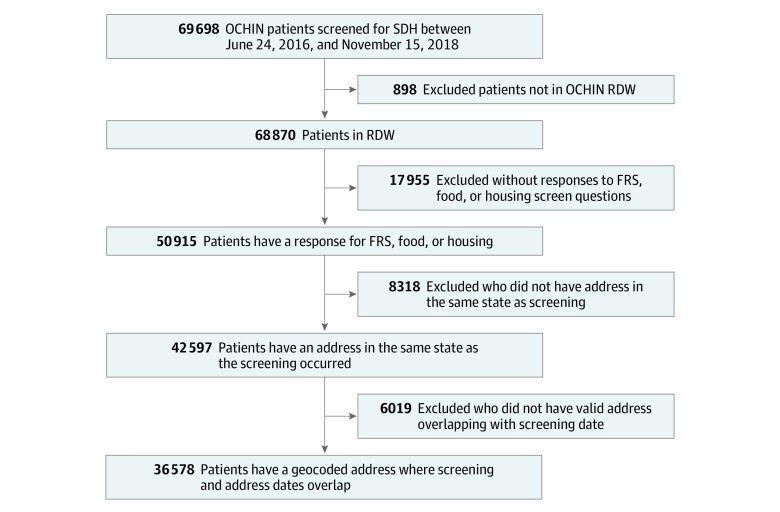
Importance: Responding to the substantial research on the relationship between social risk factors and health, enthusiasm has grown around social risk screening in health care settings, and numerous US health systems are experimenting with social risk screening initiatives. In the absence of standard social risk screening recommendations, some health systems are exploring using publicly available community-level data to identify patients who live in the most vulnerable communities as a way to characterize patient social and economic contexts, identify patients with potential social risks, and/or to target social risk screening efforts. Objective: To explore the utility of community-level data for accurately identifying patients with social risks by comparing the social deprivation index score for the census tract where a patient lives with patient-level social risk screening data. Design, Setting, and Participants: Cross-sectional study using patient-level social risk screening data from the electronic health records of a national network of community health centers between June 24, 2016, and November 15, 2018, linked to geocoded community-level data from publicly available sources. Eligible patients were those with a recorded response to social risk screening questions about food, housing, and/or financial resource strain, and a valid address of sufficient quality for geocoding. Exposures: Social risk screening documented in the electronic health record. Main Outcomes and Measures: Community-level social risk was assessed using census tract-level social deprivation index score stratified by quartile. Patient-level social risks were identified using food insecurity, housing insecurity, and financial resource strain screening responses. Results: The final study sample included 36 578 patients from 13 US states; 22 113 (60.5%) received public insurance, 21 181 (57.9%) were female, 17 578 (48.1%) were White, and 10 918 (29.8%) were Black. Although 6516 (60.0%) of those with at least 1 social risk factor were in the most deprived quartile of census tracts, patients with social risk factors lived in all census tracts. Overall, the accuracy of the community-level data for identifying patients with and without social risks was 48.0%. Conclusions and Relevance: Although there is overlap, patient-level and community-level approaches for assessing patient social risks are not equivalent. Using community-level data to guide patient-level activities may mean that some patients who could benefit from targeted interventions or care adjustments would not be identified.
Overview
The claims and statistics of this paper haven’t been checked yet.
Run the check — free, no account needed. It reads the open-access text and checks the sources it cites.
Integrity signals
Registry
Cites
Statistics
Figures
Verification
Claims the paper makes
The claims and statistics of this paper haven’t been checked yet.
Run the check — free, no account needed. It reads the open-access text and checks the sources it cites.
Claims other papers make about this one
Each is checked against this paper’s own text: does it say what the citing paper says it does?
The cited source says what the claim attributes to it.
In the citing paper
“They found that “the accuracy of the community-level data for identifying patients with and without social risks was 48.0%.””
From The quality of social determinants data in the electronic health record: a systematic review (2021) · cites this paper as [52]
The cited source says what the claim attributes to it.
In the citing paper
“The authors noted that the use of these data for patient risk stratification “may heighten the risk of ecologic fallacy, wherein incorrect assumptions are made about an individual based on aggregate-level information about a group.”52”
From The quality of social determinants data in the electronic health record: a systematic review (2021) · cites this paper as [52]
Self-check
Percentages, sums and reported differences re-computed from the paper’s own numbers.
The self-check needs the paper’s full text.
Citations
Cites
Development and Validity of a 2-Item Screen to Identify Families at Risk for Food Insecurity
Hager, E. R., Quigg, A. M., Black, M. M., Coleman, S. M., Heeren, T., Rose-Jacobs, R., Cook, J. T., de Cuba, S. A. E., Casey, P. H., Chilton, M., et al. (2010) · Pediatrics · doi:10.1542/peds.2009-3146 · Cited by 1,538
Bringing context back into epidemiology: variables and fallacies in multilevel analysis
Diez-Roux, A. V. (1998) · American Journal of Public Health · doi:10.2105/ajph.88.2.216 · Cited by 1,317
Krieger, N., Chen, J. T., Waterman, P. D., Rehkopf, D. H., & Subramanian, S. V. (2003) · American Journal of Public Health · doi:10.2105/ajph.93.10.1655 · Cited by 711
Butler, D. C., Petterson, S., Phillips, R. L., & Bazemore, A. W. (2013) · Health Services Research · doi:10.1111/j.1475-6773.2012.01449.x · Cited by 689
Ecological Correlations and the Behavior of Individuals*
Robinson, W. (2009) · International Journal of Epidemiology · doi:10.1093/ije/dyn357 · Cited by 685
Accountable Health Communities — Addressing Social Needs through Medicare and Medicaid
Alley, D. E., Asomugha, C. N., Conway, P. H., & Sanghavi, D. M. (2016) · New England Journal of Medicine · doi:10.1056/nejmp1512532 · Cited by 606
Capturing Social and Behavioral Domains and Measures in Electronic Health Records: Phase 2
Domains, B. (2015) · National Academies Press eBooks · doi:10.17226/18951 · Cited by 341
Patients in context--EHR capture of social and behavioral determinants of health.
Adler, N., & Stead, W. (2015) · New England Journal of Medicine · doi:10.1097/01.ogx.0000465303.29687.97 · Cited by 305
Part II: a qualitative study of social risk screening acceptability in patients and caregivers
Byhoff, E., De Marchis, E. H., Hessler, D., Fichtenberg, C., Adler, N., Cohen, A. J., Doran, K. M., Ettinger de Cuba, S., Fleegler, E. W., Gavin, N., et al. (2019) · American Journal of Preventive Medicine · doi:10.1016/j.amepre.2019.07.016 · Cited by 255
Self-citationAdoption of Social Determinants of Health EHR Tools by Community Health Centers
Gold, R., Bunce, A., Cowburn, S., Dambrun, K., Dearing, M., Middendorf, M., Mossman, N., Hollombe, C., Mahr, P., Melgar, G., et al. (2018) · The Annals of Family Medicine · doi:10.1370/afm.2275 · Cited by 252
Self-citationGold, R., Cottrell, E., Bunce, A., Middendorf, M., Hollombe, C., Cowburn, S., Mahr, P., & Melgar, G. (2017) · The Journal of the American Board of Family Medicine · doi:10.3122/jabfm.2017.04.170046 · Cited by 215
Self-citationBazemore, A., Cottrell, E., Gold, R. B., Hughes, L. S., Phillips, R. L., Angier, H. E., Burdick, T. E., Carrozza, M. A., & DeVoe, J. E. (2015) · Journal of the American Medical Informatics Association · doi:10.1093/jamia/ocv088 · Cited by 210
Self-citationDeVoe, J. E., Bazemore, A., Cottrell, E., Likumahuwa-Ackman, S., Grandmont, J., Spach, N., & Gold, R. B. (2016) · The Annals of Family Medicine · doi:10.1370/afm.1903 · Cited by 195
Self-citationPart I: a quantitative study of social risk screening acceptability in patients and caregivers
De Marchis, E. H., Hessler, D., Fichtenberg, C., Adler, N., Byhoff, E., Cohen, A. J., Doran, K. M., Ettinger de Cuba, S., Fleegler, E. W., Lewis, C. C., et al. (2019) · American Journal of Preventive Medicine · doi:10.1016/j.amepre.2019.07.010 · Cited by 194
Self-citationCollecting and applying data on social determinants of health in health care settings.
Gottlieb, L., Sandel, M., & Adler, N. (2013) · JAMA Internal Medicine · doi:10.1001/jamainternmed.2013.560 · Cited by 182
Self-citationPsychometric and Pragmatic Properties of Social Risk Screening Tools: A Systematic Review
Henrikson, N. B., Blasi, P. R., Dorsey, C. N., Mettert, K. D., Nguyen, M. B., Walsh‐Bailey, C., Macuiba, J., Gottlieb, L. M., & Lewis, C. C. (2019) · American Journal of Preventive Medicine · doi:10.1016/j.amepre.2019.07.012 · Cited by 178
Self-citationClinician Experiences with Screening for Social Needs in Primary Care
Tong, S. T., Liaw, W. R., Kashiri, P. L., Pecsok, J., Rozman, J., Bazemore, A. W., & Krist, A. H. (2018) · The Journal of the American Board of Family Medicine · doi:10.3122/jabfm.2018.03.170419 · Cited by 173
Committee on Integrating Social Needs Care into the Delivery of Health Care to Improve the Nation's Health, Board on Health Care Services, Division, H. A. M., & National Academies of Sciences, E. (2019) · doi:10.17226/25467 · Cited by 168
Integrating Social And Medical Data To Improve Population Health: Opportunities And Barriers
Gottlieb, L., Tobey, R., Cantor, J., Hessler, D., & Adler, N. E. (2016) · Health Affairs · doi:10.1377/hlthaff.2016.0723 · Cited by 155
Self-citationCottrell, E. K., Dambrun, K., Cowburn, S., Mossman, N., Bunce, A. E., Marino, M., Krancari, M., & Gold, R. (2019) · American Journal of Preventive Medicine · doi:10.1016/j.amepre.2019.07.014 · Cited by 111
Self-citationMapping Neighborhood Health Geomarkers To Clinical Care Decisions To Promote Equity In Child Health
Beck, A. F., Sandel, M. T., Ryan, P., & Kahn, R. S. (2017) · Health Affairs · doi:10.1377/hlthaff.2016.1425 · Cited by 105
How Other Countries Use Deprivation Indices-And Why The United States Desperately Needs One.
Phillips, R., Liaw, W., Crampton, P., Exeter, D., Bazemore, A., Vickery, K., Petterson, S., & Carrozza, M. A. (2016) · Health Affairs · doi:10.1377/hlthaff.2016.0709 · Cited by 95
Identifying Social Risk via a Clinical Social History Embedded in the Electronic Health Record
Beck, A. F., Klein, M. D., & Kahn, R. S. (2012) · Clinical Pediatrics · doi:10.1177/0009922812441663 · Cited by 76
Harnessing Geographic Information Systems (GIS) to Enable Community-Oriented Primary Care
Bazemore, A., Phillips, R., & Miyoshi, T. (2010) · Journal of the American Board of Family Medicine · doi:10.3122/jabfm.2010.01.090097 · Cited by 63
Theory vs Practice: Should Primary Care Practice Take on Social Determinants of Health Now? No.
Solberg, L. I. (2016) · The Annals of Family Medicine · doi:10.1370/afm.1918 · Cited by 59
Uses and Misuses of Patient- and Neighborhood-level Social Determinants of Health Data
Gottlieb, L. M., Francis, D., & Beck, A. F. (2018) · The Permanente Journal · doi:10.7812/tpp/18-078 · Cited by 59
Self-citationHessler, D., Bowyer, V., Gold, R. B., Shields‐Zeeman, L., Cottrell, E., & Gottlieb, L. M. (2019) · Current Diabetes Reports · doi:10.1007/s11892-019-1149-y · Cited by 54
Self-citationLiving in “Cold Spot” Communities Is Associated with Poor Health and Health Quality
Liaw, W., Krist, A., Tong, S. T., Sabo, R., Hochheimer, C. J., Rankin, J. L., Grolling, D., Grandmont, J., & Bazemore, A. (2018) · Journal of the American Board of Family Medicine · doi:10.3122/jabfm.2018.03.170421 · Cited by 51
Cottrell, E. K., Gold, R., Likumahuwa, S., Angier, H., Huguet, N., Cohen, D. J., Clark, K. D., Gottlieb, L. M., & DeVoe, J. E. (2018) · Journal of Health Care for the Poor and Underserved · doi:10.1353/hpu.2018.0071 · Cited by 41
Self-citationTheory vs Practice: Should Primary Care Practice Take on Social Determinants of Health Now? Yes.
Kaufman, A. (2016) · Annals of Family Medicine · doi:10.1370/afm.1915 · Cited by 39
Screening for Social Determinants of Health in Michigan Health Centers
Byhoff, E., Cohen, A. J., Hamati, M. C., Tatko, J., Davis, M. M., & Tipirneni, R. (2017) · The Journal of the American Board of Family Medicine · doi:10.3122/jabfm.2017.04.170079 · Cited by 36
Financial Strain and Impaired Fasting Glucose
Puterman, E. M., Adler, N. E., Matthews, K. A., & Epel, E. S. (2012) · Psychosomatic Medicine · doi:10.1097/psy.0b013e3182448d74 · Cited by 32
Cold-Spotting: Linking Primary Care and Public Health to Create Communities of Solution
Westfall, J. (2013) · Journal of the American Board of Family Medicine · doi:10.3122/jabfm.2013.03.130094 · Cited by 26
Research works printed but not linked: 1
- Manchanda, 2015, Upstream Risks Screening Tool and Guide Version 2.6
Cited by
Sorted by citations
Cardiovascular-kidney-metabolic health: a presidential advisory from the American Heart Association
Ndumele, C. E., Rangaswami, J., Chow, S. L., Neeland, I. J., Tuttle, K. R., Khan, S. S., Coresh, J., Mathew, R. O., Baker-Smith, C. M., Carnethon, M. R., et al. (2023) · Circulation · doi:10.1161/cir.0000000000001184 · Cited by 2,208
“147 In addition, health care systems can address social needs among patients with CKM syndrome by identifying, using and referring to existing community resources.”
BackgroundThe quality of social determinants data in the electronic health record: a systematic review
Cook, L. A., Sachs, J., & Weiskopf, N. G. (2021) · Journal of the American Medical Informatics Association · doi:10.1093/jamia/ocab199 · Cited by 153
Risk factors associated with post-acute sequelae of SARS-CoV-2: an N3C and NIH RECOVER study
Hill, E., Mehta, H. B., Sharma, S., Mane, K., Singh, S., Xie, C. Z., Cathey, E., Loomba, J. J., Russell, S., Spratt, H. M., et al. (2023) · BMC Public Health · doi:10.1186/s12889-023-16916-w · Cited by 97
“While research shows that county-level SDoH variables can be significant for patient-level analysis, more granular geographic unit or patient-level data would likely provide a greater understanding of the relationship between SDoH and PASC outcomes [45, 46].”
BackgroundHan, X., Yang, N., Nogueira, L., Jiang, C., Wagle, N. S., Zhao, J., Shi, K. S., Fan, Q., Schafer, E. J., Yabroff, K. R., et al. (2023) · The Lancet Oncology · doi:10.1016/s1470-2045(23)00293-0 · Cited by 74
Enzinger, A. C., Ghosh, K., Keating, N. L., Cutler, D., Clark, C. R., Florez, N., Landrum, M. B., & Wright, A. A. (2023) · Journal of Clinical Oncology · doi:10.1200/jco.22.01413 · Cited by 90
Metadata
- Authors
- Cottrell, E. K., Hendricks, M., Dambrun, K., Cowburn, S., Pantell, M., Gold, R., & Gottlieb, L. M.
- Affiliations
- Oregon Health & Science University (US)
- Ochin (US)
- University of California, San Francisco (US)
- Kaiser Permanente (US)
- Corresponding author
- Cottrell, Erika K.
- Venue
- JAMA Network Open
- Publisher
- American Medical Association (AMA)
- Published
- 2020-10-29
- Volume
- 3
- Issue
- 10
- Pages
- e2016852
- ISSN
- 2574-3805 (ISSN-L)
- PMC
- PMC7596576
- OpenAlex
- W3095119350
- Cited by
- 126
- References
- 35
- Citations by year
- 2026: 20 · 2025: 21 · 2024: 24 · 2023: 29 · 2022: 21 · 2021: 11
- FWCI
- 8.44
- Type
- journal article
- Language
- en
- Open access
- gold
- doi.org
- Licence
- cc-by
- Locations
- JAMA Network Open (publishedVersion, cc-by)
- PubMed Central (publishedVersion, cc-by)
- PubMed (publishedVersion)
- Funders
- Patient-Centered Outcomes Research Institute
- Topics
- Social Sciences › Health › Health disparities and outcomes
- Health Sciences › Medicine › Public Health, Environmental and Occupational Health › Food Security and Health in Diverse Populations
- Social Sciences › Health › Public Health and Social Inequalities
- Keywords
- social risk screening, food insecurity, housing insecurity, financial stress, community health centers, social determinants of health, screening accuracy
- MeSH terms
- Adolescent, Adult, Age Factors, Aged, Aged, 80 and over, Child, Child, Preschool, Community Health Centers, Cross-Sectional Studies, Female, Humans, Infant, Infant, Newborn, Male, Middle Aged, Residence Characteristics, Risk Factors, Sex Factors, Socioeconomic Factors, United States, Risk Assessment, Young Adult, Social Determinants of Health
About these checks
Registry, retraction, Cites and statistics results are computed, not judged, with one exception: a printed reference that no index lists is read once by a model before it counts as a citation error. Claims are extracted by a model and kept only when their quote appears verbatim in the text; each cited source is then checked, with a model’s help, for whether it says what the claim relies on. Those verdicts can be wrong — read the claim’s quote and the cited source before relying on one.
Statistics and arithmetic are recomputed, not judged.
Confidence bands are shown only for fields calibrated on our annotated test set. None is calibrated yet, so no band is shown.
What counts as a claim ›How we measure confidence ›How we check this ›
Are you an author, or do you see a problem with this page? Request a review
