

The DOI matches its Crossref record; 212 of the 222 references it cites were found in a registry or an index, and 1 are not checked yet.
Comparison of Treatments for Cocaine Use Disorder Among Adults: A Systematic Review and Meta-analysis
Open accessAbstract
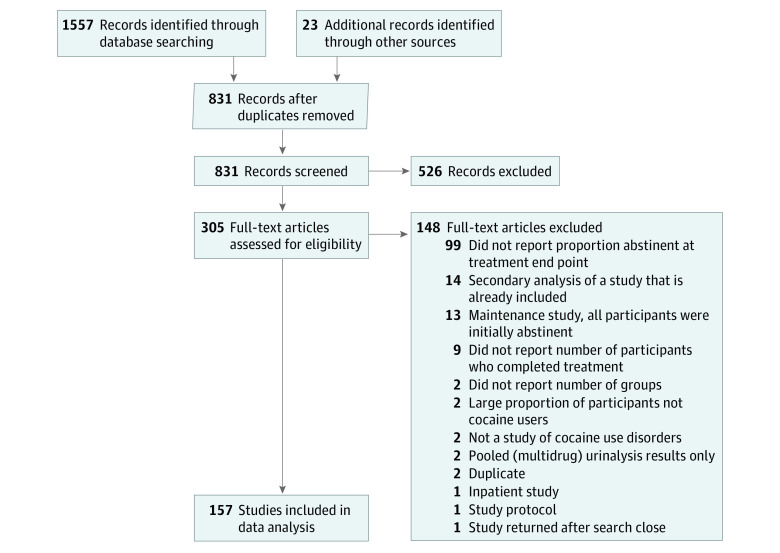
Importance: In the US and the United Kingdom, cocaine use is the second leading cause of illicit drug overdose death. Psychosocial treatments for cocaine use disorder are limited, and no pharmacotherapy is approved for use in the US or Europe. Objective: To compare treatments for active cocaine use among adults. Data Sources: PubMed and the Cochrane Database of Systematic Reviews were searched for clinical trials published between December 31, 1995, and December 31, 2017. Study Selection: This meta-analysis was registered on Covidence.org (study 8731) on December 31, 2015. Clinical trials were included if they (1) had the term cocaine in the article title; (2) were published between December 31, 1995, and December 31, 2017; (3) were written in English; (4) enrolled outpatients 18 years or older with active cocaine use at baseline; and (5) reported treatment group size, treatment duration, retention rates, and urinalysis results for the presence of cocaine metabolites. A study was excluded if (1) more than 25% of participants were not active cocaine users or more than 80% of participants had negative test results for the presence of cocaine metabolites at baseline and (2) it reported only pooled urinalysis results indicating the presence of multiple substances and did not report the specific proportion of positive test results for cocaine metabolites. Multiple reviewers reached criteria consensus. Of 831 records screened, 157 studies (18.9%) met selection criteria and were included in the analysis. Data Extraction and Synthesis: This study followed the Preferred Reporting Items for Systematic Reviews and Meta-analyses (PRISMA) guideline. Search results were imported from PubMed XML into Covidence.org then Microsoft Excel. Data extraction was completed in 2 iterations to ensure fidelity. Analyses included a multilevel random-effects model, a multilevel mixed-effects meta-regression model, and sensitivity analyses. Treatments were clustered into 11 categories (psychotherapy, contingency management programs, placebo, opioids, psychostimulants, anticonvulsants, dopamine agonists, antidepressants, antipsychotics, miscellaneous medications, and other therapies). Missing data were imputed using multiple imputation by chained equations. The significance threshold for all analyses was P = .05. Data were analyzed using the metafor and mice packages in R software, version 3.3.2 (R Foundation for Statistical Computing). Data were analyzed from January 1, 2018, to February 28, 2021. Main Outcomes and Measures: The primary outcome was the intention-to-treat logarithm of the odds ratio (OR) of having a negative urinalysis result for the presence of cocaine metabolites at the end of each treatment period compared with baseline. The hypothesis, which was formulated after data collection, was that no treatment category would have a significant association with objective reductions in cocaine use. Results: A total of 157 studies comprising 402 treatment groups and 15 842 participants were included. Excluding other therapies, the largest treatment groups across all studies were psychotherapy (mean [SD] number of participants, 40.04 [36.88]) and contingency management programs (mean [SD] number of participants, 37.51 [25.51]). Only contingency management programs were significantly associated with an increased likelihood of having a negative test result for the presence of cocaine (OR, 2.13; 95% CI, 1.62-2.80), and this association remained significant in all sensitivity analyses. Conclusions and Relevance: In this meta-analysis, contingency management programs were associated with reductions in cocaine use among adults. Research efforts and policies that align with this treatment modality may benefit those who actively use cocaine and attenuate societal burdens.
Overview
The claims and statistics of this paper haven’t been checked yet.
Run the check — free, no account needed. It reads the open-access text and checks the sources it cites.
Integrity signals
Registry
Cites
Statistics
Figures
Verification
Claims the paper makes
The claims and statistics of this paper haven’t been checked yet.
Run the check — free, no account needed. It reads the open-access text and checks the sources it cites.
Claims other papers make about this one
Each is checked against this paper’s own text: does it say what the citing paper says it does?
The source backs part of the claim, not all of it — or backs it for a different population, condition or comparison.
In the citing paper
“Contingency management (CM) has demonstrated the best effectiveness in the treatment of stimulant use disorders (StUDs) compared to any other intervention studied and represents the current standard of care.”
From The ASAM/AAAP Clinical Practice Guideline on the Management of Stimulant Use Disorder (2024) · cites this paper as [44]
Experimental — accuracy not yet measuredThe source backs part of the claim, not all of it — or backs it for a different population, condition or comparison.
In the citing paper
“Multiple systematic reviews have shown positive effects of CM on methamphetamine use, 44,45”
From The ASAM/AAAP Clinical Practice Guideline on the Management of Stimulant Use Disorder (2024) · cites this paper as [44]
Experimental — accuracy not yet measuredThe source backs part of the claim, not all of it — or backs it for a different population, condition or comparison.
In the citing paper
“There is strong evidence that CM is an effective intervention for increasing treatment engagement and reducing stimulant use.”
From The ASAM/AAAP Clinical Practice Guideline on the Management of Stimulant Use Disorder (2024) · cites this paper as [44]
Experimental — accuracy not yet measured
Self-check
Percentages, sums and reported differences re-computed from the paper’s own numbers.
The self-check needs the paper’s full text.
Citations
Cites
2 retracted
Psychosocial interventions for cocaine and psychostimulant amphetamines related disorders
Knapp, W. P., Soares, B. G., Farrell, M., & de Lima, M. S. (2007) · Cochrane Database of Systematic Reviews · doi:10.1002/14651858.cd003023.pub2 · Cited by 178
RetractedAnticonvulsants for cocaine dependence
Minozzi, S., Amato, L., Davoli, M., Farrell, M., Reisser, A. A. L., Pani, P. P., de Lima, M. S., Soares, B. G., & Vecchi, S. (2015) · Cochrane Database of Systematic Reviews · doi:10.1002/14651858.cd006754.pub3 · Cited by 26
RetractedPreferred Reporting Items for Systematic Reviews and Meta-Analyses: the PRISMA statement
Moher, D., Liberati, A., Tetzlaff, J., Altman, D. G., & for the PRISMA Group (2009) · BMJ · doi:10.1136/bmj.b2535 · Cited by 83,823
Preferred Reporting Items for Systematic Reviews and Meta-Analyses: The PRISMA Statement
Moher, D., Liberati, A., Tetzlaff, J., Altman, D. G., & The PRISMA Group (2009) · PLoS Medicine · doi:10.1371/journal.pmed.1000097 · Cited by 64,042
Bias in meta-analysis detected by a simple, graphical test
Egger, M., Smith, G. D., Schneider, M., & Minder, C. (1997) · BMJ · doi:10.1136/bmj.315.7109.629 · Cited by 56,722
Preferred reporting items for systematic reviews and meta-analyses: the PRISMA Statement.
(2009) · PubMed Central · Cited by 44,859
Conducting Meta-Analyses in R with the metafor Package
Viechtbauer, W. (2010) · Journal of Statistical Software · doi:10.18637/jss.v036.i03 · Cited by 20,464
Wang, G., Ma, R., Qiao, G., Wada, K., Aizawa, Y., & Satoh, T. (2015) · Integrative Medicine International · doi:10.1159/000368408 · Cited by 18,762
mice: Multivariate Imputation by Chained Equations in R
Buuren, S. V., & Groothuis-Oudshoorn, K. (2011) · Journal of Statistical Software · doi:10.18637/jss.v045.i03 · Cited by 13,870
(2010) · University of Twente Research Information · Cited by 6,037
Cited by
Sorted by citations
Bravo, R. R., Faria, A. C., Brito-da-Costa, A. M., Carmo, H., Mladěnka, P., da Silva, D. D., Remião, F., & Researchers, O. B. O. T. O. (2022) · Toxins · doi:10.3390/toxins14040278 · Cited by 163
The ASAM/AAAP Clinical Practice Guideline on the Management of Stimulant Use Disorder
(2024) · Journal of Addiction Medicine · doi:10.1097/adm.0000000000001299 · Cited by 78
Cocaine Use Disorder (CUD): Current Clinical Perspectives
Schwartz, E. K. C., Wolkowicz, N. R., Aquino, J. P. D., MacLean, R. R., & Sofuoglu, M. (2022) · Substance Abuse and Rehabilitation · doi:10.2147/sar.s337338 · Cited by 92
“There have been several studies examining these neurostimulation techniques as potential treatments for CUD (recently reviewed by Bolloni et al, 2018, Rachid, 2018, and Lupi et al, 2017).221–223 In summary, several studies found that TMS and tDCS have efficacy in reducing cravings224–228 or reducing risky behaviors229…”
BackgroundResultInfluentialMeta-review on the efficacy of psychological therapies for the treatment of substance use disorders
Dellazizzo, L., Potvin, S., Giguère, S., Landry, C., Léveillé, N., & Dumais, A. (2023) · Psychiatry Research · doi:10.1016/j.psychres.2023.115318 · Cited by 55
Rawson, R. A., Erath, T. G., & Clark, H. W. (2023) · Preventive Medicine · doi:10.1016/j.ypmed.2023.107625 · Cited by 48
Contingency Management for Stimulant Use Disorder: Progress, Challenges, and Recommendations
Rawson, R. A., Erath, T. G., Chalk, M., Clark, H. W., McDaid, C., Wattenberg, S. A., Roll, J. M., McDonell, M. G., Parent, S., & Freese, T. E. (2023) · Journal of Ambulatory Care Management · doi:10.1097/jac.0000000000000450 · Cited by 41
“Second, there have been very limited efforts to scale up the most consistently effective intervention for StimUD, contingency management (CM) (AshaRani et al., 2020; Bentzley et al., 2021; Higgins et al., 2019).”
Gao, Z., Winhusen, T. M., Gorenflo, M. P., Ghitza, U. E., Davis, P. B., Kaelber, D. C., & Xu, R. (2023) · Addiction · doi:10.1111/add.16168 · Cited by 40
“However, there is no Food and Drug Administration (FDA)- approved medication to treat CUD [4, 5].”
BackgroundLin, J., Arnovitz, M. D., Kotbi, N., & Francois, D. (2023) · Current Treatment Options in Psychiatry · doi:10.1007/s40501-023-00291-9 · Cited by 29
Psychosocial interventions for stimulant use disorder
Minozzi, S., Saulle, R., Amato, L., Traccis, F., & Agabio, R. (2024) · Cochrane Database of Systematic Reviews · doi:10.1002/14651858.cd011866.pub3 · Cited by 32
Carli, M., Weiss, F., Grenno, G., Ponzini, S., Kolachalam, S., Vaglini, F., Viaggi, C., Pardini, C., Tidona, S., Longoni, B., et al. (2023) · Current Neuropharmacology · doi:10.2174/1570159x21666230224102318 · Cited by 32
“Similarly, despite showing some potential efficacy for psychostimulant abuse treatment in earlier studies [117, 118], more recent accounts do not support a role for Quetiapine administration in this clinical context [119, 120].”
ResultKhazanov, G. K., McKay, J. R., & Rawson, R. A. (2024) · Addiction · doi:10.1111/add.16497 · Cited by 28
Predictors of cocaine use disorder treatment outcomes: a systematic review
Palazón-Llecha, A., Caparrós, B., Trujols, J., Duran‐Sindreu, S., Batlle, F., Madre, M., & Mallorquí‐Bagué, N. (2024) · Systematic Reviews · doi:10.1186/s13643-024-02550-z · Cited by 25
New approaches to deep phenotyping in addictions.
Watts, A. L., Latzman, R. D., Boness, C. L., Kotov, R., Keyser‐Marcus, L., DeYoung, C. G., Krueger, R. F., Zald, D. H., Moeller, F. G., & Ramey, T. (2022) · Psychology of Addictive Behaviors · doi:10.1037/adb0000878 · Cited by 31
Decreased cocaine demand following contingency management treatment
Yoon, J. H., Suchting, R., de Dios, C., Vincent, J. N., McKay, S. A., Lane, S. D., & Schmitz, J. M. (2021) · Drug and Alcohol Dependence · doi:10.1016/j.drugalcdep.2021.108883 · Cited by 21
Contingency management for drug use disorders: Meta-analysis and application of Tolin’s criteria.
Pfund, R. A., Ginley, M. K., Boness, C. L., Rash, C. J., Zajac, K., & Witkiewitz, K. A. (2022) · Clinical Psychology Science and Practice · doi:10.1037/cps0000121 · Cited by 23
Rates, characteristics and toxicology of cocaine‐related deaths in Australia, 2000–2021
Darke, S. G., Duflou, J. A., Peacock, A., Chrzanowska, A., Farrell, M., & Lappin, J. (2022) · Addiction · doi:10.1111/add.16055 · Cited by 17
Thakarar, K., Appa, A. A., Abdul‐Mutakabbir, J. C., Goff, A., Brown, J. A., Tuell, C., Fairfield, K. M., & Wurcel, A. G. (2023) · Clinical Infectious Diseases · doi:10.1093/cid/ciad664 · Cited by 17
Oliveira, P. M., Reis, C. S., & Vieira‐Coelho, M. A. (2023) · International Journal of Sexual Health · doi:10.1080/19317611.2023.2260372 · Cited by 16
“…already shown effectiveness in promoting abstinence in multiple substance addictions (Prendergast et al., 2006), including, for example, cocaine (Bentzley et al., 2021), opioids (Ainscough et al., 2017), methamphetamines (Brown & DeFulio, 2020), among others, and might also be applicable in…”
BackgroundChoi, N. G., DiNitto, D. M., Marti, C. N., & Choi, B. Y. (2021) · Drug and Alcohol Dependence · doi:10.1016/j.drugalcdep.2021.109256 · Cited by 15
Contingency Management for Stimulant Use Disorder and Association With Mortality: A Cohort Study
Coughlin, L. N., Tomlinson, D. C., Zhang, L., Kim, H. M., Frost, M. C., Khazanov, G. K., McKay, J. R., DePhilippis, D., & Lin, L. A. (2025) · American Journal of Psychiatry · doi:10.1176/appi.ajp.20250053 · Cited by 14
Data-Driven Contingency Management Incentive Magnitudes
Rash, C. J., Black, S. I., Parent, S. C., Erath, T. G., & McDonell, M. G. (2025) · JAMA Psychiatry · doi:10.1001/jamapsychiatry.2025.1341 · Cited by 13
Transcranial Stimulation for the Treatment of Stimulant Use Disorder
Edinoff, A. N., Sall, S., Roberts, T. D., Tomlinson, H., Soileau, L. G., Jackson, E. D., Murnane, K. S., Wenger, D. M., Cornett, E. M., Toms, J., et al. (2023) · Neurology International · doi:10.3390/neurolint15010021 · Cited by 12
“In a systematic review and meta-analysis of 157 studies looking at treatment options for cocaine, CM programs, when compared to other psychotherapies, revealed provided the only significant likelihood that patients would provide a negative cocaine test [24].”
BackgroundAllen, M. I., Johnson, B., Kumar, A., Su, Y., Singh, S., Deep, G., & Nader, M. A. (2024) · Addiction Neuroscience · doi:10.1016/j.addicn.2024.100151 · Cited by 12
California's Recovery Incentives Program: Implementation strategies
Freese, T. E., Rutkowski, B. A., Peck, J. A., Padwa, H., Thompson, C., Datrice, A., Simmons, J., Cooper, M., Loya, C., Trupiano, D., et al. (2024) · Journal of Substance Use and Addiction Treatment · doi:10.1016/j.josat.2024.209513 · Cited by 12
Okorom, A. V., Camacho‐Hernandez, G. A., Salomon, K., Lee, K. H., Ku, T. C., Cao, J., Won, S. J., Friedman, J., Lam, J., Paule, J., et al. (2023) · Journal of Medicinal Chemistry · doi:10.1021/acs.jmedchem.3c02037 · Cited by 11
Disulfiram for the treatment of cocaine dependence
Traccis, F., Minozzi, S., Trogu, E., Vacca, R., Vecchi, S., Pani, P. P., & Agabio, R. (2024) · Cochrane Database of Systematic Reviews · doi:10.1002/14651858.cd007024.pub3 · Cited by 14
Fitzgerald, N. D., Liu, Y., Wang, A., Striley, C. W., Setlow, B., Knackstedt, L. A., & Cottler, L. B. (2024) · Drug and Alcohol Dependence · doi:10.1016/j.drugalcdep.2024.111272 · Cited by 11
Tardelli, V., Berro, L. F., Gerra, G., Tadonio, L., Bisaga, A., & Fidalgo, T. (2023) · Addiction Biology · doi:10.1111/adb.13271 · Cited by 11
Behavioral therapies targeting reward mechanisms in substance use disorders
Wardle, M. C., Webber, H. E., Yoon, J. H., Heads, A. M. B., Stotts, A. L., Lane, S. D., & Schmitz, J. M. (2024) · Pharmacology Biochemistry and Behavior · doi:10.1016/j.pbb.2024.173787 · Cited by 10
Cocaine-Induced Locomotor Activation Differs Across Inbred Mouse Substrains
Gaines, C. H., Schoenrock, S. A., Farrington, J., Lee, D. F., Aponte‐Collazo, L. J., Shaw, G. D., Miller, D. R., Ferris, M. T., de Villena, F. P., & Tarantino, L. M. (2022) · Frontiers in Psychiatry · doi:10.3389/fpsyt.2022.800245 · Cited by 9
“We also observed a significant day x substrain interaction [F(4, 288) = 4.”
BackgroundNavigating Evidence, Challenges, and Caution in the Treatment of Stimulant Use Disorders
Bahji, A., Danilewitz, M., & Crockford, D. (2023) · Brain Sciences · doi:10.3390/brainsci13101416 · Cited by 9
Appa, A. A., Baral, S., Stein, B., Knight, K. R., Gandhi, M., Coffin, P. O., & Martín, M. (2023) · Journal of Addiction Medicine · doi:10.1097/adm.0000000000001254 · Cited by 10
A preliminary investigation of schedule parameters on cocaine abstinence in contingency management
Regnier, S. D., Strickland, J. C., & Stoops, W. W. (2022) · Journal of the Experimental Analysis of Behavior · doi:10.1002/jeab.770 · Cited by 9
Characteristics and circumstances of cocaine-related completed suicide in Australia, 2000–2021
Darke, S. G., Duflou, J. A., Peacock, A., Farrell, M., & Lappin, J. (2023) · Drug and Alcohol Dependence · doi:10.1016/j.drugalcdep.2023.109803 · Cited by 8
Rafful, C. M., Orozco, R., Peralta, D., Jiménez-Rivagorza, L., Medina‐Mora, M. E., Gutiérrez, N., & Morales, M. (2024) · Harm Reduction Journal · doi:10.1186/s12954-024-01020-y · Cited by 8
“Moreover, psychosocial treatment has not proved to be effective yet [10], with contingency management as the most promising strategy for both cocaine [11] and ATS [12].”
BackgroundCong, Z., Yang, L., Zhao, Z., Zheng, G., Bao, C., Zhang, P., Wang, J., Zheng, W., Yao, Z., & Hu, B. (2024) · Journal of Psychiatric Research · doi:10.1016/j.jpsychires.2024.06.012 · Cited by 8
Sinclair, J., Kalk, N. J., Kaar, S. J., Agabio, R., Arunogiri, S., Bisaga, A. M., Chesney, E., Daly, C., Dewhurst, J., Freeman, T. P., et al. (2026) · Journal of Psychopharmacology · doi:10.1177/02698811251399593 · Cited by 10
“Co-occurring opioid dependence and cocaine use disorder : A meta-analysis of 55 studies (5139 participants) of people with co-occurring opioid and cocaine dependence found that buprenorphine or methadone was associated with a reduction in cocaine use (Bentzley et al., 2021) (Ia).”
InfluentialPsilocybin in the Treatment of Cocaine Use Disorder
Hendricks, P. S., Lappan, S. N., Shelton, R. C., Lahti, A. C., Cropsey, K. L., Johnson, M. W., Bradley, M. K., Simonsson, O., Davis, L. L., Grossman, D. H., et al. (2026) · JAMA Network Open · doi:10.1001/jamanetworkopen.2026.11029 · Cited by 9
Endogenous opioid system modulates conditioned cocaine reward in a sex‐dependent manner
Matsumura, K., Nicot, A., Choi, I. B., Asokan, M., Le, N. N., Natividad, L. A., & Dobbs, L. K. (2023) · Addiction Biology · doi:10.1111/adb.13328 · Cited by 8
Dacosta‐Sánchez, D., Fernández‐Calderón, F., Díaz, C., Mancheño‐Velasco, C., & Lozano, O. M. (2024) · European Addiction Research · doi:10.1159/000535689 · Cited by 8
“Numerous studies have examined the factors associated with drug use relapse, either during treatment [12, 13] or after completion of treatment [14 – 16].”
BackgroundPhysiologic Effects of Substance Use
Murray, B. P., & Kiernan, E. A. (2023) · Emergency Medicine Clinics of North America · doi:10.1016/j.emc.2023.06.022 · Cited by 7
Kuijper, F. M., Mahajan, U. V., Ku, S., Barbosa, D. A. N., Alessi, S. M., Stein, S. C., Kampman, K. M., Bentzley, B. S., & Halpern, C. H. (2021) · Neuromodulation Technology at the Neural Interface · doi:10.1111/ner.13410 · Cited by 6
Self-citationSchuch, J. B., Becker, N., Rabelo‐da‐Ponte, F. D., Ornell, F. R., Freitas, H. J. M., Rebelatto, F. P., Sordi, A. O., Pechansky, F., DIEMEN, L. V., & Kessler, F. H. P. (2023) · Trends in Psychiatry and Psychotherapy · doi:10.47626/2237-6089-2022-0567 · Cited by 7
“Total MMSE scores were significantly different between the three groups evaluated (χ² [2] = 20.270, p 0.001, with medians [IQR 25-75] of 23 [21-26] for AUD, 24 [22-27] for CUD, and 26 [23-28] for polysubstance use) (Figure 1A).”
BackgroundInfluentialA Call to Action: Evidence-Based Contingency Management
Rash, C. J., McDonell, M. G., Erath, T. G., Parent, S. C., Rawson, R. A., & Wattenberg, S. (2025) · American Journal of Psychiatry · doi:10.1176/appi.ajp.20240261 · Cited by 7
Davidson, R. M., Traxler, H. K., DeFulio, A., Redish, A. D., Royle, J. A., & Gass, H. P. (2024) · Journal of Applied Behavior Analysis · doi:10.1002/jaba.2922 · Cited by 8
Regnier, S. D., Shellenberg, T., Koffarnus, M. N., Cox, D. H., Lile, J. A., Rush, C. R., & Stoops, W. W. (2023) · Drug and Alcohol Dependence · doi:10.1016/j.drugalcdep.2023.111030 · Cited by 6
Bórquez, I., Cerdá, M., Cruz, A. G., Krawczyk, N., & Castillo‐Carniglia, Á. (2024) · Addiction · doi:10.1111/add.16412 · Cited by 6
McCurdy, L. Y., DeVito, E. E., Loya, J. M., Nich, C., Zhai, Z. W., Kiluk, B. D., & Potenza, M. N. (2024) · Drug and Alcohol Dependence Reports · doi:10.1016/j.dadr.2024.100246 · Cited by 6
“At present, there are still no Food and Drug Administration-approved pharmacotherapies for CUD (Schwartz et al., 2022), and existing psychosocial interventions have variable effect sizes (Bentzley et al., 2021).”
Influence of cocaine use reduction on markers of immune function
Stoops, W. W., Shellenberg, T., Regnier, S. D., Cox, D. H., Adatorwovor, R., Hays, L. R., Anderson, D. M., Lile, J. A., Schmitz, J. M., Havens, J. R., et al. (2024) · Journal of Neuroimmunology · doi:10.1016/j.jneuroim.2024.578470 · Cited by 6
Cunha, T. T. D. S., Silva, R. R., Rodrigues, D. A., Pinheiro, P. D. S. M., Kronenberger, T., Sant’Anna, C. M. R., Noël, F., & Fraga, C. A. M. (2022) · Biomolecules · doi:10.3390/biom12081112 · Cited by 6
Mauro, P. M., Gutkind, S., Rivera‐Aguirre, A., Gary, D. S., Cerdá, M., Santos, É. C., Castillo‐Carniglia, Á., & Martins, S. S. (2022) · International Journal of Drug Policy · doi:10.1016/j.drugpo.2022.103810 · Cited by 6
Does stimulant drug–induced sensitization occur in primates?
Leyton, M. (2022) · Journal of Psychiatry and Neuroscience · doi:10.1503/jpn.220055 · Cited by 7
The Rising Tide of Stimulant-Related Morbidity and Mortality Warrants Evidence-Based Treatment
Bahji, A., dhaliwal, A., Sachdev, A., Danilewitz, M., Lamba, W., George, T., Chopra, N., & Crockford, D. (2022) · Canadian journal of psychiatry. Revue canadienne de psychiatrie · doi:10.1177/07067437221125301 · Cited by 6
“Unlike OUD, the available evidence for agonist-based pharmacological treatment of PSUD has been inconsistent, and there is no evidence of reduced mortality.(4) Although some trials have suggested that psychostimulants might be an effective strategy for PSUD treatment, multiple Cochrane Collaboration reviews on PSUD tr…”
BackgroundMongan, D., Millar, S., Carew, A. M., Kelleher, C., Daly, A., Lyons, S., Galvin, B., & Smyth, B. P. (2025) · BMC Public Health · doi:10.1186/s12889-025-23224-y · Cited by 5
Optimizing Contingency Management with Reinforcement Learning
Kim, Y.-G., Brandt, L., Cheung, K., Nunes, E. V., Roll, J., Luo, S. X., & Liu, Y. (2025) · IEEE International Conference on Healthcare Informatics (ICHI) · doi:10.1109/ichi64645.2025.00051 · Cited by 5
“Meta-analyses demonstrated that both approaches are effective in encouraging SUD remission [34], [35], [36], [37], [38], [39].”
Advances in Using Contingency Management as Addiction Treatment
Dallery, J., & Novak, M. D. (2025) · Current Addiction Reports · doi:10.1007/s40429-025-00639-6 · Cited by 5
Deficits in consummatory reward relate to severity of cocaine use
Wardle, M. C., Hoots, J. K., Miloslavich, K., Nunez, C., de Dios, C., Holden, C. C., Ahluwahlia, A., Green, C. E., Lane, S. D., & Schmitz, J. M. (2023) · Drug and Alcohol Dependence · doi:10.1016/j.drugalcdep.2023.109950 · Cited by 5
Campos, M. S., Bezerra, A. G., Curado, D. F., Pauluci, R., & Galduróz, J. C. F. (2024) · Pharmacology Biochemistry and Behavior · doi:10.1016/j.pbb.2024.173725 · Cited by 5
(Levamisole Adulterated) Cocaine-Induced Vasculitis: What Is Known/Current Evidence
Donkers, J. W. J., Feijen, R. A., & Rutgers, A. (2024) · Current Treatment Options in Rheumatology · doi:10.1007/s40674-024-00215-5 · Cited by 4
Treatment Updates for Pain Management and Opioid Use Disorder
Locke, T., Salisbury‐Afshar, E., & Coyle, D. T. (2023) · Medical Clinics of North America · doi:10.1016/j.mcna.2023.06.017 · Cited by 4
Systematic Review of Cocaine-Treatment Interventions for Black Americans
Dogan, J. N., Wheeler, P. B., Cunningham, K., Stevens-Watkins, D. J., & Stoops, W. W. (2024) · Clinical Psychological Science · doi:10.1177/21677026241242709 · Cited by 4
“…that certain treatment approaches, such as contingency management, are the most effective for reducing cocaine use in the general population (Bentzley et al., 2021), little research to date has specifically examined the effectiveness of these interventions for Black Americans, for whom…”
Gaulden, A. D., Tepe, E. A., Sia, E., Rollins, S. S., & McReynolds, J. R. (2025) · Physiology & Behavior · doi:10.1016/j.physbeh.2025.114840 · Cited by 4
“To date, there is currently no FDA-approved treatment for CUD, and psychosocial interventions have limited efficacy and adherence [2,3].”
Mallorquí‐Bagué, N., Palazón-Llecha, A., Madre, M., Batlle, F., Duran‐Sindreu, S., & Trujols, J. (2023) · Frontiers in Psychiatry · doi:10.3389/fpsyt.2023.1051528 · Cited by 4
Maahs, S., Leclair, D., Gomez‐Mancilla, B., Kiluk, B. D., Muthusamy, V. S., Banerjee, P. S., Dasgupta, S., & Waye, K. M. (2024) · Frontiers in Psychiatry · doi:10.3389/fpsyt.2024.1230699 · Cited by 4
“Although there are approved pharmacotherapies for opioid, tobacco, and alcohol use disorders, the treatment options are limited for CUD, with no approved pharmacotherapies in the United States (US) or Europe despite multiple clinical trials in the last several decades (4, 7, 8).”
BackgroundBertz, J. W., Smith, K. E., Panlilio, L. V., Stull, S. W., Reamer, D., Murville, M.-L., Sullivan, M., Holtyn, A. F., Toegel, F., Epstein, D. H., et al. (2021) · Drug and Alcohol Dependence Reports · doi:10.1016/j.dadr.2021.100011 · Cited by 5
Gut Hormones: Possible Mediators of Addictive Disorders?
Nestor, L. J., & Ersche, K. D. (2024) · European Addiction Research · doi:10.1159/000540743 · Cited by 4
Pérez, L. J. G., Cardullo, S., Zaffaina, G. C., Cuppone, D., Chindamo, S., Zattin, A., Cellini, N., Terraneo, A., & Gallimberti, L. (2025) · Journal of Substance Use and Addiction Treatment · doi:10.1016/j.josat.2025.209706 · Cited by 3
Novel Pharmacological Agents for the Treatment of Cocaine Use Disorder
Hadizadeh, H., Flores, J. M., Nunes, E. J., Mayerson, T. F., Potenza, M. N., & Angarita, G. A. (2022) · Current Behavioral Neuroscience Reports · doi:10.1007/s40473-022-00246-z · Cited by 3
Tschudi, L., Fischer, S. K. M., Perlov, E., Baumgartner, M. R., Soyka, M., Müller, T., Seifritz, E., & Mutschler, J. (2023) · European Addiction Research · doi:10.1159/000531008 · Cited by 4
“In a recent systematic review and meta-analysis, only contingency management programs were associated with reduced cocaine use [21].”
InfluentialAllen, M. I., Costa, M. B., Johnson, B., Gould, R. W., & Nader, M. A. (2024) · Neuropsychopharmacology · doi:10.1038/s41386-024-01882-7 · Cited by 4
Bórquez, I., Krawczyk, N., Matthay, E. C., Charris, R., Dupré, S., Piñones, M. M., Carvacho, P., Cerdá, M., Castillo‐Carniglia, Á., & Valenzuela, E. (2025) · Addiction · doi:10.1111/add.16731 · Cited by 3
Tatangelo, M., Tahsin, F., Morin, K., & Marsh, D. (2022) · Frontiers in Psychiatry · doi:10.3389/fpsyt.2022.1074691 · Cited by 2
Evidence-based Treatment for Stimulant Use Disorder: Time to Hit the Community
Tardelli, V., Bisaga, A., Tadonio, L., Gerra, G., & Fidalgo, T. (2022) · Canadian journal of psychiatry. Revue canadienne de psychiatrie · doi:10.1177/07067437221148831 · Cited by 3
Gómez, C. P., Langlade, J. P., & Gantiva, C. (2024) · Journal of Addictive Diseases · doi:10.1080/10550887.2024.2327762 · Cited by 2
“9,14,15 A meta-analysis by De Crescenzo et al. 16 found that CM combined with a community reinforcement approach was the only intervention that increased the number of abstinent patients at the end of treatment and during long-term follow-up.”
Stoops, W. W., Shellenberg, T., Regnier, S. D., Cox, D. H., Adatorwovor, R., Hays, L. R., Anderson, D. M., Lile, J. A., Schmitz, J. M., Havens, J. R., et al. (2025) · Drug and Alcohol Dependence · doi:10.1016/j.drugalcdep.2025.112642 · Cited by 2
Psychometric investigation of the avoidance and inflexibility scale (AIS) for cocaine use
Jo, D., Leonard, S. J., Bodalski, E. A., Schmitz, J. M., & Stotts, A. L. (2025) · Journal of Contextual Behavioral Science · doi:10.1016/j.jcbs.2025.100902 · Cited by 2
Burlew, A. K., Ruglass, L. M., Espinosa, A., McCuistian, C. L., Haeny, A. M., Jordan, A., Roundtree, C., Lopez, J., Vena, A. A., & Morgan‐López, A. A. (2025) · Drug and Alcohol Dependence · doi:10.1016/j.drugalcdep.2025.112850 · Cited by 2
Gurrieri, L., Wardle, M. C., & Garland, E. L. (2025) · Substance Use & Misuse · doi:10.1080/10826084.2025.2525379 · Cited by 2
“…et al., 1993; Falk et al., 2008; Hersh et al., 1998; Rittenberg et al., 2020), and effective treatments for these illicit substances are scant—there are no FDA-approved medications for either, and psychosocial treatments show only limited benefits (Bentzley et al., 2021; Connor et al., 2021).”
Bringing evidence-based stimulant treatment to permanent supportive housing
Peavy, K. M., Palmer, K., Leickly, E., Bains, A., Parent, S. C., & McDonell, M. G. (2025) · Journal of Prevention & Intervention in the Community · doi:10.1080/10852352.2025.2586385 · Cited by 2
“CM aimed at reinforcing stimulant (e.g. cocaine and meth-amphetamine) nonuse has decades of research evidence (Bentzley et al., 2021; Ginley et al., 2021) and is now considered the standard of care for stimulant use disorder (American Society of Addiction Medicine & American Academy of Addiction…”
Qian, G. L., Chen, Y., Rawson, R. A., Humphreys, K. N., & Brandeau, M. L. (2026) · Addiction · doi:10.1111/add.70377 · Cited by 2
Self-citationClinical characteristics of fatal cocaine toxicity in Australia, 2000–2021
Darke, S. G., Duflou, J. A., Peacock, A., Chrzanowska, A., Farrell, M., & Lappin, J. (2022) · Drug and Alcohol Review · doi:10.1111/dar.13581 · Cited by 2
Opposing Spatially Segregated Function of Endogenous GDNF-RET Signaling in Cocaine Addiction
Garton, D. R., Turconi, G., Iivanainen, V., & Andressoo, J. (2023) · Biomolecules · doi:10.3390/biom13050761 · Cited by 2
“Cocaine, however, has no FDA approved medications for the treatment of cocaine use disorder [7,8], highlighting a need for new therapeutic targets.”
BackgroundClergue‐Duval, V., Lyonnet, A., Azuar, J., Icick, R., Poireau, M., Rollet, D., Taright, N., Questel, F., Gasquet, I., & Vorspan, F. (2024) · Therapies · doi:10.1016/j.therap.2024.03.001 · Cited by 2
Sinatora, A. B., Chiloff, D., Santos, J. P. M., Xu, K. Y., Tardelli, V., & Fidalgo, T. (2025) · Substance use & addiction journal · doi:10.1177/29767342251326374 · Cited by 3
Hidden in plain sight: how to look behind the veil of cocaine-induced vasculitis
van Leuven, S. I. (2023) · Rheumatology Advances in Practice · doi:10.1093/rap/rkad047 · Cited by 2
“Recognition of cocaine as the culprit represents a prime opportunity for counselling patients regarding the risks of continued use and making efforts to link them to addiction counselling with psychosocial interventions or contingency management programmes [9].”
Understanding the patient and supporter journey in cocaine use disorder
Leclair, D., Waye, K. M., Gomez‐Mancilla, B., Kiluk, B. D., Karanam, A. K., Banerjee, P. S., Muthusamy, V. S., & Maahs, S. (2024) · Frontiers in Psychiatry · doi:10.3389/fpsyt.2024.1230626 · Cited by 1
Salloum, N., Chouchana, M., Icick, R., Bloch, V., Daumas, S., Mestikawy, S. E., Vorspan, F., & Clergue‐Duval, V. (2024) · Psychopharmacology · doi:10.1007/s00213-024-06696-5 · Cited by 1
“A recent literature review on therapies for cocaine use disorder concluded that only contingency management programs, a type of cognitive-bahavioral intervention, were effective (Bentzley et al. 2021).”
Atoui, Z., Egan, D., Jha, M. K., Hartwell, K. J., Toll, R. T., Sonne, S. C., Brunner-Jackson, B. M., Subramaniam, G., McCauley, J. L., Trivedi, M. H., et al. (2025) · Addiction Science & Clinical Practice · doi:10.1186/s13722-025-00567-w · Cited by 1
Rossi, E. D., Pérez, L. J. G., Cardullo, S., Carbone, G. A., Zaffaina, G. C., Farina, B., Terraneo, A., Massullo, C., Imperatori, C., & Gallimberti, L. (2025) · Journal of Studies on Alcohol and Drugs · doi:10.15288/jsad.24-00441 · Cited by 1
Alexander, K., Sharma, A., Fletcher, J. B., Smith, Z., Huddleston, T., Gryczynski, J., & Stitzer, M. L. (2025) · Frontiers in Psychiatry · doi:10.3389/fpsyt.2025.1576277 · Cited by 1
Cocaine Use Disorder in German outpatient addiction care - A trend analysis
Riemerschmid, C., Hoch, E., Wittekind, C. E., & Schwarzkopf, L. (2025) · Journal of Substance Use and Addiction Treatment · doi:10.1016/j.josat.2025.209769 · Cited by 1
Stimulant Overdose Prediction Model for Medicaid-Insured Persons
Srivastava, T., Harris, R. A., Bettigole, C., Zhang, H., Brensinger, C. M., Bogar, K. F., Wang, F., Nesoff, E. D., Bilker, W. B., & Hennessy, S. (2025) · JAMA Health Forum · doi:10.1001/jamahealthforum.2025.3489 · Cited by 1
Emerging neuromodulation treatments for opioid and stimulant use disorders
Howard, S., Qiu, L., Hager, N., Childress, A. R., Halpern, C. H., & Scangos, K. W. (2025) · Frontiers in Human Neuroscience · doi:10.3389/fnhum.2025.1570555 · Cited by 1
Self-citationTreatment of Cocaine and Methamphetamine Use Disorders
Wolkowicz, N. R., Schwartz, E. K. C., MacLean, R. R., & Sofuoglu, M. (2025) · Current Addiction Reports · doi:10.1007/s40429-025-00704-0 · Cited by 1
Impact of a brief fentanyl educational intervention on demand for cocaine mixed with fentanyl
Nunez, C., Anighoro, B., Yoon, J. H., & Wardle, M. C. (2026) · Drug and Alcohol Dependence · doi:10.1016/j.drugalcdep.2026.113042 · Cited by 1
Cocaine Use Disorder: Neuropathology and Exploratory Treatments
Almeida, A., Warlick, H., Arain, A., Arora, S., Boldt, E. A., Chandramohan, C., Chandramohan, P., Fogel, M., Gogerdchian, H., Hajivandi, B., et al. (2026) · Molecular Neurobiology · doi:10.1007/s12035-026-05840-w · Cited by 1
New Horizons in the Development of Treatments for Substance Use Disorders
Mariani, J. J., & LEVIN, F. R. (2026) · American Journal of Psychiatry · doi:10.1176/appi.ajp.20260362 · Cited by 1
Use, Effects, and Diagnostic Challenges of Cocaine Use in “Baby Boomers” and Older Adults
Akwe, J. A., Moussa, M., & Hall, M. A. K. (2023) · Journal of Brown Hospital Medicine · doi:10.56305/001c.87784 · Cited by 1
Klettke, E. E., Holmes, M. D., Meyer, T. D., & Jones, G. H. (2023) · Personalized Medicine in Psychiatry · doi:10.1016/j.pmip.2023.100112 · Cited by 1
McCabe, S. E., Schepis, T. S., Schulenberg, J. E., Wilens, T. E., & Veliz, P. T. (2024) · Substance Use & Addiction Journal · doi:10.1177/29767342231219139 · Cited by 1
Metadata
- Authors
- Bentzley, B. S., Han, S. S., Neuner, S., Humphreys, K., Kampman, K. M., & Halpern, C. H.
- Affiliations
- Stanford Medicine (US)
- VA Palo Alto Health Care System (US)
- University of Pennsylvania (US)
- Corresponding author
- Bentzley, Brandon S.
- ORCID
- Venue
- JAMA Network Open
- Publisher
- American Medical Association (AMA)
- Published
- 2021-05-07
- Volume
- 4
- Issue
- 5
- Pages
- e218049
- ISSN
- 2574-3805 (ISSN-L)
- PMC
- PMC8105751
- OpenAlex
- W3157239742
- Cited by
- 161
- References
- 222
- Citations by year
- 2026: 32 · 2025: 39 · 2024: 41 · 2023: 29 · 2022: 15 · 2021: 5
- FWCI
- 16.21
- Type
- journal article
- Language
- en
- Open access
- gold
- doi.org
- Licence
- cc-by
- Locations
- JAMA Network Open (publishedVersion, cc-by)
- PubMed Central (publishedVersion, cc-by)
- PubMed (publishedVersion)
- Topics
- Health Sciences › Medicine › Epidemiology › Substance Abuse Treatment and Outcomes
- Health Sciences › Medicine › Public Health, Environmental and Occupational Health › Opioid Use Disorder Treatment
- Health Sciences › Medicine › Public Health, Environmental and Occupational Health › Youth, Drugs, and Violence
- Keywords
- cocaine dependence, cocaine treatment, psychosocial interventions, pharmacotherapy, contingency management, psychostimulants, dopamine agonists, antidepressants, antipsychotic drugs, antiepileptic drugs, treatment retention, treatment effectiveness comparison, outpatients
- MeSH terms
- Clinical Trials as Topic, Humans, Psychotherapy, Cocaine-Related Disorders
About these checks
Registry, retraction, Cites and statistics results are computed, not judged, with one exception: a printed reference that no index lists is read once by a model before it counts as a citation error. Claims are extracted by a model and kept only when their quote appears verbatim in the text; each cited source is then checked, with a model’s help, for whether it says what the claim relies on. Those verdicts can be wrong — read the claim’s quote and the cited source before relying on one.
Statistics and arithmetic are recomputed, not judged.
Confidence bands are shown only for fields calibrated on our annotated test set. None is calibrated yet, so no band is shown.
What counts as a claim ›How we measure confidence ›How we check this ›
Are you an author, or do you see a problem with this page? Request a review
