

The DOI matches its Crossref record; 212 of the 222 references it cites were found in a registry or an index, and 1 are not checked yet.
Comparison of Treatments for Cocaine Use Disorder Among Adults: A Systematic Review and Meta-analysis
Open accessAbstract
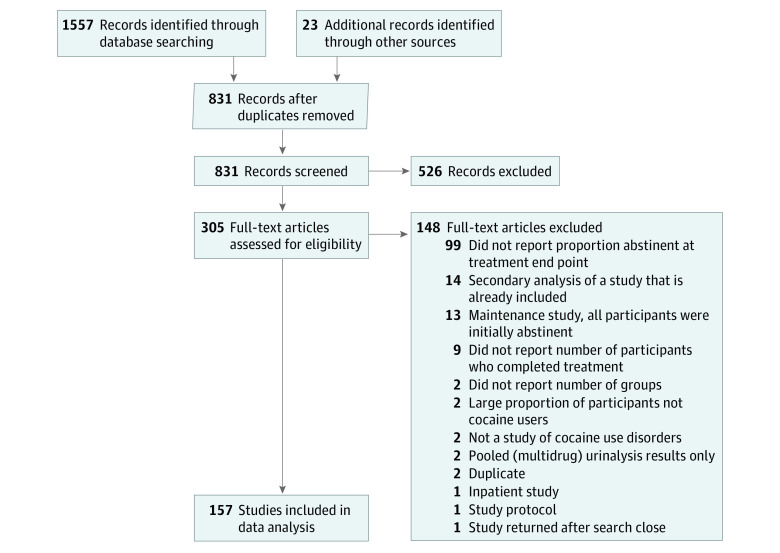
Importance: In the US and the United Kingdom, cocaine use is the second leading cause of illicit drug overdose death. Psychosocial treatments for cocaine use disorder are limited, and no pharmacotherapy is approved for use in the US or Europe. Objective: To compare treatments for active cocaine use among adults. Data Sources: PubMed and the Cochrane Database of Systematic Reviews were searched for clinical trials published between December 31, 1995, and December 31, 2017. Study Selection: This meta-analysis was registered on Covidence.org (study 8731) on December 31, 2015. Clinical trials were included if they (1) had the term cocaine in the article title; (2) were published between December 31, 1995, and December 31, 2017; (3) were written in English; (4) enrolled outpatients 18 years or older with active cocaine use at baseline; and (5) reported treatment group size, treatment duration, retention rates, and urinalysis results for the presence of cocaine metabolites. A study was excluded if (1) more than 25% of participants were not active cocaine users or more than 80% of participants had negative test results for the presence of cocaine metabolites at baseline and (2) it reported only pooled urinalysis results indicating the presence of multiple substances and did not report the specific proportion of positive test results for cocaine metabolites. Multiple reviewers reached criteria consensus. Of 831 records screened, 157 studies (18.9%) met selection criteria and were included in the analysis. Data Extraction and Synthesis: This study followed the Preferred Reporting Items for Systematic Reviews and Meta-analyses (PRISMA) guideline. Search results were imported from PubMed XML into Covidence.org then Microsoft Excel. Data extraction was completed in 2 iterations to ensure fidelity. Analyses included a multilevel random-effects model, a multilevel mixed-effects meta-regression model, and sensitivity analyses. Treatments were clustered into 11 categories (psychotherapy, contingency management programs, placebo, opioids, psychostimulants, anticonvulsants, dopamine agonists, antidepressants, antipsychotics, miscellaneous medications, and other therapies). Missing data were imputed using multiple imputation by chained equations. The significance threshold for all analyses was P = .05. Data were analyzed using the metafor and mice packages in R software, version 3.3.2 (R Foundation for Statistical Computing). Data were analyzed from January 1, 2018, to February 28, 2021. Main Outcomes and Measures: The primary outcome was the intention-to-treat logarithm of the odds ratio (OR) of having a negative urinalysis result for the presence of cocaine metabolites at the end of each treatment period compared with baseline. The hypothesis, which was formulated after data collection, was that no treatment category would have a significant association with objective reductions in cocaine use. Results: A total of 157 studies comprising 402 treatment groups and 15 842 participants were included. Excluding other therapies, the largest treatment groups across all studies were psychotherapy (mean [SD] number of participants, 40.04 [36.88]) and contingency management programs (mean [SD] number of participants, 37.51 [25.51]). Only contingency management programs were significantly associated with an increased likelihood of having a negative test result for the presence of cocaine (OR, 2.13; 95% CI, 1.62-2.80), and this association remained significant in all sensitivity analyses. Conclusions and Relevance: In this meta-analysis, contingency management programs were associated with reductions in cocaine use among adults. Research efforts and policies that align with this treatment modality may benefit those who actively use cocaine and attenuate societal burdens.
Overview
The claims and statistics of this paper haven’t been checked yet.
Run the check — free, no account needed. It reads the open-access text and checks the sources it cites.
Integrity signals
Registry
Cites
Statistics
Figures
Verification
Claims the paper makes
The claims and statistics of this paper haven’t been checked yet.
Run the check — free, no account needed. It reads the open-access text and checks the sources it cites.
Claims other papers make about this one
Each is checked against this paper’s own text: does it say what the citing paper says it does?
The source backs part of the claim, not all of it — or backs it for a different population, condition or comparison.
In the citing paper
“Contingency management (CM) has demonstrated the best effectiveness in the treatment of stimulant use disorders (StUDs) compared to any other intervention studied and represents the current standard of care.”
From The ASAM/AAAP Clinical Practice Guideline on the Management of Stimulant Use Disorder (2024) · cites this paper as [44]
Experimental — accuracy not yet measuredThe source backs part of the claim, not all of it — or backs it for a different population, condition or comparison.
In the citing paper
“Multiple systematic reviews have shown positive effects of CM on methamphetamine use, 44,45”
From The ASAM/AAAP Clinical Practice Guideline on the Management of Stimulant Use Disorder (2024) · cites this paper as [44]
Experimental — accuracy not yet measuredThe source backs part of the claim, not all of it — or backs it for a different population, condition or comparison.
In the citing paper
“There is strong evidence that CM is an effective intervention for increasing treatment engagement and reducing stimulant use.”
From The ASAM/AAAP Clinical Practice Guideline on the Management of Stimulant Use Disorder (2024) · cites this paper as [44]
Experimental — accuracy not yet measured
Self-check
Percentages, sums and reported differences re-computed from the paper’s own numbers.
The self-check needs the paper’s full text.
Citations
Cites
2 retracted
Psychosocial interventions for cocaine and psychostimulant amphetamines related disorders
Knapp, W. P., Soares, B. G., Farrell, M., & de Lima, M. S. (2007) · Cochrane Database of Systematic Reviews · doi:10.1002/14651858.cd003023.pub2 · Cited by 178
RetractedAnticonvulsants for cocaine dependence
Minozzi, S., Amato, L., Davoli, M., Farrell, M., Reisser, A. A. L., Pani, P. P., de Lima, M. S., Soares, B. G., & Vecchi, S. (2015) · Cochrane Database of Systematic Reviews · doi:10.1002/14651858.cd006754.pub3 · Cited by 26
RetractedPreferred Reporting Items for Systematic Reviews and Meta-Analyses: the PRISMA statement
Moher, D., Liberati, A., Tetzlaff, J., Altman, D. G., & for the PRISMA Group (2009) · BMJ · doi:10.1136/bmj.b2535 · Cited by 83,823
Preferred Reporting Items for Systematic Reviews and Meta-Analyses: The PRISMA Statement
Moher, D., Liberati, A., Tetzlaff, J., Altman, D. G., & The PRISMA Group (2009) · PLoS Medicine · doi:10.1371/journal.pmed.1000097 · Cited by 64,042
Bias in meta-analysis detected by a simple, graphical test
Egger, M., Smith, G. D., Schneider, M., & Minder, C. (1997) · BMJ · doi:10.1136/bmj.315.7109.629 · Cited by 56,722
Preferred reporting items for systematic reviews and meta-analyses: the PRISMA Statement.
(2009) · PubMed Central · Cited by 44,859
Conducting Meta-Analyses in R with the metafor Package
Viechtbauer, W. (2010) · Journal of Statistical Software · doi:10.18637/jss.v036.i03 · Cited by 20,464
Wang, G., Ma, R., Qiao, G., Wada, K., Aizawa, Y., & Satoh, T. (2015) · Integrative Medicine International · doi:10.1159/000368408 · Cited by 18,762
mice: Multivariate Imputation by Chained Equations in R
Buuren, S. V., & Groothuis-Oudshoorn, K. (2011) · Journal of Statistical Software · doi:10.18637/jss.v045.i03 · Cited by 13,870
(2010) · University of Twente Research Information · Cited by 6,037
Cited by
Sorted by citations
Bravo, R. R., Faria, A. C., Brito-da-Costa, A. M., Carmo, H., Mladěnka, P., da Silva, D. D., Remião, F., & Researchers, O. B. O. T. O. (2022) · Toxins · doi:10.3390/toxins14040278 · Cited by 163
The ASAM/AAAP Clinical Practice Guideline on the Management of Stimulant Use Disorder
(2024) · Journal of Addiction Medicine · doi:10.1097/adm.0000000000001299 · Cited by 78
Cocaine Use Disorder (CUD): Current Clinical Perspectives
Schwartz, E. K. C., Wolkowicz, N. R., Aquino, J. P. D., MacLean, R. R., & Sofuoglu, M. (2022) · Substance Abuse and Rehabilitation · doi:10.2147/sar.s337338 · Cited by 92
“There have been several studies examining these neurostimulation techniques as potential treatments for CUD (recently reviewed by Bolloni et al, 2018, Rachid, 2018, and Lupi et al, 2017).221–223 In summary, several studies found that TMS and tDCS have efficacy in reducing cravings224–228 or reducing risky behaviors229…”
BackgroundResultInfluentialMeta-review on the efficacy of psychological therapies for the treatment of substance use disorders
Dellazizzo, L., Potvin, S., Giguère, S., Landry, C., Léveillé, N., & Dumais, A. (2023) · Psychiatry Research · doi:10.1016/j.psychres.2023.115318 · Cited by 55
Rawson, R. A., Erath, T. G., & Clark, H. W. (2023) · Preventive Medicine · doi:10.1016/j.ypmed.2023.107625 · Cited by 48
Metadata
- Authors
- Bentzley, B. S., Han, S. S., Neuner, S., Humphreys, K., Kampman, K. M., & Halpern, C. H.
- Affiliations
- Stanford Medicine (US)
- VA Palo Alto Health Care System (US)
- University of Pennsylvania (US)
- Corresponding author
- Bentzley, Brandon S.
- ORCID
- Venue
- JAMA Network Open
- Publisher
- American Medical Association (AMA)
- Published
- 2021-05-07
- Volume
- 4
- Issue
- 5
- Pages
- e218049
- ISSN
- 2574-3805 (ISSN-L)
- PMC
- PMC8105751
- OpenAlex
- W3157239742
- Cited by
- 161
- References
- 222
- Citations by year
- 2026: 32 · 2025: 39 · 2024: 41 · 2023: 29 · 2022: 15 · 2021: 5
- FWCI
- 16.21
- Type
- journal article
- Language
- en
- Open access
- gold
- doi.org
- Licence
- cc-by
- Locations
- JAMA Network Open (publishedVersion, cc-by)
- PubMed Central (publishedVersion, cc-by)
- PubMed (publishedVersion)
- Topics
- Health Sciences › Medicine › Epidemiology › Substance Abuse Treatment and Outcomes
- Health Sciences › Medicine › Public Health, Environmental and Occupational Health › Opioid Use Disorder Treatment
- Health Sciences › Medicine › Public Health, Environmental and Occupational Health › Youth, Drugs, and Violence
- Keywords
- cocaine dependence, cocaine treatment, psychosocial interventions, pharmacotherapy, contingency management, psychostimulants, dopamine agonists, antidepressants, antipsychotic drugs, antiepileptic drugs, treatment retention, treatment effectiveness comparison, outpatients
- MeSH terms
- Clinical Trials as Topic, Humans, Psychotherapy, Cocaine-Related Disorders
About these checks
Registry, retraction, Cites and statistics results are computed, not judged, with one exception: a printed reference that no index lists is read once by a model before it counts as a citation error. Claims are extracted by a model and kept only when their quote appears verbatim in the text; each cited source is then checked, with a model’s help, for whether it says what the claim relies on. Those verdicts can be wrong — read the claim’s quote and the cited source before relying on one.
Statistics and arithmetic are recomputed, not judged.
Confidence bands are shown only for fields calibrated on our annotated test set. None is calibrated yet, so no band is shown.
What counts as a claim ›How we measure confidence ›How we check this ›
Are you an author, or do you see a problem with this page? Request a review
