

The DOI matches its Crossref record; 39 of the 40 references it cites were found in a registry or an index.
Prevalence and Variation of Developmental Screening and Surveillance in Early Childhood
Open accessAbstract
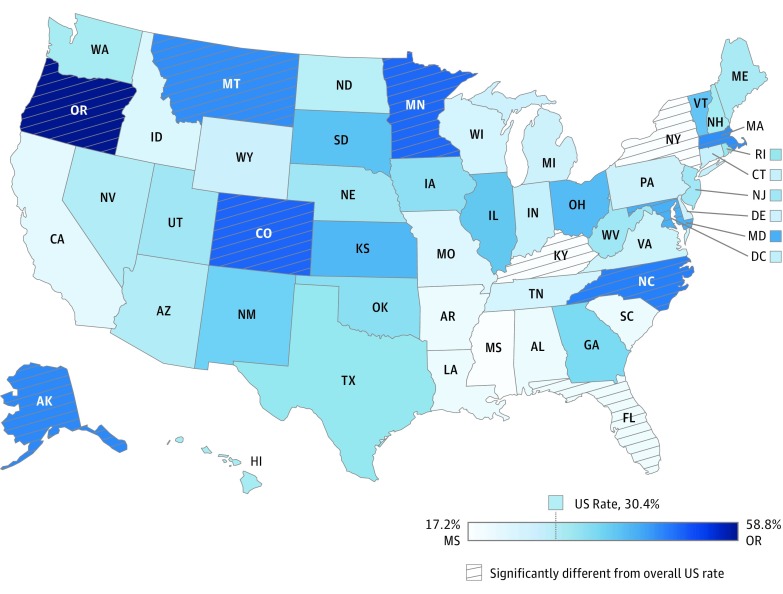
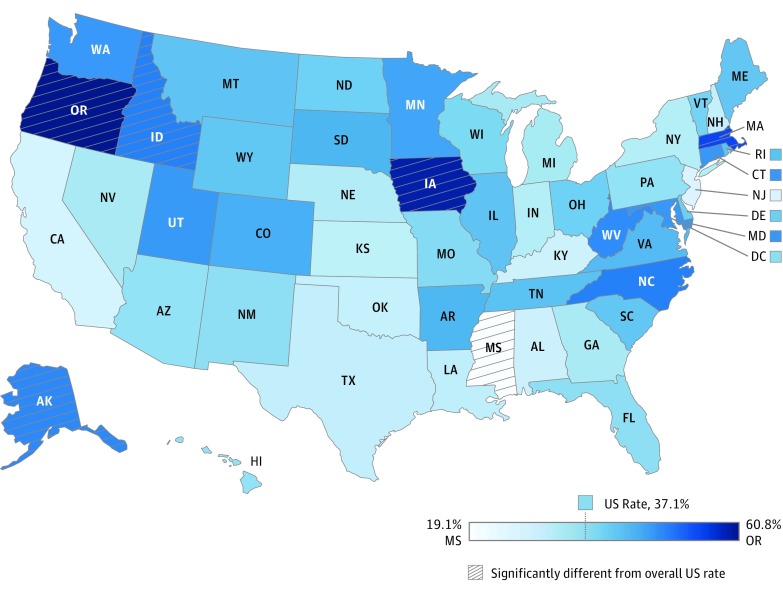
Importance: Since 2001, the American Academy of Pediatrics has recommended universal developmental screening and surveillance to promote early diagnosis and intervention and to improve the outcomes of children with developmental delays and disabilities. Objective: To examine the current prevalence and variation of developmental screening and surveillance of children by various sociodemographic, enabling, and health characteristics. Design, Setting, and Participants: This cross-sectional analysis of the Health Resources and Services Administration's 2016 National Survey of Children's Health-a nationally representative survey of US children completed between June 2016 and February 2017-examined 5668 randomly selected children 9 through 35 months of age whose parent or caregiver responded to the address-based survey by mail or via a website. All analyses were weighted to account for the probability of selection and nonresponse and to reflect population counts of all noninstitutionalized US children residing in housing units. Main Outcomes and Measures: Developmental screening was measured through a validated set of 3 items indicating receipt in the past year of parent-completed screening from a health care professional with age-appropriate content regarding language development and social behavior. Surveillance was determined by an item capturing verbal elicitation of developmental concerns by a health care professional. Results: Of the estimated 9.0 million children aged 9 through 35 months, an estimated 30.4% (95% CI, 28.0%-33.0%) were reported by their parent or guardian to have received a parent-completed developmental screening and 37.1% (95% CI, 34.4%-39.8%) were reported to have received developmental surveillance from a health care professional in the past year. Characteristics associated with screening and/or surveillance that remained significant after adjustment included primary household language, family structure, household education, income, medical home, past-year preventive visit, child health status, and special health care needs. Having health care that meets medical home criteria was significantly associated with both developmental screening (adjusted rate ratio, 1.34; 95% CI, 1.13-1.57) and surveillance (adjusted rate ratio, 1.24; 95% CI, 1.08-1.42), representing an 8 to 9 absolute percentage point increase. State-level differences spanned 40 percentage points for screening (17.2% in Mississippi and 58.8% in Oregon) and surveillance (19.1% in Mississippi and 60.8% in Oregon), with approximately 90% of variation not explained by child and family characteristics. Conclusions and Relevance: Despite more than a decade of initiatives, rates of developmental screening and surveillance remain low. However, state-level variation indicates continued potential for improvement. Systems-level quality improvement efforts, building on the medical home, will be necessary to achieve recommended screening and surveillance goals.
Overview
The claims and statistics of this paper haven’t been checked yet.
Run the check — free, no account needed. It reads the open-access text and checks the sources it cites.
Integrity signals
Registry
Cites
Statistics
Figures
Verification
Claims the paper makes
The claims and statistics of this paper haven’t been checked yet.
Run the check — free, no account needed. It reads the open-access text and checks the sources it cites.
Self-check
Percentages, sums and reported differences re-computed from the paper’s own numbers.
The self-check needs the paper’s full text.
Citations
Cites
Revisiting the Behavioral Model and Access to Medical Care: Does it Matter?
Andersen, R. M. (1995) · Journal of Health and Social Behavior · doi:10.2307/2137284 · Cited by 9,831
From Neurons to Neighborhoods: The Science of Early Childhood Development
(2000) · doi:10.17226/9824 · Cited by 4,484
From Neurons to Neighborhoods: The Science of Early Childhood Development
Carey, W. B. (2001) · Journal of Developmental & Behavioral Pediatrics · doi:10.1097/00004703-200104000-00011 · Cited by 2,678
A framework for the study of access to medical care.
(1974) · PubMed Central · Cited by 2,419
Trends in the prevalence of developmental disabilities in US children, 1997-2008
Boyle, C. A., Boulet, S., Schieve, L. A., Cohen, R. A., Blumberg, S. J., Yeargin-Allsopp, M., Visser, S., & Kogan, M. D. (2011) · Pediatrics · doi:10.1542/peds.2010-2989 · Cited by 1,732
Self-citationPediatrics, S. O. D. B. (2006) · PEDIATRICS · doi:10.1542/peds.2006-1231 · Cited by 1,472
National health surveys and the behavioral model of health services use
Andersen, R. M. (2008) · Medical Care · doi:10.1097/mlr.0b013e31817a835d · Cited by 1,100
(2002) · PEDIATRICS · doi:10.1542/peds.110.1.184 · Cited by 799
Reichow, B., Barton, E. E., Boyd, B. A., & Hume, K. (2012) · Cochrane Database of Systematic Reviews · doi:10.1002/14651858.cd009260.pub2 · Cited by 577
Developmental Surveillance and Screening of Infants and Young Children
(2001) · PEDIATRICS · doi:10.1542/peds.108.1.192 · Cited by 548
This Issue: The Family-centered Medical Home in Pediatrics
Antonelli, R. C., & Turchi, R. M. (2009) · Pediatric Annals · doi:10.3928/00904481-20090820-02 · Cited by 524
Estimating Model-Adjusted Risks, Risk Differences, and Risk Ratios From Complex Survey Data
Bieler, G. S., Brown, G. G., Williams, R. L., & Brogan, D. J. (2010) · American Journal of Epidemiology · doi:10.1093/aje/kwp440 · Cited by 461
Law, J., Garrett, Z., & Nye, C. (2003) · Cochrane Database of Systematic Reviews · doi:10.1002/14651858.cd004110 · Cited by 447
Rosenberg, S. A., Zhang, D., & Robinson, C. C. (2008) · Pediatrics · doi:10.1542/peds.2007-1680 · Cited by 429
Sand, N., Silverstein, M., Glascoe, F. P., Gupta, V. B., Tonniges, T. P., & O'Connor, K. G. (2005) · Pediatrics · doi:10.1542/peds.2004-1809 · Cited by 344 · cited 1×
“That fewer factorswere significantly associatedwith surveillance in general may reflect the greater ease with which simple monitoring can occur owing to frequently cited clinician screening barriers of time and staffing limitations and inadequate reimbursement.(36,37) Early identification of developmental disorders is…”
BackgroundThe Design and Implementation of the 2016 National Survey of Children’s Health
Ghandour, R. M., Jones, J. R., Lebrun-Harris, L. A., Minnaert, J., Blumberg, S. J., Fields, J., Bethell, C., & Kogan, M. D. (2018) · Maternal and Child Health Journal · doi:10.1007/s10995-018-2526-x · Cited by 253
Self-citationImplementing developmental screening and referrals: lessons learned from a national project
King, T. M., Tandon, S. D., Macias, M. M., Healy, J. A., Duncan, P. M., Swigonski, N. L., Skipper, S. M., & Lipkin, P. H. (2010) · Pediatrics · doi:10.1542/peds.2009-0388 · Cited by 251 · cited 2×
“However, physicians favor parent-completed screening tools for their efficiency and ability to engage parents in the process of developmental promotion.(11,25) Our estimate of developmental screening is roughly comparable to the median of the 2016 Medicaid claims-based reporting from 26 states (36%) that includes tool…”
BackgroundMethodTrends in the Use of Standardized Tools for Developmental Screening in Early Childhood: 2002–2009
Radecki, L., Sand-Loud, N., O'Connor, K. G., Sharp, S., & Olson, L. M. (2011) · PEDIATRICS · doi:10.1542/peds.2010-2180 · Cited by 235
Effectiveness of Developmental Screening in an Urban Setting
Guevara, J. P., Gerdes, M., Localio, R. A., Huang, Y.-S. V., Pinto‐Martin, J. A., Minkovitz, C. S., Hsu, D., Kyriakou, L., Baglivo, S. J., Kavanagh, J. E., et al. (2012) · PEDIATRICS · doi:10.1542/peds.2012-0765 · Cited by 231
Bethell, C. D., Kogan, M. D., Strickland, B. B., Schor, E. L., Robertson, J., & Newacheck, P. W. (2011) · Academic Pediatrics · doi:10.1016/j.acap.2010.08.011 · Cited by 191
Self-citationHow Do Primary Care Physicians Identify Young Children with Developmental Delays? A National Survey
SICES, L., FEUDTNER, C., MCLAUGHLIN, J., DROTAR, D., & WILLIAMS, M. (2003) · Journal of Developmental & Behavioral Pediatrics · doi:10.1097/00004703-200312000-00002 · Cited by 176
Trends in the Use of Standardized Tools for Developmental Screening in Early Childhood: 2002-2009
(2011) · PEDIATRICS · doi:10.1542/peds.2010-2180d · Cited by 164
Selden, T. M. (2006) · PEDIATRICS · doi:10.1542/peds.2006-0286 · Cited by 141
(2002) · PubMed · Cited by 119
Taking Stock of the CSHCN Screener: A Review of Common Questions and Current Reflections
Bethell, C. D., Blumberg, S. J., Stein, R. E. K., Strickland, B. B., Robertson, J., & Newacheck, P. W. (2014) · Academic Pediatrics · doi:10.1016/j.acap.2014.10.003 · Cited by 112
Self-citationRates of Parent-Centered Developmental Screening: Disparities and Links to Services Access
Bethell, C. D., Reuland, C. H. P., Schor, E. L., Abrahms, M., & Halfon, N. (2011) · PEDIATRICS · doi:10.1542/peds.2010-0424 · Cited by 108
Self-citationDisparities in Provider Elicitation of Parents' Developmental Concerns for US Children
Guerrero, A. D., Rodríguez, M., & Flores, G. (2011) · PEDIATRICS · doi:10.1542/peds.2011-0030 · Cited by 88
Mangione-Smith, R. M., Schiff, J. S., & Dougherty, D. M. (2011) · Academic Pediatrics · doi:10.1016/j.acap.2010.11.003 · Cited by 70
Cleave, J. M. V., Kuhlthau, K. A., Bloom, S. R., Newacheck, P. W., Nozzolillo, A. A., Homer, C. J., & Perrin, J. M. (2012) · Academic Pediatrics · doi:10.1016/j.acap.2012.02.004 · Cited by 63
Hambidge, S. J., Phibbs, S. L., Chandramouli, V., Fairclough, D. L., & Steiner, J. F. (2009) · PEDIATRICS · doi:10.1542/peds.2008-0446 · Cited by 59
Use of a Computerized Decision Aid for Developmental Surveillance and Screening
Carroll, A. E., Bauer, N. S., Dugan, T. M., Anand, V., Saha, C., & Downs, S. M. (2014) · Archives of Pediatrics and Adolescent Medicine · doi:10.1001/jamapediatrics.2014.464 · Cited by 58
Medicaid Home Visitation and Maternal and Infant Healthcare Utilization
Meghea, C. I., Raffo, J. E., Zhu, Q., & Roman, L. (2013) · American Journal of Preventive Medicine · doi:10.1016/j.amepre.2013.05.005 · Cited by 55
Rice, C. E., Braun, K. V. N., Kogan, Smith, C., Kavanagh, L. D., Strickland, B. B., & Blumberg, S. J. (2014) · PubMed · Cited by 38
A Systematic Review of the Medical Home for Children Without Special Health Care Needs
Hadland, S. E., & Long, W. E. (2013) · Maternal and Child Health Journal · doi:10.1007/s10995-013-1315-9 · Cited by 34
Shaw, J. S., Norlin, C., Gillespie, R. J., Weissman, M., & McGrath, J. (2013) · Academic Pediatrics · doi:10.1016/j.acap.2013.04.001 · Cited by 34
Caretaker Awareness of Health Care Provided Developmental Screening: Increases from 2007 to 2012
Barger, B. D., Roach, A. T., & Moreno, G. (2017) · Maternal and Child Health Journal · doi:10.1007/s10995-017-2333-9 · Cited by 7
A History of The Commonwealth Fund's Child Development and Preventive Care Program
Connolly, C. (2013) · Cited by 5
Weiss, K. B. (2002) · Ambulatory Pediatrics · doi:10.1367/1539-4409(2002)002 · Cited by 4
Research works printed but not linked: 1
- Kaye, 2009, Findings From the ABCD Screening Academy: State Policy Improvements That Support Effective Identification of Children At-Risk for Developmental Delay
Cited by
Sorted by citations
Trends in pediatricians’ developmental screening: 2002-2016
Lipkin, P. H., Macias, M. M., Baer Chen, B., Coury, D., Gottschlich, E. A., Hyman, S. L., Sisk, B., Wolfe, A., & Levy, S. E. (2020) · Pediatrics · doi:10.1542/peds.2019-0851 · Cited by 137
Screening and referral practices for autism spectrum disorder in primary pediatric care
Monteiro, S. A., Dempsey, J., Berry, L. N., Voigt, R. G., & Goin-Kochel, R. P. (2019) · Pediatrics · doi:10.1542/peds.2018-3326 · Cited by 97
Leveraging the biology of adversity and resilience to transform pediatric practice
Shonkoff, J. P., Boyce, W. T., Levitt, P., Martinez, F. D., & McEwen, B. (2021) · Pediatrics · doi:10.1542/peds.2019-3845 · Cited by 91
Li, Q., Li, Y., Zheng, J., Yan, X., Huang, J., Xu, Y., Zeng, X., Shen, T., Xing, X., Chen, Q., et al. (2023) · Scientific Reports · doi:10.1038/s41598-023-44472-1 · Cited by 67
Mozolic‐Staunton, B., Donelly, M., Yoxall, J., & Barbaro, J. (2019) · Research in Autism · doi:10.1016/j.rasd.2019.101496 · Cited by 63
Metadata
- Authors
- Hirai, A. H., Kogan, M. D., Kandasamy, V., Reuland, C., & Bethell, C.
- Affiliations
- Health Resources and Services Administration (US)
- Oak Ridge Institute for Science and Education (US)
- Oregon Health & Science University (US)
- Johns Hopkins University (US)
- Corresponding author
- Hirai, Ashley H.
- Venue
- JAMA Pediatrics
- Publisher
- American Medical Association (AMA)
- Published
- 2018-09-01
- Volume
- 172
- Issue
- 9
- Pages
- 857
- ISSN
- 1072-4710 (ISSN-L)
- 2168-6203
- PMC
- PMC6143066
- OpenAlex
- W2860098830
- Cited by
- 195
- References
- 40
- Citations by year
- 2026: 20 · 2025: 20 · 2024: 31 · 2023: 27 · 2022: 31 · 2021: 20 · 2020: 26 · 2019: 16 · 2018: 4
- FWCI
- 25.20
- Type
- journal article
- Language
- en
- Open access
- hybrid
- doi.org
- Licence
- cc-by
- Locations
- Archives of Pediatrics and Adolescent Medicine (publishedVersion, cc-by)
- Europe PMC (PubMed Central) (publishedVersion, cc-by)
- PubMed Central (publishedVersion, cc-by)
- PubMed (publishedVersion)
- Topics
- Health Sciences › Medicine › Pediatrics, Perinatology and Child Health › Child and Adolescent Health
- Health Sciences › Medicine › Pediatrics, Perinatology and Child Health › Infant Development and Preterm Care
- Health Sciences › Medicine › Pediatrics, Perinatology and Child Health › Adolescent and Pediatric Healthcare
- Keywords
- developmental screening, child development monitoring, early childhood, developmental delay, developmental disabilities, patient-centered medical home, preventive care visits, special health care needs, state-level variation, sociodemographic disparities, language barriers, family structure, household income, National Survey of Children's Health, early detection and intervention, language development, social behavior, health care access, child health status
- MeSH terms
- Child Development, Developmental Disabilities, Child Health Services, Child Welfare, Child, Preschool, Cross-Sectional Studies, Female, Humans, Infant, Male, Mass Screening, Pediatrics, Population Surveillance, United States, Early Diagnosis
About these checks
Registry, retraction, Cites and statistics results are computed, not judged, with one exception: a printed reference that no index lists is read once by a model before it counts as a citation error. Claims are extracted by a model and kept only when their quote appears verbatim in the text; each cited source is then checked, with a model’s help, for whether it says what the claim relies on. Those verdicts can be wrong — read the claim’s quote and the cited source before relying on one.
Statistics and arithmetic are recomputed, not judged.
Confidence bands are shown only for fields calibrated on our annotated test set. None is calibrated yet, so no band is shown.
What counts as a claim ›How we measure confidence ›How we check this ›
Are you an author, or do you see a problem with this page? Request a review
