

Water quality and ecosystem management: Data‐driven reality check of effects in streams and lakes
Open accessThe DOI matches its Crossref record; 20 of the 20 references it cites were found in a registry or an index.
Abstract
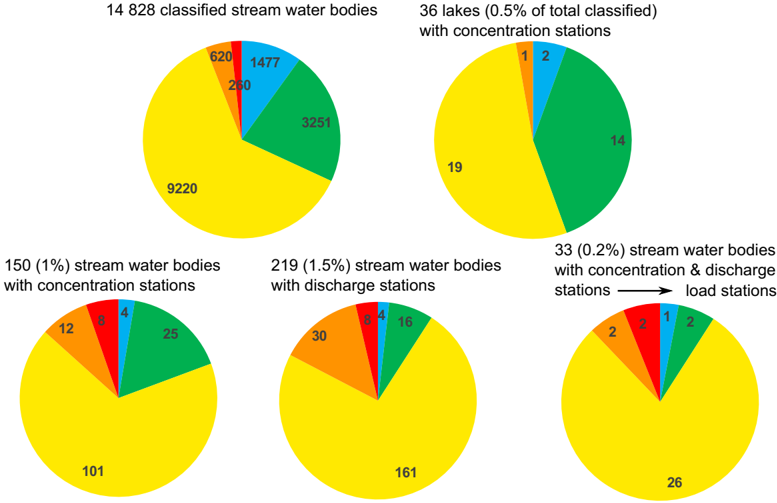
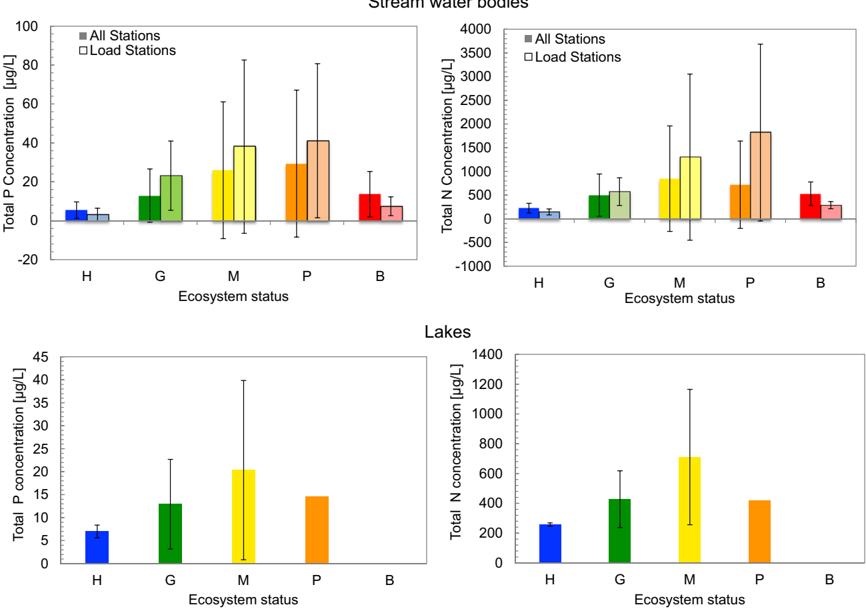
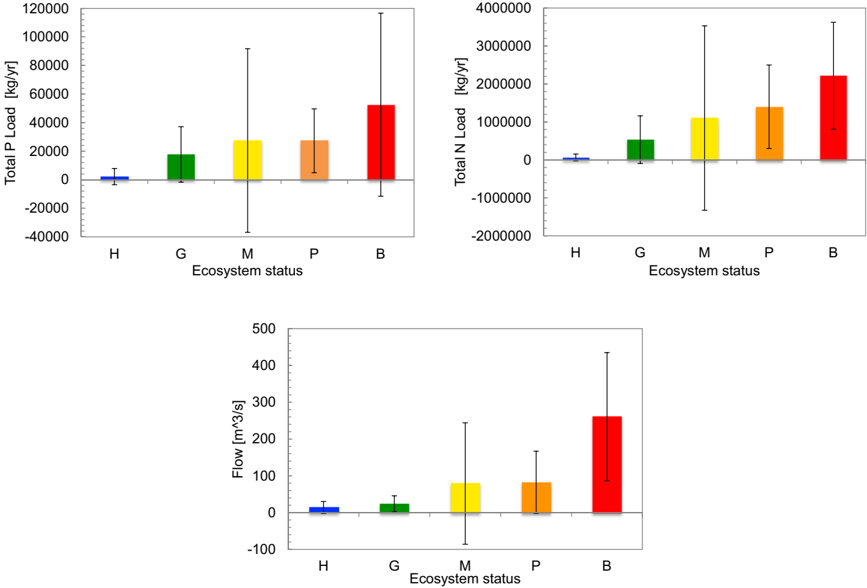
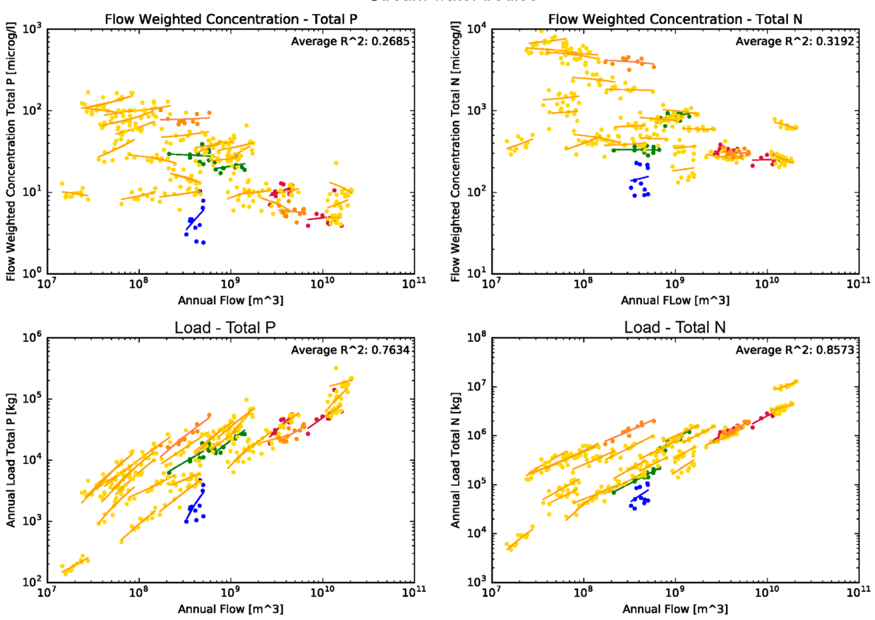
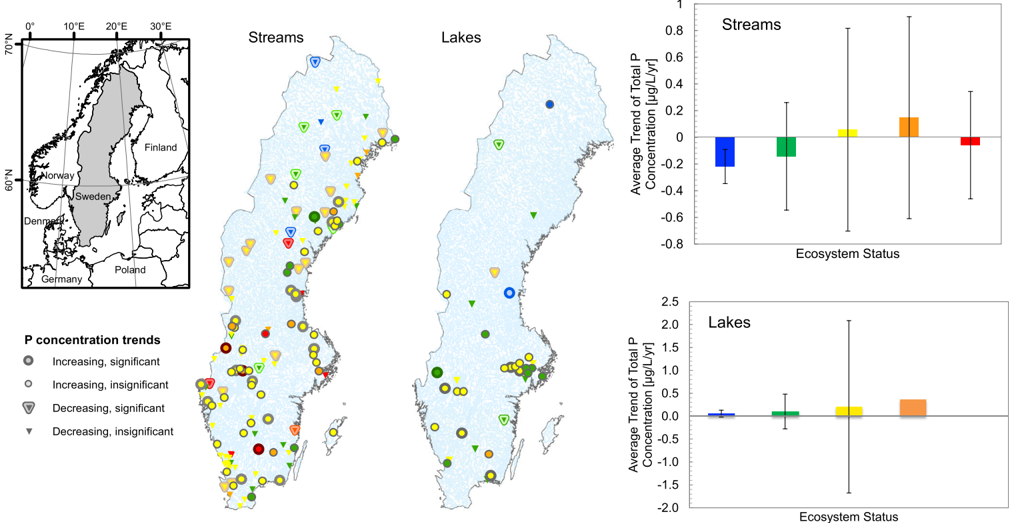
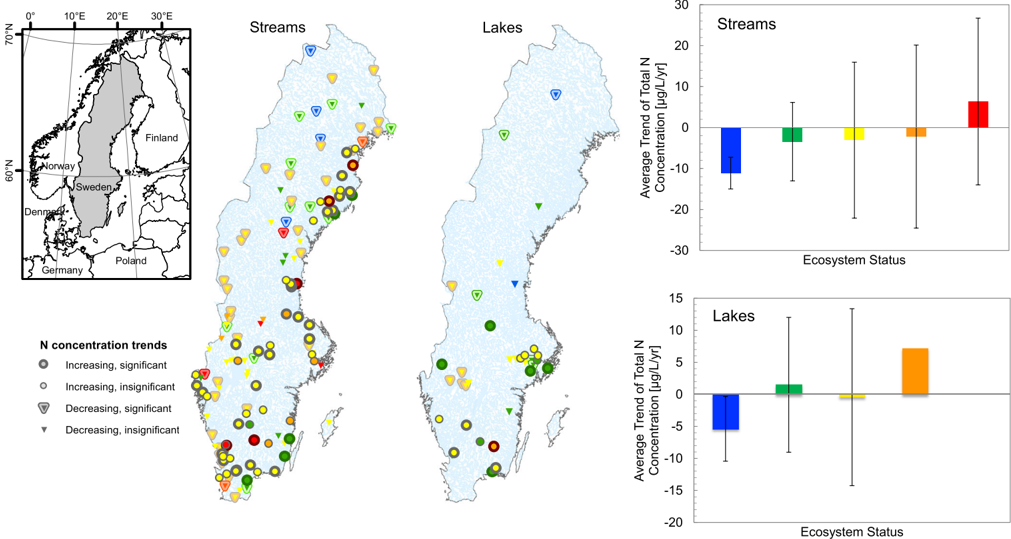
This study investigates nutrient‐related water quality conditions and change trends in the first management periods of the EU Water Framework Directive (WFD; since 2009) and Baltic Sea Action Plan (BASP; since 2007). With mitigation of nutrients in inland waters and their discharges to the Baltic Sea being a common WFD and BSAP target, we use Sweden as a case study of observable effects, by compiling and analyzing all openly available water and nutrient monitoring data across Sweden since 2003. The data compilation reveals that nutrient monitoring covers only around 1% (down to 0.2% for nutrient loads) of the total number of WFD‐classified stream and lake water bodies in Sweden. The data analysis further shows that the hydro‐climatically driven water discharge dominates the determination of waterborne loads of both total phosphorus and total nitrogen across Sweden. Both water discharge and the related nutrient loads are in turn well correlated with the ecosystem status classification of Swedish water bodies. Nutrient concentrations do not exhibit such correlation and their changes over the study period are on average small, but concentration increases are found for moderate‐to‐bad status waters, for which both the WFD and the BSAP have instead targeted concentration decreases. In general, these results indicate insufficient distinction and mitigation of human‐driven nutrient components in inland waters and their discharges to the sea by the internationally harmonized applications of the WFD and the BSAP. The results call for further comparative investigations of observable large‐scale effects of such regulatory/management frameworks in different parts of the world.
Overview
The claims and statistics of this paper haven’t been checked yet.
Free: it reads the open-access text and checks the first 5 claims that cite a source we can check. Create a free account to check every claim.
Integrity signals
Registry
Cites
Statistics
Figures
Verification
Claims the paper makes
The claims and statistics of this paper haven’t been checked yet.
Free: it reads the open-access text and checks the first 5 claims that cite a source we can check. Create a free account to check every claim.
Claims other papers make about this one
Each is checked against this paper’s own text: does it say what the citing paper says it does?
The source backs part of the claim, not all of it — or backs it for a different population, condition or comparison.
In the citing paper
“The levels of freshwater withdrawal and quality deterioration are well beyond levels that can support existing biodiversity, requisite ecological processes or good ecological status, e.g., as required by the EU Water Framework Directive (Destouni et al. 2017).”
From Scientists’ warning to humanity on the freshwater biodiversity crisis (2021) · cites this paper as Destouni et al. 2017
Experimental — accuracy not yet measuredIn the citing paper
“Agricultural practices also degrade the quality and ecological status of the freshwater ecosystems, with status improvements remaining slow and difficult long after environmental regulations have been put in place requiring such improvements (Destouni et al. 2017).”
From Scientists’ warning to humanity on the freshwater biodiversity crisis (2021) · cites this paper as Destouni et al. 2017
Self-check
Percentages, sums and reported differences re-computed from the paper’s own numbers.
The self-check needs the paper’s full text.
Citations
Cites
Transformation of the Nitrogen Cycle: Recent Trends, Questions, and Potential Solutions
Galloway, J. N., Townsend, A. R., Erisman, J. W., Bekunda, M., Cai, Z., Freney, J. R., Martinelli, L. A., Seitzinger, S. P., & Sutton, M. A. (2008) · Science · doi:10.1126/science.1136674 · Cited by 6,995 · cited 2×
“Human-driven loads of waterborne nutrients to aquatic ecosystems have led to worldwide eutrophication [Galloway, 2008; Conley et al., 2009a], and associated proliferation of harmful algal blooms [Huisman et al., 2005] and ‘‘dead zones’’ [D ıaz and Rosenberg, 2008].”
BackgroundSpreading dead zones and consequences for marine ecosystems
Diaz, R. J., & Rosenberg, R. (2008) · Science · doi:10.1126/science.1156401 · Cited by 6,626 · cited 2×
“Human-driven loads of waterborne nutrients to aquatic ecosystems have led to worldwide eutrophication [Galloway, 2008; Conley et al., 2009a], and associated proliferation of harmful algal blooms [Huisman et al., 2005] and ‘‘dead zones’’ [D ıaz and Rosenberg, 2008].”
BackgroundControlling Eutrophication: Nitrogen and Phosphorus
Conley, D. J., Paerl, H. W., Howarth, R. W., Boesch, D. F., Seitzinger, S. P., Havens, K. E., Lancelot, C., & Likens, G. E. (2009) · Science · doi:10.1126/science.1167755 · Cited by 3,905
Techniques of trend analysis for monthly water quality data
Hirsch, R. M., Slack, J. R., & Smith, R. A. (1982) · Water Resources Research · doi:10.1029/wr018i001p00107 · Cited by 2,934
Hypoxia-Related Processes in the Baltic Sea
Conley, D. J., Björck, S., Bonsdorff, E., Carstensen, J., Destouni, G., Gustafsson, B. G., Hietanen, S., Kortekaas, M., Kuosa, H., Markus Meier, H. E., et al. (2009) · Environmental Science & Technology · doi:10.1021/es802762a · Cited by 577
Self-citationNutrient loads exported from managed catchments reveal emergent biogeochemical stationarity
Basu, N. B., Destouni, G., Jawitz, J. W., Thompson, S. E., Loukinova, N. V., Darracq, A., Zanardo, S., Yaeger, M., Sivapalan, M., Rinaldo, A., et al. (2010) · Geophysical Research Letters · doi:10.1029/2010gl045168 · Cited by 544
Self-citation(2005) · Aquatic Ecology Series · doi:10.1007/1-4020-3022-3 · Cited by 247
Cherry, K. A., Shepherd, M., Withers, P. J. A., & Mooney, S. J. (2008) · Science of The Total Environment · doi:10.1016/j.scitotenv.2008.07.015 · Cited by 240
Science and Integrated Coastal Management
von Bodungen, B., & Turner, R. K. (2001) · UEA Digital Repository (University of East Anglia) · Cited by 161
Linking catchment characteristics and water chemistry with the ecological status of Irish rivers
Donohue, I., McGarrigle, M. L., & Mills, P. (2006) · Water Research · doi:10.1016/j.watres.2005.10.027 · Cited by 159 · cited 2×
“Another national assessment study, for rivers in Ireland, looked at spatial correlations instead of temporal changes, finding significant correlation between lotic ecological status (in terms of benthic macroinvertebrate community structure) and land use (urban, farming, pasture) or chemical monitoring data (including…”
Background
Research works printed but not linked: 2
- European Commission (2000), Directive 2000/60/EC of the European Parliament and of the Council of 23 October 2000 establishing a framework for community action in the field of water policy, Off. J. Eur. Commun., L327, 1-72.
- Griffith, M. (2002), The European Water Framework Directive: An approach to Integrated River Basin Management, Eur. Water Manage., 2002/05, 1-15. [Available at http://www.ewa-online.eu/tl_files/_media/content/documents_pdf/Publications/E-WAter/documents/85_ 2002_05.pdf.]
Cited by
Scientists’ warning to humanity on the freshwater biodiversity crisis
Albert, J. S., Destouni, G., Duke-Sylvester, S. M., Magurran, A. E., Oberdorff, T., Reis, R. E., Winemiller, K. O., & Ripple, W. J. (2021) · Ambio · doi:10.1007/s13280-020-01318-8 · Cited by 943
Self-citationManaging nitrogen legacies to accelerate water quality improvement
Basu, N. B., Van Meter, K. J., Byrnes, D. K., Van Cappellen, P., Brouwer, R., Jacobsen, B. H., Jarsjö, J., Rudolph, D. L., Cunha, M. C., Nelson, N., et al. (2022) · Nature Geoscience · doi:10.1038/s41561-021-00889-9 · Cited by 393
Self-citationDong, F., Liu, Y., Wu, Z., Chen, Y., & Guo, H. (2018) · Journal of Hydrology · doi:10.1016/j.jhydrol.2018.05.033 · Cited by 59
Åhlén, I., Hambäck, P. A., Thorslund, J., Frampton, A., Destouni, G., & Jarsjö, J. (2019) · The Science of The Total Environment · doi:10.1016/j.scitotenv.2019.135452 · Cited by 53
Self-citationLi, J., Tian, L., Wang, Y., Jin, S., Li, T., & Hou, X. (2021) · The Science of The Total Environment · doi:10.1016/j.scitotenv.2021.146113 · Cited by 46
“For instance, a Water Framework Directive (WFD) was introduced for all European Union (EU) member states countries since 2000, aiming to protect thewater quality and ecosystem status in the inland and coastal waters (Destouni et al., 2017).”
Background
Metadata
- Authors
- Destouni, G., Fischer, I., & Prieto, C.
- Affiliations
- Stockholm University (SE)
- Corresponding author
- Destouni, Georgia
- Venue
- Water Resources Research
- Publisher
- American Geophysical Union (AGU)
- Published
- 2017-08
- Volume
- 53
- Issue
- 8
- Pages
- 6395-6406
- ISSN
- 0043-1397 (ISSN-L)
- 1944-7973
- OpenAlex
- W2734884183
- Cited by
- 36
- References
- 20
- Citations by year
- 2026: 3 · 2025: 6 · 2024: 3 · 2023: 3 · 2022: 3 · 2021: 4 · 2020: 4 · 2019: 4 · 2018: 5 · 2017: 1
- FWCI
- 8.00
- Type
- journal article
- Language
- en
- Open access
- hybrid
- doi.org
- Licence
- Locations
- Water Resources Research (publishedVersion, cc-by-nc-nd)
- Funders
- Swedish Research Council Formas
- Topics
- Physical Sciences › Environmental Science › Management, Monitoring, Policy and Law › Environmental and Sediment Control
- Physical Sciences › Environmental Science › Environmental Chemistry › Soil and Water Nutrient Dynamics
- Physical Sciences › Environmental Science › Environmental Chemistry › Aquatic Ecosystems and Phytoplankton Dynamics
- Keywords
- nutrient pollution, water quality, Water Framework Directive, Baltic Sea Action Plan, nutrient loading, total phosphorus, total nitrogen, water discharge, water policy, Sweden
About these checks
Registry, retraction, Cites and statistics results are computed, not judged, with one exception: a printed reference that no index lists is read once by a model before it counts as a citation error. Claims are extracted by a model and kept only when their quote appears verbatim in the text; each cited source is then checked, with a model’s help, for whether it says what the claim relies on. Those verdicts can be wrong — read the claim’s quote and the cited source before relying on one.
Statistics and arithmetic are recomputed, not judged.
Confidence bands are shown only for fields calibrated on our annotated test set. None is calibrated yet, so no band is shown.
What counts as a claim ›How we measure confidence ›How we check this ›
Are you an author, or do you see a problem with this page? Request a review
How to cite
Cite CoChat for the checks on this page, and the paper for its own findings.
- This page
- CoChat. (2026). Citation check: Water quality and ecosystem management: Data‐driven reality check of effects in streams and lakes. https://app.cochat.ai/papers/10.1002/2016wr019954
- The paper
- Destouni, G., Fischer, I., & Prieto, C. (2017). Water quality and ecosystem management: Data‐driven reality check of effects in streams and lakes. Water Resources Research. https://doi.org/10.1002/2016wr019954
Data sources
Bibliographic data: Semantic Scholar, OpenAlex, Crossref.
Contains information from the Semantic Scholar Academic Graph Datasets, made available under the ODC Attribution License (ODC-BY 1.0).
Semantic Scholar’s data is described in: Kinney, R., et al. (2023). The Semantic Scholar Open Data Platform. arXiv:2301.10140.
