

Microengineered Multi‐Organoid System from hiPSCs to Recapitulate Human Liver‐Islet Axis in Normal and Type 2 Diabetes
Open accessThe DOI matches its Crossref record; 63 of the 65 references it cites were found in a registry or an index.
Abstract
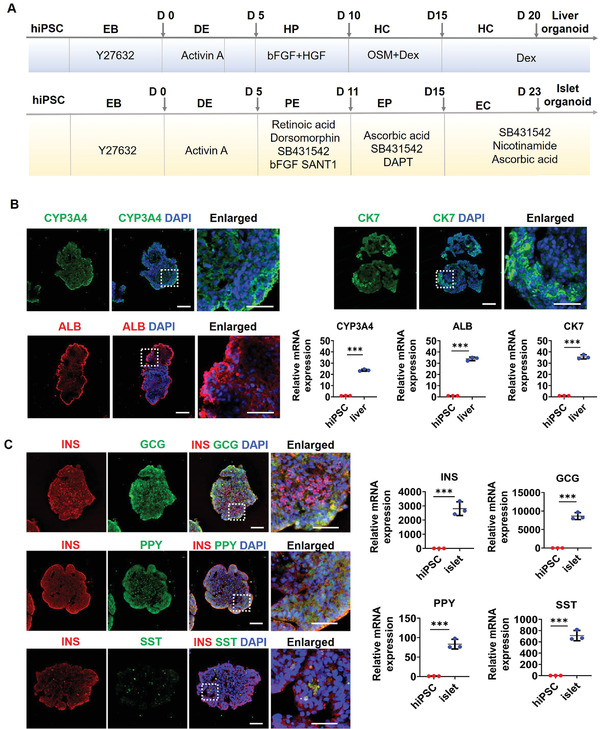
Type 2 diabetes mellitus (T2DM) is a systematic multi‐organ metabolic disease, which is characterized by the dynamic interplay among different organs. The increasing incidence of T2DM reflects an urgent need for the development of in vitro human‐relevant models for disease study and drug therapy. Here, a new microfluidic multi‐organoid system is developed that recapitulates the human liver‐pancreatic islet axis in normal and disease states. The system contains two compartmentalized regions connected by a microchannel network, enabling 3D co‐culture of human induced pluripotent stem cells (hiPSC)‐derived liver and islet organoids for up to 30 days under circulatory perfusion conditions. The co‐cultured liver and islet organoids exhibit favorable growth and improved tissue‐specific functions. Transcriptional analyses reveal the activation of metabolically relevant signaling pathways in the co‐cultured organoids. Notably, the co‐culture system facilitates sensitive glucose‐stimulated insulin secretion from islet organoids and increased glucose utilization in liver organoids by glucose tolerance tests. Both liver and islet organoids display mitochondrial dysfunction and decreased glucose transport capacity under high glucose conditions, which can be alleviated by metformin treatment. This novel multi‐organoid system can recapitulate human‐relevant liver‐islet axis under both physiological and pathological conditions, providing a unique platform for future T2DM research and drug development.
Overview
The claims and statistics of this paper haven’t been checked yet.
Free: it reads the open-access text and checks the first 5 claims that cite a source we can check. Create a free account to check every claim.
Integrity signals
Registry
Cites
Statistics
Figures



Verification
Claims the paper makes
The claims and statistics of this paper haven’t been checked yet.
Free: it reads the open-access text and checks the first 5 claims that cite a source we can check. Create a free account to check every claim.
Claims other papers make about this one
Each is checked against this paper’s own text: does it say what the citing paper says it does?
The cited source says what the claim attributes to it.
In the citing paper
“Tao et al. interfaced hiPSC-derived hepatic and pancreatic islet organoids within a unified microfluidic framework, faithfully reconstructing the human liver-islet axis under both euglycaemic and type-2-diabetic conditions.”
From Constructing biomimetic microenvironments for liver regeneration (2025) · doi:10.1186/s12951-025-03729-9 · cites this paper as [220]
In the citing paper
“This platform captures the synergistic regulation of glucose metabolism and pharmacological responses across organs, offering a powerful paradigm for interrogating multi-organ pathophysiology [220, 221].”
From Constructing biomimetic microenvironments for liver regeneration (2025) · doi:10.1186/s12951-025-03729-9 · cites this paper as [220]
Self-check
Percentages, sums and reported differences re-computed from the paper’s own numbers.
The self-check needs the paper’s full text.
Citations
Cites
Single-step method of RNA isolation by acid guanidinium thiocyanate-phenol-chloroform extraction
Chomczynski, P., & Sacchi, N. (1987) · Analytical Biochemistry · doi:10.1016/0003-2697(87)90021-2 · Cited by 46,426
Eckel, R. H., Alberti, K., Grundy, S. M., & Zimmet, P. Z. (2010) · The Lancet · doi:10.1016/s0140-6736(09)61794-3 · Cited by 6,295
Global aetiology and epidemiology of type 2 diabetes mellitus and its complications
Zheng, Y., Ley, S. H., & Hu, F. B. (2018) · Nature Reviews Endocrinology · doi:10.1038/nrendo.2017.151 · Cited by 5,697
Eckel, R. H., Grundy, S. M., & Zimmet, P. Z. (2005) · The Lancet · doi:10.1016/s0140-6736(05)66378-7 · Cited by 5,550
Type 2 diabetes: principles of pathogenesis and therapy
Stumvoll, M., Goldstein, B. J., & van Haeften, T. W. (2005) · The Lancet · doi:10.1016/s0140-6736(05)61032-x · Cited by 2,662
Serum retinol binding protein 4 contributes to insulin resistance in obesity and type 2 diabetes
Yang, Q., Graham, T. E., Mody, N., Preitner, F., Peroni, O. D., Zabolotny, J. M., Kotani, K., Quadro, L., & Kahn, B. B. (2005) · Nature · doi:10.1038/nature03711 · Cited by 2,086
Mitochondrial dysfunction and type 2 diabetes
Lowell, B. B., & Shulman, G. I. (2005) · Science · doi:10.1126/science.1104343 · Cited by 2,070
Generation of Functional Human Pancreatic β Cells In Vitro
Pagliuca, F. W., Millman, J. R., Gürtler, M., Segel, M., Van Dervort, A., Ryu, J. H., Peterson, Q. P., Greiner, D., & Melton, D. A. (2014) · Cell · doi:10.1016/j.cell.2014.09.040 · Cited by 2,025
Modeling physiological events in 2D vs. 3D cell culture
Duval, K., Grover, H., Han, L.-H., Mou, Y., Pegoraro, A. F., Fredberg, J., & Chen, Z. (2017) · Physiology · doi:10.1152/physiol.00036.2016 · Cited by 1,849
Metformin—mode of action and clinical implications for diabetes and cancer
Pernicova, I., & Korbonits, M. (2014) · Nature Reviews Endocrinology · doi:10.1038/nrendo.2013.256 · Cited by 1,349
Research works printed but not linked: 2
- 10.1038/s41574-018-0132-z · DOI
- Phillips P. J., 2012, Aust. Fam. Physician, 41, 391
Cited by
Human organs-on-chips for disease modelling, drug development and personalized medicine
Ingber, D. E. (2022) · Nature Reviews Genetics · doi:10.1038/s41576-022-00466-9 · Cited by 1,589
A guide to the organ-on-a-chip
Leung, C. M., de Haan, P., Ronaldson-Bouchard, K., Kim, G.-A., Ko, J., Rho, H. S., Chen, Z., Habibovic, P., Jeon, N. L., Takayama, S., et al. (2022) · Nature Reviews Methods Primers · doi:10.1038/s43586-022-00118-6 · Cited by 1,116
Organ-on-a-chip meets artificial intelligence in drug evaluation
Deng, S., Li, C., Cao, J., Cui, Z., Du, J., Fu, Z., Yang, H., & Chen, P. (2023) · Theranostics · doi:10.7150/thno.87266 · Cited by 260
“permission from [183], copyright 2022 Wiley.”
BackgroundMethodInfluentialIntegrating organoids and organ-on-a-chip devices
Zhao, Y., Landau, S., Okhovatian, S., Liu, C., Lu, R. X. Z., Lai, B. F. L., Wu, Q., Kieda, J., Cheung, K., Rajasekar, S., et al. (2024) · Nature Reviews Bioengineering · doi:10.1038/s44222-024-00207-z · Cited by 185
“Tissue aggregates have also been cultured in perfusable microenvironments to study inter-organ crosstalk, including islet–liver 86 , liver–intestine–stomach 87 , liver–lung 88 , liver–”
Human organoids-on-chips for biomedical research and applications
Wang, H., Ning, X., Zhao, F. H., Zhao, H., & Li, D. (2024) · Theranostics · doi:10.7150/thno.90492 · Cited by 157
“Up to now, many parts of the human body have been reproduced with OOCs, such as the brain, lung, gut, liver, kidney, islet, heart and cartilage [10, 11, 13, 69-80].”
BackgroundMethodInfluential
Metadata
- Authors
- Tao, T., Deng, P., Wang, Y., Zhang, X., Guo, Y., Chen, W., & Qin, J.
- Affiliations
- Dalian Institute of Chemical Physics (CN)
- Corresponding author
- Qin, Jianhua
- Venue
- Advanced Science
- Publisher
- Wiley
- Published
- 2021-12-23
- Volume
- 9
- Issue
- 5
- Pages
- e2103495-e2103495
- ISSN
- 2198-3844 (ISSN-L)
- PMC
- PMC8844474
- OpenAlex
- W4200627985
- Cited by
- 178
- References
- 65
- Citations by year
- 2026: 23 · 2025: 44 · 2024: 60 · 2023: 30 · 2022: 20 · 2021: 1
- FWCI
- 26.07
- Type
- journal article
- Language
- en
- Open access
- gold
- doi.org
- Licence
- Locations
- Advanced Science (publishedVersion, cc-by)
- PubMed Central (publishedVersion, cc-by)
- PubMed (publishedVersion)
- DOAJ (DOAJ: Directory of Open Access Journals) (submittedVersion, cc-by-sa)
- Funders
- Yunnan Key Research and Development Program (202003AD150009)
- Center for Advanced Study, University of Illinois at Urbana-Champaign (DICP I201934)
- Topics
- Health Sciences › Medicine › Endocrinology, Diabetes and Metabolism › Pancreatic function and diabetes
- Physical Sciences › Engineering › Biomedical Engineering › 3D Printing in Biomedical Research
- Health Sciences › Medicine › Surgery › Tissue Engineering and Regenerative Medicine
- Keywords
- type 2 diabetes, glucose-stimulated insulin secretion, glucose tolerance, mitochondrial dysfunction, glucose transport, metformin, in vitro disease model
- MeSH terms
- Diabetes Mellitus, Type 2, Humans, Islets of Langerhans, Liver, Organoids, Induced Pluripotent Stem Cells
About these checks
Registry, retraction, Cites and statistics results are computed, not judged, with one exception: a printed reference that no index lists is read once by a model before it counts as a citation error. Claims are extracted by a model and kept only when their quote appears verbatim in the text; each cited source is then checked, with a model’s help, for whether it says what the claim relies on. Those verdicts can be wrong — read the claim’s quote and the cited source before relying on one.
Statistics and arithmetic are recomputed, not judged.
Confidence bands are shown only for fields calibrated on our annotated test set. None is calibrated yet, so no band is shown.
What counts as a claim ›How we measure confidence ›How we check this ›
Are you an author, or do you see a problem with this page? Request a review
How to cite
Cite CoChat for the checks on this page, and the paper for its own findings.
- This page
- CoChat. (2026). Citation check: Microengineered Multi‐Organoid System from hiPSCs to Recapitulate Human Liver‐Islet Axis in Normal and Type 2 Diabetes. https://app.cochat.ai/papers/10.1002/advs.202103495
- The paper
- Tao, T., Deng, P., Wang, Y., Zhang, X., Guo, Y., Chen, W., & Qin, J. (2022). Microengineered Multi‐Organoid System from hiPSCs to Recapitulate Human Liver‐Islet Axis in Normal and Type 2 Diabetes. Advanced Science. https://doi.org/10.1002/advs.202103495
Data sources
Bibliographic data: Semantic Scholar, OpenAlex, Crossref.
Contains information from the Semantic Scholar Academic Graph Datasets, made available under the ODC Attribution License (ODC-BY 1.0).
Semantic Scholar’s data is described in: Kinney, R., et al. (2023). The Semantic Scholar Open Data Platform. arXiv:2301.10140.
