

In‐Memory Vector‐Matrix Multiplication in Monolithic Complementary Metal–Oxide–Semiconductor‐Memristor Integrated Circuits: Design Choices, Challenges, and Perspectives
Open accessThe DOI matches its Crossref record; 93 of the 93 references it cites were found in a registry or an index.
Abstract
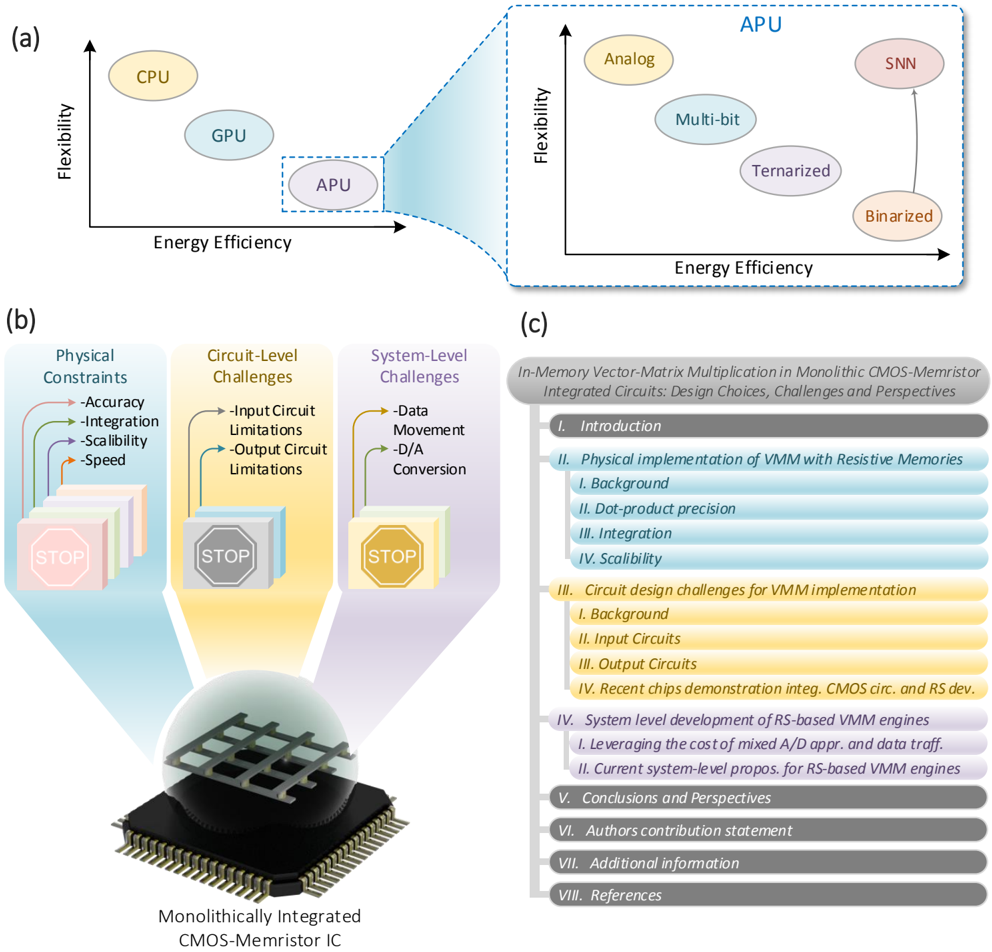
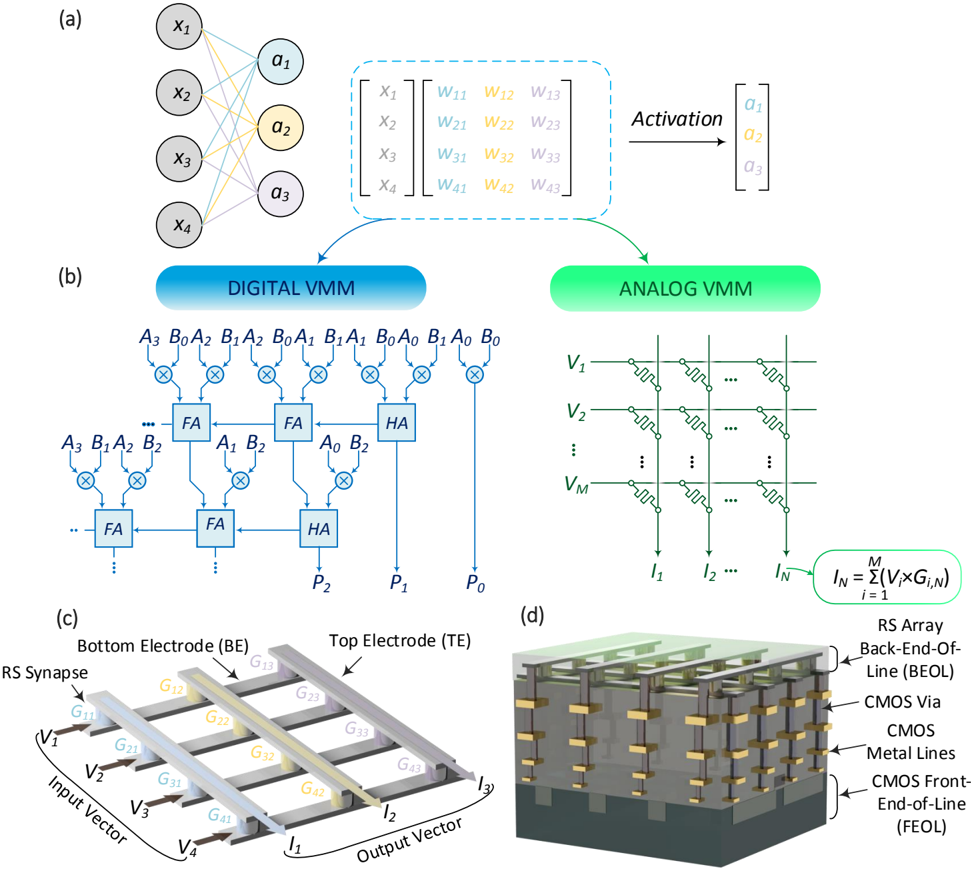
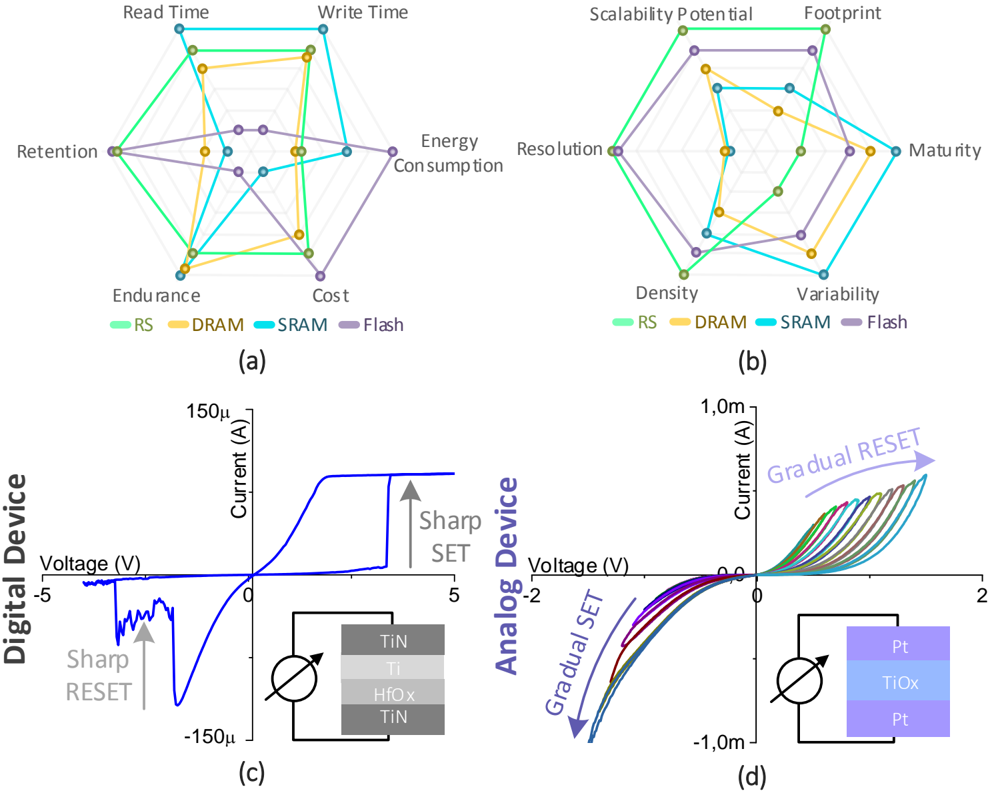
The low communication bandwidth between memory and processing units in conventional von Neumann machines does not support the requirements of emerging applications that rely extensively on large sets of data. More recent computing paradigms, such as high parallelization and near‐memory computing, help alleviate the data communication bottleneck to some extent, but paradigm‐shifting concepts are required. In‐memory computing has emerged as a prime candidate to eliminate this bottleneck by colocating memory and processing. In this context, resistive switching (RS) memory devices is a key promising choice, due to their unique intrinsic device‐level properties, enabling both storing and computing with a small, massively‐parallel footprint at low power. Theoretically, this directly translates to a major boost in energy efficiency and computational throughput, but various practical challenges remain. A qualitative and quantitative analysis of several key existing challenges in implementing high‐capacity, high‐volume RS memories for accelerating the most computationally demanding computation in machine learning (ML) inference, that of vector‐matrix multiplication (VMM), is presented. The monolithic integration of RS memories with complementary metal–oxide–semiconductor (CMOS) integrated circuits is presented as the core underlying technology. The key existing design choices in terms of device‐level physical implementation, circuit‐level design, and system‐level considerations is reviewed and an outlook for future directions is provided.
Overview
The claims and statistics of this paper haven’t been checked yet.
Free: it reads the open-access text and checks the first 5 claims that cite a source we can check. Create a free account to check every claim.
Integrity signals
Registry
Cites
Statistics
Figures

Verification
Claims the paper makes
The claims and statistics of this paper haven’t been checked yet.
Free: it reads the open-access text and checks the first 5 claims that cite a source we can check. Create a free account to check every claim.
Claims other papers make about this one
Each is checked against this paper’s own text: does it say what the citing paper says it does?
The source backs part of the claim, not all of it — or backs it for a different population, condition or comparison.
In the citing paper
“Although very popular102,113–116, this approach might be limited for the case of the smallest technology nodes implementations as the gain and bandwidth of the amplifiers are limited by the intrinsic transistor gain95,117.”
From Hardware implementation of memristor-based artificial neural networks (2024) · cites this paper as [95]
Experimental — accuracy not yet measuredThe source backs part of the claim, not all of it — or backs it for a different population, condition or comparison.
In the citing paper
“SAR-ADC and controlled oscillator-based ADCs (Current-Controlled-Oscillators -CCO, see Fig. 11c- and Voltage-Controlled-Oscillators -VCO, Fig. 11d-) are more suitable to smaller technology node implementations95,117.”
From Hardware implementation of memristor-based artificial neural networks (2024) · cites this paper as [95]
Experimental — accuracy not yet measuredThe source backs part of the claim, not all of it — or backs it for a different population, condition or comparison.
In the citing paper
“A cost-effective recurrent solution has been to use a smaller number of DACs and share them among different rows by adding a layer of analogue multiplexors between the DACs and the wordline inputs93,95,221. With this approach (which we could refer to as On-chip time-multiplexed analogue input – Analogue/Multilevel weights), a given VMM operation is divided in n different sub-VMM operations and the”
From Hardware implementation of memristor-based artificial neural networks (2024) · cites this paper as [95]
Experimental — accuracy not yet measuredThe cited source says what the claim attributes to it.
In the citing paper
“For DAC relying in resistors, the major noise source is from the CMOS operational amplifier in the output stage95, and it can be minimized using larger transistors (both in width and length) for the differential input pair.”
From Hardware implementation of memristor-based artificial neural networks (2024) · cites this paper as [95]
Self-check
Percentages, sums and reported differences re-computed from the paper’s own numbers.
The self-check needs the paper’s full text.
Citations
Cites
LeCun, Y., Bengio, Y., & Hinton, G. (2015) · Nature · doi:10.1038/nature14539 · Cited by 84,126
Strukov, D. B., Snider, G. S., Stewart, D. R., & Williams, R. S. (2008) · Nature · doi:10.1038/nature06932 · Cited by 11,828
Memristor—The Missing Circuit Element
Chua, L. (1971) · IEEE Transactions on Circuit Theory · doi:10.1109/tct.1971.1083337 · Cited by 10,268
In situ click chemistry generation of cyclooxygenase-2 inhibitors
Bhardwaj, A., Kaur, J., Wuest, M., & Wuest, F. (2017) · Nature Communications · doi:10.1038/s41467-016-0009-6 · Cited by 7,448
Structural absorption by barbule microstructures of super black bird of paradise feathers
McCoy, D. E., Feo, T., Harvey, T. A., & Prum, R. O. (2018) · Nature Communications · doi:10.1038/s41467-017-02088-w · Cited by 7,424
Cramming More Components Onto Integrated Circuits
Moore, G. E. (1998) · Proceedings of the IEEE · doi:10.1109/jproc.1998.658762 · Cited by 5,926
In-Datacenter Performance Analysis of a Tensor Processing Unit
Jouppi, N. P., Young, C., Patil, N., Patterson, D., Agrawal, G., Bajwa, R., Bates, S., Bhatia, S., Boden, N., Borchers, A., et al. (2017) · Proceedings of the 44th Annual International Symposium on Computer Architecture · doi:10.1145/3079856.3080246 · Cited by 4,537
Eyeriss: An Energy-Efficient Reconfigurable Accelerator for Deep Convolutional Neural Networks
Chen, Y.-H., Krishna, T., Emer, J. S., & Sze, V. (2017) · IEEE Journal of Solid-State Circuits · doi:10.1109/jssc.2016.2616357 · Cited by 3,247
Analog Integrated Circuit Design
Carusone, A. C., Johns, D. A., & Martin, K. W. (1996) · Cited by 2,509
In-memory computing with resistive switching devices
Ielmini, D., & Wong, H.-S. P. (2018) · Nature Electronics · doi:10.1038/s41928-018-0092-2 · Cited by 2,298
Research works printed but not linked: 41
- 2. Horowitz, M. 1.1 computing's energy problem (and what we can do about it). In 2014 IEEE International Solid-State Circuits Conference Digest of Technical Papers (ISSCC) , 10-14 (IEEE, 2014).
- 8. Sze, V., Chen, Y.-H., Emer, J., Suleiman, A. & Zhang, Z. Hardware for machine learning: Challenges and opportunities. In 2017 IEEE Custom Integrated Circuits Conference (CICC) , 1-8 (IEEE, 2017). · DOI · Paper page
- 16. Bojnordi, M. N. & Ipek, E. Memristive boltzmann machine: A hardware accelerator for combinatorial optimization and deep learning. In 2016 IEEE International Symposium on High Performance Computer Architecture (HPCA) , 1-13 (IEEE, 2016). · DOI · Paper page
- 19. Shin, J. H., Jeong, Y. J., Zidan, M. A., Wang, Q. & Lu, W. D. Hardware acceleration of simulated annealing of spin glass by rram crossbar array. In 2018 IEEE International Electron Devices Meeting (IEDM) , 3-3 (IEEE, 2018). · DOI · Paper page
- 25. Wu, T. F. et al. Brain-inspired computing exploiting carbon nanotube fets and resistive ram: Hyperdimensional computing case study. In 2018 IEEE International Solid-State Circuits Conference-(ISSCC) , 492-494 (IEEE, 2018).
- 28. Song, L., Qian, X., Li, H. & Chen, Y. Pipelayer: A pipelined reram-based accelerator for deep learning. In 2017 IEEE International Symposium on High Performance Computer Architecture (HPCA) , 541-552 (IEEE, 2017). · DOI · Paper page
- 29. Sebastian, A. et al. Computational memory-based inference and training of deep neural networks. In 2019 Symposium on VLSI Technology , T168-T169 (IEEE, 2019). · DOI
- 31. Mahmoodi, M. et al. Ultra-low power physical unclonable function with nonlinear fixed-resistance crossbar circuits. In 2019 IEEE International Electron Devices Meeting (IEDM) , 30-1 (IEEE, 2019). · doi:10.1109/iedm19573.2019.8993618
- 38. Yan, B. et al. Rram-based spiking nonvolatile computing-in-memory processing engine with precisionconfigurable in situ nonlinear activation. In 2019 Symposium on VLSI Technology , T86-T87 (IEEE, 2019). · DOI · Paper page
- 40. Gupta, I. et al. Real-time encoding and compression of neuronal spikes by metal-oxide memristors. Nat. communications 7 , 1-9 (2016).
- 59. Govoreanu, B. et al. 10 × 10nm 2 hf/hfo x crossbar resistive ram with excellent performance, reliability and low-energy operation. In 2011 International Electron Devices Meeting , 31-6 (IEEE, 2011).
- 48. Wu, T. F. et al. 14.3 a 43pj/cycle non-volatile microcontroller with 4.7 m s shutdown/wake-up integrating 2.3-bit/cell resistive ram and resilience techniques. In 2019 IEEE International Solid-State Circuits Conference(ISSCC) , 226-228 (IEEE, 2019).
- B.Govoreanu G.Kar Y.Chen V.Paraschiv S.Kubicek A.Fantini I.Radu L.Goux S.Clima R.Degraeve N.Jossart O.Richard T.Vandeweyer K.Seo P.Hendrickx G.Pourtois H.Bender L.Altimime D. J.Wouters J. A.Kittl M.Jurczak in2011 Int. Electron Devices Meeting IEEE Piscataway NJ2011 pp.31–36. · DOI · Paper page
- 68. Fantini, A. et al. Intrinsic switching variability in hfo 2 rram. In 2013 5th IEEE International Memory Workshop , 30-33 (IEEE, 2013). · DOI · Paper page
- 71. Chen, P.-Y. et al. Mitigating effects of non-ideal synaptic device characteristics for on-chip learning. In 2015 IEEE/ACM International Conference on Computer-Aided Design (ICCAD) , 194-199 (IEEE, 2015).
- 73. Fantini, A. et al. Intrinsic program instability in hfo2 rram and consequences on program algorithms. In 2015 IEEE International Electron Devices Meeting (IEDM) , 7.5.1-7.5.4 (2015). · DOI
- 74. Lee, H. et al. Evidence and solution of over-reset problem for hfo x based resistive memory with sub-ns switching speed and high endurance. In 2010 International Electron Devices Meeting , 19-7 (IEEE, 2010). · DOI · Paper page
- 82. Murmann, B. ADC Performance Survey 1997-2020 (2020).
- 87. Hashemi, S., Anthony, N., Tann, H., Bahar, R. I. & Reda, S. Understanding the impact of precision quantization on the accuracy and energy of neural networks. In Design, Automation & Test in Europe Conference & Exhibition (DATE), 2017 , 1474-1479 (IEEE, 2017).
- 89. Su, F. et al. A 462gops/j rram-based nonvolatile intelligent processor for energy harvesting ioe system featuring nonvolatile logics and processing-in-memory. In 2017 Symposium on VLSI Technology , T260-T261 (IEEE, 2017).
- 90. Bocquet, M. et al. In-memory and error-immune differential rram implementation of binarized deep neural networks. In 2018 IEEE International Electron Devices Meeting (IEDM) , 20-6 (IEEE, 2018). · DOI · Paper page
- 92. Liu, Q. et al. 33.2 a fully integrated analog reram based 78.4 tops/w compute-in-memory chip with fully parallel mac computing. In 2020 IEEE International Solid-State Circuits Conference-(ISSCC) , 500-502 (IEEE, 2020).
- 93. Mochida, R. et al. A 4m synapses integrated analog reram based 66.5 tops/w neural-network processor with cell current controlled writing and flexible network architecture. In 2018 IEEE Symposium on VLSI Technology , 175-176 (IEEE, 2018).
- 94. Xue, C.-X. et al. 24.1 a 1mb multibit reram computing-in-memory macro with 14.6 ns parallel mac computing time for cnn based ai edge processors. In 2019 IEEE International Solid-State Circuits Conference-(ISSCC) , 388-390 (IEEE, 2019).
- Q.Liu B.Gao P.Yao D.Wu J.Chen Y.Pang W.Zhang Y.Liao C.-X.Xue W.-H.Chen J.Tang Y.Wang M.-F.Chang H.Qian H.Wu in2020 IEEE Int. Solid-State Circuits Conf.-(ISSCC) IEEE Piscataway NJ2020 pp.500–502.
- 99. Karatsuba, A. A. & Ofman, Y. P. Multiplication of many-digital numbers by automatic computers. In Doklady Akademii Nauk , vol. 145, 293-294 (Russian Academy of Sciences, 1962).
- 100. Huss-Lederman, S., Jacobson, E. M., Johnson, J. R., Tsao, A. & Turnbull, T. Strassen's algorithm for matrix multiplication: Modeling, analysis, and implementation. In Proceedings of Supercomputing , vol. 96, 9-6 (Citeseer, 1996).
- 103. Bavandpour, M., Mahmoodi, M. R. & Strukov, D. acortex: An energy-efficient multi-purpose mixed-signal inference accelerator. accepted, IEEE J. Explor. Solid-State Comput. Devices Circuits (2020).
- 104. Bavandpour, M., Sahay, S., Mahmoodi, M. R. & Strukov, D. Efficient mixed-signal neurocomputing via successive integration and rescaling. IEEE Transactions on Very Large Scale Integration (VLSI) Syst. (2019).
- 108. Moons, B., Uytterhoeven, R., Dehaene, W. & Verhelst, M. 14.5 envision: A 0.26-to-10tops/w subword-parallel dynamic-voltage-accuracy-frequency-scalable convolutional neural network processor in 28nm fdsoi. In 2017 IEEE International Solid-State Circuits Conference (ISSCC) , 246-247 (IEEE, 2017).
- 109. Merritt, R. Startup Accelerates AI at the Sensor (2019).
- 110. Shin, D., Lee, J., Lee, J. & Yoo, H.-J. 14.2 dnpu: An 8.1 tops/w reconfigurable cnn-rnn processor for general-purpose deep neural networks. In 2017 IEEE International Solid-State Circuits Conference (ISSCC) , 240-241 (IEEE, 2017).
- 115. Google. Edge TPU: Google's purpose-built ASIC designed to run inference at the edge (2019).
- 117. Cutress, I. Cambricon, maker of hauwei's kirin npu ip, build a big ai chip and pcie card (2018).
- 118. Armasu, L. Move Over GPUs: Startup's Chip Claims to Do Deep Learning Inference Better (2018).
- 119. Ueyoshi, K. et al. Quest: A 7.49 tops multi-purpose log-quantized dnn inference engine stacked on 96mb 3d sram using inductive-coupling technology in 40nm cmos. In 2018 IEEE International Solid-State Circuits Conference-(ISSCC) , 216-218 (IEEE, 2018).
- 121. Hruska, J. New Movidius Myriad X VPU Packs a Custom Neural Compute Engine (2017).
- 124. Chen, Y. et al. Dadiannao: A machine-learning supercomputer. In 2014 47th Annual IEEE/ACM International Symposium on Microarchitecture , 609-622 (IEEE, 2014). · DOI · Paper page
- 125. Rockchip. Rockchip Released Its First AI Processor RK3399Pro NPU Performance up to 2.4TOPs (2018).
- R.Mochida K.Kouno Y.Hayata M.Nakayama T.Ono H.Suwa R.Yasuhara K.Katayama T.Mikawa Y.Gohou in2018 IEEE Symp. on VLSI Technology IEEE Piscataway NJ2018 pp.175–176. · DOI · Paper page
- C.-X.Xue W.-H.Chen J.-S.Liu J.-F.Li W.-Y.Lin W.-E.Lin J.-H.Wang W.-C.Wei T.-W.Chang T.-C.Chang T.-Y.Huang H.-Y.Kao S.-Y.Wei Y.-C.Chiu C.-Y.Lee C.-C.Lo Y.-C.King C.-J.Lin R.-S.Liu C.-C.Hsieh K.-T.Tang M.-F.Chang in2019 IEEE Int. Solid-State Circuits Conf.-(ISSCC) IEEE Piscataway NJ2019 pp.388–390.
Cited by
Items 201–216 of 216
Lim, K., Go, S., Wang, Q., Kim, D., Baek, C., Wang, Q., Lee, T. H., & Loke, D. K. (2026) · InfoScience. · doi:10.1002/inc2.70006
A photonically linked memristive neural network
Valov, I., & Zheng, X. (2026) · Nature Electronics · doi:10.1038/s41928-025-01536-6
Study on the Working Mechanism of Improved Memristor-CMOS-Based Logic Gates
Yan, H., Lv, T., & Li, M. (2025) · IEEE International Conference on Data Science and Computer Application (ICDSCA) · doi:10.1109/icdsca67083.2025.11350117
“Owing to these unique properties, memristors have found widespread applications in diverse fields, including artificial neural networks [9–10], integrated circuits [11], computing-in-memory architectures [12], and chaotic systems [13].”
Park, Y. R., & Wang, G. (2026) · Science Advances · doi:10.1126/sciadv.ady8518
In-memory computing based on CMOS-RRAM hybrid architectures
Esmanhotto, E. (2022) · theses.fr (ABES) · doi:10.70675/1cf79608z3789z4025z8efcz817e8621bdd9 · Cited by 1
Neuromorphic in-memory learning with analog integrated circuits and nanoscale memristive devices
Garg, N. (2024) · theses.fr (ABES) · doi:10.70675/a5f34c0ezcc3bz42c8z8a52z529a545221ca · Cited by 2
Patel, M., Pandya, B., Gosai, A., Khemnani, M., Loke, D. K., Chandra, P., & Solanki, A. (2026) · Materials Science in Semiconductor Processing · doi:10.1016/j.mssp.2026.110705
64-Point Radix-4 fast Fourier transform (FFT) Implementation in an 8 × 4 1T1R RRAM Array
Jia, S., Liu, X., Waser, R., Wiefels, S., & Menzel, S. (2026) · IEEE International Symposium on Circuits and Systems proceedings · doi:10.1109/iscas66217.2026.11562995
“Benefiting from its non-volatility and compatibility with CMOS technology [2], [3], it enables computation-in-memory (CIM), which helps to overcome the von Neumann O(1) multi-level switching RRAM devices and large scale arrays [7], [8].”
Energy‐Aware Perturbation Optimization for Memristor‐Array Convolutional Neural Networks
Xu, A., Lu, L., Wu, Y., Guo, Y., Li, Y., Wang, Y., & Li, Q. (2026) · Advanced Intelligent Systems · doi:10.1002/aisy.70477 · Cited by 1
Toward optically programmable crossbar arrays for array-level artificial neural network hardware
Jang, H., Choi, J.-H., Lee, T., & Park, H. (2026) · Nano Futures · doi:10.1088/2399-1984/ae925f
CMOS Electronic Synaptic Circuit Based on an Active Substrate Charge Injection Mechanism
Song, Z., Zhang, Y., Liu, C., & Xu, J. (2026) · IEEE Transactions on Circuits & Systems II Express Briefs · doi:10.1109/tcsii.2026.3720490
“However, their peripheral circuits and neuron interfaces still rely heavily on high-density CMOS circuitry, and they remain inferior to fully CMOS-based solutions in scalability, reliability, and process maturity [8], [9].”
Self-citationAhrar, A., Pazhouhandeh, M. R., Frappé, A., & Amirsoleimani, A. (2026) · Memories - Materials Devices Circuits and Systems · doi:10.1016/j.memori.2026.100148
Self-citationFerroelectric Memristor-CMOS Crossbar Engine for Sobel Edge Detection
Suryadevara, A. V., Ramkumar, R., Rizkalla, M., Mann, R., & Meagher, R. E. (2026) · IEEE International Midwest Symposium on Circuits and Systems (MWSCAS) · doi:10.1109/mwscas67364.2026.11680915
Role and calculation of the thermal resistance for the compact modelling of TiN/Ti/HfO2/W memristorsPreprint
Jiménez-Molinos, F., Vinuesa, G., García, H., Dueñas, S., Castán, H., González, M. B., Cantudo, A., Villena, M. A., & Roldán, J. B. (2026) · SSRN Electronic Journal · doi:10.2139/ssrn.7478478
CNN Architecture Optimization for Multiplierless Inference
Khayat, I. A., Reuben, J., & Fey, D. (2026) · Information · doi:10.3390/info17090913
Dong, C., Xie, X., Chen, J., Tan, G., Huang, Y., & Cao, S. (2026) · Electronics · doi:10.3390/electronics15194512
Metadata
- Authors
- Amirsoleimani, A., Alibart, F., Yon, V., Xu, J., Pazhouhandeh, M. R., Ecoffey, S., Beilliard, Y., Genov, R., & Drouin, D.
- Affiliations
- University of Toronto (CA)
- Centre National de la Recherche Scientifique (FR)
- Corresponding author
- Amirsoleimani, Amirali
- Alibart, Fabien
- ORCID
- Venue
- Advanced Intelligent Systems
- Publisher
- Wiley
- Published
- 2020-08-23
- Volume
- 2
- Issue
- 11
- Pages
- 2000115
- ISSN
- 2640-4567 (ISSN-L)
- OpenAlex
- W3081302630
- Cited by
- 216
- References
- 88
- Citations by year
- 2026: 21 · 2025: 52 · 2024: 44 · 2023: 41 · 2022: 38 · 2021: 19 · 2020: 1
- FWCI
- 8.49
- Type
- journal article
- Language
- en
- Open access
- gold
- doi.org
- Licence
- Locations
- Advanced Intelligent Systems (publishedVersion, cc-by)
- HAL (submittedVersion, cc-by)
- DOAJ (DOAJ: Directory of Open Access Journals) (submittedVersion)
- LillOA (Université de Lille (University Of Lille)) (submittedVersion, other-oa)
- Funders
- European Research Council (773228)
- Canadian Network for Research and Innovation in Machining Technology, Natural Sciences and Engineering Research Council of Canada (HIDATA)
- Topics
- Physical Sciences › Engineering › Electrical and Electronic Engineering › Advanced Memory and Neural Computing
- Physical Sciences › Engineering › Electrical and Electronic Engineering › Ferroelectric and Negative Capacitance Devices
- Physical Sciences › Engineering › Electrical and Electronic Engineering › Low-power high-performance VLSI design
- Keywords
- in-memory computing, matrix-vector multiplication, resistive random access memory, memristors, monolithic integration, near-memory computing, energy efficiency, circuit design
About these checks
Registry, retraction, Cites and statistics results are computed, not judged, with one exception: a printed reference that no index lists is read once by a model before it counts as a citation error. Claims are extracted by a model and kept only when their quote appears verbatim in the text; each cited source is then checked, with a model’s help, for whether it says what the claim relies on. Those verdicts can be wrong — read the claim’s quote and the cited source before relying on one.
Statistics and arithmetic are recomputed, not judged.
Confidence bands are shown only for fields calibrated on our annotated test set. None is calibrated yet, so no band is shown.
What counts as a claim ›How we measure confidence ›How we check this ›
Are you an author, or do you see a problem with this page? Request a review
Data sources
Bibliographic data: Semantic Scholar, OpenAlex, Crossref.
Contains information from the Semantic Scholar Academic Graph Datasets, made available under the ODC Attribution License (ODC-BY 1.0).
Semantic Scholar’s data is described in: Kinney, R., et al. (2023). The Semantic Scholar Open Data Platform. arXiv:2301.10140.
