

The DOI matches its Crossref record; 25 of the 25 references it cites were found in a registry or an index.
Growth differentiation factor 15 as a useful biomarker for mitochondrial disorders
Open accessAbstract
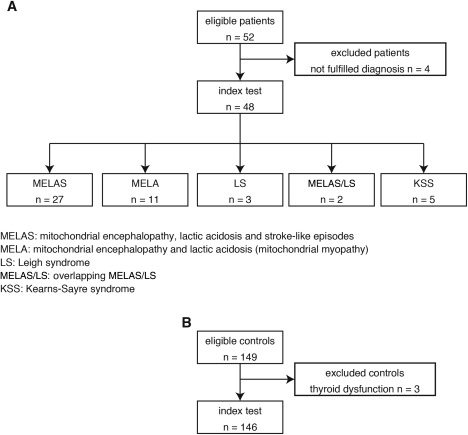
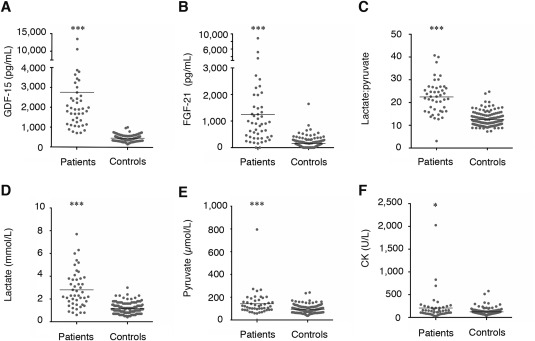
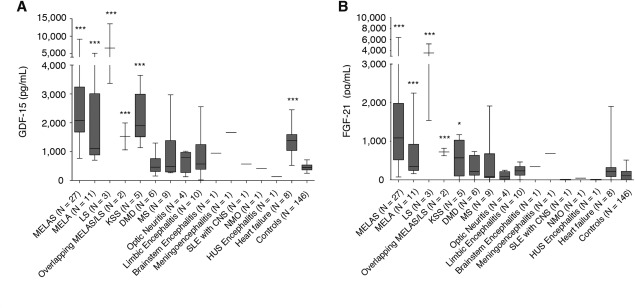
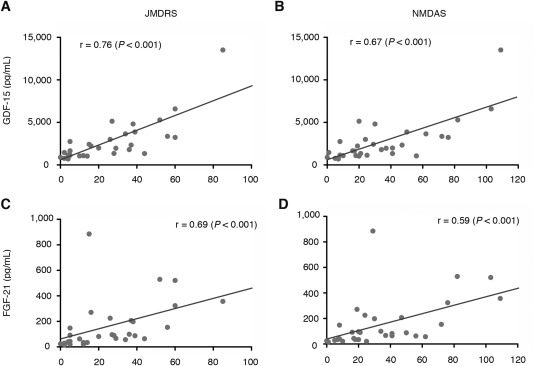
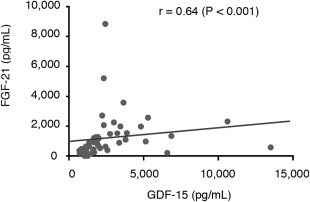
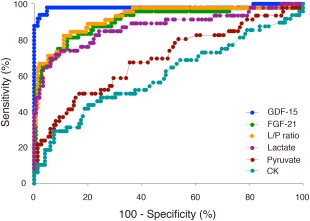
OBJECTIVE: The diagnosis of mitochondrial disorders (MDs) is occasionally difficult because patients often present with solitary, or a combination of, symptoms caused by each organ insufficiency, which may be the result of respiratory chain enzyme deficiency. Growth differentiation factor 15 (GDF-15) has been reported to be elevated in serum of patients with MDs. In this study, we investigated whether GDF-15 is a more useful biomarker for MDs than several conventional biomarkers. METHODS: We measured the serum levels of GDF-15 and fibroblast growth factor 21 (FGF-21), as well as other biomarkers, in 48 MD patients and in 146 healthy controls in Japan. GDF-15 and FGF-21 concentrations were measured by enzyme-linked immunosorbant assay and compared with lactate, pyruvate, creatine kinase, and the lactate-to-pyruvate ratio. We calculated sensitivity and specificity and also evaluated the correlation based on two rating scales, including the Newcastle Mitochondrial Disease Rating Scale (NMDAS). RESULTS: Mean GDF-15 concentration was 6-fold higher in MD patients compared to healthy controls (2,711 ± 2,459 pg/ml vs 462.5 ± 141.0 pg/mL; p < 0.001). Using a receiver operating characteristic curve, the area under the curve was significantly higher for GDF-15 than FGF-21 and other conventional biomarkers. Our date suggest that GDF-15 is the most useful biomarker for MDs of the biomarkers examined, and it is associated with MD severity. INTERPRETATION: Our results suggest that measurement of GDF-15 is the most useful first-line test to indicate the patients who have the mitochondrial respiratory chain deficiency.
Overview
The claims and statistics of this paper haven’t been checked yet.
Run the check — free, no account needed. It reads the open-access text and checks the sources it cites.
Integrity signals
Registry
Cites
Statistics
Figures
Verification
Claims the paper makes
The claims and statistics of this paper haven’t been checked yet.
Run the check — free, no account needed. It reads the open-access text and checks the sources it cites.
Claims other papers make about this one
Each is checked against this paper’s own text: does it say what the citing paper says it does?
In the citing paper
“It is considered as an indicator of mitochondrial dysfunction in muscle (21)”
From Human Aging and Longevity Are Characterized by High Levels of Mitokines (2019) · cites this paper as [21]
Self-check
Percentages, sums and reported differences re-computed from the paper’s own numbers.
The self-check needs the paper’s full text.
Citations
Cites
DeLong, E. R., DeLong, D. M., & Clarke-Pearson, D. L. (1988) · Biometrics · doi:10.2307/2531595 · Cited by 22,649
An Integrated Stress Response Regulates Amino Acid Metabolism and Resistance to Oxidative Stress
Harding, H. P., Zhang, Y., Zeng, H., Novoa, I., Lu, P. D., Calfon, M. A., Sadri, N., Yun, C., Popko, B., Paules, R. S., et al. (2003) · Molecular Cell · doi:10.1016/s1097-2765(03)00105-9 · Cited by 3,336
Suomalainen, A., Elo, J. M., Pietiläinen, K. H., Hakonen, A. H., Sevastianova, K., Korpela, M., Isohanni, P., Marjavaara, S. K., Tyni, T., Kiuru-Enari, S., et al. (2011) · The Lancet Neurology · doi:10.1016/s1474-4422(11)70155-7 · Cited by 427
MELAS: A nationwide prospective cohort study of 96 patients in Japan
Yatsuga, S., Povalko, N., Nishioka, J., Katayama, K., Kakimoto, N., Matsuishi, T., Kakuma, T., & Koga, Y. (2011) · Biochimica et Biophysica Acta (BBA) - General Subjects · doi:10.1016/j.bbagen.2011.03.015 · Cited by 309
Mitochondrial Disease: A Practical Approach for Primary Care Physicians
Haas, R., Parikh, S., Falk, M. J., Saneto, R. P., Wolf, N. I., Darín, N., & Cohen, B. H. (2007) · PEDIATRICS · doi:10.1542/peds.2007-0391 · Cited by 272
Activating transcription factor 4-dependent induction of FGF21 during amino acid deprivation
De Sousa-Coelho, A. L., Marrero, P. F., & Haro, D. (2012) · Biochemical Journal · doi:10.1042/bj20111748 · Cited by 246
Santhanakrishnan, R., Chong, J. P. C., Ng, T. P., Ling, L. H., Sim, D., Leong, K. T. G., Yeo, P. S. D., Ong, H. Y., Jaufeerally, F. R., Wong, R. C.-C., et al. (2012) · European Journal of Heart Failure · doi:10.1093/eurjhf/hfs130 · Cited by 217
Jiang, S., Cheng, Y., Fang, Q., Shao, M., Zhang, Y., Liu, Y., Deng, Y., Shan, B., Liu, J., Li, H., et al. (2014) · Journal of Biological Chemistry · doi:10.1074/jbc.m114.565960 · Cited by 182
Mitochondrial disease in adults: A scale to monitor progression and treatment
Schaefer, A. M., Phoenix, C., Elson, J. L., McFarland, R., Chinnery, P. F., & Turnbull, D. M. (2006) · Neurology · doi:10.1212/01.wnl.0000219759.72195.41 · Cited by 178
Jousse, C., Deval, C., Maurin, A., Parry, L., Chérasse, Y., Chaveroux, C., LeFloch, R., Lenormand, P., Bruhat, A., & Fafournoux, P. (2007) · Journal of Biological Chemistry · doi:10.1074/jbc.m611723200 · Cited by 174
Clinical presentation of mitochondrial disorders in childhood
Münnich, A., Rötig, A., Chrétien, D., Cormier‐Daire, V., Bourgeron, T., Bonnefont, J., Saudubray, J., & Rustin, P. (1996) · Journal of Inherited Metabolic Disease · doi:10.1007/bf01799112 · Cited by 154
GDF15 is a novel biomarker to evaluate efficacy of pyruvate therapy for mitochondrial diseases
Fujita, Y., Ito, M., Kojima, T., Yatsuga, S., Koga, Y., & Tanaka, M. (2015) · Mitochondrion · doi:10.1016/j.mito.2014.10.006 · Cited by 128
Kalko, S. G., Paco, S., Jou, C., Rodríguez, M. A., Meznarič, M., Rogač, M., Vrhovšek, M. J., Sciacco, M., Moggio, M. G., Fagiolari, G., et al. (2014) · BMC Genomics · doi:10.1186/1471-2164-15-91 · Cited by 126
Kim, K. H., Jeong, Y. T., Kim, S. H., Jung, H. S., Park, K. S., Lee, H.-Y., & Lee, M.-S. (2013) · Biochemical and Biophysical Research Communications · doi:10.1016/j.bbrc.2013.09.026 · Cited by 112
Fibroblast growth factor 21 is a sensitive biomarker of mitochondrial disease
Davis, R. L., Liang, C., Edema‐Hildebrand, F., Riley, C., Needham, M., & Sue, C. M. (2013) · Neurology · doi:10.1212/01.wnl.0000436068.43384.ef · Cited by 102
Lambrecht, S., Smith, V. M., Wilde, K. D., Coudenys, J., Decuman, S., Deforce, D. L. D., Keyser, F. D., & Elewaut, D. S. (2013) · Arthritis & Rheumatology · doi:10.1002/art.38241 · Cited by 70
The broadening spectrum of mitochondrial disease: Shifts in the diagnostic paradigm
Liang, C., Ahmad, K. E., & Sue, C. M. (2013) · Biochimica et Biophysica Acta (BBA) - General Subjects · doi:10.1016/j.bbagen.2013.10.040 · Cited by 60
GDF 15 as an anti-apoptotic, diagnostic and prognostic marker in oral squamous cell carcinoma
Schiegnitz, E., Kämmerer, P. W., Koch, F. P., Krüger, M., Berres, M., & Al‐Nawas, B. (2012) · Oral Oncology · doi:10.1016/j.oraloncology.2012.01.020 · Cited by 53
Cantó, C., & Auwerx, J. H. (2012) · Science · doi:10.1126/science.1222646 · Cited by 52
Cui, R., Gale, R. P., Zhu, G., Xu, Z., Qin, T., Zhang, Y., Huang, G., Li, B., Fang, L., Zhang, H., et al. (2014) · Leukemia Research · doi:10.1016/j.leukres.2014.01.016 · Cited by 52
The Story of Growth Differentiation Factor 15: Another Piece of the Puzzle
Lindahl, B. (2013) · Clinical Chemistry · doi:10.1373/clinchem.2013.212811 · Cited by 52
Tarkun, P., Mehtap, Ö., Ateşoğlu, E. B., Gedük, A., Musul, M. M., & Hacıhanefioğlu, A. (2013) · European Journal Of Haematology · doi:10.1111/ejh.12150 · Cited by 26
Yang, C., Ma, J., Luo, Q., Neskey, D. M., Zhu, D., Liu, Y., Myers, J. N., Zhang, C., Zhang, Z., & Zhong, L. (2013) · Journal of Oral Pathology and Medicine · doi:10.1111/jop.12091 · Cited by 23
High levels of soluble serum hemojuvelin in patients with congenital dyserythropoietic anemia type I
Shalev, H., Perez‐Avraham, G., Kapelushnik, J., Levi, I., Rabinovich, A., Swinkels, D. W., Brasse‐Lagnel, C., & Tamary, H. (2012) · European Journal Of Haematology · doi:10.1111/ejh.12027 · Cited by 15
Gustavii, B. (2017) · Cambridge University Press eBooks · doi:10.1017/9781316650431.004 · Cited by 5
Cited by
Sorted by citations
Gorman, G. S., Chinnery, P. F., DiMauro, S., Hirano, M., Koga, Y., McFarland, R., Suomalainen, A., Thorburn, D. R., Zeviani, M., & Turnbull, D. M. (2016) · Nature Reviews Disease Primers · doi:10.1038/nrdp.2016.80 · Cited by 1,650
Mitochondrial signal transduction
Picard, M. A., & Shirihai, O. S. (2022) · Cell Metabolism · doi:10.1016/j.cmet.2022.10.008 · Cited by 688
Mitochondrial diseases: the contribution of organelle stress responses to pathology
Suomalainen, A., & Battersby, B. J. (2018) · Nature Reviews Molecular Cell Biology · doi:10.1038/nrm.2017.66 · Cited by 505
POLG-related disorders and their neurological manifestations
Rahman, S., & Copeland, W. C. (2018) · Nature Reviews Neurology · doi:10.1038/s41582-018-0101-0 · Cited by 437
Tsai, V. W.-W., Husaini, Y., Sainsbury, A., Brown, D. A., & Breit, S. N. (2018) · Cell Metabolism · doi:10.1016/j.cmet.2018.07.018 · Cited by 424
Metadata
- Authors
- Yatsuga, S., Fujita, Y., Ishii, A., Fukumoto, Y., Arahata, H., Kakuma, T., Kojima, T., Ito, M., Tanaka, M., Saiki, R., & Koga, Y.
- Affiliations
- Kurume University (JP)
- Tokyo Metropolitan Institute of Gerontology (JP)
- University of Tsukuba (JP)
- Omuta hospital (JP)
- Toyohashi University of Technology (JP)
- Corresponding author
- Koga, Yasutoshi
- ORCID
- Venue
- Annals of Neurology
- Publisher
- Wiley
- Published
- 2015-10-14
- Volume
- 78
- Issue
- 5
- Pages
- 814-823
- ISSN
- 0364-5134 (ISSN-L)
- 1531-8249
- PMC
- PMC5057301
- OpenAlex
- W1903699046
- Cited by
- 293
- References
- 25
- Citations by year
- 2026: 26 · 2025: 29 · 2024: 29 · 2023: 24 · 2022: 32 · 2021: 35 · 2020: 41 · 2019: 31 · 2018: 14 · 2017: 18 · 2016: 13
- FWCI
- 12.59
- Type
- journal article
- Language
- en
- Open access
- hybrid
- doi.org
- Licence
- Locations
- Annals of Neurology (publishedVersion, cc-by-nc)
- PubMed Central (publishedVersion, cc-by-nc)
- PubMed (publishedVersion)
- Institutional Repositories DataBase (IRDB) (publishedVersion)
- Terrestrial Environment Research Center (University of Tsukuba) (submittedVersion)
- Funders
- Ministry of Education, Culture, Sports, Science and Technology (MEXT) (25461571 (to Y.K.), 25860891 (to S.Y.), 25242062 (to M.T.))
- The Ministry of Health, Labor and Welfare of Japan. (24-Nanchi-Ippan-005 (to Y.K.) for Research on Intractable Diseases)
- Topics
- Health Sciences › Medicine › Cardiology and Cardiovascular Medicine › GDF15 and Related Biomarkers
- Life Sciences › Biochemistry, Genetics and Molecular Biology › Molecular Biology › Mitochondrial Function and Pathology
- Life Sciences › Biochemistry, Genetics and Molecular Biology › Clinical Biochemistry › Metabolism and Genetic Disorders
- Keywords
- growth differentiation factor 15, mitochondrial disease, biomarkers, FGF21, respiratory chain deficiency, serum biomarkers, disease severity, sensitivity and specificity
- MeSH terms
- Adolescent, Adult, Child, Creatine Kinase, Female, Fibroblast Growth Factors, Humans, Male, Middle Aged, ROC Curve, Biomarkers, MELAS Syndrome, Pyruvic Acid, Lactic Acid, Mitochondrial Diseases, Growth Differentiation Factor 15, Young Adult
About these checks
Registry, retraction, Cites and statistics results are computed, not judged, with one exception: a printed reference that no index lists is read once by a model before it counts as a citation error. Claims are extracted by a model and kept only when their quote appears verbatim in the text; each cited source is then checked, with a model’s help, for whether it says what the claim relies on. Those verdicts can be wrong — read the claim’s quote and the cited source before relying on one.
Statistics and arithmetic are recomputed, not judged.
Confidence bands are shown only for fields calibrated on our annotated test set. None is calibrated yet, so no band is shown.
What counts as a claim ›How we measure confidence ›How we check this ›
Are you an author, or do you see a problem with this page? Request a review
