

The DOI matches its Crossref record; 59 of the 60 references it cites were found in a registry or an index.
Optimizing Hydrogen Binding on Ru Sites with RuCo Alloy Nanosheets for Efficient Alkaline Hydrogen Evolution
Open accessAbstract
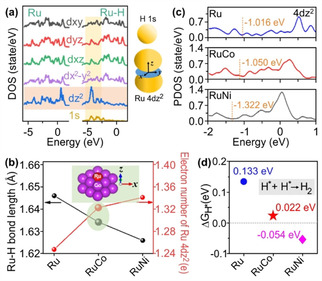
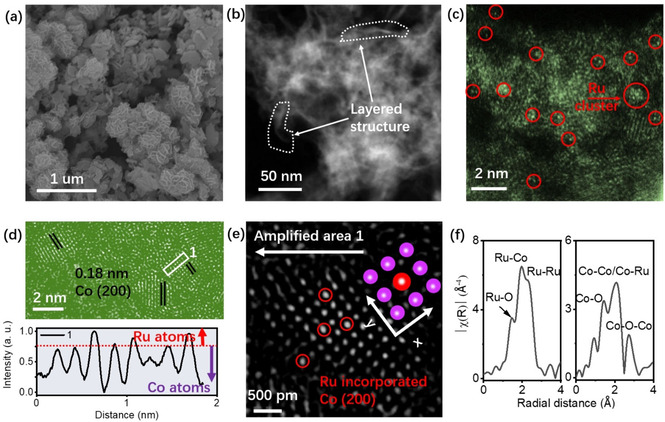
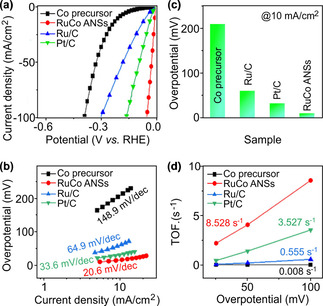
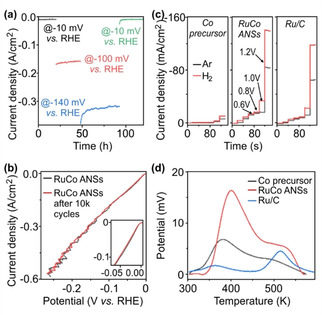
Ruthenium (Ru)‐based catalysts, with considerable performance and desirable cost, are becoming highly interesting candidates to replace platinum (Pt) in the alkaline hydrogen evolution reaction (HER). The hydrogen binding at Ru sites (Ru−H) is an important factor limiting the HER activity. Herein, density functional theory (DFT) simulations show that the essence of Ru−H binding energy is the strong interaction between the orbital of Ru and the 1s orbital of H. The charge transfer between Ru sites and substrates (Co and Ni) causes the appropriate downward shift of the ‐band center of Ru, which results in a Gibbs free energy of 0.022 eV for H* in the RuCo system, much lower than the 0.133 eV in the pure Ru system. This theoretical prediction has been experimentally confirmed using RuCo alloy‐nanosheets (RuCo ANSs). They were prepared via a fast co‐precipitation method followed with a mild electrochemical reduction. Structure characterizations reveal that the Ru atoms are embedded into the Co substrate as isolated active sites with a planar symmetric and Z‐direction asymmetric coordination structure, obtaining an optimal modulated electronic structure. Hydrogen sensor and temperature program desorption (TPD) tests demonstrate the enhanced Ru−H interactions in RuCo ANSs compared to those in pure Ru nanoparticles. As a result, the RuCo ANSs reach an ultra‐low overpotential of 10 mV at 10 mA cm −2 and a Tafel slope of 20.6 mV dec −1 in 1 M KOH, outperforming that of the commercial Pt/C. This holistic work provides a new insight to promote alkaline HER by optimizing the metal‐H binding energy of active sites.
Overview
The claims and statistics of this paper haven’t been checked yet.
Run the check — free, no account needed. It reads the open-access text and checks the sources it cites.
Integrity signals
Registry
Cites
Statistics
Figures
Verification
Claims the paper makes
The claims and statistics of this paper haven’t been checked yet.
Run the check — free, no account needed. It reads the open-access text and checks the sources it cites.
Claims other papers make about this one
Each is checked against this paper’s own text: does it say what the citing paper says it does?
The check wasn’t confident either way, so it gives no verdict — never disputed.
In the citing paper
“traditional supports on the micrometer scale are usually not compatible with the catalysts on the nanoscale and therefore do not contribute considerably to the intrinsic catalytic activity.”
From An energy-saving support made of silver nanowire aerogel for hydrogen evolution reaction (2023) · cites this paper as [31]
Experimental — accuracy not yet measured
Self-check
Percentages, sums and reported differences re-computed from the paper’s own numbers.
The self-check needs the paper’s full text.
Citations
Cites
Trends in the exchange current for hydrogen evolution
Nørskov, J. K., Bligaard, T., Logadottir, A., Kitchin, J. R., Chen, J. G., Pandelov, S., & Stimming, U. (2005) · Journal of The Electrochemical Society · doi:10.1149/1.1856988 · Cited by 6,121
Recent Advances in Electrocatalytic Hydrogen Evolution Using Nanoparticles
Zhu, J., Hu, L., Zhao, P., Lee, L. Y. S., & Wong, K.-Y. (2020) · Chemical Reviews · doi:10.1021/acs.chemrev.9b00248 · Cited by 3,133
High Electrocatalytic Hydrogen Evolution Activity of an Anomalous Ruthenium Catalyst
Zheng, Y., Jiao, Y., Zhu, Y., Li, L. H., Han, Y., Chen, Y., Jaroniec, M., & Qiao, S.-Z. (2016) · Journal of the American Chemical Society · doi:10.1021/jacs.6b11291 · Cited by 1,110
Self-citationSu, J., Yang, Y., Xia, G., Chen, J., Jiang, P., & Chen, Q. (2017) · Nature Communications · doi:10.1038/ncomms14969 · Cited by 845
Recent Advances and Prospective in Ruthenium-Based Materials for Electrochemical Water Splitting
Yu, J., He, Q., Yang, G., Zhou, W., Shao, Z., & Ni, M. (2019) · ACS Catalysis · doi:10.1021/acscatal.9b02457 · Cited by 789
Wang, Y., Kong, B., Zhao, D., Wang, H., & Selomulya, C. (2017) · Nano Today · doi:10.1016/j.nantod.2017.06.006 · Cited by 722
Chen, K., Liu, K., An, P., Li, H., Lin, Y., Hu, J., Jia, C., Fu, J., Li, H., Liu, H., et al. (2020) · Nature Communications · doi:10.1038/s41467-020-18062-y · Cited by 686
Self-citationUltrahigh-Loading of Ir Single Atoms on NiO Matrix to Dramatically Enhance Oxygen Evolution Reaction
Wang, Q., Huang, X., Zhao, Z. L., Wang, M., Xiang, B., Li, J., Feng, Z., Xu, H., & Gu, M. D. (2020) · Journal of the American Chemical Society · doi:10.1021/jacs.9b12642 · Cited by 663
Self-citationLiu, Y., Li, X., Zhang, Q., Li, W., Xie, Y., Liu, H., Shang, L., Liu, Z., Chen, Z., Gu, L., et al. (2020) · Angewandte Chemie International Edition · doi:10.1002/anie.201913910 · Cited by 647
Zhang, L., Si, R., Liu, H., Chen, N., Wang, Q., Adair, K. R., Wang, Z., Chen, J., Song, Z., Li, J., et al. (2019) · Nature Communications · doi:10.1038/s41467-019-12887-y · Cited by 610
Self-citation
Cited by
Sorted by citations
Breaking the Scaling Relationship Limit: From Single-Atom to Dual-Atom Catalysts
Li, L., Yuan, K., & Chen, Y. (2022) · Accounts of Materials Research · doi:10.1021/accountsmr.1c00264 · Cited by 350
Self-citationZhang, J., Chen, G., Liu, Q., Fan, C., Sun, D., Tang, Y., Sun, H., & Feng, X. (2022) · Angewandte Chemie International Edition · doi:10.1002/anie.202209486 · Cited by 262
Cai, C., Liu, K., Zhang, L., Li, F., Tan, Y., Li, P., Wang, Y., Wang, M., Feng, Z., Meira, D. M., et al. (2023) · Angewandte Chemie International Edition · doi:10.1002/anie.202300873 · Cited by 232
Self-citationDeng, D., Qian, J., Liu, X., Li, H., Su, D., Li, H., Li, H., & Xu, L. (2022) · Advanced Functional Materials · doi:10.1002/adfm.202203471 · Cited by 221
Self-citationEffect of Surface‐Adsorbed and Intercalated (Oxy)anions on the Oxygen Evolution Reaction
Hausmann, J. N., & Menezes, P. W. (2022) · Angewandte Chemie International Edition · doi:10.1002/anie.202207279 · Cited by 173
Metadata
- Authors
- Cai, C., Liu, K., Zhu, Y., Li, P., Wang, Q., Liu, B., Chen, S., Li, H., Zhu, L., Li, H., Fu, J., Chen, Y., Pensa, E., Hu, J., Lu, Y., Chan, T., Cortés, E., & Liu, M.
- Affiliations
- Central South University (CN)
- Southern University of Science and Technology (CN)
- Ludwig-Maximilians-Universität München (DE)
- Zhengzhou University (CN)
- National Synchrotron Radiation Research Center (TW)
- Corresponding author
- Cortés, Emiliano
- Liu, Min
- ORCID
- Venue
- Angewandte Chemie International Edition
- Publisher
- Wiley
- Published
- 2021-12-07
- Volume
- 61
- Issue
- 4
- Pages
- e202113664-e202113664
- ISSN
- 1433-7851 (ISSN-L)
- 1521-3773
- PMC
- PMC9300137
- OpenAlex
- W3217607620
- Cited by
- 213
- References
- 60
- Citations by year
- 2026: 32 · 2025: 40 · 2024: 43 · 2023: 54 · 2022: 43 · 2021: 1
- FWCI
- 6.61
- Type
- journal article
- Language
- en
- Open access
- hybrid
- doi.org
- Licence
- Locations
- Angewandte Chemie International Edition (publishedVersion, cc-by)
- PubMed Central (publishedVersion, cc-by)
- PubMed (publishedVersion)
- Spiral (Imperial College London) (submittedVersion, cc-by)
- Funders
- European Commission (ERC-STG 802989)
- Topics
- Physical Sciences › Energy › Renewable Energy, Sustainability and the Environment › Electrocatalysts for Energy Conversion
- Physical Sciences › Materials Science › Materials Chemistry › Hydrogen Storage and Materials
- Physical Sciences › Energy › Renewable Energy, Sustainability and the Environment › CO2 Reduction Techniques and Catalysts
- Keywords
- alkaline hydrogen evolution reaction, ruthenium catalysts, metal-hydrogen interaction, charge transfer, band center shift, platinum-free electrocatalysts, co-precipitation synthesis, electrochemical reduction, hydrogen adsorption, overpotential
About these checks
Registry, retraction, Cites and statistics results are computed, not judged, with one exception: a printed reference that no index lists is read once by a model before it counts as a citation error. Claims are extracted by a model and kept only when their quote appears verbatim in the text; each cited source is then checked, with a model’s help, for whether it says what the claim relies on. Those verdicts can be wrong — read the claim’s quote and the cited source before relying on one.
Statistics and arithmetic are recomputed, not judged.
Confidence bands are shown only for fields calibrated on our annotated test set. None is calibrated yet, so no band is shown.
What counts as a claim ›How we measure confidence ›How we check this ›
Are you an author, or do you see a problem with this page? Request a review
