

The DOI matches its Crossref record; 2 of the 2 references it cites were found in a registry or an index.
Sarilumab and Nonbiologic Disease-Modifying Antirheumatic Drugs in Patients With Active Rheumatoid Arthritis and Inadequate Response or Intolerance to Tumor Necrosis Factor Inhibitors
Abstract
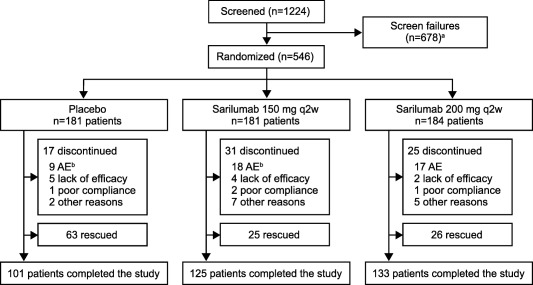
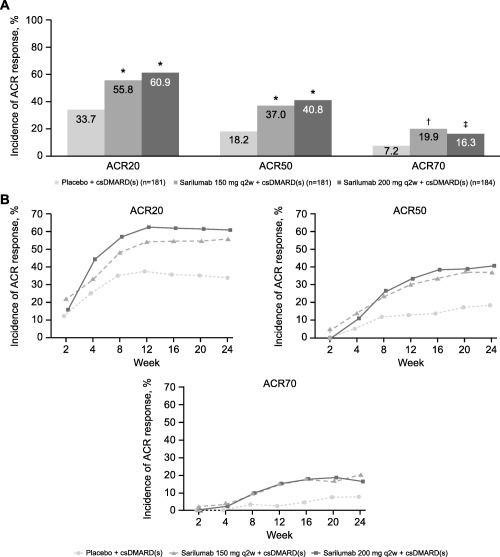
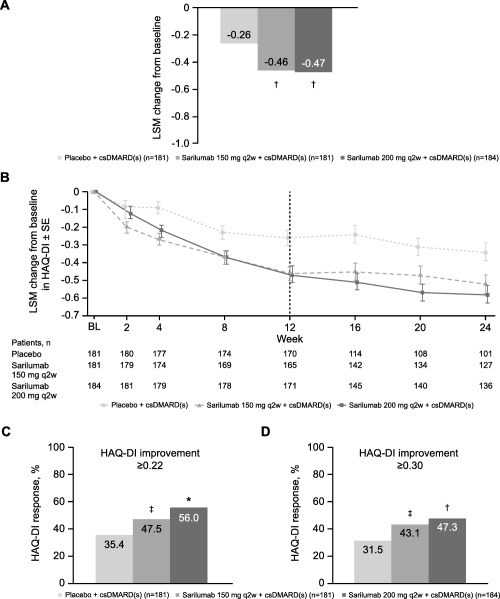
Objective: To evaluate the efficacy and safety of sarilumab plus conventional synthetic disease‐modifying antirheumatic drugs (DMARDs) in patients with active moderate‐to‐severe rheumatoid arthritis (RA) who had an inadequate response or intolerance to anti–tumor necrosis factor (anti‐TNF) therapy. Methods: Patients were randomly allocated to receive sarilumab 150 mg, sarilumab 200 mg, or placebo every 2 weeks for 24 weeks with background conventional synthetic DMARDs. The co‐primary end points were the proportion of patients achieving a response according to the American College of Rheumatology 20% criteria for improvement (ACR20) at week 24, and change from baseline in the Health Assessment Questionnaire disability index (HAQ DI) at week 12. Each sarilumab dose was evaluated against placebo; differences between the 2 sarilumab doses were not assessed. Results: The baseline characteristics of the treatment groups were similar. The ACR20 response rate at week 24 was significantly higher with sarilumab 150 mg and sarilumab 200 mg every 2 weeks compared with placebo (55.8%, 60.9%, and 33.7%, respectively; P < 0.0001). The mean change from baseline in the HAQ DI score at week 12 was significantly greater for sarilumab (least squares mean change: for 150 mg, −0.46 [ P = 0.0007]; for 200 mg, −0.47 [ P = 0.0004]) versus placebo (−0.26). Infections were the most frequently reported treatment‐emergent adverse events. Serious infections occurred in 1.1%, 0.6%, and 1.1% of patients receiving placebo, sarilumab 150 mg, and sarilumab 200 mg, respectively. Laboratory abnormalities included decreased absolute neutrophil count and increased transaminase levels in both sarilumab groups compared with placebo. In this study, reductions in the absolute neutrophil count were not associated with an increased incidence of infections or serious infections. Conclusion: Sarilumab 150 mg and sarilumab 200 mg every 2 weeks plus conventional synthetic DMARDs improved the signs and symptoms of RA and physical function in patients with an inadequate response or intolerance to anti‐TNF agents. Safety data were consistent with interleukin‐6 receptor blockade and the known safety profile of sarilumab.
Overview
The claims and statistics of this paper haven’t been checked yet.
Run the check — free, no account needed. It reads the open-access text and checks the sources it cites.
Integrity signals
Registry
Cites
Statistics
Figures
Verification
Claims the paper makes
The claims and statistics of this paper haven’t been checked yet.
Run the check — free, no account needed. It reads the open-access text and checks the sources it cites.
Claims other papers make about this one
Each is checked against this paper’s own text: does it say what the citing paper says it does?
The source backs part of the claim, not all of it — or backs it for a different population, condition or comparison.
In the citing paper
“Sarilumab, a fully human monoclonal antibody with 10- to 40-fold higher affinity for IL-6R than tocilizumab, was also approved for the treatment of RA in the EU and USA in 2017 (Fleischmann et al., 2017; Genovese et al., 2015”
From Targeting Interleukin-6 Signaling in Clinic (2019) · cites this paper as Fleischmann et al., 2017
Experimental — accuracy not yet measured
Self-check
Percentages, sums and reported differences re-computed from the paper’s own numbers.
The self-check needs the paper’s full text.
Citations
Cites
Genovese, M. C., McKay, J. D., Nasonov, E. L., Mysler, E. F., da Silva, N. A., Alecock, E., Woodworth, T., & Gomez‐Reino, J. J. (2008) · Arthritis & Rheumatism · doi:10.1002/art.23940 · Cited by 855
Inhibition of interleukin-6 receptor directly blocks osteoclast formation in vitro and in vivo
Axmann, R., Böhm, C., Krönke, G., Zwerina, J., Smolen, J., & Schett, G. (2009) · Arthritis & Rheumatism · doi:10.1002/art.24781 · Cited by 263
Research works printed but not linked: 38
- 10.1136/annrheumdis-2013-204573 · DOI
- 10.1002/art.39480 · DOI
- 10.1093/rheumatology/kes115 · DOI
- 10.1002/art.22331 · DOI
- 10.1038/nrrheum.2015.8 · DOI
- 10.1186/ar1917 · DOI
- 10.1158/2326-6066.CIR-14-0022 · DOI
- 10.1136/ard.59.suppl_1.i21 · DOI
- 10.1177/1759720X10378372 · DOI
- 10.1093/rheumatology/38.3.202 · DOI
- 10.1007/s00296-006-0143-2 · DOI
- 10.1097/00124743-199504000-00006 · DOI
- 10.1186/ar1916 · DOI
- 10.1136/ard.2008.092932 · DOI · Paper page
- 10.1136/annrheumdis-2012-202470 · DOI
- 10.1002/art.30158 · DOI
- 10.1136/annrheumdis-2011-200395 · DOI
- 10.1002/art.39093 · DOI · Paper page
- 10.1136/annrheumdis-2013-204405 · DOI
- 10.1002/art.27584 · DOI
- 10.1002/art.1780360601 · DOI
- 10.1002/art.1780380602 · DOI
- 10.1002/art.1780230202 · DOI
- 10.1002/art.1780380107 · DOI
- 10.1002/1529-0131(200007)43:7<1478::AID-ANR10>3.0.CO;2-M · DOI
- 10.1016/S0140-6736(12)61424-X · DOI
- 10.1056/NEJMoa050524 · DOI
- 10.1136/annrheumdis-2013-204920 · DOI
- 10.1093/rheumatology/keq343 · DOI
- 10.1136/annrheumdis-2013-205137 · DOI · Paper page
- 10.1136/annrheumdis-2013-204760 · DOI · Paper page
- 10.1136/ard.2008.101378 · DOI
- 10.1136/ard.2008.105197 · DOI · Paper page
- 10.1155/2014/698313 · DOI
- 10.1136/ard.2009.122374 · DOI
- 10.1016/j.berh.2007.05.007 · DOI
- 10.3899/jrheum.120573 · DOI
- Boyapati A, 2015, Evaluation of bone and joint proteins for prognostic association with radiographic progression and disease activity in methotrexate inadequate responder rheumatoid arthritis patients in a sarilumab phase 3 study [abstract], Arthritis Rheumatol, 67
Cited by
Sorted by citations
Targeting Interleukin-6 Signaling in Clinic
Kang, S., Tanaka, T., Narazaki, M., & Kishimoto, T. (2019) · Immunity · doi:10.1016/j.immuni.2019.03.026 · Cited by 904
C-reactive protein and implications in rheumatoid arthritis and associated comorbidities
Pope, J. E., & Choy, E. H. (2021) · Seminars in Arthritis and Rheumatism · doi:10.1016/j.semarthrit.2020.11.005 · Cited by 320
Metadata
- Authors
- Fleischmann, R., van Adelsberg, J., Lin, Y., Castelar‐Pinheiro, G. D. R., Brzezicki, J., Hrycaj, P., Graham, N. M. H., van Hoogstraten, H., Bauer, D., & Burmester, G. R.
- Affiliations
- Metroplex Clinical Research Center and University of Texas Southwestern Medical Center Dallas
- Regeneron Pharmaceuticals Tarrytown New York
- Sanofi Bridgewater New Jersey
- Rio de Janeiro State University Rio de Janeiro Brazil
- Centrum Kliniczno‐Badawcze Elblag Poland
- Poznań University of Medical Sciences Poznań Poland
- Charité University Medicine Free University, and Humboldt University, Berlin Germany
- Venue
- Arthritis & Rheumatology
- Publisher
- Wiley
- Published
- 2017-01-28
- Volume
- 69
- Issue
- 2
- Pages
- 277-290
- ISSN
- 2326-5191
- 2326-5205
- PMC
- PMC6207906
- Cited by
- 178
- References
- 2
- Language
- en
- Funders
- Sanofi and Regeneron Pharmaceuticals
About these checks
Registry, retraction, Cites and statistics results are computed, not judged, with one exception: a printed reference that no index lists is read once by a model before it counts as a citation error. Claims are extracted by a model and kept only when their quote appears verbatim in the text; each cited source is then checked, with a model’s help, for whether it says what the claim relies on. Those verdicts can be wrong — read the claim’s quote and the cited source before relying on one.
Statistics and arithmetic are recomputed, not judged.
Confidence bands are shown only for fields calibrated on our annotated test set. None is calibrated yet, so no band is shown.
What counts as a claim ›How we measure confidence ›How we check this ›
Are you an author, or do you see a problem with this page? Request a review
