

The DOI matches its Crossref record; 41 of the 44 references it cites were found in a registry or an index.
Sodium reduction strategies through use of meat extenders (white button mushrooms vs. textured soy) in beef patties
Open accessAbstract
Lowering the sodium content in meat products, particularly in beef patties, can be challenging because sodium plays many functional roles in these products. Meat extenders can contribute to lower sodium content by imparting complementary flavors while reducing caloric and sodium content. A systematic comparison of two meat extenders, namely mushrooms and textured soy (TSP) in terms of physical and sensory characteristics, is presented herein. The physical properties of the samples suggested that the use of mushroom and TSP extender would perform statistically similar to an all‐meat control depending on the level of substitution. Hedonic sensory analysis showed meat extension using mushrooms yielded liking scores more similar to the all‐meat formulations than TSP in reduced sodium applications. The results of this research suggest that mushrooms have the potential to be successfully incorporated into reduced sodium meat products to provide a healthier product.
Overview
The claims and statistics of this paper haven’t been checked yet.
Run the check — free, no account needed. It reads the open-access text and checks the sources it cites.
Integrity signals
Registry
Cites
Statistics
Figures
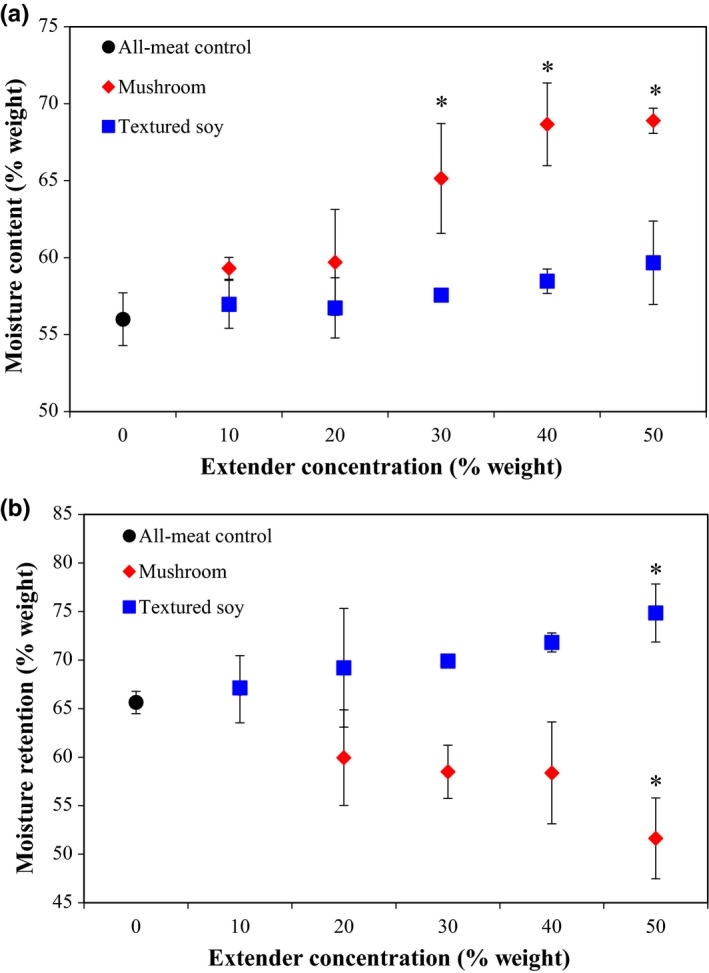
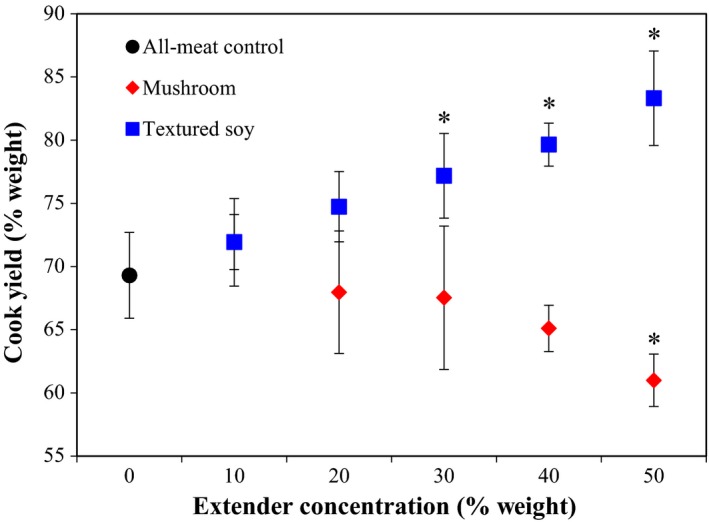
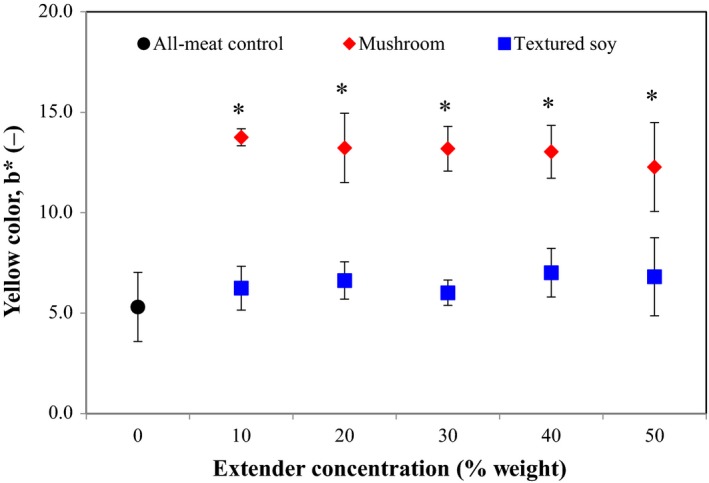
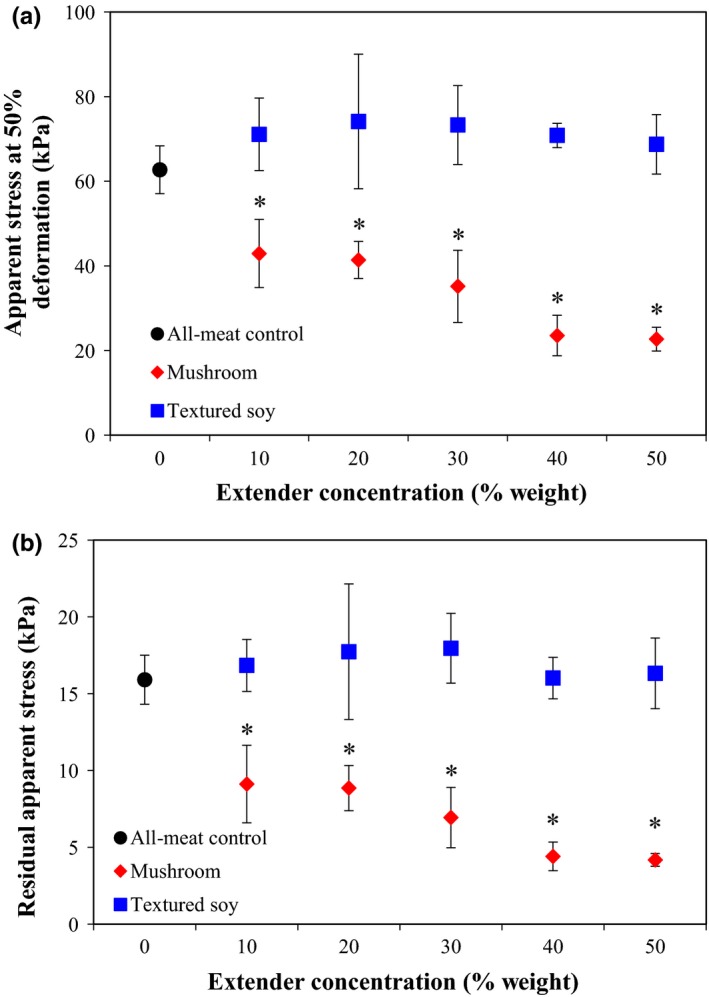
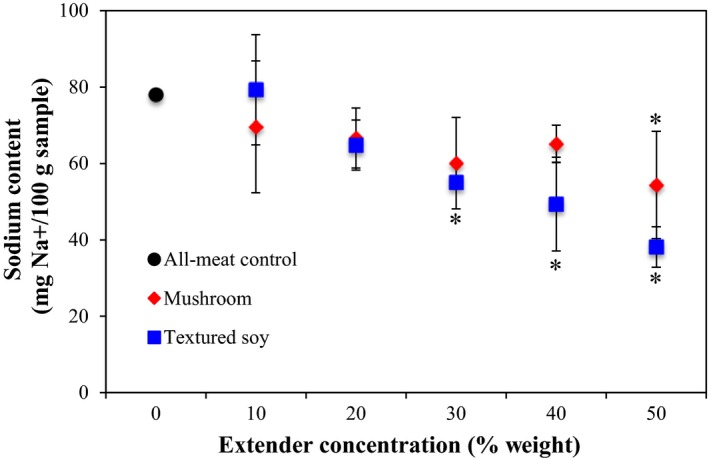
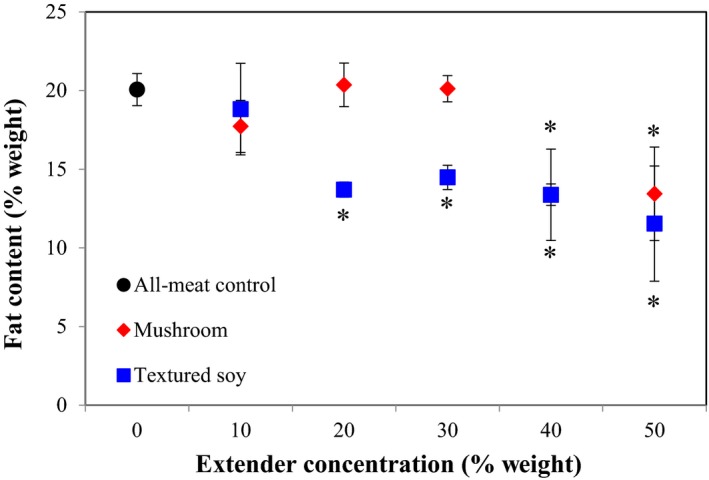
Verification
Claims the paper makes
The claims and statistics of this paper haven’t been checked yet.
Run the check — free, no account needed. It reads the open-access text and checks the sources it cites.
Claims other papers make about this one
Each is checked against this paper’s own text: does it say what the citing paper says it does?
The cited source doesn’t support the claim as written.
In the citing paper
“These findings reveal that maintaining a high sodium level in meat analogs is important for consumer acceptance in terms of flavor, although this may lower the nutritional quality of the final product.”
From Role of Sensory Evaluation in Consumer Acceptance of Plant-Based Meat Analogs and Meat Extenders: A Scoping Review (2020) · cites this paper as [31]
Checked by a reasoning model — may be wrong.
Experimental — accuracy not yet measuredThe source backs part of the claim, not all of it — or backs it for a different population, condition or comparison.
In the citing paper
“Liking scores for flavor were slightly lower in both the 20% TSP patty and the all-beef patty with reduced sodium compared to the all-beef control with regular sodium level.”
From Role of Sensory Evaluation in Consumer Acceptance of Plant-Based Meat Analogs and Meat Extenders: A Scoping Review (2020) · cites this paper as [31]
Experimental — accuracy not yet measuredThe cited source says what the claim attributes to it.
In the citing paper
“This suggests that substitution of beef with plant protein up to 30% can lead to acceptable liking scores as long as the sodium content remains unchanged.”
From Role of Sensory Evaluation in Consumer Acceptance of Plant-Based Meat Analogs and Meat Extenders: A Scoping Review (2020) · cites this paper as [31]
The cited source says what the claim attributes to it.
In the citing paper
“A first hedonic test with 55 consumers showed no significant difference in overall liking scores for all formulations compared to the all-beef control.”
From Role of Sensory Evaluation in Consumer Acceptance of Plant-Based Meat Analogs and Meat Extenders: A Scoping Review (2020) · cites this paper as [31]
Self-check
Percentages, sums and reported differences re-computed from the paper’s own numbers.
The self-check needs the paper’s full text.
Citations
Cites
Official Methods of Analysis of AOAC International
Horwitz, W., & LATIMER, G. W. (2006) · Medical Entomology and Zoology · Cited by 10,948
Official Methods of Analysis of AOAC INTERNATIONAL
(2023) · Oxford University Press eBooks · doi:10.1093/9780197610145.001.0001 · Cited by 5,942
Hedonic scale method of measuring food preferences.
Peryam, D. R., & Pilgrim, F. J. (1957) · Food technology · Cited by 1,344
Dietary Guidelines for Americans
Mosher, A. L., Piercy, K. L., Webber, B. J., Goodwin, S. K., Casavale, K. O., & Olson, R. D. (2014) · American Journal of Lifestyle Medicine · doi:10.1177/1559827614521755 · Cited by 868
Reducing salt: A challenge for the meat industry
Desmond, E. (2006) · Meat Science · doi:10.1016/j.meatsci.2006.04.014 · Cited by 815
Reducing sodium intake from meat products
Ruusunen, M., & Puolanne, E. (2005) · Meat Science · doi:10.1016/j.meatsci.2004.07.016 · Cited by 606
El-Magoli, S. B., Laroia, S., & HANSEN, P. M. T. (1996) · Meat Science · doi:10.1016/0309-1740(95)00032-1 · Cited by 259
Reducing the fat content in ground beef without sacrificing quality: A review
Brewer, M. S. (2012) · Meat Science · doi:10.1016/j.meatsci.2012.02.024 · Cited by 194
Trout, G. R., & Schmidt, G. R. (1984) · Journal of Food Science · doi:10.1111/j.1365-2621.1984.tb13189.x · Cited by 162
Ruusunen, M., Vainionpää, J., Lyly, M., Lähteenmäki, L., Niemistö, M., Ahvenainen, R. T., & Puolanne, E. (2004) · Meat Science · doi:10.1016/j.meatsci.2004.06.005 · Cited by 146
Research works printed but not linked: 8
- Angus F., 2005, Salt in processed foods: collaborative research project, Leatherhead Food International
- Barbosa C.C., 2015, Sensory profile of beef beef with reduced sodium content, Acta Scientarium, 37, 301
- Bobe I.U., 2011, Proceedings of the 11th International congress on engineering and food, 687e688
- Campbell JF. (1979).Binding properties of meat blends effects of salt type blending time and post‐blending storage. Ph.D. Thesis Michigan State University.
- Centers for Disease Control and Prevention, 2016, Leading causes of death
- Lutz G.D.(2005).Personal communication: Alberger salt improves protein functionality in meat blends: Technical Bulletin.
- Madril M. T., 1985, Antimicrobial and functional effects of six polyphosphates in reduced NaCl comminuted meat products, Lebensmittel Wissenschaft und Technologie, 18, 316
- U.S. Department of Agriculture, 2007, Keep food safe: Food safety basics, 2010
Cited by
Sorted by citations
Fiorentini, M., Kinchla, A. J., & Nolden, A. A. (2020) · Foods · doi:10.3390/foods9091334 · Cited by 398
“[31] SPC, WG Beef-like mince 55 New Zealand Chiang et al.”
BackgroundSelf-citationGiacalone, D., Clausen, M. P., & Jaeger, S. R. (2022) · Current Opinion in Food Science · doi:10.1016/j.cofs.2022.100919 · Cited by 260
Das, A. K., Nanda, P. K., Dandapat, P., Bandyopadhyay, S., Gullón, P., Sivaraman, G. K., McClements, D. J., Gullón, B., & Lorenzo, J. M. (2021) · Molecules · doi:10.3390/molecules26092463 · Cited by 212
Edible mushrooms as a novel trend in the development of healthier meat products
Pérez-Montes, A., Rangel‐Vargas, E., Lorenzo, J. M., Romero, L., & Santos, E. M. (2020) · Current Opinion in Food Science · doi:10.1016/j.cofs.2020.10.004 · Cited by 149
Current trends, limitations and future research in the fungi?
Hyde, K. D., Baldrián, P., Chen, Y., Chethana, K. W. T., de Hoog, S., Doilom, M., de Farias, A. R. G., Gonçalves, M. F. M., Gonkhom, D., Gui, H., et al. (2024) · Fungal Diversity · doi:10.1007/s13225-023-00532-5 · Cited by 148
Part Meat and Part Plant: Are Hybrid Meat Products Fad or Future?
Grasso, S., & Jaworska, S. (2020) · Foods · doi:10.3390/foods9121888 · Cited by 133
Towards More Sustainable Meat Products: Extenders as a Way of Reducing Meat Content
Pintado, T., & Delgado‐Pando, G. (2020) · Foods · doi:10.3390/foods9081044 · Cited by 115
Edible Mushrooms as a Natural Source of Food Ingredient/Additive Replacer
Rangel‐Vargas, E., Rodríguez, J. A., Domínguez, R., Lorenzo, J. M., Sosa‐Morales, M. E., Andrés, S. C., Rosmini, M. R., Pérez‐Álvarez, J. Á., Teixeira, A. D. C., & Santos, E. M. (2021) · Foods · doi:10.3390/foods10112687 · Cited by 90
Yuan, X., Jiang, W., Zhang, D., Liu, H., & Sun, B. (2021) · Foods · doi:10.3390/foods11010052 · Cited by 87
Effects of umami substances as taste enhancers on salt reduction in meat products: A review
Ma, F., Li, Y., Zhang, Y., Zhang, Q., Li, X., Cao, Q., Ma, H., Xie, D., Zhang, B., Yu, J., et al. (2024) · Food Research International · doi:10.1016/j.foodres.2024.114248 · Cited by 71
Patinho, I., Saldaña, E., Selani, M. M., de Camargo, A. C., Merlo, T. C., Menegali, B. S., Silva, A. P. D. S., & Contreras-Castillo, C. J. (2019) · Food Production Processing and Nutrition · doi:10.1186/s43014-019-0006-3 · Cited by 63
Compendium of sodium reduction strategies in foods: A scoping review
Dunteman, A. N., McKenzie, E., Yang, Y., Lee, Y., & Lee, S. (2022) · Comprehensive Reviews in Food Science and Food Safety · doi:10.1111/1541-4337.12915 · Cited by 57
Khan, A. W., Roobab, U., Wang, Z., Raza, M. M., Nawazish, H., Islam, F., & Aadil, R. M. (2024) · Trends in Food Science & Technology · doi:10.1016/j.tifs.2024.104695 · Cited by 47
Edible mushrooms: A sustainable novel ingredient for meat analogs
Singh, U., Tiwari, P., Kelkar, S., Kaul, D., Tiwari, A., Kapri, M., & Sharma, S. (2023) · eFood · doi:10.1002/efd2.122 · Cited by 53
Sogari, G., Li, J., Wang, Q., Lefebvre, M., Huang, S., Mora, C., & Gomez, M. I. (2022) · Meat Science · doi:10.1016/j.meatsci.2022.108745 · Cited by 37
Modgil, R., Tanwar, B., Goyal, A., & Kumar, V. (2020) · Springer eBooks · doi:10.1007/978-981-15-4194-0_1 · Cited by 52
Evaluating the sensory properties of hybrid (meat and plant‐based) burger patties
Chin, S. W., Baier, S. K., Stokes, J. R., & Smyth, H. E. (2024) · Journal of Texture Studies · doi:10.1111/jtxs.12819 · Cited by 32
Rocchetti, G., Ferronato, G., Sarv, V., Kerner, K., Venskutonis, P. R., & Lucini, L. (2022) · Current Opinion in Food Science · doi:10.1016/j.cofs.2022.100967 · Cited by 30
Niimi, J., Sörensen, V., Mihnea, M., Valentin, D., Bergman, P., & Collier, E. S. (2022) · Food Quality and Preference · doi:10.1016/j.foodqual.2022.104563 · Cited by 28
Du, X., Muniz, A., Davila, M., & Juma, S. (2021) · ACS Food Science & Technology · doi:10.1021/acsfoodscitech.1c00229 · Cited by 26
Samarasiri, M. H., & Chen, W. N. (2022) · Critical Reviews in Food Science and Nutrition · doi:10.1080/10408398.2022.2132211 · Cited by 25
Chan, E., Rodas‐González, A., Tulbek, M. C., & Köksel, F. (2023) · International Journal of Food Science & Technology · doi:10.1111/ijfs.16593 · Cited by 25
Botella-Martínez, C. M., Muñoz-Tébar, N., Lucas‐González, R., Pérez‐Álvarez, J. Á., Fernández‐López, J., & Viuda‐Martos, M. (2023) · Foods · doi:10.3390/foods12193591 · Cited by 24
Tokarczyk, G., Felisiak, K., Adamska, I., Przybylska, S., Hrebień-Filisińska, A. M., Biernacka, P., Bieńkiewicz, G., & Tabaszewska, M. (2023) · Molecules · doi:10.3390/molecules28196975 · Cited by 23
Boro, S., Vivek, K., Das, S. R., & Saikia, D. (2025) · Food Research International · doi:10.1016/j.foodres.2025.116632 · Cited by 24
Exploring Text Mining for Recent Consumer and Sensory Studies about Alternative Proteins
Chen, Z., Gurdian, C. E., Sharma, C., Prinyawiwatkul, W., & Torrico, D. D. (2021) · Foods · doi:10.3390/foods10112537 · Cited by 20
New Insights and Strategies in the Nutritional Reformulation of Meat Products Toward Healthier Foods
Ayuso, P., García-Pérez, P., & Nieto, G. (2025) · Molecules · doi:10.3390/molecules30122565 · Cited by 21
Du, X., Muniz, A., Sissons, J., Wang, W., & Juma, S. (2021) · Food Science & Nutrition · doi:10.1002/fsn3.2105 · Cited by 17
Fungi as biotechnological allies: Exploring contributions of edible and medicinal mushrooms
Barua, R. C., Coniglio, R. O., Molina, M. A., Díaz, G. V., & Fonseca, M. I. (2024) · Journal of Food Science · doi:10.1111/1750-3841.17390 · Cited by 16
Jadeja, R., Teng, X. M., Mohan, A., & Duggirala, K. (2022) · Current Opinion in Food Science · doi:10.1016/j.cofs.2022.100938 · Cited by 16
Tkaczewska, J., Mungure, T. E., & Warner, R. D. (2024) · Critical Reviews in Food Science and Nutrition · doi:10.1080/10408398.2024.2430750 · Cited by 15
Lin, W., & Barbut, S. (2025) · Applied Food Research · doi:10.1016/j.afres.2025.100747 · Cited by 15
Nie, T., Gao, Y., Gao, Y., Wang, W., Wang, Z., Zhang, H., Chen, H., Wang, S., & Sun, B. (2025) · Food Chemistry · doi:10.1016/j.foodchem.2025.145155 · Cited by 15
Muniz, A., Du, X., & Shanks, M. (2021) · Journal of the Science of Food and Agriculture · doi:10.1002/jsfa.11332 · Cited by 13
Mushroom: an emerging source for next generation meat analogues
Panda, J., Nath, P. C., Mishra, A. K., Rustagi, S., Nayak, D., Blundell, R. A., & Mohanta, Y. K. (2025) · Frontiers in Nutrition · doi:10.3389/fnut.2025.1638121 · Cited by 12
Flavor compounds, free amino acids, and proteins in Agaricus bisporus mushroom powder
Davila, M., Routray, J., Beatty, J., & Du, X. (2022) · Journal of Food Bioactives · doi:10.31665/jfb.2022.18325 · Cited by 11
Boylu, M., Hitka, G., & Kenesei, G. (2024) · Foods · doi:10.3390/foods13132115 · Cited by 11
Nyaguthii, K. C., Omwamba, M. N., & Nduko, J. M. (2023) · Food and Humanity · doi:10.1016/j.foohum.2023.11.010 · Cited by 11
Recent Developments in Sensory Assessment and Consumer Preference Techniques
Bareen, M. A., Prasannakumaran, K. M., & Sahu, J. K. (2025) · Food engineering series · doi:10.1007/978-3-031-75834-8_14 · Cited by 10
Nan, H., Zhou, H., Li, B., Stepanova, T., & KONDRATIUK, N. (2022) · Food Science and Technology · doi:10.1590/fst.116121 · Cited by 10
Chan, E., Sinaki, N. Y., Rodas‐González, A., Tulbek, M. C., & Köksel, F. (2023) · International Journal of Food Science & Technology · doi:10.1111/ijfs.16856 · Cited by 9
Chen, X., & Xu, B. (2024) · Food & Function · doi:10.1039/d4fo00891j · Cited by 9
Chaffee, O., & Ardoin, R. (2025) · Current Research in Food Science · doi:10.1016/j.crfs.2025.101058 · Cited by 8
Akesowan, A., & Jariyawaranugoon, U. (2021) · Food Research · doi:10.26656/fr.2017.5(1).380 · Cited by 8
Moazzam, M., Ali, S., Khan, M. A., Waseem, M., Javed, M. R., Rajput, N. A., Alsulami, T. S., Nauman, K., & Tutu, C. O. (2025) · Food Science & Nutrition · doi:10.1002/fsn3.71327 · Cited by 7
Akesowan, A. (2021) · Journal of Food Science and Technology · doi:10.1007/s13197-021-04965-1 · Cited by 7
Muniz, A., & Du, X. (2021) · ACS Food Science & Technology · doi:10.1021/acsfoodscitech.1c00187 · Cited by 7
Cultivation and Nutrient Compositions of Medicinal Mushroom, Hericium erinaceus in Thailand
Gonkhom, D., Luangharn, T., Stadler, M., & Thongklang, N. (2024) · Chiang Mai Journal of Science · doi:10.12982/cmjs.2024.028 · Cited by 6
Yang, P., Zhao, Q., Chen, J., Chen, S., Liu, D., Ye, X., & Cheng, H. (2025) · Critical Reviews in Food Science and Nutrition · doi:10.1080/10408398.2025.2547284 · Cited by 6
Market needs and consumer’s preferences for healthier foods
Eduardo, K., Aredo, V., Rios-Mera, J. D., Ambrosio, C. M. S., Siché, R., & Saldaña, E. (2023) · Elsevier eBooks · doi:10.1016/b978-0-443-15346-4.00013-6 · Cited by 7
The Potential of Cultivated Mushrooms as Salt Substitutes in Meat Products
Fernández‐López, J., Viuda‐Martos, M., Botella-Martínez, C. M., Muñoz-Bas, C., Bermúdez-Gómez, P., Lucas‐González, R., & Pérez‐Álvarez, J. Á. (2025) · Foods · doi:10.3390/foods14060977 · Cited by 6
From forest to fork: a systematic review of mushroom-based meat analogues
Fetriyuna, F., Rafi, A. Z., Zaida, Z., Purwestri, R. C., & Sikin, A. M. (2025) · International Journal of Food Science & Technology · doi:10.1093/ijfood/vvaf030 · Cited by 4
Salt reduction and replacers in food production
Fernández‐López, J., Pateiro, M., Pérez‐Álvarez, J. Á., Santos, E. M., Teixeira, A. D. C., & Viuda‐Martos, M. (2023) · Elsevier eBooks · doi:10.1016/b978-0-443-15346-4.00003-3 · Cited by 4
Umami and Salty: A Cooperative Pair
Dunteman, A. N., & Lee, S. (2023) · Food and health · doi:10.1007/978-3-031-32692-9_4 · Cited by 2
Effect of NaCl replacement on physicochemical and sensory properties of the traditional cured coppa
Domenico, J. D., Lunkes, A. M., da Rocha, B. R. P., do Prado, N. V., Weber, C. I., & Lucchetta, L. (2024) · Evidência · doi:10.18593/evid.33247 · Cited by 1
Thakur, M., Andola, H. C., & Sanches-Silva, A. T. (2024) · Food Chemistry · doi:10.1016/j.foodchem.2024.142162 · Cited by 1
Physical properties of sausage analogues made with quinoa and cañihua flours, by extrusion
Aviles, J., Tacca, A. M. L., & Medina, W. T. (2025) · Revista de la Facultad de Agronomía · doi:10.47280/revfacagron(luz).v42.n4.ii · Cited by 1
Urban mushroom farming for future foods: safety considerations and nutritional benefits
Samarasiri, M. H., & Chen, W. N. (2026) · Sustainable Microbiology · doi:10.1093/sumbio/qvag009 · Cited by 1
Pandey, S., Budhathoki, M., Olsen, K., & Thomsen, M. (2026) · Cleaner Food Systems · doi:10.1016/j.clfs.2026.100024 · Cited by 1
Devi, K. J., Khayer, S. M., Sinha, M., Semmichon, S. K., Choudhury, M., Boro, R. C., & Gogoi, M. (2026) · Journal of Food Measurement & Characterization · doi:10.1007/s11694-026-04593-3 · Cited by 1
Upcycled Mushroom Stems as a Substrate for Sustainable Seafood Analogs
Nguyen, T., Nguyen, N. T. K., Jha, K., Li, M., Wu, T., & Munafo, J. P. (2026) · ACS Food Science & Technology · doi:10.1021/acsfoodscitech.6c00409 · Cited by 1
Patinho, I. (2020) · Digital Library of Theses and Dissertations (Universidade de São Paulo) · doi:10.11606/d.11.2020.tde-17032020-152953
THE RELEVANCE OF RESEARCH THE PROGRESS ON THE APPLICATION OF MUSHROOM IN MEAT PRODUCTS PROCESSING
Bandura, I., & Кошель, О. Ю. (2023) · Herald of Khmelnytskyi National University Technical sciences · doi:10.31891/2307-5732-2023-323-4-377-384
Sensory aspects and oral processing of plant-based proteins
Boehm, M. W., Forster, R. A., Baier, S. K., Stokes, J. R., Smyth, H. E., Tahsin, N., & Carpenter, G. H. (2025) · Elsevier eBooks · doi:10.1016/b978-0-323-91725-4.00008-4
Li, M., Zhou, K., Nian, L., Xie, Y., Zhou, H. M., & Xu, B. (2026) · Food Reviews International · doi:10.1080/87559129.2026.2635615
Coşansu, S., Osoria, M., & Juneja, V. K. (2026) · Journal of Food Protection · doi:10.1016/j.jfp.2026.100828
Textural Effects of Substituting Beef With Soy Proteins in Burger Patties
Hilbig, S., Weiß, J., & Barbut, S. (2026) · Journal of Food Quality · doi:10.1155/jfq/5237360
Gashi, A., Kenesei, G., Boylu, M., Mednyánszky, Z., & Simon‐Sarkadi, L. (2026) · ChemFoodChem · doi:10.1002/cfch.70038
Metadata
- Authors
- Wong, K. M., Corradini, M. G., Autio, W., & Kinchla, A. J.
- Affiliations
- University of Massachusetts Amherst (US)
- Corresponding author
- Kinchla, Amanda J.
- Venue
- Food Science & Nutrition
- Publisher
- Wiley
- Published
- 2019-01-21
- Volume
- 7
- Issue
- 2
- Pages
- 506-518
- ISSN
- 2048-7177 (ISSN-L)
- PMC
- PMC6392865
- OpenAlex
- W2914747199
- Cited by
- 70
- References
- 44
- Citations by year
- 2026: 8 · 2025: 13 · 2024: 11 · 2023: 10 · 2022: 9 · 2021: 11 · 2020: 6 · 2019: 2
- FWCI
- 5.70
- Type
- journal article
- Language
- en
- Open access
- hybrid
- doi.org
- Locations
- Food Science & Nutrition (publishedVersion, cc-by)
- Europe PMC (PubMed Central) (publishedVersion, cc-by)
- PubMed Central (publishedVersion, cc-by)
- PubMed (publishedVersion)
- DOAJ (DOAJ: Directory of Open Access Journals) (submittedVersion, cc-by-sa)
- Informationszentrum Lebenswissenschaften (ZB MED) (submittedVersion, cc-by)
- Funders
- National Institute of Food and Agriculture
- U.S. Department of Agriculture
- University of Massachusetts (MAS00493)
- Topics
- Life Sciences › Agricultural and Biological Sciences › Animal Science and Zoology › Meat and Animal Product Quality
- Health Sciences › Nursing › Nutrition and Dietetics › Sodium Intake and Health
- Life Sciences › Agricultural and Biological Sciences › Food Science › Food Nutrient Composition and Product Development
- Keywords
- sodium reduction, meat extender, Agaricus bisporus, textured soy protein, beef patties, meat product formulation, sensory evaluation, physical properties, low-sodium meat products
About these checks
Registry, retraction, Cites and statistics results are computed, not judged, with one exception: a printed reference that no index lists is read once by a model before it counts as a citation error. Claims are extracted by a model and kept only when their quote appears verbatim in the text; each cited source is then checked, with a model’s help, for whether it says what the claim relies on. Those verdicts can be wrong — read the claim’s quote and the cited source before relying on one.
Statistics and arithmetic are recomputed, not judged.
Confidence bands are shown only for fields calibrated on our annotated test set. None is calibrated yet, so no band is shown.
What counts as a claim ›How we measure confidence ›How we check this ›
Are you an author, or do you see a problem with this page? Request a review
