

Climate Change and the Rise and Fall of the Oxus Civilization in Southern Central Asia
Open accessThe DOI matches its Crossref record; 111 of the 113 references it cites were found in a registry or an index, and 2 are not checked yet; 1 of the 74 sources its claims cite were checked for support.
Abstract
During the Final Bronze Age (around 3750/3700 BP), the proto-urban sedentary cultural entity in southern Central Asia—known as the Oxus civilization or Bactria-Margiana Archaeological Complex—underwent major social transformations in different field aspects leading to a deep cultural change in the middle of the 4th millennium BP. Among the different reasons suggested to explain these sociocultural changes, the hypothesis of global climate change in Central Asia at the beginning of the 4th millennium BP has been emphasized by different scholars. In this paper, I will examine current paleo-environmental data in relation with the climate evolution during the Mid- and Late Holocene. A critical assessment of the hypothesis of climatic change in Central Asia at the beginning of the 4th millennium BP allows to stimulate the discussion anew. I argue that the present data do not support a drastic climate change during the first half of the 4th millennium BP as a responsible factor for the fall of the Oxus civilization, although local environmental modifications should also not be underestimated and further investigated in a more integrated perspective of co-evolution of the ecological environment and the human societies.
Verified 2026-11-22 · 2 references not checked yet
Overview
CoChat Summary
TL;DR
Luneau critically reviews paleoenvironmental and archaeological evidence and argues that current data do not support a drastic climate change in the first half of the 4th millennium BP as the cause of the Oxus civilization’s fall. The paper instead emphasizes local environmental variability, human adaptation/resilience, and multiple converging causes.
Key findings
- The Oxus civilization/BMAC developed ca. 4250–3350 BP; from c. 3750/3650 BP it underwent major sociocultural transformations, with last cultural features disappearing around 3400/3350 BP, a long transitional reconfiguration rather than an abrupt collapse.
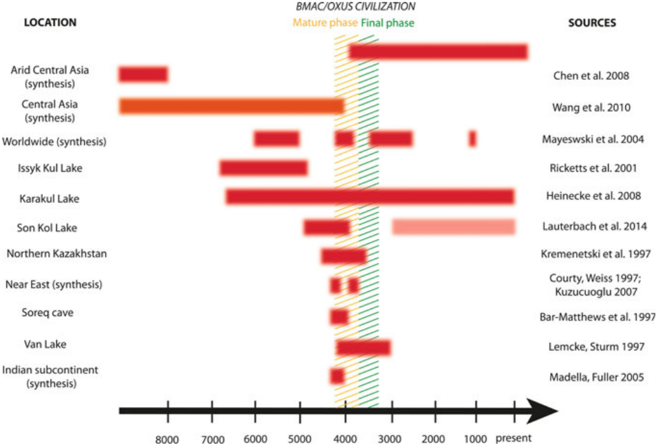
- Current palaeoclimatic data show a generally wetter Mid-Holocene with rapid changes; the well-attested 4.2 ka BP aridification may have affected the early Oxus period, while the last phase (ca. 3750–3350 BP) could have been relatively climatically stable, so no clear coincidence with the “collapse” is inferred.
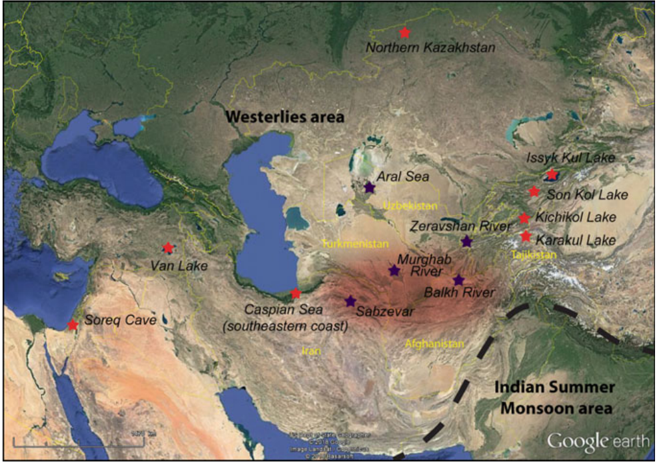
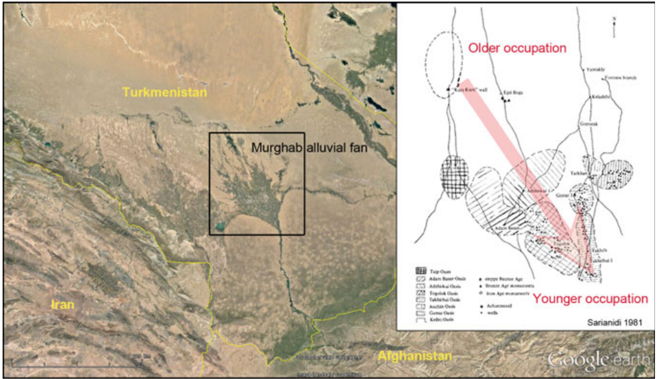
- Geomorphological studies in the Murghab alluvial fan, Balkh, Zerafshan, Sabzevar, and Aral Sea areas mostly record permanency in occupation/water availability or climate variation at the end of the 5th millennium BP, not a clear early-4th-millennium BP drought.
- The paper argues single climatic causation is inappropriate; sociocultural changes involved settlement, material culture, sociopolitical organization, exchange, ideology, and subsistence, likely from multiple causes including mobile population interactions and local adaptations.
Methods
- Design: critical review/cross-over study combining archaeological evidence with current palaeoclimatic and geomorphological data; no new primary data collection.
- Data: published palaeoclimate records from Central Asia and adjacent regions (e.g., lake records such as Issyk Kul, Karakul, Son Kol, Kichikol; Caspian sea-level; eastern Mediterranean speleothems/soils; Kazakhstan records) and geomorphological/geoarchaeological studies in southern Central Asia and northern Iran.
- Analysis: compares timing and spatial patterns of environmental records with the archaeological chronology of Oxus transformations, assessing whether a climatic event correlates with the sociocultural changes.
Limitations
- Stated: Central Asian records are still patchy; more local and detailed palaeoclimatic studies from southern Central Asia are lacking; temporal uncertainty currently prevents adequate temporal and spatial climatic reconstruction.
- Stated: previous assumptions rest on few solid studies concerning climate evolution, specific ecology, settlement duration, and prehistoric water management; further long-term field investigation is needed.
- Evident from the text: the argument is a synthesis/review rather than a new empirical test, and correlation between climate and social change remains difficult because local high-resolution records for the Oxus core area are absent and climate impacts are spatially variable.
Model-written summary. Check it against the paper before relying on it.
Integrity signals
Registry
Cites
Statistics
Figures
Verification
Claims the paper makes
1 Valid · 16 Not valid · 51 Not checked · 36 Own results and interpretations
Every source the paper cites for this claim was checked and supports it.
In the paper
“The development of the Lake Karakul in Tajikistan marked by a reduction of the lake levels from 6600 BP suggests a similar aridification of the climate (Heinecke et al. 2016).”
What the sources say
- Supportedcites Heinecke et al. 2016 matched to “Late Pleistocene to Holocene climate and limnological changes at Lake Karakul (Pamir Mountains, Tajikistan)” (2016) source
Section 5.3.3 ("6.6 cal kyr BP until present") states that continuously decreasing Fe/Mn ratios point to a decreasing lake level, that "The inferred lower lake level after 6.6 cal kyr BP likely resulted from a weaker Monsoon ... and from reduced meltwater inflow", and that "The lake interior development is assumed to be mainly related to the aridification of climate during the last 6.6 cal kyr BP." The Conclusions repeat "reducing lake levels from 6.7 cal kyr BP onwards", and the Abstract links Westerlies-dominated sediment input from 6.7 cal kyr BP to an arid climate. The citing sentence's hedged "suggests" matches the source's own hedged attribution, and 6600 BP corresponds to the paper's 6.6 cal kyr BP; the word "similar" reflects the citing paper's own comparison and is not part of what is attributed here. (LLM, conf=0.88)
hedgedstates an associationSingle case- Asserted: passes — The authors put it forward as true.
- Checkable: passes — It can be checked against evidence.
- Load-bearing: unclear — It is unclear whether the paper’s conclusions depend on it.
- Based: passes — The paper gives a reason why it holds.
- Supported
A result the paper states — it cites no source for it, so there is none to check. The quote shows it is in the paper.
In the paper
“Modifications are likewise clearly visible in the sociopolitical organization with the disappearance of social status markers, in connection with the slackening of the long-distance exchange networks.”
boostedstates an association- Asserted: passes — The authors put it forward as true.
- Checkable: passes — It can be checked against evidence.
- Load-bearing: passes — The paper’s conclusions depend on it.
- Based: passes — The paper gives a reason why it holds.
A result the paper states — it cites no source for it, so there is none to check. The quote shows it is in the paper.
In the paper
“A less cultural homogeneity over the whole territory of the Oxus civilization is also noticeable.”
plain- Asserted: passes — The authors put it forward as true.
- Checkable: passes — It can be checked against evidence.
- Load-bearing: unclear — It is unclear whether the paper’s conclusions depend on it.
- Based: passes — The paper gives a reason why it holds.
None of the sources cited for this claim have been checked yet.
In the paper
“Trade appears to have been more active among the mobile populations referred to as belonging to the 'Andronovo Cultural Community' than with the Middle Eastern cultures, as was previously the case.”
hedgedstates an association- Asserted: passes — The authors put it forward as true.
- Checkable: passes — It can be checked against evidence.
- Load-bearing: unclear — It is unclear whether the paper’s conclusions depend on it.
- Based: passes — The paper gives a reason why it holds.
The paper states this without a source or data behind it here, so there is nothing to check it against. The quote shows it is in the paper.
In the paper
“The ceramic production was affected by a higher variability.”
plainstates a cause- Asserted: passes — The authors put it forward as true.
- Checkable: passes — It can be checked against evidence.
- Load-bearing: unclear — It is unclear whether the paper’s conclusions depend on it.
- Based: unclear — It is unclear why the paper says it holds.
32 more claims
Create a free account to see all 104 claims and to verify the 48 references still open.
- Probably not a substantial claim. 33
- It may state two separate claims as one. 48
Self-check
Percentages, sums and reported differences re-computed from the paper’s own numbers.
Each contradiction between two passages listed here was confirmed by an independent check.
Rated minor: it would not touch a result — a value no result rests on, a p-value that stays on the same side of the significance level, or a conflict that is clerical, resolved elsewhere in the paper, or outside its own findings.
In the paper
§ 14.5 The Environmental Hypothesis as Responsible for the Changes of the Oxus Civilization · p. 7
“the climatic conditions were more humid during the Mid-Holocene, 2 between 8950 and 3950 BP.”
§ 14.5 The Environmental Hypothesis as Responsible for the Changes of the Oxus Civilization · p. 7
“the Early Holocene (11,700-8200 BP), the Mid-Holocene (8200-4200 BP) and the Late Holocene (4200 BP-present).”
Citations
Cites
Proceedings of the National Academy of Sciences of the United States of America
Dowling, J. E., & Wald, G. (2009) · Nutrition Reviews · doi:10.1111/j.1753-4887.1981.tb06752.x · Cited by 17,893
Mayewski, P. A., Rohling, E. E., Curt Stager, J., Karlén, W., Maasch, K. A., Meeker, L. D., Meyerson, E. A., Gasse, F., van Kreveld, S., Holmgren, K., et al. (2004) · Quaternary Research · doi:10.1016/j.yqres.2004.07.001 · Cited by 2,587
Chen, F., Yu, Z., Yang, M., Ito, E., Wang, S., Madsen, D. B., Huang, X., Zhao, Y., Sato, T., John B. Birks, H., et al. (2008) · Quaternary Science Reviews · doi:10.1016/j.quascirev.2007.10.017 · Cited by 1,249 · cited 2×
“The synthesis of palaeoclimate records in Arid Central Asia from the Caspian Sea borders to Mongolia (Chen et al. 2008) reveals global tendencies, with a dry climate in the earlyHolocene (until ca. 8000BP), followed bymaximum-moisture conditions in the Mid-Holocene (ca. 8000–4000 BP), before decreasingmoisture in the…”
BackgroundCultural Responses to Climate Change During the Late Holocene
deMenocal, P. B. (2001) · Science · doi:10.1126/science.1059287 · Cited by 1,207
Oriental Despotism: A Comparative Study of Total Power
Timasheff, N. S., & Wittfogel, K. H. (1958) · Russian Review · doi:10.2307/126034 · Cited by 1,159
Walker, M. J. C., Berkelhammer, M., Björck, S., Cwynar, L. C., Fisher, D. A., Long, A. J., Lowe, J. J., Newnham, R. M., Rasmussen, S. O., & Weiss, H. (2012) · Journal of Quaternary Science · doi:10.1002/jqs.2565 · Cited by 919 · cited 1×
“It is commonly divided into three sub-periods (Walker et al. 2012): the Early Holocene (11,700–8200 BP), the Mid-Holocene (8200–4200 BP) and the Late Holocene (4200 BP–present).”
BackgroundClimate change and the collapse of the Akkadian empire: Evidence from the deep sea
Cullen, H. M., deMenocal, P. B., Hemming, S., Hemming, G., Brown, F. H., Guilderson, T., & Sirocko, F. (2000) · Geology · doi:10.1130/0091-7613(2000)028<0379:ccatco>2.3.co;2 · Cited by 807
Climate and the Collapse of Maya Civilization
Haug, G. H., Günther, D., Peterson, L. C., Sigman, D. M., Hughen, K. A., & Aeschlimann, B. (2003) · Science · doi:10.1126/science.1080444 · Cited by 783
Bar-Matthews, M., Ayalon, A., & Kaufman, A. (1997) · Quaternary Research · doi:10.1006/qres.1997.1883 · Cited by 721
Oriental Despotism-A Comparative Study of Total Power.
Friedrich, C. J., & Wittfogel, K. A. (1958) · American Slavic and East European Review · doi:10.2307/3000842 · Cited by 515
Archaeological Landscapes of the Near East
WILKINSON, T. J. (2003) · doi:10.2307/j.ctv1jf2ddx · Cited by 507
Third Millennium BC Climate Change and Old World Collapse
(1997) · Springer eBooks · doi:10.1007/978-3-642-60616-8 · Cited by 486
Collapse, environment, and society
Butzer, K. W. (2012) · Proceedings of the National Academy of Sciences · doi:10.1073/pnas.1114845109 · Cited by 461
The climatic cyclicity in semiarid‐arid central Asia over the past 500,000 years
Cheng, H., Zhang, P. Z., Spötl, C., Edwards, R. L., Cai, Y. J., Zhang, D. Z., Sang, W. C., Tan, M., & An, Z. S. (2012) · Geophysical Research Letters · doi:10.1029/2011gl050202 · Cited by 434
Roberts, N., Eastwood, W. J., Kuzucuoğlu, C., Fiorentino, G., & Caracuta, V. (2011) · The Holocene · doi:10.1177/0959683610386819 · Cited by 408
The Making of Bronze Age Eurasia
Kohl, P. L. (2007) · Cambridge University Press eBooks · doi:10.1017/cbo9780511618468 · Cited by 368
Climate Variation and the Rise and Fall of an Andean Civilization
Binford, M. W., Kolata, A. L., Brenner, M., Janusek, J. W., Seddon, M. T., Abbott, M., & Curtis, J. H. (1997) · Quaternary Research · doi:10.1006/qres.1997.1882 · Cited by 354
Wang, Y., Liu, X., & Herzschuh, U. (2010) · Earth-Science Reviews · doi:10.1016/j.earscirev.2010.09.004 · Cited by 350
Fluvial landscapes of the Harappan civilization
Giosan, L., Clift, P. D., Macklin, M. G., Fuller, D. Q., Constantinescu, S., Durcan, J. A., Stevens, T., Duller, G. A. T., Tabrez, A. R., Gangal, K., et al. (2012) · Proceedings of the National Academy of Sciences · doi:10.1073/pnas.1112743109 · Cited by 327
Bar-Matthews, M., & Ayalon, A. (2011) · The Holocene · doi:10.1177/0959683610384165 · Cited by 313
Questioning Collapse: Human Resilience, Ecological Vulnerability, and the Aftermath of Empire
(2009) · Cambridge University Press eBooks · doi:10.1017/cbo9780511757815 · Cited by 309
Early agriculture and crop transmission among Bronze Age mobile pastoralists of Central Eurasia
Spengler, R., Frachetti, M., Doumani, P., Rouse, L., Cerasetti, B., Bullion, E., & Mar'yashev, A. (2014) · Proceedings of the Royal Society B: Biological Sciences · doi:10.1098/rspb.2013.3382 · Cited by 309
Crisis in Context: The End of the Late Bronze Age in the Eastern Mediterranean
Knapp, A. B., & Manning, S. W. (2016) · American Journal of Archaeology · doi:10.3764/aja.120.1.0099 · Cited by 292
Gessner, U., Naeimi, V., Klein, I., Kuenzer, C., Klein, D., & Dech, S. (2013) · Global and Planetary Change · doi:10.1016/j.gloplacha.2012.09.007 · Cited by 291
Ricketts, R. D., Johnson, T. C., Brown, E. T., Rasmussen, K. A., & Romanovsky, V. V. (2001) · Palaeogeography, Palaeoclimatology, Palaeoecology · doi:10.1016/s0031-0182(01)00339-x · Cited by 245
Critical perspectives on historical collapse
Butzer, K. W., & Endfield, G. H. (2012) · Proceedings of the National Academy of Sciences · doi:10.1073/pnas.1114772109 · Cited by 242 · cited 2×
“Sociocultural evolutions are expected to be more complex than simplistic hypotheses; they can result from multiple causes by the combination of different events, which are not necessarily solely environmental (Butzer 2012; Butzer and Endfield 2012; Knapp and Manning 2016).”
BackgroundMillet cultivation across Eurasia: Origins, spread, and the influence of seasonal climate
Miller, N. F., Spengler, R. N., & Frachetti, M. (2016) · The Holocene · doi:10.1177/0959683616641742 · Cited by 241
Contribution of archaeological data to studies of earthquake history in the Iranian Plateau
Berberian, M., & Yeats, R. S. (2001) · Journal of Structural Geology · doi:10.1016/s0191-8141(00)00115-2 · Cited by 239
Climate variations of Central Asia on orbital to millennial timescales
Cheng, H., Spötl, C., Breitenbach, S. F. M., Sinha, A., Wassenburg, J. A., Jochum, K. P., Scholz, D., Li, X., Yi, L., Peng, Y., et al. (2016) · Scientific Reports · doi:10.1038/srep36975 · Cited by 237
The environmental history of the near and middle east since the last ice age
Dorrell, P. G. (1979) · Journal of Archaeological Science · doi:10.1016/0305-4403(79)90013-x · Cited by 230
Civilizing climate: social responses to climate change in the ancient near East
(2007) · Choice Reviews Online · doi:10.5860/choice.45-1547 · Cited by 227
ARCHAEOLOGY AND GLOBAL CHANGE: The Holocene Record
Kirch, P. V. (2005) · Annual Review of Environment and Resources · doi:10.1146/annurev.energy.29.102403.140700 · Cited by 217 · cited 1×
“, Socio-Environmental Dynamics along the Historical Silk Road, https://doi.org/10.1007/978-3-030-00728-7_14 275 denials, although the co-evolution and co-adaptation of people and environment has recently been proposed (Dearing 2006; Holdaway et al. 2013; Kirch 2005; Morales et al. 2009).”
BackgroundInfluentialAgriculture in the Central Asian Bronze Age
Spengler, R. N. (2015) · Journal of World Prehistory · doi:10.1007/s10963-015-9087-3 · Cited by 194
Manning, J. G., Ludlow, F., Stine, A. R., Boos, W. R., Sigl, M., & Marlon, J. R. (2017) · Nature Communications · doi:10.1038/s41467-017-00957-y · Cited by 184 · cited 2×
“Environmental changes and events may not be a factor of human innovation and cultural evolution (Roberts et al. 2016), just as they may also create significant vulnerability and disruptions in human actions (Manning et al. 2017).”
BackgroundOrigins of the Bronze Age Oasis Civilization in Central Asia
Sinor, D., & Hiebert, F. T. (1997) · Journal of the American Oriental Society · doi:10.2307/606459 · Cited by 182
Palaeoecology and the Harappan Civilisation of South Asia: a reconsideration
Madella, M., & Fuller, D. Q. (2006) · Quaternary Science Reviews · doi:10.1016/j.quascirev.2005.10.012 · Cited by 180
Lemcke, G., & Sturm, M. (1997) · Third Millennium BC Climate Change and Old World Collapse · doi:10.1007/978-3-642-60616-8_29 · Cited by 179
The Origin of the Indo-Iranians
Kuz'mina (2007) · BRILL eBooks · doi:10.1163/ej.9789004160545.i-763 · Cited by 175
Dynamical downscaling of climate change in Central Asia
Mannig, B., Müller, M., Starke, E., Merkenschlager, C., Mao, W., Zhi, X., Podzun, R., Jacob, D., & Paeth, H. (2013) · Global and Planetary Change · doi:10.1016/j.gloplacha.2013.05.008 · Cited by 166
Climate-human-environment interactions: resolving our past
Dearing, J. A. (2006) · Climate of the past · doi:10.5194/cp-2-187-2006 · Cited by 158
Akkad: the first world empire: structure, ideology, traditions
Liverani, M. (1993) · Cited by 152
Morteza Djamali, A., Brewer, S., Breckle, S. W., & Jackson, S. T. (2012) · Flora · doi:10.1016/j.flora.2012.01.009 · Cited by 149
Twenty-first century approaches to ancient problems: Climate and society
d’Alpoim Guedes, J. A., Crabtree, S. A., Bocinsky, R. K., & Kohler, T. A. (2016) · Proceedings of the National Academy of Sciences · doi:10.1073/pnas.1616188113 · Cited by 145
Petrie, C. A., Singh, R. N., Bates, J., Dixit, Y., French, C. A. I., Hodell, D. A., Jones, P. J., Lancelotti, C., Lynam, F., Neogi, S., et al. (2017) · Current Anthropology · doi:10.1086/690112 · Cited by 137
Climate Change and Terrestrial Carbon Sequestration in Central Asia
(2007) · CRC Press eBooks · doi:10.1201/9780203932698 · Cited by 118
(2017) · Oxford University Press eBooks · doi:10.1093/oso/9780199329199.001.0001 · Cited by 108
Resilience and Urban Risk Management
Serre, D., Barroca, B., & Laganier, R. (2012) · CRC Press eBooks · doi:10.1201/b12994 · Cited by 104
Lauterbach, S., Witt, R., Plessen, B., Dulski, P., Prasad, S., Mingram, J., Gleixner, G., Hettler-Riedel, S., Stebich, M., Schnetger, B., et al. (2014) · The Holocene · doi:10.1177/0959683614534741 · Cited by 102
Salvatori, S., Tosi, M., & Cerasetti, B. (2008) · University of Michigan Press eBooks · doi:10.30861/9781407302935 · Cited by 89
Mischke, S., Rajabov, I., Mustaeva, N., Zhang, C., Herzschuh, U., Boomer, I., Brown, E. T., Andersen, N., Myrbo, A., Ito, E., et al. (2010) · Palaeogeography, Palaeoclimatology, Palaeoecology · doi:10.1016/j.palaeo.2010.02.004 · Cited by 86
Morales, M. R., Barberena, R., Belardi, J. B., Borrero, L. A., Cortegoso, V., Durán, V. A., Guerci, A., Goñi, R. A., Gil, A. F., Neme, G. A., et al. (2009) · Palaeogeography Palaeoclimatology Palaeoecology · doi:10.1016/j.palaeo.2008.09.019 · Cited by 85
Sorrel, P., Popescu, S.-M., Klotz, S., Suc, J.-P., & Oberhänsli, H. (2007) · Quaternary Research · doi:10.1016/j.yqres.2006.11.006 · Cited by 82
Aishan, T., Halik, Ü., Kurban, A., Cyffka, B., Kuba, M., Betz, F., & Keyimu, M. (2014) · Environmental Earth Sciences · doi:10.1007/s12665-013-3033-4 · Cited by 74
The genesis and collapse of the Akkadian empire: the accidental refraction of historical law
Weiss, H., & Courty, M. (1993) · Cited by 74
Rapid Holocene sea-level changes along the Iranian Caspian coast
Kakroodi, A. A., Kroonenberg, S. B., Hoogendoorn, R. M., Mohammd Khani, H., Yamani, M., Ghassemi, M. R., & Lahijani, H. A. K. (2012) · Quaternary International · doi:10.1016/j.quaint.2011.12.021 · Cited by 68
Postglacial Development of Kazakhstan Pine Forests
Kremenetski, C. V., Tarasov, P. E., & Cherkinsky, A. E. (2007) · Géographie physique et Quaternaire · doi:10.7202/033138ar · Cited by 64
Roberts, P., Henshilwood, C. S., van Niekerk, K. L., Keene, P., Gledhill, A., Reynard, J., Badenhorst, S., & Lee-Thorp, J. (2016) · PLOS ONE · doi:10.1371/journal.pone.0157408 · Cited by 63
Sustainable Lifeways: Cultural Persistence in an Ever-Changing Environment
Ramsey, M. N. (2013) · Ethnobiology Letters · doi:10.14237/ebl.4.2013.12 · Cited by 62
Climatic and Environmental Trends during the Third Millennium B.C. in Upper Mesopotamia
Kuzucuoğlu, C. (2007) · Varia Anatolica · doi:10.3406/anatv.2007.1113 · Cited by 61
Hollingsworth, J., Nazari, H., Ritz, J., Salamati, R., Talebian, M., Bahroudi, A., Walker, R. T., Rizza, M., & Jackson, J. (2010) · Journal of Geophysical Research Atmospheres · doi:10.1029/2009jb007185 · Cited by 58
Archaeology and climate: Settlement and lake‐level changes at the Aral Sea
Boroffka, N., Oberhänsli, H., Sorrel, P., Demory, F., Reinhardt, C., Wünnemann, B., Alimov, K., Baratov, S., Rakhimov, K., Saparov, N., et al. (2006) · Geoarchaeology · doi:10.1002/gea.20135 · Cited by 56
The World of the Oxus Civilization
(2020) · Routledge eBooks · doi:10.4324/9781315193359 · Cited by 54
Central Asia in the Bronze Age: sedentary and nomadic cultures
P'yankova, L. (1994) · Antiquity · doi:10.1017/s0003598x00046718 · Cited by 52
Land and Water Resources of Central Asia, Their Utilisation and Ecological Status
Mueller, L., Suleimenov, M., Karimov, A., Qadir, M., Saparov, A., Balgabayev, N., Helming, K., & Lischeid, G. (2013) · Environmental science and engineering · doi:10.1007/978-3-319-01017-5_1 · Cited by 39
Rosen, A. M. (1997) · Springer eBooks · doi:10.1007/978-3-642-60616-8_2 · Cited by 38
Canals versus horses: political power in the oasis of Samarkand
Stride, S., Rondelli, B., & Mantellini, S. (2009) · World Archaeology · doi:10.1080/00438240802655302 · Cited by 38
Dallmeyer, A., & Claussen, M. A. (2011) · Biogeosciences · doi:10.5194/bg-8-1499-2011 · Cited by 38
Spengler, R. N. (2014) · Human Ecology · doi:10.1007/s10745-014-9697-x · Cited by 37
Magny, M., Gauthier, E., Vannière, B., & Peyron, O. (2008) · The Holocene · doi:10.1177/0959683607086763 · Cited by 36
Beer, R., Heiri, O., & Tinner, W. (2007) · The Holocene · doi:10.1177/0959683607082413 · Cited by 36
EARLY IRRIGATION IN WEST TURKESTAN
Lewis, R. A. (1966) · Annals of the Association of American Geographers · doi:10.1111/j.1467-8306.1966.tb00573.x · Cited by 33
L'âge du bronze en Asie centrale: La civilisation de l'Oxus
Francfort, H. (2009) · Anthropology of the Middle East · doi:10.3167/ame.2009.040106 · Cited by 32
Irrigation et société en Asie centrale des origines à l’époque achéménide
Francfort, H.-P., & Lecomte, O. (2002) · Annales. Histoire, Sciences Sociales · doi:10.3406/ahess.2002.280068 · Cited by 31
Sarianidi, V. I. (1981) · Soviet Anthropology and Archeology · doi:10.2753/aae1061-1959190304165 · Cited by 28
The Late Holocene Environmental and Climate Shift in Russia and Surrounding Lands
Krementski, C. V. (1997) · Springer eBooks · doi:10.1007/978-3-642-60616-8_13 · Cited by 27
Dreslerová, D. (2012) · Interdisciplinaria Archaeologica - Natural Sciences in Archaeology · doi:10.24916/iansa.2012.1.3 · Cited by 27
Taft, L., Mischke, S., Wiechert, U., Leipe, C., Rajabov, I., & Riedel, F. (2014) · Journal of Paleolimnology · doi:10.1007/s10933-014-9776-4 · Cited by 26
Gregoricka, L. A. (2016) · International Journal of Osteoarchaeology · doi:10.1002/oa.2409 · Cited by 24
Contacts Between the Steppe and Agricultural Tribes of Central Asia in the Bronze Age
Vinogradova, N. M., & Kuzmina, E. (1996) · Anthropology & Archeology of Eurasia · doi:10.2753/aae1061-1959340429 · Cited by 23
Fouache, E., Besenval, R., Cosandey, C., Coussot, C., Ghilardi, M., Huot, S., & Lamothe, M. (2012) · Journal of Archaeological Science · doi:10.1016/j.jas.2012.05.030 · Cited by 23
Rouse, L. М., & Cerasetti, B. (2018) · Antiquity · doi:10.15184/aqy.2018.88 · Cited by 21
Rouse, L. M., & Cerasetti, B. (2017) · Quaternary International · doi:10.1016/j.quaint.2015.12.021 · Cited by 19
A New Ecological Framework for Understanding Human–Environment Interactions in Arid Australia
Webb, J. M. (2013) · Routledge eBooks · doi:10.4324/9780203508947-11 · Cited by 16
Transfers and Interactions between North and South in Central Asia during the Bronze Age
Luneau, É. (2017) · Verlag der österreichischen Akademie der Wissenschaften eBooks · doi:10.2307/j.ctt1pv891n.5 · Cited by 16
Self-citationArchaeology and Its Relevance to Climate and Water Level Changes: A Review
Boroffka, N. G. O. (2010) · The Handbook of Environmental Chemistry · doi:10.1007/698_2009_1 · Cited by 15
Principal biomes of Central Asia
Pauw, E. D. (2007) · Taylor & Francis eBooks · doi:10.1201/9780203932698.pt1 · Cited by 15
The History of Irrigation Agriculture in Southern Turkmenia
Usitsina, G. N. (1981) · Soviet Anthropology and Archeology · doi:10.2753/aae1061-1959190304350 · Cited by 14
Géographie archéologique de la province du Surkhan Darya (Ouzbékistan, Bactriane du nord)
Stride, S. (2005) · OpenGrey (Institut de l'Information Scientifique et Technique) · Cited by 13
Late Bronze Age in North-Eastern Iran: An Alternative Approach to Persisting Problems
Mousavi, A. (2008) · Iran · doi:10.1080/05786967.2008.11864739 · Cited by 13
The Ecological Prerequisites for Early Farming in Southern Turkmenia
Dolukhanov, P. M. (1981) · Soviet Anthropology and Archeology · doi:10.2753/aae1061-1959190304359 · Cited by 12
Francfort, H. (2016) · HAL · Cited by 12
The world of the Oxus Civilization
Lyonnet, B., & Dubova, N. A. (2021) · Cited by 12
Courty, M.-A., & Weiss, H. (1997) · Third Millennium BC Climate Change and Old World Collapse · doi:10.1007/978-3-642-60616-8_5 · Cited by 11
Fouache, É., Vella, C., Fleury, J., Andrieu‐Ponel, V., Zink, A., Porto, E., Brunet, F., Cez, L., & Rante, R. (2016) · International journal of geohazards and environment · doi:10.15273/ijge.2016.03.015 · Cited by 11
Rosen, A. M. (2008) · Périodiques Scientifiques en Édition Électronique · Cited by 10
Cleuziou, S. (1985) · Périodiques Scientifiques en Édition Électronique · Cited by 10
Lamberg-Karlovsky, C. C. (2013) · Cuadernos de Prehistoria y Arqueología · doi:10.15366/cupauam2013.39.002 · Cited by 10
Cattani, M., Cerasetti, B., Salvatori, S., & Tosi, M. (2008) · Archivio istituzionale della ricerca (Alma Mater Studiorum Università di Bologna) · Cited by 9
Anthropology of the Middle East
Strasser, S., & Najmabadi, S. (2010) · Cited by 8
Central Asia, the Steppe, and the near East, 2500–1500 BC
Frachetti, M. D., & Rouse, L. M. (2012) · A Companion to the Archaeology of the Ancient Near East · doi:10.1002/9781444360790.ch36 · Cited by 8
The Study of Bronze Age Sites in the Lower Murghab
Masimov, I. S. (1981) · Soviet Anthropology and Archeology · doi:10.2753/aae1061-1959190304194 · Cited by 6
Weninger, B. (2012) · La Découverte eBooks · doi:10.3917/dec.berge.2012.01.0171 · Cited by 4
Heinecke, L., Mischke, S., Adler, K., Barth, A., Biskaborn, B. K., Plessen, B., Nitze, I., Kuhn, G., Rajabov, I., & Herzschuh, U. (2016) · doi:10.5194/cp-2016-34 · Cited by 3
de Contenson, H. (1993) · Périodiques Scientifiques en Édition Électronique · Cited by 2
Using the geo-archaeological approach to explain past urban hazards
Fouache, É. (2012) · CRC Press eBooks · doi:10.1201/b12994-8 · Cited by 2
(2013) · OpenEdition (OpenEdition)
(1989)
(1998)
(2008) · Archivio istituzionale della ricerca (Alma Mater Studiorum Università di Bologna)
(2014) · HAL
Self-citation(1957) · Andalas University Repository (Andalas University)
Using the geo-archaeological approach to explain past urban hazards
Fouache, E. (2012) · Resilience and Urban Risk Management · doi:10.1201/b12994-3
Research works printed but not linked: 22
- Askarov, A. A. (1973). Sapallitepa . Tashkent: Filiala Akademija Nauk.
- Cerasetti, B. (2012). Remote sensing and survey of the Murghab alluvial fan, southern Turkmenistan: The coexistence of nomadic herders and sedentary farmers in the late Bronze Age and early Iron Age. In R. Matthews, & J. Curtis (eds.), Proceedings of the 7th International Congress on the Archaeology of the Ancient Near East, 12 April-16 April 2010 (Vol. 1, pp. 539-558). Wiesbaden: Harrassowitz Verlag.
- Dolukhanov, P. M. (1988). Paléoécologie de l'Asie centrale aux Ages de la Pierre et du Bronze. In J.-C. Gardin (Ed.), L'Asie centrale et ses rapports avec les civilisations orientales des origines à l'âge du Fer, Mémoires de la Mission Archéologique Française en Asie centrale (pp. 215-221). Paris: Editions de Boccard.
- Gentelle, P. (2001). Irrigations antiques en Bactriane du nord: l'image de satellite, la prospection archéologique, les inférences historiques. In P. Leriche, C. Pidaev, M. Gelin, & K. Abdullaev (Eds.), LaBactrianeaucarrefourdesroutesetdescivilisations d'Asie centrale. Termez et les villes de Bactriane-Tokharestan. Actes du colloque de Termez 1997 (pp. 163-172). Paris: Maisonneuve &Larose-IFEAC.
- Jungner, H. (2007). Radiocarbon dating of samples from the Necropolis of Gonur in Turkmenistan. In V. I. Sarianidi (Ed.), Necropolis of Gonur (pp. 338-339). Athens: Kapon Editions.
- Khlopina, L. I. (1972). Southern Turkmenia in the Late Bronze Age. East and West, 22 (3-4), 199-214.
- Kohl, P. L. (1984). Central Asia: Paleolithic beginnings to the Iron Age . Paris: Editions Recherche sur les Civilisations.
- Koshelenko, G. A., Gubaev, A., Gaibov, V. A., & Bader, A. (1994). Mervskij Oazis: dinamika sistem rasselenija i irrigatsii. Vestnik Drevnei Istorii, 4, 79-91.
- Lisitsyna, G. N. (1978). Stanovlenie i razvitie oroshaemogo zemledelija v juzhnoj Turkmenii . Moskow: Nauka.
- Ljapin, A. A. (1990). Paleogeografija del'ty Murgaba (bronzovij i zheleznij veka). Problemy Osvoenija Pustyn', 3, 57-65.
- Luneau, É. (2014). Lafin de la civilisation de l'Oxus. Transformations et recompositions des sociétés de l'âge du Bronze final en Asie centrale méridionale . Paris: De Boccard.
- Luneau, É. (2015). A new assessment of the end of the Oxus Civilization (Southern Central Asia, ca. 1750-1500/1400 BCE): Overview of the transformations of the society. In G. Affanni, C. Baccarin, L. Cordera, A. Di Michele & K. Gavagnin (Eds.), Broadening Horizons 4: Conference of young researchers working in the Ancient Near East, Egypt and Central Asia , University of Torino, October 2011 (pp. 303-308). Oxford: British Archaeological Reports.
- Luneau, É. (2016). The fall of the Oxus civilization and the role of exchanges with the neighboring societies during the first half of the second Millennium B.C. In V . Lefèvre, A. Didier, & B. Mutin (Eds.), South Asian Archaeology 2012, Man and environment in Prehistoric and Protohistoric South Asia: New Perspectives (Vol. 1, pp. 169-183). Turnhout: Brepols.
- Meadow, R. (1993). Continuity and change in the agriculture of the Greater Indus Valley. International Association for the Study of the Cultures of Central Asia Information Bulletin, 19, 63-77.
- Müller, J. (2015). Crisis - what crisis? Innovation: Different approaches to climatic change around 2200BC.InH.Meller,H.WolfgangArz,R.Jung,&R.Risch(Eds.), 2200BC-EinKlimasturzals UrsachefürdenZerfallderaltenWelt?7.MitteldeutscherArchäologentagvom23.bis26.Oktober 2014 in Halle (Saale) (pp. 651-667). Haale: Landesamt für Denkmalpflege und Archäologie Sachsen-Anhalt.
- Possehl, G. (2007). The Middle Asian interaction sphere. Trade and contact in the 3rd Millenium BC. Expedition, 49 (1), 40-42.
- Rossi-Osmida, G. (2007). Adzhi Kui Oasis. La citadella delle statuette . Venizia: Il Punto Edizioni.
- Sala, R. (2014). Methodological problems concerning the correlation between plaeoclimatic and archaeological data. In C.C. Lamberg-Karlovsky, B. Genito, & B. Cerasetti (Eds.), My Life is like the Summer Rose. Maurizio Tosi e l'Archeologia como modo di vivere. Papers in honour of Maurizio Tosi for his 70th birthday (pp. 677-684). Oxford: British Archaeological Reports International Series 2690.
- Salvatori, S. (1998). Margiana archaeological map: The Bronze Age settlement pattern. In A. Gubaev, G. A. Koshelenko, & M. Tosi (Eds.), The archaeological map of the Murghab delta. Preliminary reports 1990-1995 (pp. 57-65). Roma: Istituto Italiano per l'Africa e l'Oriente.
- Sarianidi, V. I. (1990). Drevnosti strany Margush . Ashkhabad: Ylym.
- Vinogradov, A. V., & Mamedov, E. D. (1974). Landshaftno-klimaticheskie uslovija sredneaziatskikh pustyn' v golotsene. Istorija Material'naja Kultury Uzbekistana, 11, 32-44.
- Vinogradova, N. M. (2004). Jugo-zapadnyj Tadzhikistan v epokhu pozdnej bronzy . Moscow: Institut Vostokovedenija - Rossijskaja Akademija Nauk.
Cited by
Indo-European and Indo-Iranian Wagon Terminology and the Date of the Indo-Iranian Split
Lubotsky, A. (2023) · Cambridge University Press eBooks · doi:10.1017/9781009261753.021 · Cited by 44
Sowing the wheat seeds of Afghanistan's future
Poole, N., Sharma, R., Nemat, O. A., Trenchard, R., Scanlon, A., Davy, C., Ataei, N., Donovan, J., & Bentley, A. R. (2022) · Plants People Planet · doi:10.1002/ppp3.10277 · Cited by 24
Yang, L. E., Bork, H., Fang, X., Mischke, S., Weinelt, M. S., & Wiesehöfer, J. (2019) · Springer eBooks · doi:10.1007/978-3-030-00728-7_1 · Cited by 15
Dugerdil, L., Peyron, O., Ménot, G., Egamberdieva, D., Alimov, J., Leroy, S. A. G., Garnier, É., Nowak, A. S., & Joannin, S. (2025) · Global and Planetary Change · doi:10.1016/j.gloplacha.2025.104857 · Cited by 14
Billings, T. N., Cerasetti, B., Forni, L., Arciero, R., Martello, R. D., Carra, M., Rouse, L. М., Boivin, N. L., & Spengler, R. N. (2022) · Frontiers in Ecology and Evolution · doi:10.3389/fevo.2022.995490 · Cited by 14
Metadata
- Authors
- Luneau, É.
- Affiliations
- Deutsches Archäologisches Institut, Zentrale (DE)
- Corresponding author
- Luneau, Élise
- ORCID
- Luneau, Élise
- Venue
- Socio-Environmental Dynamics along the Historical Silk Road
- Publisher
- Springer International Publishing
- Published
- 2019
- Pages
- 275-299
- OpenAlex
- W2918432626
- Cited by
- 20
- References
- 113
- Citations by year
- 2026: 3 · 2025: 3 · 2024: 2 · 2023: 4 · 2022: 4 · 2021: 1 · 2020: 2 · 2019: 1
- FWCI
- 8.25
- Type
- book chapter
- Language
- en
- Open access
- hybrid
- doi.org
- Licence
- cc-by
- creativecommons.org/licenses/by/4.0 (tdm)
- Locations
- Springer eBooks (publishedVersion, cc-by)
- HAL (submittedVersion)
- Funders
- Universität Heidelberg
- Topics
- Social Sciences › Archeology › Archaeology and ancient environmental studies
- Social Sciences › Arts and Humanities › Archeology (arts and humanities) › Ancient and Medieval Archaeology Studies
- Life Sciences › Agricultural and Biological Sciences › Soil Science › Soil and Environmental Studies
- Keywords
- Oxus civilization, Bactria-Margiana Archaeological Complex, climate change, Holocene climate, Final Bronze Age, southern Central Asia, sociocultural change
About these checks
Registry, retraction, Cites and statistics results are computed, not judged, with one exception: a printed reference that no index lists is read once by a model before it counts as a citation error. Claims are extracted by a model and kept only when their quote appears verbatim in the text; each cited source is then checked, with a model’s help, for whether it says what the claim relies on. Those verdicts can be wrong — read the claim’s quote and the cited source before relying on one.
A language model drew the claims from the paper on 2026-11-18, under version 3 of the claim definition (model deepseek-v4.1-flash, prompt extract-v3).
A second model labelled each claim on 2026-11-18 (model jev-1.13-20260917, definition revision gold-guideline-v0.2).
Cited sources are checked with a language model’s help (qwen3.8-omni-flash).
Statistics and arithmetic are recomputed, not judged.
Confidence bands are shown only for fields calibrated on our annotated test set. None is calibrated yet, so no band is shown.
What counts as a claim ›How we measure confidence ›How we check this ›
Are you an author, or do you see a problem with this page? Request a review
Data sources
Bibliographic data: Semantic Scholar, OpenAlex, Crossref.
Contains information from the Semantic Scholar Academic Graph Datasets, made available under the ODC Attribution License (ODC-BY 1.0).
Semantic Scholar’s data is described in: Kinney, R., et al. (2023). The Semantic Scholar Open Data Platform. arXiv:2301.10140.
