

Childlessness in Europe: Reconstructing Long-Term Trends Among Women Born in 1900–1972
Open accessThe DOI matches its Crossref record; 56 of the 59 references it cites were found in a registry or an index.
Abstract
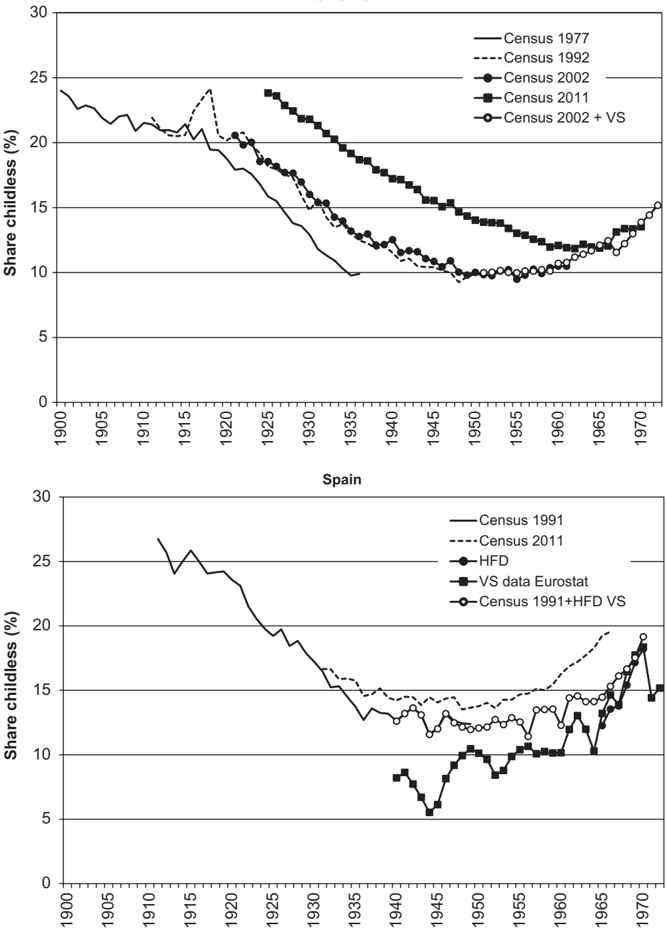
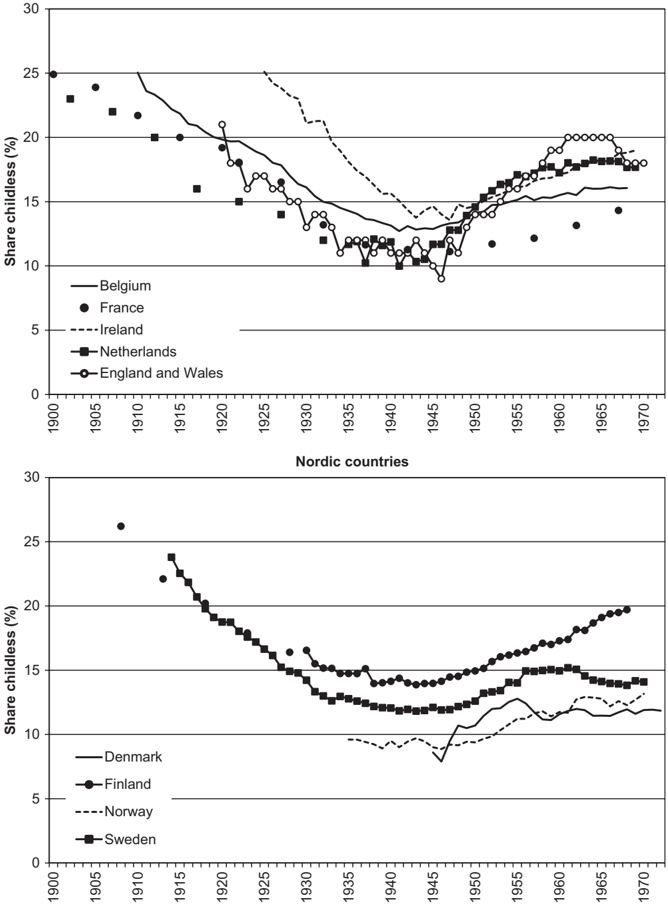
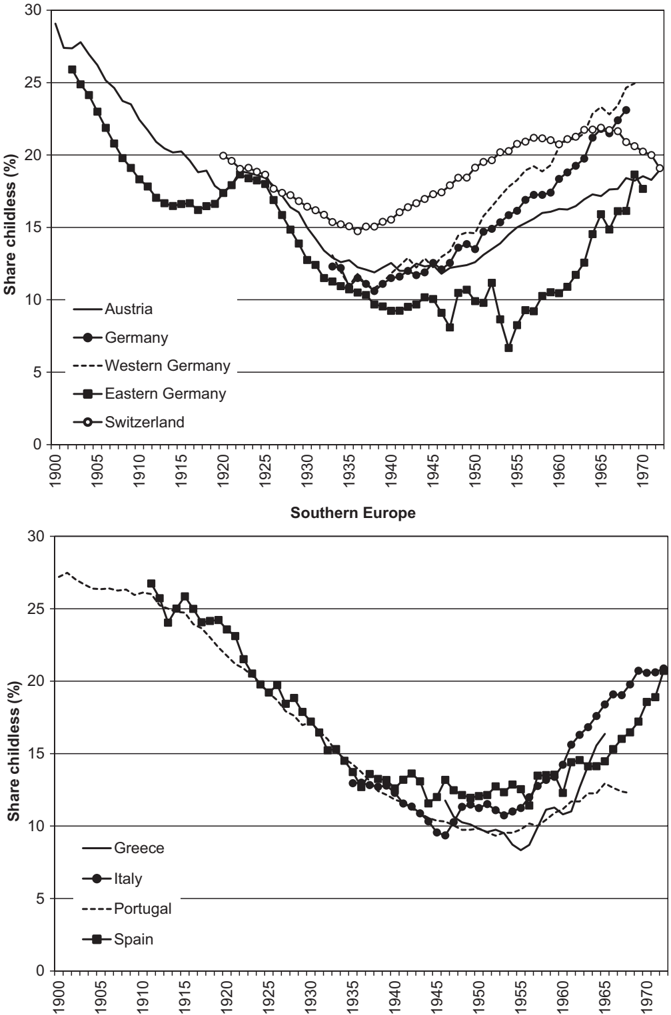
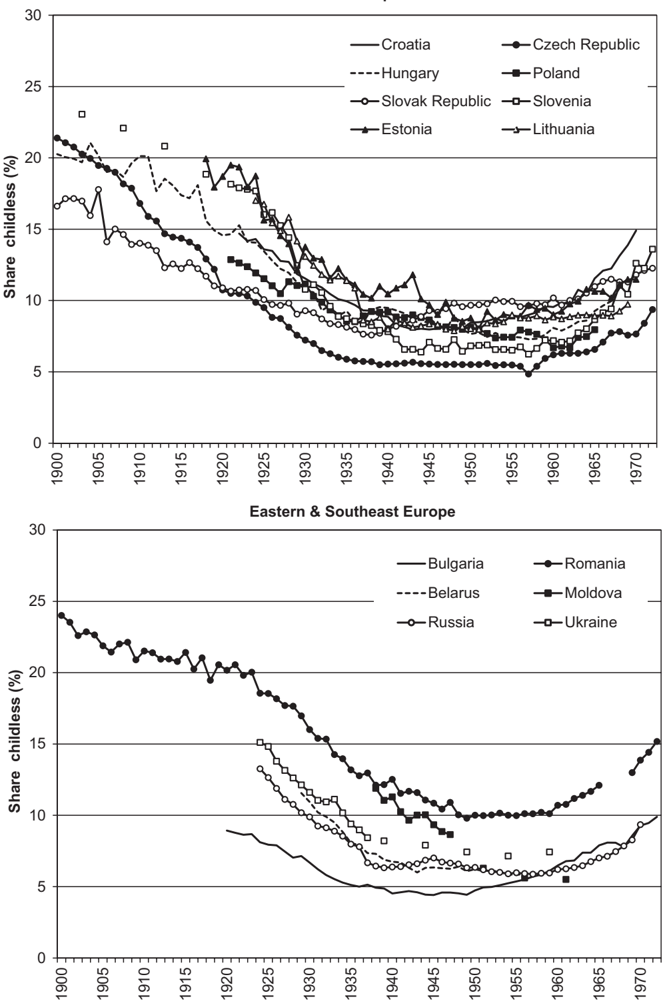
This study combines census, survey, and vital statistics data to reconstruct childlessness trends among women born between 1900 and 1972 in 30 European countries. After discussing the available sources, their strengths and weaknesses, and the selection of data used in this article, I present childlessness trends in individual countries and broader European regions, and analyse between-country variability. Europe has experienced a U-shaped pattern in permanent childlessness among women born between 1900 and 1972, with the lowest levels typically reached among the 1940s cohorts. A clear contrast exists between the generally low levels of childlessness in the former state-socialist countries of Europe and the higher levels of childlessness in other regions. However, as childlessness in central and eastern Europe has increased among women born in the late 1960s and early 1970s, this long-standing divide is now eroding. The trend towards increasing childlessness is levelling off in much of western Europe (e.g., in Switzerland and England and Wales). In conclusion, I suggest that women in southern Europe, especially in Italy and Spain, are on track to have the highest levels of childlessness in Europe. I also argue that childlessness trends might become more unstable and more difficult to predict as many women have put off parenthood until late reproductive ages, when they have relatively little time left to have a child.
Overview
The claims and statistics of this paper haven’t been checked yet.
Free: it reads the open-access text and checks the first 5 claims that cite a source we can check. Create a free account to check every claim.
Integrity signals
Registry
Cites
Statistics
Figures
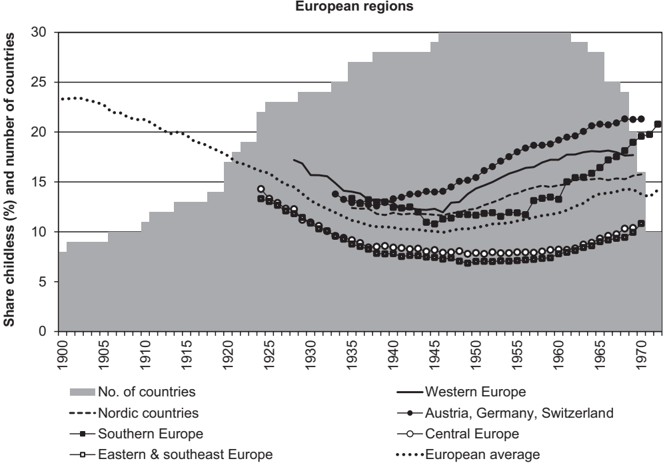
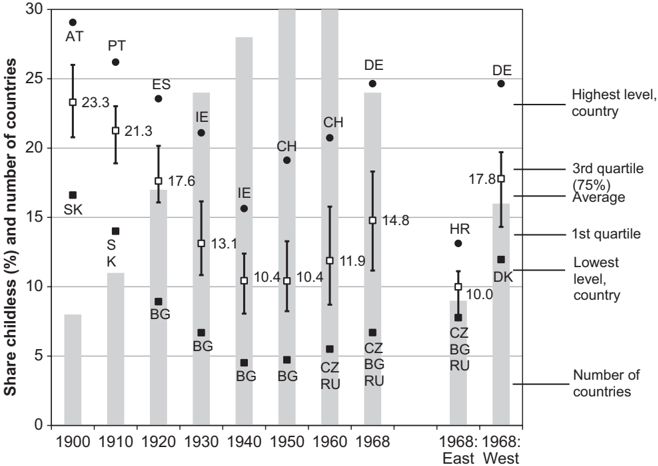
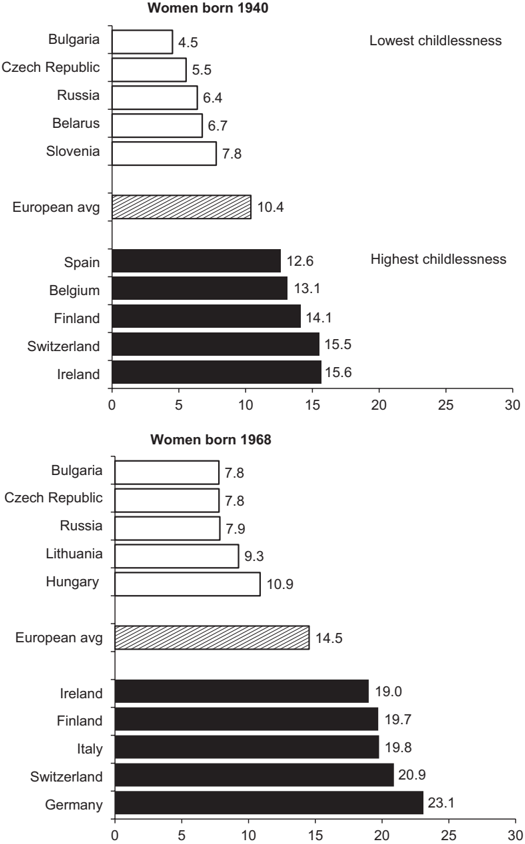
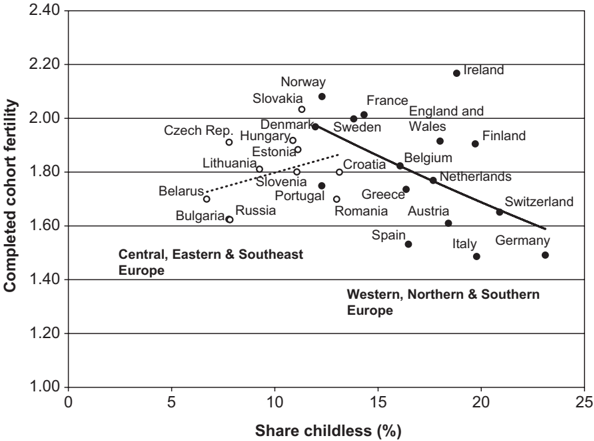
Verification
Claims the paper makes
The claims and statistics of this paper haven’t been checked yet.
Free: it reads the open-access text and checks the first 5 claims that cite a source we can check. Create a free account to check every claim.
Claims other papers make about this one
Each is checked against this paper’s own text: does it say what the citing paper says it does?
The source backs part of the claim, not all of it — or backs it for a different population, condition or comparison.
In the citing paper
“The trend reversals in later cohorts with stabilizing or slightly declining levels of childlessness in Denmark, Norway, and Sweden, are not (yet) observable in Finland, where childlessness levels in the youngest cohorts are quite substantial: 27% for men and 21% for women (see also Sobotka 2017).”
From Education, Gender, and Cohort Fertility in the Nordic Countries (2019) · cites this paper as Sobotka 2017
Experimental — accuracy not yet measuredThe cited source says what the claim attributes to it.
In the citing paper
“The trend reversals in later cohorts with stabilizing or slightly declining levels of childlessness in Denmark, Norway, and Sweden, are not (yet) observable in Finland, where childlessness levels in the youngest cohorts are quite substantial: 27% for men and 21% for women (see also Sobotka 2017).”
From Education, Gender, and Cohort Fertility in the Nordic Countries (2019) · cites this paper as Sobotka 2017
The check wasn’t confident either way, so it gives no verdict — never disputed.
In the citing paper
“However, recent studies suggest that educational expansion has had only limited effects on patterns and developments in ultimate fertility (Sobotka et al. 2017) and childlessness (Beaujouan et al. 2016) by educational level in continental European countries.”
From Education, Gender, and Cohort Fertility in the Nordic Countries (2019) · cites this paper as Sobotka et al. 2017
Experimental — accuracy not yet measuredThe check wasn’t confident either way, so it gives no verdict — never disputed.
In the citing paper
“Contrary to findings from many other European countries (Sobotka et al. 2017; Beaujouan et al. 2016), the negative educational gradients in CTF observed in older female cohorts have disappeared.”
From Education, Gender, and Cohort Fertility in the Nordic Countries (2019) · cites this paper as Sobotka et al. 2017
Experimental — accuracy not yet measured
Self-check
Percentages, sums and reported differences re-computed from the paper’s own numbers.
The self-check needs the paper’s full text.
Citations
Cites
Risk Society, Towards a New Modernity
Leiss, W., Beck, U., Ritter, M., Lash, S., & Wynne, B. (1994) · Canadian Journal of Sociology / Cahiers canadiens de sociologie · doi:10.2307/3341155 · Cited by 12,546
Risk Society: Towards a New Modernity
Boyd, W., Beck, U., & Shrader-Frechette, K. S. (1993) · Economic Geography · doi:10.2307/143601 · Cited by 9,215
The Quiet Revolution That Transformed Women's Employment, Education, and Family
Goldin, C. (2006) · American Economic Review · doi:10.1257/000282806777212350 · Cited by 1,831
The Unfolding Story of the Second Demographic Transition
Lesthaeghe, R. (2010) · Population and Development Review · doi:10.1111/j.1728-4457.2010.00328.x · Cited by 1,794
Pakulski, J., Best, H., Christmas-Best, & Horrman-Lange, U. (2012) · UTAS Research Repository · Cited by 1,785
Care in Context: Men's Unpaid Work in 20 Countries, 1965–2003
Hook, J. L. (2006) · American Sociological Review · doi:10.1177/000312240607100406 · Cited by 750
Globalization, Uncertainty and Youth in Society: The Losers in a Globalizing World
(2006) · Routledge eBooks · doi:10.4324/9780203003206 · Cited by 718
Menken, J., Trussell, J., & Larsen, U. (1986) · Science · doi:10.1126/science.3755843 · Cited by 695
Changing fertility rates in developed countries. The impact of labor market institutions
Adser�, A. (2004) · Journal of Population Economics · doi:10.1007/s00148-003-0166-x · Cited by 596
The Incomplete Revolution: Adapting to Women’s New Roles
Gornick, J. C. (2010) · Contemporary Sociology: A Journal of Reviews · doi:10.1177/0094306110386886n · Cited by 572
Research works printed but not linked: 6
- 7. Bolesławski, L. (1993). Polskie tablice dzietności kobiet 1971-1992. Polish fertility tables 1971- 1992. Warsaw: Główny urząd statystyczny.
- 53. Schwarz, K. (2003). Betrachtungen eines Demographen zu Ehe und Familie um das Jahr 2000. Zeitschrift für Bevölkerungswissenschaft, 28, 423-442.
- 58. Sobotka, T. (2016). Birth control, reproduction, and family under state socialism in Central and Eastern Europe. Forthcoming in L. Niethammer & S. Satjukow (Eds.), Gender relations and birth control in the age of the »Pill« (pp. 87-116). Göttingen: Wallstein Verlag.
- 60. Sobotka, T., & Testa, M. R. (2008). Attitudes and intentions towards childlessness in Europe. In C. Höhn, C. D. Avramov, & I. E. Kotowska (Eds.), People, population change and policies: Lessons from the population policy acceptance study (Vol. 1, pp. 177-211). Berlin: Springer. Statistics Denmark. (2014). Number of childless women by age and time. www.statbank.dk/stat- bank5a/default.asp?w=1680. Accessed 19 Mar 2014. Statistics Moldova. (2006). Moldova, Census 2004. Female population aged 15+ by age group and number of live-born children by region. www.statistica.md/pageview.php?l=ro&idc= 295&id=2234. Accessed 30 July 2015. Statistisches Bundesamt. (2015). Daten zu Geburten, Familien und Kinderlosigkeit. Ergebnisse des Mikrozensus 2012 -Tabellen mit neuer Hochrechnung anhand der Bevölkerungsfortschreibung auf Basis des Zensus 2011 -Ausgabe 2015. www.destatis.de/DE/ Publikationen/Thematisch/Bevoelkerung/HaushalteMikrozensus/Geburtentrends Tabellenband5122203159015.xlsx?__blob=publicationFile. Accessed 31 Mar 2015.
- 65. Veevers, J. E. (1980). Childless by choice. Toronto/Vancouver: Butterworth & Co.
- 67. VID. (2010). European demographic data sheet 2010. Vienna: Vienna Institute of Demography and IIASA.
Cited by
Items 101–179 of 179
Scenarios of Delayed First Births and Associated Cohort Fertility Levels
Winkler‐Dworak, M., Pohl, M., & Beaujouan, É. (2024) · Demography · doi:10.1215/00703370-11315685 · Cited by 8
Szalma, I. (2021) · Socio hu · doi:10.18030/socio.hu.2021.1.125 · Cited by 5
Folgueras, M. D., & Lesnard, L. (2018) · L Année sociologique · doi:10.3917/anso.182.0295 · Cited by 5
Tres décadas de muy baja fecundidad en España, 1991 - 2018Preprint
Esteve, A., Lozano, M., Boertien, D., Mogi, R., & Cui, Q. (2021) · SocArXiv (OSF Preprints) · doi:10.31235/osf.io/kch5n · Cited by 6
Fertility Outcomes of Adult Children With Divorced Parents: Evidence From Population Data
Palmaccio, S., Mazrekaj, D., & Witte, K. D. (2026) · Demography · doi:10.1215/00703370-12487209 · Cited by 4
Parenting, Gender and Work: A Sociological Perspective
Suwada, K. (2021) · SpringerBriefs in sociology · doi:10.1007/978-3-030-66303-2_2 · Cited by 6
Cohort change in loneliness through the lens of the second demographic transition
Raz‐Yurovich, L. (2025) · Genus · doi:10.1186/s41118-025-00249-0 · Cited by 4
“…rates of non-marriage and singlehood (Okun, 2013; Van den Berg & Verbakel, 2022), higher levels of childless-ness (Beaujouan et al., 2023; Bloom, 1982; Hayford, 2013; Jalovaara et al., 2019; Reher & Requena, 2019; Sobotka, 2017), and a rise in union dissolution (Boertien, 2020) across cohorts.”
Las trayectorias de las mujeres sin hijos en Uruguay
Pardo, I., Cabella, W., & Nathan, M. (2020) · Revista Brasileira de Estudos de População · doi:10.20947/s0102-3098a0115 · Cited by 11
Health, childlessness and poverty in Latin American countries
Castro, R., & Tapia, J. (2021) · Cadernos de Saúde Pública · doi:10.1590/0102-311x00248919 · Cited by 7
Fertility decline and the emergence of excess female survival in post-reproductive ages in Italy
Salinari, G., Santis, G. D., Zarulli, V., Giuliani, C., Franceschi, C., & Breschi, M. (2022) · Genus · doi:10.1186/s41118-022-00166-6 · Cited by 4
“However, if a link between poor health in late life and childlessness seems plausible for the past, when childlessness was mostly involuntary, it is hard to tell whether the same holds among recent cohorts, who increasingly choose not to have children (Sobotka, 2017).”
BackgroundThe transfer cost of parenthood in Europe
Gál, R. I., Medgyesi, M., & Vanhuysse, P. (2020) · Working Papers on Population Family and Welfare · doi:10.21543/wp.2020.35 · Cited by 4
Growing Childlessness and One‐Child Families in Slovakia in the Shadow of Fragile Pronatalism
Šprocha, B. (2022) · Social Inclusion · doi:10.17645/si.v10i3.5227 · Cited by 10
Motherhood and Systemic Gender Pay Gap Faced by Women in European Union Countries
Zhu, N., Gaweł, A., & Toikko, T. (2026) · Journal of Family and Economic Issues · doi:10.1007/s10834-025-10072-6 · Cited by 4
Moridi, M., Damghanian, M., & Keshavarz, S. (2024) · Reproductive Health · doi:10.1186/s12978-024-01760-x · Cited by 5
Pollmann‐Schult, M. (2025) · European Journal of Ageing · doi:10.1007/s10433-025-00853-1 · Cited by 3
“Fertility rates in Europe have significantly declined since the mid-1960s (Schumacher et al. 2024), resulting in a growing proportion of older individuals without children (Sobotka 2017).”
Nisén, J., Klüsener, S., Dahlberg, J., Dommermuth, L., Jasilioniene, A., Kreyenfeld, M. R., Lappegård, T., Li, P., Martikainen, P., Neels, K., et al. (2025) · Population Space and Place · doi:10.1002/psp.70074 · Cited by 4
“In census data, women reporting unknown parity may cause small errors in the parity estimates (Sobotka 2017).”
Šumskaitė, L., & Gedvilaitė-Kordušienė, M. (2021) · Crossroads of knowledge · doi:10.1007/978-981-16-0792-9_11 · Cited by 3
“Even if the possibility of getting pregnant after 45 years is low and is rarely used in quantitative studies of childlessness rate in society (Sobotka 2017), women are officially considered of reproductive age up to 49 years (WHO 2020).”
BackgroundVerkroost, F. C. J. (2022) · Journal of the Royal Statistical Society Series A (Statistics in Society) · doi:10.1111/rssa.12917 · Cited by 3
“In the United Kingdom, for instance, childlessness rates have doubled from approximately 10% among women born in 1945 to 20% among the 1965 female birth cohort (Sobotka, 2017).”
BackgroundMaslauskaitė, A. (2023) · Routledge eBooks · doi:10.4324/9781003193500-6 · Cited by 3
Mikucka, M. (2020) · Swiss Journal of Sociology · doi:10.2478/sjs-2020-0020 · Cited by 7
“However, the rate of childlessness is among the highest in the world, reaching the value of about 20% women in the youngest cohorts (Sobotka 2017).”
BackgroundChildlessness and women’s work trends in East and West Germany
Kreyenfeld, M. R., & Konietzka, D. (2017) · Travail genre et sociétés · doi:10.3917/tgs.037.0053 · Cited by 3
“La convergence de la proportion de femmes sans enfant observée par Tomáš Sobotka [2017] entre l’Europe de l’est et de l’ouest cadre bien avec l’évolution similaire qu’on observe à une moindre échelle dans l’est et l’ouest de l’Allemagne.”
Childlessness and Economic Development: A Survey
Baudin, T., de la Croix, D., & Gobbi, P. E. (2019) · Springer eBooks · doi:10.1007/978-3-030-21599-6_3 · Cited by 3
Huinink, J. J. (2019) · Springer eBooks · doi:10.1007/978-3-658-22803-3_23 · Cited by 3
Childlessness among women of reproductive age in Serbia from a demographic perspective
Penev, G., & Stanković, B. (2021) · Stanovnistvo · doi:10.2298/stnv200902002p · Cited by 3
“…svesni velikog uticaja odlaganja rađanja na pojavu trajne bezdetnosti, ukazuju da se merama politike kojima se podstiče donošenje odluke o rađanju i ublažavaju prepreke za njeno ostvarenje, može uticati upravo na žene koje žele da rode dete, ali to odlažu (Kneale i Joshi 2008; Sobotka 2017).”
BackgroundInfluentialEducation and Childlessness in IndiaPreprint
Baudin, T., & Sarkar, K. (2020) · RePEc: Research Papers in Economics · Cited by 3
Soto, M. F., Pardo, I., & Pedetti, G. (2020) · Notas de población · doi:10.18356/f4d794ec-es · Cited by 3
Boissonneault, M., & de Beer, J. (2021) · Demography · doi:10.1215/00703370-9624050 · Cited by 2
“Trends in almost all countries have been fol low ing a Ushaped pat tern, with prev a lences of 20%–25% among cohorts born in the early 1900s, then decreas ing to below 15% among those born in the 1940s, and increas ing to 15%–20% among those born in the 1960s (Sobotka 2017).”
BackgroundInfluentialPlöchl, K., & Obádovics, C. (2021) · Hitelintézeti szemle · doi:10.25201/hsz.20.3.80109 · Cited by 2
COVID‐19 and Childlessness among Women in the United States
Hummer, H. (2023) · Population and Development Review · doi:10.1111/padr.12545 · Cited by 5
Delayed Fertility and Childlessness
Beaujouan, É., & Neels, K. (2025) · The Springer series on demographic methods and population analysis · doi:10.1007/978-3-031-89737-5_14 · Cited by 7
Introduction: Childlessness through a Feminist Lens
Sappleton, N. (2018) · Emerald Group Publishing Limited eBooks · doi:10.1108/978-1-78754-361-420181001 · Cited by 2
Cohort fertility decline in low fertility countries: Decomposition using parity progression ratios
Zeman, K., Beaujouan, E., Brzozowska, Z., & Sobotka, T. (2018) · Demographic Research · doi:10.4054/demres.2018.38.25 · Cited by 159
“This fall in fertility was accompanied by a continuous decline in the share of large families (with three and more children), and, especially among women born in the 1960s, by increasing proportions of women without children or with one child (e.g., Schoen 2006; Frejka and Sardon 2007; Frejka 2008; Frejka, Jones, and…”
BackgroundSelf-citationDecomposing changes in first birth trends: Quantum, timing, or variance
Mogi, R., & Mundo, M. D. C. D. (2020) · Vienna Yearbook of Population Research · doi:10.1553/populationyearbook2020.res03 · Cited by 2
“It has also been projected that the future level of childlessness will increase as the fertility patterns of countries diverge (Sobotka 2017).”
BackgroundEducational differences in cohort fertility across sub-national regions in Europe
Nisén, J., Klüsener, S., Dahlberg, J., Dommermuth, L., Jasilioniene, A., Kreyenfeld, M. R., Lappegård, T., Peng, L., Martikainen, P., Neels, K., et al. (2019) · doi:10.4054/mpidr-wp-2019-018 · Cited by 2
Deindl, C., & Brandt, M. (2021) · Springer eBooks · doi:10.1007/978-3-030-22009-9_821 · Cited by 2
Hellstrand, J., Nisén, J., & Myrskylä, M. (2025) · doi:10.4054/mpidr-wp-2025-001 · Cited by 2
Socioeconomic resources and family formation among young Finnish adults
Miettinen, A. (2023) · Finnish Yearbook of Population Research · doi:10.23979/fypr.130512 · Cited by 4
(Grand)childlessness and depression across men and women’s stages of later life
Brini, E., & Zanasi, F. (2023) · Journal of Family Studies · doi:10.1080/13229400.2023.2230970 · Cited by 2
“…increase in the average age of fi rst childbirth and a growing rate of childless individuals in many developed countries (Beaujouan & Sobotka, 2019; Sobotka, 2017), an increasing share of older individuals do not experience grandparenthood at all (Skopek, 2021), whether because their children…”
BackgroundEducational migration and demographic resilience: the role of student mobility in local development
Rokita-Poskart, D., Adamska, M., Platje, J., Mąkolska-Frankowska, I., & Poskart, R. (2025) · Economics and Environment · doi:10.34659/eis.2024.91.4.1016 · Cited by 4
Augustsson, E., Celeste, R. K., Dahlberg, L., Lennartsson, C., & Agahi, N. (2026) · Aging & Mental Health · doi:10.1080/13607863.2026.2624558 · Cited by 1
“Future studies comparing parents and non-parents would add valuable insight into these potentially differing pathways, especially given the strong role of children in our results and the projected rise in childlessness among older adults (Sobotka, 2017).”
Do Europeans want children? The significance of job-related spatial mobility
Romero‐Balsas, P. (2022) · Contemporary Social Science · doi:10.1080/21582041.2022.2074530 · Cited by 2
“Nonetheless, the percentage of childless women in the 1970 cohort is not much higher than among women born in the early twentieth century (Sobotka, 2017).”
BackgroundMuted Voices of Invisible Men: The Impact of Male Childlessness
Hadley, R. (2024) · Emerald Group Publishing Limited eBooks · doi:10.1108/978-1-80382-219-820241011 · Cited by 1
Material inheritance transmission by older childless Portuguese adults
Silva, D., Patrão, M., & de Sousa, L. X. M. (2024) · Working with Older People · doi:10.1108/wwop-02-2024-0011 · Cited by 1
Wykształcenie par a (bez)dzietność w Polsce
Osiewalska, B. (2017) · Studia Demograficzne · doi:10.33119/sd.2017.2.2 · Cited by 1
“Sobotka 2017).”
Korzyści płynące z rodzicielstwa w perspektywie biegu życia
Mynarska, M. A. (2020) · Wydawnictwa Uniwersytetu Warszawskiego eBooks · doi:10.31338/uw.9788323543572.pp.153-166 · Cited by 3
Cross-sectional average length of life by parity: Country comparisons
Mogi, R., Lazzari, E., Nisén, J., & Canudas‐Romo, V. (2022) · Population Studies · doi:10.1080/00324728.2022.2049857 · Cited by 1
“The shares of women remaining ultimately childless in Denmark and Sweden have remained low to average (Sobotka 2017; Jalovaara et al. 2019), and the shares of women having at least two children have remained more stable than in many other high-income countries (Frejka and Sardon 2006; Zeman et al.”
BackgroundInfluentialAlón, I., Guimon, J., & Urbanos-Garrido, R. M. (2019) · Preprints.org · doi:10.20944/preprints201909.0269.v1 · Cited by 1
“, 2015; ASRM, 2015) and has been rising due to environmental hazards and unhealthy lifestyles (Inhorn & Patrizio, 2015; Sobotka, 2016).”
BackgroundCaputo, A., & Felaco, C. (2017) · SOCIOLOGIA DEL LAVORO · doi:10.3280/sl2017-148006
Gessa, G. D., Bordone, V., & Arpino, B. (2018) · Research Portal (King's College London)
Kinderlosigkeit im Kontext von Generationenvertrag und alltäglicher Solidarität
Fux, B. (2019) · Springer eBooks · doi:10.1007/978-3-658-22444-8_5 · Cited by 1
Suwada, K. (2021) · SpringerBriefs in sociology · doi:10.1007/978-3-030-66303-2_4 · Cited by 1
Plöchl, K., & Obádovics, C. (2021) · Financial and Economic Review · doi:10.33893/fer.20.3.80109
“The overarching goal behind demographic policies is the revival of childbearing willingness, which will reverse the declining fertility rate and contribute to population growth (Sobotka 2017).”
BackgroundSzabó, L. (2021) · Demográfia · doi:10.21543/dee.2020.1 · Cited by 1
Sarraf, M. A., Menie, M. A. W. O., & Feltham, C. (2019) · Springer eBooks · doi:10.1007/978-3-030-32984-6_5
Saarela, J. M., Hardy, M. A., & Skirbekk, V. (2022) · Journal of Comparative Family Studies · doi:10.3138/jcfs.53.2.030 · Cited by 1
“Childlessness has been increasing among men and women in Europe and elsewhere (Burkimsher & Zeman, 2017; Sobotka, 2017).”
BackgroundInfluentialRemaining childless or postponing first birth?Preprint
Mogi, R., & Mundo, M. D. C. D. (2018) · SocArXiv (OSF Preprints) · doi:10.31235/osf.io/hy98w
“Accompanied by this trend, the mean age at first childbirth has also increased (Beaujouan et al. 2015; Sobotka 2017).”
BackgroundSarraf, M. A., Menie, M. A. W. O., & Feltham, C. (2019) · Springer eBooks · doi:10.1007/978-3-030-32984-6_1
Deindl, C., & Brandt, M. (2019) · Springer eBooks · doi:10.1007/978-3-319-69892-2_821-1
Várandósok egészség-magatartása hazai és nemzetközi viszonylatban
Kocsis-Fuszkó, Z. (2023) · Iskolakultúra · doi:10.14232/iskkult.2023.1-2.160
Convergence or Divergence? The Unfolding of Cohabitation in France, Germany, Italy, and Norway
Zimmermann, O., & Konietzka, D. (2023) · Contemporary perspectives on family research · doi:10.1108/s1530-35352023007 · Cited by 1
Juhász, B. (2024) · Studia Mundi - Economica · doi:10.18531/sme.vol.11.no.4.pp.77-94
“In welfare economies, improved financial conditions enabled people to start families and have children at a relatively young age (Sobotka, 2017).”
Exploring the Middle East and North African (Mena) Region
Bhattarai, K., & Yousef, M. (2025) · World regional geography book series · doi:10.1007/978-3-031-83967-2_1
Huczewska, I., Kruk, K., & Mynarska, M. A. (2025) · Journal of Reproductive and Infant Psychology · doi:10.1080/02646838.2025.2480388 · Cited by 2
“In an age of growing childlessness rates in European countries (Sobotka, 2017), including Poland, this approach will also contribute to a better understanding of young people’s decisions related to whether or not to pursue parenthood.”
Bastianelli, E. (2025) · Springer eBooks · doi:10.1007/978-3-031-96736-8_51
The parental leave can alleviate the problem of declining population growth and rapid aging.
Zhao, Z. (2025) · Interdisciplinary Humanities and Communication Studies · doi:10.61173/vqn9yh83
Spain’s Transnational Fertility Industry
Molas, A. (2025) · Health, technology and society · doi:10.1007/978-981-96-5103-0_2
Feng, A. J., & Zhao, H. (2025) · Research Square · doi:10.21203/rs.3.rs-7475290/v1
Gender Differences in the Timing and Chances of Parenthood Across Regions
Nisén, J., Dahlberg, J., Slabá, J., & Trimarchi, A. (2026) · Population Space and Place · doi:10.1002/psp.70187
“…is characteristic of Sweden and France: in the 1960s cohorts around 86–87% of women became mothers (Jalovaara et al. 2019; Toulemon et al. 2008; Winkler‐Dworak and Toulemon 2007), while in Finland and the Netherlands, only roughly four out of five women did so (Jalovaara et al. 2019; Sobotka 2017).”
Population development in Slovak regions in time of the (first) demographic transition
Šprocha, B., & Tišliar, P. (2026) · doi:10.5817/cz.muni.m280-0823-2026
Tomkinson, J. (2018) · theses.fr (ABES) · doi:10.70675/d3c119b8zdd36z448ezadffz93ecff69e5a4 · Cited by 2
Tanguy, S. D. (2023) · theses.fr (ABES) · doi:10.70675/31c93fb0zf302z4f71z90c4z0ce70f86c100
Increasing Evolutionary Inequalities
Hopcroft, R. L. (2026) · Theory and Society · doi:10.1007/s11186-026-09698-8
Coufalová, P., & Kučerová, H. P. (2026) · Journal of Family Studies · doi:10.1080/13229400.2026.2659126
Pokyčių kartos Lietuvoje: vertybių kaitos perspektyva
Savicka, A., & Žiliukaitė, R. (2026) · Lietuvos kultūros tyrimų institutas eBooks · doi:10.53630/savicka_ziliukaite2026
Economic Uncertainty and Postponed Parenthood: A Study of Event Histories
CHRISTOFFERSEN, M. N. (2026) · Journal of Family Issues · doi:10.1177/0192513x261460828
The rise of male childlessness in Spain: a cohort analysisPreprint
Juni, M., & Requena, M. (2026) · Research Square · doi:10.21203/rs.3.rs-10163768/v1
Lozano, M., Vidal, S., & Adserà, A. (2026) · Population Studies · doi:10.1080/00324728.2026.2682465
Fertility Differentiation by Educational Attainment Among Women in Russia
Чертенков, К. О. (2026) · Вопросы статистики · doi:10.34023/2313-6383-2026-33-4-80-89
Le non-désir d’enfant : enjeux cliniques et éthiques contemporains
Bourdet-Loubère, S. (2026) · Cahiers de l enfance et de l adolescence · doi:10.3917/cead.015.0167
Metadata
- Authors
- Sobotka, T.
- Affiliations
- Austrian Academy of Sciences (AT)
- Corresponding author
- Sobotka, Tomáš
- ORCID
- Sobotka, Tomáš
- Venue
- Demographic Research Monographs
- Publisher
- Springer International Publishing
- Published
- 2017
- Pages
- 17-53
- ISSN
- 1613-5520 (ISSN-L)
- 2197-9286
- OpenAlex
- W2575363883
- Cited by
- 181
- References
- 59
- Citations by year
- 2026: 13 · 2025: 17 · 2024: 11 · 2023: 17 · 2022: 25 · 2021: 39 · 2020: 18 · 2019: 19 · 2018: 14 · 2017: 7
- FWCI
- 123.99
- Type
- book chapter
- Language
- en
- Open access
- hybrid
- doi.org
- Locations
- Demographic research monographs (publishedVersion, cc-by)
- Funders
- European Commission (2007–2013, FP7 2007-2013, FP7/2007)
- FP7 Ideas: European Research Council (284238)
- Topics
- Social Sciences › Demography › Family Dynamics and Relationships
- Social Sciences › Arts and Humanities › History › Historical Studies on Reproduction, Gender, Health, and Societal Changes
- Health Sciences › Medicine › Public Health, Environmental and Occupational Health › Reproductive Health and Contraception
- Keywords
- childlessness, fertility trends, female fertility, cohort comparison, Central and Eastern Europe, Southern Europe, delayed parenthood, reproductive age
About these checks
Registry, retraction, Cites and statistics results are computed, not judged, with one exception: a printed reference that no index lists is read once by a model before it counts as a citation error. Claims are extracted by a model and kept only when their quote appears verbatim in the text; each cited source is then checked, with a model’s help, for whether it says what the claim relies on. Those verdicts can be wrong — read the claim’s quote and the cited source before relying on one.
Statistics and arithmetic are recomputed, not judged.
Confidence bands are shown only for fields calibrated on our annotated test set. None is calibrated yet, so no band is shown.
What counts as a claim ›How we measure confidence ›How we check this ›
Are you an author, or do you see a problem with this page? Request a review
Data sources
Bibliographic data: Semantic Scholar, OpenAlex, Crossref.
Contains information from the Semantic Scholar Academic Graph Datasets, made available under the ODC Attribution License (ODC-BY 1.0).
Semantic Scholar’s data is described in: Kinney, R., et al. (2023). The Semantic Scholar Open Data Platform. arXiv:2301.10140.
