

Beyond Fairness and Consistency in Grading: The Role of Rubrics in Higher Education
Open accessThe DOI matches its Crossref record; 54 of the 55 references it cites were found in a registry or an index; none of the 48 sources its claims cite is checked for support yet.
Abstract
This chapter will examine the role of rubrics in higher education. At its best, a rubric is a carefully wrought expression of the professional judgement of a teacher, and identifies the learning goals and aspirations of performance. We will explain and illustrate how rubrics can be used as both teaching and grading tools. We will examine how, in clarifying the learning goals, rubrics help teachers not only provide feedback, but also improve course design. We will pay specific attention to the formative role rubrics play in mediating improvement in student performance. We will explore how assessment involves qualitative judgments and suggest that a good rubric can help in monitoring fairness and consistency in grading. The key features of a quality rubric for assessing student work and their effective use will be discussed. We will consider the approaches that may limit the effectiveness of rubrics and provide ways in which teachers can create valid and reliable rubrics. Finally, we will discuss how rubrics can impact and improve teaching practice.
Overview
CoChat Summary
TL;DR
This conceptual book chapter argues that rubrics in higher education should move beyond their summative role of ensuring fair and consistent grading toward a formative, student-centered role as instructional scaffolds for "assessment as learning." It reviews the literature on rubric types, construction, and use, and proposes practical frameworks including single-point rubrics and teacher summary rubrics.
Key findings
As a conceptual chapter, it synthesizes rather than reports primary data:
- Rubrics must have three essential features (per Popham): evaluative criteria, quality definitions, and a scoring strategy; rating scales and checklists differ because they lack performance-level descriptions.
- Rubrics are distinguished along several axes: analytic vs. holistic, generic vs. task-specific, and teacher-centered vs. student-centered; holistic rubrics serve mainly as scoring rubrics while analytic rubrics serve as instructional rubrics.
- Jonsson and Svingby's review is cited as concluding that "reliable scoring of performance assessments can be enhanced by the use of rubrics, especially if they are analytic, topic-specific, and complemented with exemplars and/or rater training."
- Students generally favor rubrics (reporting less anxiety, more confidence, and perceived fairness), whereas teachers tend to resist them due to a "limited conception of the purpose of a rubric"; Rezaei and Lovorn found that without training in effective rubric use, reliability or validity will likely not improve.
Methods
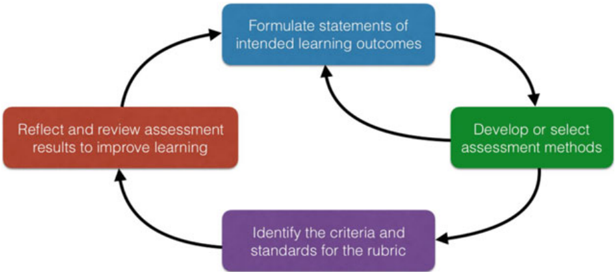
Not stated in the paper (conceptual/review chapter, no empirical design, sample, or analysis reported). The chapter synthesizes prior literature and presents two illustrative tables: a single-point rubric as an instructional scaffold (Table 3.1) and a teacher summary rubric for teaching improvement (Table 3.2). It outlines a three-step rubric development process: (a) define module learning outcomes, (b) describe assessment tasks covering those outcomes, and (c) identify criteria and standards of performance.
Limitations
The paper does not state formal limitations. Evident from the text: the chapter is a conceptual synthesis without original empirical data, so its claims rest on cited secondary literature; it also acknowledges criticisms that rubrics can be "too subjective, too vague or too detailed," may restrict students' understanding and self-regulation, and that transparency may encourage instrumentalism (Kohn) by narrowing students' scope beyond explicitly stated criteria.
Model-written summary. Check it against the paper before relying on it.
Integrity signals
Registry
Cites
Statistics
Figures
Verification
Claims the paper makes
0 Valid · 0 Not valid · 48 Not checked · 30 Own results and interpretations
In the paper
“Using rubrics, teachers can explicitly list the assessment criteria to enhance the alignment of learning, instruction, and assessment.27”
§ Beyond Fairness and Consistency in Grading: The Role of Rubrics in Higher Education > Rubrics as Scaffolds for Assessment as Learning
What the sources say
- Not matchedcites [27]
The reference list we hold has no entry [27].
plainstates a cause- Asserted: passes — The authors put it forward as true.
- Checkable: passes — It can be checked against evidence.
- Load-bearing: passes — The paper’s conclusions depend on it.
- Based: passes — The paper gives a reason why it holds.
- Not matched
In the paper
“This alignment helps teachers gain greater clarity on both content and outcomes as they are focused on what they what their students to learn rather than on what they intend to teach.”
§ Beyond Fairness and Consistency in Grading: The Role of Rubrics in Higher Education > How Rubrics Can Impact Your Teaching Practice?
What the sources say
- Not matchedcites [68]
The reference list we hold has no entry [68].
plainstates a cause- Asserted: passes — The authors put it forward as true.
- Checkable: passes — It can be checked against evidence.
- Load-bearing: passes — The paper’s conclusions depend on it.
- Based: passes — The paper gives a reason why it holds.
- Not matched
In the paper
“Torrance argues that students are more likely to succeed when assessment tasks have greater clarity on process, criteria and how the tasks are to be graded, coupled with more detailed assistance from teachers on how to achieve a particular grade or result.35”
§ Beyond Fairness and Consistency in Grading: The Role of Rubrics in Higher Education > Rubrics as Scaffolds for Assessment as Learning
What the sources say
- Not matchedcites Torrance
This doesn’t read as a citation we can look up.
hedgedstates a possible cause- Asserted: passes — The authors put it forward as true.
- Checkable: passes — It can be checked against evidence.
- Load-bearing: passes — The paper’s conclusions depend on it.
- Based: passes — The paper gives a reason why it holds.
- Not matched
A conclusion the paper draws from its own results — it cites no other source for it, so there is none to check. The quote shows it is in the paper.
In the paper
“Rubrics can thus lead to a cycle of continuous improvement.”
§ Beyond Fairness and Consistency in Grading: The Role of Rubrics in Higher Education > How Rubrics Can Impact Your Teaching Practice?
plainstates a cause- Asserted: passes — The authors put it forward as true.
- Checkable: passes — It can be checked against evidence.
- Load-bearing: passes — The paper’s conclusions depend on it.
- Based: passes — The paper gives a reason why it holds.
In the paper
“Students agree that the use of rubrics makes the grading process fair as they can easily verify if they have met the criteria or not.19”
§ Beyond Fairness and Consistency in Grading: The Role of Rubrics in Higher Education > Rubrics for Monitoring Fairness and Consistency
What the sources say
- Not matchedcites [19]
The reference list we hold has no entry [19].
plainstates a cause- Asserted: passes — The authors put it forward as true.
- Checkable: passes — It can be checked against evidence.
- Load-bearing: unclear — It is unclear whether the paper’s conclusions depend on it.
- Based: passes — The paper gives a reason why it holds.
- Not matched
21 more claims
Create a free account to see all 78 claims and to verify the 3 references still open.
- Probably not a substantial claim. 37
- It may state two separate claims as one. 34
Claims other papers make about this one
Each is checked against this paper’s own text: does it say what the citing paper says it does?
In the citing paper
“Rubrics have been found to help students understand expectations and performance standards, enabling them to better prepare (Ragupathi & Lee, 2020).”
From Interventions and facilitators of oral assessment performance in higher education: a systematic review (2025) · cites this paper as Ragupathi & Lee, 2020
Citations
Cites
Teaching For Quality Learning At University
Biggs, J., & Tang, C. S. (1999) · Cited by 11,428
Assessment and Classroom Learning
Black, P., & Wiliam, D. (1998) · Assessment in Education: Principles, Policy & Practice · doi:10.1080/0969595980050102 · Cited by 8,152
Self-Regulated Learning and Academic Achievement: An Overview
Zimmerman, B. J. (1990) · Educational Psychologist · doi:10.1207/s15326985ep2501_2 · Cited by 3,687
Creating Significant Learning Experiences: An Integrated Approach to Designing College Courses
Fink, L. D. (2003) · Thammasat University Digital Collections · Cited by 1,701
The use of scoring rubrics: Reliability, validity and educational consequences
Jonsson, A., & Svingby, G. (2007) · Educational Research Review · doi:10.1016/j.edurev.2007.05.002 · Cited by 1,509
Efklides, A. (2011) · Educational Psychologist · doi:10.1080/00461520.2011.538645 · Cited by 1,211
(1999) · Medical Entomology and Zoology · Cited by 998
Rethinking feedback practices in higher education: a peer review perspective
Nicol, D., Thomson, A., & Breslin, C. (2014) · Assessment & Evaluation in Higher Education · doi:10.1080/02602938.2013.795518 · Cited by 966
A review of rubric use in higher education
Reddy, Y. M., & Andrade, H. (2010) · Assessment & Evaluation in Higher Education · doi:10.1080/02602930902862859 · Cited by 917
The use of scoring rubrics for formative assessment purposes revisited: A review
Panadero, E., & Jonsson, A. (2013) · Educational Research Review · doi:10.1016/j.edurev.2013.01.002 · Cited by 839
Sustainable assessment revisited
Boud, D., & Soler, R. (2016) · Assessment & Evaluation in Higher Education · doi:10.1080/02602938.2015.1018133 · Cited by 576
Using Rubrics To Promote Thinking and Learning.
Andrade, H. G. (2000) · Educational leadership · Cited by 553
Stevens, D. D., & Levi, A. J. (2004) · Cited by 465
Designing scoring rubrics for your classroom
Mertler, C. A. (2020) · ScholarWorks@UMassAmherst (University of Massachusetts Amherst) · doi:10.7275/gcy8-0w24 · Cited by 436
Teaching With Rubrics: The Good, the Bad, and the Ugly
Andrade, H. G. (2005) · College Teaching · doi:10.3200/ctch.53.1.27-31 · Cited by 436
Torrance, H. (2007) · Assessment in Education: Principles, Policy & Practice · doi:10.1080/09695940701591867 · Cited by 420
Assessment rubrics: towards clearer and more replicable design, research and practice
Dawson, P. (2017) · Assessment & Evaluation in Higher Education · doi:10.1080/02602938.2015.1111294 · Cited by 368
Dávila Rubio, A. M. (2017) · Colombian Applied Linguistics Journal · doi:10.14483/calj.v19n1.11490 · Cited by 351
Student perspectives on rubric-referenced assessment
Andrade, H., & Du, Y. (2020) · doi:10.7275/g367-ye94 · Cited by 332
Feedback loops and the longer-term: towards feedback spirals
Carless, D. (2019) · Assessment & Evaluation in Higher Education · doi:10.1080/02602938.2018.1531108 · Cited by 328
Assessing outcomes and improving achievement : tips and tools for using rubrics
Rhodes, T. L. (2010) · Medical Entomology and Zoology · Cited by 314
Allen, D., & Tanner, K. (2006) · CBE—Life Sciences Education · doi:10.1187/cbe.06-06-0168 · Cited by 314
Reliability and validity of rubrics for assessment through writing
Rezaei, A. R., & Lovorn, M. (2010) · Assessing Writing · doi:10.1016/j.asw.2010.01.003 · Cited by 299
What We Really Value: Beyond Rubrics in Teaching and Assessing Writing
Broad, B. (2003) · Digital Commons - USU (Utah State University) · Cited by 264
Arter, J. A., & McTighe, J. (2000) · Medical Entomology and Zoology · Cited by 260
Tierney, R. D., & Simon, M. (2020) · Scholarworks (University of Massachusetts Amherst) · doi:10.7275/jtvt-wg68 · Cited by 244
Appropriate criteria: key to effective rubrics
Brookhart, S. M. (2018) · Frontiers in Education · doi:10.3389/feduc.2018.00022 · Cited by 243
How to Create and Use Rubrics for Formative Assessment and Grading
Brookhart, S. M. (2013) · Medical Entomology and Zoology · Cited by 225
Independent learning – what we do when you’re not there
Hockings, C., Thomas, L., Ottaway, J., & Jones, R. (2017) · Teaching in Higher Education · doi:10.1080/13562517.2017.1332031 · Cited by 204
Brookhart, S. M. (2013) · Sage eBooks · doi:10.4135/9781452218649.n15 · Cited by 200
Rubrics as a way of providing transparency in assessment
Jonsson, A. (2014) · Assessment & Evaluation in Higher Education · doi:10.1080/02602938.2013.875117 · Cited by 180
Transforming holistic assessment and grading into a vehicle for complex learning
Sadler, D. R. (2009) · Assessment, Learning and Judgement in Higher Education · doi:10.1007/978-1-4020-8905-3_4 · Cited by 162
Assessment in the Second Language Writing Classroom
Crusan, D. (2010) · doi:10.3998/mpub.770334 · Cited by 133
The futility of attempting to codify academic achievement standards
Royce Sadler, D. (2014) · Higher Education · doi:10.1007/s10734-013-9649-1 · Cited by 122
Mind the gap! Students’ use of exemplars and detailed rubrics as formative assessment
Lipnevich, A. A., McCallen, L. N., Miles, K. P., & Smith, J. K. (2014) · Instructional Science · doi:10.1007/s11251-013-9299-9 · Cited by 116
Building a better rubric: Mixed methods rubric revision
Janssen, G., Meier, V., & Trace, J. (2015) · Assessing Writing · doi:10.1016/j.asw.2015.07.002 · Cited by 96
Speaking My Mind: The Trouble with Rubrics
Kohn, A. (2006) · The English Journal · doi:10.2307/30047080 · Cited by 96
What We Really Value: Beyond Rubrics in Teaching and Assessing Writing
BROAD, B. (2003) · Utah State University Press eBooks · doi:10.2307/j.ctt46nxvm · Cited by 89
Values in evaluation – The use of rubrics
Dickinson, P., & Adams, J. (2017) · Evaluation and Program Planning · doi:10.1016/j.evalprogplan.2017.07.005 · Cited by 87
Schamber, J. F., & Mahoney, S. L. (2006) · The Journal of General Education · doi:10.1353/jge.2006.0025 · Cited by 70
Arter, J. A., & McTighe, J. (2001) · Cited by 68
A Rubric to Assess Critical Literature Evaluation Skills
Blommel, M. L., & Abate, M. A. (2007) · American Journal of Pharmaceutical Education · doi:10.5688/aj710463 · Cited by 68
Rubrics and Adult Learners: Andragogy and Assessment
Bolton, F. C. (2006) · Cited by 60
Dance, ten; looks, three: Why rubrics matter
Crusan, D. J. (2015) · Assessing Writing · doi:10.1016/j.asw.2015.08.002 · Cited by 54
Winkelmes, M., Boye, A. P., & Tapp, S. (2019) · Cited by 51
Nordrum, L., Evans, K., & Gustafsson, M. (2013) · Assessment & Evaluation in Higher Education · doi:10.1080/02602938.2012.758229 · Cited by 49
Self‐Assessment of Oral Communication Presentations in Food Science and Nutrition
Reitmeier, C. A., & Vrchota, D. A. (2009) · Journal of Food Science Education · doi:10.1111/j.1541-4329.2009.00080.x · Cited by 49
Single Point Rubric: A Tool for Responsible Student Self-Assessment
Fluckiger, J. (2010) · DigitalCommons@UNO · Cited by 43
Keeping up with the times: Revising and refreshing a rating scale
Banerjee, J., Yan, X., Chapman, M., & Elliott, H. (2015) · Assessing Writing · doi:10.1016/j.asw.2015.07.001 · Cited by 23
Rubrics and the enhancement of student learning
Reddy, M. Y. (2007) · DOAJ (DOAJ: Directory of Open Access Journals) · Cited by 21
Rubrics - Sharing the Rules of the Game
Balch, D., Blanck, R., & Balch, D. H. (2016) · Journal of Instructional Research · doi:10.9743/jir.2016.4 · Cited by 19
Calderón, P., & Ernesto, P. (2011) · Cited by 16
Panadero, E. (2011) · Hispana · doi:10.13140/rg.2.1.2547.9208 · Cited by 14
A Rubric to Assess Critical Literature Evaluation Skills
Blommel, M. L., & Abate, M. A. (2007) · American Journal of Pharmaceutical Education · doi:10.1016/s0002-9459(24)03354-0
Research works printed but not linked: 10
- Anders Jonsson, and Gunilla Svingby, "The Use of Scoring Rubrics: Reliability, Validity and Educational Consequences," Educational Research Review 2, no. 2 (2007): 130- 144;
- D. Royce Sadler, "Transforming Holistic Assessment and Grading into a Vehicle for Complex Learning," in Assessment, Learning and Judgement in Higher Education, edited by Gordon Joughin (Dordrecht: Springer, 2009), 1-19.
- ---. "Teaching with Rubrics: The Good, the Bad, and the Ugly." College Teaching 53, no. 1 (2005): 27-30.
- Cheryl A. Reitmeier and Denise A. Vrchota, "Self-Assessment of Oral Communication Presentations in Food Science and Nutrition," Journal of Food Science Education 8, no. 4 (2009): 88-92.
- Balch, David, Robert Blanck, and David H. Balch. "Rubrics-Sharing the Rules of the Game." Journal of Instructional Research 5 (2016): 19-49.
- Anastasiya A. Lipnevich, Leigh N. McCallen, Katherine P. Miles, and Jeffrey K. Smith, "Mind the Gap! Students' Use of Exemplars and Detailed Rubrics as Formative Assessment," Instructional Science 42 (2014): 539-559.
- Fluckiger, Jarene. "Single Point Rubric: A Tool for Responsible Student Self- Assessment." Delta Kappa Gamma Bulletin 76, no. 4 (2010): 18-25.
- Popham, W. James. "What's Wrong-And What's Right-With Rubrics." Edu- cational Leadership 55, no. 2 (1997): 72-75.
- Reddy, Y. M. "Effect of Rubrics on Enhancement of Student Learning." Journals of Education 7, no. 1 (2007): 3-17.
- ---. "The Futility of Attempting to Codify Academic Achievement Stan- dards." Higher Education 67 (2014): 273-288. https://doi.org/10.1007/ s10734-013-9649-1. · DOI · Paper page
Cited by
GAIDE: A Framework for Using Generative AI to Assist in Course Content Development
Dickey, E., & Bejarano, A. (2024) · 2024 IEEE Frontiers in Education Conference (FIE) · doi:10.1109/fie61694.2024.10893132 · Cited by 48
Exploring ChatGPT as a writing assessment tool
Bucol, J. L., & Sangkawong, N. (2024) · Innovations in Education and Teaching International · doi:10.1080/14703297.2024.2363901 · Cited by 92
Taylor, B. L., Kisby, F., & Reedy, A. (2024) · Assessment & Evaluation in Higher Education · doi:10.1080/02602938.2023.2299330 · Cited by 91
Assessment IS learning: developing a student‐centred approach for assessment in Higher Education
Rutherford, S., Pritchard, C., & Francis, N. (2024) · FEBS Open Bio · doi:10.1002/2211-5463.13921 · Cited by 54
Stephenson, Z., Johnson-Glauch, N., & Cruchley, S. (2025) · Assessment & Evaluation in Higher Education · doi:10.1080/02602938.2025.2504621 · Cited by 25
Metadata
- Authors
- Ragupathi, K., & Lee, A.
- Affiliations
- National University of Singapore (SG)
- Corresponding author
- Ragupathi, Kiruthika
- ORCID
- Ragupathi, Kiruthika
- Venue
- Diversity and Inclusion in Global Higher Education
- Publisher
- Springer Singapore
- Published
- 2020
- Pages
- 73-95
- OpenAlex
- W2999187679
- Semantic Scholar
- 3de045472155ed8b805f3675809f0361b88b72a9
- Cited by
- 107
- References
- 55
- Citations by year
- 2026: 16 · 2025: 22 · 2024: 27 · 2023: 19 · 2022: 10 · 2021: 9 · 2020: 4
- FWCI
- 58.84
- Type
- book chapter
- Language
- en
- Open access
- hybrid
- doi.org
- Licence
- cc-by
- creativecommons.org/licenses/by/4.0 (tdm)
- Locations
- Springer eBooks (publishedVersion, cc-by)
- Lancaster EPrints (Lancaster University) (submittedVersion)
- Funders
- Yale-NUS College
- Topics
- Social Sciences › Education › Student Assessment and Feedback
- Social Sciences › Education › Evaluation of Teaching Practices
- Social Sciences › Education › Educational Assessment and Pedagogy
- Keywords
- rubrics, grading, higher education assessment, grading fairness, grading consistency, formative assessment, student feedback, course design, learning objectives, teaching practice
About these checks
Registry, retraction, Cites and statistics results are computed, not judged, with one exception: a printed reference that no index lists is read once by a model before it counts as a citation error. Claims are extracted by a model and kept only when their quote appears verbatim in the text; each cited source is then checked, with a model’s help, for whether it says what the claim relies on. Those verdicts can be wrong — read the claim’s quote and the cited source before relying on one.
A language model drew the claims from the paper on 2026-11-16, under version 3 of the claim definition (model deepseek-v4.1-flash, prompt extract-v3).
A second model labelled each claim on 2026-11-16 (model jev-1.13-20260917, definition revision gold-guideline-v0.2).
Statistics and arithmetic are recomputed, not judged.
Confidence bands are shown only for fields calibrated on our annotated test set. None is calibrated yet, so no band is shown.
What counts as a claim ›How we measure confidence ›How we check this ›
Are you an author, or do you see a problem with this page? Request a review
Data sources
Bibliographic data: Semantic Scholar, OpenAlex, Crossref.
Contains information from the Semantic Scholar Academic Graph Datasets, made available under the ODC Attribution License (ODC-BY 1.0).
Semantic Scholar’s data is described in: Kinney, R., et al. (2023). The Semantic Scholar Open Data Platform. arXiv:2301.10140.
