

The DOI matches its Crossref record; 9 of the 9 references it cites were found in a registry or an index.
Wormholes without averaging
Abstract
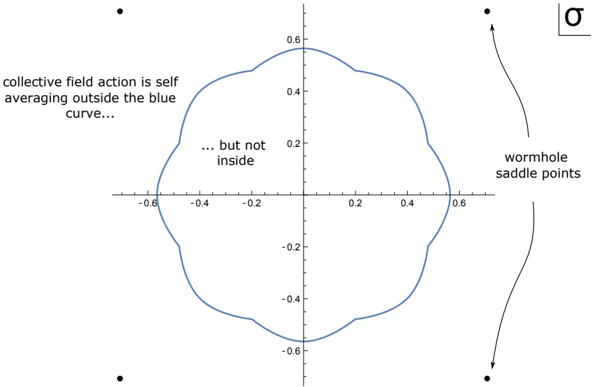
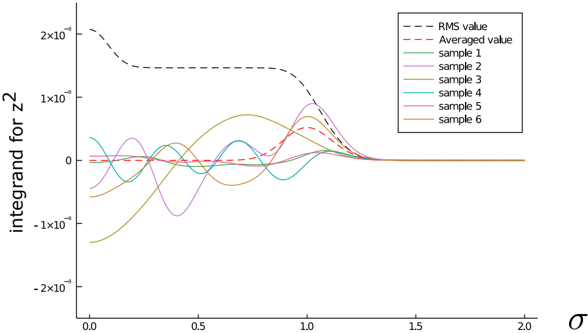
A bstract: After averaging over fermion couplings, SYK has a collective field description that sometimes has “wormhole” solutions. We study the fate of these wormholes when the couplings are fixed. Working mainly in a simple model, we find that the wormhole saddles persist, but that new saddles also appear elsewhere in the integration space — “half-wormholes.” The wormhole contributions depend only weakly on the specific choice of couplings, while the half-wormhole contributions are strongly sensitive. The half-wormholes are crucial for factorization of decoupled systems with fixed couplings, but they vanish after averaging, leaving the non-factorizing wormhole behind.
Overview
The claims and statistics of this paper haven’t been checked yet.
Run the check — free, no account needed. It reads the open-access text and checks the sources it cites.
Integrity signals
Registry
Cites
Statistics
Figures



Verification
Claims the paper makes
The claims and statistics of this paper haven’t been checked yet.
Run the check — free, no account needed. It reads the open-access text and checks the sources it cites.
Claims other papers make about this one
Each is checked against this paper’s own text: does it say what the citing paper says it does?
In the citing paper
“However, from the gravity side, evaluating such a wavefunction O I with the gravitational path integral by filling in the bulk will require some microscopic ingredient beyond the semiclassical description of the thin shell and it is not obvious that such a level of microscopic detail should be accessible semiclassically [70].”
From The baby universe is fine and the CFT knows it: on holography for closed universes (2025) · cites this paper as [70]
Self-check
Percentages, sums and reported differences re-computed from the paper’s own numbers.
The self-check needs the paper’s full text.
Citations
Cites
Gapless spin-fluid ground state in a random quantum Heisenberg magnet
Sachdev, S., & Ye, J. (1993) · Physical Review Letters · doi:10.1103/physrevlett.70.3339 · Cited by 1,910
Replica wormholes and the entropy of Hawking radiation
Almheiri, A., Hartman, T., Maldacena, J., Shaghoulian, E., & Tajdini, A. (2020) · Journal of High Energy Physics · doi:10.1007/jhep05(2020)013 · Cited by 910 · cited 1×
“Examples include: the eternal traversable wormhole [1]; the long-time behavior of the spectral form factor [2, 3] and correlation functions [4]; and the Page curve [5, 6] and squared matrix elements [7] in models of evaporating black holes.”
BackgroundReplica wormholes and the black hole interior
Penington, G., Shenker, S. H., Stanford, D., & Yang, Z. (2019) · arXiv · doi:10.48550/arxiv.1911.11977 · Cited by 809
Self-citationReplica wormholes and the black hole interior
Penington, G., Shenker, S. H., Stanford, D., & Yang, Z. (2022) · Journal of High Energy Physics · doi:10.1007/jhep03(2022)205 · Cited by 807
Self-citationJensen, K. (2016) · Physical Review Letters · doi:10.1103/physrevlett.117.111601 · Cited by 695
Loss of incoherence and determination of coupling constants in quantum gravity
Giddings, S. B., & Strominger, A. (1988) · Nuclear Physics B · doi:10.1016/0550-3213(88)90109-5 · Cited by 562
Marolf, D., & Maxfield, H. (2020) · Journal of High Energy Physics · doi:10.1007/jhep08(2020)044 · Cited by 300 · cited 4×
“• How can we confirm the picture presented in section 3 for full SYK? Are there circumstances where we should expect these arguments to fail? • Do these ideas apply to tensor models,(22) which can be viewed as particular, highly structured members of an SYK ensemble? Is the sparse SYK model [46] a useful stepping-ston…”
BackgroundMethodInfluentialAveraging over Narain moduli space
Maloney, A., & Witten, E. (2020) · Journal of High Energy Physics · doi:10.1007/jhep10(2020)187 · Cited by 197
Entanglement Entropies of Equilibrated Pure States in Quantum Many-Body Systems and Gravity
Liu, H., & Vardhan, S. (2021) · PRX Quantum · doi:10.1103/prxquantum.2.010344 · Cited by 77
Research works printed but not linked: 42
- J. Maldacena and X.-L. Qi, Eternal traversable wormhole, arXiv:1804.00491 [INSPIRE]. · arXiv
- P. Saad, S.H. Shenker and D. Stanford, A semiclassical ramp in SYK and in gravity, arXiv:1806.06840 [INSPIRE]. · arXiv
- P. Saad, S.H. Shenker and D. Stanford, JT gravity as a matrix integral, arXiv:1903.11115 [INSPIRE]. · arXiv
- P. Saad, Late Time Correlation Functions, Baby Universes, and ETH in JT Gravity, arXiv:1910.10311 [INSPIRE]. · arXiv
- D. Stanford, More quantum noise from wormholes, arXiv:2008.08570 [INSPIRE]. · arXiv
- J.M. Maldacena and L. Maoz, Wormholes in AdS, JHEP 02 (2004) 053 [hep-th/0401024] [INSPIRE]. · DOI · Paper page
- A. Kitaev and S.J. Suh, The soft mode in the Sachdev-Ye-Kitaev model and its gravity dual, JHEP 05 (2018) 183 [arXiv:1711.08467] [INSPIRE]. · DOI · Paper page
- R. Jackiw, Lower Dimensional Gravity, Nucl. Phys. B 252 (1985) 343 [INSPIRE]. · DOI · Paper page
- C. Teitelboim, Gravitation and Hamiltonian Structure in Two Space-Time Dimensions, Phys. Lett. B 126 (1983) 41 [INSPIRE]. · DOI · Paper page
- J. Maldacena and D. Stanford, Remarks on the Sachdev-Ye-Kitaev model, Phys. Rev. D 94 (2016) 106002 [arXiv:1604.07818] [INSPIRE]. · DOI · Paper page
- J. Maldacena, D. Stanford and Z. Yang, Conformal symmetry and its breaking in two dimensional Nearly Anti-de-Sitter space, PTEP 2016 (2016) 12C104 [arXiv:1606.01857] [INSPIRE]. · DOI · Paper page
- J. Engelsöy, T.G. Mertens and H. Verlinde, An investigation of AdS2 backreaction and holography, JHEP 07 (2016) 139 [arXiv:1606.03438] [INSPIRE]. · DOI · Paper page
- D. Stanford and E. Witten, JT gravity and the ensembles of random matrix theory, Adv. Theor. Math. Phys. 24 (2020) 1475 [arXiv:1907.03363] [INSPIRE]. · DOI · Paper page
- S.R. Coleman, Black holes as red herrings: Topological fluctuations and the loss of quantum coherence, Nucl. Phys. B 307 (1988) 867 [INSPIRE]. · DOI · Paper page
- J. Pollack, M. Rozali, J. Sully and D. Wakeham, Eigenstate Thermalization and Disorder Averaging in Gravity, Phys. Rev. Lett. 125 (2020) 021601 [arXiv:2002.02971] [INSPIRE]. · DOI · Paper page
- N. Afkhami-Jeddi, H. Cohn, T. Hartman and A. Tajdini, Free partition functions and an averaged holographic duality, JHEP 01 (2021) 130 [arXiv:2006.04839] [INSPIRE]. · DOI
- A. Belin and J. de Boer, Random statistics of OPE coefficients and Euclidean wormholes, Class. Quant. Grav. 38 (2021) 164001 [arXiv:2006.05499] [INSPIRE]. · DOI · Paper page
- J. Cotler and K. Jensen, AdS3 gravity and random CFT, JHEP 04 (2021) 033 [arXiv:2006.08648] [INSPIRE]. · DOI
- R. Bousso and E. Wildenhain, Gravity/ensemble duality, Phys. Rev. D 102 (2020) 066005 [arXiv:2006.16289] [INSPIRE]. · DOI · Paper page
- T. Anous, J. Kruthoff and R. Mahajan, Density matrices in quantum gravity, SciPost Phys. 9 (2020) 045 [arXiv:2006.17000] [INSPIRE]. · DOI
- Y. Chen, V. Gorbenko and J. Maldacena, Bra-ket wormholes in gravitationally prepared states, JHEP 02 (2021) 009 [arXiv:2007.16091] [INSPIRE]. · DOI
- K. Langhoff and Y. Nomura, Ensemble from Coarse Graining: Reconstructing the Interior of an Evaporating Black Hole, Phys. Rev. D 102 (2020) 086021 [arXiv:2008.04202] [INSPIRE]. · DOI
- D. Marolf and J.E. Santos, AdS Euclidean wormholes, Class. Quant. Grav. 38 (2021) 224002 [arXiv:2101.08875] [INSPIRE]. · DOI
- E. Casali, D. Marolf, H. Maxfield and M. Rangamani, Baby universes and worldline field theories, Class. Quant. Grav. 39 (2022) 134004 [arXiv:2101.12221] [INSPIRE]. · DOI
- V. Meruliya, S. Mukhi and P. Singh, Poincaré Series, 3d Gravity and Averages of Rational CFT, JHEP 04 (2021) 267 [arXiv:2102.03136] [INSPIRE]. · DOI
- L. Eberhardt, Summing over Geometries in String Theory, JHEP 05 (2021) 233 [arXiv:2102.12355] [INSPIRE]. · DOI
- A. Altland and J. Sonner, Late time physics of holographic quantum chaos, SciPost Phys. 11 (2021) 034 [arXiv:2008.02271] [INSPIRE]. · DOI
- A.M. García-García and V. Godet, Euclidean wormhole in the Sachdev-Ye-Kitaev model, Phys. Rev. D 103 (2021) 046014 [arXiv:2010.11633] [INSPIRE]. · DOI
- A. Blommaert, T.G. Mertens and H. Verschelde, Eigenbranes in Jackiw-Teitelboim gravity, JHEP 02 (2021) 168 [arXiv:1911.11603] [INSPIRE]. · DOI
- P. Saad, S. Shenker and S. Yao, Comments on wormholes and factorization, arXiv:2107.13130. · arXiv
- D. Harlow, Wormholes, Emergent Gauge Fields, and the Weak Gravity Conjecture, JHEP 01 (2016) 122 [arXiv:1510.07911] [INSPIRE]. · DOI
- D. Harlow and D. Jafferis, The Factorization Problem in Jackiw-Teitelboim Gravity, JHEP 02 (2020) 177 [arXiv:1804.01081] [INSPIRE]. · DOI · Paper page
- J.S. Cotler et al., Black Holes and Random Matrices, JHEP 05 (2017) 118 [Erratum ibid. 09 (2018) 002] [arXiv:1611.04650] [INSPIRE]. · arXiv
- S.D. Mathur, The Information paradox: A Pedagogical introduction, Class. Quant. Grav. 26 (2009) 224001 [arXiv:0909.1038] [INSPIRE]. · DOI · Paper page
- S.D. Mathur, Fuzzballs and black hole thermodynamics, arXiv:1401.4097 [INSPIRE]. · arXiv
- I.R. Klebanov, F. Popov and G. Tarnopolsky, TASI Lectures on Large N Tensor Models, PoS TASI2017 (2018) 004 [arXiv:1808.09434] [INSPIRE]. · DOI
- S. Xu, L. Susskind, Y. Su and B. Swingle, A Sparse Model of Quantum Holography, arXiv:2008.02303 [INSPIRE]. · arXiv
- E. Brézin and S. Hikami, Characteristic Polynomials of Random Matrices, Commun. Math. Phys. 214 (2000) 111 [math-ph/9910005]. · DOI
- E. Brézin and S. Hikami, Intersection theory from duality and replica, Commun. Math. Phys. 283 (2008) 507 [arXiv:0708.2210] [INSPIRE]. · DOI
- M.R. Zirnbauer, The color-flavor transformation and a new approach to quantum chaotic maps, chao-dyn/9810016. · arXiv
- J.M. Maldacena, G.W. Moore, N. Seiberg and D. Shih, Exact vs. semiclassical target space of the minimal string, JHEP 10 (2004) 020 [hep-th/0408039] [INSPIRE]. · DOI
- D. Gaiotto and L. Rastelli, A paradigm of open/closed duality: Liouville D-branes and the Kontsevich model, JHEP 07 (2005) 053 [hep-th/0312196] [INSPIRE]. · DOI
Cited by
Sorted by citations
Carlip, S. (2023) · Reports on Progress in Physics · doi:10.1088/1361-6633/acceb4 · Cited by 41
The baby universe is fine and the CFT knows it: on holography for closed universes
Antonini, S., Rath, P., Sasieta, M., Swingle, B., & Vilar López, A. (2025) · Journal of High Energy Physics · doi:10.1007/jhep12(2025)159 · Cited by 35
Metadata
- Authors
- Saad, P., Shenker, S. H., Stanford, D., & Yao, S.
- Venue
- Journal of High Energy Physics
- Published
- 2024-09-19
- Volume
- 2024
- Issue
- 9
- ISSN
- 1029-8479
- Cited by
- 31
- References
- 9
- Language
- en
About these checks
Registry, retraction, Cites and statistics results are computed, not judged, with one exception: a printed reference that no index lists is read once by a model before it counts as a citation error. Claims are extracted by a model and kept only when their quote appears verbatim in the text; each cited source is then checked, with a model’s help, for whether it says what the claim relies on. Those verdicts can be wrong — read the claim’s quote and the cited source before relying on one.
Statistics and arithmetic are recomputed, not judged.
Confidence bands are shown only for fields calibrated on our annotated test set. None is calibrated yet, so no band is shown.
What counts as a claim ›How we measure confidence ›How we check this ›
Are you an author, or do you see a problem with this page? Request a review
