

The DOI matches its Crossref record; 19 of the 19 references it cites were found in a registry or an index.
Gravity/ensemble duality
Overview
The claims and statistics of this paper haven’t been checked yet.
Run the check — free, no account needed. It reads the open-access text and checks the sources it cites.
Integrity signals
Registry
Cites
Statistics
Figures
Verification
Claims the paper makes
The claims and statistics of this paper haven’t been checked yet.
Run the check — free, no account needed. It reads the open-access text and checks the sources it cites.
Claims other papers make about this one
Each is checked against this paper’s own text: does it say what the citing paper says it does?
In the citing paper
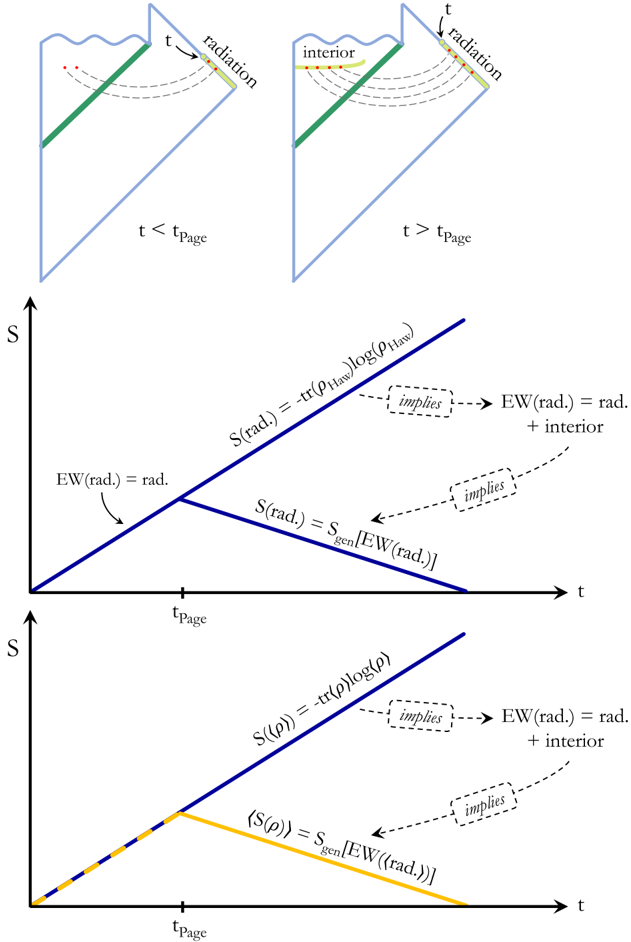
“The entropy obtained from this computation is interpreted as the average of the entropy of microscopic states, Spρq [69].”
From The baby universe is fine and the CFT knows it: on holography for closed universes (2025) · cites this paper as [69]
In the citing paper
“To reinforce the analogy with the evaporating black hole, the coarse-grained state discussed here is equivalent to the coarse-grained state of Hawking radiation, which can in fact be interpreted as an ensemble-averaged state[69].”
From The baby universe is fine and the CFT knows it: on holography for closed universes (2025) · cites this paper as [69]
In the citing paper
“This discussion is clearly reminiscent of black hole evaporation, see e.g.[66,67,69], in which the growing entropy of the Hawking state (the equivalent of [QFT] in our setting) emerges from averaging the state in each replica separately, whereas the Page curve emerges when including spacetime wormholes, which implement correlated averages among replicas (the equivalent of [EFT] in our discussion).”
From The baby universe is fine and the CFT knows it: on holography for closed universes (2025) · cites this paper as [69]
Self-check
Percentages, sums and reported differences re-computed from the paper’s own numbers.
The self-check needs the paper’s full text.
Citations
Cites
Wald, R. M. (1984) · doi:10.7208/chicago/9780226870373.001.0001 · Cited by 7,188
HAWKING, S. W. (1974) · Nature · doi:10.1038/248030a0 · Cited by 5,669 · cited 3×
“description [2], but globally the state remains pure.”
BackgroundRyu, S., & Takayanagi, T. (2006) · Physical Review Letters · doi:10.1103/physrevlett.96.181602 · Cited by 4,302
A covariant holographic entanglement entropy proposal
Hubeny, V. E., Rangamani, M., & Takayanagi, T. (2007) · Journal of High Energy Physics · doi:10.1088/1126-6708/2007/07/062 · Cited by 1,822 · cited 13×
“This was first proposed by Ryu and Takayanagi [8, 9] for stationary states.”
MethodInfluentialA Covariant Holographic Entanglement Entropy Proposal
Hubeny, V. E., Rangamani, M., & Takayanagi, T. (2007) · arXiv · doi:10.48550/arxiv.0705.0016 · Cited by 1,822
Black Holes: Complementarity or Firewalls?
Almheiri, A., Marolf, D., Polchinski, J., & Sully, J. (2012) · arXiv · doi:10.48550/arxiv.1207.3123 · Cited by 1,471
Entanglement wedge reconstruction and the information paradox
Penington, G. (2020) · Journal of High Energy Physics · doi:10.1007/jhep09(2020)002 · Cited by 968 · cited 10×
“Discussion The discovery of entanglement islands [5, 6] provides evidence for unitarity, independently of AdS/CFT.”
BackgroundMethodInfluentialReplica wormholes and the entropy of Hawking radiation
Almheiri, A., Hartman, T., Maldacena, J., Shaghoulian, E., & Tajdini, A. (2020) · Journal of High Energy Physics · doi:10.1007/jhep05(2020)013 · Cited by 910 · cited 3×
“After the Page time, one finds that the dominant saddle point has wormholes connecting the replicas [15, 16]; see Ref.”
BackgroundThe Page curve of Hawking radiation from semiclassical geometry
Almheiri, A., Mahajan, R., Maldacena, J., & Zhao, Y. (2020) · Journal of High Energy Physics · doi:10.1007/jhep03(2020)149 · Cited by 898
Replica wormholes and the black hole interior
Penington, G., Shenker, S. H., Stanford, D., & Yang, Z. (2019) · arXiv · doi:10.48550/arxiv.1911.11977 · Cited by 809
Research works printed but not linked: 38
- J. Polchinski, 2017, The Black Hole Information Problem, 10.1142/9789813149441_0006 · DOI
- 10.1103/PhysRevD.13.191 · DOI · Paper page
- 10.4310/ATMP.1998.v2.n2.a1 · DOI · Paper page
- 10.1007/JHEP12(2019)063 · DOI · Paper page
- 10.1007/JHEP08(2013)090 · DOI · Paper page
- 10.1088/1126-6708/2006/08/045 · DOI · Paper page
- 10.1007/JHEP11(2013)074 · DOI · Paper page
- 10.1007/JHEP03(2014)068 · DOI
- 10.1007/JHEP02(2013)062 · DOI · Paper page
- 10.1007/JHEP07(2020)022 · DOI
- 10.1103/PhysRevD.15.2752 · DOI · Paper page
- 10.1007/JHEP08(2020)032 · DOI
- 10.1016/0370-2693(83)90012-6 · DOI · Paper page
- 10.1016/0550-3213(85)90448-1 · DOI · Paper page
- 10.1007/JHEP03(2020)152 · DOI
- 10.21468/SciPostPhys.9.1.001 · DOI
- J. Cardy, 2006, Encyclopedia of Mathematical Physics
- 10.1103/PhysRevLett.67.161 · DOI
- 10.1103/PhysRevLett.107.101602 · DOI · Paper page
- 10.1007/JHEP11(2011)043 · DOI · Paper page
- 10.1088/1126-6708/2006/06/012 · DOI · Paper page
- 10.1007/JHEP06(2013)013 · DOI
- 10.1103/PhysRevLett.111.171301 · DOI · Paper page
- 10.1007/JHEP09(2013)018 · DOI · Paper page
- 10.1103/PhysRevD.87.124023 · DOI · Paper page
- 10.1103/PhysRevD.88.084035 · DOI
- 10.1103/PhysRevLett.112.041102 · DOI
- 10.1103/PhysRevLett.83.3370 · DOI · Paper page
- 10.1007/JHEP07(2019)065 · DOI
- 10.1007/JHEP01(2015)073 · DOI · Paper page
- 10.1007/BF02757029 · DOI · Paper page
- 10.1103/PhysRevD.52.6997 · DOI
- 10.1103/PhysRevD.74.066009 · DOI · Paper page
- 10.1088/0264-9381/31/22/225007 · DOI · Paper page
- 10.1007/JHEP06(2016)004 · DOI · Paper page
- 10.1103/PhysRevLett.117.021601 · DOI · Paper page
- 10.1088/1126-6708/2001/05/008 · DOI · Paper page
- 10.1088/1126-6708/2002/04/057 · DOI
Cited by
Sorted by citations
Evaporating black holes coupled to a thermal bath
Chen, H. Z., Fisher, Z., Hernandez, J., Myers, R. C., & Ruan, S.-M. (2021) · Journal of High Energy Physics · doi:10.1007/jhep01(2021)065 · Cited by 99
Island finder and entropy bound
Bousso, R., & Shahbazi-Moghaddam, A. (2021) · Physical Review D · doi:10.1103/physrevd.103.106005 · Cited by 44
The baby universe is fine and the CFT knows it: on holography for closed universes
Antonini, S., Rath, P., Sasieta, M., Swingle, B., & Vilar López, A. (2025) · Journal of High Energy Physics · doi:10.1007/jhep12(2025)159 · Cited by 35
Quantum Extremal Surfaces and the Holographic Entropy Cone
Akers, C., Hernández-Cuenca, S., & Rath, P. (2021) · Journal of High Energy Physics · doi:10.1007/jhep11(2021)177 · Cited by 32
Metadata
- Authors
- Bousso, R., & Wildenhain, E.
- Venue
- Physical Review D
- Publisher
- American Physical Society (APS)
- Published
- 2020-09-16
- Volume
- 102
- Issue
- 6
- ISSN
- 2470-0010
- 2470-0029
- Cited by
- 101
- References
- 19
- Language
- en
- Funders
- U.S. Department of Energy (DE-SC0019380, DE-AC02-05CH11231)
- National Science Foundation (PHY1820912)
- Berkeley Center for Theoretical Physics
About these checks
Registry, retraction, Cites and statistics results are computed, not judged, with one exception: a printed reference that no index lists is read once by a model before it counts as a citation error. Claims are extracted by a model and kept only when their quote appears verbatim in the text; each cited source is then checked, with a model’s help, for whether it says what the claim relies on. Those verdicts can be wrong — read the claim’s quote and the cited source before relying on one.
Statistics and arithmetic are recomputed, not judged.
Confidence bands are shown only for fields calibrated on our annotated test set. None is calibrated yet, so no band is shown.
What counts as a claim ›How we measure confidence ›How we check this ›
Are you an author, or do you see a problem with this page? Request a review
How to cite
Cite CoChat for the checks on this page, and the paper for its own findings.
- This page
- CoChat. (2026). Citation check: Gravity/ensemble duality. https://app.cochat.ai/papers/10.1103/physrevd.102.066005
- The paper
- Bousso, R., & Wildenhain, E. (2020). Gravity/ensemble duality. Physical Review D. https://doi.org/10.1103/physrevd.102.066005
