

The DOI matches its Crossref record; 142 of the 143 references it cites were found in a registry or an index, and 1 are not checked yet; none of the 119 sources its claims cite is checked for support yet.
Nothing is certain in string compactifications
Open accessAbstract
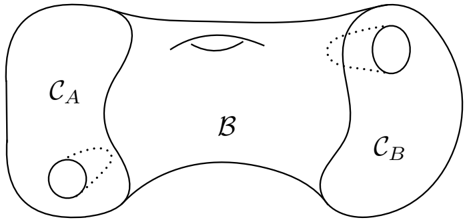
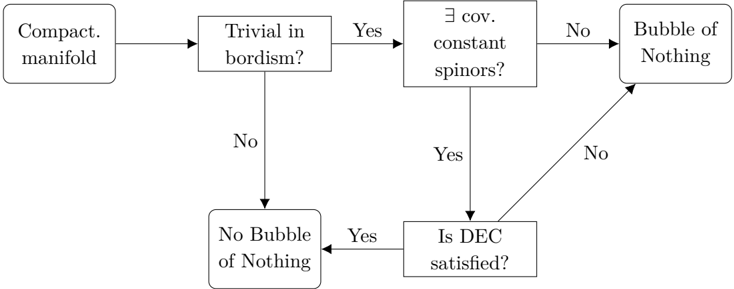
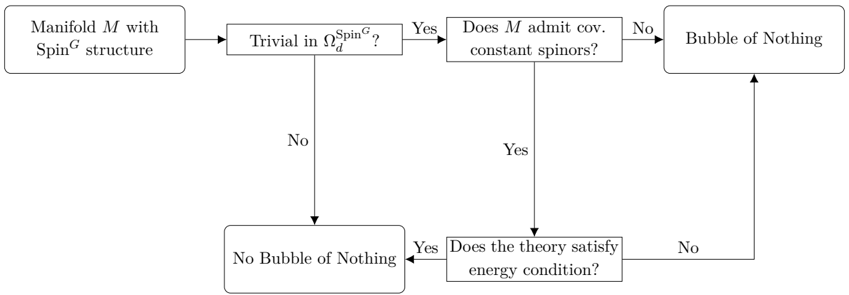
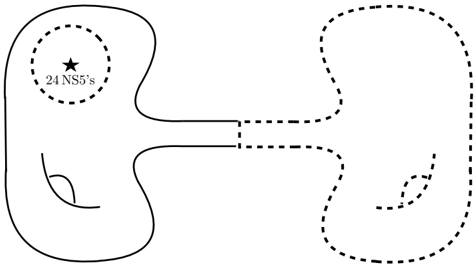
A bubble of nothing is a spacetime instability where a compact dimension collapses. After nucleation, it expands at the speed of light, leaving “nothing” behind. We argue that the topological and dynamical mechanisms which could protect a compactification against decay to nothing seem to be absent in string compactifications once supersymmetry is broken. The topological obstruction lies in a bordism group and, surprisingly, it can disappear even for a SUSY-compatible spin structure. As a proof of principle, we construct an explicit bubble of nothing for a T3 with completely periodic (SUSY-compatible) spin structure in an Einstein dilaton Gauss-Bonnet theory, which arises in the low-energy limit of certain heterotic and type II flux compactifications. Without the topological protection, supersymmetric compactifications are purely stabilized by a Coleman-deLuccia mechanism, which relies on a certain local energy condition. This is violated in our example by the nonsupersymmetric GB term. In the presence of fluxes this energy condition gets modified and its violation might be related to the Weak Gravity Conjecture. We expect that our techniques can be used to construct a plethora of new bubbles of nothing in any setup where the low-energy bordism group vanishes, including type II compactifications on CY3, AdS flux compactifications on 5-manifolds, and M-theory on 7-manifolds. This lends further evidence to the conjecture that any non-supersymmetric vacuum of quantum gravity is ultimately unstable.
Checked 2026-11-13 · 1 reference not checked yet
Overview
CoChat Summary
TL;DR
The paper argues that the usual topological protection against bubbles of nothing is absent for compactifications with three or more internal dimensions, since Ω^Spin_3 = 0, and explicitly constructs a bubble of nothing for T^3 with supersymmetry-preserving periodic spin structure in an Einstein-dilaton-Gauss-Bonnet theory. The decay is dynamically forbidden in the supersymmetric limit α → 0, but a finite-rate instability appears once the Gauss-Bonnet term breaks supersymmetry and violates the Dominant Energy Condition.
Key findings
- For T^3 with periodic (SUSY-compatible) spin structure, there is no topological obstruction because Ω^Spin_3 = 0; the authors construct an explicit smooth bubble of nothing in an Einstein-dilaton-Gauss-Bonnet model with α > 0.
- For the T^3 compactification, the nucleation radius and Euclidean action scale as R(α) ∝ 24π² V_T3 α^{-1} and S_BON(α) ∝ 24π² V_T3 α^{-(D-5)}, so the decay rate vanishes as α → 0 via a Coleman-de Luccia mechanism.
- For the 27 non-supersymmetric T^3/Γ quotients, bubbles exist with finite rate even at α = 0; the radius and action are R = 6(D−5)/(12−N) R_kk and S_BON = A_{D−4}/(8πG_{D−3}) R^{D−5}/2, with the missing G3 case corresponding to N = 8.
- The construction is embedded in heterotic/type I string theory, where the required flux breaks supersymmetry; the authors argue this supports the conjecture that any non-supersymmetric vacuum of quantum gravity is ultimately unstable.
Methods
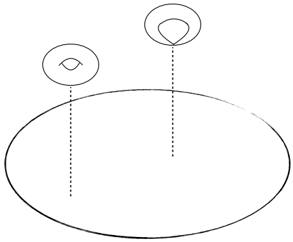
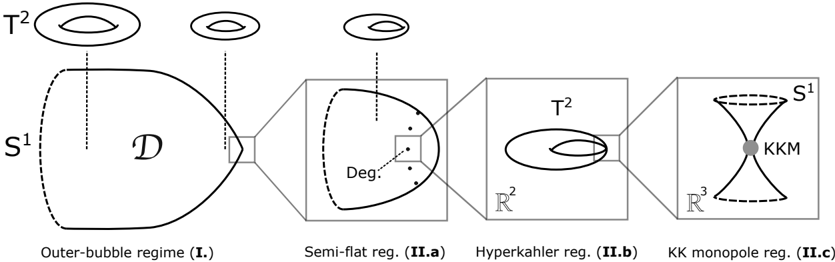
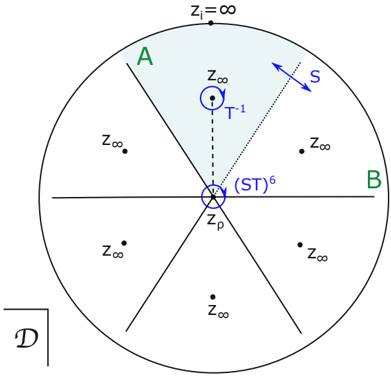
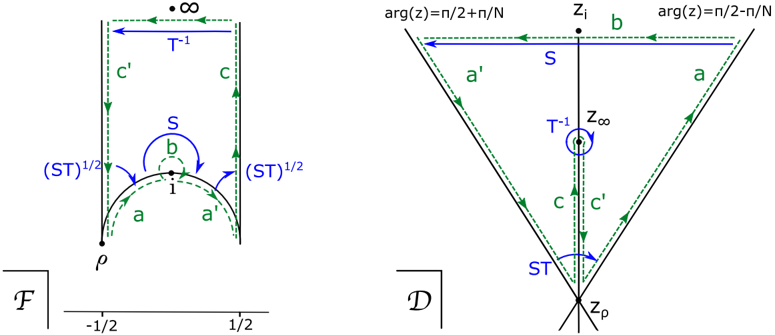
- The authors construct Euclidean bubble-of-nothing solutions with ansatz M_D = B_4 ×_W S^{D−4}, where B_4 is a nulbordism of T^3 or T^3/Γ, described by a Weierstrass elliptic fibration with N degenerations.
- They solve the Einstein-dilaton-Gauss-Bonnet equations using a layered approximation: perturbative treatment in α near the bubble core, semi-flat and hyperkähler/Taub-NUT descriptions around degenerations, numerical integration of the outer-bubble ODEs, and gluing across layers.
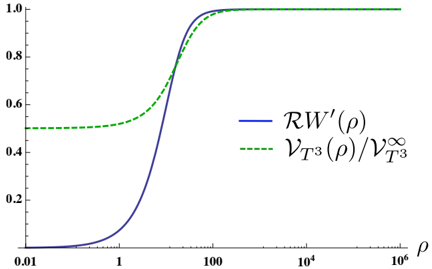
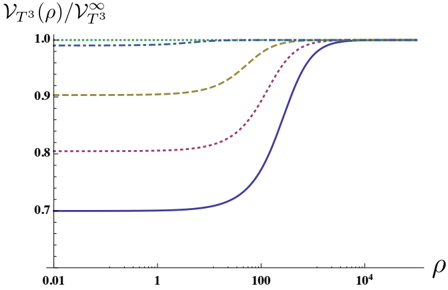
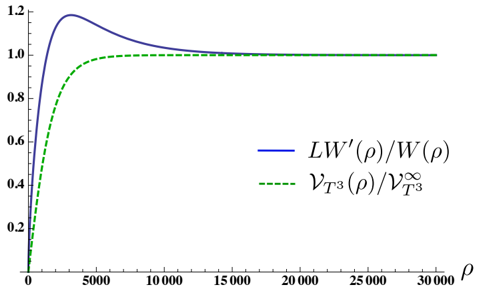
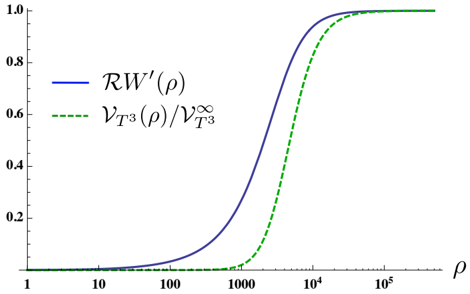
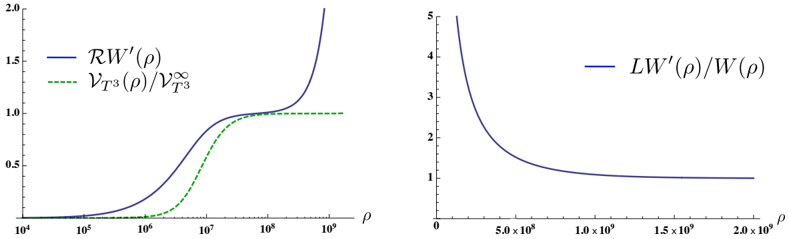
- A numerical example for D = 7 gives R = 32.2 for 24π² V_T3 α = 0.02 and V*_T3/V_T3 = 0.5; the paper also discusses string embeddings via heterotic on T^4 and type I/IIB duals.
Limitations
- The paper states that the solutions are approximate and perturbative in α, that the fluctuation spectrum is not computed, and that quantum effects are not computed; the resulting expressions provide an upper bound on the actual decay rate.
- The construction relies on a degenerate/large-volume limit, a small T^2 fibre, well-separated degenerations, and small α; the string embedding turns on flux that produces runaway potentials and vacuum energy at higher order in α.
- The paper does not provide a general construction for arbitrary compactifications; it focuses on T^3 and T^3/Γ, with explicit numerical checks mainly in D = 7, and leaves broader flux/AdS/CY cases for future work.
Model-written summary. Check it against the paper before relying on it.
Integrity signals
Registry
Cites
Statistics
Figures
Verification
Claims the paper makes
0 Valid · 9 Not valid · 93 Not checked · 535 Own results and interpretations
A check of a cited source is scheduled, or we don’t hold its full text yet; the claim is checked once it runs.
In the paper
“Actually, our method (also alternative to [30]) allows to obtain systematically higher order corrections to the metrics of [29].”
§ Nothing is certain in string compactifications > JHEP12(2020)032
What the sources say
- Not checked yetcites [29] M. Gross and P.M.H. Wilson, Large complex structure limits of K3 surfaces, J. Diff. Geom. 55 (2000) 475 [math/0008018]. source
A check is scheduled.
- Not matchedcites [30] S. Kachru, A. Tripathy and M. Zimet, K3 metrics from little string theory, arXiv:1810.10540 [INSPIRE].
Couldn’t be matched to a paper in Crossref, so it can’t be checked.
plainstates a cause- Asserted: passes — The authors put it forward as true.
- Checkable: passes — It can be checked against evidence.
- Load-bearing: unclear — It is unclear whether the paper’s conclusions depend on it.
- Based: passes — The paper gives a reason why it holds.
- Not checked yet
A result the paper reports from its own data — it cites no other source for it, so there is none to check. The quote shows it is in the paper.
In the paper
“As a proof of principle, we construct an explicit bubble of nothing for a T 3 with completely periodic (SUSY-compatible) spin structure in an Einstein dilaton Gauss-Bonnet theory, which arises in the low-energy limit of certain heterotic and type II flux compactifications.”
§ Nothing is certain in string compactifications > Abstract
boostedstates a causeSingle case- Asserted: passes — The authors put it forward as true.
- Checkable: passes — It can be checked against evidence.
- Load-bearing: passes — The paper’s conclusions depend on it.
- Based: passes — The paper gives a reason why it holds.
The paper states this without a source or data behind it here, so there is nothing to check it against. The quote shows it is in the paper.
In the paper
“We will dispel doubts on this point by showing that the effective theory under consideration with the Gauss-Bonnet term can be embedded in string theory compactifications, as well as discuss the potential impact on string phenomenology.”
§ Nothing is certain in string compactifications > JHEP12(2020)032
plainstates an association- Asserted: passes — The authors put it forward as true.
- Checkable: passes — It can be checked against evidence.
- Load-bearing: passes — The paper’s conclusions depend on it.
- Based: unclear — It is unclear why the paper says it holds.
A result the paper states — it cites no source for it, so there is none to check. The quote shows it is in the paper.
In the paper
“Topologically, it is an elliptic fibration with an E 6 singularity.”
§ Nothing is certain in string compactifications > JHEP12(2020)032
plainstates an association- Asserted: passes — The authors put it forward as true.
- Checkable: passes — It can be checked against evidence.
- Load-bearing: unclear — It is unclear whether the paper’s conclusions depend on it.
- Based: passes — The paper gives a reason why it holds.
A result the paper reports from its own data — it cites no other source for it, so there is none to check. The quote shows it is in the paper.
In the paper
“Furthermore, our construction provides a detailed characterisation of the warping induced by higher derivative terms and fluxes in these geometries (see e.g.appendix A, where we extend our results to an AdS compactification on T 3 with fluxes).”
§ Nothing is certain in string compactifications > JHEP12(2020)032
plainstates a cause- Asserted: passes — The authors put it forward as true.
- Checkable: passes — It can be checked against evidence.
- Load-bearing: unclear — It is unclear whether the paper’s conclusions depend on it.
- Based: passes — The paper gives a reason why it holds.
349 more claims
Create a free account to see all 637 claims and to verify the 56 references still open.
- It may state two separate claims as one. 208
- Probably not a substantial claim. 91
- The quote only partly states this claim. 6
Self-check
Percentages, sums and reported differences re-computed from the paper’s own numbers.
Each contradiction between two passages listed here was confirmed by an independent check.
Rated major: it would touch a result — a value a result rests on, reported and recomputed p-values on opposite sides of the significance level, two passages that conflict with no sign which is right, or a cited work retracted before this paper was published.
In the paper
§ Nothing is certain in string compactifications > JHEP12(2020)032
“The bubble nucleation radius is R = 32.2, and the three-torus volume at the boundary of the inner-bubble regime is given by V * T 3 = 0.5 × V ∞ T 3”
§ Nothing is certain in string compactifications > 5.4.1 Bubble decay of the T 3 compactification
“for the case 24π 2 V T 3 α = 0.02 and V * T 3 /V T 3 = 0.5, where we find a BON nucleation radius R = 32.2.”
Rated minor: it would not touch a result — a value no result rests on, a p-value that stays on the same side of the significance level, or a conflict that is clerical, resolved elsewhere in the paper, or outside its own findings.
In the paper
§ Nothing is certain in string compactifications > JHEP12(2020)032
“W | I (ρ) = 1 + (D -5 )ρ 2 4R 2 + . . .,”
§ Nothing is certain in string compactifications > 5.4.2 Bubble decay for the G3 compactification
“W (ρ) = 1 + (D -5)ρ 2 2R 2 + . . . ,”
Rated minor: it would not touch a result — a value no result rests on, a p-value that stays on the same side of the significance level, or a conflict that is clerical, resolved elsewhere in the paper, or outside its own findings.
In the paper
§ Nothing is certain in string compactifications > JHEP12(2020)032
“It can be checked explicitly that DEC is satisfied when α = 0”
§ Nothing is certain in string compactifications > JHEP12(2020)032
“Conversely, when α = 0 the model violates DEC, and the Positive Energy Theorem can not protect the stability of the compactification”
Rated minor: it would not touch a result — a value no result rests on, a p-value that stays on the same side of the significance level, or a conflict that is clerical, resolved elsewhere in the paper, or outside its own findings.
In the paper
§ Nothing is certain in string compactifications > JHEP12(2020)032
“Consider e.g. the circle with periodic spin structure, which generates Ω Spin 2 = Z 2 .”
§ Nothing is certain in string compactifications > 2.2 Topological obstruction
“The nontrivial class is generated precisely by an S 1 with a periodic (i.e.susy-preserving) spin structure.”
Rated minor: it would not touch a result — a value no result rests on, a p-value that stays on the same side of the significance level, or a conflict that is clerical, resolved elsewhere in the paper, or outside its own findings.
In the paper
§ Nothing is certain in string compactifications > JHEP12(2020)032
“Only the first class, T 3 with a periodic spin structure, is compatible with supersymmetry; it is the only one for which there is no nulbordism and hence no bubble of nothing.”
§ Nothing is certain in string compactifications > 3.1 Topology of the solutions
“the fact that Ω Spin 3 = 0 tells us that there is a spin four-manifold B 4 such that ∂B 4 = T 3 .”
Citations
Cites
Wald, R. M. (1984) · doi:10.7208/chicago/9780226870373.001.0001 · Cited by 7,188
Action integrals and partition functions in quantum gravity
Gibbons, G. W., & Hawking, S. W. (1977) · Physical Review D · doi:10.1103/physrevd.15.2752 · Cited by 3,449
String theory dynamics in various dimensions
Witten, E. (1995) · Nuclear Physics B · doi:10.1016/0550-3213(95)00158-o · Cited by 2,775
Singular hypersurfaces and thin shells in general relativity
Israel, W. (1966) · Il Nuovo Cimento B Series 10 · doi:10.1007/bf02710419 · Cited by 2,660
Coleman, S. (1985) · Cambridge University Press eBooks · doi:10.1017/cbo9780511565045 · Cited by 2,269
Semi-Riemannian Geometry With Applications to Relativity
O’Neill, B. (2011) · Cited by 2,236
String theory dynamics in various dimensionsPreprint
Witten, E. (1995) · Cited by 1,898
Gravitation, gauge theories and differential geometry
Eguchi, T., Gilkey, P., & Hanson, A. J. (1980) · Physics Reports · doi:10.1016/0370-1573(80)90130-1 · Cited by 1,809
Fate of the false vacuum. II. First quantum corrections
Callan, C. G., & Coleman, S. (1977) · Physical Review D · doi:10.1103/physrevd.16.1762 · Cited by 1,789
Wormholes, Time Machines, and the Weak Energy Condition
Morris, M. S., Thorne, K. S., & Yurtsever, U. (1988) · Physical Review Letters · doi:10.1103/physrevlett.61.1446 · Cited by 1,609
Cited by
Lectures on the Swampland Program in String Compactifications
van Beest, M., Calderón-Infante, J., Mirfendereski, D., & Valenzuela, I. (2022) · Physics Reports · doi:10.1016/j.physrep.2022.09.002 · Cited by 483
Self-citationString cosmology: From the early universe to today
Cicoli, M., Conlon, J. P., Maharana, A., Parameswaran, S., Quevedo, F., & Ivonne Zavala, C. (2024) · Physics Reports · doi:10.1016/j.physrep.2024.01.002 · Cited by 238
The Swampland Conjectures: A Bridge from Quantum Gravity to Particle Physics
Mariana Graña, A., & Herráez, Á. (2021) · Universe · doi:10.3390/universe7080273 · Cited by 191
Dynamical Cobordism and Swampland Distance Conjectures
Buratti, G., Calderón-Infante, J., Delgado, M., & Uranga, Á. M. (2021) · Journal of High Energy Physics · doi:10.1007/jhep10(2021)037 · Cited by 80
The Chronicles of IIBordia: Dualities, Bordisms, and the Swampland
Debray, A., Dierigl, M., Heckman, J. J., & Montero, M. (2024) · Advances in Theoretical and Mathematical Physics · doi:10.4310/atmp.241028224804 · Cited by 77
Self-citation
Metadata
- Authors
- Etxebarria, I. G., Montero, M., Sousa, K., & Valenzuela, I.
- Affiliations
- Harvard University (US)
- Charles University (CZ)
- Corresponding author
- Montero, Miguel
- Sousa, Kepa
- Valenzuela, Irene
- Venue
- Journal of High Energy Physics
- Published
- 2020-12
- Volume
- 2020
- Issue
- 12
- ISSN
- 1029-8479 (ISSN-L)
- OpenAlex
- W3024522407
- Semantic Scholar
- f04bc50c30f8c73faf01aa0e86378dfadec020ac
- Cited by
- 87
- References
- 143
- Citations by year
- 2026: 10 · 2025: 12 · 2024: 17 · 2023: 14 · 2022: 19 · 2021: 10 · 2020: 5
- FWCI
- 4.70
- Type
- journal article
- Language
- en
- Open access
- diamond
- doi.org
- Locations
- Journal of High Energy Physics (publishedVersion, cc-by)
- Durham Research Online (Durham University) (acceptedVersion, other-oa)
- arXiv (Cornell University) (submittedVersion)
- Durham Research Online (Durham University) (submittedVersion, cc-by)
- DOAJ (DOAJ: Directory of Open Access Journals) (submittedVersion, cc-by-sa)
- arXiv (Cornell University)
- Funders
- National Science Foundation (ST/P000371/1, 602883, 1748958)
- Simons Foundation (602883, PHY-1748958)
- Grantová Agentura České Republiky (GA19-01850S)
- Fonds Wetenschappelijk Onderzoek (PHY-1748958)
- KU Leuven
- Science and Technology Facilities Council (ST/P000371/, ST/P000371/1)
- Kavli Institute for Theoretical Physics, University of California, Santa Barbara (1748958, PHY-1748958)
- Topics
- Physical Sciences › Physics and Astronomy › Nuclear and High Energy Physics › Black Holes and Theoretical Physics
- Physical Sciences › Physics and Astronomy › Nuclear and High Energy Physics › Noncommutative and Quantum Gravity Theories
- Physical Sciences › Physics and Astronomy › Nuclear and High Energy Physics › Particle physics theoretical and experimental studies
- Keywords
- bubble of nothing, string compactification, bordism groups, supersymmetry breaking, spin structure, energy condition violation, flux compactification, heterotic compactifications, weak gravity conjecture, vacuum instability, M-theory
About these checks
Registry, retraction, Cites and statistics results are computed, not judged, with one exception: a printed reference that no index lists is read once by a model before it counts as a citation error. Claims are extracted by a model and kept only when their quote appears verbatim in the text; each cited source is then checked, with a model’s help, for whether it says what the claim relies on. Those verdicts can be wrong — read the claim’s quote and the cited source before relying on one.
A language model drew the claims from the paper on 2026-11-13, under version 3 of the claim definition (model deepseek-v4.1-flash, prompt extract-v3).
A second model labelled each claim on 2026-11-13 (model jev-1.13-20260917, definition revision gold-guideline-v0.2).
Statistics and arithmetic are recomputed, not judged.
Confidence bands are shown only for fields calibrated on our annotated test set. None is calibrated yet, so no band is shown.
What counts as a claim ›How we measure confidence ›How we check this ›
Are you an author, or do you see a problem with this page? Request a review
Data sources
Bibliographic data: Semantic Scholar, OpenAlex, Crossref.
Contains information from the Semantic Scholar Academic Graph Datasets, made available under the ODC Attribution License (ODC-BY 1.0).
Semantic Scholar’s data is described in: Kinney, R., et al. (2023). The Semantic Scholar Open Data Platform. arXiv:2301.10140.
