

Pharmacological properties of JTE-052: a novel potent JAK inhibitor that suppresses various inflammatory responses in vitro and in vivo
Open accessThe DOI matches its Crossref record; 23 of the 23 references it cites were found in a registry or an index.
Abstract
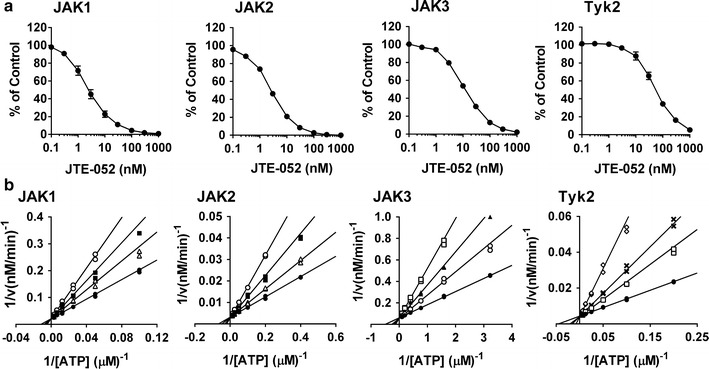
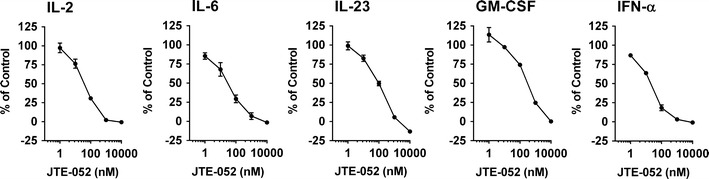
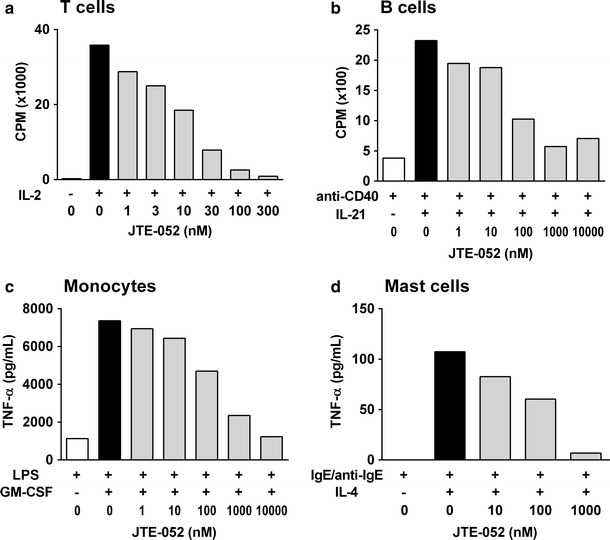
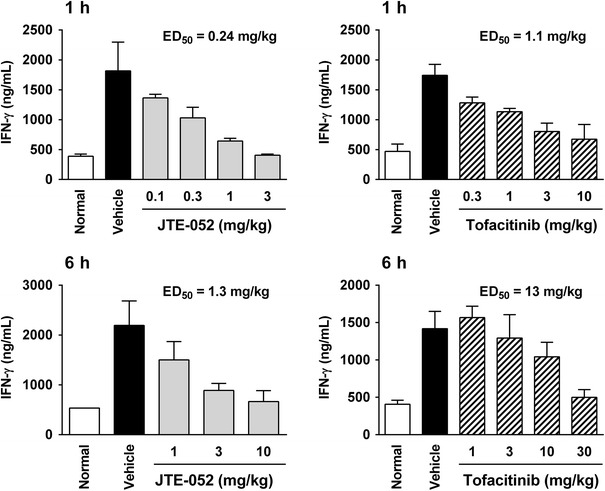
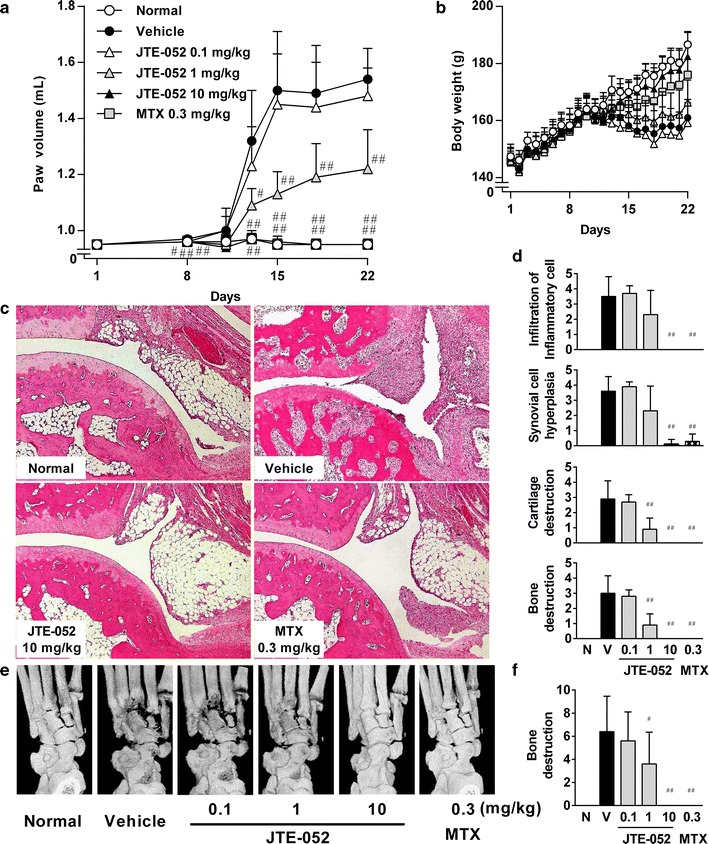
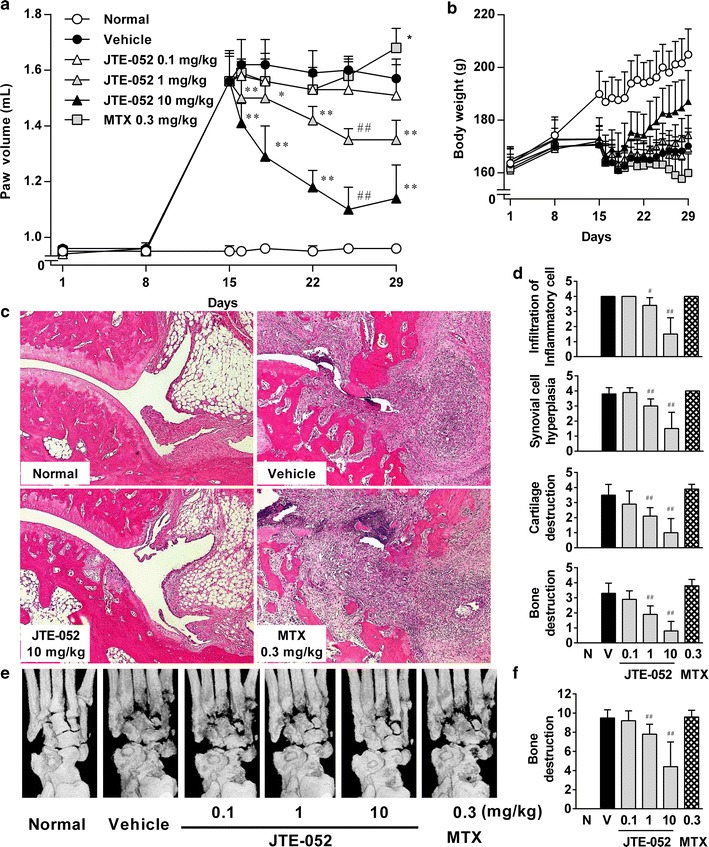
OBJECTIVE: To evaluate the pharmacological properties of JTE-052, a novel Janus kinase (JAK) inhibitor. METHODS: The JAK inhibitory activity of JTE-052 was evaluated using recombinant human enzymes. The inhibitory effects on cytokine signaling pathways were evaluated using primary human inflammatory cells. The in vivo efficacy and potency of JTE-052 were examined in a mouse interleukin (IL)-2-induced interferon (IFN)-γ production model and a rat collagen-induced arthritis model. RESULTS: JTE-052 inhibited the JAK1, JAK2, JAK3, and tyrosine kinase (Tyk)2 enzymes in an adenosine triphosphate (ATP)-competitive manner and inhibited cytokine signaling evoked by IL-2, IL-6, IL-23, granulocyte/macrophage colony-stimulating factor, and IFN-α. JTE-052 inhibited the activation of inflammatory cells, such as T cells, B cells, monocytes, and mast cells, in vitro. Oral dosing of JTE-052 resulted in potent suppression of the IL-2-induced IFN-γ production in mice with an ED50 value of 0.24 mg/kg, which was more potent than that of tofacitinib (ED50 = 1.1 mg/kg). In the collagen-induced arthritis model, JTE-052 ameliorated articular inflammation and joint destruction even in therapeutic treatments where methotrexate was ineffective. CONCLUSIONS: The present results indicate that JTE-052 is a highly potent JAK inhibitor, and represents a candidate anti-inflammatory agent for suppressing various types of inflammation.
Overview
The claims and statistics of this paper haven’t been checked yet.
Free: it reads the open-access text and checks the first 5 claims that cite a source we can check. Create a free account to check every claim.
Integrity signals
Registry
Cites
Statistics
Figures
Verification
Claims the paper makes
The claims and statistics of this paper haven’t been checked yet.
Free: it reads the open-access text and checks the first 5 claims that cite a source we can check. Create a free account to check every claim.
Claims other papers make about this one
Each is checked against this paper’s own text: does it say what the citing paper says it does?
The source backs part of the claim, not all of it — or backs it for a different population, condition or comparison.
In the citing paper
“Delgocitinib (JTE-052/LEO 242549) is a first-generation, non-selective JAK inhibitor that, upon topical and oral application, was shown to improve allergic contact sensitization and AD-like inflammation in animal models221–223.”
From Atopic dermatitis: an expanding therapeutic pipeline for a complex disease (2022) · cites this paper as [222]
Experimental — accuracy not yet measured
Self-check
Percentages, sums and reported differences re-computed from the paper’s own numbers.
The self-check needs the paper’s full text.
Citations
Cites
A quantitative analysis of kinase inhibitor selectivity
Karaman, M. W., Herrgard, S., Treiber, D. K., Gallant, P., Atteridge, C. E., Campbell, B. T., Chan, K. W., Ciceri, P., Davis, M. I., Edeen, P. T., et al. (2008) · Nature Biotechnology · doi:10.1038/nbt1358 · Cited by 2,466 · cited 1×
“Tofacitinib represents the first small molecule developed as a selective inhibitor of the JAKs, and exhibits nanomolar potency and a high degree of kinome selectivity [4].”
BackgroundBorst, O., Walker, B., Münzer, P., Russo, A., Schmid, E., Faggio, C., Bigalke, B., Laufer, S., Gawaz, M., & Lang, F. (2013) · Cellular Physiology and Biochemistry · doi:10.1159/000350110 · Cited by 1,860
JAK and STAT Signaling Molecules in Immunoregulation and Immune-Mediated Disease
O'Shea, J. J., & Plenge, R. (2012) · Immunity · doi:10.1016/j.immuni.2012.03.014 · Cited by 1,138 · cited 1×
“Several small-molecule JAK inhibitors are currently under clinical development [3].”
BackgroundQuintás-Cardama, A., Vaddi, K., Liu, P., Manshouri, T., Li, J., Scherle, P. A., Caulder, E., Wen, X., Li, Y., Waeltz, P., et al. (2010) · Blood · doi:10.1182/blood-2009-04-214957 · Cited by 843 · cited 1×
“reported to inhibit JAK1 and JAK2 with nanomolar potency and JAK3 with 100-fold weaker potency [20].”
BackgroundTofacitinib, an Oral Janus Kinase Inhibitor, in Active Ulcerative Colitis
Sandborn, W. J., Ghosh, S., Panes, J., Vranic, I., Su, C., Rousell, S., & Niezychowski, W. (2012) · New England Journal of Medicine · doi:10.1056/nejmoa1112168 · Cited by 800 · cited 2×
“These may be a reason why JAK inhibitors such as tofacitinib showed apparent effects in RA patients who had inadequate responses to MTX and in patients with various inflammatory diseases such as psoriasis, IBD, and transplantation rejection.”
BackgroundYamaoka, K., Saharinen, P., Pesu, M., Holt, V. E., Silvennoinen, O., & O'Shea, J. J. (2004) · Genome Biology · doi:10.1186/gb-2004-5-12-253 · Cited by 635 · cited 14×
“3b and S1b, human B cells underwent proliferation upon stimulation with IL-21 Table 1 IC50 and Ki values of JAK inhibitors in enzyme assays Compounds JAK1 JAK2 JAK3 Tyk2 JTE-052 IC50 (nM) 2.8 ± 0.6 2.6 ± 0.2 13 ± 0 58 ± 9 Ki (nM) 2.1 ± 0.3 1.7 ± 0.0 5.5 ± 0.3 14 ± 1 Tofacitinib Ki (nM) 2.0 ± 0.4 1.3 ± 0.0 0.74 ± 0.01…”
BackgroundInfluentialPrevention of organ allograft rejection by a specific Janus kinase 3 inhibitor
Changelian, P. S., Flanagan, M. E., Ball, D. J., Kent, C. R., Magnuson, K. S., Martin, W. H., Rizzuti, B. J., Sawyer, P. S., Perry, B. D., Brissette, W. H., et al. (2003) · Science · doi:10.1126/science.1087061 · Cited by 607 · cited 1×
“Tofacitinib is a selective inhibitor for the JAK family of kinases and has been reported to block the cytokine signaling related to JAK1/3 [10, 11] and inhibit the function of T cells [12], but the precise mechanism by which tofacitinib shows such broad efficacy is not well understood.”
BackgroundMeyer, D. M., Jesson, M. I., Li, X., Elrick, M. M., Funckes-Shippy, C. L., Warner, J. D., Gross, C. J., Dowty, M. E., Ramaiah, S. K., Hirsch, J. L., et al. (2010) · Journal of Inflammation · doi:10.1186/1476-9255-7-41 · Cited by 461 · cited 2×
“Tofacitinib inhibited JAK1, JAK2, and JAK3 with nanomolar potency and Tyk2 with 10-fold weaker potency, consistent with a previous report [10].”
BackgroundResultFleischmann, R., Cutolo, M., Genovese, M. C., Lee, E. B., Kanik, K. S., Sadis, S., Connell, C. A., Gruben, D., Krishnaswami, S., Wallenstein, G., et al. (2012) · Arthritis & Rheumatism · doi:10.1002/art.33383 · Cited by 376 · cited 14×
“There are several reports regarding adverse events, including elevation of transaminases or rates of infection, in tofacitinib-treated patients [5, 6].”
BackgroundInfluentialTanaka, Y., Suzuki, M., Nakamura, H., Toyoizumi, S., Zwillich, S. H., & Tofacitinib Study Investigators (2011) · Arthritis Care & Research · doi:10.1002/acr.20494 · Cited by 297
Cited by
Items 101–117 of 117
Arita, K., Otake, S., Kobayashi, K., Iwasaki, H., Okamoto, Y., Katsuda, Y., Konishi, N., & Yamaguchi, T. (2025) · Biological and Pharmaceutical Bulletin · doi:10.1248/bpb.b25-00249 · Cited by 1
P24: Benzalkonium chloride: a potential emerging allergen in the era of the COVID‐19 pandemic
(2022) · British Journal of Dermatology · doi:10.1111/bjd.21146 · Cited by 1
Mechanism of atopic dermatitis and usefulness of topical JAK inhibitor (delgocitinib)
Kajita, N., & Yoshida, K. (2023) · Nihon Shoni Arerugi Gakkaishi The Japanese Journal of Pediatric Allergy and Clinical Immunology · doi:10.3388/jspaci.37.513
Avcı, A., & Ertaş, R. (2025) · Springer eBooks · doi:10.1007/978-3-031-84274-0_15
Emerging Strategies in Innovative Topical Delivery Systems for Treating Atopic Dermatitis
Raysing, S. D., & Mote, V. (2025) · Asian Journal of Pharmaceutical Research · doi:10.52711/2231-5691.2025.00035
Igarashi, A., Hatori, M., & Yamada, R. (2025) · 日本臨床皮膚科医会雑誌 · doi:10.3812/jocd.42.784
Biton, J., Hervé, R., Breckler, M., Lemeiter, D., Decker, P., Sigaux, J., Assier, É., Semerano, L., Bessis, N., Boissier, M., et al. (2026) · Scientific Reports · doi:10.1038/s41598-026-54494-0
How many protein pairs can we chemically target?
Falaguera, M. J., Oprea, T. I., & Mestres, J. (2026) · Drug Discovery Today · doi:10.1016/j.drudis.2026.104718
Yan, R., Chen, S., & Yan, J. (2026) · Dermatologic Therapy · doi:10.1155/dth/5327330
Silverberg, J. I., Beck, L. A., Gooderham, M., Murrell, D. F., Wiseman, M., Sørensen, L., Jönsson, P. G., & Stein‐Gold, L. (2026) · British Journal of Dermatology · doi:10.1093/bjd/ljag296
Why JAK3 selectivity matters: biology, approved JAK inhibitors, and medicinal chemistry perspectives
da Silva, S. D., & Parise-Filho, R. (2026) · Bioorganic Chemistry · doi:10.1016/j.bioorg.2026.110298
Janus Kinase Inhibitors in Atopic Dermatitis: A Global Bibliometric Analysis (2015–2025)
Aktaş, S., Yıldız, S., Temiz, S. A., Dursun, R., & Khachemoune, A. (2026) · Journal of Clinical Practice and Research · doi:10.14744/cpr.2026.22998
“28 First-generation JAK inhibitors include tofacitinib, ruxolitinib, baricitinib, and oclacitinib, whereas second-generation inhibitors include upadacitinib, deucravacitinib, and abrocitinib.”
Chapter IV: Pharmacotherapy: Topical therapy
Tanaka, A., & Tsunemi, Y. (2026) · Nihon Shoni Arerugi Gakkaishi The Japanese Journal of Pediatric Allergy and Clinical Immunology · doi:10.3388/jspaci.40.269
BindingDB (2025) · UC San Diego · doi:10.7270/q2jw8khb
Metadata
- Authors
- Tanimoto, A., Ogawa, Y., Oki, C., Kimoto, Y., Nozawa, K., Amano, W., Noji, S., Shiozaki, M., Matsuo, A., Shinozaki, Y., & Matsushita, M.
- Affiliations
- Japan Tobacco (Japan) (JP)
- Corresponding author
- Tanimoto, Atsuo
- Venue
- Inflammation Research
- Published
- 2014-11-12
- Volume
- 64
- Issue
- 1
- Pages
- 41-51
- ISSN
- 1023-3830 (ISSN-L)
- 1420-908X
- PMC
- PMC4286029
- OpenAlex
- W1966518661
- Cited by
- 111
- References
- 23
- Citations by year
- 2026: 9 · 2025: 21 · 2024: 7 · 2023: 8 · 2022: 17 · 2021: 15 · 2020: 13 · 2019: 8 · 2018: 4 · 2017: 3 · 2016: 3 · 2015: 3
- FWCI
- 1.45
- Type
- journal article
- Language
- en
- Open access
- hybrid
- doi.org
- Locations
- Inflammation Research (publishedVersion, cc-by)
- PubMed Central (publishedVersion, cc-by)
- PubMed (publishedVersion)
- Topics
- Life Sciences › Immunology and Microbiology › Immunology › Cytokine Signaling Pathways and Interactions
- Health Sciences › Medicine › Rheumatology › Rheumatoid Arthritis Research and Therapies
- Health Sciences › Medicine › Hematology › Autoimmune and Inflammatory Disorders Research
- Keywords
- JAK inhibitors, Janus kinase, JAK1, JAK2, JAK3, TYK2, cytokine signaling, interleukin-2, interleukin-6, IL-23, interferon-gamma, collagen-induced arthritis, articular inflammation, joint destruction, anti-inflammatory agents, tofacitinib, oral bioavailability, pharmacokinetics
- MeSH terms
- Animals, Anti-Inflammatory Agents, Arthritis, Experimental, B-Lymphocytes, Cells, Cultured, Collagen, Disease Models, Animal, Humans, Inflammation, Interferon-gamma, Interleukin-2, Mast Cells, Methotrexate, Mice, Inbred DBA, Rats, Inbred Lew, T-Lymphocytes, Signal Transduction, Cytokines, Antirheumatic Agents, Protein Kinase Inhibitors, Mice, Rats, Janus Kinases, In Vitro Techniques
About these checks
Registry, retraction, Cites and statistics results are computed, not judged, with one exception: a printed reference that no index lists is read once by a model before it counts as a citation error. Claims are extracted by a model and kept only when their quote appears verbatim in the text; each cited source is then checked, with a model’s help, for whether it says what the claim relies on. Those verdicts can be wrong — read the claim’s quote and the cited source before relying on one.
Statistics and arithmetic are recomputed, not judged.
Confidence bands are shown only for fields calibrated on our annotated test set. None is calibrated yet, so no band is shown.
What counts as a claim ›How we measure confidence ›How we check this ›
Are you an author, or do you see a problem with this page? Request a review
Data sources
Bibliographic data: Semantic Scholar, OpenAlex, Crossref.
Contains information from the Semantic Scholar Academic Graph Datasets, made available under the ODC Attribution License (ODC-BY 1.0).
Semantic Scholar’s data is described in: Kinney, R., et al. (2023). The Semantic Scholar Open Data Platform. arXiv:2301.10140.
