

Self-regulation of the inflammatory response by peroxisome proliferator-activated receptors
Open accessThe DOI matches its Crossref record; 232 of the 233 references it cites were found in a registry or an index.
Abstract
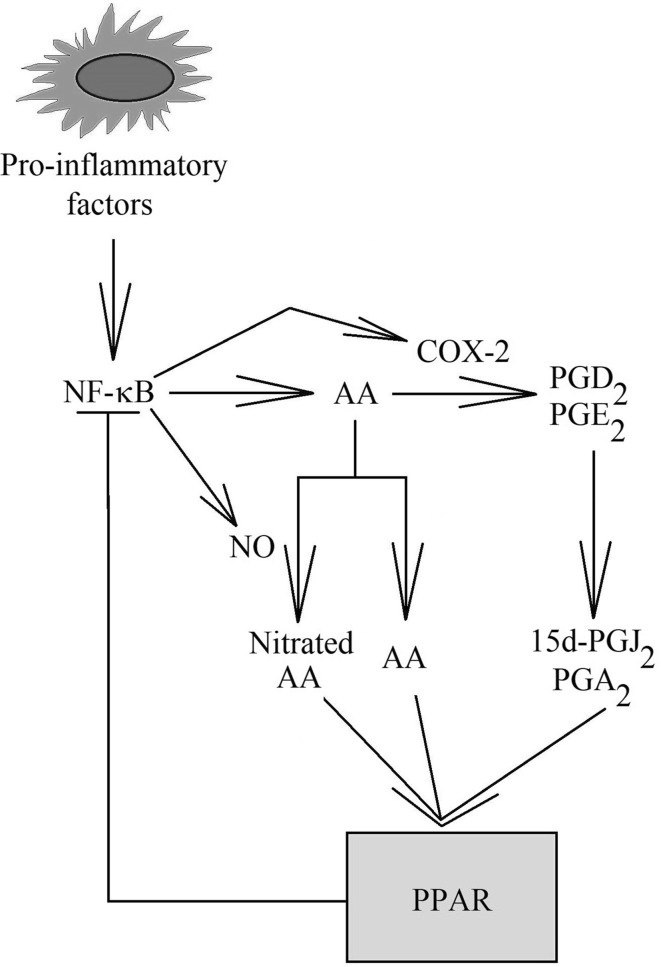
The peroxisome proliferator-activated receptor (PPAR) family includes three transcription factors: PPARα, PPARβ/δ, and PPARγ. PPAR are nuclear receptors activated by oxidised and nitrated fatty acid derivatives as well as by cyclopentenone prostaglandins (PGA 2 and 15d-PGJ 2 ) during the inflammatory response. This results in the modulation of the pro-inflammatory response, preventing it from being excessively activated. Other activators of these receptors are nonsteroidal anti-inflammatory drug (NSAID) and fatty acids, especially polyunsaturated fatty acid (PUFA) (arachidonic acid, ALA, EPA, and DHA). The main function of PPAR during the inflammatory reaction is to promote the inactivation of NF-κB. Possible mechanisms of inactivation include direct binding and thus inactivation of p65 NF-κB or ubiquitination leading to proteolytic degradation of p65 NF-κB. PPAR also exert indirect effects on NF-κB. They promote the expression of antioxidant enzymes, such as catalase, superoxide dismutase, or heme oxygenase-1, resulting in a reduction in the concentration of reactive oxygen species (ROS), i.e., secondary transmitters in inflammatory reactions. PPAR also cause an increase in the expression of IκBα, SIRT1, and PTEN, which interferes with the activation and function of NF-κB in inflammatory reactions.
Overview
The claims and statistics of this paper haven’t been checked yet.
Free: it reads the open-access text and checks the first 5 claims that cite a source we can check. Create a free account to check every claim.
Integrity signals
Registry
Cites
Statistics
Figures
Verification
Claims the paper makes
The claims and statistics of this paper haven’t been checked yet.
Free: it reads the open-access text and checks the first 5 claims that cite a source we can check. Create a free account to check every claim.
Claims other papers make about this one
Each is checked against this paper’s own text: does it say what the citing paper says it does?
In the citing paper
“PPAR-α directly binds to inflammatory transcription factors in hepatocytes such as p65 & c-Jun (NF-κB components), AP-1, STAT and thereby suppresses their transcriptional activity.[110]”
From Nuclear receptors in liver fibrosis (2021) · cites this paper as [110]
Self-check
Percentages, sums and reported differences re-computed from the paper’s own numbers.
The self-check needs the paper’s full text.
Citations
Cites
2 retracted
Items 201–232 of 232
Chang, W., Chang, C.-C., Wang, Y., Wang, Y., Weng, W.-T., Yoshioka, T., & Juo, S. H. (2010) · Toxicology · doi:10.1016/j.tox.2010.09.004 · Cited by 29
Olszowski, T., Gutowska, I., Baranowska‐Bosiacka, I., Piotrowska, K., Korbecki, J., Kurzawski, M., & Chlubek, D. (2015) · Biological Trace Element Research · doi:10.1007/s12011-015-0234-6 · Cited by 29
Self-citationAarenstrup, L., Flindt, E. N., Otkjær, K., Kirkegaard, M., Andersen, J., & Kristiansen, K. (2007) · Journal of Investigative Dermatology · doi:10.1038/sj.jid.5701146 · Cited by 29
Ayoub, S. S., Botting, R. M., Joshi, A. N., Seed, M. P., & Colville‐Nash, P. (2009) · Molecular and Cellular Biochemistry · doi:10.1007/s11010-009-0048-y · Cited by 29
PPARγ stabilizes HO-1 mRNA in monocytes/macrophages which affects IFN-β expression
von Knethen, A., Neb, H., Morbitzer, V., Schmidt, M. V., Kühn, A., Kuchler, L., & Brüne, B. (2011) · Free Radical Biology and Medicine · doi:10.1016/j.freeradbiomed.2011.04.033 · Cited by 27
Fang, X., Moore, S. A., Nwankwo, O. J., Weintraub, N. L., Oberley, W. L., Snyder, D. G., & Spector, A. A. (2000) · Journal of Neurochemistry · doi:10.1046/j.1471-4159.2000.0750614.x · Cited by 27
Liu, M. H., Li, J., Shen, P., Husna, B., Tai, E. S., & Yong, E. L. (2008) · Molecular Endocrinology · doi:10.1210/me.2007-0547 · Cited by 27
Yao, P., Chen, L., Dobrzański, T. P., Zhu, B., Kang, B., Müller, R., Gonzalez, F. J., & Peters, J. M. (2016) · Molecular Carcinogenesis · doi:10.1002/mc.22607 · Cited by 27
Ko, H. M., Lee, S. H., Bang, M., Kim, K. C., Jeon, S. J., Park, Y., Han, S., Kim, H. Y., Lee, J., & Shin, C. Y. (2017) · Biochemical and Biophysical Research Communications · doi:10.1016/j.bbrc.2017.11.143 · Cited by 26
Expression and spatial distribution of secretin and secretin receptor in human cerebellum
Lee, S. M. Y., Yung, W., Chen, L., & Chow, B. (2005) · Neuroreport · doi:10.1097/00001756-200502280-00003 · Cited by 25
Cyclooxygenase-1 as the Main Source of Proinflammatory Factors After Sodium Orthovanadate Treatment
Korbecki, J., Baranowska‐Bosiacka, I., Gutowska, I., Piotrowska, K., & Chlubek, D. (2014) · Biological Trace Element Research · doi:10.1007/s12011-014-0176-4 · Cited by 24
Self-citationLiu, X., Jang, S. S., An, Z., Song, H., Kim, W.-D., Yu, J.-R., & Park, W. (2012) · Radiation Oncology Journal · doi:10.3857/roj.2012.30.2.88 · Cited by 24
Gutting, T., Weber, C. A., Weidner, P., Herweck, F., Henn, S., Friedrich, T., Yin, S., Kzhyshkowska, J. G., Gaiser, T., Janssen, K., et al. (2018) · OncoImmunology · doi:10.1080/2162402x.2017.1423168 · Cited by 24
Mochizuki, K., Suzuki, T., & Goda, T. (2008) · Journal of Nutritional Science and Vitaminology · doi:10.3177/jnsv.54.298 · Cited by 23
The target of arachidonic acid pathway is a new anticancer strategy for human prostate cancer
Matsuyama, M., & Yoshimura, R. (2008) · Biologics · doi:10.2147/btt.s3151 · Cited by 22
Shiraki, T., Kodama, T. S., Shiki, S., Nakagawa, T., & Jingami, H. (2006) · Biochemical Journal · doi:10.1042/bj20050930 · Cited by 21
PPARα: A Master Regulator of Bilirubin Homeostasis
Bigo, C., Kaeding, J., Husseini, D. E., Rudkowska, I., Verreault, M., Vohl, M., & Barbier, O. (2014) · PPAR Research · doi:10.1155/2014/747014 · Cited by 21
Su, X., Zhou, G., Wang, Y., Xu, Y., Li, L., Yu, R., & Li, D. (2013) · Inflammation · doi:10.1007/s10753-013-9791-z · Cited by 20
Araújo, T. G., Oliveira, A. G., Vecina, J. F., Marin, R. M., Franco, E. S., Saad, M. J. A., & Maia, M. B. D. S. (2016) · Molecular and Cellular Biochemistry · doi:10.1007/s11010-016-2753-7 · Cited by 20
Jisaka, M., Iwanaga, C., Takahashi, N., Goto, T., Kawada, T., Yamamoto, T., Ikeda, I., Nishimura, K., Nagaya, T., Fushiki, T., et al. (2005) · Biochemical and Biophysical Research Communications · doi:10.1016/j.bbrc.2005.08.029 · Cited by 19
Involvement of ZIP/p62 in the regulation of PPARα transcriptional activity by p38-MAPK
Diradourian, C., May, C. L., Caüzac, M., Girard, J. R., Burnol, A., & Pégorier, J. P. (2008) · Biochimica et Biophysica Acta (BBA) - Molecular and Cell Biology of Lipids · doi:10.1016/j.bbalip.2008.02.002 · Cited by 19
Synergy between peroxisome proliferator‐activated receptor γ agonist and radiotherapy in cancer
Huang, G., Yin, L., Lan, J., Tong, R., Li, M., Na, F., Mo, X., Chen, C., Xue, J., & Lu, Y. (2018) · Cancer Science · doi:10.1111/cas.13650 · Cited by 19
Borland, M. G., Kehres, E. M., Lee, C., Wagner, A. L., Shannon, B. E., Albrecht, P. P., Zhu, B., Gonzalez, F. J., & Peters, J. M. (2018) · Toxicology · doi:10.1016/j.tox.2018.05.003 · Cited by 18
Regulation of TAK1/TAB1-Mediated IL-1β Signaling by Cytoplasmic PPARβ/δ
Stockert, J., Wolf, A., Kaddatz, K., Schnitzer, E., Finkernagel, F., Meißner, W., Müller‐Brüsselbach, S., Kracht, M., & Müller, R. (2013) · PLoS ONE · doi:10.1371/journal.pone.0063011 · Cited by 17
PPARαAgonist WY-14643 Induces SIRT1 Activity in Rat Fatty Liver Ischemia-Reperfusion Injury
Pantazi, E. D., Folch‐Puy, E., Béjaoui, M., Rosello, A. P., Varela, A. T. I. F., Rolo, A. P., Palmeira, C. M., & Roselló‐Catafau, J. (2015) · BioMed Research International · doi:10.1155/2015/894679 · Cited by 17
Wang, S., Hannafon, B. N., Zhou, J., & Ding, W. (2013) · Cellular Physiology and Biochemistry · doi:10.1159/000354524 · Cited by 16
Wang, Y., Yu, M., Ma, Y., Wang, R., Liu, W., Xia, W., Guan, A., Xing, C., Lu, F., & Ji, X. (2016) · Current Neurovascular Research · doi:10.2174/1567202613666161014161943 · Cited by 16
Enzyme association with PPARγ: evidence of a new role for 15-lipoxygenase type 2
Flores, A. M., Li, L., McHugh, N. G., & Aneskievich, B. J. (2004) · Chemico-Biological Interactions · doi:10.1016/j.cbi.2004.11.001 · Cited by 14
Gutowska, I., Baranowska‐Bosiacka, I., Safranow, K., Jakubowska, K., Olszewska, M. J., Telesiński, A., Siennicka, A., Droździk, M., Chlubek, D., & Stachowska, E. (2012) · Toxicology · doi:10.1016/j.tox.2012.02.014 · Cited by 14
Liang, C., Tseng, C., Yang, C., & Ma, Y. (2011) · British Journal of Pharmacology · doi:10.1111/j.1476-5381.2011.01263.x · Cited by 13
Juan, H., & Sametz, W. (1983) · Naunyn-Schmiedeberg s Archives of Pharmacology · doi:10.1007/bf00503896 · Cited by 13
Prostaglandin E 2 regulates renal function in C57/BL6 mouse with 5/6 nephrectomy
Jin, J., Tang, Q., Li, Z., Zhao, Z., Zhang, Z., Lü, L., Zhu, T., Vanhoutte, P. M., Leung, S. W. S., Tu, R., et al. (2017) · Life Sciences · doi:10.1016/j.lfs.2017.03.001 · Cited by 9
Cited by
Consideration of pathways for immunotoxicity of per-and polyfluoroalkyl substances (PFAS)
Ehrlich, V., Bil, W., Vandebriel, R., Granum, B., Luijten, M., Lindeman, B., Grandjean, P., Kaiser, A.-M., Hauzenberger, I., Hartmann, C., et al. (2023) · Environmental Health · doi:10.1186/s12940-022-00958-5 · Cited by 318
Update on Anti-Inflammatory Molecular Mechanisms Induced by Oleic Acid
Santa-María, C., López-Enríquez, S., Montserrat-de la Paz, S., Geniz, I., Reyes-Quiroz, M. E., Moreno, M., Palomares, F., Sobrino, F., & Alba, G. (2023) · Nutrients · doi:10.3390/nu15010224 · Cited by 300
Functional states of myeloid cells in cancer
van Vlerken-Ysla, L., Tyurina, Y. Y., Kagan, V. E., & Gabrilovich, D. I. (2023) · Cancer Cell · doi:10.1016/j.ccell.2023.02.009 · Cited by 261
Endothelial Dysfunction in Diabetic Retinopathy
Gui, F., You, Z., Fu, S., Wu, H., & Zhang, Y. (2020) · Frontiers in Endocrinology · doi:10.3389/fendo.2020.00591 · Cited by 207
Pharmacological Effects of Astragaloside IV: A Review
Liang, Y., Chen, B., Liang, D., Quan, X., Gu, R., Meng, Z., Gan, H., Wu, Z., Sun, Y., Liu, S., et al. (2023) · Molecules · doi:10.3390/molecules28166118 · Cited by 200
“PPARγ influences NF-κB signaling, signal transcription, and protein-1-mediated signaling pathway activation [29,30].”
Background
Metadata
- Authors
- Korbecki, J., Bobiński, R., & Dutka, M.
- Affiliations
- Medical University of Silesia (PL)
- University of Bielsko-Biała (PL)
- Corresponding author
- Korbecki, Jan
- Venue
- Inflammation Research
- Published
- 2019-03-29
- Volume
- 68
- Issue
- 6
- Pages
- 443-458
- ISSN
- 1023-3830 (ISSN-L)
- 1420-908X
- PMC
- PMC6517359
- OpenAlex
- W2930592277
- Cited by
- 415
- References
- 233
- Citations by year
- 2026: 44 · 2025: 49 · 2024: 88 · 2023: 62 · 2022: 75 · 2021: 61 · 2020: 26 · 2019: 9
- FWCI
- 4.07
- Type
- journal article
- Language
- en
- Open access
- hybrid
- doi.org
- Licence
- cc-by
- creativecommons.org/licenses/by/4.0 (tdm)
- Locations
- Inflammation Research (publishedVersion, cc-by)
- Europe PMC (PubMed Central) (publishedVersion, cc-by)
- PubMed Central (publishedVersion, cc-by)
- PubMed (publishedVersion)
- Topics
- Life Sciences › Biochemistry, Genetics and Molecular Biology › Molecular Biology › Peroxisome Proliferator-Activated Receptors
- Health Sciences › Nursing › Nutrition and Dietetics › Fatty Acid Research and Health
- Life Sciences › Biochemistry, Genetics and Molecular Biology › Cancer Research › NF-κB Signaling Pathways
- Keywords
- peroxisome proliferator-activated receptors, PPARα, PPARδ, PPARγ, inflammation, NF-κB inactivation, cyclopentenone prostaglandins, oxidized fatty acids, nonsteroidal anti-inflammatory drugs, polyunsaturated fatty acids, reactive oxygen species, antioxidant enzymes, heme oxygenase-1, SIRT1, PTEN, IκBα, transcriptional regulation
- MeSH terms
- Animals, Humans, Inflammation, Ligands, NF-kappa B, Peroxisome Proliferator-Activated Receptors, Cyclooxygenase 2
About these checks
Registry, retraction, Cites and statistics results are computed, not judged, with one exception: a printed reference that no index lists is read once by a model before it counts as a citation error. Claims are extracted by a model and kept only when their quote appears verbatim in the text; each cited source is then checked, with a model’s help, for whether it says what the claim relies on. Those verdicts can be wrong — read the claim’s quote and the cited source before relying on one.
Statistics and arithmetic are recomputed, not judged.
Confidence bands are shown only for fields calibrated on our annotated test set. None is calibrated yet, so no band is shown.
What counts as a claim ›How we measure confidence ›How we check this ›
Are you an author, or do you see a problem with this page? Request a review
Data sources
Bibliographic data: Semantic Scholar, OpenAlex, Crossref.
Contains information from the Semantic Scholar Academic Graph Datasets, made available under the ODC Attribution License (ODC-BY 1.0).
Semantic Scholar’s data is described in: Kinney, R., et al. (2023). The Semantic Scholar Open Data Platform. arXiv:2301.10140.
