

Self-regulation of the inflammatory response by peroxisome proliferator-activated receptors
Open accessThe DOI matches its Crossref record; 232 of the 233 references it cites were found in a registry or an index.
Abstract
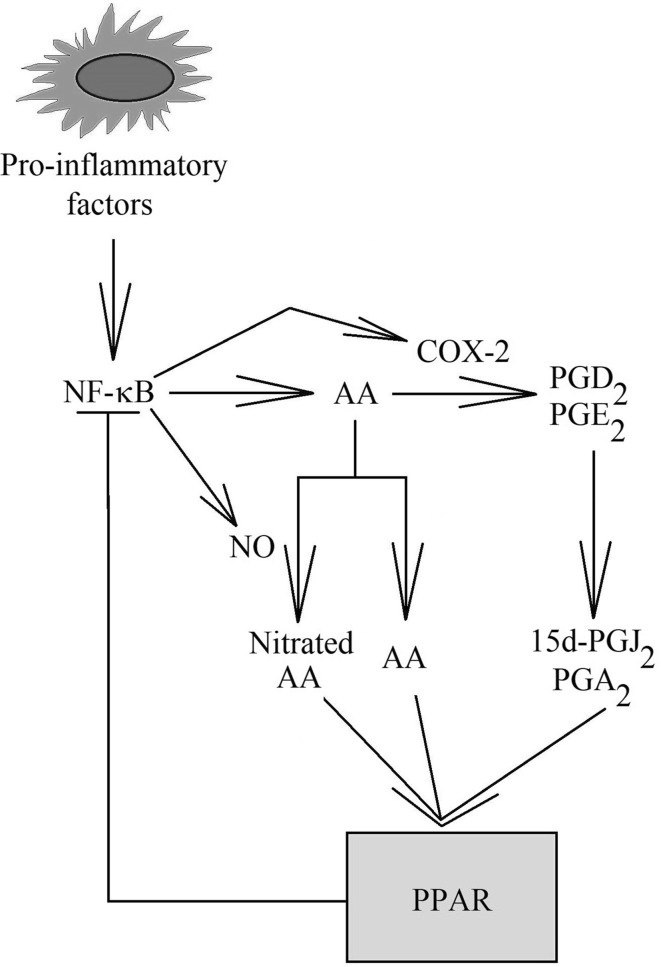
The peroxisome proliferator-activated receptor (PPAR) family includes three transcription factors: PPARα, PPARβ/δ, and PPARγ. PPAR are nuclear receptors activated by oxidised and nitrated fatty acid derivatives as well as by cyclopentenone prostaglandins (PGA 2 and 15d-PGJ 2 ) during the inflammatory response. This results in the modulation of the pro-inflammatory response, preventing it from being excessively activated. Other activators of these receptors are nonsteroidal anti-inflammatory drug (NSAID) and fatty acids, especially polyunsaturated fatty acid (PUFA) (arachidonic acid, ALA, EPA, and DHA). The main function of PPAR during the inflammatory reaction is to promote the inactivation of NF-κB. Possible mechanisms of inactivation include direct binding and thus inactivation of p65 NF-κB or ubiquitination leading to proteolytic degradation of p65 NF-κB. PPAR also exert indirect effects on NF-κB. They promote the expression of antioxidant enzymes, such as catalase, superoxide dismutase, or heme oxygenase-1, resulting in a reduction in the concentration of reactive oxygen species (ROS), i.e., secondary transmitters in inflammatory reactions. PPAR also cause an increase in the expression of IκBα, SIRT1, and PTEN, which interferes with the activation and function of NF-κB in inflammatory reactions.
Overview
The claims and statistics of this paper haven’t been checked yet.
Free: it reads the open-access text and checks the first 5 claims that cite a source we can check. Create a free account to check every claim.
Integrity signals
Registry
Cites
Statistics
Figures
Verification
Claims the paper makes
The claims and statistics of this paper haven’t been checked yet.
Free: it reads the open-access text and checks the first 5 claims that cite a source we can check. Create a free account to check every claim.
Claims other papers make about this one
Each is checked against this paper’s own text: does it say what the citing paper says it does?
In the citing paper
“PPAR-α directly binds to inflammatory transcription factors in hepatocytes such as p65 & c-Jun (NF-κB components), AP-1, STAT and thereby suppresses their transcriptional activity.[110]”
From Nuclear receptors in liver fibrosis (2021) · cites this paper as [110]
Self-check
Percentages, sums and reported differences re-computed from the paper’s own numbers.
The self-check needs the paper’s full text.
Citations
Cites
2 retracted
Subbaramaiah, K., Lin, D. T., Hart, J. C., & Dannenberg, A. J. (2001) · Journal of Biological Chemistry · doi:10.1074/jbc.m007237200 · Cited by 275
RetractedSodhi, K., Puri, N., Kim, D.-H., Hinds, T. D., Stechschulte, L. A., Favero, G., Rodella, L. F., Shapiro, J. I., Jude, D., & Abraham, N. G. (2013) · International Journal of Obesity · doi:10.1038/ijo.2013.116 · Cited by 28
RetractedModulation of NF‐κB‐dependent transcription and cell survival by the SIRT1 deacetylase
Yeung, F., Hoberg, J. E., Ramsey, C. S., Keller, M. D., Jones, D. R., Frye, R. A., & Mayo, M. W. (2004) · The EMBO Journal · doi:10.1038/sj.emboj.7600244 · Cited by 2,750
Kliewer, S. A., Sundseth, S. S., Jones, S. A., Brown, P. J., Wisely, G. B., Koble, C. S., Devchand, P., Wahli, W., Willson, T. M., Lenhard, J. M., et al. (1997) · Proceedings of the National Academy of Sciences · doi:10.1073/pnas.94.9.4318 · Cited by 2,164
Forman, B. M., Chen, J., & Evans, R. M. (1997) · Proceedings of the National Academy of Sciences · doi:10.1073/pnas.94.9.4312 · Cited by 2,116
Ros and ros-mediated cellular signaling
Zhang, J., Wang, X., Vikash, V., Ye, Q., Wu, D., Liu, Y., & Dong, W. (2016) · Oxidative Medicine and Cellular Longevity · doi:10.1155/2016/4350965 · Cited by 1,980
Sirt1 promotes fat mobilization in white adipocytes by repressing PPAR-γ
Picard, F., Kurtev, M., Chung, N., Topark-Ngarm, A., Senawong, T., Machado de Oliveira, R., Leid, M., McBurney, M. W., & Guarente, L. (2004) · Nature · doi:10.1038/nature02583 · Cited by 1,952
Rubbo, H., Radi, R., Trujillo, M., Telleri, R., Kalyanaraman, B., Barnes, S., Kirk, M., & Freeman, B. A. (1994) · Journal of Biological Chemistry · doi:10.1016/s0021-9258(18)47160-8 · Cited by 1,359 · cited 1×
“Both compounds, NO and ONOO−, lead to nitration of double bonds in unsaturated fatty acids [42, 61].”
BackgroundA SUMOylation-dependent pathway mediates transrepression of inflammatory response genes by PPAR-γ
Pascual, G., Fong, A. L., Ogawa, S., Gamliel, A., Li, A. C., Perissi, V., Rose, D. W., Willson, T. M., Rosenfeld, M. G., & Glass, C. K. (2005) · Nature · doi:10.1038/nature03988 · Cited by 1,254
Krey, G. D., Braissant, O., L’Horset, F., Kalkhoven, E., Perroud, M., Parker, M. G., & Wahli, W. (1997) · Molecular Endocrinology · doi:10.1210/me.11.6.779 · Cited by 1,221
Cited by
Consideration of pathways for immunotoxicity of per-and polyfluoroalkyl substances (PFAS)
Ehrlich, V., Bil, W., Vandebriel, R., Granum, B., Luijten, M., Lindeman, B., Grandjean, P., Kaiser, A.-M., Hauzenberger, I., Hartmann, C., et al. (2023) · Environmental Health · doi:10.1186/s12940-022-00958-5 · Cited by 318
Update on Anti-Inflammatory Molecular Mechanisms Induced by Oleic Acid
Santa-María, C., López-Enríquez, S., Montserrat-de la Paz, S., Geniz, I., Reyes-Quiroz, M. E., Moreno, M., Palomares, F., Sobrino, F., & Alba, G. (2023) · Nutrients · doi:10.3390/nu15010224 · Cited by 300
Functional states of myeloid cells in cancer
van Vlerken-Ysla, L., Tyurina, Y. Y., Kagan, V. E., & Gabrilovich, D. I. (2023) · Cancer Cell · doi:10.1016/j.ccell.2023.02.009 · Cited by 261
Endothelial Dysfunction in Diabetic Retinopathy
Gui, F., You, Z., Fu, S., Wu, H., & Zhang, Y. (2020) · Frontiers in Endocrinology · doi:10.3389/fendo.2020.00591 · Cited by 207
Pharmacological Effects of Astragaloside IV: A Review
Liang, Y., Chen, B., Liang, D., Quan, X., Gu, R., Meng, Z., Gan, H., Wu, Z., Sun, Y., Liu, S., et al. (2023) · Molecules · doi:10.3390/molecules28166118 · Cited by 200
“PPARγ influences NF-κB signaling, signal transcription, and protein-1-mediated signaling pathway activation [29,30].”
BackgroundDama, A., Shpati, K., Daliu, P., Dümür, Ş., Gorica, E., & Santini, A. (2024) · Nutrients · doi:10.3390/nu16040507 · Cited by 164
“PPAR-γ interacts with NF-κ B, reducing ROS and cytokines [63].”
BackgroundPeng, Z., Zhang, C., Yan, L., Zhang, Y., Yang, Z., Wang, J., & Song, C. (2020) · International Journal of Molecular Sciences · doi:10.3390/ijms21051769 · Cited by 162
“Although EPA is far less abundant in the brain than DHA, it is highly neuroactive, as a meta-analysis reported that EPA may be more effective than DHA in the treatment of depression [27].”
BackgroundStrosznajder, A. K., Wójtowicz, S., Jeżyna, M. J., Sun, G. Y., & Strosznajder, J. B. (2020) · NeuroMolecular Medicine · doi:10.1007/s12017-020-08629-9 · Cited by 137
From Selenium Absorption to Selenoprotein Degradation
Ha, H. Y., Alfulaij, N., Berry, M. J., & Seale, L. A. (2019) · Biological Trace Element Research · doi:10.1007/s12011-019-01771-x · Cited by 134
Marine Alkaloids with Anti-Inflammatory Activity: Current Knowledge and Future Perspectives
Souza, C. R. D. M., Bezerra, W. P., & de Souto, J. T. (2020) · Marine Drugs · doi:10.3390/md18030147 · Cited by 126
Berthier, A., Johanns, M., Zummo, F. P., Lefebvre, P., & Staels, B. (2021) · Biochimica et Biophysica Acta (BBA) - Molecular Basis of Disease · doi:10.1016/j.bbadis.2021.166097 · Cited by 125
“To the best of our knowledge, the species specificity of natural PPARβ/δ agonists has not been studied yet [1,148,162] and studies focused essentially on endocrine disruptors or potential therapeutic drugs.”
BackgroundMicroalgal polyunsaturated fatty acids: Hotspots and production techniques
Chen, W., Li, T., Du, S., Chen, H., & Wang, Q. (2023) · Frontiers in Bioengineering and Biotechnology · doi:10.3389/fbioe.2023.1146881 · Cited by 124
“Clinical studies have shown that after taking ALA, the activity of glutathione peroxidase and superoxide dismutase increases, the generation of malondialdehyde decreases, and it has an antioxidant effect (Mahsa et al., 2017; Boskabady et al., 2019; Korbecki et al., 2019).”
BackgroundThe bridge of the gut–joint axis: Gut microbial metabolites in rheumatoid arthritis
Xu, X., Wang, M., Wang, Z., Chen, Q., Chen, X., Xu, Y., Dai, M., Wu, B., & Li, Y. (2022) · Frontiers in Immunology · doi:10.3389/fimmu.2022.1007610 · Cited by 105
“SCFAs can achieve direct anti-inflammatory effects through different pathways, but these effects are all achieved through inhibition of the transcription factor NF-kB, such as by inhibition of the histone deacetylase (HDAC) pathway and activation of the peroxisome proliferator activated receptor g (peroxisome prolifer…”
BackgroundInfluentialCoumarin Derivatives in Inflammatory Bowel Disease
Stasi, L. C. D. (2021) · Molecules · doi:10.3390/molecules26020422 · Cited by 105
“Each group of MAPK is activated by different kinase pathways using distinct interlinked kinase components, as elegantly described [86].”
BackgroundMerecz-Sadowska, A., Sitarek, P., Śliwiński, T., & Zajdel, R. (2020) · International Journal of Molecular Sciences · doi:10.3390/ijms21249605 · Cited by 100
“The overall activity of plant polysaccharides enhances macrophage immune response via reactive oxygen species (ROS) production and excessive secretion of cytokines and chemokines [48].”
BackgroundInfluentialMolecular Pathogenesis of Intrahepatic Cholestasis of Pregnancy
Xiao, J., Li, Z., Song, Y., Sun, Y., Shi, H., Chen, D., & Zhang, Y. (2021) · Canadian Journal of Gastroenterology and Hepatology · doi:10.1155/2021/6679322 · Cited by 100
“PPAR can reduce the concentration of reactive oxygen species (ROS), indirectly acting on NF-κB [12].”
Quintão, N. L. M., Santin, J. R., Stoeberl, L. C., Corrêa, T. P., Melato, J., & da Costa, R. (2019) · Frontiers in Neuroscience · doi:10.3389/fnins.2019.00907 · Cited by 95
“…39 2019 Recruiting Phase II Omega-3/Vitamin D3 NCT02294149 Canada 600 2014 Unknown Phase III Vitamin E NCT00363129 United States 207 2006 Completed Phase III – use not supported Kottschade et al., 2011 α-Lipoic acid – United States 462 Completed Use not supported Guo et al.,…”
BackgroundReactive gliosis in traumatic brain injury: a comprehensive review
Amlerova, Z., Chmelová, M., Anděrová, M., & Vargová, L. (2024) · Frontiers in Cellular Neuroscience · doi:10.3389/fncel.2024.1335849 · Cited by 93
The “root” causes behind the anti-inflammatory actions of ginger compounds in immune cells
Pázmándi, K., Szöllősi, A. G., & Fekete, T. (2024) · Frontiers in Immunology · doi:10.3389/fimmu.2024.1400956 · Cited by 93
PPARs as Metabolic Sensors and Therapeutic Targets in Liver Diseases
Monroy-Ramírez, H. C., Galicia‐Moreno, M., Sandoval-Rodriguez, A. S., Meza-Ríos, A., Santos, A., & Armendáriz‐Borunda, J. (2021) · International Journal of Molecular Sciences · doi:10.3390/ijms22158298 · Cited by 90
Tewari, D., Bawari, S., Sharma, S., DeLiberto, L. K., & Bishayee, A. (2021) · Pharmacology & Therapeutics · doi:10.1016/j.pharmthera.2021.107876 · Cited by 88
Microglia as Therapeutic Target for Radiation-Induced Brain Injury
Liu, Q., Yan, H., Duan, M., Yang, Q., Ren, B., & Tang, F. R. (2022) · International Journal of Molecular Sciences · doi:10.3390/ijms23158286 · Cited by 88
Pleiotropic use of Statins as non-lipid-lowering drugs
Zhang, Q., Dong, J., & Yu, Z. Y. (2020) · International Journal of Biological Sciences · doi:10.7150/ijbs.42965 · Cited by 86
“It is involved in activation of immune cells, T and B lymphocyte development, the stress response, apoptosis and other cellular activities [39].”
BackgroundGut microbiota is involved in male reproductive function: a review
Lv, S., Huang, J., Luo, Y., Wen, Y., Chen, B., Qiu, H., Chen, H., Yue, T., He, L., Feng, B., et al. (2024) · Frontiers in Microbiology · doi:10.3389/fmicb.2024.1371667 · Cited by 86
Flavonoids-mediated SIRT1 signaling activation in hepatic disorders
Sayed, A. M. M., Hassanein, E. H. M., Salem, S. H., Hussein, O. E., & Mahmoud, A. M. (2020) · Life Sciences · doi:10.1016/j.lfs.2020.118173 · Cited by 78
Prowse, N. A., & Hayley, S. P. (2021) · Neuroscience & Biobehavioral Reviews · doi:10.1016/j.neubiorev.2021.09.018 · Cited by 78
“Drawing on research from a variety of other disorders, we will highlight challenges and opportunities for Abbreviations: 2-AG, 2-Arachidonoylglycerol; A2AR, Adenosine 2A receptors; ACTH, Adrenocorticotropic hormone; AD, Alzheimer’s disease; ADP, Adenosine diphosphate; Akt, Protein kinase B; ALS, Amyotrophic lateral sc…”
BackgroundAlshehri, A. S., El-kott, A. F., El-Kenawy, A. E.-M., Khalifa, H. S., & Al‐Ramlawy, A. M. (2021) · The Science of The Total Environment · doi:10.1016/j.scitotenv.2021.147182 · Cited by 76
Pan, Y., Wei, Y., Wang, M., Tao, J., Ouyang, H., Du, Z., Li, S., & Jiang, H. (2022) · Food & Function · doi:10.1039/d1fo04386b · Cited by 76
The protective effects of activating Sirt1/NF-κB pathway for neurological disorders
Song, Y., Wu, Z., & Zhao, P. (2021) · Reviews in the Neurosciences · doi:10.1515/revneuro-2021-0118 · Cited by 71
Murru, E., Carta, G., Manca, C., Sogos, V., Pistis, M., Melis, M., & Banni, S. (2021) · Frontiers in Pharmacology · doi:10.3389/fphar.2020.587140 · Cited by 70
Cellular crosstalk in fibrosis: Insights into macrophage and fibroblast dynamics
Froom, Z. S. C. S., Callaghan, N. I., & Huyer, L. D. (2025) · Journal of Biological Chemistry · doi:10.1016/j.jbc.2025.110203 · Cited by 70
Bariatric surgery: remission of inflammation, cardiometabolic benefits, and common adverse effects
Biobaku, F., Ghanim, H., Monte, S. V., Caruana, J. A., & Dandona, P. (2020) · Journal of the Endocrine Society · doi:10.1210/jendso/bvaa049 · Cited by 68
“SCFAs activate the nuclear receptor peroxisome proliferator activated receptor γ (PPARγ) without inducing PPARγ-mediated adipogenesis [56], and PPARγ ligands suppress inflammatory gene expression via the suppression of nuclear factor kappa B [57].”
BackgroundAdvances in Technologies for Highly Active Omega-3 Fatty Acids from Krill Oil: Clinical Applications
Colletti, A., Cravotto, G., Citi, V., Martelli, A., Testai, L., & Cicero, A. F. G. (2021) · Marine Drugs · doi:10.3390/md19060306 · Cited by 68
Guo, C., Zhang, Y., Tao, L., Zhao, C., Li, Y., Geng, M., Gai, S., Wei, Q., Luo, X., Chen, L., et al. (2022) · Marine Drugs · doi:10.3390/md20020096 · Cited by 68
“Studies have shown that PPARγ interferes with the function of NF-κB in inflammatory response by directly binding to p65, causing the ubiquitination and degradation of p65, or increasing the expression of Sirtuin 1 (SIRT1) [7].”
BackgroundRole of puerarin in pathological cardiac remodeling: A review
Lv, J., Shi, S., Zhang, B., Xu, X., Zheng, H., Li, Y., Cui, X., Wu, H., & Song, Q. (2022) · Pharmacological Research · doi:10.1016/j.phrs.2022.106152 · Cited by 67
Bao, L., Sun, H., Zhao, Y., Feng, L., Wu, K., Shang, S., Xu, J., Shan, R., Duan, S., Qiu, M., et al. (2023) · PLoS Pathogens · doi:10.1371/journal.ppat.1011764 · Cited by 67
Liu, S., Knochelmann, H. M., Lomeli, S. H., Hong, A., Richardson, M. S., Yang, Z., Lim, R. J., Wang, Y., Dumitras, C., Krysan, K., et al. (2021) · Cell Reports Medicine · doi:10.1016/j.xcrm.2021.100411 · Cited by 66
“Cell Repor target because PPARg serves to adaptively temper COX-2-mediated inflammation.(43) The action of PPARgmay be mediated, at least in part, by PTEN upregulation(27,28), which is supported here by the positive correlation between PPARG and PTEN signature enrichments among pretreatment OCSCC tumors.”
BackgroundLi, P., Zhang, R., Wang, M., Chen, Y., Chen, Z., Ke, X., Zuo, L., & Wang, J. (2022) · Frontiers in Pharmacology · doi:10.3389/fphar.2022.917329 · Cited by 64
Peroxisome Proliferator-Activated Receptors as a Therapeutic Target in Asthma
Kytikovа, O. Y., Perelman, J. M., Novgorodtseva, T. P., Denisenko, Y., Колосов, В. П., Antonyuk, M. V., & Gvozdenko, T. A. (2020) · PPAR Research · doi:10.1155/2020/8906968 · Cited by 63
“LXA4 protects cells from damage by activating the p38 MAPK/PPARγ/nuclear factor E2-related factor 2-antioxidantresponsive element/heme oxygenase 1 pathway [126].”
BackgroundInfluentialMahmoud, A. M., El‐Ghafar, O. A. M. A., Alzoghaibi, M. A., & Hassanein, E. H. M. (2021) · Life Sciences · doi:10.1016/j.lfs.2021.119600 · Cited by 63
From Food to Genes: Transcriptional Regulation of Metabolism by Lipids and Carbohydrates
Bravo-Ruiz, I., Medina, M. Á., & Martínez-Poveda, B. (2021) · Nutrients · doi:10.3390/nu13051513 · Cited by 61
“This is most likely related to the important biological function of prostanoids following the rationale of a substrate, PUFAs, promoting the expression of its processing enzyme, COX-2 [80].”
BackgroundInfluentialKhera, R., Mehan, S., Kumar, S., Sethi, P., Bhalla, S., & Prajapati, A. (2022) · Molecular Neurobiology · doi:10.1007/s12035-022-02819-1 · Cited by 60
“As a result, inhibiting STAT3 reduces the inflammatory cytokines IL-6, IL-1, and TNF levels in the brain [77].”
BackgroundGong, S., Cao, G., Li, F., Chen, Z., Pan, X., Ma, H., Zhang, Y., Bo-yang, Y., & Kou, J. (2021) · Stroke · doi:10.1161/strokeaha.120.031410 · Cited by 58
Fadaly, W. A. A., ElShewy, A. M., Nemr, M. T. M., Abdou, K., Sayed, A. M., & Kahk, N. M. (2024) · Bioorganic Chemistry · doi:10.1016/j.bioorg.2024.107760 · Cited by 57
New Insights into the Role of PPARγ in Skin Physiopathology
Briganti, S., Mosca, S., Di Nardo, A., Flori, E., & Ottaviani, M. (2024) · Biomolecules · doi:10.3390/biom14060728 · Cited by 56
“…and repression, an additional mechanism described in the literature is that PPARs can also act as transrepressors of genes primarily associated with pro-inflammatory pathways through a protein–protein PPRE-independent interaction with other transcription factors, such as NF-kB and AP1 [8,9].”
BackgroundZhang, N., Chen, G., Liu, Z., Li, C., Yang, C., Xu, L., Niu, M., Zhao, L., Zhou, B., Che, L., et al. (2022) · Frontiers in Pharmacology · doi:10.3389/fphar.2022.970616 · Cited by 56
“One of the possible reasons is that pro-inflammatory stimulation causes a decrease in the expression of PPARγ (Korbecki et al., 2019).”
BackgroundSouza-Tavares, H., Miranda, C. S., Vasques‐Monteiro, I. M. L., Sandoval, C., Santana-Oliveira, D. A., Silva-Veiga, F. M., Fernandes‐da‐Silva, A., & Souza‐Mello, V. (2023) · World Journal of Gastroenterology · doi:10.3748/wjg.v29.i26.4136 · Cited by 54
Bai, J., Qian, B., Cai, T., Chen, Y., Li, T., Cheng, Y., Wu, Z., Liu, C., Ye, M., Du, Y., et al. (2023) · Journal of Agricultural and Food Chemistry · doi:10.1021/acs.jafc.3c01721 · Cited by 54
Adipokine Signaling Pathways in Osteoarthritis
Zhang, C., Lin, Y., Yan, C. H., & Zhang, W. (2022) · Frontiers in Bioengineering and Biotechnology · doi:10.3389/fbioe.2022.865370 · Cited by 53
“PPAR interferes with the activation of NF-κB in the inflammatory response mainly by upregulating the expression of IκBα, sirtuin 1, and phosphatase and tensin homolog (Korbecki et al., 2019).”
BackgroundAlzheimer’s Disease, a Lipid Story: Involvement of Peroxisome Proliferator-Activated Receptor α
Sáez-Orellana, F., Octave, J., & Pierrot, N. (2020) · Cells · doi:10.3390/cells9051215 · Cited by 52
“Due to their overlapping expression in all brain cell types from mouse and human and given that they share similarities in their ligand-binding domains [162,163], a tight interconnection between PPARs isoforms was described a couple of years ago [164,165].”
BackgroundIL‐17‐induced inflammation modulates the mPGES‐1/PPAR‐γ pathway in monocytes/macrophages
Raucci, F., Saviano, A., Casillo, G. M., Guerra-Rodríguez, M., Mansour, A. A., Piccolo, M., Ferraro, M. G., Panza, E., Vellecco, V., Irace, C., et al. (2021) · British Journal of Pharmacology · doi:10.1111/bph.15413 · Cited by 48
Effects of Anthraquinones on Immune Responses and Inflammatory Diseases
Xin, D., Li, H., Zhou, S., Zhong, H., & Pu, W. (2022) · Molecules · doi:10.3390/molecules27123831 · Cited by 48
“PPARγ, a fatty acid-activated transcription factors, could negatively regulated the activation of NF-κB by several mechanisms [26,27].”
BackgroundPPARα: A potential therapeutic target of cholestasis
Ye, X., Zhang, T., & Han, H. (2022) · Frontiers in Pharmacology · doi:10.3389/fphar.2022.916866 · Cited by 47
“PPARα can promote the inactivation of NF-κB during the inflammatory reaction, and the inhibition can inhibit the inflammatory cascade (Korbecki et al., 2019).”
BackgroundWang, D., Wang, T., Zhang, Z., Li, Z., Guo, Y., Zhao, G., & Wu, L. (2022) · Current Opinion in Food Science · doi:10.1016/j.cofs.2022.100921 · Cited by 47
Hole, C., Dhamsania, A., Brown, C., & Ryznar, R. J. (2025) · Cells · doi:10.3390/cells14080607 · Cited by 47
“PEA is also thought to reduce inflammation by managing ROS through increases in the expression of antioxidant enzymes, such as catalase, heme oxygenase-1, Mn-superoxide dismutase, and CuZn-superoxide dismutase [86].”
Gallucci, G. M., Alsuwayt, B., Auclair, A. M., Boyer, J. L., Assis, D. N., & Ghonem, N. S. (2022) · Inflammation · doi:10.1007/s10753-022-01713-1 · Cited by 46
“The peroxisome proliferator-activated receptor alpha (PPARα) inhibits NF-κB signaling by directly binding to the NF-κB subunit p65 and increasing the activity of IκB, through the deactivation and deacetylation of NF-κB [11].”
BackgroundNuclear receptors in liver fibrosis
Königshofer, P., Brusilovskaya, K., Petrenko, O., Hofer, B. S., Schwabl, P., Trauner, M., & Reiberger, T. (2021) · Biochimica et Biophysica Acta (BBA) - Molecular Basis of Disease · doi:10.1016/j.bbadis.2021.166235 · Cited by 45
Targeting PPARs for therapy of atherosclerosis: A review
Miao, M., Wang, X., Liu, T., Li, Y., Yu, W., Yang, T.-M., & Guo, S. (2023) · International Journal of Biological Macromolecules · doi:10.1016/j.ijbiomac.2023.125008 · Cited by 45
Messina, A., Concerto, C., Rodolico, A., Petralia, A., Caraci, F., & Signorelli, M. S. (2023) · Brain Sciences · doi:10.3390/brainsci13060957 · Cited by 44
“PPAR-γ is widely expressed in microglia and exhibits a potent anti-inflammatory activity, influencing multiple pathways through inhibiting cytokine gene expression and prostaglandins and inducing apoptosis in activated microglia cells [51].”
BackgroundInfluentialSantos, D. S., Morais, J. A. V., Vanderlei, I. A. C., Santos, A. S., Azevedo, R. B., Muehlmann, L. A., Júnior, O. R. P., Mortari, M. R., Silva, D., da Silva, S. W., et al. (2020) · Biomedicine & Pharmacotherapy · doi:10.1016/j.biopha.2020.110980 · Cited by 44
Chen, C., Qiu, R., Yang, J., Zhang, Q., Sun, G., Gao, X., Hei, Z., & Ji, H. (2021) · Frontiers in Immunology · doi:10.3389/fimmu.2021.637753 · Cited by 44
“Pretreatment with LXA4 significantly restored renal function, increased rat survival rate, and inhibited NF-kB-mediated inflammatory response and premature senescence.”
BackgroundInfluentialLi, D., Luo, F., Guo, T., Han, S., Wang, H., & Lin, Q. (2022) · Critical Reviews in Food Science and Nutrition · doi:10.1080/10408398.2022.2026871 · Cited by 44
Chen, Y., Lin, Y., Liu, Z., Zhang, Y., Hu, Z., Ai, M., Shen, Y., Lian, D., Wang, C., Liu, X., et al. (2025) · Materials Today Bio · doi:10.1016/j.mtbio.2025.101856 · Cited by 43
“Dual immunofluorescence detection detected the markers iNOS [83] (red fluorescence) and PPAR γ [84] (green fluorescence) of M1 and M2.”
Paciello, F., Pisani, A., Rolesi, R., Escarrat, V., Galli, J., Paludetti, G., Grassi, C., Troiani, D., & Fetoni, A. R. (2021) · Antioxidants · doi:10.3390/antiox10081188 · Cited by 43
Wang, Y., Pan, Y., Hou, M., Luo, R., He, J., Lin, F., Xia, X., Li, P., He, C., He, P., et al. (2023) · Biomedicine & Pharmacotherapy · doi:10.1016/j.biopha.2023.115736 · Cited by 42
Zhu, J., Zhang, Y., Sun, Y., Yu, F., Lu, Y., Hu, Q., Guo, J., Zhang, H., Chen, T., Lian, F., et al. (2025) · Journal of Nanobiotechnology · doi:10.1186/s12951-024-02937-z · Cited by 42
Sayed, A. M. M., Hassanein, E. H. M., Ali, F. E. M., Omar, Z. M. M., Rashwan, E. K., Mohammedsaleh, Z. M., & El‐Ghafar, O. A. M. A. (2021) · Life Sciences · doi:10.1016/j.lfs.2021.119911 · Cited by 42
Docosahexaenoic Acid as Master Regulator of Cellular Antioxidant Defenses: A Systematic Review
Borgonovi, S. M., Iametti, S., & Nunzio, M. D. (2023) · Antioxidants · doi:10.3390/antiox12061283 · Cited by 41
“The cap’n’collar basic-region leucine zipper transcription factor Nrf2, encoded by NFE2L2, is a master regulator of intracellular redox homeostasis because, in response to oxidative stress, it orchestrates induction of a battery of genes such as SOD, NAD(P)H quinone dehydrogenase 1, and heme oxygenase-1 that serve to…”
BackgroundInfluentialMolecular mechanisms underlying methotrexate-induced intestinal injury and protective strategies
Ali, G. F., Hassanein, E. H. M., & Mohamed, W. R. (2024) · Naunyn-Schmiedeberg s Archives of Pharmacology · doi:10.1007/s00210-024-03164-x · Cited by 41
“It is interesting to note that PPAR-γ is a significant nuclear receptor whose beneficial antioxidant and anti-inflammatory properties have led to the investigation of a variety of disorders (Korbecki et al. 2019).”
BackgroundOxidative Stress and the Nrf2/PPARγ Axis in the Endometrium: Insights into Female Fertility
Artimovič, P., Badovská, Z., Toporcerová, S., Špaková, I., Smolko, L., Sabolová, G., Kriváková, E., & Rabajdová, M. (2024) · Cells · doi:10.3390/cells13131081 · Cited by 41
“In humans, three distinct subtypes, PPAR α , β / δ , and γ , are encoded by separate genes, each with its unique tissue-speci fi c expression pa tt erns [97].”
BackgroundInfluentialProtective effects of natural products against drug-induced nephrotoxicity: A review in recent years
Gao, C., Liu, C., Chen, Y., Wang, Q., & Hao, Z. (2021) · Food and Chemical Toxicology · doi:10.1016/j.fct.2021.112255 · Cited by 41
Impact of zinc on DNA integrity and age-related inflammation
Ho, E., Wong, C. P., & King, J. C. (2021) · Free Radical Biology and Medicine · doi:10.1016/j.freeradbiomed.2021.12.256 · Cited by 41
Gart, E., Salic, K., Morrison, M. C., Caspers, M. P. M., van Duyvenvoorde, W., Heijnk, M., Giera, M. A., Bobeldijk‐Pastorova, I., Keijer, J., Storsve, A. B., et al. (2021) · Nutrients · doi:10.3390/nu13082836 · Cited by 40
“Activated PPARs can negatively interfere with proinflammatory transcription factors such as NF-κB in several ways: PPARs can directly interact with NF-κB proteins [69] or increase the cytosolic inhibitor, IκBα, thereby preventing nuclear translocation and NF-κB-mediated gene expression [10,11].”
BackgroundNagatake, T., Kishino, S., Urano, E., Murakami, H., Kitamura, N., Konishi, K., Ohno, H., Tiwari, P., Morimoto, S., Node, E., et al. (2022) · Mucosal Immunology · doi:10.1038/s41385-021-00477-5 · Cited by 40
“This scenario is in accordance with previous reports indicating that the activation of PPARγ suppresses NF-κB activation and consequent inflammatory responses.(50,51) NF-κB-mediated gene induction of Tnfa and Il1b is a hallmark of M1 macrophage polarization.”
ResultHassanein, E. H. M., Sayed, A. M. M., El‐Ghafar, O. A. M. A., Omar, Z. M. M., Rashwan, E. K., Mohammedsaleh, Z. M., Kyung, S. Y., Park, J. H., Kim, H. S., & Ali, F. E. M. (2023) · Archives of Pharmacal Research · doi:10.1007/s12272-023-01436-3 · Cited by 40
The Role of Oxidative Stress in Periodontitis
Bullón, P., Giampieri, F., Bullón, B., & Battino, M. A. (2025) · Journal of Periodontal Research · doi:10.1111/jre.70016 · Cited by 38
Fawzy, M. A., Nasr, G., Ali, F. E. M., & Fathy, M. (2022) · Life Sciences · doi:10.1016/j.lfs.2022.121343 · Cited by 38
Fatty Acid-Binding Proteins Aggravate Cerebral Ischemia-Reperfusion Injury in Mice
Guo, Q., Kawahata, K., Degawa, T., Ikeda‐Matsuo, Y., Sun, M., Han, F., & Fukunaga, K. (2021) · Biomedicines · doi:10.3390/biomedicines9050529 · Cited by 37
“In addition, there are several the binding sites (PPRE) of PPARs on the promoter region of FABP3, FABP5 and FABP7 genes and the activations of PPARβ/δ and PPARγ mediate the expression of FABP5 [30,62].”
BackgroundInfluentialLopez‐Salazar, V., Sánchez‐Tapia, M., Tobón‐Cornejo, S., Díaz, D., Alemán, G., Granados‐Portillo, O., Noriega, L. G., Tovar, A. R., & Torres, N. (2021) · The Journal of Nutritional Biochemistry · doi:10.1016/j.jnutbio.2021.108751 · Cited by 36
Silva-Gómez, J. A., Galicia‐Moreno, M., Sandoval-Rodriguez, A. S., Miranda-Roblero, H. O., Lucano‐Landeros, S., Santos, A., Monroy-Ramírez, H. C., & Armendáriz‐Borunda, J. (2021) · International Journal of Molecular Sciences · doi:10.3390/ijms222111360 · Cited by 36
“Generally, genes coding for these proteins are involved in lipid oxidation, however they also have properties that are associated with gene expression [5].”
de Paula Dias Moreira, L., Enes, B. N., de São José, V. P. B., Toledo, R. C. L., Ladeira, L. C. M., Cardoso, R. R., da Silva Duarte, V., Hermsdorff, H. H. M., de Barros, F. A. R., & Martino, H. S. D. (2022) · Foods · doi:10.3390/foods11030285 · Cited by 29
“High levels of this protein can promote the inactivation and proteolytic degradation of p65-NF-κB, and consequently inhibit pro-inflammatory processes [45].”
BackgroundAjayi, A. M., Adedapo, A. D. A., Badaki, V. B., Oyagbemi, A. A., & Adedapo, A. A. (2021) · Biomedicine & Pharmacotherapy · doi:10.1016/j.biopha.2021.111879 · Cited by 35
Epoxyeicosatrienoic Acids and Fibrosis: Recent Insights for the Novel Therapeutic Strategies
Guan, X., Rao, D., Liu, Y.-Z., Zhou, Y., & Yang, H. (2021) · International Journal of Molecular Sciences · doi:10.3390/ijms221910714 · Cited by 35
“RB394, a dual PPAR-γ agonist/sEH inhibitor, ameliorates DN by reducing renal interstitial fibrosis [47].”
BackgroundInfluentialNAD kinase sustains lipogenesis and mitochondrial metabolismthrough fatty acid synthesis
Xu, M., Ding, L., Liang, J., Yang, X. N., Liu, Y. M., Wang, Y., Ding, M., & Huang, X. (2021) · Cell Reports · doi:10.1016/j.celrep.2021.110157 · Cited by 34
Geng, X. H., Yang, B., Li, R., Teng, T., LaDu, M. J., Sun, G. Y., Greenlief, C. M., & Lee, J. C. (2019) · Molecular Neurobiology · doi:10.1007/s12035-019-01805-4 · Cited by 33
Metformin attenuates sepsis-induced neuronal injury and cognitive impairment
Qin, Z., Zhou, C., Xiao, X., & Guo, C. (2021) · BMC Neuroscience · doi:10.1186/s12868-021-00683-8 · Cited by 33
“Activation of NF-κB mediates the transfer of P65 from the cytoplasm to the nucleus, which in turn mediates immune responses and the release of pro-inflammatory mediators [37, 38].”
BackgroundPotential Therapeutic Effects of PPAR Ligands in Glioblastoma
Basilotta, R., Lanza, M., Casili, G., Chisari, G., Munaò, S., Colarossi, L., Cucinotta, L., Campolo, M., Esposito, E., & Paterniti, I. (2022) · Cells · doi:10.3390/cells11040621 · Cited by 33
Venkataraman, B., Almarzooqi, S. S., Raj, V., Dudeja, P. K., Bhongade, B. A., Patil, R. B., Ojha, S. K., Attoub, S., Adrian, T. E., & Subramanya, S. B. (2022) · PPAR Research · doi:10.1155/2022/5498115 · Cited by 33
“Indeed, PPAR-γ plays a critical role in downregulating inflammation by inhibiting NF-κB activation [49, 50].”
BackgroundMeng, X., Guo, X., Zhang, J., Moriya, J., Kobayashi, J., Yamaguchi, R., & Yamada, S. (2019) · Metabolites · doi:10.3390/metabo9120299 · Cited by 33
“Peroxisome proliferator-activated receptors (PPARs) are primary modulators in the metabolism of fatty acids in the liver [19] and include PPARα, PPARβ/δ, and PPARγ.”
BackgroundZeng, K., Li, Q., Song, G., Chen, B., Luo, M., Miao, J., & Liu, B. (2023) · Cellular Signalling · doi:10.1016/j.cellsig.2023.110838 · Cited by 32
The Influence of Circadian Rhythms on DNA Damage Repair in Skin Photoaging
Su, Z. G., Hu, Q., Li, X., Wang, Z., & Xie, Y. (2024) · International Journal of Molecular Sciences · doi:10.3390/ijms252010926 · Cited by 32
“PPARs can also increase the expression of antioxidant enzymes (e.g., catalase CAT, superoxide dismutase SOD) and effectively reduce intracellular ROS levels, thereby protecting cells from oxidative stress [216].”
BackgroundKim, D., Ansari, M. M., Ghosh, M., Heo, Y., Choi, K.-C., & Son, Y. (2025) · Molecular Aspects of Medicine · doi:10.1016/j.mam.2025.101361 · Cited by 32
Quan, W., Xu, C., Li, X., Yang, C., Lan, T., Wang, M.-Y., Yu, D., Tang, F. R., Wang, X., & Li, Z. (2023) · International Immunopharmacology · doi:10.1016/j.intimp.2023.110761 · Cited by 32
Zhou, Y., Xiong, X., Cheng, Z., Chen, Z., Wu, S., Yu, Y., Liu, Y., Chen, G., & Li, L. (2024) · Drug Design Development and Therapy · doi:10.2147/dddt.s481769 · Cited by 31
Chen, Y., Chia, Y., & Huang, B. (2021) · Molecules · doi:10.3390/molecules26175369 · Cited by 31
“In addition to their antiinflammatory function [66], PPAR and PPAR agonists have been shown to treat dyslipidaemia or type II diabetes, respectively [67], which could correlate to the phytochemicals in the Polyalthia genus with an anti-inflammatory characteristic.”
BackgroundEicosanoids derived from cytochrome P450 pathway of arachidonic acid and inflammatory shock
Tunçtan, B., Şenol, Ş. P., Temiz-Reşitoğlu, M., Güden, D. S., Şahan-Fırat, S., Falck, J. R., & Malik, K. U. (2019) · Prostaglandins & Other Lipid Mediators · doi:10.1016/j.prostaglandins.2019.106377 · Cited by 31
An inflammatory triangle in Sarcoidosis: PPAR-γ, immune microenvironment, and inflammation
Jabbari, P., Sadeghalvad, M., & Rezaei, N. (2021) · Expert Opinion on Biological Therapy · doi:10.1080/14712598.2021.1913118 · Cited by 31
“PPAR-α and PPAR-γ, have the potential roles in inhibition of inflammatory-related genes expression [39,40].”
BackgroundRe, A., Corpetti, C., Pesce, M., Seguella, L., Steardo, L., Palenca, I., Rurgo, S., Conno, B. D., Sarnelli, G., & Esposito, G. (2021) · Metabolites · doi:10.3390/metabo11090592 · Cited by 30
“um-PEA can inhibit NF-κB with a dual mechanism, either by physically interacting with NF-κB p65 or by upregulating the expression of inhibitors of NF-κB (IκBs) in many cell types [35].”
BackgroundMeng, L., Xu, M., Xing, Y., Chen, C., Jiang, J., & Xu, X. (2022) · International Journal of Molecular Sciences · doi:10.3390/ijms231911008 · Cited by 30
Dendritic cells: understanding ontogeny, subsets, functions, and their clinical applications
Li, W., Yu, C., Zhang, X., Gu, Y., He, X., Xu, R., Xu, J. F., Yu, G., & Wu, Y. (2025) · Molecular Biomedicine · doi:10.1186/s43556-025-00300-8 · Cited by 30
“In DCs, PUFA phospholipids initiate COX-and LOX-medi-ated pathways that generate immunosuppressive mediators such as PGE2 [316].”
Metadata
- Authors
- Korbecki, J., Bobiński, R., & Dutka, M.
- Affiliations
- Medical University of Silesia (PL)
- University of Bielsko-Biała (PL)
- Corresponding author
- Korbecki, Jan
- Venue
- Inflammation Research
- Published
- 2019-03-29
- Volume
- 68
- Issue
- 6
- Pages
- 443-458
- ISSN
- 1023-3830 (ISSN-L)
- 1420-908X
- PMC
- PMC6517359
- OpenAlex
- W2930592277
- Cited by
- 415
- References
- 233
- Citations by year
- 2026: 44 · 2025: 49 · 2024: 88 · 2023: 62 · 2022: 75 · 2021: 61 · 2020: 26 · 2019: 9
- FWCI
- 4.07
- Type
- journal article
- Language
- en
- Open access
- hybrid
- doi.org
- Licence
- cc-by
- creativecommons.org/licenses/by/4.0 (tdm)
- Locations
- Inflammation Research (publishedVersion, cc-by)
- Europe PMC (PubMed Central) (publishedVersion, cc-by)
- PubMed Central (publishedVersion, cc-by)
- PubMed (publishedVersion)
- Topics
- Life Sciences › Biochemistry, Genetics and Molecular Biology › Molecular Biology › Peroxisome Proliferator-Activated Receptors
- Health Sciences › Nursing › Nutrition and Dietetics › Fatty Acid Research and Health
- Life Sciences › Biochemistry, Genetics and Molecular Biology › Cancer Research › NF-κB Signaling Pathways
- Keywords
- peroxisome proliferator-activated receptors, PPARα, PPARδ, PPARγ, inflammation, NF-κB inactivation, cyclopentenone prostaglandins, oxidized fatty acids, nonsteroidal anti-inflammatory drugs, polyunsaturated fatty acids, reactive oxygen species, antioxidant enzymes, heme oxygenase-1, SIRT1, PTEN, IκBα, transcriptional regulation
- MeSH terms
- Animals, Humans, Inflammation, Ligands, NF-kappa B, Peroxisome Proliferator-Activated Receptors, Cyclooxygenase 2
About these checks
Registry, retraction, Cites and statistics results are computed, not judged, with one exception: a printed reference that no index lists is read once by a model before it counts as a citation error. Claims are extracted by a model and kept only when their quote appears verbatim in the text; each cited source is then checked, with a model’s help, for whether it says what the claim relies on. Those verdicts can be wrong — read the claim’s quote and the cited source before relying on one.
Statistics and arithmetic are recomputed, not judged.
Confidence bands are shown only for fields calibrated on our annotated test set. None is calibrated yet, so no band is shown.
What counts as a claim ›How we measure confidence ›How we check this ›
Are you an author, or do you see a problem with this page? Request a review
Data sources
Bibliographic data: Semantic Scholar, OpenAlex, Crossref.
Contains information from the Semantic Scholar Academic Graph Datasets, made available under the ODC Attribution License (ODC-BY 1.0).
Semantic Scholar’s data is described in: Kinney, R., et al. (2023). The Semantic Scholar Open Data Platform. arXiv:2301.10140.
