

Cancer research using organoid technology
Open accessThe DOI matches its Crossref record; 142 of the 142 references it cites were found in a registry or an index.
Abstract
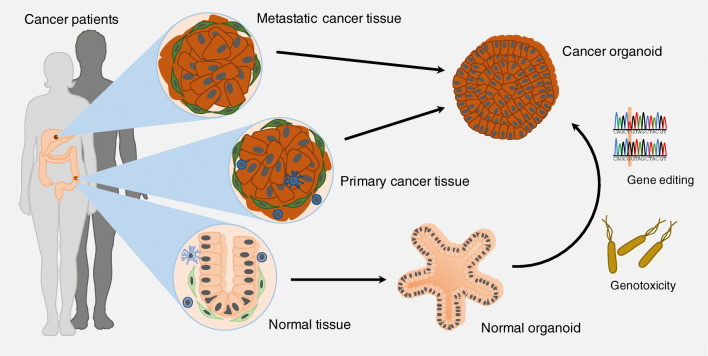
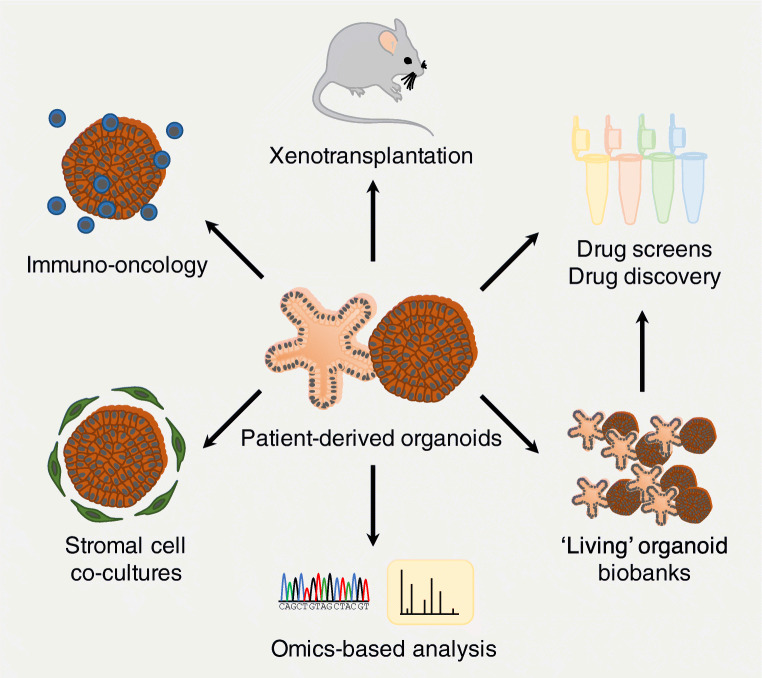
Organoid technology has rapidly transformed basic biomedical research and contributed to significant discoveries in the last decade. With the application of protocols to generate organoids from cancer tissue, organoid technology has opened up new opportunities for cancer research and therapy. Using organoid cultures derived from healthy tissues, different aspects of tumour initiation and progression are widely studied including the role of pathogens or specific cancer genes. Cancer organoid cultures, on the other hand, are applied to generate biobanks, perform drug screens, and study mutational signatures. With the incorporation of cellular components of the tumour microenvironment such as immune cells into the organoid cultures, the technology is now also exploited in the rapidly advancing field of immuno-oncology. In this review, I discuss how organoid technology is currently being utilised in cancer research and what obstacles are still to be overcome for its broader use in anti-cancer therapy.
Overview
The claims and statistics of this paper haven’t been checked yet.
Free: it reads the open-access text and checks the first 5 claims that cite a source we can check. Create a free account to check every claim.
Integrity signals
Registry
Cites
Statistics
Figures
Verification
Claims the paper makes
The claims and statistics of this paper haven’t been checked yet.
Free: it reads the open-access text and checks the first 5 claims that cite a source we can check. Create a free account to check every claim.
Claims other papers make about this one
Each is checked against this paper’s own text: does it say what the citing paper says it does?
In the citing paper
“Cancer organoids can reflect the heterogeneous structure of the tumor and preserve gene mutations of a specific cancer type, giving a reliable response to drugs in cytotoxicity assays.12”
From A layered cancer-on-a-chip system for anticancer drug screening and disease modeling (2023) · cites this paper as [12]
In the citing paper
“In contrast to organoids, the layered model is very versatile and can be widely used in drug screening.12”
From A layered cancer-on-a-chip system for anticancer drug screening and disease modeling (2023) · cites this paper as [12]
Self-check
Percentages, sums and reported differences re-computed from the paper’s own numbers.
The self-check needs the paper’s full text.
Citations
Cites
Hallmarks of Cancer: The Next Generation
Hanahan, D., & Weinberg, R. A. (2011) · Cell · doi:10.1016/j.cell.2011.02.013 · Cited by 66,590 · cited 4×
“On the other hand, an active immune response may suppress tumour growth and, therefore, cancer cells may develop means to avoid immune destruction [106].”
BackgroundInfluentialA genetic model for colorectal tumorigenesis
Fearon, E. R., & Vogelstein, B. (1990) · Cell · doi:10.1016/0092-8674(90)90186-i · Cited by 12,132 · cited 1×
“For instance, several studies have been published on the stepwise introduction of classical CRC driver mutations—APC, TP53, SMAD4, and KRAS—following the socalled Vogelgram cancer progression model [93].”
BackgroundSingle Lgr5 stem cells build crypt-villus structures in vitro without a mesenchymal niche
Sato, T., Vries, R. G., Snippert, H. J., van de Wetering, M., Barker, N., Stange, D. E., van Es, J. H., Abo, A., Kujala, P., Peters, P. J., et al. (2009) · Nature · doi:10.1038/nature07935 · Cited by 7,204 · cited 6×
“As such, it has also been possible to generate ASCenriched epithelial organoids from tissue pieces [11] or tissue pieces containing both epithelial and stromal cells [34].”
BackgroundInfluentialThe new frontier of genome engineering with CRISPR-Cas9
Doudna, J. A., & Charpentier, E. (2014) · Science · doi:10.1126/science.1258096 · Cited by 7,062
Wang, H., Naghavi, M., Allen, C., Barber, R. M., Bhutta, Z. A., Carter, A., Casey, D. C., Charlson, F. J., Chen, A. Z., Coates, M. M., et al. (2016) · The Lancet · doi:10.1016/s0140-6736(16)31012-1 · Cited by 6,596
Cerebral organoids model human brain development and microcephaly
Lancaster, M. A., Renner, M., Martin, C.-A., Wenzel, D., Bicknell, L. S., Hurles, M. E., Homfray, T., Penninger, J. M., Jackson, A. P., & Knoblich, J. A. (2013) · Nature · doi:10.1038/nature12517 · Cited by 5,372 · cited 1×
“PSC-derived organoids reflecting various types of tissues and organs including the brain [44], intestine [45], kidney [46, 47], and retina [48, 49] have been described.”
BackgroundNeoantigens in cancer immunotherapy
Schumacher, T. N., & Schreiber, R. D. (2015) · Science · doi:10.1126/science.aaa4971 · Cited by 4,783 · cited 1×
“Since high degree of neoantigen presentation is critical to elicit a robust antitumour immune response by antigen-specific T cells [109, 110], the authors chose organoids generated from specific subtypes of CRC and non-small cell lung cancer with a high mutational burden.”
BackgroundSato, T., Stange, D. E., Ferrante, M., Vries, R. G. J., van Es, J. H., van den Brink, S., van Houdt, W. J., Pronk, A., van Gorp, J., Siersema, P. D., et al. (2011) · Gastroenterology · doi:10.1053/j.gastro.2011.07.050 · Cited by 3,753 · cited 4×
“Therefore, pure CRC organoid cultures have been achieved by removal of Wnt pathway stimulants such as Wnt ligands and R-spondins from the growth medium [17, 72, 88].”
BackgroundInfluentialOrganoid Models and Applications in Biomedical Research
Xinaris, C., Brizi, V., & Remuzzi, G. (2015) · Nephron · doi:10.1159/000433566 · Cited by 3,515
Stratton, M. R., Campbell, P. J., & Futreal, P. A. (2009) · Nature · doi:10.1038/nature07943 · Cited by 3,449 · cited 2×
“While most of the DNA damage induced is being continuously repaired by one of the DNA repair pathways, errors in the DNA repair process may result in the gain ofmutations at a low frequency [52, 55].”
Background
Research works printed but not linked: 1
- 102. Betge J et al. (2019), Multiparametric phenotyping of compound effects on patient derived organoids. bioRxiv:660993 106.
Cited by
Items 101–123 of 123
Preclinical Models for Cancer Research and Drug Development
Singh, L. (2025) · Springer eBooks · doi:10.1007/978-981-97-5742-8_1 · Cited by 1
Yaqing, W. A. N. G., Tao, T., & Qin, J. (2022) · Scientia Sinica Vitae · doi:10.1360/ssv-2022-0027 · Cited by 2
Organoids: ready for the revolution?
Koo, B., Bartfeld, S., & Alev, C. (2021) · Journal of Molecular Medicine · doi:10.1007/s00109-021-02063-5 · Cited by 1
He, S., Zhang, J., Wang, X., Qi, Z., Zhou, Z., Wang, Y., Xu, S., Li, D., Ye, X., Liu, Z., et al. (2024) · bioRxiv (Cold Spring Harbor Laboratory) · doi:10.1101/2024.09.01.610617 · Cited by 1
Zeng, X., Ma, Q., Li, X., You, L., Li, J., Fu, X., Ren, Y., & You, F. (2022) · Chinese Science Bulletin (Chinese Version) · doi:10.1360/tb-2022-1027
Tumor heterogeneity in glioblastoma: a real-life brain teaser
Verduin, M. (2023) · Research Publications (Maastricht University) · doi:10.26481/dis.20231113mv
Polysaccharide-Based Hydrogels for Bioengineering 3D Tumor Models
Magalhães, M. V., Coutinho, I., Barrias, C. C., & Bidarra, S. J. (2024) · Springer eBooks · doi:10.1007/978-3-031-56363-8_22
Patient-Derived Organoids: Past, Present, and Future
Acar, A. (2024) · Interdisciplinary cancer research · doi:10.1007/16833_2024_343 · Cited by 1
Bioinformatics approaches for the validation of functional analysis of 3D cancer models
Padhy, I., Saha, A., & Sharma, T. (2025) · Elsevier eBooks · doi:10.1016/b978-0-443-26518-1.00004-5
Organoids: New Research Tool in Cancer Diagnostics and Therapeutics
Potdar, P. D. (2025) · BENTHAM SCIENCE PUBLISHERS eBooks · doi:10.2174/9789815238693125010009
Guo, L., Chen, Q., Xu, M., Huang, J., & Ye, H. (2024) · Figshare · doi:10.6084/m9.figshare.26755456
Guo, L., Chen, Q., Xu, M., Huang, J., & Ye, H. (2024) · Figshare · doi:10.6084/m9.figshare.26755468
Guo, L., Chen, Q., Xu, M., Huang, J., & Ye, H. (2024) · Figshare · doi:10.6084/m9.figshare.26755465
He, L., She, C., Jiang, S., Qi, Z., Deng, Z., Ji, L., Cui, Y., & Wu, J. (2024) · Figshare · doi:10.6084/m9.figshare.25374731
Guo, L., Chen, Q., Xu, M., Huang, J., & Ye, H. (2024) · Figshare · doi:10.6084/m9.figshare.26755471
Guo, L., Chen, Q., Xu, M., Huang, J., & Ye, H. (2024) · Figshare · doi:10.6084/m9.figshare.26755459
Guo, L., Chen, Q., Xu, M., Huang, J., & Ye, H. (2024) · Figshare · doi:10.6084/m9.figshare.26755474
Guo, L., Chen, Q., Xu, M., Huang, J., & Ye, H. (2024) · Figshare · doi:10.6084/m9.figshare.26755477
Hu, P., Zeng, S., Lei, J., Zhou, H., Wang, B., Liu, Z., Liu, X., & Wei, F. (2026) · Discover Oncology · doi:10.1007/s12672-026-05086-x
“Recent work has also demonstrated the feasibility of generating chordoma organoids and using them for early-phase drug discovery [22–25].”
Stem cell-based tactics in the remodeling and treatment of intestinal diseases
Ren, Y. Q., Zhang, S., Wang, J., Wang, Y., Xu, M., Zhang, L., Ge, K., Chu, Y., & Zhang, L. (2026) · Stem Cell Research & Therapy · doi:10.1186/s13287-026-05124-z
“Due to the multidimensional variations and the potential large-scale application of stem cell-based fundamental research and clinical application, there’s also an urgent demand for the establishment of stem cell biobanks and organoid bio-banks [116, 170–172].”
Zhou, D.-Y., Xie, P., Wang, S., Liu, W.-L., Hao, M.-D., Wang, Z.-Y., Xin-xin, Z., & Zhang, X.-H. (2026) · Cancer Cell International · doi:10.1186/s12935-026-04400-5
“Compared to traditional 2D cultures, this model not only morphologically recre-ates the tumor’s three-dimensional architecture and cellular heterogeneity but, more importantly, functionally reproduces drug-resistant phenotypes closer to clinical reality [40, 41].”
Makris, E. A., Ives, J. K., & Votanopoulos, K. I. (2026) · International Journal of Molecular Sciences · doi:10.3390/ijms27177911
“Organoid technologies have been applied across multiple cancer types and peritoneal malignancies [23–25].”
Advances in integrated diagnostics: Innovation and translation of laboratory diagnostic technologies
Bernardini, S., & Zhang, J. (2026) · Integrated Diagnostics · doi:10.1016/j.intdia.2026.100005
Metadata
- Authors
- Kretzschmar, K.
- Affiliations
- Universitätsklinikum Würzburg (DE)
- Corresponding author
- Kretzschmar, Kai
- ORCID
- Kretzschmar, Kai
- Venue
- Journal of Molecular Medicine
- Published
- 2020-10-14
- Volume
- 99
- Issue
- 4
- Pages
- 501-515
- ISSN
- 0946-2716 (ISSN-L)
- 1432-1440
- PMC
- PMC8026469
- OpenAlex
- W3093085024
- Semantic Scholar
- 8f772ed849ddff9aa1812e33dc5876434ccc42f2
- Cited by
- 120
- References
- 141
- Citations by year
- 2026: 13 · 2025: 29 · 2024: 32 · 2023: 22 · 2022: 14 · 2021: 9 · 2020: 1
- FWCI
- 1.23
- Type
- journal article
- Language
- en
- Open access
- hybrid
- doi.org
- Licence
- cc-by
- creativecommons.org/licenses/by/4.0 (tdm)
- creativecommons.org/licenses/by/4.0 (vor)
- Locations
- Journal of Molecular Medicine (publishedVersion, cc-by)
- PubMed Central (publishedVersion, cc-by)
- PubMed (publishedVersion)
- Informationszentrum Lebenswissenschaften (ZB MED) (submittedVersion, cc-by)
- Online Publication Service of Würzburg University (Würzburg University) (submittedVersion, cc-by)
- Funders
- Deutsche Krebshilfe (MSNZ Würzburg)
- Topics
- Health Sciences › Medicine › Oncology › Cancer Cells and Metastasis
- Physical Sciences › Engineering › Biomedical Engineering › 3D Printing in Biomedical Research
- Life Sciences › Biochemistry, Genetics and Molecular Biology › Cancer Research › Cancer Genomics and Diagnostics
- Keywords
- tumor organoids, organoid technology, cancer biobank, drug screening, mutational signatures, tumor microenvironment, immune cells, cancer immunotherapy, cancer therapy, cancer genes
- MeSH terms
- Cell Transformation, Neoplastic, DNA Mutational Analysis, Drug Screening Assays, Antitumor, Epithelial Cells, Forecasting, Humans, Medical Oncology, Neoplasm Metastasis, Neoplasms, Organoids, Neoplastic Stem Cells, Biological Specimen Banks, Genes, Neoplasm, Translational Research, Biomedical, Stem Cell Research, Tumor Microenvironment, Carcinogenesis
About these checks
Registry, retraction, Cites and statistics results are computed, not judged, with one exception: a printed reference that no index lists is read once by a model before it counts as a citation error. Claims are extracted by a model and kept only when their quote appears verbatim in the text; each cited source is then checked, with a model’s help, for whether it says what the claim relies on. Those verdicts can be wrong — read the claim’s quote and the cited source before relying on one.
Statistics and arithmetic are recomputed, not judged.
Confidence bands are shown only for fields calibrated on our annotated test set. None is calibrated yet, so no band is shown.
What counts as a claim ›How we measure confidence ›How we check this ›
Are you an author, or do you see a problem with this page? Request a review
Data sources
Bibliographic data: Semantic Scholar, OpenAlex, Crossref.
Contains information from the Semantic Scholar Academic Graph Datasets, made available under the ODC Attribution License (ODC-BY 1.0).
Semantic Scholar’s data is described in: Kinney, R., et al. (2023). The Semantic Scholar Open Data Platform. arXiv:2301.10140.
