

Clinical perspectives on the age-related increase of immunosuppressive activity
Open accessThe DOI matches its Crossref record; 207 of the 207 references it cites were found in a registry or an index.
Abstract
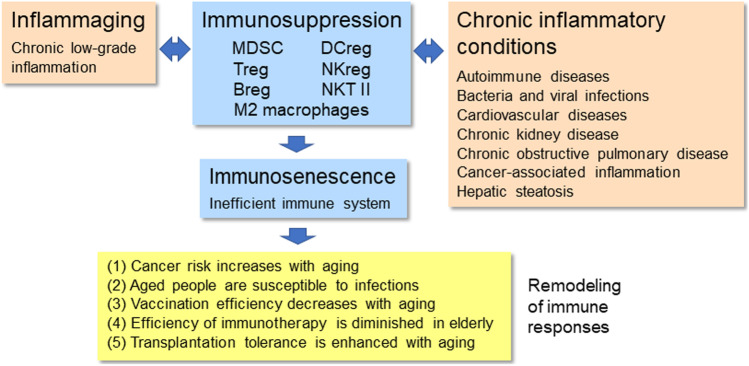
The aging process is associated with a remodeling of the immune system involving chronic low-grade inflammation and a gradual decline in the function of the immune system. These processes are also called inflammaging and immunosenescence. The age-related immune remodeling is associated with many clinical changes, e.g., risk for cancers and chronic infections increases, whereas the efficiency of vaccination and immunotherapy declines with aging. On the other hand, there is convincing evidence that chronic inflammatory states promote the premature aging process. The inflammation associated with aging or chronic inflammatory conditions stimulates a counteracting immunosuppression which protects tissues from excessive inflammatory injuries but promotes immunosenescence. Immunosuppression is a driving force in tumors and chronic infections and it also induces the tolerance to vaccination and immunotherapies. Immunosuppressive cells, e.g., myeloid-derived suppressor cells (MDSC), regulatory T cells (Treg), and type M2 macrophages, have a crucial role in tumorigenesis and chronic infections as well as in the tolerance to vaccination and immunotherapies. Interestingly, there is substantial evidence that inflammaging is also associated with an increased immunosuppressive activity, e.g., upregulation of immunosuppressive cells and anti-inflammatory cytokines. Given that both the aging and chronic inflammatory states involve the activation of immunosuppression and immunosenescence, this might explain why aging is a risk factor for tumorigenesis and chronic inflammatory states and conversely, chronic inflammatory insults promote the premature aging process in humans.
Overview
The claims and statistics of this paper haven’t been checked yet.
Free: it reads the open-access text and checks the first 5 claims that cite a source we can check. Create a free account to check every claim.
Integrity signals
Registry
Cites
Statistics
Figures
Verification
Claims the paper makes
The claims and statistics of this paper haven’t been checked yet.
Free: it reads the open-access text and checks the first 5 claims that cite a source we can check. Create a free account to check every claim.
Claims other papers make about this one
Each is checked against this paper’s own text: does it say what the citing paper says it does?
In the citing paper
“This is in part due to the age-driven accumulation of immunosuppressive cell types in the tumor microenvironment, as documented for MDSCs, type 2 macrophages (M2), and Tregs, 260”
From Meta-hallmarks of aging and cancer (2023) · cites this paper as [260]
Self-check
Percentages, sums and reported differences re-computed from the paper’s own numbers.
The self-check needs the paper’s full text.
Citations
Cites
Items 201–207 of 207
Epigenetics As The Driving Force In Long-Term Immunosuppression
Giménez, J. L. G., & Carbonell, N. (2016) · Journal of Clinical Epigenetics · doi:10.21767/2472-1158.100017 · Cited by 11
Achmus, L., Ruhnau, J., Grothe, S., von Sarnowski, B., Bröker, B. M., Dressel, A., Schulze, J., & Vogelgesang, A. (2020) · Frontiers in Neurology · doi:10.3389/fneur.2020.577971 · Cited by 11
Jylhävä, J., Kananen, L., Raitanen, J. A., Marttila, S., Nevalainen, T., Hervonen, A., Jylhä, M. K., & Hurme, M. (2016) · Oncotarget · doi:10.18632/oncotarget.8278 · Cited by 10
Zhou, Z., Lai, P., Zhang, S., Wang, Y., Qu, N., Lu, D., Gao, L., Xu, L., Yang, Y., Zhang, T., et al. (2021) · BioMed Research International · doi:10.1155/2021/6612477 · Cited by 10 · cited 1×
“[125] demonstrated that the accumulation of MDSCs into human liver during the progression of NAFLD positively correlated with the clinical parameters of liver disease.”
BackgroundRosado‐Sánchez, I., Pablo-Bernal, R. S. D., Rull, A., González, J., Moreno, S., García, D. V., Estrada, V., Muñoz‐Fernández, M. Á., Vidal, F., Leal, M., et al. (2020) · Frontiers in Immunology · doi:10.3389/fimmu.2020.581307 · Cited by 9
Epigenetic networks driving T cell identity and plasticity during immunosenescence
Rodríguez, R. M. A., Sáiz, M. L., Suárez-Álvarez, B., & López‐Larrea, C. (2021) · Trends in Genetics · doi:10.1016/j.tig.2021.08.014 · Cited by 6
Immunological discrepancy in aged mice facilitates skin allograft survival
Lee, W., Wang, Y., Hsu, H.-Y., Hsu, P., Cheng, C., Lee, C., Wu, T.-J., & Chan, K. (2021) · Aging · doi:10.18632/aging.203152 · Cited by 5
Cited by
Meta-hallmarks of aging and cancer
López-Otín, C., Pietrocola, F., Roiz-Valle, D., Galluzzi, L., & Kroemer, G. (2023) · Cell Metabolism · doi:10.1016/j.cmet.2022.11.001 · Cited by 529
Progress and prospects of mRNA-based drugs in pre-clinical and clinical applications
Shi, Y., Shi, M., Wang, Y., & You, J. (2024) · Signal Transduction and Targeted Therapy · doi:10.1038/s41392-024-02002-z · Cited by 206
Pacinella, G., Ciaccio, A. M., & Tuttolomondo, A. (2022) · International Journal of Molecular Sciences · doi:10.3390/ijms232415722 · Cited by 202
“Additionally, some authors documented that improving the autophagic capacity by pharmacological stimuli may prevent agerelated disease and extend lifespan [24].”
BackgroundNAD metabolism: Role in senescence regulation and aging
Chini, C. C. S., Cordeiro, H. S., Tran, N. L. K., & Chini, E. N. (2023) · Aging Cell · doi:10.1111/acel.13920 · Cited by 168
“In addition, through their SASP, they can attract immunosuppressive and proinflammatory cells to tissues, contributing to age-related tissue dysfunction (Salminen, 2022a).”
BackgroundLiu, Y., Lomeli, I., & Kron, S. J. (2024) · Cells · doi:10.3390/cells13151281 · Cited by 77
“Cellular senescence has been implicated in dampening immune responses (Figure 3 and Table 3) [300,301].”
Background
Metadata
- Authors
- Salminen, A.
- Affiliations
- University of Eastern Finland (FI)
- Corresponding author
- Salminen, Antero
- ORCID
- Salminen, Antero
- Venue
- Journal of Molecular Medicine
- Published
- 2022-04-06
- Volume
- 100
- Issue
- 5
- Pages
- 697-712
- ISSN
- 0946-2716 (ISSN-L)
- 1432-1440
- PMC
- PMC8985067
- OpenAlex
- W4225766275
- Cited by
- 57
- References
- 207
- Citations by year
- 2026: 9 · 2025: 7 · 2024: 19 · 2023: 18 · 2022: 4
- FWCI
- 1.26
- Type
- journal article
- Language
- en
- Open access
- hybrid
- doi.org
- Licence
- cc-by
- creativecommons.org/licenses/by/4.0 (tdm)
- creativecommons.org/licenses/by/4.0 (vor)
- Locations
- Journal of Molecular Medicine (publishedVersion, cc-by)
- PubMed Central (publishedVersion, cc-by)
- PubMed (publishedVersion)
- Funders
- N/A
- University of Eastern Finland (UEF) including Kuopio University Hospital
- Topics
- Life Sciences › Immunology and Microbiology › Immunology › Immune cells in cancer
- Life Sciences › Immunology and Microbiology › Immunology › T-cell and B-cell Immunology
- Life Sciences › Biochemistry, Genetics and Molecular Biology › Aging › Genetics, Aging, and Longevity in Model Organisms
- Keywords
- inflammaging, immunosenescence, immunosuppression, aging, chronic inflammation, myeloid-derived suppressor cells, regulatory T cells, M2 macrophages, anti-inflammatory cytokines, vaccine tolerance, carcinogenesis, chronic infection, premature aging
- MeSH terms
- Immunosenescence, Aging, Humans, Immunosuppressive Agents, Inflammation, Neoplasms, Aging, Premature, Carcinogenesis
About these checks
Registry, retraction, Cites and statistics results are computed, not judged, with one exception: a printed reference that no index lists is read once by a model before it counts as a citation error. Claims are extracted by a model and kept only when their quote appears verbatim in the text; each cited source is then checked, with a model’s help, for whether it says what the claim relies on. Those verdicts can be wrong — read the claim’s quote and the cited source before relying on one.
Statistics and arithmetic are recomputed, not judged.
Confidence bands are shown only for fields calibrated on our annotated test set. None is calibrated yet, so no band is shown.
What counts as a claim ›How we measure confidence ›How we check this ›
Are you an author, or do you see a problem with this page? Request a review
Data sources
Bibliographic data: Semantic Scholar, OpenAlex, Crossref.
Contains information from the Semantic Scholar Academic Graph Datasets, made available under the ODC Attribution License (ODC-BY 1.0).
Semantic Scholar’s data is described in: Kinney, R., et al. (2023). The Semantic Scholar Open Data Platform. arXiv:2301.10140.
