

Clinical perspectives on the age-related increase of immunosuppressive activity
Open accessThe DOI matches its Crossref record; 207 of the 207 references it cites were found in a registry or an index.
Abstract
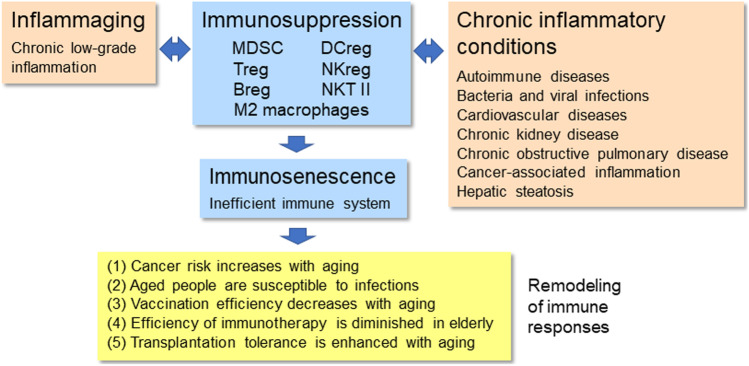
The aging process is associated with a remodeling of the immune system involving chronic low-grade inflammation and a gradual decline in the function of the immune system. These processes are also called inflammaging and immunosenescence. The age-related immune remodeling is associated with many clinical changes, e.g., risk for cancers and chronic infections increases, whereas the efficiency of vaccination and immunotherapy declines with aging. On the other hand, there is convincing evidence that chronic inflammatory states promote the premature aging process. The inflammation associated with aging or chronic inflammatory conditions stimulates a counteracting immunosuppression which protects tissues from excessive inflammatory injuries but promotes immunosenescence. Immunosuppression is a driving force in tumors and chronic infections and it also induces the tolerance to vaccination and immunotherapies. Immunosuppressive cells, e.g., myeloid-derived suppressor cells (MDSC), regulatory T cells (Treg), and type M2 macrophages, have a crucial role in tumorigenesis and chronic infections as well as in the tolerance to vaccination and immunotherapies. Interestingly, there is substantial evidence that inflammaging is also associated with an increased immunosuppressive activity, e.g., upregulation of immunosuppressive cells and anti-inflammatory cytokines. Given that both the aging and chronic inflammatory states involve the activation of immunosuppression and immunosenescence, this might explain why aging is a risk factor for tumorigenesis and chronic inflammatory states and conversely, chronic inflammatory insults promote the premature aging process in humans.
Overview
The claims and statistics of this paper haven’t been checked yet.
Free: it reads the open-access text and checks the first 5 claims that cite a source we can check. Create a free account to check every claim.
Integrity signals
Registry
Cites
Statistics
Figures
Verification
Claims the paper makes
The claims and statistics of this paper haven’t been checked yet.
Free: it reads the open-access text and checks the first 5 claims that cite a source we can check. Create a free account to check every claim.
Claims other papers make about this one
Each is checked against this paper’s own text: does it say what the citing paper says it does?
In the citing paper
“This is in part due to the age-driven accumulation of immunosuppressive cell types in the tumor microenvironment, as documented for MDSCs, type 2 macrophages (M2), and Tregs, 260”
From Meta-hallmarks of aging and cancer (2023) · cites this paper as [260]
Self-check
Percentages, sums and reported differences re-computed from the paper’s own numbers.
The self-check needs the paper’s full text.
Citations
Cites
Myeloid-derived-suppressor cells as regulators of the immune system
Gabrilovich, D. I., & Nagaraj, S. (2009) · Nature Reviews Immunology · doi:10.1038/nri2506 · Cited by 6,753 · cited 1×
“, spleen and lymph nodes, or directly into inflamed tissues [50, 51].”
BackgroundMANTOVANI, A., SOZZANI, S., LOCATI, M., ALLAVENA, P., & SICA, A. (2002) · Trends in Immunology · doi:10.1016/s1471-4906(02)02302-5 · Cited by 5,528
Inflamm‐aging: An Evolutionary Perspective on Immunosenescence
FRANCESCHI, C., BONAFÈ, M., VALENSIN, S., OLIVIERI, F., DE LUCA, M., OTTAVIANI, E., & DE BENEDICTIS, G. (2000) · Annals of the New York Academy of Sciences · doi:10.1111/j.1749-6632.2000.tb06651.x · Cited by 5,358 · cited 2×
“The aging process is associated with a remodeling of the immune system in humans and different animal species [1, 2].”
BackgroundThe senescence-associated secretory phenotype: the dark side of tumor suppression
Coppé, J.-P., Desprez, P.-Y., Krtolica, A., & Campisi, J. (2010) · Annual Review of Pathology: Mechanisms of Disease · doi:10.1146/annurev-pathol-121808-102144 · Cited by 5,206 · cited 6×
“The inflammatory state not only triggers the senescence of immune cells but it also elicits cellular senescence in non-immune cells which secrete pro-inflammatory mediators (SASP state), thus aggravating the inflammatory state in TME [140].”
BackgroundInfluentialChronic inflammation in the etiology of disease across the life span
Furman, D., Campisi, J., Verdin, E., Carrera-Bastos, P., Targ, S., Franceschi, C., Ferrucci, L., Gilroy, D. W., Fasano, A., Miller, G. W., et al. (2019) · Nature Medicine · doi:10.1038/s41591-019-0675-0 · Cited by 4,915 · cited 2×
“, cardiovascular diseases (CVD), COPD, CKD, hepatic steatosis, many cancers, autoimmune diseases, and neurodegenerative diseases [6].”
BackgroundInflammation and cancer: triggers, mechanisms, and consequences
Greten, F. R., & Grivennikov, S. I. (2019) · Immunity · doi:10.1016/j.immuni.2019.06.025 · Cited by 3,806
TGF-β: the master regulator of fibrosis
Meng, X.-M., Nikolic-Paterson, D. J., & Lan, H. Y. (2016) · Nature Reviews Nephrology · doi:10.1038/nrneph.2016.48 · Cited by 3,528
Vignali, D. A. A., Collison, L. W., & Workman, C. J. (2008) · Nature Reviews Immunology · doi:10.1038/nri2343 · Cited by 3,463
Ageing as a risk factor for neurodegenerative disease
Hou, Y., Dan, X., Babbar, M., Wei, Y., Hasselbalch, S. G., Croteau, D. L., & Bohr, V. A. (2019) · Nature Reviews Neurology · doi:10.1038/s41582-019-0244-7 · Cited by 3,310 · cited 1×
“For instance, chronic inflammation prevails in cardiovascular diseases [7], chronic kidney diseases [8], and neurodegenerative diseases [9].”
BackgroundDNA methylation-based biomarkers and the epigenetic clock theory of ageing
Horvath, S., & Raj, K. (2018) · Nature Reviews Genetics · doi:10.1038/s41576-018-0004-3 · Cited by 3,095 · cited 1×
“The epigenetic clock based on DNA methylation has been used to evaluate the biological aging process [19].”
MethodAging with multimorbidity: A systematic review of the literature
Marengoni, A., Angleman, S., Melis, R., Mangialasche, F., Karp, A., Garmen, A., Meinow, B., & Fratiglioni, L. (2011) · Ageing Research Reviews · doi:10.1016/j.arr.2011.03.003 · Cited by 3,092 · cited 1×
“Commonly, multimorbidity and frailty exist in the elderly and mortality increases exponentially in aged-related diseases [12, 13].”
BackgroundMurray, P. J. (2017) · Annual Review of Physiology · doi:10.1146/annurev-physiol-022516-034339 · Cited by 2,981 · cited 2×
“The immune cells are exceedingly plastid and the phenotype of immune cells can be modulated from a pro-inflammatory to an immunosuppressive state, a process also called polarization [52].”
BackgroundSepsis-induced immunosuppression: from cellular dysfunctions to immunotherapy
Hotchkiss, R. S., Monneret, G., & Payen, D. (2013) · Nature Reviews Immunology · doi:10.1038/nri3552 · Cited by 2,772
Top 10 Challenges in Cancer Immunotherapy
Hegde, P. S., & Chen, D. S. (2020) · Immunity · doi:10.1016/j.immuni.2019.12.011 · Cited by 2,238
TRANSFORMING GROWTH FACTOR-β REGULATION OF IMMUNE RESPONSES
Li, M. O., Wan, Y. Y., Sanjabi, S., Robertson, A.-K. L., & Flavell, R. A. (2006) · Annual Review of Immunology · doi:10.1146/annurev.immunol.24.021605.090737 · Cited by 2,206
Feuerer, M., Herrero, L., Cipolletta, D., Naaz, A., Wong, J., Nayer, A., Lee, J., Goldfine, A. B., Benoist, C., Shoelson, S., et al. (2009) · Nature Medicine · doi:10.1038/nm.2002 · Cited by 2,145 · cited 1×
“The role of Tregs in the aging process is still far from clear since tissues contain several unique populations of tissue-resident Tregs which are crucially involved in the regulation of tissue homeostasis [58, 109].”
BackgroundMechanisms of photoaging and chronological skin aging
Fisher, G. J., Kang, S., Varani, J., Bata-Csorgo, Z., Wan, Y., Datta, S., & Voorhees, J. J. (2002) · Archives of Dermatology · doi:10.1001/archderm.138.11.1462 · Cited by 1,849
An Interaction between Kynurenine and the Aryl Hydrocarbon Receptor Can Generate Regulatory T Cells
Mezrich, J. D., Fechner, J. H., Zhang, X., Johnson, B. P., Burlingham, W. J., & Bradfield, C. A. (2010) · The Journal of Immunology · doi:10.4049/jimmunol.0903670 · Cited by 1,601
Huang, B., Pan, P.-Y., Li, Q., Sato, A. I., Levy, D. E., Bromberg, J., Divino, C. M., & Chen, S.-H. (2006) · Cancer Research · doi:10.1158/0008-5472.can-05-1299 · Cited by 1,435 · cited 1×
“Moreover, MDSCs can promote the differentiation of resting T cells to immunosuppressive Tregs [53, 54].”
BackgroundAltered recognition of antigen is a mechanism of CD8+ T cell tolerance in cancer
Nagaraj, S., Gupta, K., Pisarev, V., Kinarsky, L., Sherman, S., Kang, L., Herber, D. L., Schneck, J., & Gabrilovich, D. I. (2007) · Nature Medicine · doi:10.1038/nm1609 · Cited by 1,174 · cited 1×
“[81] demonstrated that MDSCs were able to nitrate the TCR complex and thus inhibiting the antigen recognition of mouse tolerant CD8 T cells.”
BackgroundTargeting STAT3 in Cancer Immunotherapy
Zou, S., Tong, Q., Liu, B., Huang, W., Tian, Y., & Fu, X. (2020) · Molecular Cancer · doi:10.1186/s12943-020-01258-7 · Cited by 1,050
Human bone marrow hematopoietic stem cells are increased in frequency and myeloid-biased with age
Pang, W. W., Price, E. A., Sahoo, D., Beerman, I., Maloney, W. J., Rossi, D. J., Schrier, S. L., & Weissman, I. L. (2011) · Proceedings of the National Academy of Sciences · doi:10.1073/pnas.1116110108 · Cited by 991
Ghiringhelli, F., Ménard, C., Terme, M., Flament, C., Taieb, J., Chaput, N., Puig, P. E., Novault, S., Escudier, B., Vivier, E., et al. (2005) · The Journal of Experimental Medicine · doi:10.1084/jem.20051511 · Cited by 949
Monteran, L., & Erez, N. (2019) · Frontiers in Immunology · doi:10.3389/fimmu.2019.01835 · Cited by 675
Hoechst, B., Voigtlaender, T., Ormandy, L., Gamrekelashvili, J., Zhao, F., Wedemeyer, H., Lehner, F., Manns, M. P., Greten, T. F., & Korangy, F. (2009) · Hepatology · doi:10.1002/hep.23054 · Cited by 643
Ultraviolet-radiation-induced inflammation promotes angiotropism and metastasis in melanoma
Bald, T., Quast, T., Landsberg, J., Rogava, M., Glodde, N., Lopez-Ramos, D., Kohlmeyer, J., Riesenberg, S., van den Boorn-Konijnenberg, D., Hömig-Hölzel, C., et al. (2014) · Nature · doi:10.1038/nature13111 · Cited by 623
tTregs, pTregs, and iTregs: similarities and differences
Shevach, E. M., & Thornton, A. M. (2014) · Immunological Reviews · doi:10.1111/imr.12160 · Cited by 606 · cited 1×
“, thymic (tTreg), peripheral (pTreg), and inducible (iTreg), which have some similar and some distinctive properties [103].”
BackgroundUltraviolet light induced injury: Immunological and inflammatory effects
Clydesdale, G. J., Dandie, G. W., & Muller, H. K. (2001) · Immunology & Cell Biology · doi:10.1046/j.1440-1711.2001.01047.x · Cited by 583 · cited 1×
“For instance, the UVradiation (UVR)-induced photoaging of the skin is a wellknown example of an accelerated aging process driven by repeated inflammatory insults [23, 24].”
BackgroundOstrand-Rosenberg, S., Sinha, P., Beury, D. W., & Clements, V. K. (2012) · Seminars in Cancer Biology · doi:10.1016/j.semcancer.2012.01.011 · Cited by 583
Salminen, A., Huuskonen, J., Ojala, J., Kauppinen, A., Kaarniranta, K., & Suuronen, T. (2008) · Ageing Research Reviews · doi:10.1016/j.arr.2007.09.002 · Cited by 581
Self-citationImpaired immune surveillance accelerates accumulation of senescent cells and aging
Ovadya, Y., Landsberger, T., Leins, H., Vadai, E., Gal, H., Biran, A., Yosef, R., Sagiv, A., Agrawal, A., Shapira, A., et al. (2018) · Nature Communications · doi:10.1038/s41467-018-07825-3 · Cited by 578 · cited 2×
“[89] demonstrated that the ablation of the Perforin 1 (Prf1) gene in mice increased the accumulation of senescent cells within tissues, triggered chronic inflammatory state, and finally reduced the survival of the animals.”
BackgroundPerna, L., Zhang, Y., Mons, U., Holleczek, B., Saum, K.-U., & Brenner, H. (2016) · Clinical Epigenetics · doi:10.1186/s13148-016-0228-z · Cited by 572
Immunosenescence: a key player in cancer development
Lian, J., Yue, Y., Yu, W., & Zhang, Y. (2020) · Journal of Hematology & Oncology · doi:10.1186/s13045-020-00986-z · Cited by 510
Stromal senescence establishes an immunosuppressive microenvironment that drives tumorigenesis
Ruhland, M. K., Loza, A. J., Capietto, A.-H., Luo, X., Knolhoff, B. L., Flanagan, K. C., Belt, B. A., Alspach, E., Leahy, K., Luo, J., et al. (2016) · Nature Communications · doi:10.1038/ncomms11762 · Cited by 496 · cited 3×
“However, there are observations indicating that the level of MDSCs increased with aging in mouse and human skin [108].”
BackgroundInfluentialTumor-Driven Evolution of Immunosuppressive Networks during Malignant Progression
Kim, R., Emi, M., Tanabe, K., & Arihiro, K. (2006) · Cancer Research · doi:10.1158/0008-5472.can-05-4128 · Cited by 445 · cited 1×
“, to switch proinflammatory cells to immunosuppressive phenotypes [60].”
BackgroundTargeting Myeloid-Derived Suppressor Cells to Bypass Tumor-Induced Immunosuppression
Fleming, V., Hu, X., Weber, R., Nagibin, V., Groth, C., Altevogt, P., Utikal, J., & Umansky, V. (2018) · Frontiers in Immunology · doi:10.3389/fimmu.2018.00398 · Cited by 443
Fritsche, E., Schäfer, C., Calles, C., Bernsmann, T., Bernshausen, T., Wurm, M., Hübenthal, U., Cline, J. E., Hajimiragha, H., Schroeder, P., et al. (2007) · Proceedings of the National Academy of Sciences · doi:10.1073/pnas.0701764104 · Cited by 437
Cellular senescence: a link between cancer and age-related degenerative disease?
Campisi, J., Andersen, J. K., Kapahi, P., & Melov, S. (2011) · Seminars in Cancer Biology · doi:10.1016/j.semcancer.2011.09.001 · Cited by 421
Lages, C. S., Suffia, I., Velilla, P. A., Huang, B., Warshaw, G., Hildeman, D. A., Belkaid, Y., & Chougnet, C. (2008) · The Journal of Immunology · doi:10.4049/jimmunol.181.3.1835 · Cited by 399 · cited 2×
“Accordingly, the number of Tregs was augmented with aging in human blood [78, 99].”
BackgroundChiesa, M. D., Carlomagno, S., Frumento, G., Balsamo, M., Cantoni, C., Conte, R., Moretta, L., Moretta, A., & Vitale, M. (2006) · Blood · doi:10.1182/blood-2006-03-006700 · Cited by 399
TGF-β Signaling in Cellular Senescence and Aging-Related Pathology
Tominaga, K., & Suzuki, H. I. (2019) · International Journal of Molecular Sciences · doi:10.3390/ijms20205002 · Cited by 393
The interplay between immunosenescence and age-related diseases
Barbé-Tuana, F., Funchal, G., Schmitz, C. R. R., Maurmann, R. M., & Bauer, M. E. (2020) · Seminars in Immunopathology · doi:10.1007/s00281-020-00806-z · Cited by 384
Immunosenescence: Implications for response to infection and vaccination in older people
Pera, A., Campos, C., López, N., Hassouneh, F., Alonso, C., Tarazona, R., & Solana, R. (2015) · Maturitas · doi:10.1016/j.maturitas.2015.05.004 · Cited by 373
Benayoun, B. A., Pollina, E. A., Singh, P. P., Mahmoudi, S., Harel, I., Casey, K. M., Dulken, B. W., Kundaje, A., & Brunet, A. (2019) · Genome Research · doi:10.1101/gr.240093.118 · Cited by 360
Hall, B. M., Balan, V., Gleiberman, A. S., Strom, E., Krasnov, P., Virtuoso, L. P., Rydkina, E., Vujcic, S., Balan, K., Gitlin, I., et al. (2016) · Aging · doi:10.18632/aging.100991 · Cited by 357 · cited 1×
“, telomere shortening, DNA damages, augmented expression of SA-β-Gal and cell cycle inhibitors (p16INK4a, p21WAF1, p53) as well as increased oxidative and endoplasmic reticulum stresses [5, 76, 83, 84].”
BackgroundImmunosuppression associated with chronic inflammation in the tumor microenvironment
Wang, D., & DuBois, R. N. (2015) · Carcinogenesis · doi:10.1093/carcin/bgv123 · Cited by 355
Inflammation markers predicting frailty and mortality in the elderly
De Martinis, M., Franceschi, C., Monti, D., & Ginaldi, L. (2006) · Experimental and Molecular Pathology · doi:10.1016/j.yexmp.2005.11.004 · Cited by 345
NKG2D ligands mediate immunosurveillance of senescent cells
Sagiv, A., Burton, D. G. A., Moshayev, Z., Vadai, E., Wensveen, F., Ben-Dor, S., Golani, O., Polic, B., & Krizhanovsky, V. (2016) · Aging · doi:10.18632/aging.100897 · Cited by 345
Arai, Y., Martin-Ruiz, C. M., Takayama, M., Abe, Y., Takebayashi, T., Koyasu, S., Suematsu, M., Hirose, N., & von Zglinicki, T. (2015) · EBioMedicine · doi:10.1016/j.ebiom.2015.07.029 · Cited by 333
Kuro-o, M. (2009) · Biochimica et Biophysica Acta (BBA) - General Subjects · doi:10.1016/j.bbagen.2009.02.005 · Cited by 331 · cited 1×
“Klotho-deficient mice display many pathological properties which are similar to those appearing during the aging process [47].”
BackgroundReactive Oxygen Species as Regulators of MDSC-Mediated Immune Suppression
Ohl, K., & Tenbrock, K. (2018) · Frontiers in Immunology · doi:10.3389/fimmu.2018.02499 · Cited by 330
Depletion of fat-resident Treg cells prevents age-associated insulin resistance
Bapat, S. P., Myoung Suh, J., Fang, S., Liu, S., Zhang, Y., Cheng, A., Zhou, C., Liang, Y., LeBlanc, M., Liddle, C., et al. (2015) · Nature · doi:10.1038/nature16151 · Cited by 324 · cited 1×
“[112] demonstrated that the depletion of fat-resident Tregs prevented the development of age-associated insulin resistance (IR).”
BackgroundTGF- downregulates the activating receptor NKG2D on NK cells and CD8+ T cells in glioma patients
Crane, C. A., Han, S. J., Barry, J. J., Ahn, B. J., Lanier, L. L., & Parsa, A. T. (2010) · Neuro-Oncology · doi:10.1093/neuonc/nop009 · Cited by 322
Iclozan, C., Antonia, S., Chiappori, A., Chen, D.-T., & Gabrilovich, D. (2013) · Cancer Immunology, Immunotherapy · doi:10.1007/s00262-013-1396-8 · Cited by 317
Decreased epigenetic age of PBMCs from Italian semi-supercentenarians and their offspring
Horvath, S., Pirazzini, C., Bacalini, M. G., Gentilini, D., Di Blasio, A. M., Delledonne, M., Mari, D., Arosio, B., Monti, D., Passarino, G., et al. (2015) · Aging · doi:10.18632/aging.100861 · Cited by 316
Regulatory T Cells and the Immune Aging Process: A Mini-Review
Jagger, A., Shimojima, Y., Goronzy, J. J., & Weyand, C. M. (2014) · Gerontology · doi:10.1159/000355303 · Cited by 301
Skin-resident T cells: the ups and downs of on site immunity
Clark, R. A. (2010) · Journal of Investigative Dermatology · doi:10.1038/jid.2009.247 · Cited by 298 · cited 1×
“, in the skin [55] and the adipose tissue [56].”
BackgroundThe expanding family of regulatory B cells
Mauri, C., & Menon, M. (2015) · International Immunology · doi:10.1093/intimm/dxv038 · Cited by 297 · cited 1×
“The immunosuppressive network also includes regulatory subsets of B cells (Breg) [62], DC cells (DCreg) [63], NK cells (NKreg) [64], and type II NKT cells [65] (Fig.”
BackgroundAgeing and inflammation in patients with HIV infection
Nasi, M., De Biasi, S., Gibellini, L., Bianchini, E., Pecorini, S., Bacca, V, Guaraldi, G., Mussini, C., Pinti, M., & Cossarizza, A. (2016) · Clinical and Experimental Immunology · doi:10.1111/cei.12814 · Cited by 277 · cited 1×
“, cardiovascular diseases, osteoporosis, cognitive impairments, and frailty [38, 39].”
BackgroundThe Role of Immunosenescence in the Development of Age-Related Diseases
Fülöp, T., Dupuis, G., Witkowski, J. M., & Larbi, A. (2016) · Revista de Investigación Clínica · doi:10.1016/s0034-8376(25)00212-8 · Cited by 269
Senescence in COPD and Its Comorbidities
Barnes, P. J. (2017) · Annual Review of Physiology · doi:10.1146/annurev-physiol-022516-034314 · Cited by 266 · cited 8×
“COPD is also associated with an increase in the hallmarks of aging, e.g., epigenetic changes, telomere shortening, cellular senescence, immunosenescence, and low-grade inflammation [42].”
BackgroundInfluentialHuman CD 8+EMRA T cells display a senescence‐associated secretory phenotype regulated by p38 MAPK
Callender, L. A., Carroll, E. C., Beal, R. W. J., Chambers, E. S., Nourshargh, S., Akbar, A. N., & Henson, S. M. (2018) · Aging Cell · doi:10.1111/acel.12675 · Cited by 265
Emerging Functions of Regulatory T Cells in Tissue Homeostasis
Sharma, A., & Rudra, D. (2018) · Frontiers in Immunology · doi:10.3389/fimmu.2018.00883 · Cited by 262 · cited 1×
“The role of Tregs in the aging process is still far from clear since tissues contain several unique populations of tissue-resident Tregs which are crucially involved in the regulation of tissue homeostasis [58, 109].”
BackgroundAmino acid auxotrophy as a system of immunological control nodes
Murray, P. J. (2016) · Nature Immunology · doi:10.1038/ni.3323 · Cited by 249 · cited 1×
“In addition, immunosuppressive cells robustly express ARG1 and IDO1 enzymes which catabolize L-arginine (L-Arg) and L-tryptophan (L-Trp), respectively [67].”
BackgroundTreg Enhancing Therapies to Treat Autoimmune Diseases
Eggenhuizen, P. J., Ng, B. H., & Ooi, J. D. (2020) · International Journal of Molecular Sciences · doi:10.3390/ijms21197015 · Cited by 246
Cunha, L. L., Perazzio, S. F., Azzi, J., Cravedi, P., & Riella, L. V. (2020) · Frontiers in Immunology · doi:10.3389/fimmu.2020.01748 · Cited by 245
Inflammation and Premature Ageing in Chronic Kidney Disease
Ebert, T., Pawelzik, S.-C., Witasp, A., Arefin, S., Hobson, S., Kublickiene, K., Shiels, P. G., Bäck, M., & Stenvinkel, P. (2020) · Toxins · doi:10.3390/toxins12040227 · Cited by 242
Granule exocytosis mediates immune surveillance of senescent cells
Sagiv, A., Biran, A., Yon, M., Simon, J., Lowe, S. W., & Krizhanovsky, V (2013) · Oncogene · doi:10.1038/onc.2012.206 · Cited by 240 · cited 1×
“It is known that NK cells can recognize senescent fibroblasts and eliminate them through perforin-mediated cytolysis [90].”
BackgroundInflammation and premature aging in advanced chronic kidney disease
Kooman, J. P., Dekker, M. J., Usvyat, L. A., Kotanko, P., van der Sande, F. M., Schalkwijk, C. G., Shiels, P. G., & Stenvinkel, P. (2017) · American Journal of Physiology-Renal Physiology · doi:10.1152/ajprenal.00256.2017 · Cited by 240 · cited 7×
“CKD also exposes the individual to the co-morbidity of many agerelated diseases.”
BackgroundInfluentialVerschoor, C. P., Johnstone, J., Millar, J., Dorrington, M. G., Habibagahi, M., Lelic, A., Loeb, M., Bramson, J. L., & Bowdish, D. M. E. (2013) · Journal of Leukocyte Biology · doi:10.1189/jlb.0912461 · Cited by 235
On the origin of myeloid-derived suppressor cells
Millrud, C. R., Bergenfelz, C., & Leandersson, K. (2017) · Oncotarget · doi:10.18632/oncotarget.12278 · Cited by 230 · cited 1×
“, spleen and lymph nodes, or directly into inflamed tissues [50, 51].”
BackgroundCellular Senescence and the Senescence-Associated Secretory Phenotype as Drivers of Skin Photoaging
Fitsiou, E., Pulido, T., Campisi, J., Alimirah, F., & Demaria, M. (2021) · Journal of Investigative Dermatology · doi:10.1016/j.jid.2020.09.031 · Cited by 227 · cited 1×
“, oxidative stress and DNA-damage, which evoke a cellular senescent state in skin fibroblasts and keratinocytes [25, 26].”
BackgroundNew insights into chronic inflammation-induced immunosuppression
Kanterman, J., Sade-Feldman, M., & Baniyash, M. (2012) · Seminars in Cancer Biology · doi:10.1016/j.semcancer.2012.02.008 · Cited by 224 · cited 1×
“Acute inflammatory states stimulate compensatory antiinflammatory responses which counteract excessive inflammatory reactions, promote resolution processes, and thus prevent unneeded damages to the host tissues [48, 49].”
BackgroundMyeloid-Derived Suppressor Cells in Sepsis
Schrijver, I. T., Théroude, C., & Roger, T. (2019) · Frontiers in Immunology · doi:10.3389/fimmu.2019.00327 · Cited by 224
Biomarkers of human immunosenescence: impact of cytomegalovirus infection
Derhovanessian, E., Larbi, A., & Pawelec, G. (2009) · Current Opinion in Immunology · doi:10.1016/j.coi.2009.05.012 · Cited by 220 · cited 2×
“Given that CMV infection affects the properties of immune cells and impairs immune responses, it is not surprising that it increases the risk for age-related diseases [31, 36].”
BackgroundBiology of premature ageing in survivors of cancer
Cupit-Link, M. C., Kirkland, J. L., Ness, K. K., Armstrong, G. T., Tchkonia, T., LeBrasseur, N. K., Armenian, S. H., Ruddy, K. J., & Hashmi, S. K. (2017) · ESMO Open · doi:10.1136/esmoopen-2017-000250 · Cited by 214 · cited 2×
“Tumorigenesis is another example of an increased chronic inflammatory state which can promote both local and systemic premature aging processes in cancer survivors [28, 29].”
BackgroundThe role of klotho in chronic kidney disease
Zou, D., Wu, W., He, Y., Ma, S., & Gao, J. (2018) · BMC Nephrology · doi:10.1186/s12882-018-1094-z · Cited by 214 · cited 1×
“One specific indicator of CDK is a major decline in the production of α-klotho protein, a well-known anti-aging protein [45].”
BackgroundRegulatory dendritic cells: there is more than just immune activation
Schmidt, S. V., Nino-Castro, A. C., & Schultze, J. L. (2012) · Frontiers in Immunology · doi:10.3389/fimmu.2012.00274 · Cited by 212 · cited 1×
“The immunosuppressive network also includes regulatory subsets of B cells (Breg) [62], DC cells (DCreg) [63], NK cells (NKreg) [64], and type II NKT cells [65] (Fig.”
BackgroundHuman Tumor-Infiltrating Myeloid Cells: Phenotypic and Functional Diversity
Elliott, L. A., Doherty, G. A., Sheahan, K., & Ryan, E. J. (2017) · Frontiers in Immunology · doi:10.3389/fimmu.2017.00086 · Cited by 208
Challenges for vaccination in the elderly
Aspinall, R., Del Giudice, G., Effros, R. B., Grubeck-Loebenstein, B., & Sambhara, S. (2007) · Immunity & Ageing · doi:10.1186/1742-4933-4-9 · Cited by 204
Cellular Senescence and Inflammaging in the Skin Microenvironment
Lee, Y. I., Choi, S., Roh, W. S., Lee, J. H., & Kim, T.-G. (2021) · International Journal of Molecular Sciences · doi:10.3390/ijms22083849 · Cited by 204 · cited 1×
“, oxidative stress and DNA-damage, which evoke a cellular senescent state in skin fibroblasts and keratinocytes [25, 26].”
BackgroundHuman regulatory T cells induce T-lymphocyte senescence
Ye, J., Huang, X., Hsueh, E. C., Zhang, Q., Ma, C., Zhang, Y., Varvares, M. A., Hoft, D. F., & Peng, G. (2012) · Blood · doi:10.1182/blood-2012-03-416040 · Cited by 198
Proinflammation: the key to arterial aging
Wang, M., Jiang, L., Monticone, R. E., & Lakatta, E. G. (2014) · Trends in Endocrinology & Metabolism · doi:10.1016/j.tem.2013.10.002 · Cited by 195
Cipolletta, D., Cohen, P., Spiegelman, B. M., Benoist, C., & Mathis, D. (2015) · Proceedings of the National Academy of Sciences · doi:10.1073/pnas.1423486112 · Cited by 186
Profound Treg perturbations correlate with COVID-19 severity
Galván-Peña, S., Leon, J., Chowdhary, K., Michelson, D. A., Vijaykumar, B., Yang, L., Magnuson, A. M., Chen, F., Manickas-Hill, Z., Piechocka-Trocha, A., et al. (2021) · Proceedings of the National Academy of Sciences · doi:10.1073/pnas.2111315118 · Cited by 185
Aging is associated with increased regulatory T‐cell function
Garg, S. K., Delaney, C., Toubai, T., Ghosh, A., Reddy, P., Banerjee, R., & Yung, R. (2014) · Aging Cell · doi:10.1111/acel.12191 · Cited by 184
Marcos-Pérez, D., Sánchez-Flores, M., Proietti, S., Bonassi, S., Costa, S., Teixeira, J. P., Fernández-Tajes, J., Pásaro, E., Laffon, B., & Valdiglesias, V. (2020) · GeroScience · doi:10.1007/s11357-020-00247-4 · Cited by 184 · cited 1×
“Several studies have revealed that inflammatory markers predict frailty status and mortality in older people [14, 15].”
BackgroundKrstic, J., & Santibanez, J. F. (2014) · The Scientific World Journal · doi:10.1155/2014/521754 · Cited by 174
Derhovanessian, E., Solana, R., Larbi, A., & Pawelec, G. (2008) · Immunity & Ageing · doi:10.1186/1742-4933-5-11 · Cited by 169
MDSC targeting with Gemtuzumab ozogamicin restores T cell immunity and immunotherapy against cancers
Fultang, L., Panetti, S., Ng, M., Collins, P., Graef, S., Rizkalla, N., Booth, S., Lenton, R., Noyvert, B., Shannon-Lowe, C., et al. (2019) · EBioMedicine · doi:10.1016/j.ebiom.2019.08.025 · Cited by 169
Ali, N., & Rosenblum, M. D. (2017) · Immunology · doi:10.1111/imm.12791 · Cited by 167
Chimeric Antigen Receptor (CAR) Treg: A Promising Approach to Inducing Immunological Tolerance
Zhang, Q., Lu, W., Liang, C.-L., Chen, Y., Liu, H., Qiu, F., & Dai, Z. (2018) · Frontiers in Immunology · doi:10.3389/fimmu.2018.02359 · Cited by 164
Szurek, E., Cebula, A., Wojciech, L., Pietrzak, M., Rempala, G., Kisielow, P., & Ignatowicz, L. (2015) · PLOS ONE · doi:10.1371/journal.pone.0141161 · Cited by 163 · cited 1×
“[106] demonstrated that the markers of tTreg and iTreg, i.”
BackgroundTargeting macrophages rescues age‐related immune deficiencies in C57 BL/6J geriatric mice
Jackaman, C., Radley‐Crabb, H. G., Soffe, Z., Shavlakadze, T., Grounds, M. D., & Nelson, D. J. (2013) · Aging Cell · doi:10.1111/acel.12062 · Cited by 162
Regulatory T Cells in Tumor Microenvironment and Approach for Anticancer Immunotherapy
Kim, J.-H., Kim, B. S., & Lee, S. (2020) · Immune Network · doi:10.4110/in.2020.20.e4 · Cited by 158
Salminen, A., Kaarniranta, K., Hiltunen, M. O., & Kauppinen, A. (2014) · Journal of Molecular Medicine · doi:10.1007/s00109-014-1182-x · Cited by 155
Self-citationMonocytic Myeloid-Derived Suppressor Cells in Chronic Infections
Dorhoi, A., & du Plessis, N. (2018) · Frontiers in Immunology · doi:10.3389/fimmu.2017.01895 · Cited by 155 · cited 1×
“1 3 the immunosuppressive microenvironment which prevents excessive inflammation [128].”
BackgroundSalminen, A., Kaarniranta, K., & Kauppinen, A. (2019) · Cellular and Molecular Life Sciences · doi:10.1007/s00018-019-03048-x · Cited by 154
Self-citationAging disturbs the balance between effector and regulatory CD4+ T cells
van der Geest, K. S. M., Abdulahad, W. H., Tete, S. M., Lorencetti, P. G., Horst, G., Bos, N. A., Kroesen, B., Brouwer, E., & Boots, A. M. H. (2014) · Experimental Gerontology · doi:10.1016/j.exger.2014.11.005 · Cited by 153
Trzonkowski, P., Szmit, E., Myśliwska, J. M., & Myśliwski, A. (2006) · Clinical Immunology · doi:10.1016/j.clim.2006.02.002 · Cited by 152
Activation of immunosuppressive network in the aging process
Salminen, A. (2020) · Ageing Research Reviews · doi:10.1016/j.arr.2019.100998 · Cited by 151 · cited 2×
“In addition to MDSCs and Tregs, there are clear changes with aging in the phenotypes of other members of the immunosuppressive network [59].”
BackgroundSelf-citationImpairment of NKG2D-Mediated Tumor Immunity by TGF-β
Lazarova, M., & Steinle, A. (2019) · Frontiers in Immunology · doi:10.3389/fimmu.2019.02689 · Cited by 149 · cited 1×
“, MDSCs, Tregs, and M2 macrophages, can inhibit the expression of NKG2D in NK cells through membrane-bound TGF-β1 signaling or the IDO1-mediated kynurenine secretion [92, 93].”
BackgroundHou, A., Hou, K., Huang, Q., Lei, Y., & Chen, W. (2020) · Frontiers in Immunology · doi:10.3389/fimmu.2020.00783 · Cited by 145
Ness, K. K., Kirkland, J. L., Gramatges, M. M., Wang, Z., Kundu, M., McCastlain, K., Li-Harms, X., Zhang, J., Tchkonia, T., Pluijm, S. M. F., et al. (2018) · Journal of Clinical Oncology · doi:10.1200/jco.2017.76.7467 · Cited by 140 · cited 1×
“Tumorigenesis is another example of an increased chronic inflammatory state which can promote both local and systemic premature aging processes in cancer survivors [28, 29].”
BackgroundAutoimmunity in the Elderly: Insights from Basic Science and Clinics - A Mini-Review
Watad, ., Bragazzi, N. L., Adawi, M., Amital, H., Toubi, E., Katz, B.-S. P., & Shoenfeld, Y. (2017) · Gerontology · doi:10.1159/000478012 · Cited by 138
Ageing as an Important Risk Factor for Cancer
SMETANA JR., K., LACINA, L., SZABO, P., DVOŘÁNKOVÁ, B., BROŽ, P., & ŠEDO, A. (2016) · Anticancer Research · doi:10.21873/anticanres.11069 · Cited by 137
The Janus Head of T Cell Aging – Autoimmunity and Immunodeficiency
Goronzy, J. J., Li, G., Yang, Z., & Weyand, C. M. (2013) · Frontiers in Immunology · doi:10.3389/fimmu.2013.00131 · Cited by 134
Immunotherapy comes of age: Immune aging & checkpoint inhibitors
Elias, R., Karantanos, T., Sira, E., & Hartshorn, K. L. (2017) · Journal of Geriatric Oncology · doi:10.1016/j.jgo.2017.02.001 · Cited by 133
Regulatory NK-Cell Functions in Inflammation and Autoimmunity
Lünemann, A., Lünemann, J. D., & Münz, C. (2009) · Molecular Medicine · doi:10.2119/molmed.2009.00035 · Cited by 132
A Role for Immature Myeloid Cells in Immune Senescence
Enioutina, E. Y., Bareyan, D., & Daynes, R. A. (2011) · The Journal of Immunology · doi:10.4049/jimmunol.1002987 · Cited by 132 · cited 3×
“There are numerous reports which have revealed that the presence of MDSCs significantly increased with aging in mouse spleen and lymph nodes [97, 101].”
BackgroundPremature Immunosenescence in Rheumatoid Arthritis and Multiple Sclerosis Patients
THEWISSEN, M., LINSEN, L., SOMERS, V., GEUSENS, P., RAUS, J., & STINISSEN, P. (2005) · Annals of the New York Academy of Sciences · doi:10.1196/annals.1361.066 · Cited by 132
Aging induces B cell defects and decreased antibody responses to influenza infection and vaccination
Frasca, D., & Blomberg, B. B. (2020) · Immunity & Ageing · doi:10.1186/s12979-020-00210-z · Cited by 130
Weltevrede, M., Eilers, R., de Melker, H. E., & van Baarle, D. (2016) · Experimental Gerontology · doi:10.1016/j.exger.2016.02.005 · Cited by 128 · cited 1×
“Several investigators have revealed that CMV infection is able to enhance immunosenescence [31, 32] although this topic is still a matter of some debate.”
BackgroundThe frail elderly: role of dendritic cells in the susceptibility of infection
Uyemura, K., Castle, S. C., & Makinodan, T. (2002) · Mechanisms of Ageing and Development · doi:10.1016/s0047-6374(02)00033-7 · Cited by 127
Ladomersky, E., Scholtens, D. M., Kocherginsky, M., Hibler, E. A., Bartom, E. T., Otto-Meyer, S., Zhai, L., Lauing, K. L., Choi, J., Sosman, J. A., et al. (2019) · Frontiers in Pharmacology · doi:10.3389/fphar.2019.00200 · Cited by 127
He, B., Wu, L., Xie, W., Shao, Y., Jiang, J., Zhao, Z., Yan, M., Chen, Z., & Cui, D. (2017) · BMC Immunology · doi:10.1186/s12865-017-0215-y · Cited by 126 · cited 1×
“There is clear evidence that the balance between Th17 and Treg cells has a significant role in the progression of NAFLD in both mice and humans [126, 127].”
BackgroundSacchi, A., Grassi, G., Bordoni, V., Lorenzini, P., Cimini, E., Casetti, R., Tartaglia, E., Marchioni, L., Petrosillo, N., Palmieri, F., et al. (2020) · Cell Death and Disease · doi:10.1038/s41419-020-03125-1 · Cited by 126
A Rationale for Age-Adapted Immunosuppression in Organ Transplantation
Krenzien, F., Elkhal, A., Quante, M., Biefer, H. R. C., Hirofumi, U., Gabardi, S., & Tullius, S. G. (2015) · Transplantation · doi:10.1097/tp.0000000000000842 · Cited by 124
Grizzle, W. E., Xu, X., Zhang, S., Stockard, C. R., Liu, C., Yu, S., Wang, J., Mountz, J. D., & Zhang, H. (2007) · Mechanisms of Ageing and Development · doi:10.1016/j.mad.2007.10.003 · Cited by 124 · cited 3×
“There is convincing evidence that the inflammation-induced recruitment and expansion of MDSCs and Tregs promote the age-related tumor incidence in different tissues [101, 155, 156].”
BackgroundAccelerated immunosenescence in rheumatoid arthritis: impact on clinical progression
Bauer, M. E. (2020) · Immunity & Ageing · doi:10.1186/s12979-020-00178-w · Cited by 124 · cited 1×
“, rheumatoid arthritis and multiple sclerosis [87, 199].”
Increased immunosuppression impairs tissue homeostasis with aging and age-related diseases
Salminen, A. (2020) · Journal of Molecular Medicine · doi:10.1007/s00109-020-01988-7 · Cited by 124 · cited 4×
“These mechanisms also affect the neighboring non-immune cells in host tissues [4].”
BackgroundSelf-citationSoontrapa, K., Honda, T., Sakata, D., Yao, C., Hirata, T., Hori, S., Matsuoka, T., Kita, Y., Shimizu, T., Kabashima, K., et al. (2011) · Proceedings of the National Academy of Sciences · doi:10.1073/pnas.1018625108 · Cited by 119
Kadambari, S., Klenerman, P., & Pollard, A. J. (2020) · Reviews in Medical Virology · doi:10.1002/rmv.2144 · Cited by 118
Ultraviolet radiation-induced immunosuppression and its relevance for skin carcinogenesis
Hart, P. H., & Norval, M. (2018) · Photochemical & Photobiological Sciences · doi:10.1039/c7pp00312a · Cited by 117
Skewed macrophage polarization in aging skeletal muscle
Cui, C., Driscoll, R. K., Piao, Y., Chia, C. W., Gorospe, M., & Ferrucci, L. (2019) · Aging Cell · doi:10.1111/acel.13032 · Cited by 117 · cited 1×
“For instance, tissue-resident macrophages displayed an increased polarization toward the anti-inflammatory M2 phenotype not only in BM, spleen, and lymph nodes but also in lungs and skeletal muscles [113, 114].”
BackgroundSalminen, A. (2021) · Journal of Molecular Medicine · doi:10.1007/s00109-021-02123-w · Cited by 117 · cited 5×
“The resolution phases of inflammatory insults are associated with counteracting immunosuppressive responses which are intended to protect tissues from excessive inflammatory injuries although immunosuppression also promotes the senescence of immune and non-immune cells [4, 5].”
BackgroundSelf-citationRheumatoid Arthritis, Immunosenescence and the Hallmarks of Aging
Chalan, P., van den Berg, A., Kroesen, B.-J., Brouwer, L., & Boots, A. (2015) · Current Aging Science · doi:10.2174/1874609808666150727110744 · Cited by 116 · cited 2×
“, rheumatoid arthritis, accelerate the aging process, similarly to the situation in many other chronic inflammatory diseases [43, 200].”
BackgroundAntigen-Specific Regulatory T Cell Therapy in Autoimmune Diseases and Transplantation
Selck, C., & Dominguez‐Villar, M. (2021) · Frontiers in Immunology · doi:10.3389/fimmu.2021.661875 · Cited by 114
The Paradoxical Role of Cellular Senescence in Cancer
Yang, J., Liu, M., Hong, D., Zeng, M., & Zhang, X. (2021) · Frontiers in Cell and Developmental Biology · doi:10.3389/fcell.2021.722205 · Cited by 114
Bauer, R., Udonta, F., Wroblewski, M., Ben-Batalla, I., Santos, I. M., Taverna, F., Kuhlencord, M., Gensch, V., Päsler, S., Vinckier, S., et al. (2018) · Cancer Research · doi:10.1158/0008-5472.can-17-3415 · Cited by 112
Mitigating Age-Related Immune Dysfunction Heightens the Efficacy of Tumor Immunotherapy in Aged Mice
Hurez, V., Daniel, B. J., Sun, L., Liu, A.-J., Ludwig, S. M., Kious, M. J., Thibodeaux, S. R., Pandeswara, S., Murthy, K., Livi, C. B., et al. (2012) · Cancer Research · doi:10.1158/0008-5472.can-11-3019 · Cited by 109
Immunosenescence is both functional/adaptive and dysfunctional/maladaptive
Fulop, T., Larbi, A., Hirokawa, K., Cohen, A. A., & Witkowski, J. M. (2020) · Seminars in Immunopathology · doi:10.1007/s00281-020-00818-9 · Cited by 108
Inflammatory Mediators of Hepatic Steatosis
Hijona, E., Hijona, L., Arenas, J. I., & Bujanda, L. (2010) · Mediators of Inflammation · doi:10.1155/2010/837419 · Cited by 107
Flores, R. R., Clauson, C. L., Cho, J., Lee, B.-C., McGowan, S. J., Baker, D. J., Niedernhofer, L. J., & Robbins, P. D. (2017) · Aging Cell · doi:10.1111/acel.12571 · Cited by 107
Type II NKT Cells: An Elusive Population With Immunoregulatory Properties
Singh, A. K., Tripathi, P., & Cardell, S. (2018) · Frontiers in Immunology · doi:10.3389/fimmu.2018.01969 · Cited by 102 · cited 1×
“The immunosuppressive network also includes regulatory subsets of B cells (Breg) [62], DC cells (DCreg) [63], NK cells (NKreg) [64], and type II NKT cells [65] (Fig.”
BackgroundThe effects of donor age on organ transplants: A review and implications for aging research
Dayoub, J. C., Cortese, F., Anžič, A., Grum, T., & de Magalhães, J. P. (2018) · Experimental Gerontology · doi:10.1016/j.exger.2018.06.019 · Cited by 99
Premature aging and immune senescence in HIV-infected children
Gianesin, K., Noguera-Julian, A., Zanchetta, M., Del Bianco, P., Petrara, M. R., Freguja, R., Rampon, O., Fortuny, C., Camós, M., Mozzo, E., et al. (2016) · AIDS · doi:10.1097/qad.0000000000001093 · Cited by 96
Channappanavar, R., & Perlman, S. (2020) · Journal of Clinical Investigation · doi:10.1172/jci144115 · Cited by 95
Myeloid Suppressor Cells Accumulate and Regulate Blood Pressure in Hypertension
Shah, K. H., Shi, P. D., Giani, J. F., Janjulia, T., Bernstein, E. A., Li, Y., Zhao, T. V., Harrison, D. G., Bernstein, K. E., & Shen, X. Z. (2015) · Circulation Research · doi:10.1161/circresaha.115.306539 · Cited by 93
Premature Aging in Young Cancer Survivors
Armenian, S. H., Gibson, C. J., Rockne, R. C., & Ness, K. K. (2019) · JNCI: Journal of the National Cancer Institute · doi:10.1093/jnci/djy229 · Cited by 92 · cited 1×
“, osteoporosis, muscle atrophy, pulmonary fibrosis, cardiotoxicity, and characteristics of frailty [28, 30].”
BackgroundInflammatory Co-morbidities in HIV+ Individuals: Learning Lessons from Healthy Ageing
Hearps, A. C., Martin, G. E., Rajasuriar, R., & Crowe, S. M. (2014) · Current HIV/AIDS Reports · doi:10.1007/s11904-013-0190-8 · Cited by 91 · cited 1×
“, cardiovascular diseases, osteoporosis, cognitive impairments, and frailty [38, 39].”
BackgroundAge-related diseases as vicious cycles
Belikov, A. V. (2019) · Ageing Research Reviews · doi:10.1016/j.arr.2018.11.002 · Cited by 90 · cited 1×
“Commonly, multimorbidity and frailty exist in the elderly and mortality increases exponentially in aged-related diseases [12, 13].”
BackgroundRegulatory Mechanisms of Inhibitory Immune Checkpoint Receptors Expression
Curdy, N., Lanvin, O., Laurent, C., Fournié, J.-J., & Franchini, D.-M. (2019) · Trends in Cell Biology · doi:10.1016/j.tcb.2019.07.002 · Cited by 83
Skobowiat, C., Postlethwaite, A. E., & Slominski, A. T. (2017) · Photochemistry and Photobiology · doi:10.1111/php.12642 · Cited by 82
Interactions between Autophagy and Inhibitory Cytokines
Wu, T.-T., Li, W.-M., & Yao, Y.-M. (2016) · International Journal of Biological Sciences · doi:10.7150/ijbs.15194 · Cited by 81
Phenotypic and Functional Characterization of Ultraviolet Radiation-Induced Regulatory T Cells
Maeda, A., Beissert, S., Schwarz, T., & Schwarz, A. (2008) · The Journal of Immunology · doi:10.4049/jimmunol.180.5.3065 · Cited by 77
Newson, J., Motwani, M. P., Kendall, A. C., Nicolaou, A., Muccioli, G. G., Alhouayek, M., Bennett, M., Van De Merwe, R., James, S., De Maeyer, R. P. H., et al. (2017) · Cell Reports · doi:10.1016/j.celrep.2017.08.098 · Cited by 77
Trzonkowski, P., Dębska-Ślizień, A. M., Jankowska, M., Wardowska, A., Carvalho‐Gaspar, M., Hak, Ł., Moszkowska, G., Bzoma, B., Mills, N., Wood, K. J., et al. (2010) · Mechanisms of Ageing and Development · doi:10.1016/j.mad.2009.12.006 · Cited by 74
Impact of Aging and Cytomegalovirus on Immunological Response to Influenza Vaccination and Infection
Merani, S., Pawelec, G., Kuchel, G. A., & McElhaney, J. E. (2017) · Frontiers in Immunology · doi:10.3389/fimmu.2017.00784 · Cited by 74
Regulatory T cells in ischemic stroke
Wang, H., Wang, Z., Wu, Q., Yuan, Y., Cao, W., & Zhang, X. (2021) · CNS Neuroscience & Therapeutics · doi:10.1111/cns.13611 · Cited by 74
Molecular and cellular basis of immunosenescence
Solana, R., & Pawelec, G. (1998) · Mechanisms of Ageing and Development · doi:10.1016/s0047-6374(98)00029-3 · Cited by 73
Wang, L., Zhao, J., Ren, J. P., Wu, X. Y., Morrison, Z. D., Gazzar, M. E., Ning, S., Moorman, J. P., & Yao, Z. Q. (2016) · AIDS · doi:10.1097/qad.0000000000001083 · Cited by 73
Aiello, A. E., Chiu, Y.-L., & Frasca, D. (2017) · GeroScience · doi:10.1007/s11357-017-9983-9 · Cited by 73
Salminen, A. (2021) · Ageing Research Reviews · doi:10.1016/j.arr.2021.101280 · Cited by 73 · cited 1×
“Recently, I reviewed the mechanisms which immunosuppressive cells exploit to inhibit the surveillance and clearance of senescent cells [94].”
BackgroundSelf-citationImmunosenescence and organ transplantation
Heinbokel, T., Elkhal, A., Liu, G., Edtinger, K., & Tullius, S. G. (2013) · Transplantation Reviews · doi:10.1016/j.trre.2013.03.001 · Cited by 72
Bucci, L., Ostan, R., Cevenini, E., Pini, E., Scurti, M., Vitale, G., Mari, D., Caruso, C., Sansoni, P., Fanelli, F., et al. (2016) · Aging · doi:10.18632/aging.100912 · Cited by 71 · cited 1×
“There are other studies indicating that the offspring of centenarian people have a lower prevalence of several age-related diseases [18].”
ResultA Unique Population: Adipose-Resident Regulatory T Cells
Zeng, Q., Sun, X., Xiao, L., Xie, Z., Bettini, M., & Deng, T. (2018) · Frontiers in Immunology · doi:10.3389/fimmu.2018.02075 · Cited by 70 · cited 1×
“, in the skin [55] and the adipose tissue [56].”
BackgroundAmodio, G., Cichy, J., Conde, P., Matteoli, G., Moreau, A., Ochando, J., Oral, B. H., Pekarová, M., Ryan, E. J., Roth, J., et al. (2018) · Cancer Immunology Immunotherapy · doi:10.1007/s00262-018-2264-3 · Cited by 70 · cited 1×
“Acute inflammatory states stimulate compensatory antiinflammatory responses which counteract excessive inflammatory reactions, promote resolution processes, and thus prevent unneeded damages to the host tissues [48, 49].”
BackgroundUremia-Associated Ageing of the Thymus and Adaptive Immune Responses
Betjes, M. G. H. (2020) · Toxins · doi:10.3390/toxins12040224 · Cited by 70
Molecular and genetic inflammation networks in major human diseases
Zhao, Y., Forst, C. V., Sayegh, C. E., Wang, I.-M., Yang, X., & Zhang, B. (2016) · Molecular BioSystems · doi:10.1039/c6mb00240d · Cited by 69
Okuma, A., Hanyu, A., Watanabe, S., & Hara, E. (2017) · Nature Communications · doi:10.1038/s41467-017-02281-x · Cited by 69
Regulatory T Cells Induced by Ultraviolet Radiation
Schwarz, T. (2005) · International Archives of Allergy and Immunology · doi:10.1159/000086330 · Cited by 68
Older but Not Wiser: the Age-Driven Changes in Neutrophil Responses during Pulmonary Infections
Simmons, S. R., Bhalla, M., Herring, S. E., Tchalla, E. Y. I., & Ghanem, E. N. B. (2021) · Infection and Immunity · doi:10.1128/iai.00653-20 · Cited by 61
The Aryl Hydrocarbon Receptor Is Involved in UVR-Induced Immunosuppression
Navid, F., Bruhs, A., Schuller, W., Fritsche, E., Krutmann, J., Schwarz, T., & Schwarz, A. (2013) · Journal of Investigative Dermatology · doi:10.1038/jid.2013.221 · Cited by 60
Halliday, G. M., Damian, D. L., Rana, S., & Byrne, S. N. (2011) · Journal of Dermatological Science · doi:10.1016/j.jdermsci.2011.12.009 · Cited by 60
Prasad, R., & Katiyar, S. K. (2017) · Photochemistry and Photobiology · doi:10.1111/php.12687 · Cited by 60
Goronzy, J. J., Hu, B., Kim, C., Jadhav, R. R., & Weyand, C. M. (2018) · Journal of Leukocyte Biology · doi:10.1002/jlb.1ri0418-160r · Cited by 60
Sidler, C., Wóycicki, R., Ilnytskyy, Y., Metz, G., Kovalchuk, I., & Kovalchuk, O. (2013) · Frontiers in Genetics · doi:10.3389/fgene.2013.00211 · Cited by 59 · cited 1×
“The remodelling of immune cells toward either an immunosuppressive or an immunosenescent state is underpinned by epigenetic regulation [69, 70].”
BackgroundInduction of transplantation tolerance through regulatory cells: from mice to men
Ferrer, I. R., Hester, J., Bushell, A., & Wood, K. J. (2014) · Immunological Reviews · doi:10.1111/imr.12158 · Cited by 57
Corsini, E., Vismara, L., Lucchi, L., Viviani, B., Govoni, S., Galli, C. L., Marinovich, M., & Racchi, M. (2006) · Journal of Leukocyte Biology · doi:10.1189/jlb.0306190 · Cited by 56
T Cells in Adipose Tissue in Aging
Kalathookunnel Antony, A., Lian, Z., & Wu, H. (2018) · Frontiers in Immunology · doi:10.3389/fimmu.2018.02945 · Cited by 56
Functional Changes of T-Cell Subsets with Age and CMV Infection
Hassouneh, F., Goldeck, D., Pera, A., van Heemst, D., Slagboom, P. E., Pawelec, G., & Solana, R. (2021) · International Journal of Molecular Sciences · doi:10.3390/ijms22189973 · Cited by 55 · cited 1×
“[33] demonstrated that there are clear differences in the immunosenescent states induced by the aging process or CMV infection, e.”
BackgroundCytomegalovirus infection accelerates epigenetic aging
Kananen, L., Nevalainen, T., Jylhävä, J., Marttila, S., Hervonen, A., Jylhä, M. K., & Hurme, M. (2015) · Experimental Gerontology · doi:10.1016/j.exger.2015.10.008 · Cited by 53
Regulatory T cells participate in the recovery of ischemic stroke patients
Santamaría-Cadavid, M., Castro, E. R., Rodríguez‐Yáñez, M., Arias-Rivas, S., López‐Dequidt, I., Pérez‐Mato, M., Rodríguez-Pérez, M., López-Loureiro, I., Hervella, P., Campos, F., et al. (2020) · BMC Neurology · doi:10.1186/s12883-020-01648-w · Cited by 53 · cited 1×
“For instance, the occurrence of a stroke increased the level of Tregs which attenuated inflammatory responses and enhanced the appearance of post-stroke regeneration [119, 120].”
BackgroundImbalances of Th17 and Treg cells and their respective cytokines in COPD patients by disease stage.
Li, X., Pan, X., & Qiu, D. (2014) · PubMed Central · Cited by 52
Duong, L., Radley-Crabb, H. G., Gardner, J. K., Tomay, F., Dye, D. E., Grounds, M. D., Pixley, F. J., Nelson, D. J., & Jackaman, C. (2018) · Frontiers in Genetics · doi:10.3389/fgene.2018.00526 · Cited by 52 · cited 1×
“[115] demonstrated that the depletion of macrophages in elderly mice augmented the antitumor activity of T cells and improved the responses of mice to tumor immunotherapy.”
BackgroundMyeloid‐derived suppressor cells mediate tolerance induction in autoimmune disease
Wegner, A., Verhagen, J., & Wraith, D. C. (2017) · Immunology · doi:10.1111/imm.12718 · Cited by 51
Kuan, R., Agrawal, D. K., & Thankam, F. G. (2021) · Molecular Biology Reports · doi:10.1007/s11033-021-06483-x · Cited by 51
Chou, J. P., Ramirez, C. M., Ryba, D. M., Koduri, M. P., & Effros, R. B. (2014) · PLoS ONE · doi:10.1371/journal.pone.0099432 · Cited by 50 · cited 1×
“, telomere shortening, DNA damages, augmented expression of SA-β-Gal and cell cycle inhibitors (p16INK4a, p21WAF1, p53) as well as increased oxidative and endoplasmic reticulum stresses [5, 76, 83, 84].”
BackgroundImmunosenescence and Immune Response in Organ Transplantation
Martins, P. N. A., Tullius, S. G., & Markmann, J. F. (2013) · International Reviews of Immunology · doi:10.3109/08830185.2013.829469 · Cited by 48
Age-Dependent Changes in Regulatory T Lymphocyte Development and Function: A Mini-Review
Darrigues, J., van Meerwijk, J. P. M., & Romagnoli, P. (2018) · Gerontology · doi:10.1159/000478044 · Cited by 48
Roles of Myeloid-Derived Suppressor Cell Subpopulations in Autoimmune Arthritis
Li, M., Zhu, D., Wang, T., Xia, X., Tian, J., & Wang, S. (2018) · Frontiers in Immunology · doi:10.3389/fimmu.2018.02849 · Cited by 45
Mytych, J., Romerowicz-Misielak, M., & Koziorowski, M. (2018) · Molecular and Cellular Endocrinology · doi:10.1016/j.mce.2017.05.003 · Cited by 42 · cited 1×
“Klotho protein has many antiinflammatory properties which confer protection against the immune senescence of human monocytic leukemia cell line-1 (THP-1) [46].”
BackgroundProlonged immune alteration following resolution of acute inflammation in humans
Motwani, M. P., Newson, J., Kwong, S., Richard-Loendt, A., Colas, R., Dalli, J., & Gilroy, D. W. (2017) · PLOS ONE · doi:10.1371/journal.pone.0186964 · Cited by 42 · cited 1×
“extended to the post-resolution phase since immunosuppressive cells can support the repair processes of host tissues [71, 72].”
BackgroundScrimini, S., Pons, J., Agustí, A. G. N., Clemente, A., Sallan, M. C., Bauçà, J. M., Soriano, J. B., Cosío, B. G., López, M., Crespí, C., et al. (2015) · Cancer Immunology Immunotherapy · doi:10.1007/s00262-015-1737-x · Cited by 38 · cited 1×
“In COPD patients, the number of circulating MDSCs significantly increased [122], whereas the Th17/Treg balance was upregulated in the acute phase of COPD but significantly decreased when COPD moved to the stable phase [123].”
BackgroundSalminen, A., Kaarniranta, K., & Kauppinen, A. (2018) · International Immunopharmacology · doi:10.1016/j.intimp.2018.06.005 · Cited by 36
Self-citationCurrent state of organ transplant tolerance
Rickert, C. G., & Markmann, J. F. (2019) · Current Opinion in Organ Transplantation · doi:10.1097/mot.0000000000000670 · Cited by 36
Chen, S., Akbar, S. M. F., Miyake, T., Abe, M., Al‐Mahtab, M., Furukawa, S., Matsuura, B., Hiasa, Y., & Onji, M. (2014) · Obesity Research & Clinical Practice · doi:10.1016/j.orcp.2013.12.006 · Cited by 35
Aryl Hydrocarbon Receptor Modulates Carcinogenesis and Maintenance of Skin Cancers
Hidaka, T., Fujimura, T., & Aiba, S. (2019) · Frontiers in Medicine · doi:10.3389/fmed.2019.00194 · Cited by 35
Epigenetic age acceleration and clinical outcomes in gliomas
Zheng, C., Berger, N. A., Li, L., & Xu, R. (2020) · PLoS ONE · doi:10.1371/journal.pone.0236045 · Cited by 35
Poloni, C., Szyf, M., Cheishvili, D., & Tsoukas, C. M. (2021) · The Journal of Infectious Diseases · doi:10.1093/infdis/jiab365 · Cited by 34
Cairoli, V., Matteo, E. D., Rios, D. A., Lezama, C., Galoppo, M., Casciato, P. C., Müllen, E., Giadans, C. G., Bertot, G. M., Preciado, M. V., et al. (2021) · Scientific Reports · doi:10.1038/s41598-021-84674-z · Cited by 32 · cited 1×
“There is clear evidence that the balance between Th17 and Treg cells has a significant role in the progression of NAFLD in both mice and humans [126, 127].”
BackgroundSicilian centenarian offspring are more resistant to immune ageing
Rubino, G., Bulati, M., Aiello, A., Aprile, S., Gambino, C. M., Gervasi, F., Caruso, C., & Accardi, G. (2018) · Aging Clinical and Experimental Research · doi:10.1007/s40520-018-0936-7 · Cited by 30 · cited 1×
“[17] demonstrated in their study on the offspring of Sicilian centenarians that these individuals were more resistant to the aging-induced immune changes than their counterparts.”
BackgroundExpansion of Myeloid-Derived Suppressor Cells in Patients with Acute Coronary Syndrome
Wang, Y., Xiong, X., Chen, Z.-Y., Liu, K.-L., Yang, J., Wen, Q., Wu, F., Hu, X.-F., Peng, Y., Wu, J., et al. (2015) · Cellular Physiology and Biochemistry · doi:10.1159/000369696 · Cited by 28
Aging and immunotherapies: New horizons for the golden ages
Hamilton, J. A. G., & Henry, C. J. (2020) · Aging and Cancer · doi:10.1002/aac2.12014 · Cited by 28
Sepsis and immunosenescence: closely associated in a vicious circle
Monneret, G., Gossez, M., & Venet, F. (2019) · Aging Clinical and Experimental Research · doi:10.1007/s40520-019-01350-z · Cited by 25
Myeloid-derived suppressor cells in transplantation tolerance induction
Cao, P., Sun, Z., Feng, C., Zhang, J., Zhang, F., Wang, W., & Zhao, Y. X. (2020) · International Immunopharmacology · doi:10.1016/j.intimp.2020.106421 · Cited by 22
Myeloid-derived suppressor cells and myeloid regulatory cells in cancer and autoimmune disorders
Barnie, P. A., Zhang, P., Lv, H., Wang, D., Su, X., Su, Z., & Xu, H. (2016) · Experimental and Therapeutic Medicine · doi:10.3892/etm.2016.4018 · Cited by 19
Sarkar, R., Mathew, A., & Sehrawat, S. (2019) · The Journal of Immunology · doi:10.4049/jimmunol.1900142 · Cited by 14 · cited 1×
“[129] demonstrated that in mouse ocular HSV1 infection, MDSCs suppressed the proliferation and cytokine production of activated CD4 T cells, i.”
BackgroundRegulatory T cells and vaccine effectiveness in older adults. Challenges and prospects
Batista-Duharte, A., Pera, A., Aliño, S. F., & Solana, R. (2021) · International Immunopharmacology · doi:10.1016/j.intimp.2021.107761 · Cited by 13
Cited by
Meta-hallmarks of aging and cancer
López-Otín, C., Pietrocola, F., Roiz-Valle, D., Galluzzi, L., & Kroemer, G. (2023) · Cell Metabolism · doi:10.1016/j.cmet.2022.11.001 · Cited by 529
Progress and prospects of mRNA-based drugs in pre-clinical and clinical applications
Shi, Y., Shi, M., Wang, Y., & You, J. (2024) · Signal Transduction and Targeted Therapy · doi:10.1038/s41392-024-02002-z · Cited by 206
Pacinella, G., Ciaccio, A. M., & Tuttolomondo, A. (2022) · International Journal of Molecular Sciences · doi:10.3390/ijms232415722 · Cited by 202
“Additionally, some authors documented that improving the autophagic capacity by pharmacological stimuli may prevent agerelated disease and extend lifespan [24].”
BackgroundNAD metabolism: Role in senescence regulation and aging
Chini, C. C. S., Cordeiro, H. S., Tran, N. L. K., & Chini, E. N. (2023) · Aging Cell · doi:10.1111/acel.13920 · Cited by 168
“In addition, through their SASP, they can attract immunosuppressive and proinflammatory cells to tissues, contributing to age-related tissue dysfunction (Salminen, 2022a).”
BackgroundLiu, Y., Lomeli, I., & Kron, S. J. (2024) · Cells · doi:10.3390/cells13151281 · Cited by 77
“Cellular senescence has been implicated in dampening immune responses (Figure 3 and Table 3) [300,301].”
Background
Metadata
- Authors
- Salminen, A.
- Affiliations
- University of Eastern Finland (FI)
- Corresponding author
- Salminen, Antero
- ORCID
- Salminen, Antero
- Venue
- Journal of Molecular Medicine
- Published
- 2022-04-06
- Volume
- 100
- Issue
- 5
- Pages
- 697-712
- ISSN
- 0946-2716 (ISSN-L)
- 1432-1440
- PMC
- PMC8985067
- OpenAlex
- W4225766275
- Cited by
- 57
- References
- 207
- Citations by year
- 2026: 9 · 2025: 7 · 2024: 19 · 2023: 18 · 2022: 4
- FWCI
- 1.26
- Type
- journal article
- Language
- en
- Open access
- hybrid
- doi.org
- Licence
- cc-by
- creativecommons.org/licenses/by/4.0 (tdm)
- creativecommons.org/licenses/by/4.0 (vor)
- Locations
- Journal of Molecular Medicine (publishedVersion, cc-by)
- PubMed Central (publishedVersion, cc-by)
- PubMed (publishedVersion)
- Funders
- N/A
- University of Eastern Finland (UEF) including Kuopio University Hospital
- Topics
- Life Sciences › Immunology and Microbiology › Immunology › Immune cells in cancer
- Life Sciences › Immunology and Microbiology › Immunology › T-cell and B-cell Immunology
- Life Sciences › Biochemistry, Genetics and Molecular Biology › Aging › Genetics, Aging, and Longevity in Model Organisms
- Keywords
- inflammaging, immunosenescence, immunosuppression, aging, chronic inflammation, myeloid-derived suppressor cells, regulatory T cells, M2 macrophages, anti-inflammatory cytokines, vaccine tolerance, carcinogenesis, chronic infection, premature aging
- MeSH terms
- Immunosenescence, Aging, Humans, Immunosuppressive Agents, Inflammation, Neoplasms, Aging, Premature, Carcinogenesis
About these checks
Registry, retraction, Cites and statistics results are computed, not judged, with one exception: a printed reference that no index lists is read once by a model before it counts as a citation error. Claims are extracted by a model and kept only when their quote appears verbatim in the text; each cited source is then checked, with a model’s help, for whether it says what the claim relies on. Those verdicts can be wrong — read the claim’s quote and the cited source before relying on one.
Statistics and arithmetic are recomputed, not judged.
Confidence bands are shown only for fields calibrated on our annotated test set. None is calibrated yet, so no band is shown.
What counts as a claim ›How we measure confidence ›How we check this ›
Are you an author, or do you see a problem with this page? Request a review
Data sources
Bibliographic data: Semantic Scholar, OpenAlex, Crossref.
Contains information from the Semantic Scholar Academic Graph Datasets, made available under the ODC Attribution License (ODC-BY 1.0).
Semantic Scholar’s data is described in: Kinney, R., et al. (2023). The Semantic Scholar Open Data Platform. arXiv:2301.10140.
