

Clinical perspectives on the age-related increase of immunosuppressive activity
Open accessThe DOI matches its Crossref record; 207 of the 207 references it cites were found in a registry or an index.
Abstract
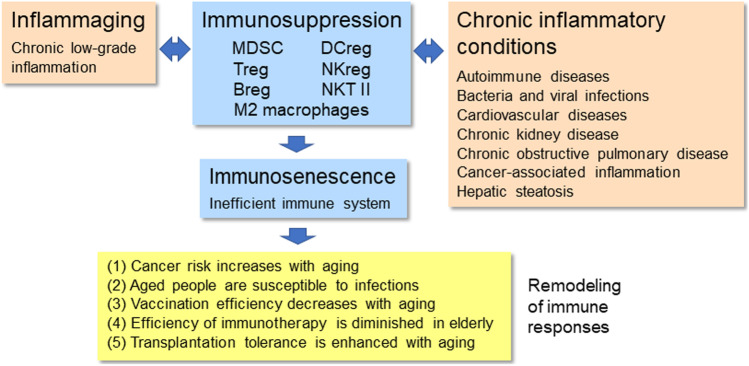
The aging process is associated with a remodeling of the immune system involving chronic low-grade inflammation and a gradual decline in the function of the immune system. These processes are also called inflammaging and immunosenescence. The age-related immune remodeling is associated with many clinical changes, e.g., risk for cancers and chronic infections increases, whereas the efficiency of vaccination and immunotherapy declines with aging. On the other hand, there is convincing evidence that chronic inflammatory states promote the premature aging process. The inflammation associated with aging or chronic inflammatory conditions stimulates a counteracting immunosuppression which protects tissues from excessive inflammatory injuries but promotes immunosenescence. Immunosuppression is a driving force in tumors and chronic infections and it also induces the tolerance to vaccination and immunotherapies. Immunosuppressive cells, e.g., myeloid-derived suppressor cells (MDSC), regulatory T cells (Treg), and type M2 macrophages, have a crucial role in tumorigenesis and chronic infections as well as in the tolerance to vaccination and immunotherapies. Interestingly, there is substantial evidence that inflammaging is also associated with an increased immunosuppressive activity, e.g., upregulation of immunosuppressive cells and anti-inflammatory cytokines. Given that both the aging and chronic inflammatory states involve the activation of immunosuppression and immunosenescence, this might explain why aging is a risk factor for tumorigenesis and chronic inflammatory states and conversely, chronic inflammatory insults promote the premature aging process in humans.
Overview
The claims and statistics of this paper haven’t been checked yet.
Free: it reads the open-access text and checks the first 5 claims that cite a source we can check. Create a free account to check every claim.
Integrity signals
Registry
Cites
Statistics
Figures
Verification
Claims the paper makes
The claims and statistics of this paper haven’t been checked yet.
Free: it reads the open-access text and checks the first 5 claims that cite a source we can check. Create a free account to check every claim.
Claims other papers make about this one
Each is checked against this paper’s own text: does it say what the citing paper says it does?
In the citing paper
“This is in part due to the age-driven accumulation of immunosuppressive cell types in the tumor microenvironment, as documented for MDSCs, type 2 macrophages (M2), and Tregs, 260”
From Meta-hallmarks of aging and cancer (2023) · cites this paper as [260]
Self-check
Percentages, sums and reported differences re-computed from the paper’s own numbers.
The self-check needs the paper’s full text.
Citations
Cites
Myeloid-derived-suppressor cells as regulators of the immune system
Gabrilovich, D. I., & Nagaraj, S. (2009) · Nature Reviews Immunology · doi:10.1038/nri2506 · Cited by 6,753 · cited 1×
“, spleen and lymph nodes, or directly into inflamed tissues [50, 51].”
BackgroundMANTOVANI, A., SOZZANI, S., LOCATI, M., ALLAVENA, P., & SICA, A. (2002) · Trends in Immunology · doi:10.1016/s1471-4906(02)02302-5 · Cited by 5,528
Inflamm‐aging: An Evolutionary Perspective on Immunosenescence
FRANCESCHI, C., BONAFÈ, M., VALENSIN, S., OLIVIERI, F., DE LUCA, M., OTTAVIANI, E., & DE BENEDICTIS, G. (2000) · Annals of the New York Academy of Sciences · doi:10.1111/j.1749-6632.2000.tb06651.x · Cited by 5,358 · cited 2×
“The aging process is associated with a remodeling of the immune system in humans and different animal species [1, 2].”
BackgroundThe senescence-associated secretory phenotype: the dark side of tumor suppression
Coppé, J.-P., Desprez, P.-Y., Krtolica, A., & Campisi, J. (2010) · Annual Review of Pathology: Mechanisms of Disease · doi:10.1146/annurev-pathol-121808-102144 · Cited by 5,206 · cited 6×
“The inflammatory state not only triggers the senescence of immune cells but it also elicits cellular senescence in non-immune cells which secrete pro-inflammatory mediators (SASP state), thus aggravating the inflammatory state in TME [140].”
BackgroundInfluentialChronic inflammation in the etiology of disease across the life span
Furman, D., Campisi, J., Verdin, E., Carrera-Bastos, P., Targ, S., Franceschi, C., Ferrucci, L., Gilroy, D. W., Fasano, A., Miller, G. W., et al. (2019) · Nature Medicine · doi:10.1038/s41591-019-0675-0 · Cited by 4,915 · cited 2×
“, cardiovascular diseases (CVD), COPD, CKD, hepatic steatosis, many cancers, autoimmune diseases, and neurodegenerative diseases [6].”
BackgroundInflammation and cancer: triggers, mechanisms, and consequences
Greten, F. R., & Grivennikov, S. I. (2019) · Immunity · doi:10.1016/j.immuni.2019.06.025 · Cited by 3,806
TGF-β: the master regulator of fibrosis
Meng, X.-M., Nikolic-Paterson, D. J., & Lan, H. Y. (2016) · Nature Reviews Nephrology · doi:10.1038/nrneph.2016.48 · Cited by 3,528
Vignali, D. A. A., Collison, L. W., & Workman, C. J. (2008) · Nature Reviews Immunology · doi:10.1038/nri2343 · Cited by 3,463
Ageing as a risk factor for neurodegenerative disease
Hou, Y., Dan, X., Babbar, M., Wei, Y., Hasselbalch, S. G., Croteau, D. L., & Bohr, V. A. (2019) · Nature Reviews Neurology · doi:10.1038/s41582-019-0244-7 · Cited by 3,310 · cited 1×
“For instance, chronic inflammation prevails in cardiovascular diseases [7], chronic kidney diseases [8], and neurodegenerative diseases [9].”
BackgroundDNA methylation-based biomarkers and the epigenetic clock theory of ageing
Horvath, S., & Raj, K. (2018) · Nature Reviews Genetics · doi:10.1038/s41576-018-0004-3 · Cited by 3,095 · cited 1×
“The epigenetic clock based on DNA methylation has been used to evaluate the biological aging process [19].”
Method
Cited by
Meta-hallmarks of aging and cancer
López-Otín, C., Pietrocola, F., Roiz-Valle, D., Galluzzi, L., & Kroemer, G. (2023) · Cell Metabolism · doi:10.1016/j.cmet.2022.11.001 · Cited by 529
Progress and prospects of mRNA-based drugs in pre-clinical and clinical applications
Shi, Y., Shi, M., Wang, Y., & You, J. (2024) · Signal Transduction and Targeted Therapy · doi:10.1038/s41392-024-02002-z · Cited by 206
Pacinella, G., Ciaccio, A. M., & Tuttolomondo, A. (2022) · International Journal of Molecular Sciences · doi:10.3390/ijms232415722 · Cited by 202
“Additionally, some authors documented that improving the autophagic capacity by pharmacological stimuli may prevent agerelated disease and extend lifespan [24].”
BackgroundNAD metabolism: Role in senescence regulation and aging
Chini, C. C. S., Cordeiro, H. S., Tran, N. L. K., & Chini, E. N. (2023) · Aging Cell · doi:10.1111/acel.13920 · Cited by 168
“In addition, through their SASP, they can attract immunosuppressive and proinflammatory cells to tissues, contributing to age-related tissue dysfunction (Salminen, 2022a).”
BackgroundLiu, Y., Lomeli, I., & Kron, S. J. (2024) · Cells · doi:10.3390/cells13151281 · Cited by 77
“Cellular senescence has been implicated in dampening immune responses (Figure 3 and Table 3) [300,301].”
BackgroundHematopoietic Stem Cells and the Immune System in Development and Aging
Shevyrev, D., Tereshchenko, V., Berezina, T. N., & Александрович, Р. С. (2023) · International Journal of Molecular Sciences · doi:10.3390/ijms24065862 · Cited by 66
Salminen, A. (2024) · Journal of Molecular Medicine · doi:10.1007/s00109-024-02444-6 · Cited by 69
“There is abundant evidence that the aging process is associated with the activation of an immunosuppressive network [10, 57].”
BackgroundSelf-citationZhang, Z., Tan, R., Xiong, Z., Feng, Y., & Chen, L. (2025) · Frontiers in Pharmacology · doi:10.3389/fphar.2025.1562845 · Cited by 46
“Chronic low-grade in fl ammation, often termed in fl ammaging, is a hallmark of both chronological aging and photoaging (Salminen, 2022; Salminen et al., 2022).”
The immune and metabolic milieu of the choroid plexus as a potential target in brain protection
Tsitsou-Kampeli, A., Suzzi, S., & Schwartz, M. (2024) · Trends in Neurosciences · doi:10.1016/j.tins.2024.05.010 · Cited by 39
Zhu, W., Liu, Q., Zhang, Z., Wang, Y., Mei, J., Xu, D., Zhou, J. Y., Su, Z., Zhang, X., Zhu, C., et al. (2024) · Small Structures · doi:10.1002/sstr.202400014 · Cited by 34
Salminen, A. (2024) · Biogerontology · doi:10.1007/s10522-024-10114-w · Cited by 29
“Moreover, there is abundant evidence that aged tissues contain an increased number of immunosuppressive cells, such as MDSCs, Tregs, and M2 macrophages (Grizzle et al. 2007; Enioutina et al. 2011; Garg et al. 2014; Ruhland et al. 2016; Salminen 2020, 2022).”
BackgroundSelf-citationThe role and impact of viruses on cancer development
Rengifo, A. C., Amaya, S., Rodríguez‐Medina, C., & Botero, J. E. (2024) · Periodontology 2000 · doi:10.1111/prd.12566 · Cited by 29
Targeting immunosenescence for improved tumor immunotherapy
Liu, Z., Zuo, L., Zhou, Z., Liu, S., Ba, Y., Zuo, A., Ren, Y., Zhang, C., Chen, Y., Ma, H., et al. (2024) · MedComm · doi:10.1002/mco2.777 · Cited by 29
“84 Inflammatory mediators facilitate myelopoiesis and induce immature myeloid-derived suppressor cells (MDSCs) generation that scale up immunosuppressive network.”
BackgroundThe role of immunosuppressive myofibroblasts in the aging process and age-related diseases
Salminen, A. (2023) · Journal of Molecular Medicine · doi:10.1007/s00109-023-02360-1 · Cited by 29
“Common immune hallmarks of the aging process are chronic low-grade inflammation, increased immunosuppression, and a decline in the functional efficiency of the immune system [8, 10, 168–171].”
Self-citationTreatment of type 2 diabetes mellitus in the elderly – Special considerations
Gadó, K., Tabák, Á. G., Vingender, I., Domján, G., & Dörnyei, G. (2024) · Physiology International · doi:10.1556/2060.2024.00317 · Cited by 27
Advocating for the recognition of underlying immunosuppression in critical illness
Martín‐Loeches, I., David, S., Pène, F., Kreitmann, L., Russell, L., Puxty, K. A., Silva, J. S., Mata, A. V., Creagh-Brown, B. C., Castro, P., et al. (2025) · EClinicalMedicine · doi:10.1016/j.eclinm.2025.103300 · Cited by 24
The emerging importance of lymphangiogenesis in aging and aging-associated diseases
Ji, R. (2024) · Mechanisms of Ageing and Development · doi:10.1016/j.mad.2024.111975 · Cited by 22
“In animal models and humans, the decline of lymphatic clearance and draining function during aging is usually accompanied by decreased lymphatic density and transport capacity of collecting lymphatic vessels (Karaman et al., 2015; Jakic et al., 2020; Zhou et al., 2020).”
BackgroundChaumont, A., Martin, A. L., Flamaing, J., Wiseman, D., Vandermeulen, C., Jongert, E., Doherty, T. M., Buchy, P., Varga, S. M., & Warter, L. (2025) · Expert Review of Clinical Immunology · doi:10.1080/1744666x.2025.2494658 · Cited by 17
“Inflammaging is envisaged to be an adaptive process that counters age-related proinflammatory changes [151] and may lead to immunose-nescence [152].”
Kirchner, V. A., Badshah, J. S., Hong, S. K., Martinez, O. M., Pruett, T. L., & Niedernhofer, L. J. (2023) · Transplantation · doi:10.1097/tp.0000000000004838 · Cited by 16
Wang, G., Liu, Y., Liu, K., Jin, L., Yu, J., & Sun, Z. (2024) · Biomedical Signal Processing and Control · doi:10.1016/j.bspc.2024.106347 · Cited by 13
Li, Y., Wang, Y., Chen, B., Guo, J., & Zhang, D. (2023) · International Journal of Clinical Practice · doi:10.1155/2023/1688385 · Cited by 12
“Some scholars refer to this phenomenon as immune senescence [32, 33].”
BackgroundRebuilding and rebooting immunity with stem cells
Stankiewicz, L. N., Rossi, F. M. V., & Zandstra, P. W. (2024) · Cell stem cell · doi:10.1016/j.stem.2024.03.012 · Cited by 11
Animal models of alphavirus infection and human disease
Lucas, C. J., & Morrison, T. E. (2022) · Advances in virus research · doi:10.1016/bs.aivir.2022.07.001 · Cited by 9
Lu, G., Li, J., Ruan, Y., Shi, Y., Zhang, X., Xia, Y., Zhu, Z., Lin, J., & Li, L. (2022) · BMC Cancer · doi:10.1186/s12885-022-10333-9 · Cited by 9
“Organ aging accompanied by decreased immune function in elderly patients may be responsible for the increased risk of tumor recurrence [9, 10].”
BackgroundBrusaferri, L., Alshelh, Z., Schnieders, J. H., Sandström, A., Mohammadian, M., Morrissey, E. J., Kim, M., Chane, C. A., Grmek, G., Murphy, J. P., et al. (2023) · Brain Behavior and Immunity · doi:10.1016/j.bbi.2023.12.016 · Cited by 8
Xu, W., Ye, J., Cao, Z., Zhao, Y., Zhu, Y., & Li, L. (2024) · Heliyon · doi:10.1016/j.heliyon.2024.e32357 · Cited by 8
“…the bloodstream increase in quantity during inflammation and stress events [160], playing a crucial regulatory role in preventing excessive activation of inflammation and other potent defense responses, which, if left uncontrolled, may lead to a state of dysregulation in the organism [161].”
BackgroundZhao, J., Guan, K., & Xing, J. (2023) · International Journal of Immunopathology and Pharmacology · doi:10.1177/03946320231172072 · Cited by 5
“12 Immunotherapies have shown great potential in tumor treatment, 13 and immunotherapeutic responses have a close association with patient prognosis in multiple cancers.”
BackgroundZhao, J., Li, C., Li, Q., Shen, S., Hu, X., Dong, Z., Zhang, Y., & Xing, J. (2023) · Analytical Cellular Pathology · doi:10.1155/2023/5735339 · Cited by 5
“The aging process is associated with low-grade inflammation [19].”
BackgroundZhang, L., Zhang, Q., Wu, Q., Zhao, L., Gao, Y., Li, X., Guan, S., & Meng, Y. (2024) · Scientific Reports · doi:10.1038/s41598-024-62533-x · Cited by 4
“…ratio (NLR), platelets-to-lymphocyte ratio (PLR) and lymphocyte-to-monocyte ratio (LMR), are significantly correlated with prognosis in patients with resectable lung cancer 18 , locally advanced colorectal cancer 19 , non-muscular invasive bladder cancer 20 and other cancers.”
BackgroundMycotic aneurysms as a rare cause of subarachnoid hemorrhage
Albrecht, C., Sanchin, A., Jörger, A.-K., Delbridge, C., Boeckh‐Behrens, T., Wantia, N., Wunderlich, S., Wessels, L., Vajkoczy, P., Meyer, B., et al. (2025) · Scientific Reports · doi:10.1038/s41598-025-20673-8 · Cited by 3
“In general, a global increase in the number of immunosuppressed patients is driven by medical advances and demographic changes 23,24 .”
Cancer-Associated Fibroblasts and Their Role in Cancer Progression
Lacina, L., Szabó, P., Klepáček, I., Kolář, M., & Smetana, K. (2022) · Interdisciplinary cancer research · doi:10.1007/16833_2022_79 · Cited by 3
Bueno, V. (2024) · Springer eBooks · doi:10.1007/978-3-031-55022-5_7 · Cited by 2
Pharmacological Properties and Phytochemical Profile of Sargassum filipendula Extracts
Jaiswal, V., & Lee, H. (2026) · Marine Drugs · doi:10.3390/md24050153 · Cited by 2
“An immunosuppressed condition may arise from several factors, including age, lifestyle choices, drug treatments, and malnutrition [67,68].”
Clearing the Air: Acute Invasive Fungal Rhinosinusitis in Hematologic Cancer Patients
Pak‐Harvey, E., Lubin, D. J., Chen, A. Y.-C., & Willingham, E. S. (2024) · The Laryngoscope · doi:10.1002/lary.31513 · Cited by 1
“17 It is possible that this difference in age could stem from older AHUs providing poorer air fl ow and thus leading to AIFRS infection at an earlier age.”
Jia, J., Guo, J. P., Yan, C., Gu, Y., & Xia, X. (2025) · Food & Function · doi:10.1039/d4fo06068g · Cited by 1
Aboelkhir, H. A. B., Alaoui, Y. E., Padmanabhan, R., Hadid, M., Elomri, A., Alam, T., Rejeb, M. A., Omri, H. E., Taha, R. Y., Elsabah, H., et al. (2025) · Cancer Control · doi:10.1177/10732748241275026 · Cited by 1
Meeraus, W. H., Carty, L., Dube, S., Evans, K., Evans, R. A., Goios, A., Justo, N., Lu, Y., Quint, J. K., Taylor, S., et al. (2026) · Infectious Diseases and Therapy · doi:10.1007/s40121-026-01332-5 · Cited by 1
“In addition to a natural decline in immune function with advancing age, medical conditions leading to reduced immune function or requiring use of immunosuppressive medication (such as cancer and organ transplants) are more common in older age groups [27, 28].”
Chaumont, A., Gould, H., Flamaing, J., Wiseman, D., Vandermeulen, C., Jongert, E., Doherty, T. M., Buchy, P., & Warter, L. (2026) · Expert Review of Clinical Immunology · doi:10.1080/1744666x.2026.2672499 · Cited by 1
“Thus, inflammaging is thought to be closely associated with the development of immunosenescence [18].”
Ling, T., Basic, D., Tcharkhedian, E., Campisi, J., Pringle, B., & Khoo, A. (2024) · Australian Journal on Ageing · doi:10.1111/ajag.13356 · Cited by 1
Guo, S., Zhang, Y., Wang, Y., Guo, T., Zhu, J., Chang, L., Ling, W., Westover, K. D., Zhou, Z., & Wei, X. (2025) · Chemical Engineering Journal · doi:10.1016/j.cej.2025.159277 · Cited by 1
Immunobiography and women's health: repercussions from conception to senility
Lira, G. V. D. A. G., Barros, M. T., Andrade, M. E. B., Sarinho, F. W., Fernandes, F. R., Kuschnir, F. C., & SARINHO, E. S. C. (2023) · Revista da Associação Médica Brasileira · doi:10.1590/1806-9282.2023s104
Тkachuk, S. S., Ткачук, О. В., Denysenko, O. I., & Sorokhan, V. D. (2024) · Clinical & experimental pathology · doi:10.24061/1727-4338.xxii.4.86.2023.05
Pulmonary-Renal Syndrome in the Elderly: Immunosuppressive Treatment – Case Report
Żerek, M., Sitarek, G., Płonka, W., Chruścicki, D., Bednarczyk, P., & Pelc, M. (2024) · Quality in Sport · doi:10.12775/qs.2024.24.54674
Lu, G., Li, J., Ruan, Y., Shi, Y., Zhang, X., Xia, Y., Zhu, Z., Lin, J., & Li, L. (2023) · Figshare · doi:10.6084/m9.figshare.22604761
Lu, G., Li, J., Ruan, Y., Shi, Y., Zhang, X., Xia, Y., Zhu, Z., Lin, J., & Li, L. (2023) · Figshare · doi:10.6084/m9.figshare.22604773
Lu, G., Li, J., Ruan, Y., Shi, Y., Zhang, X., Xia, Y., Zhu, Z., Lin, J., & Li, L. (2023) · Figshare · doi:10.6084/m9.figshare.22604776
Lu, G., Li, J., Ruan, Y., Shi, Y., Zhang, X., Xia, Y., Zhu, Z., Lin, J., & Li, L. (2023) · Figshare · doi:10.6084/m9.figshare.22604764
Lu, G., Li, J., Ruan, Y., Shi, Y., Zhang, X., Xia, Y., Zhu, Z., Lin, J., & Li, L. (2023) · Figshare · doi:10.6084/m9.figshare.22604770
Stankiewicz, L. N. (2024) · cIRcle (University of British Columbia) · doi:10.14288/1.0447445
Lu, G., Li, J., Ruan, Y., Shi, Y., Zhang, X., Xia, Y., Zhu, Z., Lin, J., & Li, L. (2023) · Figshare · doi:10.6084/m9.figshare.22604767
Lu, G., Li, J., Ruan, Y., Shi, Y., Zhang, X., Xia, Y., Zhu, Z., Lin, J., & Li, L. (2023) · Figshare · doi:10.6084/m9.figshare.22604779
Sabrina, A. H. N. (2023) · Repository at Universitas Pendidikan Indonesia (Universitas Pendidikan Indonesia)
Tarle, M., Raguž, M., Hat, K., Čvrljević, I., Salarić, I., & Lukšić, I. (2026) · Journal of Clinical Medicine · doi:10.3390/jcm15041563
Gliwiński, M., Koliński, T., Urban‐Wójciuk, Z., Zieliński, M., Piekarska, K., Fraściszewska, M., ŻYŁKO, A., Pęksa, R., Karczewska, J., Peszyńska-Sularz, G., et al. (2026) · Scientific Reports · doi:10.1038/s41598-026-40323-x
Enikeev, D. A., Degtyaryova, E. A., Gergaia, A. T., Dolnikova, M. V., Teterina, V. A., Ismailov, A. I., Atoyan, M. A., Shevchenko, A. A., Nerukh, A. S., Sudakova, E. A., et al. (2026) · Russian Journal of Oncology · doi:10.17816/onco706031
Rewiring mTOR signaling in Alzheimer’s disease: emerging mTOR modulators beyond oncology
Lohnes, B. J., Myšková, A., Tyagi, A., Hartwig, U. F., & Poddar, N. K. (2026) · Bioscience Reports · doi:10.1042/bsr20260203
Fang, W., Wang, Y., Yang, Z., Zheng, H., Wu, Y., Chen, R., Wang, R., Tang, H., Tang, M., & Ye, X. (2026) · Frontiers in Immunology · doi:10.3389/fimmu.2026.1785073
“At the same time, the proportion of regulatory T cells increases and myeloid-derived suppressor cells accumulate, contributing to a more immunosuppressive internal environment (83).”
Lymphatic vascular aging and age-related bone loss: current status and future perspectives
Chudhary, M., Zhang, S., Docshin, P. M., Liu, J., Aripova, T., Zhou, J., Li, J., Malashicheva, A., & Liu, J. (2026) · Frontiers in Immunology · doi:10.3389/fimmu.2026.1900206
“In addition, VEGF-C/VEGFR-3 downregulation in aged lymphatics reduces immune cell traf fi cking by approximately 40-60%, thereby disrupting tissue homeostasis and impairing in fl am-matory resolution (34, 35).”
Deng, Z., Dong, Y., Zhou, J., Liu, K., & Liu, M. (2026) · Frontiers in Endocrinology · doi:10.3389/fendo.2026.1985010
Metadata
- Authors
- Salminen, A.
- Affiliations
- University of Eastern Finland (FI)
- Corresponding author
- Salminen, Antero
- ORCID
- Salminen, Antero
- Venue
- Journal of Molecular Medicine
- Published
- 2022-04-06
- Volume
- 100
- Issue
- 5
- Pages
- 697-712
- ISSN
- 0946-2716 (ISSN-L)
- 1432-1440
- PMC
- PMC8985067
- OpenAlex
- W4225766275
- Cited by
- 57
- References
- 207
- Citations by year
- 2026: 9 · 2025: 7 · 2024: 19 · 2023: 18 · 2022: 4
- FWCI
- 1.26
- Type
- journal article
- Language
- en
- Open access
- hybrid
- doi.org
- Licence
- cc-by
- creativecommons.org/licenses/by/4.0 (tdm)
- creativecommons.org/licenses/by/4.0 (vor)
- Locations
- Journal of Molecular Medicine (publishedVersion, cc-by)
- PubMed Central (publishedVersion, cc-by)
- PubMed (publishedVersion)
- Funders
- N/A
- University of Eastern Finland (UEF) including Kuopio University Hospital
- Topics
- Life Sciences › Immunology and Microbiology › Immunology › Immune cells in cancer
- Life Sciences › Immunology and Microbiology › Immunology › T-cell and B-cell Immunology
- Life Sciences › Biochemistry, Genetics and Molecular Biology › Aging › Genetics, Aging, and Longevity in Model Organisms
- Keywords
- inflammaging, immunosenescence, immunosuppression, aging, chronic inflammation, myeloid-derived suppressor cells, regulatory T cells, M2 macrophages, anti-inflammatory cytokines, vaccine tolerance, carcinogenesis, chronic infection, premature aging
- MeSH terms
- Immunosenescence, Aging, Humans, Immunosuppressive Agents, Inflammation, Neoplasms, Aging, Premature, Carcinogenesis
About these checks
Registry, retraction, Cites and statistics results are computed, not judged, with one exception: a printed reference that no index lists is read once by a model before it counts as a citation error. Claims are extracted by a model and kept only when their quote appears verbatim in the text; each cited source is then checked, with a model’s help, for whether it says what the claim relies on. Those verdicts can be wrong — read the claim’s quote and the cited source before relying on one.
Statistics and arithmetic are recomputed, not judged.
Confidence bands are shown only for fields calibrated on our annotated test set. None is calibrated yet, so no band is shown.
What counts as a claim ›How we measure confidence ›How we check this ›
Are you an author, or do you see a problem with this page? Request a review
Data sources
Bibliographic data: Semantic Scholar, OpenAlex, Crossref.
Contains information from the Semantic Scholar Academic Graph Datasets, made available under the ODC Attribution License (ODC-BY 1.0).
Semantic Scholar’s data is described in: Kinney, R., et al. (2023). The Semantic Scholar Open Data Platform. arXiv:2301.10140.
