

Insulin promoter DNA methylation correlates negatively with insulin gene expression and positively with HbA1c levels in human pancreatic islets
Open accessThe DOI matches its Crossref record; 20 of the 20 references it cites were found in a registry or an index.
Abstract
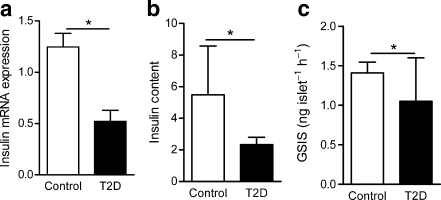
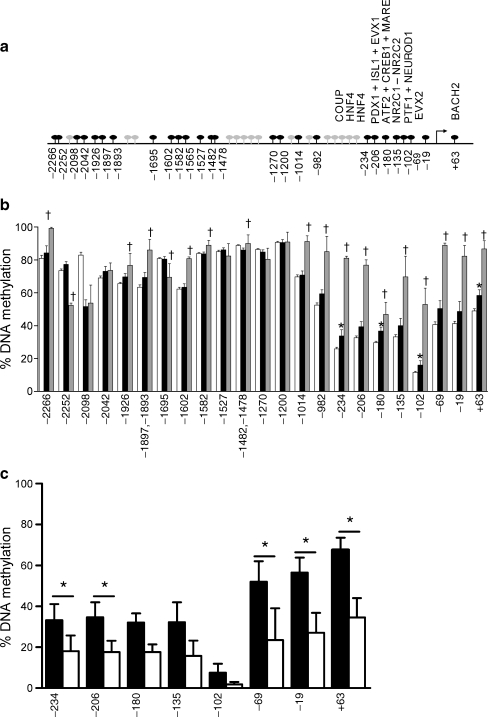
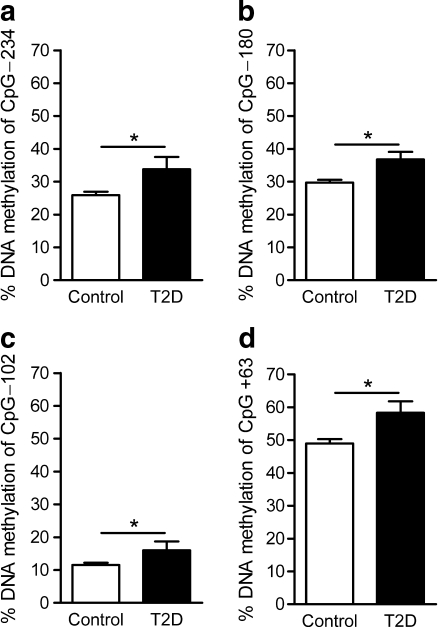
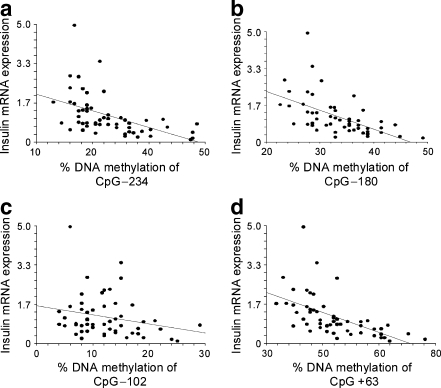
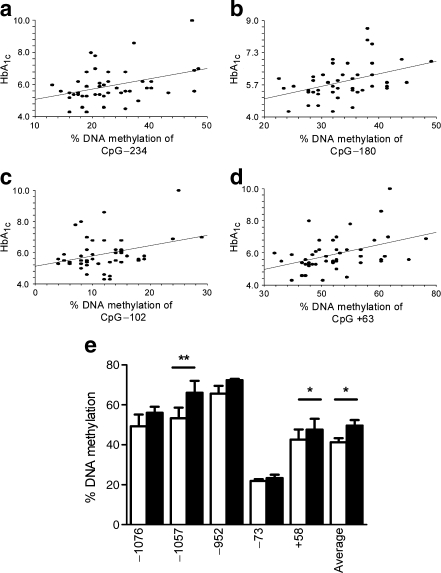
AIMS/HYPOTHESIS: Although recent studies propose that epigenetic factors influence insulin expression, the regulation of the insulin gene in type 2 diabetic islets is still not fully understood. Here, we examined DNA methylation of the insulin gene promoter in pancreatic islets from patients with type 2 diabetes and non-diabetic human donors and related it to insulin expression, HbA(1c) levels, BMI and age. METHODS: DNA methylation was analysed in 25 CpG sites of the insulin promoter and insulin mRNA expression was analysed using quantitative RT-PCR in pancreatic islets from nine donors with type 2 diabetes and 48 non-diabetic donors. RESULTS: Insulin mRNA expression (p = 0.002), insulin content (p = 0.004) and glucose-stimulated insulin secretion (p = 0.04) were reduced in pancreatic islets from patients with type 2 diabetes compared with non-diabetic donors. Moreover, four CpG sites located 234 bp, 180 and 102 bp upstream and 63 bp downstream of the transcription start site (CpG -234, -180, -102 and +63, respectively), showed increased DNA methylation in type 2 diabetic compared with non-diabetic islets (7.8%, p = 0.03; 7.1%, p = 0.02; 4.4%, p = 0.03 and 9.3%, p = 0.03, respectively). While insulin mRNA expression correlated negatively (p < 1 × 10(-6)), the level of HbA(1c) correlated positively (p ≤ 0.01) with the degree of DNA methylation for CpG -234, -180 and +63. Furthermore, DNA methylation for nine additional CpG sites correlated negatively with insulin mRNA expression (p ≤ 0.01). Also, exposure to hyperglycaemia for 72 h increased insulin promoter DNA methylation in clonal rat beta cells (p = 0.005). CONCLUSIONS/INTERPRETATIONS: This study demonstrates that DNA methylation of the insulin promoter is increased in patients with type 2 diabetes and correlates negatively with insulin gene expression in human pancreatic islets.
Overview
The claims and statistics of this paper haven’t been checked yet.
Free: it reads the open-access text and checks the first 5 claims that cite a source we can check. Create a free account to check every claim.
Integrity signals
Registry
Cites
Statistics
Figures
Verification
Claims the paper makes
The claims and statistics of this paper haven’t been checked yet.
Free: it reads the open-access text and checks the first 5 claims that cite a source we can check. Create a free account to check every claim.
Claims other papers make about this one
Each is checked against this paper’s own text: does it say what the citing paper says it does?
The cited source says what the claim attributes to it.
In the citing paper
“further suggest that hyperglycemia alters DNA methylation of PDX1 and INS ( 22 – 25 ).”
From β-Cell Failure in Type 2 Diabetes: Postulated Mechanisms and Prospects for Prevention and Treatment (2014) · cites this paper as [23]
Self-check
Percentages, sums and reported differences re-computed from the paper’s own numbers.
The self-check needs the paper’s full text.
Citations
Cites
A genome-wide association study identifies novel risk loci for type 2 diabetes
Sladek, R., Rocheleau, G., Rung, J., Dina, C., Shen, L., Serre, D., Boutin, P., Vincent, D., Belisle, A., Hadjadj, S., et al. (2007) · Nature · doi:10.1038/nature05616 · Cited by 2,993 · cited 1×
“Type 2 diabetes is a polygenic disease and it is possible that the effects of DNA methylation on type 2 diabetes are similar to those seen in genetic studies, where multiple loci with small effect sizes together contribute to an increased risk for disease [13–16].”
BackgroundGenome-wide association analysis identifies loci for type 2 diabetes and triglyceride levels
Saxena, R., Voight, B. F., Lyssenko, V., Burtt, N. P., de Bakker, P. I. W., Chen, H., Roix, J. J., Kathiresan, S., Hirschhorn, J. N., Daly, M. J., et al. (2007) · Science · doi:10.1126/science.1142358 · Cited by 2,843 · cited 1×
“Type 2 diabetes is a polygenic disease and it is possible that the effects of DNA methylation on type 2 diabetes are similar to those seen in genetic studies, where multiple loci with small effect sizes together contribute to an increased risk for disease [13–16].”
BackgroundSelf-citationA genome-wide association study of type 2 diabetes in Finns detects multiple susceptibility variants
Scott, L. J., Mohlke, K. L., Bonnycastle, L. L., Willer, C. J., Li, Y., Duren, W. L., Erdos, M. R., Stringham, H. M., Chines, P. S., Jackson, A. U., et al. (2007) · Science · doi:10.1126/science.1142382 · Cited by 2,753
Replication of Genome-Wide Association Signals in UK Samples Reveals Risk Loci for Type 2 Diabetes
Zeggini, E., Weedon, M. N., Lindgren, C. M., Frayling, T. M., Elliott, K. S., Lango, H., Timpson, N. J., Perry, J. R. B., Rayner, N. W., Freathy, R. M., et al. (2007) · Science · doi:10.1126/science.1142364 · Cited by 2,194 · cited 1×
“Type 2 diabetes is a polygenic disease and it is possible that the effects of DNA methylation on type 2 diabetes are similar to those seen in genetic studies, where multiple loci with small effect sizes together contribute to an increased risk for disease [13–16].”
BackgroundEl-Osta, A., Brasacchio, D., Yao, D., Pocai, A., Jones, P. L., Roeder, R. G., Cooper, M. E., & Brownlee, M. (2008) · The Journal of Experimental Medicine · doi:10.1084/jem.20081188 · Cited by 1,115 · cited 1×
“Recent studies have demonstrated that hyperglycaemia may induce epigenetic changes and thereby increase expression of pro-inflammatory genes in vascular cells, which subsequently may increase the risk for diabetic complications [17–20].”
BackgroundEpigenetics: a molecular link between environmental factors and type 2 diabetes
Ling, C., & Groop, L. (2009) · Diabetes · doi:10.2337/db09-1003 · Cited by 617
Self-citationNon-CpG methylation of the PGC-1α promoter through DNMT3B controls mitochondrial density.
Barrès, R., Osler, M. E., Yan, J., Rune, A., Fritz, T., Caidahl, K., Krook, A., & Zierath, J. R. (2009) · Cell Metabolism · doi:10.1016/j.cmet.2009.07.011 · Cited by 602 · cited 2×
“Recent studies suggest that epigenetic factors, including DNA methylation and histone modifications, may influence the pathogenesis of type 2 diabetes [1–4].”
BackgroundResultBrasacchio, D., Okabe, J., Tikellis, C., Balcerczyk, A., George, P., Baker, E. K., Calkin, A. C., Brownlee, M., Cooper, M. E., & El-Osta, A. (2009) · Diabetes · doi:10.2337/db08-1666 · Cited by 534 · cited 1×
“Recent studies have demonstrated that hyperglycaemia may induce epigenetic changes and thereby increase expression of pro-inflammatory genes in vascular cells, which subsequently may increase the risk for diabetic complications [17–20].”
BackgroundEpigenetic regulation of PPARGC1A in human type 2 diabetic islets and effect on insulin secretion
Ling, C., Del Guerra, S., Lupi, R., Rönn, T., Granhall, C., Luthman, H., Masiello, P., Marchetti, P., Groop, L., & Del Prato, S. (2008) · Diabetologia · doi:10.1007/s00125-007-0916-5 · Cited by 495 · cited 3×
“Our study suggests that DNA methylation can regulate gene expression in pancreatic islets from patients with type 2 diabetes and subsequently contribute to impaired insulin secretion [5].”
BackgroundResultSelf-citationMiao, F., Gonzalo, I. G., Lanting, L., & Natarajan, R. (2004) · Journal of Biological Chemistry · doi:10.1074/jbc.m311786200 · Cited by 374 · cited 1×
“Recent studies have demonstrated that hyperglycaemia may induce epigenetic changes and thereby increase expression of pro-inflammatory genes in vascular cells, which subsequently may increase the risk for diabetic complications [17–20].”
Background
Cited by
Items 101–200 of 261
Chen, X., Lin, Q., Wen, J., Lin, W., Liang, J., Huang, H., Li, L., Huang, J., Chen, F., Liu, D., et al. (2020) · Journal of Diabetes Investigation · doi:10.1111/jdi.13201 · Cited by 36
Nilsson, E., Ernst, B., Voisin, S. A. C., Almén, M. S., Benedict, C., Mwinyi, J., Fredriksson, R., Schultes, B., & Schiöth, H. B. (2015) · PLoS ONE · doi:10.1371/journal.pone.0115186 · Cited by 35
“Interestingly, variations of body weight and plasma glucose concentrations have previously been associated with fluctuations in DNA methylation in humans, including promoter sites [5].”
Metabolic memory and diabetic nephropathy: Beneficial effects of natural epigenetic modifiers
Kushwaha, K., Sharma, S., & Gupta, J. (2020) · Biochimie · doi:10.1016/j.biochi.2020.01.007 · Cited by 36
Votsi, C., Toufexis, C., Michailidou, K., Antoniades, A., Skordis, N., Karaolis, M., Pattichis, C. S., & Christodoulou, K. (2017) · Genes · doi:10.3390/genes8010016 · Cited by 32
New insights from monogenic diabetes for “common” type 2 diabetes
Tallapragada, D. S. P., Bhaskar, S., & Chandak, G. R. (2015) · Frontiers in Genetics · doi:10.3389/fgene.2015.00251 · Cited by 35
“…differential methylation has been observed in common loci like PPARG and IRS1 in adipose tissue from unrelated T2D patients compared with control individuals and expression of PDX1 and INS was decreased in pancreatic islets from diabetics compared to non-diabetic donors (Yang et al., 2011, 2012).”
ResultLocation, location, location: Beneficial effects of autologous fat transplantation
Satoor, S. N., Puranik, A. S., Kumar, S., Williams, M. D., Ghale, M., Rahalkar, A. M., Karandikar, M. S., Shouche, Y. S., Patole, M. S., Bhonde, R. R., et al. (2011) · Scientific Reports · doi:10.1038/srep00081 · Cited by 32
Developmental origins of diabetes mellitus: Environmental epigenomics and emerging patterns
Zhu, H., Ding, G., Liu, X., & Huang, H. (2023) · Journal of Diabetes · doi:10.1111/1753-0407.13403 · Cited by 28
Shen, J., & Zhu, B. (2018) · Molecular Medicine Reports · doi:10.3892/mmr.2018.8804 · Cited by 30
Xi, Z., Fang, L., Xu, J., Li, B., Zuo, Z., Lv, L., & Wang, C. (2019) · Environmental Pollution · doi:10.1016/j.envpol.2019.03.101 · Cited by 26
Slieker, R. C., van der Heijden, A. A. W. A., van Leeuwen, N., Mei, H., Nijpels, G., Beulens, J. W. J., & Hart, L. M. ‘. (2017) · Diabetologia · doi:10.1007/s00125-017-4467-0 · Cited by 29
“For example, DNA methylation near known type 2 diabetes loci (for example, KLF14, ZNF518B, INS) is associated with measures of glucose homeostasis (HbA1c, 2 h insulin) in healthy individuals [6, 7].”
BackgroundOdimegwu, C. L., Uwaezuoke, S. N., Chikani, U. N., Mbanefo, N. R., Adiele, K., Nwolisa, C. E., Eneh, C. I., Ndiokwelu, C. O., Okpala, S. C., Ogbuka, F. N., et al. (2024) · Diabetes Metabolic Syndrome and Obesity · doi:10.2147/dmso.s479077 · Cited by 26
NT5C2 methylation regulatory interplay between DNMT1 and insulin receptor in type 2 diabetes
Chen, Y., Lin, W., Liao, W., Tsai, Y., Liao, J., & Tsai, F. (2020) · Scientific Reports · doi:10.1038/s41598-020-71336-9 · Cited by 24
Cai, W.-J., Liang, X., Yuan, X., Li, A., & He, S. (2020) · Frontiers in Endocrinology · doi:10.3389/fendo.2020.00398 · Cited by 27
Dynamic Ins2 Gene Activity Defines β-Cell Maturity States
Chu, C. M. J., Modi, H., Ellis, C. E., Krentz, N. A. J., Skovsø, S., Zhao, Y., Cen, H. H., Noursadeghi, N., Panzhinskiy, E., Hu, X., et al. (2022) · Diabetes · doi:10.2337/db21-1065 · Cited by 23
A systems view of epigenetic networks regulating pancreas development and β‐cell function
Xie, R., Carrano, A. C., & Sander, M. (2015) · WIREs Systems Biology and Medicine · doi:10.1002/wsbm.1287 · Cited by 27
Sala, P., Torrinhas, R. S., Fonseca, D. C., Ravacci, G. R., Waitzberg, D. L., & Giannella‐Neto, D. (2017) · Diabetology & Metabolic Syndrome · doi:10.1186/s13098-017-0214-4 · Cited by 23
Deng, X., Yang, Y., Sun, H. X., Qi, W., Duan, Y., & Qian, Y. (2018) · Journal of the Chinese Medical Association · doi:10.1016/j.jcma.2017.06.027 · Cited by 23
DNA methylation profiling reveals novel pathway implicated in cardiovascular diseases of diabetes
Hu, S., Chen, L., Zeng, T., Wang, W., Yan, Y., Qiu, K., Xie, Y., & Liao, Y. (2023) · Frontiers in Endocrinology · doi:10.3389/fendo.2023.1108126 · Cited by 23
“Similarly, the relationship between CpG methylation pattern of the proximal insulin gene promoter and diabetes had been reported (35, 36).”
BackgroundEpigenetics of Insulin Resistance: An Emerging Field in Translational Medicine
Sookoian, S., & Pirola, C. J. (2013) · Current Diabetes Reports · doi:10.1007/s11892-012-0361-9 · Cited by 21
The dynamic methylome of islets in health and disease
Avrahami, D., & Kaestner, K. H. (2019) · Molecular Metabolism · doi:10.1016/j.molmet.2019.06.007 · Cited by 20
Early postnatal overnutrition accelerates aging-associated epigenetic drift in pancreatic islets
Li, G., Petkova, T. D., Laritsky, E., Kessler, N. J., Baker, M. S., Zhu, S., & Waterland, R. A. (2019) · Environmental Epigenetics · doi:10.1093/eep/dvz015 · Cited by 20
Zhang, J., Wang, C., Ha, X., Li, W., Xu, P., Gu, Y., Wang, T., Wang, Y., & Xie, J. (2016) · Journal of Diabetes · doi:10.1111/1753-0407.12478 · Cited by 18
“(INS) gene is known to modulate INS gene expression.(16) In the present study, the DNA methylation-positive rate of the ADIPOQ gene promoter region increased gradually across the NC, Ob, and T2DM groups (P< 0.”
BackgroundGlucokinase Gene May Be a More Suitable Target Than the Insulin Gene for Detection of β Cell Death
Sklenarova, J., Petruželková, L., Koloušková, S., Lebl, J., Šumník, Z., & Cinek, O. (2017) · Endocrinology · doi:10.1210/en.2016-1923 · Cited by 18
Martínez‐Ramírez, O. C., Salazar-Piña, D. A., Cerón-Ramírez, X., Rubio-Lightbourn, J., Torres-Romero, F., Casas-Ávila, L., & Hernández, C. C. (2022) · Nutrients · doi:10.3390/nu14235195 · Cited by 19
“Insulin (INS) is the main product synthesized by pancreatic β-cells [14], and a relationship has been found between the methylation of the INS gene promoter and the regulation of INS gene expression in both pancreatic islets and β-cells [15,16].”
BackgroundResultEpigenetic modifications and diabetic nephropathy
Reddy, M. A., Park, J. T., & Natarajan, R. D. (2012) · Kidney Research and Clinical Practice · doi:10.1016/j.krcp.2012.07.004 · Cited by 17
“Epigenetics 6:405–409, 2011 [90] Yang BT, Dayeh TA, Kirkpatrick CL, Taneera J, Kumar R, Groop L, Wollheim CB, Nitert MD, Ling C: Insulin promoter DNA methylation correlates negatively with insulin gene expression and positively with HbA(1c) levels in human pancreatic islets.”
BackgroundCurrent Understanding of DNA Methylation and Age-related Disease
Aquino, E. M., Benton, M. C., Haupt, L. M., Sutherland, H. G. E., Griffiths, L. R., & Lea, R. A. (2018) · OBM Genetics · doi:10.21926/obm.genet.1802016 · Cited by 18
PIWI-Interacting RNA (piRNA) and Epigenetic Editing in Environmental Health Sciences
Perera, B. P. U., Morgan, R. K., Polemi, K. M., Sala-Hamrick, K. E., Svoboda, L. K., & Dolinoy, D. C. (2022) · Current Environmental Health Reports · doi:10.1007/s40572-022-00372-6 · Cited by 19
DNA methylation signatures of youth-onset type 2 diabetes and exposure to maternal diabetes
Salama, O. E., Hizon, N. A., VECCHIO, M. D., Kolsun, K. P., Fonseca, M. A., Lin, D. T. S., Urtatiz, O., MacIsaac, J. L., Kobor, M. S., Sellers, E. A. C., et al. (2024) · Clinical Epigenetics · doi:10.1186/s13148-024-01675-1 · Cited by 16
“We acknowledge that blood-based DNAm may not always directly reflect DNAm methylation in other cell and tissue systems such as the β -cell [51].”
BackgroundDiané, A., Mu-u-min, R., & Al-Siddiqi, H. (2025) · Cell and Tissue Research · doi:10.1007/s00441-025-03952-8 · Cited by 17
Personalized Epigenetic Management of Diabetes
Fodor, A., Cozma, A., & Karnieli, E. (2015) · Personalized Medicine · doi:10.2217/pme.15.17 · Cited by 16
Tomiga, Y., Ito, A., Sudo, M., Ando, S., Eshima, H., Sakai, K., Nakashima, S., Uehara, Y., Tanaka, H., Soejima, H., et al. (2019) · The Journal of Physiology · doi:10.1113/jp277019 · Cited by 16
“Previous studies have reported that various environmental factors, such as acute, long and short periods of exercise, physical inactivity, and type 2 diabetes, modulate promotor DNA methylation patterns in skeletal muscle (Alibegovic et al. 2010; Nakajima et al. 2010; Yang et al. 2011; Barrès et al. 2012; Nitert et al…”
BackgroundXu, F., Liu, J., Na, L., & Chen, L. (2020) · Frontiers in Cell and Developmental Biology · doi:10.3389/fcell.2020.00748 · Cited by 16
RetractedHarvey, K. E., LaVigne, E. K., Dar, M. S., Salyer, A. E., Pratt, E. P. S., Sample, P. A., Aryal, U. K., Gowher, H., & Hockerman, G. H. (2022) · Scientific Reports · doi:10.1038/s41598-022-11276-8 · Cited by 15
Epigenetic Mechanisms in the Transfer of Metabolic Disorders: A Comprehensive Review
Swathi, N. L., Shakhatreh, Z., Tahir, A., Singh, J., Sulaiman, S. A., Athul, H., Sadhankar, A., Patel, P., Patel, R., & Nashwan, A. J. (2025) · Cureus · doi:10.7759/cureus.80418 · Cited by 19
“Methylation of the C-5 group of cytosine adjacent to guanosine cytosine-phosphate-guanine (CpG) typically leads to gene suppression, but abnormal hyper-or hypomethylation leads to transcription misregulation and results in unfavorable outcomes [10,11].”
Preconception and Prenatal Factors and Metabolic Risk
Wang, G., Bartell, T. R., & Wang, X. (2017) · Springer eBooks · doi:10.1007/978-3-319-47143-3_3 · Cited by 22
“…and/or insulin signaling, including leptin (Milagro et al. 2009), peroxisome proliferator-activated receptor gamma (Noer et al. 2007), insulin (Yang et al. 2011), glucose transporter (Yokomori et al. 1999), proliferatoractivated receptor-γ (Fujiki et al. 2009), lipoprotein lipase (Noer et al.…”
BackgroundZhou, Z., Wang, L., Wen, Z., Zheng, S., Ye, X., Liu, D., Wu, J., Zou, X., Liu, Y., Wang, Y., et al. (2018) · Frontiers in Endocrinology · doi:10.3389/fendo.2018.00709 · Cited by 15
“The variation in DNA methylation within the INS gene promoter is able tomodify INS transcription and expression in pancreatic β cells and islets in diabetic patients (12, 13).”
BackgroundPuddu, A., Sanguineti, R., Durante, A., Nencioni, A., Mach, F., Montecucco, F., & Viviani, G. L. (2013) · Mediators of Inflammation · doi:10.1155/2013/317120 · Cited by 15
“Since it has been reported that insulin gene expression can be regulated by epigenetic mechanisms and that methylation of the insulin promoter negatively correlates with insulin gene expression [33], our results suggest that AGEs may alter DNA making it less accessible to transcription factors of the insulin gene.”
BackgroundDifferentially methylated circulating DNA: A novel biomarker to monitor beta cell death
Liu, Y., Tan, Q., & Liu, F. (2017) · Journal of Diabetes and its Complications · doi:10.1016/j.jdiacomp.2017.08.012 · Cited by 14
CpG-SNP site methylation regulates allele-specific expression of MTHFD1 gene in type 2 diabetes
Vohra, M., Adhikari, P., Souza, S. C. D., Nagri, S. K., Umakanth, S., Satyamoorthy, K., & Rai, P. S. (2020) · Laboratory Investigation · doi:10.1038/s41374-020-0422-7 · Cited by 14
Ayan, E. B., & DeMirci, H. (2022) · Current Diabetes Reviews · doi:10.2174/1573399819666220610150342 · Cited by 15
DNA methylation in the pathogenesis of type 2 diabetes
Kaimala, S., Ansari, S. A., & Emerald, B. S. (2022) · Vitamins and hormones · doi:10.1016/bs.vh.2022.11.002 · Cited by 14
Role of Epigenetics in Type 2 Diabetes and Obesity
Capparelli, R., & Iannelli, D. (2021) · Biomedicines · doi:10.3390/biomedicines9080977 · Cited by 15
“Pancreatic islets from T2D patients displayed increased levels of DNA methylation and decreased expression of the above genes [43,44].”
BackgroundBenhima (1962) · Présence Africaine · doi:10.3917/presa.042.0147 · Cited by 13
Ou, K., Song, J., Zhang, S., Fang, L., Lin, L., Lan, M., Chen, M., & Wang, C. (2022) · Ecotoxicology and Environmental Safety · doi:10.1016/j.ecoenv.2022.113695 · Cited by 14
Andreeva-Gateva, P. A., Mihaleva, I., & Dimova, I. I. (2019) · Postgraduate Medicine · doi:10.1080/00325481.2019.1681215 · Cited by 17
Narayanan, S., Loganathan, G., Mokshagundam, S. L., Hughes, M. G., Williams, S. K., & Balamurugan, A. N. (2018) · Diabetes Research and Clinical Practice · doi:10.1016/j.diabres.2018.06.018 · Cited by 13
Dobosz, A. M., Janikiewicz, J., Borkowska, A. M., Dziewulska, A., Lipiec, E. W., Dobrzyń, P., Kwiatek, W. M., & Dobrzyń, A. (2020) · International Journal of Molecular Sciences · doi:10.3390/ijms21186844 · Cited by 13
“, the INS gene that encodes insulin [28]), can be altered in the T2D in response to lipotoxicity [13,14,29,30].”
BackgroundInsulin gene expression and biosynthesis
Poitout, V., Stein, R. W., & Rhodes, C. J. (2015) · Wiley eBooks · doi:10.1002/9781118387658.ch6 · Cited by 13
Indumathi, B., Oruganti, S. S., Sreenu, B., & Kutala, V. K. (2020) · Indian Journal of Clinical Biochemistry · doi:10.1007/s12291-020-00932-3 · Cited by 12
Ahmed, I., Chakraborty, R., Faizy, A. F., & Moin, S. (2024) · Journal of Diabetes & Metabolic Disorders · doi:10.1007/s40200-024-01496-2 · Cited by 14
Genetics of macrovascular complications in type 2 diabetes
Tonyan, Z. N., Nasykhova, Y. A., Danilova, M. M., & Glotov, A. S. (2021) · World Journal of Diabetes · doi:10.4239/wjd.v12.i8.1200 · Cited by 13
Wicklow, B. A., & Sellers, E. A. C. (2014) · Best Practice & Research Clinical Obstetrics & Gynaecology · doi:10.1016/j.bpobgyn.2014.04.017 · Cited by 14
Coşkun, Z. M., Ersöz, M., Adaş, M., Hançer, V. S., Boysan, Ş. N., Gönen, M. S., & Acar, A. (2019) · Archives of Medical Research · doi:10.1016/j.arcmed.2019.05.012 · Cited by 11
DNA Methylation and Type 2 Diabetes: the Use of Mendelian Randomization to Assess Causality
Juvinao-Quintero, D. L., Hivert, M., Sharp, G. C., Relton, C. L., & Elliott, H. R. (2019) · Current Genetic Medicine Reports · doi:10.1007/s40142-019-00176-5 · Cited by 12
Differential DNA Methylation and Gene Expression Between ALV-J-Positive and ALV-J-Negative Chickens
Yan, Y., Zhang, H., Gao, S., Zhang, H., Zhang, X., Chen, W., Lin, W., & Xie, Q. (2021) · Frontiers in Veterinary Science · doi:10.3389/fvets.2021.659840 · Cited by 11
Sharma, B., Kumar, A., Sharma, U., Pal, D., & Prashar, S. (2022) · Endocrine Metabolic & Immune Disorders - Drug Targets · doi:10.2174/1871530322666220331152809 · Cited by 11
Grdović, N., Rajić, J., Petrović, S., Dinić, S., Uskoković, A. S., Mihailović, M., Јovanović, J. A., Tolić, A., Pucar, A., Milašin, J., et al. (2016) · Archives of Oral Biology · doi:10.1016/j.archoralbio.2016.08.025 · Cited by 12
Maternal Type 1 Diabetes Reduces Autoantigen-Responsive CD4+ T Cells in Offspring
Knoop, J., Eugster, A., Gavrisan, A., Lickert, R., Sedlmeier, E., Dietz, S., Lindner, A., Warncke, K., Hummel, N., Ziegler, A., et al. (2020) · Diabetes · doi:10.2337/db19-0751 · Cited by 12
“Insulin expression is affected by methylation (41,42).”
Udesen, P. B., Sørensen, A. E., Joglekar, M. V., Hardikar, A. A., Wissing, M. L., Englund, A. L. M., & Dalgaard, L. T. (2019) · Reproductive Biology and Endocrinology · doi:10.1186/s12958-019-0478-7 · Cited by 10
“Studies indicate that the DNA methylation is not stable and not all CpG sites are consistently methylated during periods of cellular stress, which could be an explanation to the inconsistency in findings [7].”
BackgroundResultInfluentialGreeny, A., Nair, A., Sadanandan, P., Satarker, S., Famurewa, A. C., & Nampoothiri, M. (2024) · Biology · doi:10.3390/biology13030157 · Cited by 10
“Two CpG sites, namely − 1057 and +58 in the INS gene promoter, were reported to be hypermethylated [54].”
BackgroundChristiansen, C., Potier, L., Martin, T. C., Villicaña, S., Fernandez, J. C., Mangino, M., Menni, C., Tsai, P.-C., Campbell, P. J., Mullin, S., et al. (2024) · EBioMedicine · doi:10.1016/j.ebiom.2024.105096 · Cited by 9
Understanding of type 1 diabetes mellitus: what we know and where we go
Cheon, C. K. (2018) · Korean Journal of Pediatrics · doi:10.3345/kjp.2018.06870 · Cited by 11
Wang, X., Liu, J., Wang, Q., & Chen, Q. (2023) · Frontiers in Endocrinology · doi:10.3389/fendo.2023.1122047 · Cited by 12
“Previous studies have shown that many genes are related to islet function, such as PDX1 (10), PPARGC1A (11), INS (12), GLP1R (13) and KCNQ1 (14), have been associated with the development of T2DM.”
BackgroundMorgan, A. E., Acutt, K. D., & Auley, M. T. M. (2020) · Bioscience Reports · doi:10.1042/bsr20202571 · Cited by 9
Personalized Epigenetic Management of Diabetes
Fodor, A., Cozma, A., & Karnieli, E. (2017) · Personalized Medicine · doi:10.2217/pme-2017-0043 · Cited by 13
The impact of site-specific DNA methylation in KCNJ11 promoter on type 2 diabetes
Zhu, M., Huang, Q., Li, H., Zhao, Y., Guo, H., Wang, T., Liu, X., Huang, Y. L., Hu, J., Fang, C., et al. (2024) · Heliyon · doi:10.1016/j.heliyon.2024.e39934 · Cited by 10
Pharmacoepigenetics in type 2 diabetes: is it clinically relevant?
Ling, C. (2022) · Diabetologia · doi:10.1007/s00125-022-05681-x · Cited by 8
Self-citationDynamic Ins2 gene activity defines β-cell maturity statesPreprint
Chu, C. M. J., Modi, H., Skovsø, S., Ellis, C., Krentz, N. A. J., Zhao, Y. B., Cen, H., Noursadeghi, N., Panzhinskiy, E., Hu, X., et al. (2019) · bioRxiv (Cold Spring Harbor Laboratory) · doi:10.1101/702589 · Cited by 8
MASLD, diabetes and PMOS across the female life stages
Stener‐Victorin, E., Carlsson, S., Hagström, H., & Taebnia, N. (2026) · Diabetologia · doi:10.1007/s00125-026-06761-y · Cited by 7
“Moreover, epigenetic alterations, such as methylation of PPARGC1A , INS and GLUT4 (also known as SLC2A4 ), have been found in muscle, liver and adipose tissue of individuals with type 2 diabetes [60, 72–74] and PMOS [75, 76], linking early exposures to long-term metabolic impairment.”
Pahkuri, S., Ekman, I., Vandamme, C., Näntö‐Salonen, K., Toppari, J., Veijola, R., Knip, M., Kinnunen, T. T., Ilonen, J., & Lempainen, J. (2023) · Autoimmunity · doi:10.1080/08916934.2023.2259118 · Cited by 7
“Interestingly, similar methylation changes have also been observed in blood [14] and islet cells [24] from patients with type 2 diabetes.”
BackgroundResultWang, Q., Wang, H., Sun, Y., Li, S., Donelan, W., Chang, L., Jin, S., Terada, N., Cheng, H., Reeves, W. H., et al. (2013) · Journal of Cell Science · doi:10.1242/jcs.124925 · Cited by 7
“For instance, insulin gene expression is regulated by its DNA promoter methylation (Yang et al., 2011).”
BackgroundElliott, H. R., Walia, G. K., Duggirala, A., Groom, A., Reddy, S., Chandak, G. R., Gupta, V., Laakso, M., Dekker, J. M., Walker, M., et al. (2013) · journal of Diabetes Research and Clinical Metabolism · doi:10.7243/2050-0866-2-6 · Cited by 7
“Methylation changes of this magnitude are known to elicit alterations in gene expression [43,44].”
BackgroundMunns, S., Brown, A. D. H., & Buckberry, S. (2025) · Frontiers in Molecular Biosciences · doi:10.3389/fmolb.2025.1502640 · Cited by 6
Domingo, J. S., Chareyron, I., Broenimann, C., Lassueur, S., & Wiederkehr, A. (2017) · Experimental Cell Research · doi:10.1016/j.yexcr.2017.05.013 · Cited by 6
Sharma, S., & Bhonde, R. R. (2023) · Epigenomics · doi:10.2217/epi-2023-0302 · Cited by 6
Lappas, M., Georgiou, H. M., Willcox, J. C., Permezel, M., Shub, A., Maynard, C.-L., Joglekar, M. V., & Hardikar, A. A. (2019) · Journal of Diabetes Research · doi:10.1155/2019/3264184 · Cited by 6
“Firstly, the -69 site was chosen for these analyses as this site is preferentially unmethylated in islet β-cells [8, 9] and is very stable to changes in metabolic stress such that it does not undergo methylation in T2DM [21].”
Ofori, J. K., Ruhrmann, S., Lindström, A., Perfilyev, A., Martin, M., Karagiannopoulos, A., Scisciola, L., Kost, K., Jönsson, J., Nilsson, Å., et al. (2026) · Nature Metabolism · doi:10.1038/s42255-026-01498-9 · Cited by 5
Self-citationNarcolepsy is (not) an autoimmune disease
Vassalli, A., Tafti, M., & Liblau, R. (2026) · Nature Reviews Neurology · doi:10.1038/s41582-026-01232-9 · Cited by 5
Narayanasamy, A., Karuppusamy, P. A., Gnanarajan, R., Ravichandran, N., Uvarajan, D., Iyer, M., Krishnan, J., Parkash, J., HariKrishnaReddy, D., Muniraj, A., et al. (2026) · Cell Biology International · doi:10.1002/cbin.70180 · Cited by 6
Epigenetic Epidemiology of Type 1 Diabetes
MacFarlane, A. J. (2011) · Springer eBooks · doi:10.1007/978-94-007-2495-2_19 · Cited by 4
van de Leemkolk, F. E. M., Nell, R. J., Versluis, M., de Koning, E. J. P., Huurman, V. A. L., Alwayn, I. P. J., Ploeg, R. J., van der Velden, P. A., & Engelse, M. A. (2022) · Transplant International · doi:10.3389/ti.2022.10167 · Cited by 4
“Primers and FAM-labelled hydrolysis probes (both SigmaAldrich) were designed to be 1) gene specific, 2) to contain an MSRE specific CpG site and 3) to possess optimal melting temperature (±55°C) based on the region identified previously (Supplementary Figure S1) (11, 16).”
MethodInfluentialEpigenetics of Diabetes: A bioinformatic approach
Putra, S. E. D., Humardani, F. M., Antonius, Y., Jonathan, J., & Mulyanata, L. T. (2024) · Clinica Chimica Acta · doi:10.1016/j.cca.2024.117856 · Cited by 4
Molecular Aspects of Glucose Regulation of Pancreatic β Cells
Gasa, R., Gomis, R., Novials, A., & Servitja, J. (2016) · Elsevier eBooks · doi:10.1016/b978-0-12-801585-8.00013-0 · Cited by 5
Xue, B., Zhang, P., Li, Z. H., Zhao, L., Xu, W., Sun, J., Ma, H. K., Yan, B., & Gao, H. (2017) · Journal of Crustacean Biology · doi:10.1093/jcbiol/rux053 · Cited by 4
Epigenetics of Metabolic Diseases
Gillberg, L., & Hjort, L. (2017) · Elsevier eBooks · doi:10.1016/b978-0-12-805388-1.00037-7 · Cited by 5
Prabakaran, A. D., Karakkat, J. V., Vijayan, R., Chalissery, J., Ibrahim, M. F., Kaimala, S., Adeghate, E. A., Al-Marzouqi, A. H., Ansari, S. A., Mensah‐Brown, E. P. K., et al. (2018) · Disease Models & Mechanisms · doi:10.1242/dmm.031815 · Cited by 4
“Primer sequences used for the methylation analysis were as follows (Yang et al., 2011): InsII Pro – 1136 – 835F 5 ′ -aggaagagagGGTTTTTTGGTTTT- TTTATGGTTTT-3 ′ ; InsII Pro – 1136 – 835R 5 ′ -cagtaatacgactcactatagggag- aaggctACCTTTCTCAACCTCCACTTAAAAT-3 ′ ; InsII Pro – 245+118F 5 ′…”
Asllanaj, E., Ochoa‐Rosales, C., Glišić, M., Nano, J., Muka, T., & Franco, O. H. (2019) · Elsevier eBooks · doi:10.1016/b978-0-12-814259-2.00012-1 · Cited by 4
Epigenetic and Developmental Basis of Risk of Obesity and Metabolic Disease
Low, F. M., Gluckman, P. D., & Hanson, M. A. (2021) · Elsevier eBooks · doi:10.1016/b978-0-12-819801-8.00014-4 · Cited by 4
Epigenetic and Developmental Basis of Risk of Obesity and Metabolic Disease
Low, F. M., Gluckman, P. D., & Hanson, M. A. (2014) · Elsevier eBooks · doi:10.1016/b978-0-12-408134-5.00008-1 · Cited by 5
Zhou, G., Liu, L., Li, X., Hou, X., Wang, L., Sun, R., Huang, H., Li, Z., Li, W., Wang, C., et al. (2021) · Frontiers in Public Health · doi:10.3389/fpubh.2021.578134 · Cited by 4
Islet Epigenetic Impacts on β‐Cell Identity and Function
Golson, M. L. (2021) · Comprehensive physiology · doi:10.1002/cphy.c200004 · Cited by 3
Epigenetics: Future prospective in human disorders and therapeutics
Rajpathak, S. N., Biradar, V. S., & Deobagkar, D. D. (2021) · Elsevier eBooks · doi:10.1016/b978-0-12-823928-5.00010-4 · Cited by 3
Jeje, S. O., Adenawoola, M. I., & Abosede, C. (2022) · Nigerian Journal of Physiological Sciences · doi:10.54548/njps.v37i1.1 · Cited by 3
“Genes that regulate adipogenesis, glucose homeostasis, inflammation, and/or insulin signaling are regulated by epigenetic mechanisms (Yang et al., 2011), including genes encoding hormones (e.g., leptin) (Milagro et al., 2009), nuclear receptors (adipogenic and lipogenic transcription factors PPARγ…”
BackgroundZhang, J., Zhang, W. J., Ding, Y., Xu, P., Wang, T., Xu, W.-J., Lu, H., Liu, Z. Z., & Xie, J.-X. (2015) · PubMed · doi:10.16288/j.yczz.14-199 · Cited by 4
“[DOI] [18] Yang BT, Dayeh TA, Kirkpatrick CL, Taneera J, Kumar R, Groop L, Wollheim CB, Nitert MD, Ling C.”
BackgroundInfluentialDevelopmental Epigenetic Programming in Diabetes and Obesity
Relton, C. L., Smith, G. D., & Ozanne, S. E. (2013) · Epigenetics and human health · doi:10.1007/978-3-642-36827-1_11 · Cited by 3
Genome plasticity and endocrine diseases
Li, X., Wang, L., Tan, X., & Wang, W. (2020) · Elsevier eBooks · doi:10.1016/b978-0-12-817819-5.00013-9 · Cited by 3
Mukherjee, A. K., Debbarman, T., Banerjee, B. D., & Siddiqi, S. S. (2024) · Indian Journal of Endocrinology and Metabolism · doi:10.4103/ijem.ijem_43_24 · Cited by 2
Zhao, X., Ding, C., Zhang, H. Z., Xu, Y., Gong, Y., Hao, D., Wang, Z., & Li, X. (2026) · Maturitas · doi:10.1016/j.maturitas.2026.108827 · Cited by 2
Reprogramming the mitochondrial–circadian energy code with incretins
Nisoli, E., Ragni, M., Ruocco, C., & Valerio, A. (2026) · Trends in Endocrinology and Metabolism · doi:10.1016/j.tem.2026.02.011 · Cited by 2
Wang, L., Li, X., Tang, D., & Wang, W. (2020) · Elsevier eBooks · doi:10.1016/b978-0-12-817819-5.00007-3 · Cited by 2
Metadata
- Authors
- Yang, B. T., Dayeh, T. A., Kirkpatrick, C. L., Taneera, J., Kumar, R., Groop, L., Wollheim, C. B., Nitert, M. D., & Ling, C.
- Affiliations
- Lund University (SE)
- Corresponding author
- Ling, C.
- Venue
- Diabetologia
- Published
- 2010-11-23
- Volume
- 54
- Issue
- 2
- Pages
- 360-367
- ISSN
- 0012-186X (ISSN-L)
- 1432-0428
- PMC
- PMC3017313
- OpenAlex
- W1985935160
- Cited by
- 251
- References
- 20
- Citations by year
- 2026: 12 · 2025: 5 · 2024: 18 · 2023: 14 · 2022: 19 · 2021: 16 · 2020: 16 · 2019: 26 · 2018: 14 · 2017: 15 · 2016: 18 · 2015: 22 · 2014: 21 · 2013: 15 · 2012: 15
- FWCI
- 11.49
- Type
- journal article
- Language
- en
- Open access
- hybrid
- doi.org
- Licence
- cc-by-nc
- Locations
- Diabetologia (publishedVersion, cc-by-nc)
- PubMed Central (publishedVersion, cc-by-nc)
- PubMed (publishedVersion)
- Archive ouverte UNIGE (University of Geneva) (publishedVersion, other-oa)
- Lund University Publications (Lund University) (submittedVersion)
- Archive ouverte UNIGE (University of Geneva) (submittedVersion, cc-by)
- Funders
- National Science Foundation
- Schweizerischer Nationalfonds zur Förderung der Wissenschaftlichen Forschung
- Knut och Alice Wallenbergs Stiftelse
- Novo Nordisk
- Vetenskapsrådet
- Kungliga Fysiografiska Sällskapet i Lund
- Malmö Högskola
- Uppsala Universitet
- Università di Pisa
- Region Skåne
- Topics
- Health Sciences › Medicine › Endocrinology, Diabetes and Metabolism › Pancreatic function and diabetes
- Life Sciences › Biochemistry, Genetics and Molecular Biology › Molecular Biology › Epigenetics and DNA Methylation
- Life Sciences › Biochemistry, Genetics and Molecular Biology › Genetics › Diabetes and associated disorders
- Keywords
- insulin promoter, DNA methylation, insulin gene expression, type 2 diabetes, pancreatic islets, HbA1c, glucose-stimulated insulin secretion, epigenetics, hyperglycemia, pancreatic beta cells, CpG sites
- MeSH terms
- Animals, Cell Line, Humans, Insulin, Islets of Langerhans, Promoter Regions, Genetic, DNA Methylation, Insulin-Secreting Cells, Rats, In Vitro Techniques
About these checks
Registry, retraction, Cites and statistics results are computed, not judged, with one exception: a printed reference that no index lists is read once by a model before it counts as a citation error. Claims are extracted by a model and kept only when their quote appears verbatim in the text; each cited source is then checked, with a model’s help, for whether it says what the claim relies on. Those verdicts can be wrong — read the claim’s quote and the cited source before relying on one.
Statistics and arithmetic are recomputed, not judged.
Confidence bands are shown only for fields calibrated on our annotated test set. None is calibrated yet, so no band is shown.
What counts as a claim ›How we measure confidence ›How we check this ›
Are you an author, or do you see a problem with this page? Request a review
Data sources
Bibliographic data: Semantic Scholar, OpenAlex, Crossref.
Contains information from the Semantic Scholar Academic Graph Datasets, made available under the ODC Attribution License (ODC-BY 1.0).
Semantic Scholar’s data is described in: Kinney, R., et al. (2023). The Semantic Scholar Open Data Platform. arXiv:2301.10140.
