

Insulin promoter DNA methylation correlates negatively with insulin gene expression and positively with HbA1c levels in human pancreatic islets
Open accessThe DOI matches its Crossref record; 20 of the 20 references it cites were found in a registry or an index.
Abstract
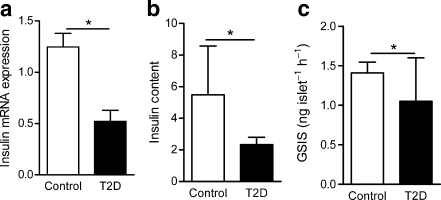
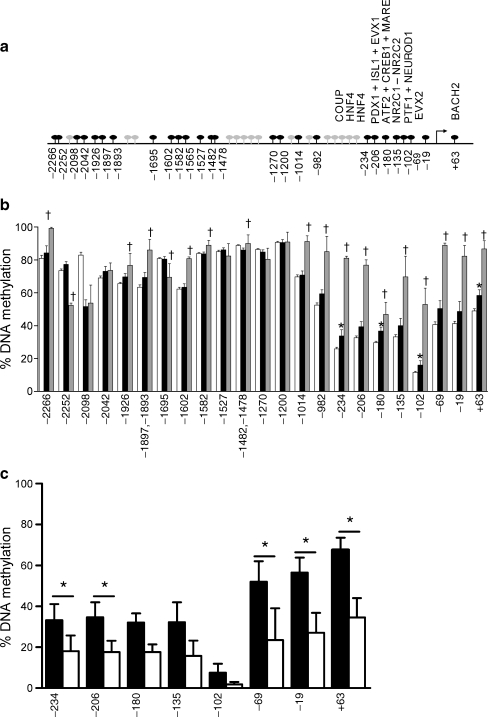
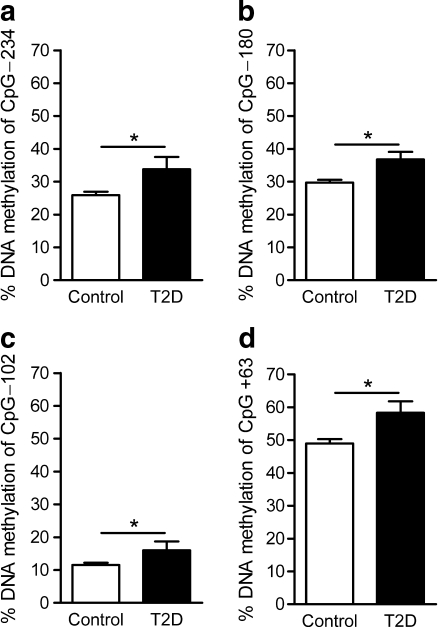
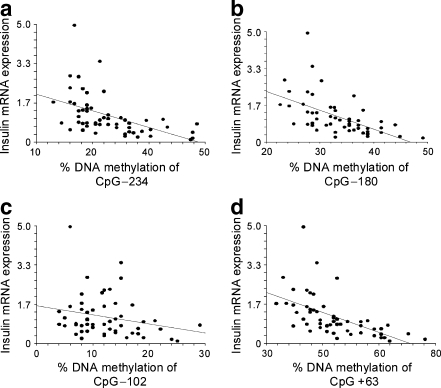
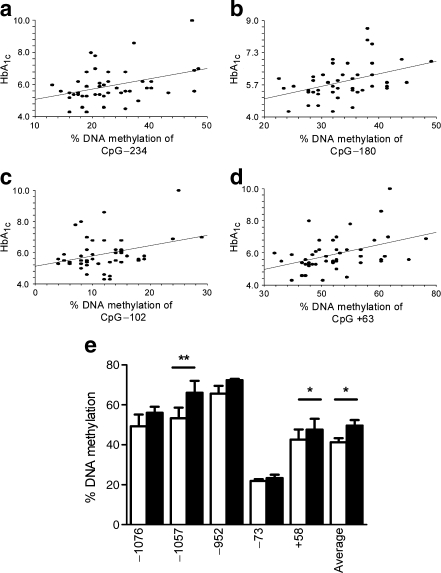
AIMS/HYPOTHESIS: Although recent studies propose that epigenetic factors influence insulin expression, the regulation of the insulin gene in type 2 diabetic islets is still not fully understood. Here, we examined DNA methylation of the insulin gene promoter in pancreatic islets from patients with type 2 diabetes and non-diabetic human donors and related it to insulin expression, HbA(1c) levels, BMI and age. METHODS: DNA methylation was analysed in 25 CpG sites of the insulin promoter and insulin mRNA expression was analysed using quantitative RT-PCR in pancreatic islets from nine donors with type 2 diabetes and 48 non-diabetic donors. RESULTS: Insulin mRNA expression (p = 0.002), insulin content (p = 0.004) and glucose-stimulated insulin secretion (p = 0.04) were reduced in pancreatic islets from patients with type 2 diabetes compared with non-diabetic donors. Moreover, four CpG sites located 234 bp, 180 and 102 bp upstream and 63 bp downstream of the transcription start site (CpG -234, -180, -102 and +63, respectively), showed increased DNA methylation in type 2 diabetic compared with non-diabetic islets (7.8%, p = 0.03; 7.1%, p = 0.02; 4.4%, p = 0.03 and 9.3%, p = 0.03, respectively). While insulin mRNA expression correlated negatively (p < 1 × 10(-6)), the level of HbA(1c) correlated positively (p ≤ 0.01) with the degree of DNA methylation for CpG -234, -180 and +63. Furthermore, DNA methylation for nine additional CpG sites correlated negatively with insulin mRNA expression (p ≤ 0.01). Also, exposure to hyperglycaemia for 72 h increased insulin promoter DNA methylation in clonal rat beta cells (p = 0.005). CONCLUSIONS/INTERPRETATIONS: This study demonstrates that DNA methylation of the insulin promoter is increased in patients with type 2 diabetes and correlates negatively with insulin gene expression in human pancreatic islets.
Overview
The claims and statistics of this paper haven’t been checked yet.
Free: it reads the open-access text and checks the first 5 claims that cite a source we can check. Create a free account to check every claim.
Integrity signals
Registry
Cites
Statistics
Figures
Verification
Claims the paper makes
The claims and statistics of this paper haven’t been checked yet.
Free: it reads the open-access text and checks the first 5 claims that cite a source we can check. Create a free account to check every claim.
Claims other papers make about this one
Each is checked against this paper’s own text: does it say what the citing paper says it does?
The cited source says what the claim attributes to it.
In the citing paper
“further suggest that hyperglycemia alters DNA methylation of PDX1 and INS ( 22 – 25 ).”
From β-Cell Failure in Type 2 Diabetes: Postulated Mechanisms and Prospects for Prevention and Treatment (2014) · cites this paper as [23]
Self-check
Percentages, sums and reported differences re-computed from the paper’s own numbers.
The self-check needs the paper’s full text.
Citations
Cites
A genome-wide association study identifies novel risk loci for type 2 diabetes
Sladek, R., Rocheleau, G., Rung, J., Dina, C., Shen, L., Serre, D., Boutin, P., Vincent, D., Belisle, A., Hadjadj, S., et al. (2007) · Nature · doi:10.1038/nature05616 · Cited by 2,993 · cited 1×
“Type 2 diabetes is a polygenic disease and it is possible that the effects of DNA methylation on type 2 diabetes are similar to those seen in genetic studies, where multiple loci with small effect sizes together contribute to an increased risk for disease [13–16].”
BackgroundGenome-wide association analysis identifies loci for type 2 diabetes and triglyceride levels
Saxena, R., Voight, B. F., Lyssenko, V., Burtt, N. P., de Bakker, P. I. W., Chen, H., Roix, J. J., Kathiresan, S., Hirschhorn, J. N., Daly, M. J., et al. (2007) · Science · doi:10.1126/science.1142358 · Cited by 2,843 · cited 1×
“Type 2 diabetes is a polygenic disease and it is possible that the effects of DNA methylation on type 2 diabetes are similar to those seen in genetic studies, where multiple loci with small effect sizes together contribute to an increased risk for disease [13–16].”
BackgroundSelf-citationA genome-wide association study of type 2 diabetes in Finns detects multiple susceptibility variants
Scott, L. J., Mohlke, K. L., Bonnycastle, L. L., Willer, C. J., Li, Y., Duren, W. L., Erdos, M. R., Stringham, H. M., Chines, P. S., Jackson, A. U., et al. (2007) · Science · doi:10.1126/science.1142382 · Cited by 2,753
Replication of Genome-Wide Association Signals in UK Samples Reveals Risk Loci for Type 2 Diabetes
Zeggini, E., Weedon, M. N., Lindgren, C. M., Frayling, T. M., Elliott, K. S., Lango, H., Timpson, N. J., Perry, J. R. B., Rayner, N. W., Freathy, R. M., et al. (2007) · Science · doi:10.1126/science.1142364 · Cited by 2,194 · cited 1×
“Type 2 diabetes is a polygenic disease and it is possible that the effects of DNA methylation on type 2 diabetes are similar to those seen in genetic studies, where multiple loci with small effect sizes together contribute to an increased risk for disease [13–16].”
BackgroundEl-Osta, A., Brasacchio, D., Yao, D., Pocai, A., Jones, P. L., Roeder, R. G., Cooper, M. E., & Brownlee, M. (2008) · The Journal of Experimental Medicine · doi:10.1084/jem.20081188 · Cited by 1,115 · cited 1×
“Recent studies have demonstrated that hyperglycaemia may induce epigenetic changes and thereby increase expression of pro-inflammatory genes in vascular cells, which subsequently may increase the risk for diabetic complications [17–20].”
BackgroundEpigenetics: a molecular link between environmental factors and type 2 diabetes
Ling, C., & Groop, L. (2009) · Diabetes · doi:10.2337/db09-1003 · Cited by 617
Self-citationNon-CpG methylation of the PGC-1α promoter through DNMT3B controls mitochondrial density.
Barrès, R., Osler, M. E., Yan, J., Rune, A., Fritz, T., Caidahl, K., Krook, A., & Zierath, J. R. (2009) · Cell Metabolism · doi:10.1016/j.cmet.2009.07.011 · Cited by 602 · cited 2×
“Recent studies suggest that epigenetic factors, including DNA methylation and histone modifications, may influence the pathogenesis of type 2 diabetes [1–4].”
BackgroundResultBrasacchio, D., Okabe, J., Tikellis, C., Balcerczyk, A., George, P., Baker, E. K., Calkin, A. C., Brownlee, M., Cooper, M. E., & El-Osta, A. (2009) · Diabetes · doi:10.2337/db08-1666 · Cited by 534 · cited 1×
“Recent studies have demonstrated that hyperglycaemia may induce epigenetic changes and thereby increase expression of pro-inflammatory genes in vascular cells, which subsequently may increase the risk for diabetic complications [17–20].”
BackgroundEpigenetic regulation of PPARGC1A in human type 2 diabetic islets and effect on insulin secretion
Ling, C., Del Guerra, S., Lupi, R., Rönn, T., Granhall, C., Luthman, H., Masiello, P., Marchetti, P., Groop, L., & Del Prato, S. (2008) · Diabetologia · doi:10.1007/s00125-007-0916-5 · Cited by 495 · cited 3×
“Our study suggests that DNA methylation can regulate gene expression in pancreatic islets from patients with type 2 diabetes and subsequently contribute to impaired insulin secretion [5].”
BackgroundResultSelf-citationMiao, F., Gonzalo, I. G., Lanting, L., & Natarajan, R. (2004) · Journal of Biological Chemistry · doi:10.1074/jbc.m311786200 · Cited by 374 · cited 1×
“Recent studies have demonstrated that hyperglycaemia may induce epigenetic changes and thereby increase expression of pro-inflammatory genes in vascular cells, which subsequently may increase the risk for diabetic complications [17–20].”
Background
Cited by
Items 201–261 of 261
Dinda, B., & Saha, S. (2022) · Springer eBooks · doi:10.1007/978-3-030-92196-5_1 · Cited by 2
Rönn, T., Ling, C., & Researcher, A. (2014) · US Endocrinology · doi:10.17925/use.2014.10.01.64 · Cited by 2
Self-citationEpigenetic Modifications and Type 2 Diabetes in Humans
Ling, C. (2014) · Frontiers in diabetes · doi:10.1159/000362470 · Cited by 2
Self-citationZhang, X., & Zhang, W. (2016) · Genetics · doi:10.1534/genetics.115.185504 · Cited by 2
“Accumulating experimental evidence also indicated that cytosine modification-dependent gene regulation may execute ondistinct phases of transcription andmay coordinatewith other epigenetic mechanisms (Yang et al. 2011; Rao et al. 2014).”
BackgroundMahmoudi, T., Nobakht, H., Dabiri, R., Maleki, I., Dehghan, P., Mansour‐Ghanaei, F., Derakhshan, F., & Zali, M. R. (2016) · Meta Gene · doi:10.1016/j.mgene.2016.10.012 · Cited by 2
Epigenetics of Diabetes in Humans
Nano, J., Portilla-Fernández, E., Troup, J., Ghanbari, M., Franco, O. H., & Muka, T. (2018) · Elsevier eBooks · doi:10.1016/b978-0-12-812215-0.00016-9 · Cited by 3
Epigenetic Epidemiology of Obesity and Type 2 Diabetes
Ling, C., Ruhrmann, S., Säll, J., Bacos, K., & Rönn, T. (2022) · Springer eBooks · doi:10.1007/978-3-030-94475-9_19 · Cited by 2
Self-citationEpigenetics of Metabolic Diseases
Gillberg, L., & Hjort, L. (2022) · Elsevier eBooks · doi:10.1016/b978-0-323-91909-8.00026-8 · Cited by 2
Epigenetics of diabetes in humans
Kowluru, R. A., & Kowluru, A. (2023) · Elsevier eBooks · doi:10.1016/b978-0-443-18661-5.00009-9 · Cited by 2
Epigenetics of autoimmune diseases
Farhadi, E., & Mahmoudi, M. (2019) · Elsevier eBooks · doi:10.1016/b978-0-12-814259-2.00009-1 · Cited by 1
The role of several SNPs in genetic diagnosis of Type 2 diabetes mellitus
Akhundova, L., Mustafayev, N., & Huseynova, I. M. (2023) · INSTITUTE OF MOLECULAR BIOLOGY & BIOTECHNOLOGIES TRANSACTIONS · doi:10.62088/timbb/7.2.3 · Cited by 1
Parmar, G. R., Chudasama, J. M., Maheshwari, R. A., Hinsu, D., Shah, A. P., Seth, A. K., & Balaraman, R. (2025) · Naunyn-Schmiedeberg s Archives of Pharmacology · doi:10.1007/s00210-025-04467-3 · Cited by 1
“Researchers are looking for ways to be more specific, either developing molecules to fine-tune EP300’s metabolic activity or focusing on downstream effects of EP300 that directly impact insulin signalling or fat metabolism (Yang et al. 2011).”
Ghasemi, A., Jeddi, S., & Kashfi, K. (2026) · EXCLI journal · doi:10.17179/excli2026-9229 · Cited by 2
Devi, L., Tiwari, P., & Dada, R. (2026) · Acta Diabetologica · doi:10.1007/s00592-026-02680-x · Cited by 1
“Similarly, in human T2D islets, promoter hypermethylation of INS, PDX1 and PPARGC1A correlates with diminished gene expression, disrupted mitochondrial function, and impaired insulin biosynthesis [29–31 ].”
Mechanisms of Programming: Pancreatic Islets and Fetal Programming
Barella, L. F., Mathias, P. C. D. F., & de Oliveira, J. C. (2017) · Springer eBooks · doi:10.1007/978-3-319-60289-9_37 · Cited by 2
Epigenetics in the Pathophysiology of Type 2 Diabetes
Ling, C. (2012) · Elsevier eBooks · doi:10.1016/b978-0-12-385083-6.00018-8 · Cited by 1
Self-citationNarne, P. (2019) · Springer eBooks · doi:10.1007/978-981-13-8946-7_18 · Cited by 1
Li, Q. (2024) · European journal of medical research · doi:10.1186/s40001-024-02174-y · Cited by 1
The association of DNA methylation patterns in TCF7L2 and GIPR genes with Type 2 Diabetes
Canivell, S. (2014) · Tesis Doctorals en Xarxa (Consorci de Serveis Universitaris de Catalunya) · Cited by 3
Chen, Y., Lin, W., Liao, W., Tsai, Y., Liao, J., & Tsai, F. (2021) · Scientific Reports · doi:10.1038/s41598-021-85727-z · Cited by 1
Shang, B. (2025) · Carolina Digital Repository (University of North Carolina at Chapel Hill) · doi:10.17615/x8d7-0b51 · Cited by 2
Investigation of DNA methylation in type 2 diabetes genetic risk loci
Aðalsteinsson, B. Þ. (2012)
Chromatin Switching and Gene Dynamics Associated with Type 2 Diabetes
Wood, I. C. (2013) · Epigenetics and human health · doi:10.1007/978-3-642-36827-1_10
Search for molecular and metabolic mechanisms contributing to impaired β-cell function
Malmgren, S. (2012) · Lund University Publications (Lund University)
Genome-Wide DNA and Histone Modification Studies in Metabolic Disease
Ling, C., & Rönn, T. (2015) · Elsevier eBooks · doi:10.1016/b978-0-12-800140-0.00012-1
Self-citationClinical Epigenetics and Epigenomics
Dong, N., Shi, L., Chen, C., Ma, W., & Wang, X. (2016) · Translational bioinformatics · doi:10.1007/978-94-017-7543-4_5
Epigenetic Regulation of the Dlk1-Meg3 Imprinted Locus in Human Islets
Kameswaran, V. (2016) · ScholarlyCommons (University of Pennsylvania)
Méthylation de l’ADN dans les îlots pancréatiques et risque de diabète de type 2
Cauchi, S. (2015) · Médecine des Maladies Métaboliques · doi:10.1016/s1957-2557(15)30164-4
Epigenetic Regulation of Islet Development and Regeneration
Khare, S., Katre, P. A., & Galande, S. (2016) · Stem cell biology and regenerative medicine · doi:10.1007/978-3-319-45307-1_4
DNA methylation : a risk factor for type 2 diabetes mellitus
Mutize, T. (2016) · Cited by 1
Levasseur, E. M. (2017) · IUScholarWorks (Indiana University) · doi:10.7912/c2qm05
Epigenomics of Diabetes Mellitus
Dimova, I. I. (2019) · Elsevier eBooks · doi:10.1016/b978-0-12-814513-5.00012-x
Ivanova, O. N., Степанова, С. М., Смирнова, Н. Б., Zvereva, Y. S., Suntsov, Y. I., Bardymova, T. P., Данилова, Г. И., Коваленко, Т. В., Титович, Е. В., Кураева, Т. Л., et al. (2014) · Problems of Endocrinology · doi:10.14341/probl20146064-9
Leslie, K. A. (2019) · Figshare
Mutize, T., Dludla, P. V., Mkandla, Z., & Nkambule, B. B. (2019) · bioRxiv (Cold Spring Harbor Laboratory) · doi:10.1101/825125
Gorus, F., Keymeulen, B., & Martens, G. A. (2019) · Elsevier eBooks · doi:10.1016/b978-0-12-814833-4.00056-3
Znaczenie nutrigenomiki w profilaktyce i wspomaganiu leczenia cukrzycy
Syta, E., & Bobrowska‐Korczak, B. (2021) · Postępy Higieny i Medycyny Doświadczalnej · doi:10.5604/01.3001.0014.7834
La epigenética en la diabetes mellitus tipo 2: una enfermedad crónica no transmisible
Martagón, A. J. (2021) · Alad · doi:10.24875/alad.21000013 · Cited by 1
Epigenetic mechanisms in cardiovascular diseases
Varadarajan, S., Ushio‐Fukai, M., & Fukai, T. (2023) · Elsevier eBooks · doi:10.1016/b978-0-12-823931-5.00020-7
İnsülin 100 Yıllık Mucize Hormon
Cerit, E. T., Barlas, T., Atalar, K., Bahçelioğlu, M., Kaplanoğlu, G. T., Seymen, C. M., Erdem, H. B., Ergün, M. A., Demir, Ö., Gülbahar, Ö., et al. (2022) · Akademisyen Kitabevi eBooks · doi:10.37609/akya.871
Omics Sciences in Drug Discovery, Safety, and Pharmacokinetics
Giovanni, T., Giannese, F., & Lazarević, D. (2024) · Springer eBooks · doi:10.1007/978-3-030-73317-9_131-1
Omics Sciences in Drug Discovery, Safety, and Pharmacokinetics
Tonon, G., Giannese, F., & Lazarević, D. (2024) · Springer eBooks · doi:10.1007/978-3-031-35529-5_131
Islet-specific DNA hypomethylation identifies gene enhancer loci driving Type 2 Diabetes riskPreprint
Miranda, V. E., Scott, T. J., Dorans, E., Mei, S., Miranda, A. X., Powers, A. C., Davis, L. K., Briššová, M., & Hodges, E. C. (2025) · medRxiv · doi:10.1101/2025.09.09.25335336
Salama, O. E., Hizon, N. A., VECCHIO, M. D., Kolsun, K. P., Fonseca, M. A., Lin, D. T. S., Urtatiz, O., MacIsaac, J. L., Kobor, M. S., Sellers, E. A. C., et al. (2024) · Figshare · doi:10.6084/m9.figshare.26719815
Salama, O. E., Hizon, N. A., VECCHIO, M. D., Kolsun, K. P., Fonseca, M. A., Lin, D. T. S., Urtatiz, O., MacIsaac, J. L., Kobor, M. S., Sellers, E. A. C., et al. (2024) · Figshare · doi:10.6084/m9.figshare.26719821
Salama, O. E., Hizon, N. A., VECCHIO, M. D., Kolsun, K. P., Fonseca, M. A., Lin, D. T. S., Urtatiz, O., MacIsaac, J. L., Kobor, M. S., Sellers, E. A. C., et al. (2024) · Figshare · doi:10.6084/m9.figshare.26719824
Salama, O. E., Hizon, N. A., VECCHIO, M. D., Kolsun, K. P., Fonseca, M. A., Lin, D. T. S., Urtatiz, O., MacIsaac, J. L., Kobor, M. S., Sellers, E. A. C., et al. (2024) · Figshare · doi:10.6084/m9.figshare.26719830
Salama, O. E., Hizon, N. A., VECCHIO, M. D., Kolsun, K. P., Fonseca, M. A., Lin, D. T. S., Urtatiz, O., MacIsaac, J. L., Kobor, M. S., Sellers, E. A. C., et al. (2024) · Figshare · doi:10.6084/m9.figshare.26719827
Salama, O. E., Hizon, N. A., VECCHIO, M. D., Kolsun, K. P., Fonseca, M. A., Lin, D. T. S., Urtatiz, O., MacIsaac, J. L., Kobor, M. S., Sellers, E. A. C., et al. (2024) · Figshare · doi:10.6084/m9.figshare.26719818
Salama, O. E., Hizon, N. A., VECCHIO, M. D., Kolsun, K. P., Fonseca, M. A., Lin, D. T. S., Urtatiz, O., MacIsaac, J. L., Kobor, M. S., Sellers, E. A. C., et al. (2024) · Figshare · doi:10.6084/m9.figshare.25815631
Salama, O. E., Hizon, N. A., VECCHIO, M. D., Kolsun, K. P., Fonseca, M. A., Lin, D. T. S., Urtatiz, O., MacIsaac, J. L., Kobor, M. S., Sellers, E. A. C., et al. (2024) · Figshare · doi:10.6084/m9.figshare.25815056
Fetal programming and parent-of-origin effects of type 2 diabetes and insulin secretion
Hatem, G. (2023) · Lund University Publications (Lund University)
Pahkuri, S. (2026) · UTUPub (University of Turku)
Maurin, L. (2024) · theses.fr (ABES) · doi:10.70675/bdd8c28bzecbaz4b2az99cdz98131319a267
TBL1X/TBL1XR1 govern β-cell identity through a PAX6-containing gene regulatory network
Walth-Hummel, A. A., Jouffe, C., Weber, P., Motzler, K., Geppert, J., Sterr, M., Gan, W., Szczerbinska, I., König, A., Hauck, S. M., et al. (2026) · Nature Communications · doi:10.1038/s41467-026-72077-5
“Impaired insulin expression can cause hyperglycemia and diabetes development in patients 41 .”
Shah, J., Mahajan, A., & Muley, A. (2026) · Precision Nutrition · doi:10.1097/pn9.0000000000000136
Zubrzycki, M., Kuśmierczyk, M., Gummert, J. F., Costard‐Jäckle, A., Paluszkiewicz, L., Hecht, T., Birschmann, I., Zubrzycka, A., & Zubrzycka, M. (2026) · Metabolites · doi:10.3390/metabo16050341
Gene-environment interaction in type 2 diabetes mellitus (T2DM)
Sohtun, L. P., & Aguan, K. (2026) · Elsevier eBooks · doi:10.1016/b978-0-443-33590-7.00017-4
Cáceres-Durán, M. Á., & Ribeiro‐dos‐Santos, Â. (2026) · Genetics and Molecular Biology · doi:10.1590/1678-4685-gmb-2025-0113
“They found that the promoters of the insuline ( INS) (Yang et al. , 2011), pancreatic and duodenal homeobox 1 ( PDX1) (Jonsson et al. , 1994), peroxisome proliferator-activaed receptor gamma coactivator 1-alpha ( PPARGC1A ) (Wu et al. , 2016), and glucagon-like peptide-1 receptor ( GLP1R ) (Hall et al. , 2013) genes w…”
InfluentialNg, R. R., Gao, Y., Xu, Y., & Lau, A. T. Y. (2026) · Advances in predictive, preventive and personalised medicine · doi:10.1007/978-3-032-32838-0_4
Metadata
- Authors
- Yang, B. T., Dayeh, T. A., Kirkpatrick, C. L., Taneera, J., Kumar, R., Groop, L., Wollheim, C. B., Nitert, M. D., & Ling, C.
- Affiliations
- Lund University (SE)
- Corresponding author
- Ling, C.
- Venue
- Diabetologia
- Published
- 2010-11-23
- Volume
- 54
- Issue
- 2
- Pages
- 360-367
- ISSN
- 0012-186X (ISSN-L)
- 1432-0428
- PMC
- PMC3017313
- OpenAlex
- W1985935160
- Cited by
- 251
- References
- 20
- Citations by year
- 2026: 12 · 2025: 5 · 2024: 18 · 2023: 14 · 2022: 19 · 2021: 16 · 2020: 16 · 2019: 26 · 2018: 14 · 2017: 15 · 2016: 18 · 2015: 22 · 2014: 21 · 2013: 15 · 2012: 15
- FWCI
- 11.49
- Type
- journal article
- Language
- en
- Open access
- hybrid
- doi.org
- Licence
- cc-by-nc
- Locations
- Diabetologia (publishedVersion, cc-by-nc)
- PubMed Central (publishedVersion, cc-by-nc)
- PubMed (publishedVersion)
- Archive ouverte UNIGE (University of Geneva) (publishedVersion, other-oa)
- Lund University Publications (Lund University) (submittedVersion)
- Archive ouverte UNIGE (University of Geneva) (submittedVersion, cc-by)
- Funders
- National Science Foundation
- Schweizerischer Nationalfonds zur Förderung der Wissenschaftlichen Forschung
- Knut och Alice Wallenbergs Stiftelse
- Novo Nordisk
- Vetenskapsrådet
- Kungliga Fysiografiska Sällskapet i Lund
- Malmö Högskola
- Uppsala Universitet
- Università di Pisa
- Region Skåne
- Topics
- Health Sciences › Medicine › Endocrinology, Diabetes and Metabolism › Pancreatic function and diabetes
- Life Sciences › Biochemistry, Genetics and Molecular Biology › Molecular Biology › Epigenetics and DNA Methylation
- Life Sciences › Biochemistry, Genetics and Molecular Biology › Genetics › Diabetes and associated disorders
- Keywords
- insulin promoter, DNA methylation, insulin gene expression, type 2 diabetes, pancreatic islets, HbA1c, glucose-stimulated insulin secretion, epigenetics, hyperglycemia, pancreatic beta cells, CpG sites
- MeSH terms
- Animals, Cell Line, Humans, Insulin, Islets of Langerhans, Promoter Regions, Genetic, DNA Methylation, Insulin-Secreting Cells, Rats, In Vitro Techniques
About these checks
Registry, retraction, Cites and statistics results are computed, not judged, with one exception: a printed reference that no index lists is read once by a model before it counts as a citation error. Claims are extracted by a model and kept only when their quote appears verbatim in the text; each cited source is then checked, with a model’s help, for whether it says what the claim relies on. Those verdicts can be wrong — read the claim’s quote and the cited source before relying on one.
Statistics and arithmetic are recomputed, not judged.
Confidence bands are shown only for fields calibrated on our annotated test set. None is calibrated yet, so no band is shown.
What counts as a claim ›How we measure confidence ›How we check this ›
Are you an author, or do you see a problem with this page? Request a review
Data sources
Bibliographic data: Semantic Scholar, OpenAlex, Crossref.
Contains information from the Semantic Scholar Academic Graph Datasets, made available under the ODC Attribution License (ODC-BY 1.0).
Semantic Scholar’s data is described in: Kinney, R., et al. (2023). The Semantic Scholar Open Data Platform. arXiv:2301.10140.
