

Physical activity and incident type 2 diabetes mellitus: a systematic review and dose-response meta-analysis of prospective cohort studies.
Open accessThe DOI matches its Crossref record; 76 of the 76 references it cites were found in a registry or an index.
Abstract
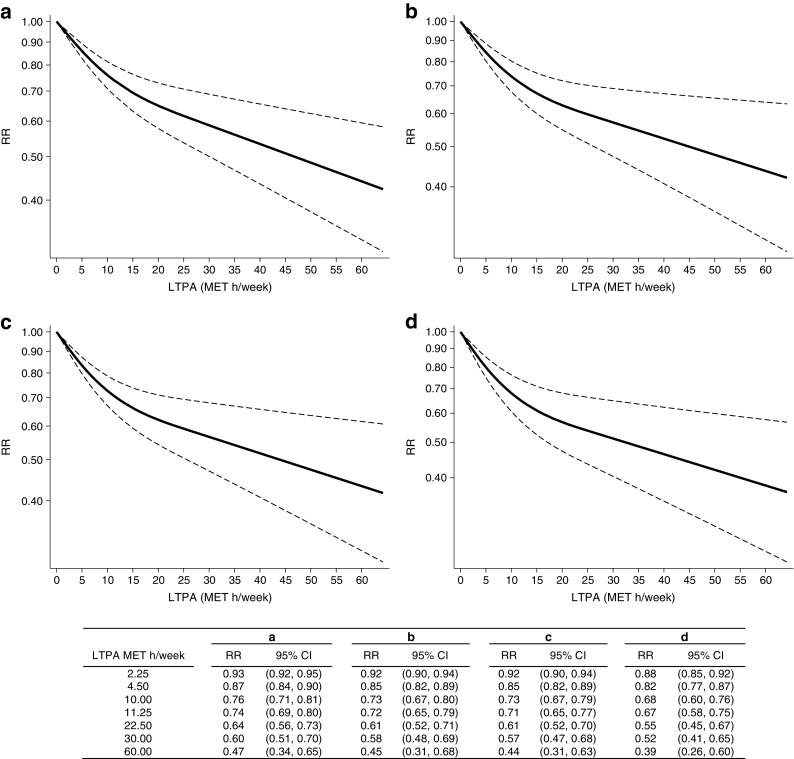
AIMS/HYPOTHESIS: Inverse associations between physical activity (PA) and type 2 diabetes mellitus are well known. However, the shape of the dose-response relationship is still uncertain. This review synthesises results from longitudinal studies in general populations and uses non-linear models of the association between PA and incident type 2 diabetes. METHODS: A systematic literature search identified 28 prospective studies on leisure-time PA (LTPA) or total PA and risk of type 2 diabetes. PA exposures were converted into metabolic equivalent of task (MET) h/week and marginal MET (MMET) h/week, a measure only considering energy expended above resting metabolic rate. Restricted cubic splines were used to model the exposure-disease relationship. RESULTS: Our results suggest an overall non-linear relationship; using the cubic spline model we found a risk reduction of 26% (95% CI 20%, 31%) for type 2 diabetes among those who achieved 11.25 MET h/week (equivalent to 150 min/week of moderate activity) relative to inactive individuals. Achieving twice this amount of PA was associated with a risk reduction of 36% (95% CI 27%, 46%), with further reductions at higher doses (60 MET h/week, risk reduction of 53%). Results for the MMET h/week dose-response curve were similar for moderate intensity PA, but benefits were greater for higher intensity PA and smaller for lower intensity activity. CONCLUSIONS/INTERPRETATION: Higher levels of LTPA were associated with substantially lower incidence of type 2 diabetes in the general population. The relationship between LTPA and type 2 diabetes was curvilinear; the greatest relative benefits are achieved at low levels of activity, but additional benefits can be realised at exposures considerably higher than those prescribed by public health recommendations.
Overview
The claims and statistics of this paper haven’t been checked yet.
Free: it reads the open-access text and checks the first 5 claims that cite a source we can check. Create a free account to check every claim.
Integrity signals
Registry
Cites
Statistics
Figures
Verification
Claims the paper makes
The claims and statistics of this paper haven’t been checked yet.
Free: it reads the open-access text and checks the first 5 claims that cite a source we can check. Create a free account to check every claim.
Claims other papers make about this one
Each is checked against this paper’s own text: does it say what the citing paper says it does?
The source backs part of the claim, not all of it — or backs it for a different population, condition or comparison.
In the citing paper
“One such factor, physical activity, has long been known to reduce the risk of a wide range of diseases and conditions, including cardiovascular disease, stroke, and diabetes.8,9,10”
From Association of Levels of Physical Activity With Risk of Parkinson Disease: A Systematic Review and Meta-analysis (2018) · cites this paper as [10]
Experimental — accuracy not yet measuredThe cited source says what the claim attributes to it.
In the citing paper
“a meta-analysis of prospective cohort studies which found a clear dose-response relationship between physical activity and reduced risk of developing T2D [58]”
From Economic evaluation of wearable fitness trackers versus metformin for preventing type 2 diabetes in the UK population (2025) · cites this paper as [58]
In the citing paper
“People with obesity are at increased risk for a variety of medical disorders including hypertension, dyslipidemia, type 2 diabetes mellitus, cardiovascular disease (CVD), and several cancers [4–6]”
From Mediterranean Diet and Obesity-related Disorders: What is the Evidence? (2022) · cites this paper as [5]
Self-check
Percentages, sums and reported differences re-computed from the paper’s own numbers.
The self-check needs the paper’s full text.
Citations
Cites
R: A Language and Environment for Statistical Computing
R Core Team (2025) · doi:10.32614/r.manuals · Cited by 352,181
Meta-analysis in clinical trials
DerSimonian, R., & Laird, N. (1986) · Controlled Clinical Trials · doi:10.1016/0197-2456(86)90046-2 · Cited by 39,552 · cited 1×
“Studyspecific dose–response coefficients were pooled using the DerSimonian–Laird estimator in a random-effects model [50].”
MethodReduction in the incidence of type 2 diabetes with lifestyle intervention or metformin
(2002) · New England Journal of Medicine · doi:10.1056/nejmoa012512 · Cited by 19,011
Lozano, R., Naghavi, M., Foreman, K., Lim, S., Shibuya, K., Aboyans, V., Abraham, J., Adair, T., Aggarwal, R., Ahn, S. Y., et al. (2012) · The Lancet · doi:10.1016/s0140-6736(12)61728-0 · Cited by 14,070
Garber, C. E., Blissmer, B., Deschenes, M. R., Franklin, B. A., Lamonte, M. J., Lee, I.-M., Nieman, D. C., & Swain, D. P. (2011) · Medicine & Science in Sports & Exercise · doi:10.1249/mss.0b013e318213fefb · Cited by 9,319 · cited 1×
“Public health guidelines [16, 17] recommend a minimum of 150 min of moderate to vigorous PA (MVPA) or 75 min vigorous PA (VPA) a week to maintain general health.”
BackgroundHealth benefits of physical activity: the evidence
Warburton, D. E. R. (2006) · Canadian Medical Association Journal · doi:10.1503/cmaj.051351 · Cited by 8,007
2011 Compendium of Physical Activities: A Second Update of Codes and MET Values
AINSWORTH, B. E., HASKELL, W. L., HERRMANN, S. D., MECKES, N., BASSETT, D. R., TUDOR-LOCKE, C., GREER, J. L., VEZINA, J., WHITT-GLOVER, M. C., & LEON, A. S. (2011) · Medicine & Science in Sports & Exercise · doi:10.1249/mss.0b013e31821ece12 · Cited by 6,317 · cited 1×
“5 and 7 marginal METs [MMETs]), respectively [34].”
BackgroundGlobal physical activity levels: surveillance progress, pitfalls, and prospects
Hallal, P. C., Andersen, L. B., Bull, F. C., Guthold, R., Haskell, W., & Ekelund, U. (2012) · The Lancet · doi:10.1016/s0140-6736(12)60646-1 · Cited by 5,711 · cited 1×
“Selfreport data suggest that around a third of adults globally are not meeting these targets [18].”
BackgroundPan, X.-R., Li, G.-W., Hu, Y.-H., Wang, J.-X., Yang, W.-Y., An, Z.-X., Hu, Z.-X., Juan-Lin, Xiao, J.-Z., Cao, H.-B., et al. (1997) · Diabetes Care · doi:10.2337/diacare.20.4.537 · Cited by 4,320
Prince, S. A., Adamo, K. B., Hamel, M., Hardt, J., Connor Gorber, S., & Tremblay, M. (2008) · International Journal of Behavioral Nutrition and Physical Activity · doi:10.1186/1479-5868-5-56 · Cited by 3,162
Research works printed but not linked: 2
- International Diabetes Federation IDF diabetes atlas 2015 7 Brussels International Diabetes Federation 35914061
- FAO/WHO/UNU Expert Consultation (2011) Human energy requirements. Chapter 5: Energy requirements of adults. Available from: www.fao.org/3/a-y5686e.pdf, Accessed 12 Nov 2015
Cited by
Items 101–200 of 429
Castillo, M. D., Anenberg, S. C., Chafe, Z. A., Huxley, R., Johnson, L. S., Kheirbek, I., Malik, M., Marshall, J. D., Naidoo, S., Nelson, M. L., et al. (2021) · Frontiers in Sustainable Cities · doi:10.3389/frsc.2021.768227 · Cited by 29
“, 2009), cardiovascular disease mortality (Hamer and Chida, 2008), dementia (Hamer and Chida, 2009), type II diabetes incidence (Smith et al., 2016).”
BackgroundFarhadnejad, H., Teymoori, F., Asghari, G., Mokhtari, E., Mirmiran, P., & Azizi, F. (2022) · BMC Endocrine Disorders · doi:10.1186/s12902-022-00961-4 · Cited by 29
A personalized mobile app for physical activity: An experimental mixed-methods study
Tong, H. L., Quiroz, J. C., Kocaballi, A. B., Ijaz, K., Coiera, E. W., Chow, C. K., & Laranjo, L. (2022) · Digital Health · doi:10.1177/20552076221115017 · Cited by 39
Bahadoran, Z., Mirmiran, P., Shabani, M., & Azizi, F. (2023) · Preventive Medicine Reports · doi:10.1016/j.pmedr.2023.102233 · Cited by 26
“Serum TG was measured using the enzymatic colorimetric method (Pars Azmoon, Tehran, Iran) (Tohidi et al., 2014).”
MethodDolan, C., Glynn, R. W., & LAWLOR, B. A. (2020) · Canadian Journal of Diabetes · doi:10.1016/j.jcjd.2020.01.004 · Cited by 24
Reducing the Risk of Developing Diabetes
Prebtani, A. P. H., BAJAJ, H. S., Goldenberg, R., & Mullan, Y. (2018) · Canadian Journal of Diabetes · doi:10.1016/j.jcjd.2017.10.033 · Cited by 37
“Higher levels of leisure time physical activity (LTPA) are associated with substantially lower incidence of type 2 diabetes (31).”
Kim, Y., Sharp, S., Hwang, S., & Jee, S. H. (2019) · BMJ Open · doi:10.1136/bmjopen-2018-025590 · Cited by 23
Smartphone-recorded physical activity for estimating cardiorespiratory fitness
Eades, M. T., Tsanas, A., Juraschek, S. P., Kramer, D. B., Gervino, E. V., & Mukamal, K. J. (2021) · Scientific Reports · doi:10.1038/s41598-021-94164-x · Cited by 25
Paudel, S., Owen, A. J., & Smith, B. J. (2021) · BMC Public Health · doi:10.1186/s12889-021-11484-3 · Cited by 31
Janus, C., Vistisen, D., Amadid, H., Witte, D. R., Lauritzen, T., Brage, S., Bjerregaard, A., Hansen, T. F., Holst, J. J., Jørgensen, M. E., et al. (2019) · Endocrine Connections · doi:10.1530/ec-19-0408 · Cited by 24
Self-citationIwasaki, M., Kudo, A., Asahi, K., Machii, N., Iseki, K., Satoh, H., Moriyama, T., Yamagata, K., Tsuruya, K., Fujimoto, S., et al. (2021) · Scientific Reports · doi:10.1038/s41598-020-80572-y · Cited by 23
Exercise retards ongoing adipose tissue fibrosis in diet-induced obese mice
Li, L., Wei, Y., Fang, C., Liu, S., Zhou, F., Zhao, G., Li, Y., Luo, Y., Guo, Z., Lin, W., et al. (2021) · Endocrine Connections · doi:10.1530/ec-20-0643 · Cited by 23
Lindsay, T., Wijndaele, K., Westgate, K. L., Dempsey, P. C., Strain, T., Rolfe, E. D. L., Forouhi, N. G., Griffin, S. J., Wareham, N. J., & Brage, S. (2021) · International Journal of Obesity · doi:10.1038/s41366-021-00970-8 · Cited by 23
Self-citationKurian, J., Mohanthy, S., & Mavathur, R. N. (2021) · Journal of Bodywork and Movement Therapies · doi:10.1016/j.jbmt.2021.10.003 · Cited by 27
Vézina‐Im, L., Nicklas, T. A., & Baranowski, T. (2018) · Current Nutrition Reports · doi:10.1007/s13668-018-0246-x · Cited by 25
Eating Speed and Incidence of Diabetes in a Japanese General Population: ISSA-CKD
Fujii, H., Funakoshi, S., Maeda, T., Satoh, A., Kawazoe, M., Ishida, S., Yoshimura, C., Yokota, S., Tada, K., Takahashi, K., et al. (2021) · Journal of Clinical Medicine · doi:10.3390/jcm10091949 · Cited by 27
Wang, Y., Cao, P., Liu, F., Chen, Y., Xie, J., Bai, B., Liu, Q., Ma, H., & Geng, Q. (2022) · International Journal of Environmental Research and Public Health · doi:10.3390/ijerph192416412 · Cited by 28
Association between anthropometric indices and hyperuricemia: a nationwide study in China
Chen, D., Lu, C., Chen, K., Liu, T., Li, Y., Shan, Z., Teng, W., & the Thyroid disorders, I. S. A. D. E. S. G. (. (2024) · Clinical Rheumatology · doi:10.1007/s10067-024-06884-w · Cited by 21
“We used restricted cubic splines to fit linear regression or logistics regression to analyze the relationship between each anthropometric index and hyperuricemia OR value and serum uric acid value [22].”
Mansour‐Ghanaei, R., Mansour‐Ghanaei, F., Naghipour, M., & Joukar, F. (2019) · Open Access Macedonian Journal of Medical Sciences · doi:10.3889/oamjms.2019.647 · Cited by 22
Chen, Y., Jin, X., Chen, G., Wang, R., & Tian, H. (2024) · JMIR Public Health and Surveillance · doi:10.2196/54318 · Cited by 23
“RenderX the average duration of a given exercise, we assumed that the individuals performed it at an intensity of 4.5 MET [33,34].”
BackgroundInfluentialMcNeil, J., Farris, M. S., Ruan, Y., Merry, H. R., Lynch, B. M., Matthews, C. E., Courneya, K. S., & Friedenreich, C. M. (2018) · International Journal of Behavioral Nutrition and Physical Activity · doi:10.1186/s12966-018-0659-3 · Cited by 24
Gc, V. S., Suhrcke, M., Atkin, A. J., van Sluijs, E. M. F., & Turner, D. (2019) · BMJ Open · doi:10.1136/bmjopen-2018-027566 · Cited by 26
Qiu, S., Du, Z., Li, W., Chen, J., Wu, H., Liu, J., Cai, M., Wang, B., Guo, H., & Sun, Z. (2020) · Annals of Laboratory Medicine · doi:10.3343/alm.2020.40.6.457 · Cited by 20
“Furthermore, our study suggests that neither regular exercise, which reduces the risk of diabetes [28], nor medications, such as statins, which increase the risk of diabetes [29], weaken the performance of HbA1c in detecting diabetes.”
BackgroundFarhat, L. C., Flores, J. M., Avila-Quintero, V. J., Polanczyk, G. V., Cipriani, A., Furukawa, T. A., Bloch, M. H., & Cortese, S. (2023) · JAMA Psychiatry · doi:10.1001/jamapsychiatry.2023.3985 · Cited by 25
García-Pérez-de-Sevilla, G., Guido, O. B., la Cruz, M. D. L. P. D., Fernández, A. B., Alejo, L. B., Goercke, M. I. R., & Pérez, M. (2021) · International Journal of Environmental Research and Public Health · doi:10.3390/ijerph182212198 · Cited by 21
“The protective effect of physical exercise against NCDs depends on the dose [3], and in this sense, the World Health Organization (WHO) proposes general recommendations for the promotion of PA worldwide in 2020 to prevent NCDs [4].”
BackgroundIs chronic low back pain a risk factor for diabetes? The Nord-Trøndelag Health Study
Heuch, I., Heuch, I., Hagen, K., Sørgjerd, E. P., Åsvold, B. O., & Zwart, J. (2018) · BMJ Open Diabetes Research & Care · doi:10.1136/bmjdrc-2018-000569 · Cited by 25
Spatiotemporal trends and influence factors of global diabetes prevalence in recent years
Li, J., Wang, S., Han, X., Zhang, G., Zhao, M., & Ma, L. (2020) · Social Science & Medicine · doi:10.1016/j.socscimed.2020.113062 · Cited by 20
Odimegwu, C. L., Uwaezuoke, S. N., Chikani, U. N., Mbanefo, N. R., Adiele, K., Nwolisa, C. E., Eneh, C. I., Ndiokwelu, C. O., Okpala, S. C., Ogbuka, F. N., et al. (2024) · Diabetes Metabolic Syndrome and Obesity · doi:10.2147/dmso.s479077 · Cited by 26
“37,38 Findings from a recent mixed-methods study corroborated that lifestyle changes, particularly with regard to dietary quality and physical activity, are essential in managing T2DM.”
BackgroundMagkos, F., Reeds, D. N., & Mittendorfer, B. (2022) · Physiological Reviews · doi:10.1152/physrev.00015.2022 · Cited by 21
Tu, K., Liu, K., Wang, Y., Jiang, Y., & Zhang, C. (2023) · Nutrients · doi:10.3390/nu15143253 · Cited by 19
“Finally, the RCS regression models were used to analyze the shape of the dose–response relationship, which allowed us to observe how breast cancer risk varies at different levels of dietary Zn/Se intake [69,70].”
MethodGarcia, L., Pearce, M., Abbas, A., Mok, A., Strain, T., Ali, S., Crippa, A., Dempsey, P., Golubic, R., Kelly, P., et al. (2022) · medRxiv · doi:10.1101/2022.03.02.22271753 · Cited by 10
Self-citationExercise Prescription: Pioneering the “Third Pole” for Clinical Health Management
Luo, Z., Zhang, T., & Chen, S. (2023) · Research · doi:10.34133/research.0284 · Cited by 22
Bourke, E., Rawstorn, J. C., Maddison, R., & Blakely, T. A. (2024) · Preventive Medicine Reports · doi:10.1016/j.pmedr.2024.102866 · Cited by 38
“Diabetes or high fasting plasma glucose: Five reviews included a total of 122 studies (Aune et al., 2015; Cloostermans et al., 2015; Kyu et al., 2016; Raza et al., 2020; Smith et al., 2016) (of which 66 studies were reported in only one review, 38 in two, and 18 in three or more).”
BackgroundMethodResultInfluentialChikwati, R. P., Crowther, N. J., Ramsay, M., Micklesfield, L. K., Norris, S. A., Seakamela, K. P., Nonterah, E. A., Agongo, G., Mohamed, S. F., Kisiangani, I., et al. (2025) · The Lancet Global Health · doi:10.1016/s2214-109x(24)00520-5 · Cited by 22
Short-Term Physical Inactivity Induces Endothelial Dysfunction
Davies, K. A. B., Norman, J. A., Thompson, A., Mitchell, K. L., Harrold, J. A., Halford, J. C. G., Wilding, J. P. H., Kemp, G. J., Cuthbertson, D. J., & Sprung, V. S. (2021) · Frontiers in Physiology · doi:10.3389/fphys.2021.659834 · Cited by 24
Gugusheff, J., Foley, B. C., Owen, K., Drayton, B., Ding, D., Stamatakis, E., Rasmussen, C. L., Bauman, A. E., & Thomas, M. M. (2020) · Journal of Physical Activity and Health · doi:10.1123/jpah.2020-0070 · Cited by 16
Wan, Q., Zhou, Y., Zhu, W., & Liu, X. (2021) · Frontiers in Cardiovascular Medicine · doi:10.3389/fcvm.2021.710071 · Cited by 20
Chen, G., Qi, Q., Hua, S., Moon, J., Spartano, N. L., Vasan, R. S., Sotres‐Alvarez, D., Castañeda, S. F., Evenson, K. R., Perreira, K. M., et al. (2020) · American Journal of Clinical Nutrition · doi:10.1093/ajcn/nqaa232 · Cited by 19
Associations of Physical Activity and Sedentary Time with Metabolic Syndrome in Saudi Adult Males
Aljuhani, O. E., Alkahtani, S. A., Alhussain, M. H., Smith, L., & Habib, S. S. (2020) · Risk Management and Healthcare Policy · doi:10.2147/rmhp.s267575 · Cited by 18
Lee, R. E., Joseph, R. P., Carr, L. T. B., Strayhorn, S. M., Faro, J. M., Lane, H., Monroe, C. M., Pekmezi, D., & Szeszulski, J. (2021) · Translational Behavioral Medicine · doi:10.1093/tbm/ibab026 · Cited by 17
Metabolite Signature of Physical Activity and the Risk of Type 2 Diabetes in 7271 Men
Kemppainen, S., Silva, L. F., Lankinen, M. A., Schwab, U., & Laakso, M. (2022) · Metabolites · doi:10.3390/metabo12010069 · Cited by 19
“Similarly, prospective cohort studies have reported that PA reduces the risk of type 2 diabetes by 30–50% compared to those who are physically inactive [4].”
BackgroundFarrugia, M. A., Garf, S. L., Chierici, A. P., Piche, T., Gual, P., Iannelli, A., & Anty, R. (2023) · Metabolites · doi:10.3390/metabo13030330 · Cited by 18
“Furthermore, a meta-analysis published in 2016 showed that the average pooled risk reduction for type 2 diabetes was 13% (95% confidence interval (CI): 11%, 16%) for a 10 MET h/wk increment in PA [12].”
BackgroundYang, D., Bian, Y., Zeng, Z., Cui, Y., Wang, Y., & Yu, C. (2020) · International Journal of Environmental Research and Public Health · doi:10.3390/ijerph17228628 · Cited by 17
Exercise in the Prevention and Treatment of Type 2 Diabetes
Kirwan, J. P., Heintz, E. C., Rebello, C. J., & Axelrod, C. L. (2023) · Wiley eBooks · doi:10.1002/cphy.c220009 · Cited by 26
Zhao, W. F., Yan, Q., & Mou, C. (2025) · BMC Cardiovascular Disorders · doi:10.1186/s12872-025-05216-3 · Cited by 19
“A systematic review encompassing 28 prospective cohort studies confirmed that both low-and high-intensity physical activity can reduce type 2 diabetes risk by 26% to 36% [27].”
Carlsson, S. (2022) · Frontiers in Endocrinology · doi:10.3389/fendo.2022.917850 · Cited by 17
Takase, M., Nakaya, N., Nakamura, T., Kogure, M., Hatanaka, R., Nakaya, K., Chiba, I., Kanno, I., Nochioka, K., Tsuchiya, N., et al. (2023) · Journal of Atherosclerosis and Thrombosis · doi:10.5551/jat.64425 · Cited by 19
MacDonald, C., Bennekou, M., Midtgaard, J., Langberg, H., & Lieberman, D. E. (2024) · British Journal of Sports Medicine · doi:10.1136/bjsports-2024-108396 · Cited by 17
“30 Higher doses of exercise generally have even larger preventive effects; 300 min/ week of moderate-intensity exercise is associated with a 36% risk reduction (95% CI, 27% to 46”
Physical activity correlates in people with anxiety: Data from 46 low- and middle-income countries
Vancampfort, D., Stubbs, B., & Koyanagi, A. (2017) · General Hospital Psychiatry · doi:10.1016/j.genhosppsych.2017.04.007 · Cited by 21
“There is an abundance of evidence that complying with the international recommendation of 150 min of moderate to vigorous physical activity per week has important physical and mental health benefits (1-5).”
BackgroundCarrillo-Larco, R. M., Pearson‐Stuttard, J., Bernabé‐Ortiz, A., & Gregg, E. W. (2019) · Diabetes Research and Clinical Practice · doi:10.1016/j.diabres.2019.107978 · Cited by 20
“In this line, population-based prevention strategies should include healthy food consumption [33], physical activity [34,35], and environmental risk factors [36–38].”
BackgroundGarcía-Pérez-de-Sevilla, G., Guido, O. B., la Cruz, M. D. L. P. D., Fernández, A. B., Alejo, L. B., Martínez, M. M., & Pérez, M. (2021) · International Journal of Environmental Research and Public Health · doi:10.3390/ijerph18147510 · Cited by 25
“In this sense, there is a dose-response relationship regarding the effects of physical exercise in preventing NCDs [25].”
BackgroundInfluentialKato, S., Ando, M., Honda, H., Yoshida, Y., Imaizumi, T., Yamamoto, N., & Maruyama, S. (2019) · Internal Medicine · doi:10.2169/internalmedicine.3150-19 · Cited by 20
Li, X., Chen, W., Zhang, Z., Li, Z., Fan, X., Ma, T., Ding, S., Yang, F., & Lei, J. (2025) · EClinicalMedicine · doi:10.1016/j.eclinm.2025.103285 · Cited by 21
Quality-of-Life Determinants in People with Diabetes Mellitus in Europe
Fuentes-Merlos, Á., Orozco‐Beltrán, D., Rico, J. A. Q., & Reina, R. (2021) · International Journal of Environmental Research and Public Health · doi:10.3390/ijerph18136929 · Cited by 18
“According to recent studies [12,30,31], lifestyle interventions (e.”
BackgroundA guide to value of information methods for prioritising research in health impact modelling
Jackson, C. H., Johnson, R., de Nazelle, A. J., Goel, R., de Sá, T. H., Tainio, M., & Woodcock, J. (2021) · Epidemiologic Methods · doi:10.1515/em-2021-0012 · Cited by 16
“For physical activity, reported units of measurement may vary, and synthesising all available data may require converting to a standard unit, e.g. marginal metabolic equivalent of task (MMET) h/week (19) — the associated uncertainty might be quantified using a regression model fitted to data where both the reported un…”
MethodSelf-citationFluca, A. L., Pani, B., Janjusevic, M., Zwas, D. R., Abraham, Y., Calligaris, M., Beltrami, A. P., Corgosinho, F. C., Marketou, M. E., D’Errico, S., et al. (2024) · Life Sciences · doi:10.1016/j.lfs.2024.122911 · Cited by 16
Wu, Y., Luo, M., Tan, X. W., & Chen, L. (2022) · Journal of sport and health science/Journal of Sport and Health Science · doi:10.1016/j.jshs.2022.10.002 · Cited by 15
Coetzee, A., Beukes, A., Dreyer, R., Solomon, S., van Wyk, L., Mistry, R., Conradie, M., & van de Vyver, M. (2019) · Journal of Endocrinology Metabolism and Diabetes of South Africa · doi:10.1080/16089677.2019.1620009 · Cited by 22
Lee, J., Won, D., & Lee, K. (2023) · PLoS ONE · doi:10.1371/journal.pone.0288648 · Cited by 19
Dose‒Response Association between Physical Activity and Blood Pressure
Guan, T., Cao, M., Zheng, C., Zhou, H., Wang, X., Chen, Z., Zhang, L., Cao, X., Tian, Y., Guo, J., et al. (2022) · Journal of Hypertension · doi:10.1097/hjh.0000000000003587 · Cited by 14
Diabetes-induced peripheral neuropathy: Is prescribing physical exercise the answer?
Akhtar, S. (2024) · Biomolecules and Biomedicine · doi:10.17305/bb.2023.10188 · Cited by 20
“It appears that the greatest relative benefits of exercise are achieved at low levels of activity, with additional benefits realized at considerably higher levels of activitythanthoserecommendedinprescriptions[27].”
BackgroundYang, W., Wu, Y., Chen, Y., Chen, S., Gao, X., Wu, S., & Sun, L. (2024) · Nutrition Journal · doi:10.1186/s12937-024-01013-4 · Cited by 20
“A review included 28 prospective studies on leisure-time physical activity or total physical activity and risk of T2D had indicated physical activity to be the primary approach for preventing and controlling T2D [12].”
BackgroundMethodRasmussen, C. L., Dumuid, D., Hron, K., Gupta, N., Jørgensen, M. B., Nabe‐Nielsen, K., & Holtermann, A. (2021) · BMC Public Health · doi:10.1186/s12889-021-11409-0 · Cited by 17
Pandey, A., Mehta, A., Paluch, A. E., Ning, H., Carnethon, M. R., Allen, N. B., Michos, E. D., Berry, J. D., Lloyd‐Jones, D. M., & Wilkins, J. T. (2021) · JAMA Cardiology · doi:10.1001/jamacardio.2021.0948 · Cited by 17
Osaki, Y., Kuwahara, K., Hu, H., Nakagawa, T., Yamamoto, S., Honda, T., Mizoue, T., Islam, Z., Akter, S., Inoue, Y., et al. (2021) · Acta Diabetologica · doi:10.1007/s00592-021-01770-2 · Cited by 18
Ayensa-Vazquez, J. A., Leiva, A., Tauler, P., López‐González, Á. A., Aguiló, A., Salvá, M. T., & Bennasar‐Veny, M. (2020) · Journal of Clinical Medicine · doi:10.3390/jcm9051546 · Cited by 15
Niemelä, O. J., Bloigu, A. H., Bloigu, R., Halkola, A. S., Niemelä, M., Aalto, M., & Laatikainen, T. K. (2022) · International Journal of Environmental Research and Public Health · doi:10.3390/ijerph192215048 · Cited by 17
Occupational physical activity and risk of mortality in women and men: the Tromsø Study 1986–2021
Sagelv, E. H., Dalene, K. E., Eggen, A. E., Ekelund, U., Fimland, M. S., Heitmann, K. A., Holtermann, A., Johansen, K. R., Løchen, M., Morseth, B., et al. (2023) · British Journal of Sports Medicine · doi:10.1136/bjsports-2023-107282 · Cited by 13
“Higher physical activity levels are generally associated with lower risk of non-communicable diseases 1 2 and premature mortality.”
BackgroundEffects of Nature-Based Solutions on Mental Well-Being—The Case of Urban Parks in Marivan, Iran
Rastkhadiv, A., Hami, A., & Pouya, S. (2024) · Arboriculture & Urban Forestry · doi:10.48044/jauf.2024.012 · Cited by 16
Chen, H., Cheng, M.-C., You, S., Zhu, Y.-Q., Sun, L., Zhang, Y., Feng, B.-B., & Wu, G. (2024) · Heliyon · doi:10.1016/j.heliyon.2024.e33769 · Cited by 14
“However, previous studies have quantified PA through the use of more detailed exposure coordination and examined the relationship between physical activity and type 2 diabetes using dose-response meta-analysis techniques [24], which could clarify the risk of frailty at different PA doses.”
BackgroundThe Physical Activity Health Paradox in Type 2 Diabetes
Stage, A., Wibæk, R., Rønn, P. F., Bjoernsbo, K. S., Brøns, C., Allesøe, K., Holtermann, A., Vaag, A. A., Linneberg, A. R., & Aadahl, M. (2025) · American Journal of Preventive Medicine · doi:10.1016/j.amepre.2024.11.018 · Cited by 15
Association of Fitness With Racial Differences in Chronic Kidney Disease
Paluch, A. E., Pool, L. R., Isakova, T., Lewis, C. E., Mehta, R. C., Schreiner, P. J., Sidney, S., Wolf, M. S., & Carnethon, M. R. (2019) · American Journal of Preventive Medicine · doi:10.1016/j.amepre.2019.02.016 · Cited by 14
Tao, L., Li, X., Zhang, J., Liu, J., Liu, Y., Li, H., Liu, X., Luo, Y., & Guo, X. (2019) · BMC Public Health · doi:10.1186/s12889-019-6887-x · Cited by 13
Using Step Counts to Prescribe Physical Activity: What Is the Optimal Dose?
Washburn, B. D., & Ihm, J. M. (2021) · Current Sports Medicine Reports · doi:10.1249/jsr.0000000000000868 · Cited by 16
Cycle‐network expansion plan in Oslo: Modeling cost‐effectiveness analysis and health equity impact
Lamu, A. N., Norheim, O. F., Gregersen, F. A., & Barra, M. (2021) · Health Economics · doi:10.1002/hec.4435 · Cited by 14
Man, J. D., Kasujja, F. X., Delobelle, P., Annerstedt, K. S., Alvesson, H. M., Absetz, P., Wouters, E., Daivadanam, M., Guwatudde, D. Y., Puoane, T. R., et al. (2022) · BMC Public Health · doi:10.1186/s12889-022-12539-9 · Cited by 17
“The bene cial role of physical activity (PA) in the prevention of T2D has been well established[3] and more people engaging in regular PA could help in curbing this growing pandemic.”
BackgroundJelstad, S., Valsdottir, T. D., Johansen, E. I., & Jensen, J. (2019) · Archives of Physiology and Biochemistry · doi:10.1080/13813455.2018.1563189 · Cited by 13
Kolovos, S., Finch, A. P., van der Ploeg, H. P., van Nassau, F., Broulíková, H. M., Baka, A., Treweek, S. P., Gray, C. M., Jelsma, J. G. M., Bunn, C., et al. (2020) · International Journal of Behavioral Nutrition and Physical Activity · doi:10.1186/s12966-020-00934-7 · Cited by 15
Li, N., Cai, L., Heizhati, M., Wang, L., Li, M., Zhang, D., Abulikemu, S., Yao, X., Hong, J., Zou, B., et al. (2020) · Journal of Clinical Hypertension · doi:10.1111/jch.14015 · Cited by 13
Arsenault, B. J., & Després, J. (2023) · Diabetes Care · doi:10.2337/dci22-0065 · Cited by 14
Gaesser, G. A. (2022) · Reviews in Cardiovascular Medicine · doi:10.31083/j.rcm2311364 · Cited by 14
“In two meta-analyses, PA equal to 11.25 MET-hour/week was associated with a 26% lower risk of T2D [84,85].”
BackgroundInfluentialLlavero-Valero, M., Escalada, J., Martínez‐González, M. Á., Álvarez-Mon, M. Á., Álvarez‐Álvarez, I., Martínez-González, J., & Bes‐Rastrollo, M. (2020) · Nutrition Metabolism and Cardiovascular Diseases · doi:10.1016/j.numecd.2020.09.027 · Cited by 12
Wang, J., He, L., Yang, N., Li, Z., Xu, L., Li, W., Ping, F., Zhang, H., & Li, Y. (2022) · Frontiers in Endocrinology · doi:10.3389/fendo.2022.1054046 · Cited by 13
Technology in Diabetes Treatment: Update and Future
Schiel, R., Bambauer, R., & Steveling, A. (2018) · Artificial Organs · doi:10.1111/aor.13296 · Cited by 14
Ruiz-Estigarribia, L., Martínez‐González, M. Á., Díaz‐Gutiérrez, J., Sayón-Orea, C., Basterra-Gortari, F. J., & Bes‐Rastrollo, M. (2020) · Nutrition Metabolism and Cardiovascular Diseases · doi:10.1016/j.numecd.2020.04.006 · Cited by 13
Länsitie, M., Kangas, M., Jokelainen, J. J., Venojärvi, M., Vaaramo, E., Härkönen, P. K., Keinanen-Kiukaanniemi, S. M., & Korpelainen, R. (2021) · Diabetes Research and Clinical Practice · doi:10.1016/j.diabres.2021.108937 · Cited by 13
Li, C., Zhao, K., Ren, Q., Chen, L., Zhang, Y., Wang, G., & Xie, K. (2024) · Frontiers in Cellular and Infection Microbiology · doi:10.3389/fcimb.2024.1488505 · Cited by 11
Pacheco, L. S., Tobias, D. K., Haslam, D. E., Drouin‐Chartier, J., Li, Y., Bhupathiraju, S. N., Willett, W. C., Ludwig, D. S., Ebbeling, C. B., Hu, F. B., et al. (2025) · Diabetologia · doi:10.1007/s00125-024-06351-w · Cited by 14
“Physical activity plays an important role in the prevention and management of diabetes [9].”
Wu, C., Han, X., Yan, X., Shang, X., Zhang, L., & He, M. (2018) · British Journal of Ophthalmology · doi:10.1136/bjophthalmol-2018-312407 · Cited by 10
Analisis Faktor Risiko Kejadian Diabetes Mellitus Tipe II di Wilayah Pedesaan
Wijayanti, S. P. M., Nurbaiti, T. T., & Maqfiroch, A. F. A. (2020) · JURNAL PROMOSI KESEHATAN INDONESIA · doi:10.14710/jpki.15.1.16-21 · Cited by 10
“Penelitian sebelumnya menyebutkan bahwa orang dengan aktivitas fisik > 600 MET/menit per minggu memiliki risiko terkena DM tipe II lebih rendah 26% bila dibandingkan dengan orang yang memiliki aktivitas fisik ≤ 600 MET/menitminggu.20 Aktivitas fisik yang dilakukan seseorang akan dapat mempengaruhi kadar gulanya, karen…”
Morinaga, A., Iwanaga, K., Maki, K., Ueno, T., Kawano, K., Funakoshi, S., Yamanokuchi, T., Tsuji, M., Abe, M., Satoh, A., et al. (2023) · BMJ Open · doi:10.1136/bmjopen-2023-074007 · Cited by 12
Pan, X., Chen, J., Wang, T., Zhang, M., Wang, H., & Gao, H. (2019) · Diabetes Metabolic Syndrome and Obesity · doi:10.2147/dmso.s215789 · Cited by 11
Sluijs, T., Lokkers, L., Özsezen, S., Veldhuis, G. A., & Wortelboer, H. M. (2021) · Frontiers in Public Health · doi:10.3389/fpubh.2021.652694 · Cited by 17
Kuwahara, K., Yamamoto, S., Honda, T., Nakagawa, T., Ishikawa, H., Hayashi, T., & Mizoue, T. (2021) · Journal of Diabetes Investigation · doi:10.1111/jdi.13713 · Cited by 12
Paudel, S., Tran, T. D., Owen, A. J., & Smith, B. J. (2020) · Nutrition Metabolism and Cardiovascular Diseases · doi:10.1016/j.numecd.2020.06.003 · Cited by 11
Phillips, S. M., & Joyner, M. J. (2018) · British Journal of Sports Medicine · doi:10.1136/bjsports-2018-100226 · Cited by 10
Exercise in the Prevention and Treatment of Type 2 Diabetes
Kirwan, J. P., Heintz, E. C., Rebello, C. J., & Axelrod, C. L. (2023) · Comprehensive physiology · doi:10.1002/j.2040-4603.2023.tb00259.x · Cited by 18
“A meta-analysis evaluating physical activity and diabetes incidence found that there is a nonlinear relationship between exercise and disease outcomes, with the greatest benefits of exercise occurring in those who were previously sedentary (273).”
Sandholzer-Yilmaz, A. S., Kroeber, E. S., Ayele, W., Frese, T., Kantelhardt, E. J., & Unverzagt, S. (2022) · BMJ Open · doi:10.1136/bmjopen-2021-050021 · Cited by 9
Honda, T., Hirakawa, Y., Hata, J., Chen, S., Shibata, M., Sakata, S., Furuta, Y., Higashioka, M., Oishi, E., Kitazono, T., et al. (2022) · Journal of Diabetes Investigation · doi:10.1111/jdi.13844 · Cited by 12
Physical Activity and Health Equity for Middle-Aged and Older Adults
Márquez, D. X., Jaldin, M., Negrete, M. A., Whitt‐Glover, M. C., & Glover, C. M. (2023) · Kinesiology Review · doi:10.1123/kr.2022-0032 · Cited by 8
Metadata
- Authors
- Smith, A. D., Crippa, A., Woodcock, J., & Brage, S.
- Affiliations
- University of Cambridge (GB)
- Karolinska Institutet (SE)
- Corresponding author
- Smith, Andrea D.
- Venue
- Diabetologia
- Published
- 2016-10-17
- Volume
- 59
- Issue
- 12
- Pages
- 2527-2545
- ISSN
- 0012-186X (ISSN-L)
- 1432-0428
- PMC
- PMC6207340
- OpenAlex
- W2531081995
- Cited by
- 430
- References
- 76
- Citations by year
- 2026: 30 · 2025: 54 · 2024: 60 · 2023: 43 · 2022: 53 · 2021: 56 · 2020: 42 · 2019: 47 · 2018: 27 · 2017: 16
- FWCI
- 3.52
- Type
- journal article
- Language
- en
- Open access
- hybrid
- doi.org
- Locations
- Diabetologia (publishedVersion, cc-by)
- Europe PMC (PubMed Central) (publishedVersion, other-oa)
- PubMed Central (publishedVersion, cc-by)
- PubMed (publishedVersion)
- UCL Discovery (University College London) (submittedVersion)
- Apollo (University of Cambridge) (submittedVersion, cc-by)
- Apollo (cc-by)
- Funders
- Medical Research Council (MC_UU_12015/3)
- Topics
- Health Sciences › Medicine › Public Health, Environmental and Occupational Health › Physical Activity and Health
- Health Sciences › Medicine › Endocrinology, Diabetes and Metabolism › Diabetes, Cardiovascular Risks, and Lipoproteins
- Health Sciences › Medicine › Endocrinology, Diabetes and Metabolism › Diabetes Management and Research
- Keywords
- physical activity, type 2 diabetes, leisure-time physical activity, dose-response relationship, diabetes incidence, physical activity intensity, public health recommendations
- MeSH terms
- Animals, Diabetes Mellitus, Type 2, Humans, Leisure Activities, Motor Activity, Prospective Studies, Risk Factors, Exercise
About these checks
Registry, retraction, Cites and statistics results are computed, not judged, with one exception: a printed reference that no index lists is read once by a model before it counts as a citation error. Claims are extracted by a model and kept only when their quote appears verbatim in the text; each cited source is then checked, with a model’s help, for whether it says what the claim relies on. Those verdicts can be wrong — read the claim’s quote and the cited source before relying on one.
Statistics and arithmetic are recomputed, not judged.
Confidence bands are shown only for fields calibrated on our annotated test set. None is calibrated yet, so no band is shown.
What counts as a claim ›How we measure confidence ›How we check this ›
Are you an author, or do you see a problem with this page? Request a review
Data sources
Bibliographic data: Semantic Scholar, OpenAlex, Crossref.
Contains information from the Semantic Scholar Academic Graph Datasets, made available under the ODC Attribution License (ODC-BY 1.0).
Semantic Scholar’s data is described in: Kinney, R., et al. (2023). The Semantic Scholar Open Data Platform. arXiv:2301.10140.
