

Physical activity and incident type 2 diabetes mellitus: a systematic review and dose-response meta-analysis of prospective cohort studies.
Open accessThe DOI matches its Crossref record; 76 of the 76 references it cites were found in a registry or an index.
Abstract
AIMS/HYPOTHESIS: Inverse associations between physical activity (PA) and type 2 diabetes mellitus are well known. However, the shape of the dose-response relationship is still uncertain. This review synthesises results from longitudinal studies in general populations and uses non-linear models of the association between PA and incident type 2 diabetes. METHODS: A systematic literature search identified 28 prospective studies on leisure-time PA (LTPA) or total PA and risk of type 2 diabetes. PA exposures were converted into metabolic equivalent of task (MET) h/week and marginal MET (MMET) h/week, a measure only considering energy expended above resting metabolic rate. Restricted cubic splines were used to model the exposure-disease relationship. RESULTS: Our results suggest an overall non-linear relationship; using the cubic spline model we found a risk reduction of 26% (95% CI 20%, 31%) for type 2 diabetes among those who achieved 11.25 MET h/week (equivalent to 150 min/week of moderate activity) relative to inactive individuals. Achieving twice this amount of PA was associated with a risk reduction of 36% (95% CI 27%, 46%), with further reductions at higher doses (60 MET h/week, risk reduction of 53%). Results for the MMET h/week dose-response curve were similar for moderate intensity PA, but benefits were greater for higher intensity PA and smaller for lower intensity activity. CONCLUSIONS/INTERPRETATION: Higher levels of LTPA were associated with substantially lower incidence of type 2 diabetes in the general population. The relationship between LTPA and type 2 diabetes was curvilinear; the greatest relative benefits are achieved at low levels of activity, but additional benefits can be realised at exposures considerably higher than those prescribed by public health recommendations.
Overview
The claims and statistics of this paper haven’t been checked yet.
Free: it reads the open-access text and checks the first 5 claims that cite a source we can check. Create a free account to check every claim.
Integrity signals
Registry
Cites
Statistics
Figures
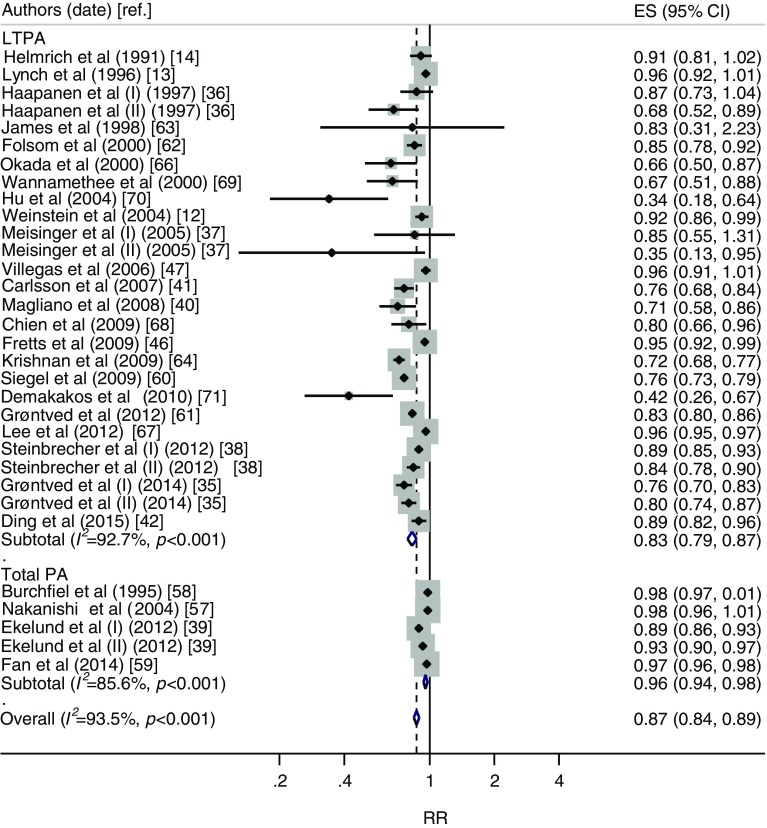
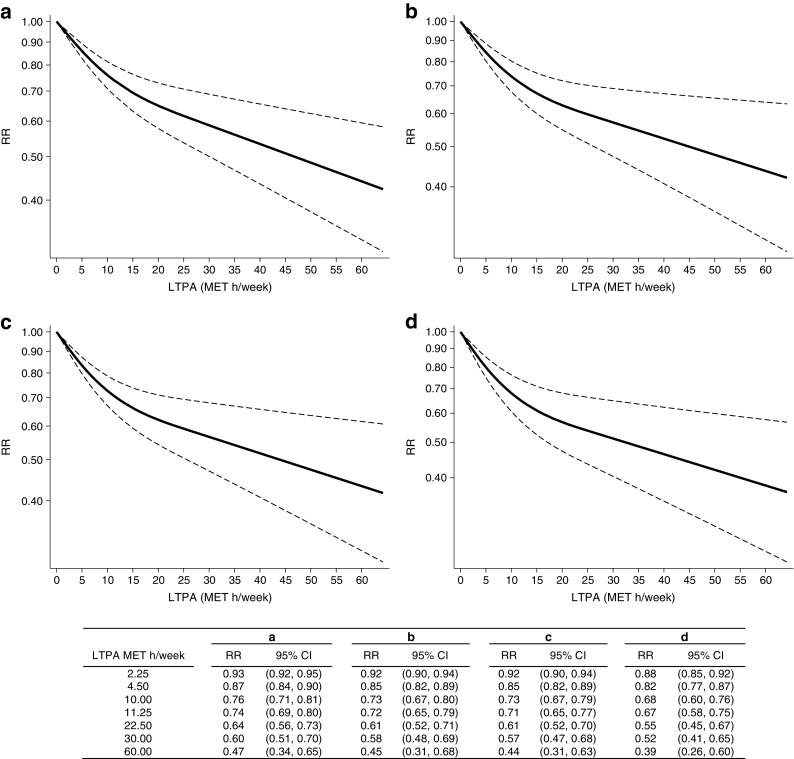
Verification
Claims the paper makes
The claims and statistics of this paper haven’t been checked yet.
Free: it reads the open-access text and checks the first 5 claims that cite a source we can check. Create a free account to check every claim.
Claims other papers make about this one
Each is checked against this paper’s own text: does it say what the citing paper says it does?
The source backs part of the claim, not all of it — or backs it for a different population, condition or comparison.
In the citing paper
“One such factor, physical activity, has long been known to reduce the risk of a wide range of diseases and conditions, including cardiovascular disease, stroke, and diabetes.8,9,10”
From Association of Levels of Physical Activity With Risk of Parkinson Disease: A Systematic Review and Meta-analysis (2018) · cites this paper as [10]
Experimental — accuracy not yet measuredThe cited source says what the claim attributes to it.
In the citing paper
“a meta-analysis of prospective cohort studies which found a clear dose-response relationship between physical activity and reduced risk of developing T2D [58]”
From Economic evaluation of wearable fitness trackers versus metformin for preventing type 2 diabetes in the UK population (2025) · cites this paper as [58]
In the citing paper
“People with obesity are at increased risk for a variety of medical disorders including hypertension, dyslipidemia, type 2 diabetes mellitus, cardiovascular disease (CVD), and several cancers [4–6]”
From Mediterranean Diet and Obesity-related Disorders: What is the Evidence? (2022) · cites this paper as [5]
Self-check
Percentages, sums and reported differences re-computed from the paper’s own numbers.
The self-check needs the paper’s full text.
Citations
Cites
R: A Language and Environment for Statistical Computing
R Core Team (2025) · doi:10.32614/r.manuals · Cited by 352,181
Meta-analysis in clinical trials
DerSimonian, R., & Laird, N. (1986) · Controlled Clinical Trials · doi:10.1016/0197-2456(86)90046-2 · Cited by 39,552 · cited 1×
“Studyspecific dose–response coefficients were pooled using the DerSimonian–Laird estimator in a random-effects model [50].”
MethodReduction in the incidence of type 2 diabetes with lifestyle intervention or metformin
(2002) · New England Journal of Medicine · doi:10.1056/nejmoa012512 · Cited by 19,011
Lozano, R., Naghavi, M., Foreman, K., Lim, S., Shibuya, K., Aboyans, V., Abraham, J., Adair, T., Aggarwal, R., Ahn, S. Y., et al. (2012) · The Lancet · doi:10.1016/s0140-6736(12)61728-0 · Cited by 14,070
Garber, C. E., Blissmer, B., Deschenes, M. R., Franklin, B. A., Lamonte, M. J., Lee, I.-M., Nieman, D. C., & Swain, D. P. (2011) · Medicine & Science in Sports & Exercise · doi:10.1249/mss.0b013e318213fefb · Cited by 9,319 · cited 1×
“Public health guidelines [16, 17] recommend a minimum of 150 min of moderate to vigorous PA (MVPA) or 75 min vigorous PA (VPA) a week to maintain general health.”
BackgroundHealth benefits of physical activity: the evidence
Warburton, D. E. R. (2006) · Canadian Medical Association Journal · doi:10.1503/cmaj.051351 · Cited by 8,007
2011 Compendium of Physical Activities: A Second Update of Codes and MET Values
AINSWORTH, B. E., HASKELL, W. L., HERRMANN, S. D., MECKES, N., BASSETT, D. R., TUDOR-LOCKE, C., GREER, J. L., VEZINA, J., WHITT-GLOVER, M. C., & LEON, A. S. (2011) · Medicine & Science in Sports & Exercise · doi:10.1249/mss.0b013e31821ece12 · Cited by 6,317 · cited 1×
“5 and 7 marginal METs [MMETs]), respectively [34].”
BackgroundGlobal physical activity levels: surveillance progress, pitfalls, and prospects
Hallal, P. C., Andersen, L. B., Bull, F. C., Guthold, R., Haskell, W., & Ekelund, U. (2012) · The Lancet · doi:10.1016/s0140-6736(12)60646-1 · Cited by 5,711 · cited 1×
“Selfreport data suggest that around a third of adults globally are not meeting these targets [18].”
BackgroundPan, X.-R., Li, G.-W., Hu, Y.-H., Wang, J.-X., Yang, W.-Y., An, Z.-X., Hu, Z.-X., Juan-Lin, Xiao, J.-Z., Cao, H.-B., et al. (1997) · Diabetes Care · doi:10.2337/diacare.20.4.537 · Cited by 4,320
Prince, S. A., Adamo, K. B., Hamel, M., Hardt, J., Connor Gorber, S., & Tremblay, M. (2008) · International Journal of Behavioral Nutrition and Physical Activity · doi:10.1186/1479-5868-5-56 · Cited by 3,162
Research works printed but not linked: 2
- International Diabetes Federation IDF diabetes atlas 2015 7 Brussels International Diabetes Federation 35914061
- FAO/WHO/UNU Expert Consultation (2011) Human energy requirements. Chapter 5: Energy requirements of adults. Available from: www.fao.org/3/a-y5686e.pdf, Accessed 12 Nov 2015
Cited by
Items 401–429 of 429
Rasmussen, C. L., Dumuid, D., Hron, K., Gupta, N., Jørgensen, M. B., Nabe‐Nielsen, K., & Holtermann, A. (2021) · Figshare · doi:10.6084/m9.figshare.14926774
Ballin, M., Nordström, P., Niklasson, J., Alamäki, A., Condell, J., Tedesco, S., & Nordström, A. (2020) · Figshare · doi:10.6084/m9.figshare.13310233
Berntzen, B. J., Tolvanen, A. J., Kujala, U. M., Silventoinen, K., Vuoksimaa, E., Kaprio, J., & Aaltonen, S. (2024) · Figshare · doi:10.6084/m9.figshare.26713040
Berntzen, B. J., Tolvanen, A. J., Kujala, U. M., Silventoinen, K., Vuoksimaa, E., Kaprio, J. A., & Aaltonen, S. (2024) · Figshare · doi:10.6084/m9.figshare.26713025
Stokholm, L., Grønkjær, M. S., Rungby, J., Mortensen, E. L., & Osler, M. (2026) · PLoS ONE · doi:10.1371/journal.pone.0340622
“We had no information on physical inactivity and diet, which are both associated with T2D [31–33] and modest predictors of cognitive decline [34–36], and thus could have explained part of the association.”
Guo, M., Chen, S., Wang, H., Fang, J., & Yang, M. (2026) · Diabetes Research and Clinical Practice · doi:10.1016/j.diabres.2026.113135
The quality of life of competitive and recreational Spanish surfers and para surfers
González-Noriega, M., Cancela, A., García-Naveira, A., & Barquín, R. R. (2026) · Acta Psychologica · doi:10.1016/j.actpsy.2026.106433
Lehbab, A., Berrichi, M., Benmouna, M., Kachekouche, Y., Dib, H., Bekkara, M. S., Djeziri, F. Z., Yezli, M. F., Chaouche, T. M., Khan, A. S., et al. (2026) · Nutrition & Food Science · doi:10.1108/nfs-02-2025-0075
Al-Shariqi, F., Al-Mazrooei, S., Al-Harrasi, A., Ismail, M., Al-Kathiri, F., Al-Ismaili, M., Al-Harthi, R., Al-Rajhi, Z., Al-Maimani, S., Al-Kharusi, Z., et al. (2026) · Journal of the Oman Medical Association · doi:10.3390/joma3010004
“%) emerged as a critical modifiable factor even though it was not statistically significant, contrary to meta-analyses [23].”
Ndiaye, F. K. (2017) · theses.fr (ABES) · doi:10.70675/2a2c2612zd875z404bzbc26zda085d7bc617 · Cited by 1
Laget, J. (2019) · theses.fr (ABES) · doi:10.70675/ed653ea5z6ff4z4915za368z0d23f0cd9829 · Cited by 1
Fosse‐Edorh, S. (2022) · theses.fr (ABES) · doi:10.70675/bc30f236ze8bez4498z9a3cza853e3734009 · Cited by 1
Alawadi, F., Abdelgadir, E., Hassoun, A. A. K., Abusnana, S., Afandi, B. O., Aldahmani, K. M., Alkaabi, J., Bashier, A. M., Bayado, F., Belaila, B. A. B., et al. (2026) · Dubai Diabetes and Endocrinology Journal · doi:10.18502/ddej.v32i1.21067
Bui, T. T., Nakamoto, M., Nakamoto, A., Tojyo, A., Hata, A., Aki, N., Shikama, Y., Bando, Y., Ichihara, T., Minagawa, T., et al. (2026) · Journal of Diabetes & Metabolic Disorders · doi:10.1007/s40200-026-01985-6
“Higher physical activity has been linked to substantially lower risk of T2D [41], whereas smoking has been associated with increased T2D risk [42].”
Bever, A. M., Du, M., Eliassen, A. H., Giovannucci, E. L., Liang, L., Stampfer, M. J., Rimm, E. B., Willett, W. C., Hu, F. B., & Song, M. (2026) · The Lancet Regional Health - Americas · doi:10.1016/j.lana.2026.101540
Yuan, M., Peng, F., Song, B., Liu, C., Zhang, X., Zhang, C., & Sun, Y. (2026) · Frontiers in Public Health · doi:10.3389/fpubh.2026.1857690
“Regular physical activity has been associated with lower risks of cardiovascular disease (2), type 2 diabetes (3), hypertension (4), cancer (5), obesity (6), and depression (7).”
The association between diabetes mellitus and low back pain: a systematic review and meta-analysis
Noaimi, M. E., Hareni, N., Jehpsson, L., & Rosengren, B. E. (2026) · BMC Musculoskeletal Disorders · doi:10.1186/s12891-026-10226-z
“This reduction in physical activity is a well-established risk factor for metabolic decline, whereas maintaining physical activity levels serves as a protective factor against the development of DM [63, 64].”
Sun, Z., Ma, Y., Wu, X., & Wang, P. (2026) · Research Square · doi:10.21203/rs.3.rs-10312704/v1
Feter, N., Rodrigues, K. D. S., de Paula, D., Scherer, L. C., Feter, J., Schröeder, N., Vieira, Y. P., Rocha, J. Q., Cunha, L., Silva, L. S. D., et al. (2026) · BMJ Open · doi:10.1136/bmjopen-2026-117508 · Cited by 1
Silva, L. A., Cintra, A. C. D. B., & dos Reis, I. G. M. (2026) · International Journal of Environmental Research and Public Health · doi:10.3390/ijerph23080946
“While the bulk of epidemiological studies indicates that PI is associated with a higher risk of developing diabetes [17], the prevalence of diabetes in this study was not associated with PI across any age range in either female or male participants, including those aged 50 to 59 years (Tables 4 and…”
Goldney, J., Rowlands, A. V., Hamza, M., Hall, A. P., Misra, S., Wilmot, E. G., Edwardson, C. L., Khunti, K., Yates, T. E., Daynes, E., et al. (2026) · Metabologia · doi:10.1007/s44357-026-00007-5
“Despite this, extensive prospective epidemiological research suggests that adverse lifestyle behaviours typically precede incident type 2 diabetes [10–12], and evidence suggests that levels of physical activity do not change meaningfully after diagnosis [45].”
Rokhmah, F. D., Rachmawati, L., Setyaningsih, A., Faizin, M., Khaila, R. N. A., Putra, L. R., & Priyanti, L. J. (2026) · BIO Web of Conferences · doi:10.1051/bioconf/202624705005
Zhao, W., Yan, Q., & Mou, C. (2026) · Research Square · doi:10.21203/rs.3.rs-10551124/v1
Shweta, F., Partab, F., Kumar, S., Kashish, F., Kumar, A., Kumari, P., Virwani, L., Bheesham, N., & Virwani, S. (2026) · Cureus · doi:10.7759/cureus.115553
“Smith and colleagues also reported a nonlinear association between PA and incident type 2 diabetes in prospective cohort studies [18].”
Wang, Z., Su, C., Lu, J., Hasebe, M., Mejía‐García, A., Tsao, H. M., Hu, J., Lu, T., & Zhou, S. (2026) · Cardiovascular Diabetology · doi:10.1186/s12933-026-03363-1
“Large prospective cohorts and Mendelian randomization (MR) studies have linked guideline-adherent MVPA to a substantially lower risk of incident T2D, including risk reductions that persist after accounting for adiposity and other lifestyle factors [3, 4].”
Xu, W.-Z., Zhou, Y., Wang, J., Zhang, X.-Y., Lv, H., & Wang, R. (2026) · BMC Public Health · doi:10.1186/s12889-026-29341-6
Cureau, F. V., Elías, G., Costa, E. C., & Barreira, T. V. (2026) · Sport Sciences for Health · doi:10.1007/s11332-026-01971-8
“Regular participation in physical activity (PA) positively influences overall health and quality of life, reducing the risk of developing conditions like obesity, hypertension, and type 2 diabetes [1–3].”
Fuglsang, J., Kampmann, U., Johnsen, S. K., McIntyre, D. H., & Ovesen, P. (2026) · Elsevier eBooks · doi:10.1016/b978-0-443-13265-0.00007-0
Kossmann, D., Hirschbeck, A., Khorikian–Ghazari, N., Petzold, M. B., Hasan, A., & Röh, A. (2026) · Bundesgesundheitsblatt - Gesundheitsforschung - Gesundheitsschutz · doi:10.1007/s00103-026-04316-5
Metadata
- Authors
- Smith, A. D., Crippa, A., Woodcock, J., & Brage, S.
- Affiliations
- University of Cambridge (GB)
- Karolinska Institutet (SE)
- Corresponding author
- Smith, Andrea D.
- Venue
- Diabetologia
- Published
- 2016-10-17
- Volume
- 59
- Issue
- 12
- Pages
- 2527-2545
- ISSN
- 0012-186X (ISSN-L)
- 1432-0428
- PMC
- PMC6207340
- OpenAlex
- W2531081995
- Cited by
- 430
- References
- 76
- Citations by year
- 2026: 30 · 2025: 54 · 2024: 60 · 2023: 43 · 2022: 53 · 2021: 56 · 2020: 42 · 2019: 47 · 2018: 27 · 2017: 16
- FWCI
- 3.52
- Type
- journal article
- Language
- en
- Open access
- hybrid
- doi.org
- Locations
- Diabetologia (publishedVersion, cc-by)
- Europe PMC (PubMed Central) (publishedVersion, other-oa)
- PubMed Central (publishedVersion, cc-by)
- PubMed (publishedVersion)
- UCL Discovery (University College London) (submittedVersion)
- Apollo (University of Cambridge) (submittedVersion, cc-by)
- Apollo (cc-by)
- Funders
- Medical Research Council (MC_UU_12015/3)
- Topics
- Health Sciences › Medicine › Public Health, Environmental and Occupational Health › Physical Activity and Health
- Health Sciences › Medicine › Endocrinology, Diabetes and Metabolism › Diabetes, Cardiovascular Risks, and Lipoproteins
- Health Sciences › Medicine › Endocrinology, Diabetes and Metabolism › Diabetes Management and Research
- Keywords
- physical activity, type 2 diabetes, leisure-time physical activity, dose-response relationship, diabetes incidence, physical activity intensity, public health recommendations
- MeSH terms
- Animals, Diabetes Mellitus, Type 2, Humans, Leisure Activities, Motor Activity, Prospective Studies, Risk Factors, Exercise
About these checks
Registry, retraction, Cites and statistics results are computed, not judged, with one exception: a printed reference that no index lists is read once by a model before it counts as a citation error. Claims are extracted by a model and kept only when their quote appears verbatim in the text; each cited source is then checked, with a model’s help, for whether it says what the claim relies on. Those verdicts can be wrong — read the claim’s quote and the cited source before relying on one.
Statistics and arithmetic are recomputed, not judged.
Confidence bands are shown only for fields calibrated on our annotated test set. None is calibrated yet, so no band is shown.
What counts as a claim ›How we measure confidence ›How we check this ›
Are you an author, or do you see a problem with this page? Request a review
Data sources
Bibliographic data: Semantic Scholar, OpenAlex, Crossref.
Contains information from the Semantic Scholar Academic Graph Datasets, made available under the ODC Attribution License (ODC-BY 1.0).
Semantic Scholar’s data is described in: Kinney, R., et al. (2023). The Semantic Scholar Open Data Platform. arXiv:2301.10140.
