

Short-term decreased physical activity with increased sedentary behaviour causes metabolic derangements and altered body composition: effects in individuals with and without a first-degree relative with type 2 diabetes
Open accessThe DOI matches its Crossref record; 36 of the 36 references it cites were found in a registry or an index.
Abstract
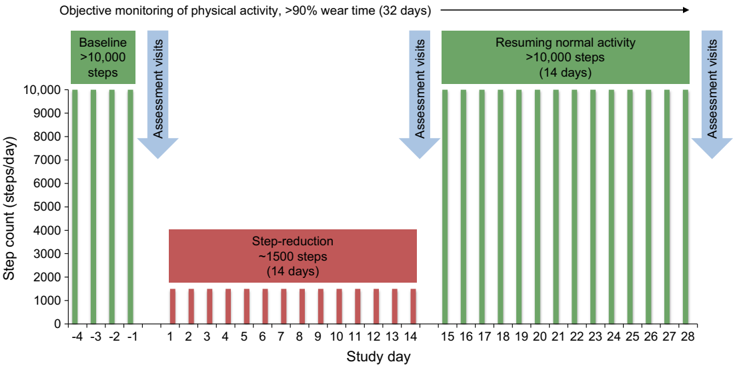
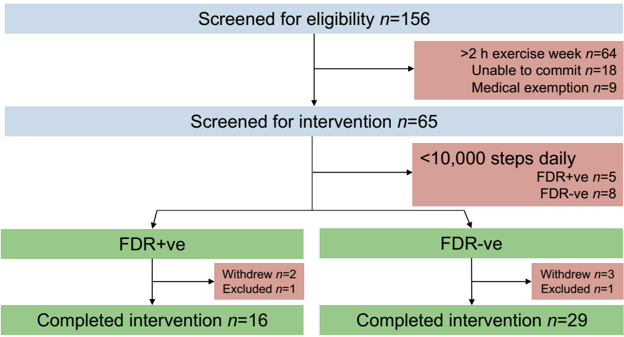
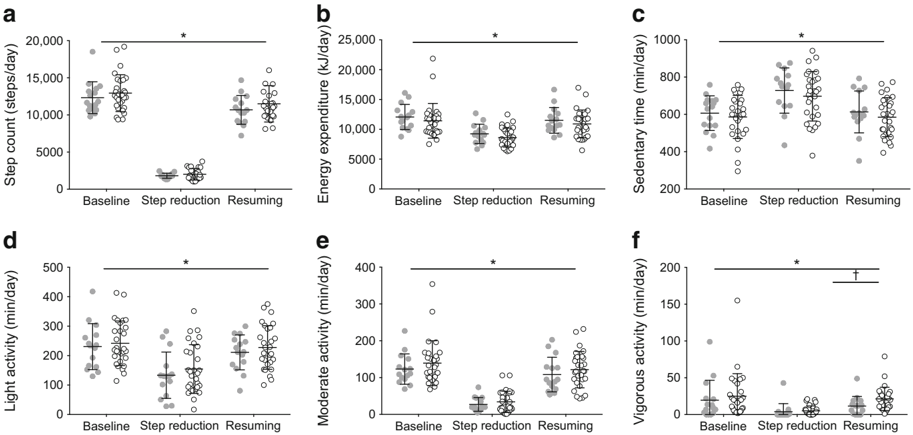
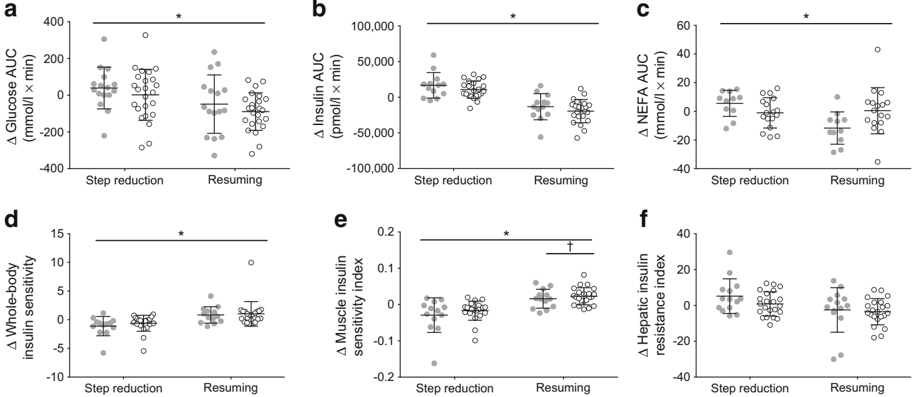
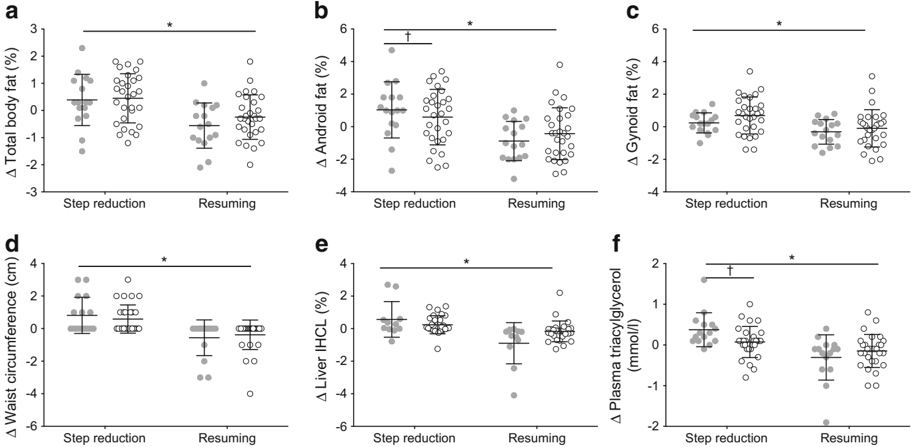
AIMS/HYPOTHESIS: Low physical activity levels and sedentary behaviour are associated with obesity, insulin resistance and type 2 diabetes. We investigated the effects of a short-term reduction in physical activity with increased sedentary behaviour on metabolic profiles and body composition, comparing the effects in individuals with first-degree relatives with type 2 diabetes (FDR+ve) vs those without (FDR-ve). METHODS: Forty-five habitually active participants (16 FDR+ve [10 female, 6 male] and 29 FDR-ve [18 female, 11 male]; age 36 ± 14 years) were assessed at baseline, after 14 days of step reduction and 14 days after resuming normal activity. We determined physical activity (using a SenseWear armband), cardiorespiratory fitness ([Formula: see text]), body composition (dual-energy x-ray absorptiometry/magnetic resonance spectroscopy) and multi-organ insulin sensitivity (OGTT) at each time point. Statistical analysis was performed using a two-factor between-groups ANCOVA, with data presented as mean ± SD or (95% CI). RESULTS: There were no significant between-group differences in physical activity either at baseline or following step reduction. During the step-reduction phase, average daily step count decreased by 10,285 steps (95% CI 9389, 11,182; p < 0.001), a reduction of 81 ± 8%, increasing sedentary time by 223 min/day (151, 295; p < 0.001). Pooling data from both groups, following step reduction there was a significant decrease in whole-body insulin sensitivity (Matsuda index) (p < 0.001), muscle insulin sensitivity index (p < 0.001), cardiorespiratory fitness (p = 0.002) and lower limb lean mass (p = 0.004). Further, there was a significant increase in total body fat (p < 0.001), liver fat (p = 0.001) and LDL-cholesterol (p = 0.013), with a borderline significant increase in NEFA AUC during the OGTT (p = 0.050). Four significant between-group differences were apparent: following step reduction, FDR+ve participants accumulated 1.5% more android fat (0.4, 2.6; p = 0.008) and increased triacylglycerol by 0.3 mmol/l (0.1, 0.6; p = 0.044). After resuming normal activity, FDR+ve participants engaged in lower amounts of vigorous activity (p = 0.006) and had lower muscle insulin sensitivity (p = 0.023). All other changes were reversed with no significant between-group differences. CONCLUSIONS/INTERPRETATION: A short-term reduction in physical activity with increased sedentary behaviour leads to a reversible reduction in multi-organ insulin sensitivity and cardiorespiratory fitness, with concomitant increases in central and liver fat and dyslipidaemia. The effects are broadly similar in FDR+ve and FDR-ve individuals. Public health recommendations promoting physical activity should incorporate advice to avoid periods of sedentary behaviour.
Overview
The claims and statistics of this paper haven’t been checked yet.
Free: it reads the open-access text and checks the first 5 claims that cite a source we can check. Create a free account to check every claim.
Integrity signals
Registry
Cites
Statistics
Figures
Verification
Claims the paper makes
The claims and statistics of this paper haven’t been checked yet.
Free: it reads the open-access text and checks the first 5 claims that cite a source we can check. Create a free account to check every claim.
Claims other papers make about this one
Each is checked against this paper’s own text: does it say what the citing paper says it does?
The source backs part of the claim, not all of it — or backs it for a different population, condition or comparison.
In the citing paper
“it is perhaps unsurprising that glucose metabolism is also perturbed in all these studies, typically with maintenance of normal glucose profiles but hyperinsulinaemia.28–30”
From Reduced physical activity in young and older adults: Metabolic and musculoskeletal implications (2019) · cites this paper as [28]
Experimental — accuracy not yet measuredThe source backs part of the claim, not all of it — or backs it for a different population, condition or comparison.
In the citing paper
“Older adults with lower baseline lean mass and slower rate of recovery following physical inactivity may be even more prone to these acute periods of muscle disuse when compared to young people [2,241].”
From Nutrition for Older Athletes: Focus on Sex-Differences (2021) · cites this paper as [2]
Experimental — accuracy not yet measuredIn the citing paper
“Insulin resistance has been primarily linked to impaired peripheral insulin resistance (inability of skeletal muscle to increase glucose uptake) rather than hepatic insulin resistance (an inability to inhibit endogenous glucose production) in both free-living28,29 and bed-rest34 models of reduced PA.”
From Reduced physical activity in young and older adults: Metabolic and musculoskeletal implications (2019) · cites this paper as [28]
In the citing paper
“Subsequent studies have reported findings in agreement; one example states an increase in body fat (predominately central) and magnetic resonance spectroscopy (MRS) measured liver fat was observed in 45 young, healthy males and females following a similar step-reduction protocol.28”
From Reduced physical activity in young and older adults: Metabolic and musculoskeletal implications (2019) · cites this paper as [28]
In the citing paper
“When focusing on studies in which individuals transition from well-defined high levels of PA (~10,000 steps/day) to low (~1500 steps/day) for ⩾14 days, the results are striking, especially when one considers the volunteers were young, healthy adults.28–30”
From Reduced physical activity in young and older adults: Metabolic and musculoskeletal implications (2019) · cites this paper as [28]
3 more claims about this paper
Create a free account to see every claim other papers make about this one.
Self-check
Percentages, sums and reported differences re-computed from the paper’s own numbers.
The self-check needs the paper’s full text.
Citations
Cites
Matthews, D. R., Hosker, J. P., Rudenski, A. S., Naylor, B. A., Treacher, D. F., & Turner, R. C. (1985) · Diabetologia · doi:10.1007/bf00280883 · Cited by 31,502
Lee, I.-M., Shiroma, E. J., Lobelo, F., Puska, P., Blair, S. N., & Katzmarzyk, P. T. (2012) · The Lancet · doi:10.1016/s0140-6736(12)61031-9 · Cited by 8,215
Matsuda, M., & DeFronzo, R. A. (1999) · Diabetes Care · doi:10.2337/diacare.22.9.1462 · Cited by 5,621
Sedentary Behavior Research Network (SBRN)—Terminology Consensus Project process and outcome
on behalf of SBRN Terminology Consensus Project Participants, Tremblay, M. S., Aubert, S., Barnes, J. D., Saunders, T. J., Carson, V., Latimer-Cheung, A. E., Chastin, S. F. M., Altenburg, T. M., & Chinapaw, M. J. M. (2017) · International Journal of Behavioral Nutrition and Physical Activity · doi:10.1186/s12966-017-0525-8 · Cited by 3,793
Skeletal Muscle Insulin Resistance Is the Primary Defect in Type 2 Diabetes
DeFronzo, R. A., & Tripathy, D. (2009) · Diabetes Care · doi:10.2337/dc09-s302 · Cited by 2,102
Wilmot, E. G., Edwardson, C. L., Achana, F. A., Davies, M. J., Gorely, T., Gray, L. J., Khunti, K., Yates, T., & Biddle, S. J. H. (2012) · Diabetologia · doi:10.1007/s00125-012-2677-z · Cited by 1,789 · cited 1×
“Although the changes observed in this short period were reversed on resumption of normal physical activity, the pattern of the changes provides mechanistic insight into how chronically increased sedentary behaviour contributes to development of the metabolic syndrome, type 2 diabetes, non-alcoholic fatty liver disease…”
BackgroundChurch, T. S., Thomas, D. M., Tudor-Locke, C., Katzmarzyk, P. T., Earnest, C. P., Rodarte, R. Q., Martin, C. K., Blair, S. N., & Bouchard, C. (2011) · PLoS ONE · doi:10.1371/journal.pone.0019657 · Cited by 1,294 · cited 1×
“reduced physical activity and more sedentary time) [14, 15].”
BackgroundLarge-scale physical activity data reveal worldwide activity inequality
Althoff, T., Sosič, R., Hicks, J. L., King, A. C., Delp, S. L., & Leskovec, J. (2017) · Nature · doi:10.1038/nature23018 · Cited by 1,000
Hu, F. B., Sigal, R. J., Rich-Edwards, J. W., Colditz, G. A., Solomon, C. G., Willett, W. C., Speizer, F. E., & Manson, J. E. (1999) · JAMA · doi:10.1001/jama.282.15.1433 · Cited by 914 · cited 1×
“First-degree relatives of individuals with type 2 diabetes (FDR+ve) have a threefold increased risk of developing the disease compared with those without a family history (FDR −ve) [21]; this risk can further be increased with low physical activity levels [22].”
BackgroundThe role of skeletal muscle insulin resistance in the pathogenesis of the metabolic syndrome
Petersen, K. F., Dufour, S., Savage, D. B., Bilz, S., Solomon, G., Yonemitsu, S., Cline, G. W., Befroy, D., Zemany, L., Kahn, B. B., et al. (2007) · Proceedings of the National Academy of Sciences · doi:10.1073/pnas.0705408104 · Cited by 759
Cited by
Items 101–179 of 179
Physiological Responses to Sedentary Behaviour
Pinto, A. J., Bergouignan, A., & Dempsey, P. C. (2023) · Springer series on epidemiology and public health · doi:10.1007/978-3-031-41881-5_5 · Cited by 3
Therapeutic resistance training: proposal for an algorithm-based approach
Weber, F., Stark, C., Bloch, W., Böcker, J., Drey, M., Gehlert, S., Maier, B., Peters, K., Sachs, L., Schoser, B. G. H., et al. (2024) · Translational Exercise Biomedicine · doi:10.1515/teb-2024-2009 · Cited by 3
Queiroz, J. D. N. (2021) · LA Referencia (Red Federada de Repositorios Institucionales de Publicaciones Científicas) · Cited by 3
Dalle, S., Vanderbeke, K., Schouten, M., Ramaekers, M., Abou‐Samra, M., Costamagna, D., & Koppo, K. (2025) · The Journals of Gerontology Series A · doi:10.1093/gerona/glaf189 · Cited by 2
Notaro, N. M., Budd, J. M., Green, L. A., Caruso, B. R., & Dyck, D. J. (2025) · Journal of Pharmacology and Experimental Therapeutics · doi:10.1016/j.jpet.2025.103712 · Cited by 2
Mendoza, M. F., Anzelmo, M. A., Rojas, A. A., Suan, N. M., & Lavie, C. J. (2026) · Current Atherosclerosis Reports · doi:10.1007/s11883-026-01439-7 · Cited by 2
Stärkung des Immunsystems durch Sport – Eine Frage der Intensität
Freese, J., & Proschinger, S. (2020) · Erfahrungsheilkunde · doi:10.1055/a-1205-8025 · Cited by 2
Goodrich, J. A., Frisco, D. J., Ryan, S. P. P., Newman, A. A., Trikha, S. R. J., Braun, B., Bell, C., & Byrnes, W. C. (2020) · Experimental Physiology · doi:10.1113/ep088329 · Cited by 2
Huber-Pérez, T., Campos-Núñez, V., Guerrero-Ibacache, P., Hernández-Jaña, S., Palma-Leal, X., Zavala-Crichton, J. P., & Cristi‐Montero, C. (2020) · Journal of Movement & Health · doi:10.5027/jmh-vol18-issue2(2021)art107 · Cited by 2
Short-term changes in time spent sitting during the COVID-19 pandemic
Aladro-Gonzalvo, A. R. (2021) · Gazzetta Medica Italiana Archivio per le Scienze Mediche · doi:10.23736/s0393-3660.20.04459-9 · Cited by 2
Saghiv, M. S., & Sagiv, M. S. (2020) · Springer eBooks · doi:10.1007/978-3-030-48806-2_2 · Cited by 2
Tetlow, N., Dewar, A., Arina, P., Tan, M., Sridhar, A. N., Kelly, J. D., Arulkumaran, N., Stephens, R. C. M., Martín, D., Moonesinghe, R., et al. (2024) · BJA Open · doi:10.1016/j.bjao.2023.100255 · Cited by 2
Bhundoo, A. K., Wilke, J., & Pillay, J. D. (2024) · African Journal of Inter/Multidisciplinary Studies · doi:10.51415/ajims.v6i1.1485 · Cited by 2
Sedentary Behavior and Cardiovascular Disease/Risk of Mortality: A Literature Review
赵, 凯. (2024) · Advances in Clinical Medicine · doi:10.12677/acm.2024.1441199 · Cited by 1
Desafíos y retos de la movilidad sustentable en el mundo contemporáneo
de la Cultura, D. D. E. (2024) · doi:10.29057/books.166 · Cited by 1
Hwang, D.-J., Choi, D.-H., & Hyun, A.-H. (2025) · Frontiers in Physiology · doi:10.3389/fphys.2025.1711436 · Cited by 1
Jiarong, Z., Xu, Z., Qi, M., Jingjing, W., Fan, C., Yini, W., Mengdie, W., Yuting, Y., & Qiang, F. (2026) · BMC Geriatrics · doi:10.1186/s12877-026-07230-2 · Cited by 1
Yang, Y. L., & Li, Y. (2026) · Archives of Medical Science · doi:10.5114/aoms/221198 · Cited by 1
Rosero, R., Uribe, J. P., Jaramillo, A. M. A., Polanco, J. P., Rizo, P. C., Jaramillo, A. U., Salazar, I. C., Arbeláez, J. P. Á., & Cendales, J. G. (2019) · Revista Repertorio de Medicina y Cirugía · doi:10.31260/repertmedcir.v28.n3.2019.954 · Cited by 1
Mohamed, I. (2022) · Open Journal of Social Sciences · doi:10.4236/jss.2022.107019 · Cited by 1
Uçurum, S. G., AKDENİZ, S., ŞAHİN, A., & Kaya, D. Ö. (2022) · Türk fizyoterapi ve rehabilitasyon dergisi · doi:10.21653/tjpr.995388 · Cited by 1
Ghasemi, P., Shirvani, H., & Shamsoddini, A. (2023) · Hormone Molecular Biology and Clinical Investigation · doi:10.1515/hmbci-2022-0057 · Cited by 1
Impact of Covid-19 pandemic on physical activity and energy expenditure
Sundro, R. (2022) · Zenodo (CERN European Organization for Nuclear Research) · doi:10.5281/zenodo.6849827 · Cited by 1
Moghadam, M. R. S. F., Jandari, S., Vaezi, A., & Rezvani, R. (2023) · Qeios · doi:10.32388/g24my5 · Cited by 1
Role of Adipose-to-Muscle Communication in PCB126-induced Metabolic Defects
Caron, A. (2018) · uO Research (University of Ottawa) · doi:10.20381/ruor-22048
Bovolini, J. A. F. (2019) · Portuguese National Funding Agency for Science, Research and Technology (RCAAP Project by FCT) · doi:10.34626/1wsk-tj75
Rollo, A. S. (2019) · Scholarship@Western (Western University)
Hidden Threat During Quarantine and Transition Phase in Elderly: The Need for Special Precautions
Nathania, M., & Sunardi, D. (2020) · Journal Of The Indonesian Medical Association · doi:10.47830/jinma-vol.70.10-2020-292
Chronic stress-associated accelerated ageing: inflammation and oxidative stress treatment
Petersen-Ross, K. S. (2020) · SUNScholar (Stellenbosch University)
Khan, A. H. D. S., Huma, T. Z. D. A., & Sohail, S. S. (2018) · Zenodo (CERN European Organization for Nuclear Research) · doi:10.5281/zenodo.1889035
Physical activity and health during the SARS-CoV2 pandemic
Wilke, J. (2022) · Publication Server of Goethe University Frankfurt am Main (Goethe University Frankfurt) · doi:10.21248/gups.71408
Şolpan, N. Ö., & Irmak, A. Y. (2023) · The Turkish Journal of Geriatrics · doi:10.29400/tjgeri.2023.348
Codella, R. (2023) · Springer eBooks · doi:10.1007/978-3-031-27192-2_16
Kerr, N. R. (2023) · MOspace Institutional Repository (University of Missouri) · doi:10.32469/10355/97056
تأثير احترازات الحظر الكلي لجائحة كورونا على نمط النشاط البدني للرياضيين في الأندية الصحية-
حسن, م. ب., أكبر, ع. ع., النصار, ف. م., & خان, ع. ف. (2022) · مجلة أسيوط لعلوم وفنون التربية الرياضية · doi:10.21608/jprr.2022.345296
Effect of Meal Frequency on Insulin Regulation in Athletes: A Cross-Sectional Study
Khan, S. A. (2024) · MedERA - Journal of CMH LMC and IOD · doi:10.61982/medera.v6i2.198
Budiawan, P. A. M., Tinduh, D., Prawitri, Y. D., & Deshmukh, M. (2025) · African Journal of Biomedical Research · doi:10.53555/ajbr.v28i1s.6271
Lifestyle Medicine in Patient Care
Fagundes, C. P., Merlo, G., & Rippe, J. M. (2025) · Oxford University Press eBooks · doi:10.1093/med/9780197640814.003.0015
Moghadam, M. R. S. F., Jandari, S., Vaezi, A., & Rezvani, R. (2023) · Qeios · doi:10.32388/g24my5.2
Huy, T. Q., Nguyet, N. M., & Trường, P. V. (2025) · Bangladesh Journal of Medical Science · doi:10.3329/bjms.v24i4.85382
Bhundoo, A. K. (2025) · DUT Open Scholar (Durban University of Technology) · doi:10.51415/10321/6135
Editorial: (Un)healthy lifestyles, aging, and type 2 diabetes
Duarte‐Mendes, P., Silva, F. M., & Teixeira, A. M. (2025) · Frontiers in Aging · doi:10.3389/fragi.2025.1696856
Wang, Z., Zou, P., Liu, M., Ruan, L., Niu, B., Zhang, C., Chen, L., & Zhang, Y. (2025) · International Journal of Surgery · doi:10.1097/js9.0000000000004444
Wilke, J., Rahlf, A. L., Füzéki, E., Groneberg, D. A., Hespanhol, L., Mai, P., de Oliveira, G. M., Robbin, J., Tan, B., Willwacher, S., et al. (2022) · Figshare · doi:10.6084/m9.figshare.21316220
Parlberg, L. M., Cheng, T., Caison, B., & Fratus, A. (2024) · Carolina Digital Repository (University of North Carolina at Chapel Hill) · doi:10.17615/a9zk-hn98
Parlberg, L. M., Cheng, T., Fratus, A., & Caison, B. (2024) · Carolina Digital Repository (University of North Carolina at Chapel Hill) · doi:10.17615/7hpk-hw11
Parlberg, L., Caison, B., Cheng, T., & Fratus, A. (2024) · Carolina Digital Repository (University of North Carolina at Chapel Hill) · doi:10.17615/h5b1-9z70
Cheng, T., Caison, B., Fratus, A., & Parlberg, L. M. (2024) · Carolina Digital Repository (University of North Carolina at Chapel Hill) · doi:10.17615/1erp-pa98
Bannell, D. J. (2025) · Liverpool John Moores University · doi:10.24377/ljmu.t.00023492
Ding, D., Cheng, M., del Pozo Cruz, B., Lin, T., Sun, S., Zhang, L., Yang, Q., Ma, Z., Wang, J., Jia, Y., et al. (2021) · Figshare · doi:10.6084/m9.figshare.14235070
Creedon, L. (2025) · Nottingham ePrints (University of Nottingham)
Exercise and nutritional strategies for human muscle metabolic regulation with ageing and inactivity
Marshall, R. N. (2023) · University of Birmingham Institutional Research Archive (University of Birmingham)
Freitas, D. F. L. (2023) · Portuguese National Funding Agency for Science, Research and Technology (RCAAP Project by FCT)
Characterising human muscle protein synthetic responses across the physical activity spectrum
Shad, B. J. (2019) · University of Birmingham Institutional Research Archive (University of Birmingham)
Laine, S. (2025) · UTUPub (University of Turku)
Physiological phenotyping of human frailty
Taylor, J. (2024) · Nottingham ePrints (University of Nottingham)
López Olivares, M. (2022) · Institutional Repository of the University of Granada (University of Granada)
An, L. (2025) · Electronic Theses of LMU Munich (Ludwig-Maximilians-Universität München) · doi:10.5282/edoc.35741
Predictive Analysis of Weight Management in Men and Women Aged 25 to 45 Using the Decision Tree
Laabidi, A., Tkatek, S., & Ouhssine, M. (2026) · Lecture notes in networks and systems · doi:10.1007/978-3-032-12869-0_18
Sturrock, S. L. (2025) · TSpace (University of Toronto)
The effect of exercise on brain derived neurotrophic factor levels:A meta-analysis study
Süleymanoğulları, M., & Yüksekokulu, B. E. V. S. (2024) · Ağrı İbrahim Çeçen University Institutional Repository
Exploring Exercise Intensity in Outpatient Cardiac Rehabilitation and Home Environments.
Hannan, A. L. (n.d.) · Bond University Research Portal (Bond University)
Evaluación de la efectividad de un programa de actividad física universitario
Varela, M. M. F. (2022) · Investigo repository of University of Vigo (University of Vigo) · doi:10.35869/11093/3342
Anczyk, A., Handzel, K. M., Wysoczański, J., Śliwa, W., Tłoczek, W., Twardowska, D., Kret, D. I., Szlachta, W. K., Karbowiak, K., Nawrat, N., et al. (2026) · Quality in Sport · doi:10.12775/qs.2026.55.70980
Prameswari, A. A., Lestari, L. A., & Pramantara, I. D. P. (2026) · Amerta Nutrition · doi:10.20473/amnt.v10i2.2026.307-313
HARJUNEN, M. A. (2026) · Jyväskylä University Digital Archive (University of Jyväskylä)
The association between sedentary behavior and eye diseases: a prospective study from the UK Biobank
Zhang, X., & Zou, H. (2026) · BMC Public Health · doi:10.1186/s12889-026-28869-x
AIKAWA, H., Hatamoto, Y., Yoshimura, E., Tobina, T., Ayabe, M., Ichida, Y., Kato, M., & Kumahara, H. (2026) · European Journal of Applied Physiology · doi:10.1007/s00421-026-06378-4
The effects of the Covid-19 pandemic on the physical activity of the population
Rigatos, S., & Κιέκκας, Π. (2024) · Nosīleutikī
GAMBARAN AKTIVITAS FISIK PADA LANSIA DENGAN DIABETES MELLITUS
Hartanti, A. P. (2026) · UMM Institutional Repository (Universitas Muhammadiyah Malang)
Katinė, A., Gray, S. R., & Ratkevičius, A. (2026) · Baltic Journal of Sport and Health Sciences · doi:10.33607/bjshs.v2i143.2361
Нагаева, Е. И., Рашидович, Х. Д., Степановна, С. Н., Николаевич, З. Д., Юрьевна, Г. Е., & Насиповна, З. З. (2026) · Scientific Notes of V I Vernadsky Crimean Federal University Biology Chemistry
Reidy, P. T., Betz, A. C., Yeager, J. P., Liu, Y., Binion, R., Ayton, S., Lefkowitz, L., Slattery, E. W., Skujins, R. J., Walsh, A., et al. (2026) · Physiological Reports · doi:10.14814/phy2.71151
Mouvement et alternance entre travail et récupération
Colonnese, A., & Panzironi, R. (2026) · doi:10.68559/lsh.libro.19.fr
Movimento e alternanza tra lavoro e recupero
Colonnese, A., & Panzironi, R. (2026) · doi:10.68559/lsh.libro.19.it
Movement and the balance between work and recovery
Colonnese, A., & Panzironi, R. (2026) · doi:10.68559/lsh.libro.19
Bewegung und der Wechsel zwischen Belastung und Erholung
Colonnese, A., & Panzironi, R. (2026) · doi:10.68559/lsh.libro.19.de
Movimiento y alternancia entre trabajo y recuperación
Colonnese, A., & Panzironi, R. (2026) · doi:10.68559/lsh.libro.19.es
Metadata
- Authors
- Bowden Davies, K. A., Sprung, V. S., Norman, J. A., Thompson, A., Mitchell, K. L., Halford, J. C. G., Harrold, J. A., Wilding, J. P. H., Kemp, G. J., & Cuthbertson, D. J.
- Affiliations
- University of Liverpool (GB)
- ORCID
- Venue
- Diabetologia
- Published
- 2018-04-18
- Volume
- 61
- Issue
- 6
- Pages
- 1282-1294
- ISSN
- 0012-186X (ISSN-L)
- 1432-0428
- OpenAlex
- W2802469991
- Cited by
- 138
- References
- 36
- Citations by year
- 2026: 6 · 2025: 16 · 2024: 15 · 2023: 14 · 2022: 22 · 2021: 29 · 2020: 27 · 2019: 6 · 2018: 3
- FWCI
- 11.14
- Type
- journal article
- Language
- en
- Open access
- hybrid
- doi.org
- Licence
- cc-by
- creativecommons.org/licenses/by/4.0 (tdm)
- Locations
- Diabetologia (publishedVersion, cc-by)
- PubMed (publishedVersion)
- e-space (Manchester Metropolitan University) (acceptedVersion)
- White Rose Research Online (University of Leeds, The University of Sheffield, University of York) (acceptedVersion)
- Liverpool John Moores University (acceptedVersion)
- Funders
- MRC-Arthritis Research UK Centre for Integrated research into Musculoskeletal Ageing
- Diabetes UK (13/0004719)
- Topics
- Health Sciences › Medicine › Public Health, Environmental and Occupational Health › Physical Activity and Health
- Health Sciences › Medicine › Endocrinology, Diabetes and Metabolism › Adipokines, Inflammation, and Metabolic Diseases
- Health Sciences › Medicine › Endocrinology, Diabetes and Metabolism › Diabetes, Cardiovascular Risks, and Lipoproteins
- Keywords
- type 2 diabetes, sedentary behavior, physical activity reduction, first-degree relatives, insulin sensitivity, cardiorespiratory fitness, body composition, liver fat, LDL cholesterol, free fatty acids, insulin resistance, skeletal muscle insulin sensitivity, total body fat, metabolic disorders
- MeSH terms
- Adipose Tissue, Adult, Anthropometry, Body Composition, Diabetes Mellitus, Type 2, Family Health, Female, Glucose Tolerance Test, Humans, Insulin, Insulin Resistance, Life Style, Lipids, Liver, Male, Middle Aged, Magnetic Resonance Spectroscopy, Physical Fitness, Exercise, Muscle, Skeletal, Young Adult, Sedentary Behavior
About these checks
Registry, retraction, Cites and statistics results are computed, not judged, with one exception: a printed reference that no index lists is read once by a model before it counts as a citation error. Claims are extracted by a model and kept only when their quote appears verbatim in the text; each cited source is then checked, with a model’s help, for whether it says what the claim relies on. Those verdicts can be wrong — read the claim’s quote and the cited source before relying on one.
Statistics and arithmetic are recomputed, not judged.
Confidence bands are shown only for fields calibrated on our annotated test set. None is calibrated yet, so no band is shown.
What counts as a claim ›How we measure confidence ›How we check this ›
Are you an author, or do you see a problem with this page? Request a review
Data sources
Bibliographic data: Semantic Scholar, OpenAlex, Crossref.
Contains information from the Semantic Scholar Academic Graph Datasets, made available under the ODC Attribution License (ODC-BY 1.0).
Semantic Scholar’s data is described in: Kinney, R., et al. (2023). The Semantic Scholar Open Data Platform. arXiv:2301.10140.
