

Short-term decreased physical activity with increased sedentary behaviour causes metabolic derangements and altered body composition: effects in individuals with and without a first-degree relative with type 2 diabetes
Open accessThe DOI matches its Crossref record; 36 of the 36 references it cites were found in a registry or an index.
Abstract
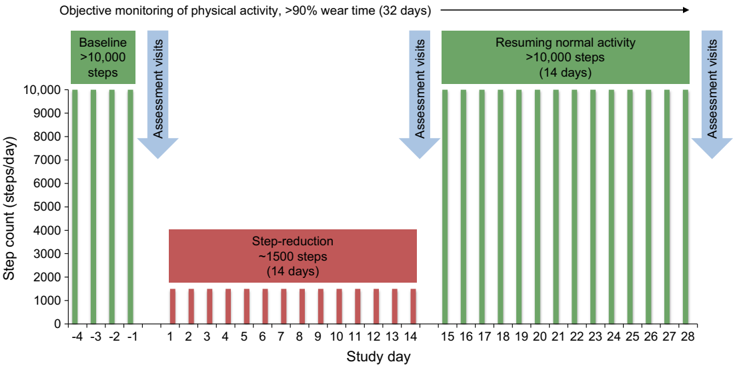
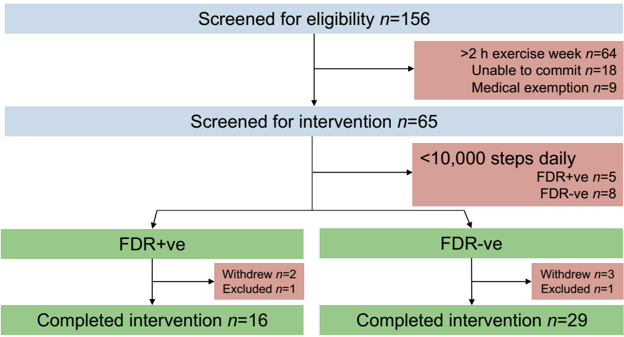
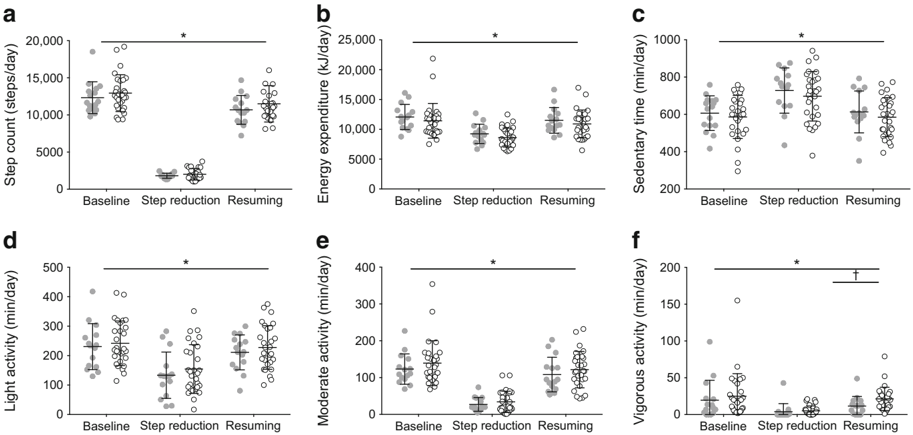
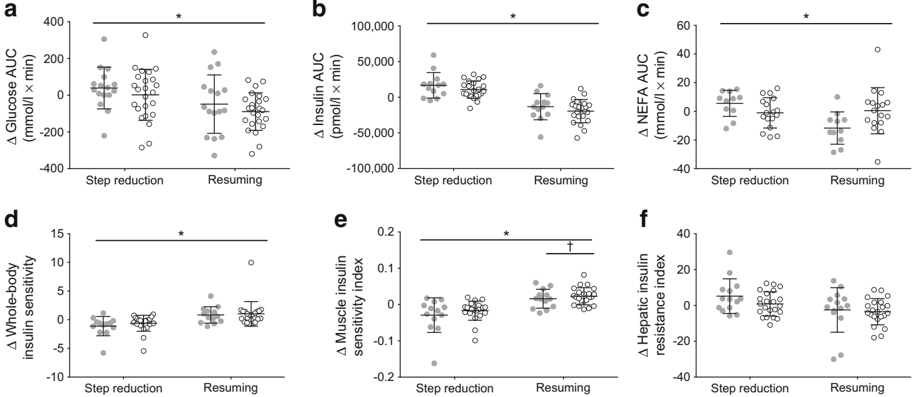
AIMS/HYPOTHESIS: Low physical activity levels and sedentary behaviour are associated with obesity, insulin resistance and type 2 diabetes. We investigated the effects of a short-term reduction in physical activity with increased sedentary behaviour on metabolic profiles and body composition, comparing the effects in individuals with first-degree relatives with type 2 diabetes (FDR+ve) vs those without (FDR-ve). METHODS: Forty-five habitually active participants (16 FDR+ve [10 female, 6 male] and 29 FDR-ve [18 female, 11 male]; age 36 ± 14 years) were assessed at baseline, after 14 days of step reduction and 14 days after resuming normal activity. We determined physical activity (using a SenseWear armband), cardiorespiratory fitness ([Formula: see text]), body composition (dual-energy x-ray absorptiometry/magnetic resonance spectroscopy) and multi-organ insulin sensitivity (OGTT) at each time point. Statistical analysis was performed using a two-factor between-groups ANCOVA, with data presented as mean ± SD or (95% CI). RESULTS: There were no significant between-group differences in physical activity either at baseline or following step reduction. During the step-reduction phase, average daily step count decreased by 10,285 steps (95% CI 9389, 11,182; p < 0.001), a reduction of 81 ± 8%, increasing sedentary time by 223 min/day (151, 295; p < 0.001). Pooling data from both groups, following step reduction there was a significant decrease in whole-body insulin sensitivity (Matsuda index) (p < 0.001), muscle insulin sensitivity index (p < 0.001), cardiorespiratory fitness (p = 0.002) and lower limb lean mass (p = 0.004). Further, there was a significant increase in total body fat (p < 0.001), liver fat (p = 0.001) and LDL-cholesterol (p = 0.013), with a borderline significant increase in NEFA AUC during the OGTT (p = 0.050). Four significant between-group differences were apparent: following step reduction, FDR+ve participants accumulated 1.5% more android fat (0.4, 2.6; p = 0.008) and increased triacylglycerol by 0.3 mmol/l (0.1, 0.6; p = 0.044). After resuming normal activity, FDR+ve participants engaged in lower amounts of vigorous activity (p = 0.006) and had lower muscle insulin sensitivity (p = 0.023). All other changes were reversed with no significant between-group differences. CONCLUSIONS/INTERPRETATION: A short-term reduction in physical activity with increased sedentary behaviour leads to a reversible reduction in multi-organ insulin sensitivity and cardiorespiratory fitness, with concomitant increases in central and liver fat and dyslipidaemia. The effects are broadly similar in FDR+ve and FDR-ve individuals. Public health recommendations promoting physical activity should incorporate advice to avoid periods of sedentary behaviour.
Overview
The claims and statistics of this paper haven’t been checked yet.
Free: it reads the open-access text and checks the first 5 claims that cite a source we can check. Create a free account to check every claim.
Integrity signals
Registry
Cites
Statistics
Figures
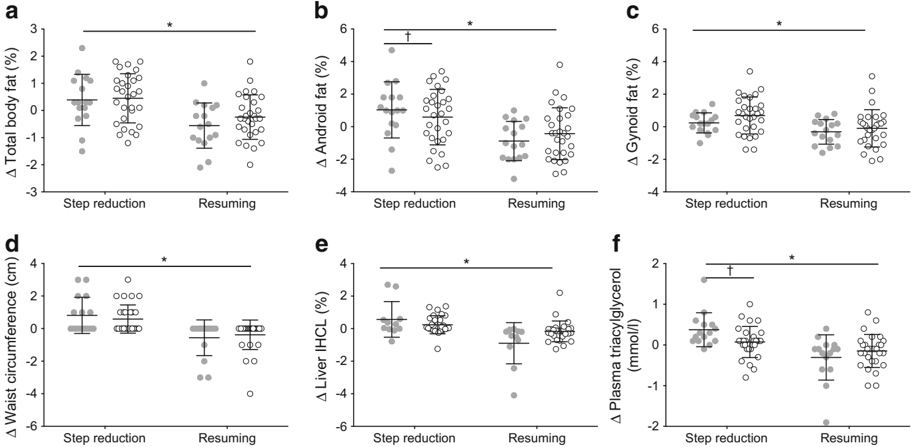
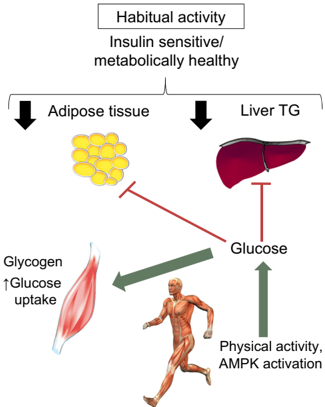
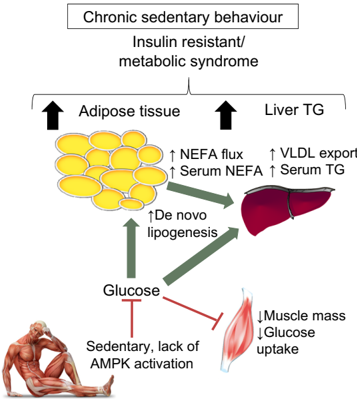
Verification
Claims the paper makes
The claims and statistics of this paper haven’t been checked yet.
Free: it reads the open-access text and checks the first 5 claims that cite a source we can check. Create a free account to check every claim.
Claims other papers make about this one
Each is checked against this paper’s own text: does it say what the citing paper says it does?
The source backs part of the claim, not all of it — or backs it for a different population, condition or comparison.
In the citing paper
“it is perhaps unsurprising that glucose metabolism is also perturbed in all these studies, typically with maintenance of normal glucose profiles but hyperinsulinaemia.28–30”
From Reduced physical activity in young and older adults: Metabolic and musculoskeletal implications (2019) · cites this paper as [28]
Experimental — accuracy not yet measuredThe source backs part of the claim, not all of it — or backs it for a different population, condition or comparison.
In the citing paper
“Older adults with lower baseline lean mass and slower rate of recovery following physical inactivity may be even more prone to these acute periods of muscle disuse when compared to young people [2,241].”
From Nutrition for Older Athletes: Focus on Sex-Differences (2021) · cites this paper as [2]
Experimental — accuracy not yet measuredIn the citing paper
“Insulin resistance has been primarily linked to impaired peripheral insulin resistance (inability of skeletal muscle to increase glucose uptake) rather than hepatic insulin resistance (an inability to inhibit endogenous glucose production) in both free-living28,29 and bed-rest34 models of reduced PA.”
From Reduced physical activity in young and older adults: Metabolic and musculoskeletal implications (2019) · cites this paper as [28]
In the citing paper
“Subsequent studies have reported findings in agreement; one example states an increase in body fat (predominately central) and magnetic resonance spectroscopy (MRS) measured liver fat was observed in 45 young, healthy males and females following a similar step-reduction protocol.28”
From Reduced physical activity in young and older adults: Metabolic and musculoskeletal implications (2019) · cites this paper as [28]
In the citing paper
“When focusing on studies in which individuals transition from well-defined high levels of PA (~10,000 steps/day) to low (~1500 steps/day) for ⩾14 days, the results are striking, especially when one considers the volunteers were young, healthy adults.28–30”
From Reduced physical activity in young and older adults: Metabolic and musculoskeletal implications (2019) · cites this paper as [28]
3 more claims about this paper
Create a free account to see every claim other papers make about this one.
Self-check
Percentages, sums and reported differences re-computed from the paper’s own numbers.
The self-check needs the paper’s full text.
Citations
Cites
Matthews, D. R., Hosker, J. P., Rudenski, A. S., Naylor, B. A., Treacher, D. F., & Turner, R. C. (1985) · Diabetologia · doi:10.1007/bf00280883 · Cited by 31,502
Lee, I.-M., Shiroma, E. J., Lobelo, F., Puska, P., Blair, S. N., & Katzmarzyk, P. T. (2012) · The Lancet · doi:10.1016/s0140-6736(12)61031-9 · Cited by 8,215
Matsuda, M., & DeFronzo, R. A. (1999) · Diabetes Care · doi:10.2337/diacare.22.9.1462 · Cited by 5,621
Sedentary Behavior Research Network (SBRN)—Terminology Consensus Project process and outcome
on behalf of SBRN Terminology Consensus Project Participants, Tremblay, M. S., Aubert, S., Barnes, J. D., Saunders, T. J., Carson, V., Latimer-Cheung, A. E., Chastin, S. F. M., Altenburg, T. M., & Chinapaw, M. J. M. (2017) · International Journal of Behavioral Nutrition and Physical Activity · doi:10.1186/s12966-017-0525-8 · Cited by 3,793
Skeletal Muscle Insulin Resistance Is the Primary Defect in Type 2 Diabetes
DeFronzo, R. A., & Tripathy, D. (2009) · Diabetes Care · doi:10.2337/dc09-s302 · Cited by 2,102
Wilmot, E. G., Edwardson, C. L., Achana, F. A., Davies, M. J., Gorely, T., Gray, L. J., Khunti, K., Yates, T., & Biddle, S. J. H. (2012) · Diabetologia · doi:10.1007/s00125-012-2677-z · Cited by 1,789 · cited 1×
“Although the changes observed in this short period were reversed on resumption of normal physical activity, the pattern of the changes provides mechanistic insight into how chronically increased sedentary behaviour contributes to development of the metabolic syndrome, type 2 diabetes, non-alcoholic fatty liver disease…”
BackgroundChurch, T. S., Thomas, D. M., Tudor-Locke, C., Katzmarzyk, P. T., Earnest, C. P., Rodarte, R. Q., Martin, C. K., Blair, S. N., & Bouchard, C. (2011) · PLoS ONE · doi:10.1371/journal.pone.0019657 · Cited by 1,294 · cited 1×
“reduced physical activity and more sedentary time) [14, 15].”
BackgroundLarge-scale physical activity data reveal worldwide activity inequality
Althoff, T., Sosič, R., Hicks, J. L., King, A. C., Delp, S. L., & Leskovec, J. (2017) · Nature · doi:10.1038/nature23018 · Cited by 1,000
Hu, F. B., Sigal, R. J., Rich-Edwards, J. W., Colditz, G. A., Solomon, C. G., Willett, W. C., Speizer, F. E., & Manson, J. E. (1999) · JAMA · doi:10.1001/jama.282.15.1433 · Cited by 914 · cited 1×
“First-degree relatives of individuals with type 2 diabetes (FDR+ve) have a threefold increased risk of developing the disease compared with those without a family history (FDR −ve) [21]; this risk can further be increased with low physical activity levels [22].”
BackgroundThe role of skeletal muscle insulin resistance in the pathogenesis of the metabolic syndrome
Petersen, K. F., Dufour, S., Savage, D. B., Bilz, S., Solomon, G., Yonemitsu, S., Cline, G. W., Befroy, D., Zemany, L., Kahn, B. B., et al. (2007) · Proceedings of the National Academy of Sciences · doi:10.1073/pnas.0705408104 · Cited by 759
Cited by
Martinez-Ferran, M., de la Guía-Galipienso, F., Sanchis-Gomar, F., & Pareja-Galeano, H. (2020) · Nutrients · doi:10.3390/nu12061549 · Cited by 376
Physiology of sedentary behavior
Pinto, A. J., Bergouignan, A., Dempsey, P. C., Roschel, H., Owen, N., Gualano, B., & Dunstan, D. W. (2023) · Physiological Reviews · doi:10.1152/physrev.00022.2022 · Cited by 358
Reduced physical activity in young and older adults: Metabolic and musculoskeletal implications
Bowden Davies, K. A., Pickles, S., Sprung, V. S., Kemp, G. J., Alam, U., Moore, D. R., Tahrani, A. A., & Cuthbertson, D. J. (2019) · Therapeutic Advances in Endocrinology and Metabolism · doi:10.1177/2042018819888824 · Cited by 278
Self-citationWilke, J., Mohr, L., Tenforde, A. S., Edouard, P., Fossati, C., González-Gross, M., Sánchez Ramírez, C., Laiño, F., Tan, B., Pillay, J. D., et al. (2021) · International Journal of Environmental Research and Public Health · doi:10.3390/ijerph18052235 · Cited by 265
Multisystem physiological perspective of human frailty and its modulation by physical activity
Taylor, J. A., Greenhaff, P. L., Bartlett, D. B., Jackson, T. A., Duggal, N. A., & Lord, J. M. (2023) · Physiological Reviews · doi:10.1152/physrev.00037.2021 · Cited by 197
Physical Activity Over the Lifecourse and Cardiovascular Disease
Perry, A. S., Dooley, E. E., Master, H., Spartano, N. L., Brittain, E. L., & Pettee Gabriel, K. (2023) · Circulation Research · doi:10.1161/circresaha.123.322121 · Cited by 188
Nunes, E. A., Stokes, T., McKendry, J., Currier, B. S., & Phillips, S. M. (2022) · American Journal of Physiology-Cell Physiology · doi:10.1152/ajpcell.00425.2021 · Cited by 183
Jakobsson, J., Malm, C., Furberg, M., Ekelund, U., & Svensson, M. (2020) · Frontiers in Sports and Active Living · doi:10.3389/fspor.2020.00057 · Cited by 172
Santini, Z. I., Jose, P. E., Koyanagi, A., Meilstrup, C., Nielsen, L., Madsen, K. R., & Koushede, V. (2020) · Social Science & Medicine · doi:10.1016/j.socscimed.2020.112906 · Cited by 162
Benefits of physical activity and physical exercise in the time of pandemic.
Amatriain-Fernández, S., Murillo-Rodríguez, E. S., Gronwald, T., Machado, S., & Budde, H. (2020) · Psychological Trauma: Theory, Research, Practice, and Policy · doi:10.1037/tra0000643 · Cited by 122
Ismail, L. C., Osaili, T. M. I., Mohamad, M. N., Marzouqi, A. M. A., Jarrar, A. H., Zampelas, A., Habib-Mourad, C., Jamous, D. O. A., Ali, H. I., Sabbah, H. A., et al. (2020) · British Journal Of Nutrition · doi:10.1017/s0007114520004547 · Cited by 134
Insulin translates unfavourable lifestyle into obesity
Kolb, H., Stumvoll, M., Kramer, W., Kempf, K., & Martin, S. (2018) · BMC Medicine · doi:10.1186/s12916-018-1225-1 · Cited by 113
Silva, F. M., Duarte‐Mendes, P., Teixeira, A. M., Soares, C., & Ferreira, J. P. (2024) · Scientific Reports · doi:10.1038/s41598-024-51832-y · Cited by 300
Hannan, A. L., Harders, M. P., Hing, W., Climstein, M., Coombes, J. S., & Furness, J. (2019) · BMC Sports Science, Medicine and Rehabilitation · doi:10.1186/s13102-019-0126-8 · Cited by 119
Hydes, T., Alam, U., & Cuthbertson, D. J. (2021) · Frontiers in Nutrition · doi:10.3389/fnut.2021.640557 · Cited by 120
Self-citationContributions of physical inactivity and sedentary behavior to metabolic and endocrine diseases
Kerr, N. R., & Booth, F. W. (2022) · Trends in Endocrinology and Metabolism · doi:10.1016/j.tem.2022.09.002 · Cited by 112
Rahman, M. E., Islam, M. S., Bishwas, M. S., Moonajilin, M. S., & Gozal, D. (2020) · Heliyon · doi:10.1016/j.heliyon.2020.e05392 · Cited by 108
Sánchez, G. F. L., López‐Bueno, R., Gil-Salmerón, A., Zauder, R., Skalska, M., Jastrzębska, J., Jastrzębski, Z., Schuch, F. B., Grabovac, I., Tully, M. A., et al. (2020) · European Journal of Public Health · doi:10.1093/eurpub/ckaa159 · Cited by 103
Yaribeygi, H., Maleki, M., Sathyapalan, T., Jamialahmadi, T., & Sahebkar, A. (2021) · Journal of Diabetes Research · doi:10.1155/2021/7796727 · Cited by 91
Obesity: pathophysiology and therapeutic interventions
Kong, Y., Yang, H., Nie, R., Zhang, X., Zuo, F., Zhang, H., & Nian, X. (2025) · Molecular Biomedicine · doi:10.1186/s43556-025-00264-9 · Cited by 89
Farinha, J. B., Ramis, T. R., Vieira, A., Macedo, R. C. O., Rodrigues-Krause, J. D. C., Boeno, F. P., Schroeder, H. T., Muller, C. H. D. L., Boff, W., Krause, M. D. S., et al. (2018) · Journal of Diabetes and its Complications · doi:10.1016/j.jdiacomp.2018.09.008 · Cited by 86
Wilke, J., Rahlf, A. L., Füzéki, E., Groneberg, D. A., Hespanhol, L., Mai, P., de Oliveira, G. M., Robbin, J., Tan, B., Willwacher, S., et al. (2022) · Sports Medicine - Open · doi:10.1186/s40798-022-00515-x · Cited by 78
Sedentary lifestyle and body composition in type 2 diabetes
Li, D., Yang, Y., Gao, Z.-Y., Zhao, L.-H., Yang, X., Xu, F., Yu, C., Zhang, X., Wang, X., Wang, L., et al. (2022) · Diabetology & Metabolic Syndrome · doi:10.1186/s13098-021-00778-6 · Cited by 75
Ding, D., Cheng, M., Cruz, B. D. P., Lin, T., Sun, S., Zhang, L., Yang, Q., Ma, Z., Wang, J., Jia, Y., et al. (2021) · International Journal of Behavioral Nutrition and Physical Activity · doi:10.1186/s12966-021-01106-x · Cited by 69
Comparison of Physical Activity Levels in Youths before and during a Pandemic Lockdown
Bronikowska, M., Krzysztoszek, J., Łopatka, M., Ludwiczak, M., & Pluta, B. (2021) · International Journal of Environmental Research and Public Health · doi:10.3390/ijerph18105139 · Cited by 65
Queiroz, J. D. N., Macedo, R. C. O., dos Santos, G. C., Munhoz, S. V., Machado, C. L. F., de Menezes, R. L., Menzem, E. N., Moritz, C. E. J., Pinto, R. S., Tinsley, G. M., et al. (2023) · British Journal of Nutrition · doi:10.1017/s0007114522001581 · Cited by 39
Pediatric Flatfeet—A Disease Entity That Demands Greater Attention and Treatment
Bresnahan, P. J., & Juanto, M. A. (2020) · Frontiers in Pediatrics · doi:10.3389/fped.2020.00019 · Cited by 64
O’Donovan, S. D., Lenz, M., Goossens, G. H., Kallen, C., Eussen, S. J. P. M., Stehouwer, C. D. A., van Greevenbroek, M. M. J., Schram, M. T., Sep, S. J. S., Peeters, R., et al. (2019) · Scientific Reports · doi:10.1038/s41598-019-45858-w · Cited by 52
The immune-modulatory effects of exercise should be favorably harnessed against COVID-19
Codella, R., Chirico, A., Lucidi, F., Ferrulli, A., Torre, A. L., & Luzi, L. (2020) · Journal of Endocrinological Investigation · doi:10.1007/s40618-020-01403-5 · Cited by 50
Daniele, A., Lucas, S. J. E., & Rendeiro, C. (2022) · Frontiers in Physiology · doi:10.3389/fphys.2022.998380 · Cited by 50
When COVID-19 affects muscle: effects of quarantine in older adults
Moro, T., & Paoli, A. (2020) · European Journal of Translational Myology · doi:10.4081/ejtm.0.9069 · Cited by 51
Understanding NAFLD: From Case Identification to Interventions, Outcomes, and Future Perspectives
Clayton‐Chubb, D., Kemp, W. W., Majeed, A., Lubel, J. S., Hodge, A., & Roberts, S. K. (2023) · Nutrients · doi:10.3390/nu15030687 · Cited by 48
Prete, M., Luzzetti, A., Augustin, L. S. A., Porciello, G., Montagnese, C., Calabrese, I., Ballarin, G., Coluccia, S., Patel, L., Vitale, S., et al. (2021) · Nutrients · doi:10.3390/nu13061923 · Cited by 45
When COVID-19 affects muscle: effects of quarantine in older adults
Moro, T., & Paoli, A. (2020) · European Journal of Translational Myology · doi:10.4081/ejtm.2020.9069 · Cited by 46
von Loeffelholz, C., Roth, J., Coldewey, S. M., & Birkenfeld, A. L. (2021) · Biomedicines · doi:10.3390/biomedicines9121853 · Cited by 41
Sui, H., Dou, J., Shi, B., & Cheng, X. (2024) · Frontiers in Physiology · doi:10.3389/fphys.2024.1349253 · Cited by 39
Julian, V., Bergsten, P., Forslund, A. H., Ahlström, H. K., Ciba, I., Dahlbom, M., Furthner, D., Gomahr, J., Kullberg, J., Maruszczak, K., et al. (2022) · Pediatric Obesity · doi:10.1111/ijpo.12897 · Cited by 36
Liu, Y., Zhang, E., Li, H., Ge, X., Hu, F., Cai, Y., & Xiang, M. (2024) · Child and Adolescent Psychiatry and Mental Health · doi:10.1186/s13034-024-00705-3 · Cited by 34
Ferrari, M., Speight, J., Beath, A., Browne, J. L., & Mosely, K. (2020) · Psychology Health & Medicine · doi:10.1080/13548506.2020.1749292 · Cited by 32
The physiological benefits of sitting less and moving more: Opportunities for future research
Hwang, C., Chen, S.-H., Chou, C., Grigoriadis, G., Liao, T., Fancher, I. S., Arena, R. A., & Phillips, S. A. (2021) · Progress in Cardiovascular Diseases · doi:10.1016/j.pcad.2020.12.010 · Cited by 33
Emerging and Established Therapeutic Approaches for Nonalcoholic Fatty Liver Disease
Brown, E. E., Hydes, T., Hamid, A., & Cuthbertson, D. J. (2021) · Clinical Therapeutics · doi:10.1016/j.clinthera.2021.07.013 · Cited by 31
Self-citationSooriyaarachchi, P., Francis, T. V., King, N. A., & Jayawardena, R. (2021) · Diabetes & Metabolic Syndrome Clinical Research & Reviews · doi:10.1016/j.dsx.2021.06.022 · Cited by 30
Li, Y., Su, S., Luo, B., Wang, J., & Liao, S. (2022) · International Journal of Disaster Risk Reduction · doi:10.1016/j.ijdrr.2022.102793 · Cited by 30
Siripoksup, P., Cao, G., Cluntun, A. A., Maschek, J. A., Pearce, Q., Brothwell, M. J., Jeong, M.-Y., Eshima, H., Ferrara, P. J., Opurum, P. C., et al. (2024) · Journal of Clinical Investigation · doi:10.1172/jci167371 · Cited by 30
Nutrition for Older Athletes: Focus on Sex-Differences
Strasser, B., Pesta, D., Rittweger, J., Burtscher, J., & Burtscher, M. (2021) · Nutrients · doi:10.3390/nu13051409 · Cited by 25
Sarto, F., Bottinelli, R., Franchi, M. V., Porcelli, S., Šimunič, B., Pišot, R., & Narici, M. V. (2023) · Acta Physiologica · doi:10.1111/apha.13986 · Cited by 26
Short-Term Physical Inactivity Induces Endothelial Dysfunction
Davies, K. A. B., Norman, J. A., Thompson, A., Mitchell, K. L., Harrold, J. A., Halford, J. C. G., Wilding, J. P. H., Kemp, G. J., Cuthbertson, D. J., & Sprung, V. S. (2021) · Frontiers in Physiology · doi:10.3389/fphys.2021.659834 · Cited by 24
Self-citationPhysical distancing ≠ physical inactivity
Meyer, S. M., Landry, M. J., Gustat, J., Lemon, S. C., & Webster, C. A. (2021) · Translational Behavioral Medicine · doi:10.1093/tbm/ibaa134 · Cited by 23
COVID-19: Are Non-Communicable Diseases Risk Factors for Its Severity?
Bello, B., & Useh, U. (2021) · American Journal of Health Promotion · doi:10.1177/0890117121990518 · Cited by 23
Physical Activity Time and Intensity in Physical Education During the COVID-19 Pandemic
Lourenço, J., Rodrigues, C., Flôres, F. S., & Soares, D. P. (2022) · Perceptual and Motor Skills · doi:10.1177/00315125221093906 · Cited by 22
Amagasa, S., Inoue, S., Murayama, H., Fujiwara, T., Kikuchi, H., Fukushima, N., Machida, M., CHASTIN, S. F. M., Owen, N. G., & Shobugawa, Y. (2020) · BMC Public Health · doi:10.1186/s12889-020-09343-8 · Cited by 20
Balboa‐Castillo, T., Andrade-Mayorga, O., Marzuca-Nassr, G. N., Morales, G. I., Ortíz, M. S., Schifferli, I., Aguilar-Farías, N., Soto, Á., V, & SAPUNAR, J. (2021) · Medwave · doi:10.5867/medwave.2021.04.8180 · Cited by 20
Effects of the COVID-19 pandemic on the global health of women aged 50 to 70 years
de Lima, J. G. R., Abud, G. F., de Freitas, E. C., & Júnior, C. R. B. (2021) · Experimental Gerontology · doi:10.1016/j.exger.2021.111349 · Cited by 20
Movement matters: short-term impacts of physical activity on mood and well-being
Pham, L. T., Hernandez, R., Spruijt‐Metz, D., Gonzalez, J. S., & Pyatak, E. A. (2023) · Journal of Behavioral Medicine · doi:10.1007/s10865-023-00407-9 · Cited by 18
Wanders, L., Gijbels, A., Bakker, E. A., Trouwborst, I., Jardon, K. M. C., Manusama, K., Hul, G. B. J., Feskens, E. J. M., Afman, L. A., Blaak, E. E., et al. (2023) · Acta Physiologica · doi:10.1111/apha.13945 · Cited by 17
Casella-Mariolo, J. R., Castagneto‐Gissey, L., Angelini, G., Zoli, A., Marini, P., Bornstein, S. R., Pournaras, D. J., Rubino, F., le Roux, C. W., Mingrone, G., et al. (2019) · EBioMedicine · doi:10.1016/j.ebiom.2019.07.069 · Cited by 16
Białkowski, A., Soszynski, P. A., Pinkas, J., Ostrowski, J., & Religioni, U. (2024) · Healthcare · doi:10.3390/healthcare12212140 · Cited by 15
Impact of the COVID-19 pandemic on phase 2 cardiac rehabilitation patients in Japan
Ogura, A., Izawa, K. P., Tawa, H., Kureha, F., Wada, M., Harada, N., Ikeda, Y., Kimura, K., Kondo, N., Kanai, M., et al. (2021) · Heart and Vessels · doi:10.1007/s00380-021-01783-5 · Cited by 15
Freitas, S. P., Júdice, P. B., Hetherington‐Rauth, M., Magalhães, J. P., Correia, I. R., Lopes, J. M. C., Strong, C., Matos, D. N., & Sardinha, L. B. (2020) · Experimental Gerontology · doi:10.1016/j.exger.2020.111175 · Cited by 14
Sedentary Lifestyle as a Leading cause of Some Diseases and Disability
Tjahjono, C. T., & Arthamin, M. Z. (2024) · Clinical and Research Journal in Internal Medicine · doi:10.21776/ub.crjim.2024.005.01.09 · Cited by 14
Hernández-Jaña, S., Huber-Pérez, T., Palma-Leal, X., Guerrero-Ibacache, P., Campos-Núñez, V., Zavala-Crichton, J. P., Jorquera-Aguilera, C., Sadarangani, K. P., Rodríguez‐Rodríguez, F., & Cristi‐Montero, C. (2020) · International Journal of Environmental Research and Public Health · doi:10.3390/ijerph17145149 · Cited by 13
Ebaditabar, M., Imani, H., Babaei, N., Davarzani, S., & Shab‐Bidar, S. (2020) · Obesity Medicine · doi:10.1016/j.obmed.2020.100309 · Cited by 13
Haris, F., Ilham, I., Taufan, J., Aulia, F., Gusril, G., Komaini, A., & Pranoto, N. W. (2023) · International journal of human movement and sports sciences · doi:10.13189/saj.2023.110323 · Cited by 13
The Significant Role of Physical Activity and Exercise in Health and Metabolic Diseases
Dimitriadis, G., Chryssanthopοulos, C., Philippou, Α., & Koutsilieris, M. (2025) · Physiologia · doi:10.3390/physiologia5040057 · Cited by 12
Silva, F. M., Duarte‐Mendes, P., Carvalho, E., Soares, C., Farinha, C. M. N., Serrano, J., Paulo, R. M., Massart, A. G. M., Rodrigues, R. N., Teixeira, A. M., et al. (2022) · Frontiers in Public Health · doi:10.3389/fpubh.2022.1040714 · Cited by 12
Slobodová, L., Oreská, Ľ., Schön, M., Krumpolec, P., Tirpáková, V., Jurina, P., Laurovič, J., Vajda, M., Nemec, M., Niess, E., et al. (2021) · Gerontology · doi:10.1159/000515325 · Cited by 12
Bohn, L., Barros, D. G. M., Borges‐Machado, F., Carrapatoso, S., Pizarro, A. I. N., & Carvalho, J. (2021) · Journal of Aging and Physical Activity · doi:10.1123/japa.2020-0395 · Cited by 12
Jakobsson, J., Cotgreave, I. A., Furberg, M., Arnberg, N., & Svensson, M. (2021) · Sports · doi:10.3390/sports9090121 · Cited by 10
Rollo, S., & Prapavessis, H. (2020) · Applied Psychology Health and Well-Being · doi:10.1111/aphw.12190 · Cited by 10
Ren, Z., Fan, H., Xue, Y., Yang, X., Liu, X., Luo, J., Zhao, J., Wang, L., Zhang, Y., & Liang, B. (2025) · BMC Public Health · doi:10.1186/s12889-025-22925-8 · Cited by 9
COVID-19: impatto sulla salute mentale e supporto psicosociale
Cantelmi, T., Lambiase, E., Pensavalli, M., Laselva, P., & Cecchetti, S. (2021) · MODELLI DELLA MENTE · doi:10.3280/mdm1-2020oa10908 · Cited by 9
Silva, F. M., Duarte‐Mendes, P., Ferreira, J. P., Carvalho, E., Monteiro, D., Massart, A. G. M., Farinha, C. M. N., Soares, C., & Teixeira, A. M. (2024) · Medicine & Science in Sports & Exercise · doi:10.1249/mss.0000000000003510 · Cited by 8
Fontanella, F. O., da Silva, D. F., Mazur, C. E., Federizzi, M., & Bennemann, G. D. (2019) · Revista Brasileira de Atividade Física & Saúde · doi:10.12820/rbafs.24e0108 · Cited by 8
Moghadam, M. R. S. F., Vaezi, A., Jandari, S., Araste, A., & Rezvani, R. (2024) · Aging Medicine · doi:10.1002/agm2.12287 · Cited by 8
Deng, K.-L., Li, H., Yang, W., Jin-li, H., Xu, Y., & Xiao, S. (2021) · Nutrients · doi:10.3390/nu13072163 · Cited by 8
Bovolini, A., Garcia, J., Andrade, M. A., & Duarte, J. A. (2020) · Physiology & Behavior · doi:10.1016/j.physbeh.2020.113040 · Cited by 7
Ke, H.-T., Hsieh, C.-L., & Cheng, W.-J. (2022) · Nutrients · doi:10.3390/nu14224941 · Cited by 7
Ciriminna, S., Veronese, N., Cannizzo, C., D’Aleo, A., Ganci, A., Lampo, S. E. M., Bifara, F., Battaglia, G., Messina, G., Giustino, V., et al. (2024) · Sustainability · doi:10.3390/su16031331 · Cited by 7
Is the Time Right for Preventive Cardiology Guidelines on Sedentary Behaviours and Sitting Time?
Riopel-Meunier, J., Poirier, P., Després, J., & Piché, M. (2024) · Canadian Journal of Cardiology · doi:10.1016/j.cjca.2024.12.024 · Cited by 7
Brun, J.-F., Myzia, J., Varlet-Marie, E., Mercier, J., & Raynaud de Mauverger, E. (2022) · Science & Sports · doi:10.1016/j.scispo.2022.03.002 · Cited by 6
Cemali, M., Öztürk, D., Sari, M. E., & Karaduman, A. A. (2025) · Journal of Aging and Physical Activity · doi:10.1123/japa.2024-0134 · Cited by 6
Liu, Z., Kuang, J., Yan, W., Zhu, Y. H., Yang, X., & Xu, Y. (2025) · Scientific Reports · doi:10.1038/s41598-025-22442-z · Cited by 6
Global Prevalence of Metabolic Disorders, Associated Factors and Management
Aanuoluwa, O. S. (2026) · INTERNATIONAL JOURNAL OF HEALTH AND PHARMACEUTICAL RESEARCH · doi:10.56201/ijhpr.vol.10.no4.2025.pg39.52 · Cited by 6
Eckart, A. C., & Ghimire, P. S. (2025) · Journal of Clinical Medicine · doi:10.3390/jcm14020458 · Cited by 6
James, J., Hardeman, W., Eborall, H., Goodall, M., & Wilding, J. P. H. (2021) · BMJ Open · doi:10.1136/bmjopen-2021-051638 · Cited by 6
Self-citationKarabulut, A., & Şahin, M. (2022) · Journal of Health Sciences and Medicine · doi:10.32322/jhsm.1062633 · Cited by 5
COVID-19 and obesity: an opportunity for change
Cuthbertson, D. J., Alam, U., & Tahrani, A. A. (2020) · Therapeutic Advances in Endocrinology and Metabolism · doi:10.1177/2042018820949742 · Cited by 5
Self-citationByeon, N., Shin, J.-H., Kim, S., Kim, W., & Lee, W. (2025) · Medical Science Monitor · doi:10.12659/msm.947877 · Cited by 4
Meyer, A., Kim, N., Nguyen, M., Misch, M., Marmo, K., Dowd, J., Will, C., Janosevic, M., & Stephenson, E. J. (2024) · Physiological Reports · doi:10.14814/phy2.70140 · Cited by 4
Silva, F. M., Ferreira, J. P., Teixeira, A. M., Massart, A. G. M., & Duarte‐Mendes, P. (2025) · Frontiers in Aging · doi:10.3389/fragi.2025.1603635 · Cited by 4
Role of Physical Activity in Positive Psychology Perspective
Parlakyıldız, S. (2024) · Psikiyatride Guncel Yaklasimlar - Current Approaches in Psychiatry · doi:10.18863/pgy.1446409 · Cited by 4
Physical Activity, Gut Microbiota, and the Risk of Dyslipidemia in a Community‐Based Cohort Study
Wang, W., Liang, S., Cao, H., Lyu, Y., Zhao, Q., Zhang, Z., & Yang, W. (2025) · Journal of the American Heart Association · doi:10.1161/jaha.125.043797 · Cited by 4
Sekiguchi, T., Hagiwara, Y., Yabe, Y., Sugawara, Y., Tsuji, I., & Itoi, E. (2021) · BMJ Open · doi:10.1136/bmjopen-2021-051751 · Cited by 4
Role of Exercise and Physical Activity in Promoting Weight Loss and Weight Loss Maintenance
Cuthbertson, D. J., & Dobbie, L. J. (2022) · Wiley eBooks · doi:10.1002/9781119695257.ch20 · Cited by 4
Self-citationTu, D., Song, Z., Ren, C., Hu, Y., Jin, Q., & Wang, Y. (2025) · BMC Public Health · doi:10.1186/s12889-025-21725-4 · Cited by 3
Li, X., Zhu, H., Xu, P., & Guo, Z. (2025) · Scientific Reports · doi:10.1038/s41598-025-07262-5 · Cited by 3
Threat of obesity behind COVID-19
Aini, N. (2021) · Jurnal kedokteran dan kesehatan Indonesia · doi:10.20885/jkki.vol12.iss2.art2 · Cited by 4
Insulin resistance: Unsolved issues of harm and use
Belik, E. V., & Gruzdeva, O. V. (2020) · Сибирский журнал клинической и экспериментальной медицины · doi:10.29001/2073-8552-2019-34-4-39-48 · Cited by 3
Pippi, R., & Fanelli, C. G. (2021) · Journal of Human Sport and Exercise · doi:10.14198/jhse.2022.174.09 · Cited by 3
The Physical Activity Level of Ophthalmologists at Work: A Pedometer-Based Study
Assayag, E., Wiener, R., Gelman, E., Abulafia, A., Wasser, L. M., Hanhart, J., Zadok, D., & Weill, Y. (2022) · Workplace Health & Safety · doi:10.1177/21650799221099039 · Cited by 3
Metadata
- Authors
- Bowden Davies, K. A., Sprung, V. S., Norman, J. A., Thompson, A., Mitchell, K. L., Halford, J. C. G., Harrold, J. A., Wilding, J. P. H., Kemp, G. J., & Cuthbertson, D. J.
- Affiliations
- University of Liverpool (GB)
- ORCID
- Venue
- Diabetologia
- Published
- 2018-04-18
- Volume
- 61
- Issue
- 6
- Pages
- 1282-1294
- ISSN
- 0012-186X (ISSN-L)
- 1432-0428
- OpenAlex
- W2802469991
- Cited by
- 138
- References
- 36
- Citations by year
- 2026: 6 · 2025: 16 · 2024: 15 · 2023: 14 · 2022: 22 · 2021: 29 · 2020: 27 · 2019: 6 · 2018: 3
- FWCI
- 11.14
- Type
- journal article
- Language
- en
- Open access
- hybrid
- doi.org
- Licence
- cc-by
- creativecommons.org/licenses/by/4.0 (tdm)
- Locations
- Diabetologia (publishedVersion, cc-by)
- PubMed (publishedVersion)
- e-space (Manchester Metropolitan University) (acceptedVersion)
- White Rose Research Online (University of Leeds, The University of Sheffield, University of York) (acceptedVersion)
- Liverpool John Moores University (acceptedVersion)
- Funders
- MRC-Arthritis Research UK Centre for Integrated research into Musculoskeletal Ageing
- Diabetes UK (13/0004719)
- Topics
- Health Sciences › Medicine › Public Health, Environmental and Occupational Health › Physical Activity and Health
- Health Sciences › Medicine › Endocrinology, Diabetes and Metabolism › Adipokines, Inflammation, and Metabolic Diseases
- Health Sciences › Medicine › Endocrinology, Diabetes and Metabolism › Diabetes, Cardiovascular Risks, and Lipoproteins
- Keywords
- type 2 diabetes, sedentary behavior, physical activity reduction, first-degree relatives, insulin sensitivity, cardiorespiratory fitness, body composition, liver fat, LDL cholesterol, free fatty acids, insulin resistance, skeletal muscle insulin sensitivity, total body fat, metabolic disorders
- MeSH terms
- Adipose Tissue, Adult, Anthropometry, Body Composition, Diabetes Mellitus, Type 2, Family Health, Female, Glucose Tolerance Test, Humans, Insulin, Insulin Resistance, Life Style, Lipids, Liver, Male, Middle Aged, Magnetic Resonance Spectroscopy, Physical Fitness, Exercise, Muscle, Skeletal, Young Adult, Sedentary Behavior
About these checks
Registry, retraction, Cites and statistics results are computed, not judged, with one exception: a printed reference that no index lists is read once by a model before it counts as a citation error. Claims are extracted by a model and kept only when their quote appears verbatim in the text; each cited source is then checked, with a model’s help, for whether it says what the claim relies on. Those verdicts can be wrong — read the claim’s quote and the cited source before relying on one.
Statistics and arithmetic are recomputed, not judged.
Confidence bands are shown only for fields calibrated on our annotated test set. None is calibrated yet, so no band is shown.
What counts as a claim ›How we measure confidence ›How we check this ›
Are you an author, or do you see a problem with this page? Request a review
Data sources
Bibliographic data: Semantic Scholar, OpenAlex, Crossref.
Contains information from the Semantic Scholar Academic Graph Datasets, made available under the ODC Attribution License (ODC-BY 1.0).
Semantic Scholar’s data is described in: Kinney, R., et al. (2023). The Semantic Scholar Open Data Platform. arXiv:2301.10140.
