

Management of type 2 diabetes with the dual GIP/GLP-1 receptor agonist tirzepatide: a systematic review and meta-analysis
Open accessThe DOI matches its Crossref record; 32 of the 32 references it cites were found in a registry or an index.
Abstract
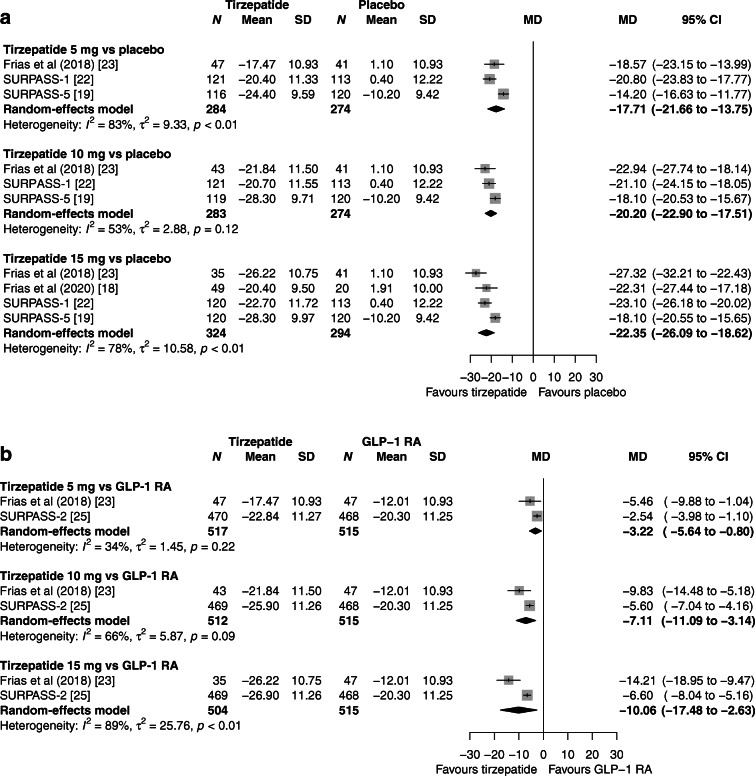
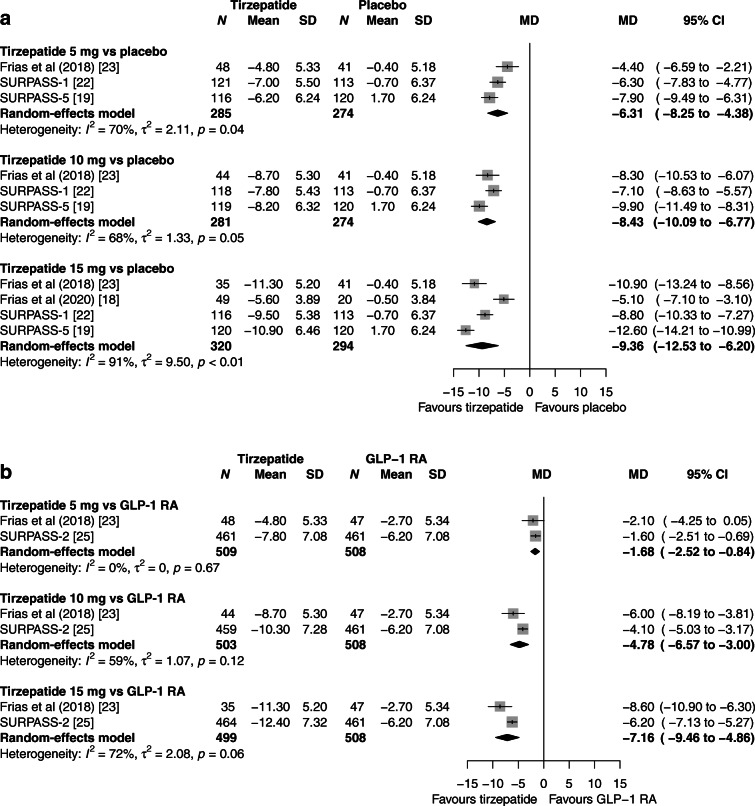
Aims/hypothesis: Tirzepatide is a novel dual glucose-dependent insulinotropic peptide (GIP) and glucagon-like peptide-1 receptor agonist (GLP-1 RA) currently under review for marketing approval. Individual trials have assessed the clinical profile of tirzepatide vs different comparators. We conducted a systematic review and meta-analysis to assess the efficacy and safety of tirzepatide for type 2 diabetes. Methods: We searched PubMed, Embase, Cochrane and ClinicalTrials.gov up until 27 October 2021 for randomised controlled trials with a duration of at least 12 weeks that compared once-weekly tirzepatide 5, 10 or 15 mg with placebo or other glucose-lowering drugs in adults with type 2 diabetes irrespective of their background glucose-lowering treatment. The primary outcome was change in HbA 1c from baseline. Secondary efficacy outcomes included change in body weight, proportion of individuals reaching the HbA 1c target of <53 mmol/mol (<7.0%), ≤48 mmol/mol (≤6.5%) or <39 mmol/mol (<5.7%), and proportion of individuals with body weight loss of at least 5%, 10% or 15%. Safety outcomes included hypoglycaemia, gastrointestinal adverse events, treatment discontinuation due to adverse events, serious adverse events, and mortality. We used version 2 of the Cochrane risk-of-bias tool for randomised trials to assess risk of bias for the primary outcome. Results: Seven trials (6609 participants) were included. A dose-dependent superiority in lowering HbA 1c was evident with all three tirzepatide doses vs all comparators, with mean differences ranging from −17.71 mmol/mol (−1.62%) to −22.35 mmol/mol (−2.06%) vs placebo, −3.22 mmol/mol (−0.29%) to −10.06 mmol/mol (−0.92%) vs GLP-1 RAs, and −7.66 mmol/mol (−0.70%) to −12.02 mmol/mol (−1.09%) vs basal insulin regimens. Tirzepatide was more efficacious in reducing body weight; reductions vs GLP-1 RAs ranged from 1.68 kg with tirzepatide 5 mg to 7.16 kg with tirzepatide 15 mg. Incidence of hypoglycaemia with tirzepatide was similar vs placebo and lower vs basal insulin. Nausea was more frequent with tirzepatide vs placebo, especially with tirzepatide 15 mg (OR 5.60 [95% CI 3.12, 10.06]), associated with higher incidence of vomiting (OR 5.50 [95% CI 2.40, 12.59]) and diarrhoea (OR 3.31 [95% CI 1.40, 7.85]). Odds of gastrointestinal events were similar between tirzepatide and GLP-1 RAs, except for diarrhoea with tirzepatide 10 mg (OR 1.51 [95% CI 1.07, 2.15]). Tirzepatide 15 mg led to higher discontinuation rate of study medication due to adverse events regardless of comparator, while all tirzepatide doses were safe in terms of serious adverse events and mortality. Conclusions/interpretation: A dose-dependent superiority on glycaemic efficacy and body weight reduction was evident with tirzepatide vs placebo, GLP-1 RAs and basal insulin. Tirzepatide did not increase the odds of hypoglycaemia but was associated with increased incidence of gastrointestinal adverse events. Study limitations include presence of statistical heterogeneity in the meta-analyses for change in HbA 1c and body weight, assessment of risk of bias solely for the primary outcome, and generalisation of findings mainly to individuals who are overweight or obese and already on metformin-based background therapy. PROSPERO registration no. CRD42021283449. Graphical abstract:
Overview
The claims and statistics of this paper haven’t been checked yet.
Free: it reads the open-access text and checks the first 5 claims that cite a source we can check. Create a free account to check every claim.
Integrity signals
Registry
Cites
Statistics
Figures
Verification
Claims the paper makes
The claims and statistics of this paper haven’t been checked yet.
Free: it reads the open-access text and checks the first 5 claims that cite a source we can check. Create a free account to check every claim.
Claims other papers make about this one
Each is checked against this paper’s own text: does it say what the citing paper says it does?
The source backs part of the claim, not all of it — or backs it for a different population, condition or comparison.
In the citing paper
“Based on meta-analysis fi ndings, tirzepatide was superior to its comparators, including other long-acting GLP-1 RA, in reducing glucose and body weight, but was associated with increased odds for gastrointestinal adverse events, in particular nausea (189).”
From Management of Hyperglycemia in Type 2 Diabetes, 2022. A Consensus Report by the American Diabetes Association (ADA) and the European Association for the Study of Diabetes (EASD) (2022) · cites this paper as [189]
Experimental — accuracy not yet measuredThe cited source says what the claim attributes to it.
In the citing paper
“The occurrence of such gastrointestinal side effects increases with the dose used. 86 , 87”
From Real‐world evidence on the utilization, clinical and comparative effectiveness, and adverse effects of newer GLP ‐ 1RA ‐based weight‐loss therapies (2025) · cites this paper as [86]
The cited source says what the claim attributes to it.
In the citing paper
“Some studies have demonstrated that tirzepatide achieves greater weight loss compared to existing GLP-1 RAs [20,21,22].”
From The Efficacy and Safety of Tirzepatide in Patients with Diabetes and/or Obesity: Systematic Review and Meta-Analysis of Randomized Clinical Trials (2025) · cites this paper as [20]
The cited source says what the claim attributes to it.
In the citing paper
“Data from RCTs have consistently shown the efficacy of tirzepatide in reducing HbA1c and body weight in people with type 2 diabetes [3].”
The check wasn’t confident either way, so it gives no verdict — never disputed.
In the citing paper
“In a randomized clinical trial of 224 participants with type 2 diabetes taking insulin, CGM decreased hypoglycemic episodes, reducing time with blood glucose less than 70 mg/dL by 0.47 hours per day compared with BGM.50”
From Diagnosis and Treatment of Type 2 Diabetes in Adults: A Review (2025) · cites this paper as [50]
Experimental — accuracy not yet measured
1 more claim about this paper
Create a free account to see every claim other papers make about this one.
Self-check
Percentages, sums and reported differences re-computed from the paper’s own numbers.
The self-check needs the paper’s full text.
Citations
Cites
The PRISMA 2020 statement: An updated guideline for reporting systematic reviews
Page, M. J., McKenzie, J. E., Bossuyt, P. M., Boutron, I., Hoffmann, T. C., Mulrow, C. D., Shamseer, L., Tetzlaff, J. M., Akl, E. A., Brennan, S. E., et al. (2021) · BMJ · doi:10.1136/bmj.n71 · Cited by 108,283
RoB 2: a revised tool for assessing risk of bias in randomised trials
Sterne, J. A. C., Savović, J., Page, M. J., Elbers, R. G., Blencowe, N. S., Boutron, I., Cates, C. J., Cheng, H.-Y., Corbett, M. S., Eldridge, S. M., et al. (2019) · BMJ · doi:10.1136/bmj.l4898 · Cited by 34,787 · cited 2×
“As such, we did not consider open-label status as a source of bias, given that measurement of HbA1c is an objective outcome and thus is not affected by blinding status [15].”
BackgroundMethodThe PRISMA 2020 statement: an updated guideline for reporting systematic reviews
Page, M. J., McKenzie, J., Bossuyt, P., Boutron, I., Hoffmann, T., mulrow, C., Shamseer, L., Tetzlaff, J., Akl, E., Brennan, S. E., et al. (2020) · doi:10.31222/osf.io/v7gm2_v1 · Cited by 8,090
The PRISMA 2020 statement: an updated guideline for reporting systematic reviews
Page, M. J., McKenzie, J., Bossuyt, P., Boutron, I., Hoffmann, T., mulrow, C., Shamseer, L., Tetzlaff, J., Akl, E., Brennan, S. E., et al. (2020) · doi:10.31222/osf.io/v7gm2 · Cited by 5,177
Biology of Incretins: GLP-1 and GIP
Baggio, L. L., & Drucker, D. J. (2007) · Gastroenterology · doi:10.1053/j.gastro.2007.03.054 · Cited by 3,639 · cited 1×
“GLP-1 is released from L cells in the distal ileum and colon, while GIP is secreted from K cells in the duodenum and jejunum and is responsible for most of the insulinotropic incretin effect [2].”
BackgroundGerstein, H. C., Colhoun, H. M., Dagenais, G. R., Diaz, R., Lakshmanan, M., Pais, P., Probstfield, J., Riesmeyer, J. S., Riddle, M. C., Rydén, L., et al. (2019) · The Lancet · doi:10.1016/s0140-6736(19)31149-3 · Cited by 3,163 · cited 1×
“NCT04255433) is expected to provide definitive answers on the impact of tirzepatide on cardiovascular disease compared with dulaglutide, a long-acting GLP-1 RA that has been shown to be cardioprotective in individuals with type 2 diabetes at increased cardiovascular risk [31].”
BackgroundTirzepatide versus Semaglutide Once Weekly in Patients with Type 2 Diabetes
Frías, J. P., Davies, M. J., Rosenstock, J., Pérez Manghi, F. C., Fernández Landó, L., Bergman, B. K., Liu, B., Cui, X., & Brown, K. (2021) · New England Journal of Medicine · doi:10.1056/nejmoa2107519 · Cited by 2,096 · cited 7×
“06 Frias et al (2018) [23] SURPASS-2 [25]”
BackgroundMethodInfluentialMethods to estimate the between‐study variance and its uncertainty in meta‐analysis
Veroniki, A. A., Jackson, D., Viechtbauer, W., Bender, R., Bowden, J., Knapp, G., Kuss, O., Higgins, J. P., Langan, D., & Salanti, G. (2016) · Research Synthesis Methods · doi:10.1002/jrsm.1164 · Cited by 1,685 · cited 1×
“In all analyses, we used the Paule–Mandel method to estimate between-study variance [17], and the I(2) statistic to assess statistical heterogeneity.”
MethodReduced incretin effect in Type 2 (non-insulin dependent) diabetes
Nauck, M., Stöckmann, F., Ebert, R., & Creutzfeldt, W. (1986) · Diabetologia · doi:10.1007/bf02427280 · Cited by 1,307 · cited 1×
“In people with type 2 diabetes the incretin effect is considerably diminished [3].”
BackgroundRosenstock, J., Wysham, C., Frías, J. P., Kaneko, S., Lee, C. J., Fernández Landó, L., Mao, H., Cui, X., Karanikas, C. A., & Thieu, V. T. (2021) · The Lancet · doi:10.1016/s0140-6736(21)01324-6 · Cited by 1,080 · cited 8×
“01 Frias et al (2018) [23] SURPASS-1 [22] SURPASS-5 [19]”
BackgroundMethodResultInfluential9. Pharmacologic Approaches to Glycemic Treatment: Standards of Medical Care in Diabetes—2021
American Diabetes Association (2021) · Diabetes Care · doi:10.2337/dc21-s009 · Cited by 972
Incretin hormones: Their role in health and disease
Nauck, M. A., & Meier, J. J. (2018) · Diabetes, Obesity and Metabolism · doi:10.1111/dom.13129 · Cited by 950 · cited 1×
“Glucagon-like peptide-1 (GLP-1) and glucose-dependent insulinotropic peptide (GIP) are among the main incretin hormones [1].”
BackgroundCoskun, T., Sloop, K. W., Loghin, C., Alsina-Fernandez, J., Urva, S., Bokvist, K. B., Cui, X., Briere, D. A., Cabrera, O., Roell, W. C., et al. (2018) · Molecular Metabolism · doi:10.1016/j.molmet.2018.09.009 · Cited by 882 · cited 3×
“Early proof-of-concept and phase 2 studies suggested that tirzepatide can improve both markers of beta cell function and insulin sensitivity compared with selective GLP-1 RA therapy [9, 10].”
BackgroundFrias, J. P., Nauck, M. A., Van, J., Kutner, M. E., Cui, X., Benson, C., Urva, S., Gimeno, R. E., Milicevic, Z., Robins, D., et al. (2018) · The Lancet · doi:10.1016/s0140-6736(18)32260-8 · Cited by 815 · cited 8×
“Frias et al, 2018 [23]; NCT03131687 26 Double-blind Drug naive (9.”
BackgroundInfluentialDel Prato, S., Kahn, S. E., Pavo, I., Weerakkody, G. J., Yang, Z., Doupis, J., Aizenberg, D., Wynne, A. G., Riesmeyer, J. S., Heine, R. J., et al. (2021) · The Lancet · doi:10.1016/s0140-6736(21)02188-7 · Cited by 684 · cited 10×
“Tirzepatide 5 mg 358 65.8 (8.2) 94.4 8.5 57.2 Tirzepatide 10 mg 360 65.9 (8.2) 93.8 8.4 57.4 Tirzepatide 15 mg 359 66.2 (8.2) 94.9 8.5 57.5 Insulin degludec 360 65.2 (8.1) 94.0 8.1 57.5 Del Prato et al, 2021 SURPASS-4 [21]; NCT03730662 52 Open-label Monotherapy with or any combination of metformin (95%), sulfonylurea…”
BackgroundMethodInfluentialLudvik, B., Giorgino, F., Jódar, E., Frias, J. P., Fernández Landó, L., Brown, K., Bray, R., & Rodríguez, Á. (2021) · The Lancet · doi:10.1016/s0140-6736(21)01443-4 · Cited by 639 · cited 6×
“Tirzepatide 5 mg 470 67.5 (8.3) 92.5 9.1 56.3 Tirzepatide 10 mg 469 67.2 (8.3) 94.8 8.4 57.2 Tirzepatide 15 mg 470 66.8 (8.3) 93.8 8.7 55.9 Semaglutide 1 mg 469 66.7 (8.3) 93.7 8.3 56.9 Ludvik et al, 2021 (SURPASS-3) [20]; NCT038882970 52 Open-label Metformin monotherapy (68”
BackgroundMethodInfluentialDahl, D., Onishi, Y., Norwood, P., Huh, R., Bray, R., Patel, H., & Rodríguez, Á. (2022) · JAMA · doi:10.1001/jama.2022.0078 · Cited by 597 · cited 9×
“Dahl et al, 2022 (SURPASS-5) [19]; NCT04039503 40 Double-blind Insulin glargine monotherapy (17%) or in combination with metformin (83%) Tirzepatide 5 mg 116 67.”
BackgroundMethodInfluentialTsapas, A., Avgerinos, I., Karagiannis, T., Malandris, K., Manolopoulos, A., Andreadis, P., Liakos, A., Matthews, D. R., & Bekiari, E. (2020) · Annals of Internal Medicine · doi:10.7326/m20-0864 · Cited by 346
Self-citationThomas, M. K., Nikooienejad, A., Bray, R., Cui, X., Wilson, J., Duffin, K., Milicevic, Z., Haupt, A., & Robins, D. A. (2021) · The Journal of Clinical Endocrinology & Metabolism · doi:10.1210/clinem/dgaa863 · Cited by 345 · cited 1×
“Early proof-of-concept and phase 2 studies suggested that tirzepatide can improve both markers of beta cell function and insulin sensitivity compared with selective GLP-1 RA therapy [9, 10].”
BackgroundSemaglutide 2.4 mg for the treatment of obesity: key elements of the STEP trials 1 to 5
Kushner, R. F., Calanna, S., Davies, M., Dicker, D., Garvey, W. T., Goldman, B., Lingvay, I., Thomsen, M., Wadden, T. A., Wharton, S., et al. (2020) · Obesity · doi:10.1002/oby.22794 · Cited by 288 · cited 1×
“4 mg for obesity in the Semaglutide Treatment Effect in People with obesity (STEP) programme [27].”
BackgroundMin, T., & Bain, S. C. (2021) · Diabetes Therapy · doi:10.1007/s13300-020-00981-0 · Cited by 285 · cited 1×
“On the basis of these findings, the overall efficacy and safety of tirzepatide has been investigated in the SURPASS clinical trial programme in comparison with placebo and other glucose-lowering medications including GLP-1 RAs and basal insulin [11].”
BackgroundDebray, T. P. A., Moons, K. G. M., & Riley, R. D. (2018) · Research Synthesis Methods · doi:10.1002/jrsm.1266 · Cited by 212 · cited 1×
“We did not evaluate small-study effect bias with a funnel plot due to the small number of included trials [16].”
Frias, J. P., Nauck, M. A., Van, J., Benson, C., Bray, R., Cui, X., Milicevic, Z., Urva, S., Haupt, A., & Robins, D. A. (2020) · Diabetes, Obesity and Metabolism · doi:10.1111/dom.13979 · Cited by 208 · cited 1×
“Tirzepatide 5 mg 55 66.1 (8.2) 92.8 8.9 57.9 Tirzepatide 10 mg 51 66.1 (8.2) 92.7 7.9 56.5 Tirzepatide 15 mg 53 65.0 (8.1) 89.1 8.5 56.0 Placebo 51 63.9 (8.0) 91.5 8.6 56.6 Dulaglutide 1.5 mg 54 65.0 (8.1) 89.8 9.3 58.7 Frias et al, 2020 [18]; NCT03311724 12 Double-blind Drug naive (13.4”
InfluentialFrias, J. P., Bonora, E., Nevarez Ruiz, L., Li, Y. G., Yu, Z., Milicevic, Z., Malik, R., Bethel, M. A., & Cox, D. A. (2021) · Diabetes Care · doi:10.2337/dc20-1473 · Cited by 199 · cited 1×
“Tirzepatide 5 mg 121 63.6 (8.0) 87.0 4.6 54.1 Tirzepatide 10 mg 121 62.9 (7.9) 86.2 4.9 55.8 Tirzepatide 15 mg 121 62.3 (7.9) 85.4 4.8 52.9 Placebo 115 64.5 (8.1) 84.8 4.5 53.6 Frias et al, 2021 (SURPASS-2) [24, 25]; NCT03987919 40 Open-label Metformin monotherapy (100”
InfluentialFrías, J. P., Auerbach, P., Bajaj, H. S., Fukushima, Y., Lingvay, I., Macura, S., Søndergaard, A. L., Tankova, T. I., Tentolouris, N., & Buse, J. B. (2021) · The Lancet Diabetes & Endocrinology · doi:10.1016/s2213-8587(21)00174-1 · Cited by 188 · cited 2×
“Tirzepatide 5 mg 121 63.6 (8.0) 87.0 4.6 54.1 Tirzepatide 10 mg 121 62.9 (7.9) 86.2 4.9 55.8 Tirzepatide 15 mg 121 62.3 (7.9) 85.4 4.8 52.9 Placebo 115 64.5 (8.1) 84.8 4.5 53.6 Frias et al, 2021 (SURPASS-2) [24, 25]; NCT03987919 40 Open-label Metformin monotherapy (100”
BackgroundInfluentialTsapas, A., Karagiannis, T., Kakotrichi, P., Avgerinos, I., Mantsiou, C., Tousinas, G., Manolopoulos, A., Liakos, A., Malandris, K., Matthews, D. R., et al. (2021) · Diabetes, Obesity and Metabolism · doi:10.1111/dom.14451 · Cited by 179 · cited 1×
“In addition, tirzepatide, even at the lowest maintenance dose of 5 mg, can reduce body weight to a greater extent compared with GLP-1 RAs including subcutaneous semaglutide which, in turn, has been shown to be superior to other glucoselowering agents [28].”
BackgroundSelf-citationLawrance, R., Degtyarev, E., Griffiths, P., Trask, P., Lau, H., D’Alessio, D., Griebsch, I., Wallenstein, G., Cocks, K., & Rufibach, K. (2020) · Journal of Patient-Reported Outcomes · doi:10.1186/s41687-020-00218-5 · Cited by 66 · cited 1×
“For efficacy outcomes, in case trials reported results for different estimand analyses, we preferably extracted data for the efficacy estimand, which represents on-treatment efficacy without the influence of rescue therapy [14].”
BackgroundBastin, M., & Andreelli, F. (2019) · Diabetes, Metabolic Syndrome and Obesity: Targets and Therapy · doi:10.2147/dmso.s191438 · Cited by 62 · cited 1×
“The combined GLP-1 and GIP receptor activation has been examined recently as a promising therapeutic concept, given that the two incretins can act on pancreatic beta cells both synergistically and complementarily through distinct metabolic effects [7].”
BackgroundAsmar, M., Simonsen, L., Asmar, A., Holst, J. J., Dela, F., & Bülow, J. (2016) · The Journal of Clinical Endocrinology & Metabolism · doi:10.1210/jc.2016-1933 · Cited by 61 · cited 1×
“Moreover, GIP can exert therapeutic benefits beyond its primary incretin role, by improving insulin sensitivity and lipid homeostasis in adipose tissue [8].”
BackgroundBhagavathula, A. S., Vidyasagar, K., & Tesfaye, W. (2021) · Pharmaceuticals · doi:10.3390/ph14100991 · Cited by 58 · cited 2×
“More specifically, Bhagavathula and colleagues pooled efficacy outcome data in the same analysis irrespective of type of comparator (placebo or GLP-1 RA) [26].”
BackgroundAlexander, J. T., Staab, E. M., Wan, W., Franco, M. I., KNITTER, A. C., Skandari, M. R., Bolen, S. D., Maruthur, N. M., Huang, E. S., Philipson, L. H., et al. (2021) · Journal of General Internal Medicine · doi:10.1007/s11606-021-07105-9 · Cited by 46
Frías, J. P., Davies, M. J., Rosenstock, J., Manghi, F. P., Landó, L. F., Bergman, B. K., Liu, B., Cui, X., & Brown, K. E. (2021) · Diabetes · doi:10.2337/db21-84-lb · Cited by 3 · cited 1×
“Tirzepatide 5 mg 121 63.6 (8.0) 87.0 4.6 54.1 Tirzepatide 10 mg 121 62.9 (7.9) 86.2 4.9 55.8 Tirzepatide 15 mg 121 62.3 (7.9) 85.4 4.8 52.9 Placebo 115 64.5 (8.1) 84.8 4.5 53.6 Frias et al, 2021 (SURPASS-2) [24, 25]; NCT03987919 40 Open-label Metformin monotherapy (100”
Influential
Cited by
Davies, M. J., Aroda, V. R., Collins, B. S., Gabbay, R. A., Green, J., Maruthur, N. M., Rosas, S. E., Del Prato, S., Mathieu, C., Mingrone, G., et al. (2022) · Diabetes Care · doi:10.2337/dci22-0034 · Cited by 2,104
“Based on meta-analysis findings, tirzepatide was superior to its comparators, including other long-acting GLP-1 RA, in reducing glucose and body weight, but was associated with increased odds for gastrointestinal adverse events, in particular nausea (189).”
BackgroundDavies, M. J., Aroda, V. R., Collins, B. S., Gabbay, R. A., Green, J., Maruthur, N. M., Rosas, S. E., Del Prato, S., Mathieu, C., Mingrone, G., et al. (2022) · Diabetologia · doi:10.1007/s00125-022-05787-2 · Cited by 1,048
“Based on meta-analysis findings, tirzepatide was superior to its comparators, including other long-acting GLP-1 RA, in reducing glucose and body weight, but was associated with increased odds for gastrointestinal adverse events, in particular nausea [189].”
Glucagon-like peptide-1 receptor: mechanisms and advances in therapy
Zheng, Z., Zong, Y., Ma, Y., Tian, Y., Pang, Y., Zhang, C., & Gao, J. (2024) · Signal Transduction and Targeted Therapy · doi:10.1038/s41392-024-01931-z · Cited by 1,036
“124,129 A common combination is GLP-1 with GIP or insulin-like growth factor.”
BackgroundObesity and type 2 diabetes mellitus: connections in epidemiology, pathogenesis, and treatments
Ruze, R., Liu, T., Zou, X., Song, J., Chen, Y., Xu, R., Yin, X., & Xu, Q. (2023) · Frontiers in Endocrinology · doi:10.3389/fendo.2023.1161521 · Cited by 799
Blonde, L., Umpierrez, G. E., Reddy, S. S., McGill, J. B., Berga, S. L., Bush, M., Chandrasekaran, S., DeFronzo, R. A., Einhorn, D., Galindo, R. J., et al. (2022) · Endocrine Practice · doi:10.1016/j.eprac.2022.08.002 · Cited by 507
Metadata
- Authors
- Karagiannis, T., Avgerinos, I., Liakos, A., Del Prato, S., Matthews, D. R., Tsapas, A., & Bekiari, E.
- Affiliations
- Aristotle University of Thessaloniki (GR)
- Churchill Hospital (GB)
- Corresponding author
- Karagiannis, Thomas
- ORCID
- Venue
- Diabetologia
- Published
- 2022-05-17
- Volume
- 65
- Issue
- 8
- Pages
- 1251-1261
- ISSN
- 0012-186X (ISSN-L)
- 1432-0428
- PMC
- PMC9112245
- OpenAlex
- W4280579438
- Cited by
- 272
- References
- 30
- Citations by year
- 2026: 32 · 2025: 66 · 2024: 81 · 2023: 72 · 2022: 21
- FWCI
- 8.54
- Type
- journal article
- Language
- en
- Open access
- hybrid
- doi.org
- Licence
- cc-by
- creativecommons.org/licenses/by/4.0 (tdm)
- creativecommons.org/licenses/by/4.0 (vor)
- Locations
- Diabetologia (publishedVersion, cc-by)
- PubMed Central (publishedVersion, cc-by)
- PubMed (publishedVersion)
- Topics
- Health Sciences › Medicine › Endocrinology, Diabetes and Metabolism › Diabetes Treatment and Management
- Health Sciences › Medicine › Endocrinology, Diabetes and Metabolism › Diabetes Management and Research
- Health Sciences › Medicine › Pharmacology (medical) › Pharmacology and Obesity Treatment
- Keywords
- type 2 diabetes, GIP/GLP-1 receptor agonist, glucose-dependent insulinotropic polypeptide, GLP-1 receptor agonists, HbA1c, HbA1c reduction, weight loss, hypoglycemia, gastrointestinal adverse effects, drug safety, dose-response relationship, basal insulin, antidiabetic drugs
- MeSH terms
- Glucagon-Like Peptide-1 Receptor, Glucagon-Like Peptide-1 Receptor Agonists, Tirzepatide, Blood Glucose, Body Weight, Diabetes Mellitus, Type 2, Diarrhea, Gastric Inhibitory Polypeptide, Glycated Hemoglobin, Humans, Hypoglycemia, Hypoglycemic Agents, Treatment Outcome, Glucagon-Like Peptide 1, Insulins
About these checks
Registry, retraction, Cites and statistics results are computed, not judged, with one exception: a printed reference that no index lists is read once by a model before it counts as a citation error. Claims are extracted by a model and kept only when their quote appears verbatim in the text; each cited source is then checked, with a model’s help, for whether it says what the claim relies on. Those verdicts can be wrong — read the claim’s quote and the cited source before relying on one.
Statistics and arithmetic are recomputed, not judged.
Confidence bands are shown only for fields calibrated on our annotated test set. None is calibrated yet, so no band is shown.
What counts as a claim ›How we measure confidence ›How we check this ›
Are you an author, or do you see a problem with this page? Request a review
Data sources
Bibliographic data: Semantic Scholar, OpenAlex, Crossref.
Contains information from the Semantic Scholar Academic Graph Datasets, made available under the ODC Attribution License (ODC-BY 1.0).
Semantic Scholar’s data is described in: Kinney, R., et al. (2023). The Semantic Scholar Open Data Platform. arXiv:2301.10140.
