

Dose-response effects on HbA1c and bodyweight reduction of survodutide, a dual glucagon/GLP-1 receptor agonist, compared with placebo and open-label semaglutide in people with type 2 diabetes: a randomised clinical trial
Open accessThe DOI matches its Crossref record; 42 of the 42 references it cites were found in a registry or an index.
Abstract
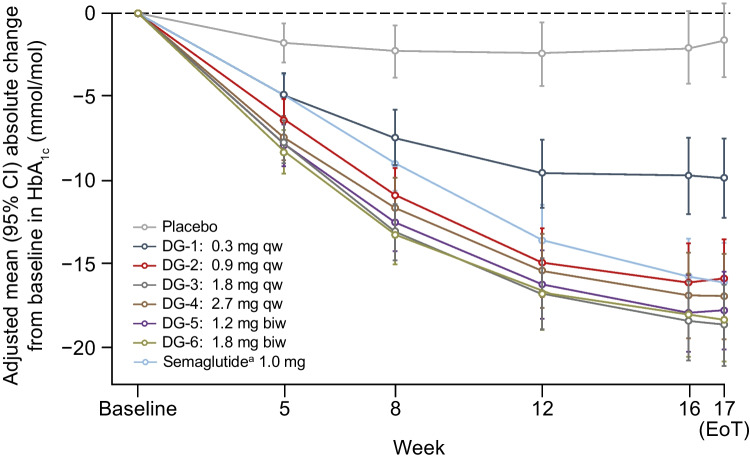
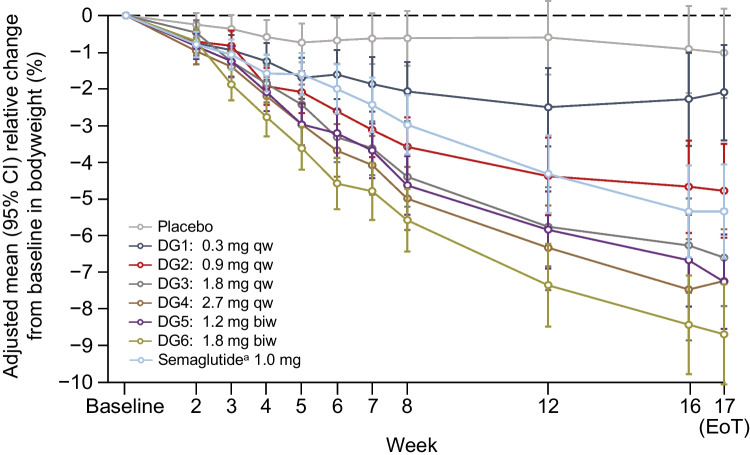
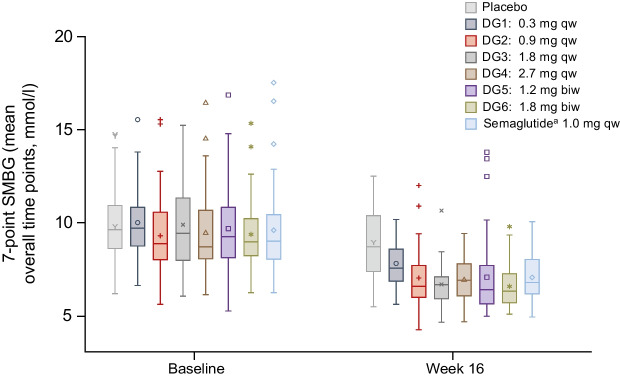
Aims/hypothesis: The aim of this study was to assess the dose–response effects of the subcutaneous glucagon receptor/glucagon-like peptide-1 receptor dual agonist survodutide (BI 456906) on HbA 1c levels and bodyweight reduction. Methods: This Phase II, multicentre, randomised, double-blind, parallel-group, placebo-controlled study, conducted in clinical research centres, assessed survodutide in participants aged 18–75 years with type 2 diabetes, an HbA 1c level of 53–86 mmol/mol (7.0–10.0%) and a BMI of 25–50 kg/m 2 on a background of metformin therapy. Participants were randomised via interactive response technology to receive survodutide (up to 0.3, 0.9, 1.8 or 2.7 mg once weekly [qw; dose group (DG) 1–4, respectively] or 1.2 or 1.8 mg twice weekly [DG 5 and 6, respectively]), placebo or semaglutide (up to 1.0 mg qw). Participants and all those involved in the trial conduct/analysis were blinded; the semaglutide arm was open-label. The primary endpoint was absolute change from baseline in HbA 1c after 16 weeks’ treatment. The key secondary endpoint was relative change from baseline in bodyweight after 16 weeks’ treatment. Results: A total of 413 participants were randomised (DG1, n =50; DG2, n =50; DG3, n =52; DG4, n =50; DG5, n =51; DG6, n =50; semaglutide, n =50; placebo, n =60). The full analysis set comprised 411 treated participants (DG6, n =49; placebo, n =59). Adjusted mean (95% CI) HbA 1c decreased from baseline (mean ± SD 64.7±9.2 mmol/mol [8.07±0.84%] after 16 weeks’ treatment: DG1 ( n =41), −9.92 mmol/mol (−12.27, −7.56; −0.91% [−1.12, −0.69]); DG2 ( n =46), −15.95 mmol/mol (−18.27, −13.63; −1.46% [−1.67, −1.25]); DG3 ( n =36), −18.72 mmol/mol (−21.15, −16.29; −1.71% [−1.94, −1.49]); DG4 ( n =33), −17.01 mmol/mol (−19.59, −14.43; −1.56% [−1.79, −1.32]); DG5 ( n =44), −17.84 mmol/mol (−20.18, −15.51; −1.63% [−1.85, −1.42]); DG6 ( n =36), −18.38 mmol/mol (−20.90, −15.87; −1.68% [−1.91, −1.45]). The mean reduction in HbA 1c was similar with low-dose survodutide (DG2: −15.95 mmol/mol [−1.46%]; n =46) and semaglutide (−16.07 mmol/mol [−1.47%]; n =45). Mean (95% CI) bodyweight decreased dose-dependently up to −8.7% (−10.1, −7.3; DG6, n =37); survodutide ≥1.8 mg qw produced greater bodyweight reductions than semaglutide (−5.3% [−6.6, −4.1]; n =45). Adverse events (AEs) were reported for 77.8% of survodutide-treated participants (mainly gastrointestinal), 52.5% receiving placebo and 52.0% receiving semaglutide. Conclusions/interpretation: Survodutide reduced HbA 1c levels and bodyweight after 16 weeks’ treatment in participants with type 2 diabetes. Dose-related gastrointestinal AEs could be mitigated with slower dose escalations. Trial registration: ClinicalTrials.gov NCT04153929 and EudraCT 2019-002390-60. Funding: Boehringer Ingelheim Pharma GmbH & Co. KG, Ingelheim, Germany. Graphical Abstract:
Overview
The claims and statistics of this paper haven’t been checked yet.
Free: it reads the open-access text and checks the first 5 claims that cite a source we can check. Create a free account to check every claim.
Integrity signals
Registry
Cites
Statistics
Figures
Verification
Claims the paper makes
The claims and statistics of this paper haven’t been checked yet.
Free: it reads the open-access text and checks the first 5 claims that cite a source we can check. Create a free account to check every claim.
Claims other papers make about this one
Each is checked against this paper’s own text: does it say what the citing paper says it does?
The source backs part of the claim, not all of it — or backs it for a different population, condition or comparison.
In the citing paper
“A new weight loss plateau was not reached during the study period.125”
From GLP-1 receptor agonists and next-generation incretin-based medications: metabolic, cardiovascular, and renal benefits (2026) · cites this paper as [125]
Experimental — accuracy not yet measuredThe source backs part of the claim, not all of it — or backs it for a different population, condition or comparison.
In the citing paper
“The risk of experiencing nausea (up to 46%), vomiting (up to 26%), or drug discontinuation (up to 30%) was greater than with semaglutide (nausea 9%, vomiting 2%, and drug discontinuation due to adverse events 5%) or placebo (nausea 12%, vomiting 4%, and drug discontinuation due to adverse events 4%).125”
From GLP-1 receptor agonists and next-generation incretin-based medications: metabolic, cardiovascular, and renal benefits (2026) · cites this paper as [125]
Experimental — accuracy not yet measuredThe source backs part of the claim, not all of it — or backs it for a different population, condition or comparison.
In the citing paper
“Weight loss with survodutide (up to 7•7%) was greater than with semaglutide (5•3%) or placebo (0•9%).”
From GLP-1 receptor agonists and next-generation incretin-based medications: metabolic, cardiovascular, and renal benefits (2026) · cites this paper as [125]
Experimental — accuracy not yet measuredThe source backs part of the claim, not all of it — or backs it for a different population, condition or comparison.
In the citing paper
“In a phase 2 trial in people with T2D, after 16 weeks of treatment, doses of survodutide up to 2•7 mg once weekly reduced HbA 1c by up to 1•6% (95% CI 1•3-1•8) or 17 mmol/mol (14-20) compared with semaglutide (1 mg once weekly; reduction of 1•5% [16 mmol/mol]; table).125”
From GLP-1 receptor agonists and next-generation incretin-based medications: metabolic, cardiovascular, and renal benefits (2026) · cites this paper as [125]
Experimental — accuracy not yet measuredThe source backs part of the claim, not all of it — or backs it for a different population, condition or comparison.
In the citing paper
“Thus, hepatic glucagon receptor stimulation increased hepatic lipid oxidation and reversed diet-induced steatosis in mice [137].”
From Obesity and MASLD: Is weight loss the (only) key to treat metabolic liver disease? (2024) · cites this paper as [137]
Experimental — accuracy not yet measured
5 more claims about this paper
Create a free account to see every claim other papers make about this one.
Self-check
Percentages, sums and reported differences re-computed from the paper’s own numbers.
The self-check needs the paper’s full text.
Citations
Cites
Once-Weekly Semaglutide in Adults with Overweight or Obesity
Wilding, J. P. H., Batterham, R. L., Calanna, S., Davies, M., Van Gaal, L. F., Lingvay, I., McGowan, B. M., Rosenstock, J., Tran, M. T. D., Wadden, T. A., et al. (2021) · New England Journal of Medicine · doi:10.1056/nejmoa2032183 · Cited by 5,205 · cited 1×
“The occurrence of GI disorders is common in people treated with GLP-1R agonists [23, 24] and can be linked to the central effects of GLP-1R agonism and delayed gastric emptying [25, 26].”
BackgroundSelf-citationA Randomized, Controlled Trial of 3.0 mg of Liraglutide in Weight Management
Pi-Sunyer, X., Astrup, A., Fujioka, K., Greenway, F., Halpern, A., Krempf, M., Lau, D. C. W., le Roux, C. W., Violante Ortiz, R., Jensen, C. B., et al. (2015) · New England Journal of Medicine · doi:10.1056/nejmoa1411892 · Cited by 2,724
Tirzepatide versus Semaglutide Once Weekly in Patients with Type 2 Diabetes
Frías, J. P., Davies, M. J., Rosenstock, J., Pérez Manghi, F. C., Fernández Landó, L., Bergman, B. K., Liu, B., Cui, X., & Brown, K. (2021) · New England Journal of Medicine · doi:10.1056/nejmoa2107519 · Cited by 2,096 · cited 2×
“…such as glucose-dependent insuli-notropic polypeptide receptor (GIPR)/GLP-1R and glucagon receptor (GCGR)/GLP-1R dual agonists, have the potential for enhanced therapeutic efficacy and improved tolerability compared with GLP-1R mono-agonists, owing to their multiple mechanisms of action [5, 6].”
BackgroundSelf-citationNauck, M., Frid, A., Hermansen, K., Shah, N. S., Tankova, T., Mitha, I. H., Zdravkovic, M., Düring, M., Matthews, D. R., & for the LEAD-2 Study Group (2009) · Diabetes Care · doi:10.2337/dc08-1355 · Cited by 1,129
Anti-obesity drug discovery: advances and challenges
Müller, T. D., Blüher, M., Tschöp, M. H., & DiMarchi, R. D. (2022) · Nature Reviews Drug Discovery · doi:10.1038/s41573-021-00337-8 · Cited by 1,021
Self-citationon behalf of the NN8022-1807 Investigators, Astrup, A., Carraro, R., Finer, N., Harper, A., Kunesova, M., Lean, M. E. J., Niskanen, L., Rasmussen, M. F., Rissanen, A., et al. (2012) · International Journal of Obesity · doi:10.1038/ijo.2011.158 · Cited by 757 · cited 1×
“The occurrence of GI disorders is common in people treated with GLP-1R agonists [23, 24] and can be linked to the central effects of GLP-1R agonism and delayed gastric emptying [25, 26].”
BackgroundGIP and GLP-1, the two incretin hormones: Similarities and differences
Seino, Y., Fukushima, M., & Yabe, D. (2010) · Journal of Diabetes Investigation · doi:10.1111/j.2040-1124.2010.00022.x · Cited by 746
Ahmann, A. J., Capehorn, M., Charpentier, G., Dotta, F., Henkel, E., Lingvay, I., Holst, A. G., Annett, M. P., & Aroda, V. R. (2018) · Diabetes Care · doi:10.2337/dc17-0417 · Cited by 596
Usdin, T. B., Mezey, E., Button, D. C., Brownstein, M. J., & Bonner, T. I. (1993) · Endocrinology · doi:10.1210/endo.133.6.8243312 · Cited by 534
Subcutaneous Oxyntomodulin Reduces Body Weight in Overweight and Obese Subjects
Wynne, K., Park, A. J., Small, C. J., Patterson, M., Ellis, S. M., Murphy, K. G., Wren, A. M., Frost, G. S., Meeran, K., Ghatei, M. A., et al. (2005) · Diabetes · doi:10.2337/diabetes.54.8.2390 · Cited by 435
Buteau, J., Foisy, S., Joly, E., & Prentki, M. (2003) · Diabetes · doi:10.2337/diabetes.52.1.124 · Cited by 411
Nauck, M. A., & D‘Alessio, D. A. (2022) · Cardiovascular Diabetology · doi:10.1186/s12933-022-01604-7 · Cited by 407
Graaf, C. D., Donnelly, D., Wootten, D., Lau, J., Sexton, P. M., Miller, L. J., Ahn, J.-M., Liao, J., Fletcher, M. M., Yang, D., et al. (2016) · Pharmacological Reviews · doi:10.1124/pr.115.011395 · Cited by 403
Nauck, M. A., Quast, D. R., Wefers, J., & Pfeiffer, A. F. H. (2021) · Diabetes, Obesity and Metabolism · doi:10.1111/dom.14496 · Cited by 388
Wynne, K., Park, A. J., Small, C. J., Meeran, K., Ghatei, M. A., Frost, G. S., & Bloom, S. R. (2006) · International Journal of Obesity · doi:10.1038/sj.ijo.0803344 · Cited by 363 · cited 1×
“Oxyntomodulin has been shown to reduce bodyweight and food intake in rodents and humans [11, 12] and to increase energy expenditure in people with obesity [13], via activity at both receptors.”
BackgroundPeripheral Oxyntomodulin Reduces Food Intake and Body Weight Gain in Rats
Dakin, C. L., Small, C. J., Batterham, R. L., Neary, N. M., Cohen, M. A., Patterson, M., Ghatei, M. A., & Bloom, S. R. (2004) · Endocrinology · doi:10.1210/en.2003-1338 · Cited by 342 · cited 1×
“Oxyntomodulin has been shown to reduce bodyweight and food intake in rodents and humans [11, 12] and to increase energy expenditure in people with obesity [13], via activity at both receptors.”
BackgroundNahra, R., Wang, T., Gadde, K. M., Oscarsson, J., Stumvoll, M., Jermutus, L., Hirshberg, B., & Ambery, P. (2021) · Diabetes Care · doi:10.2337/dc20-2151 · Cited by 323 · cited 2×
“[6].”
BackgroundComparative Effectiveness and Safety of Bariatric Procedures for Weight Loss: A PCORnet Cohort Study
Arterburn, D., Wellman, R., Emiliano, A., Smith, S. R., Odegaard, A. O., Murali, S., Williams, N., Coleman, K. J., Courcoulas, A., Coley, R. Y., et al. (2018) · Annals of Internal Medicine · doi:10.7326/m17-2786 · Cited by 317
Nauck, M., Weinstock, R. S., Umpierrez, G. E., Guerci, B., Skrivanek, Z., & Milicevic, Z. (2014) · Diabetes Care · doi:10.2337/dc13-2761 · Cited by 284 · cited 1×
“%) and –3.1 kg for HbA 1c and bodyweight, respectively, after 52 weeks of treatment [20].”
BackgroundInfluentialBoland, M. L., Laker, R. C., Mather, K., Nawrocki, A., Oldham, S., Boland, B. B., Lewis, H., Conway, J., Naylor, J., Guionaud, S., et al. (2020) · Nature Metabolism · doi:10.1038/s42255-020-0209-6 · Cited by 270
Henderson, S. J., Konkar, A., Hornigold, D. C., Trevaskis, J. L., Jackson, R., Fritsch Fredin, M., Jansson‐Löfmark, R., Naylor, J., Rossi, A., Bednarek, M. A., et al. (2016) · Diabetes, Obesity and Metabolism · doi:10.1111/dom.12735 · Cited by 240 · cited 1×
“GCGR/GLP-1R dual agonism is also a focus in the treatment of NASH as it can potentially ameliorate hepatic fat accumulation, steatosis and fibrosis, alongside reductions in bodyweight [29, 30].”
BackgroundFunctional GIP Receptors Are Present on Adipocytes
Yip, R. G.-C., Boylan, M. O., Kieffer, T. J., & Wolfe, M. M. (1998) · Endocrinology · doi:10.1210/endo.139.9.6288 · Cited by 237
Nauck, M. A., Petrie, J. R., Sesti, G., Mannucci, E., Courrèges, J.-P., Lindegaard, M. L., Jensen, C. B., & Atkin, S. L. (2016) · Diabetes Care · doi:10.2337/dc15-0165 · Cited by 233 · cited 3×
“…Phase II semaglutide study also highlighted that the proportion of participants reporting GI AEs was notably reduced with dose escalation compared with no escalation and that GI AEs were mostly transient; it was suggested from this that GI AEs may be ameliorated with slower dose escalation [16].”
BackgroundResultInfluentialHolz, G. G., Leech, C. A., Heller, R. S., Castonguay, M., & Habener, J. F. (1999) · Journal of Biological Chemistry · doi:10.1074/jbc.274.20.14147 · Cited by 220
Incretins (GLP-1 receptor agonists and dual/triple agonists) and the liver
Newsome, P. N., & Ambery, P. (2023) · Journal of Hepatology · doi:10.1016/j.jhep.2023.07.033 · Cited by 211
Frias, J. P., Nauck, M. A., Van, J., Benson, C., Bray, R., Cui, X., Milicevic, Z., Urva, S., Haupt, A., & Robins, D. A. (2020) · Diabetes, Obesity and Metabolism · doi:10.1111/dom.13979 · Cited by 208 · cited 1×
“%) and body-weight by up to −5.7 kg after 12 weeks [21].”
BackgroundInfluentialGlucagon increases energy expenditure independently of brown adipose tissue activation in humans
Salem, V., Izzi‐Engbeaya, C., Coello, C., Thomas, D. B., Chambers, E. S., Comninos, A. N., Buckley, A., Win, Z., Al‐Nahhas, A., Rabiner, E. A., et al. (2016) · Diabetes, Obesity and Metabolism · doi:10.1111/dom.12585 · Cited by 167 · cited 2×
“In addition to the glucose-lowering effects associated with GLP-1R agonism, GCGR agonism, via receptors in the liver, may lead to increased energy expenditure [7, 8].”
BackgroundTrapp, S., & Brierley, D. I. (2022) · British Journal of Pharmacology · doi:10.1111/bph.15638 · Cited by 154
Semaglutide for type 2 diabetes mellitus: A systematic review and meta‐analysis
Andreadis, P., Karagiannis, T., Malandris, K., Avgerinos, I., Liakos, A., Manolopoulos, A., Bekiari, E., Matthews, D. R., & Tsapas, A. (2018) · Diabetes, Obesity and Metabolism · doi:10.1111/dom.13361 · Cited by 153
Zimmermann, T., Thomas, L., Baader-Pagler, T., Haebel, P., Simon, E., Reindl, W., Bajrami, B., Rist, W., Uphues, I., Drucker, D. J., et al. (2022) · Molecular Metabolism · doi:10.1016/j.molmet.2022.101633 · Cited by 149
Performance of the PRO-C3 collagen neo-epitope biomarker in non-alcoholic fatty liver disease
Boyle, M., Tiniakos, D., Schattenberg, J. M., Ratziu, V., Bugianessi, E., Petta, S., Oliveira, C. P., Govaere, O., Younes, R., McPherson, S., et al. (2019) · JHEP Reports · doi:10.1016/j.jhepr.2019.06.004 · Cited by 140 · cited 1×
“During fibrosis, type III collagen is synthesised and deposited; therefore, Pro-C3 as the pro-peptide of type III collagen may be a useful biomarker for fibrogenesis and the monitoring of disease progression in NASH [31].”
BackgroundParker, V. E. R., Robertson, D., Wang, T., Hornigold, D. C., Petrone, M., Cooper, A. T., Posch, M. G., Heise, T., Plum-Moerschel, L., Schlichthaar, H., et al. (2020) · The Journal of Clinical Endocrinology & Metabolism · doi:10.1210/clinem/dgz047 · Cited by 123
Central administration of GLP-1 and GIP decreases feeding in mice
NamKoong, C., Kim, M. S., Jang, B.-T., Lee, Y. H., Cho, Y.-M., & Choi, H. J. (2017) · Biochemical and Biophysical Research Communications · doi:10.1016/j.bbrc.2017.06.031 · Cited by 114
Andreozzi, F., Raciti, G. A., Nigro, C., Mannino, G. C., Procopio, T., Davalli, A. M., Beguinot, F., Sesti, G., Miele, C., & Folli, F. (2016) · Journal of Translational Medicine · doi:10.1186/s12967-016-0985-7 · Cited by 102
Kim, T., Nason, S., Holleman, C., Pepin, M., Wilson, L., Berryhill, T. F., Wende, A. R., Steele, C., Young, M. E., Barnes, S., et al. (2018) · Diabetes · doi:10.2337/db17-1502 · Cited by 97 · cited 1×
“In addition to the glucose-lowering effects associated with GLP-1R agonism, GCGR agonism, via receptors in the liver, may lead to increased energy expenditure [7, 8].”
BackgroundOxyntomodulin: actions and role in diabetes
Holst, J. J., Albrechtsen, N. J. W., Gabe, M. B. N., & Rosenkilde, M. M. (2018) · Peptides · doi:10.1016/j.peptides.2017.09.018 · Cited by 86 · cited 1×
“The efficacy of GCGR/GLP-1R dual agonism has been demonstrated by oxyntomodulin, an endogenous progluca-gon derivative [10].”
BackgroundThe Liver–α-Cell Axis in Health and in Disease
Richter, M. M., Galsgaard, K. D., Elmelund, E., Knop, F. K., Suppli, M. P., Holst, J. J., Winther-Sørensen, M., Kjeldsen, S. A. S., & Wewer Albrechtsen, N. J. (2022) · Diabetes · doi:10.2337/dbi22-0004 · Cited by 86
Glucagon in physiological concentrations stimulates brown fat thermogenesis in vivo
Billington, C. J., Briggs, J. E., Link, J. G., & Levine, A. S. (1991) · American Journal of Physiology-Regulatory, Integrative and Comparative Physiology · doi:10.1152/ajpregu.1991.261.2.r501 · Cited by 71
Jungnik, A., Arrubla Martinez, J., Plum‐Mörschel, L., Kapitza, C., Lamers, D., Thamer, C., Schölch, C., Desch, M., & Hennige, A. M. (2023) · Diabetes, Obesity and Metabolism · doi:10.1111/dom.14948 · Cited by 63
Self-citationPratt, E., Ma, X., Liu, R., Robins, D., Haupt, A., Coskun, T., Sloop, K. W., & Benson, C. (2023) · Diabetes, Obesity and Metabolism · doi:10.1111/dom.15184 · Cited by 62
Hayashi, Y. (2021) · Journal of Diabetes Investigation · doi:10.1111/jdi.13315 · Cited by 28
Li, W., Kirchner, T., Ho, G., Bonilla, F., D'Aquino, K., Littrell, J., Zhang, R., Jian, W., Qiu, X., Zheng, S., et al. (2020) · Diabetes, Obesity and Metabolism · doi:10.1111/dom.14173 · Cited by 20 · cited 3×
“These therapies have produced placebo-corrected bodyweight decreases of up to 5.4% (liraglutide 3 mg) [1] and 12.4% (semaglutide 2.4 mg), and HbA 1c reductions of –12.0 to –17.5 mmol/mol (–1.1 to –1.6”
BackgroundInfluential
Cited by
Tacke, F., Horn, P., Wai-Sun Wong, V., Ratziu, V., Bugianesi, E., Francque, S., Zelber-Sagi, S., Valenti, L., Roden, M., Schick, F., et al. (2024) · Journal of Hepatology · doi:10.1016/j.jhep.2024.04.031 · Cited by 2,210
European Association for the Study of the Liver (EASL), European Association for the Study of Diabetes (EASD), & European Association for the Study of Obesity (EASO) (2024) · Obesity Facts · doi:10.1159/000539371 · Cited by 471
le Roux, C. W., Steen, O., Lucas, K. J., Startseva, E., Unseld, A., & Hennige, A. M. (2024) · The Lancet Diabetes & Endocrinology · doi:10.1016/s2213-8587(23)00356-x · Cited by 237
Self-citationAlfaris, N., Waldrop, S., Johnson, V., Boaventura, B., Kendrick, K., & Stanford, F. C. (2024) · EClinicalMedicine · doi:10.1016/j.eclinm.2024.102782 · Cited by 224
Obesity and MASLD: Is weight loss the (only) key to treat metabolic liver disease?
Huttasch, M., Roden, M., & Kahl, S. (2024) · Metabolism · doi:10.1016/j.metabol.2024.155937 · Cited by 169
Metadata
- Authors
- Blüher, M., Rosenstock, J., Hoefler, J., Manuel, R., & Hennige, A. M.
- Affiliations
- Helmholtz Munich (DE)
- Boehringer Ingelheim (United States) (US)
- Boehringer Ingelheim (Germany) (DE)
- Corresponding author
- Blüher, Matthias
- Hennige, Anita M.
- Venue
- Diabetologia
- Published
- 2023-12-14
- Volume
- 67
- Issue
- 3
- Pages
- 470-482
- ISSN
- 0012-186X (ISSN-L)
- 1432-0428
- PMC
- PMC10844353
- OpenAlex
- W4389739323
- Cited by
- 138
- References
- 28
- Citations by year
- 2026: 50 · 2025: 42 · 2024: 46
- FWCI
- 28.14
- Type
- journal article
- Language
- en
- Update notices
- correction (2024-02-13)
- Open access
- hybrid
- doi.org
- Licence
- cc-by
- creativecommons.org/licenses/by/4.0 (tdm)
- creativecommons.org/licenses/by/4.0 (vor)
- Locations
- Diabetologia (publishedVersion, cc-by)
- PubMed Central (publishedVersion, cc-by)
- PubMed (publishedVersion)
- Qucosa (Saxon State and University Library Dresden) (publishedVersion, other-oa)
- PUBLISSO (German National Library of Medicine) (submittedVersion, cc-by)
- PuSH - Publication Server of Helmholtz Zentrum München (submittedVersion, cc-by)
- Funders
- Boehringer Ingelheim
- Universität Leipzig
- Topics
- Health Sciences › Medicine › Endocrinology, Diabetes and Metabolism › Diabetes Treatment and Management
- Health Sciences › Medicine › Pharmacology (medical) › Pharmacology and Obesity Treatment
- Health Sciences › Medicine › Endocrinology, Diabetes and Metabolism › Diabetes Management and Research
- Keywords
- survodutide, type 2 diabetes, HbA1c, dose-response relationship, semaglutide, metformin, weight loss, glycemic control, GLP-1 receptor agonists, glucagon receptor agonist
- MeSH terms
- Glucagon-Like Peptide-1 Receptor Agonists, Semaglutide, Diabetes Mellitus, Type 2, Double-Blind Method, Glucagon-Like Peptides, Glucagon, Humans, Hypoglycemic Agents, Peptides, Treatment Outcome, Glucagon-Like Peptide 1
About these checks
Registry, retraction, Cites and statistics results are computed, not judged, with one exception: a printed reference that no index lists is read once by a model before it counts as a citation error. Claims are extracted by a model and kept only when their quote appears verbatim in the text; each cited source is then checked, with a model’s help, for whether it says what the claim relies on. Those verdicts can be wrong — read the claim’s quote and the cited source before relying on one.
Statistics and arithmetic are recomputed, not judged.
Confidence bands are shown only for fields calibrated on our annotated test set. None is calibrated yet, so no band is shown.
What counts as a claim ›How we measure confidence ›How we check this ›
Are you an author, or do you see a problem with this page? Request a review
Data sources
Bibliographic data: Semantic Scholar, OpenAlex, Crossref.
Contains information from the Semantic Scholar Academic Graph Datasets, made available under the ODC Attribution License (ODC-BY 1.0).
Semantic Scholar’s data is described in: Kinney, R., et al. (2023). The Semantic Scholar Open Data Platform. arXiv:2301.10140.
