

Recommender systems and their ethical challenges
Open accessThe DOI matches its Crossref record; 47 of the 47 references it cites were found in a registry or an index.
Abstract
This article presents the first, systematic analysis of the ethical challenges posed by recommender systems through a literature review. The article identifies six areas of concern, and maps them onto a proposed taxonomy of different kinds of ethical impact. The analysis uncovers a gap in the literature: currently user-centred approaches do not consider the interests of a variety of other stakeholders—as opposed to just the receivers of a recommendation—in assessing the ethical impacts of a recommender system.
Overview
The claims and statistics of this paper haven’t been checked yet.
Free: it reads the open-access text and checks the first 5 claims that cite a source we can check. Create a free account to check every claim.
Integrity signals
Registry
Cites
Statistics
Figures
Verification
Claims the paper makes
The claims and statistics of this paper haven’t been checked yet.
Free: it reads the open-access text and checks the first 5 claims that cite a source we can check. Create a free account to check every claim.
Claims other papers make about this one
Each is checked against this paper’s own text: does it say what the citing paper says it does?
The cited source says what the claim attributes to it.
In the citing paper
“While this poses a problem of inconclusive evidence, it also indicates that if group privacy (Taylor et al. 2017) is not ensured, it may be impossible for individuals to ever remove themselves from the process of algorithmic profiling and predictions (Milano et al. 2020).”
From The ethics of algorithms: key problems and solutions (2022) · cites this paper as Milano et al. 2020
In the citing paper
“Giving individuals the ability to contribute to the design of a recommender system can help create more accurate profiles that account for attributes and social categories that would have otherwise not been included in the labelling used by the system to categorise users (Milano et al. 2020).”
From The ethics of algorithms: key problems and solutions (2022) · cites this paper as Milano et al. 2020
Self-check
Percentages, sums and reported differences re-computed from the paper’s own numbers.
The self-check needs the paper’s full text.
Citations
Cites
Lecture Notes in Computer Science 1205
(1999) · Industrial Robot: An International Journal · doi:10.1108/ir.1999.04926fae.001 · Cited by 38,662
Adomavicius, G., & Tuzhilin, A. (2005) · IEEE Transactions on Knowledge and Data Engineering · doi:10.1109/tkde.2005.99 · Cited by 10,310 · cited 2×
“…the technology, which took off with the spread of internet-based services and the introduction of collaborative filtering techniques in the 1990s (Adomavicius and Tuzhilin 2005; Pennock et al. 2000); and the proprietary and privacy issues involved in the design and deployment of this class of…”
BackgroundRobust De-anonymization of Large Sparse Datasets
Narayanan, A., & Shmatikov, V. (2008) · 2008 IEEE Symposium on Security and Privacy (sp 2008) · doi:10.1109/sp.2008.33 · Cited by 2,372
Explaining collaborative filtering recommendations
Herlocker, J. L., Konstan, J. A., & Riedl, J. (2000) · Proceedings of the 2000 ACM conference on Computer supported cooperative work · doi:10.1145/358916.358995 · Cited by 1,731 · cited 1×
“As noted by Herlocker et al. (2000), recommendations generated by collaborative filtering techniques can, on a simple level, be conceptualised as analogous to “word of mouth” recommendations among users.”
BackgroundHow AI can be a force for good
Taddeo, M., & Floridi, L. (2018) · Science · doi:10.1126/science.aat5991 · Cited by 760 · cited 1×
“…individual users’ autonomy, by providing recommendations that nudge users in a particular direction, by attempting to “addict” them to some types of contents, or by limiting the range of options to which they are exposed (Burr et al. 2018; de Vries 2010; Koene et al. 2015; Taddeo and Floridi 2018).”
BackgroundSelf-citationBias in algorithmic filtering and personalization
Bozdag, E. (2013) · Ethics and Information Technology · doi:10.1007/s10676-013-9321-6 · Cited by 649 · cited 1×
“…biases and “filter bubbles” that are damaging to the normal functioning of public debate, group deliberation, and democratic institutions more generally (Bozdag 2013; Bozdag and van den Hoven, 2015; Harambam et al. 2018; Helberger et al. 2016; Koene et al. 2015; Reviglio 2017; Zook et al. 2017).”
BackgroundFloridi, L., & Taddeo, M. (2016) · Philosophical Transactions of the Royal Society A: Mathematical, Physical and Engineering Sciences · doi:10.1098/rsta.2016.0360 · Cited by 637 · cited 1×
“This is an approach that is able to consider specifically ethical problems related to data, algorithms, and practices, but also how the problems relate, depend on, and impact each other (Floridi and Taddeo 2016).”
BackgroundSelf-citationCaptivating algorithms: Recommender systems as traps
Seaver, N. (2019) · Journal of Material Culture · doi:10.1177/1359183518820366 · Cited by 492 · cited 1×
“The methodologies that they adopt are more varied, ranging from ethnographic study (Seaver 2018b), to hermeneutics (de Vries 2010), decision theory (Burr et al. 2018), and economics (Abdollahpouri et al. 2017).”
MethodBreaking the filter bubble: democracy and design
Bozdag, E., & van den Hoven, J. (2015) · Ethics and Information Technology · doi:10.1007/s10676-015-9380-y · Cited by 375 · cited 2×
“In this respect, Bozdag and van den Hoven (2015) argue that the design of algorithmic tools to combat informational segregation should be more sensitive to the democratic norms that are implicitly built into these tools.”
BackgroundExposure diversity as a design principle for recommender systems
Helberger, N., Karppinen, K., & D’Acunto, L. (2018) · Information, Communication & Society · doi:10.1080/1369118x.2016.1271900 · Cited by 366 · cited 2×
“…by several authors is that news recommendation systems, in particular, must reach a trade-off between the expected relevance to the user and diversity when generating personalised recommendations based on pre-specified user preferences or behavioural data (Helberger et al. 2016; Reviglio 2017).”
Background
Research works printed but not linked: 1
- Seaver N (2018b) Captivating algorithms: recommender systems as traps. J Mater Cult. https ://doi.org/10.1177/13591 83518 82036 · doi:10.1177/13591
Cited by
Items 101–200 of 638
Chizari, N., Shoeibi, N., & García, M. N. M. (2022) · Electronics · doi:10.3390/electronics11203301 · Cited by 27
“Bias also can cause serious problems in different aspects: economic, legal, social, security, and technological [17], as well as ethical aspects including content, privacy, autonomy, opacity, fairness, and social aspects [18,19].”
Artificial intelligence and identity: the rise of the statistical individual
Bjerring, J. C., & Busch, J. (2024) · AI & Society · doi:10.1007/s00146-024-01877-4 · Cited by 33
“For such facts are simply not relevant for their professional identity: they do not reflect properties that we 14 Refer to de Vries (2010), Milano et al. (2020), and Søe (2021) for discussions that touch upon somewhat related topics—although in very different vocabularies and settings from ours.”
Beyond Algorithmic Fairness in Recommender Systems
Elahi, M., Abdollahpouri, H., Mansoury, M., & Torkamaan, H. (2021) · ACM Conference on User Modeling, Adaptation and Personalization (UMAP) · doi:10.1145/3450614.3461685 · Cited by 25
“In recent years, there has been a growing interest in fairness and relevant ethical considerations of recommender systems [9, 21].”
BackgroundAutonomous Vehicles: From Whether and When to Where and How
Floridi, L. (2021) · Philosophical studies series · doi:10.1007/978-3-030-81907-1_19 · Cited by 24
Self-citationIonescu, C. G., Ciupercă, E. M., Cotel, A., & Licu, M. (2024) · BMC Psychology · doi:10.1186/s40359-024-02046-4 · Cited by 26
“…but also individual effects on privacy, consent, personal identity and fairness, which are at the advent of their exploration among social sciences and mental health professionals with a paucity of studies examining how these algorithms interact with and influence personal values [11, 12, 35–37].”
BackgroundAbduljabbar, T. A., Tao, X., Zhang, J., Zhou, X., Li, L., & Cai, Y. (2021) · The Computer Journal · doi:10.1093/comjnl/bxab065 · Cited by 29
Chaturvedi, A., Aylward, B. S., Shah, S., Graziani, G., Zhang, J., Manuel, B., Telewa, E., Froelich, S., Baruwa, O., Kulkarni, P., et al. (2022) · JMIR Formative Research · doi:10.2196/38831 · Cited by 24
“Finally, one should be mindful of how demographics can play a role in how sensitive users are to different levels and types of personalization [28].”
BackgroundReframing deception for human-centered AI
Umbrello, S., & Natale, S. (2024) · International Journal of Social Robotics · doi:10.1007/s12369-024-01184-4 · Cited by 23
“The varied approaches to design have been applied in a host of domains of AI applications such as recommenders systems [28, 43], care robots [55, 79], autonomous vehicles [41, 81], and even military robots [75, 76, 78].”
Fabbri, M. (2022) · AI & Society · doi:10.1007/s00146-022-01467-2 · Cited by 27
“This essay is not aimed at providing an ethical taxonomy of the risks posed by RSs, which has already been proposed in a seminal work by Milano et al. (2020).”
BackgroundPersonalisation in Journalism: Ethical insights and blindspots in Finnish legacy media
Rydenfelt, H., Haapanen, L., Haapoja, J., & Lehtiniemi, T. (2022) · Journalism · doi:10.1177/14648849221138424 · Cited by 28
“Risks to privacy inhere in the fact that data about users may be collected or shared without their knowledge or consent, as well as abused and leaked (e.g., Milano et al., 2020).”
BackgroundInfluentialEthical and legal considerations for nutrition virtual coaches
Calvaresi, D., Carli, R., Piguet, J.-G., Contreras, V. H., Luzzani, G., Najjar, A., Calbimonte, J.-P., & Schumacher, M. (2022) · AI and Ethics · doi:10.1007/s43681-022-00237-6 · Cited by 25
“Prior studies principally focus on Food RS, proposing evaluation frameworks [5, 6].”
BackgroundMethodArtificial intelligence and human autonomy: the case of driving automation
Fossa, F. (2024) · AI & Society · doi:10.1007/s00146-024-01955-7 · Cited by 27
“As many scholars further clarify (Dana-her 2018; Milano et al. 2020; Calvo et al. 2020), recommendation systems co-shape how individuals access, make sense of, and act on digital information.”
BackgroundRecommending With, Not For: Co-Designing Recommender Systems for Social Good
Ekstrand, M. D., Razi, A., Sarcevic, A., Pera, M. S., Burke, R., & Wright, K. L. (2026) · ACM Transactions on Recommender Systems · doi:10.1145/3759261 · Cited by 25
“However, recommender systems can also entrench established players, facilitate the spread of disinformation and propaganda, promote social division or unsustainable consumption practices, and generally catalyze societal harm [Belkin and Robertson 1976; Milano et al. 2020].”
Purnat, T. D., Wilhelm, E., White, B. K., Okan, O., Rosario, R. V., & Scales, D. A. (2025) · Health Promotion International · doi:10.1093/heapro/daaf166 · Cited by 22
“Just as the tobacco industry was brought under public health regulation once shown to be addictive and harmful to health, the platform economy must be reshaped to support health equity and well-being (Milano et al .”
Kerr, J. I., Naegelin, M., Benk, M., von Wangenheim, F., Meins, E., Viganò, E., & Ferrario, A. (2023) · Journal of Medical Internet Research · doi:10.2196/44131 · Cited by 24
Ethical and legal implications of using AI-powered recommendation systems in streaming services
Sorbán, K. (2021) · Információs Társadalom · doi:10.22503/inftars.xxi.2021.2.5 · Cited by 27
The algorithmic public opinion: a literature reviewPreprint
Gandini, A., Gerosa, A., Gobbo, B., Keeling, S., Leonini, L., Mosca, L., Orofino, M., Reviglio, U., & Splendore, S. (2022) · SocArXiv (OSF Preprints) · doi:10.31235/osf.io/m6zn8 · Cited by 27
Rethinking the filter bubble? Developing a research agenda for the protective filter bubble
Erickson, J. (2024) · Big Data & Society · doi:10.1177/20539517241231276 · Cited by 22
“Algorithmic recommendation systems (i.e., recommender systems ) are pervasive throughout the internet and mediate much of an individual ’ s digital experience (Milano et al., 2020).”
Economic corollaries of personalized recommendations
Molaie, M. M., & Lee, W.-J. (2022) · Journal of Retailing and Consumer Services · doi:10.1016/j.jretconser.2022.103003 · Cited by 24
Human Autonomy in Algorithmic Management
Unruh, C. F., Haid, C., Fottner, J., & Büthe, T. (2022) · Proceedings of the AAAI/ACM Conference on AI Ethics and Society · doi:10.1145/3514094.3534168 · Cited by 24
Afroogh, S., Mostafavi, A., Akbari, A., Pouresmaeil, Y., Goudarzi, S., Hajhosseini, F., & Rasoulkhani, K. (2023) · AI and Ethics · doi:10.1007/s43681-023-00309-1 · Cited by 24
GPT4Rec: Graph Prompt Tuning for Streaming Recommendation
Zhang, P., Yan, Y., Zhang, X., Kang, L., Li, C., Huang, F., Wang, S., & Kim, S. (2024) · International ACM SIGIR Conference on Research and Development in Information Retrieval (SIGIR) · doi:10.1145/3626772.3657720 · Cited by 21
Artificial intelligence methods for a Bayesian epistemology‐powered evidence evaluation
Pretis, F. D., Landes, J., & Peden, W. (2021) · Journal of Evaluation in Clinical Practice · doi:10.1111/jep.13542 · Cited by 24
Making Sense of Responsibility: A Semio-Ethic Perspective on TikTok’s Algorithmic Pluralism
Scalvini, M. (2023) · Social Media + Society · doi:10.1177/20563051231180625 · Cited by 30
“…2021) that has three ethical implications for algorithmic recommendation systems: first, algorithms may undermine individual agency and autonomy (Milano et al., 2020); second, the collection and use of personal data by companies to create personalized content may also raise privacy concerns…”
BackgroundInfluentialHow to Reach Nirvana: Yandex, News Personalisation, and the Future of Russian Journalistic Media
Довбыш, О. С., Wijermars, M., & Makhortykh, M. (2022) · Digital Journalism · doi:10.1080/21670811.2021.2024080 · Cited by 25
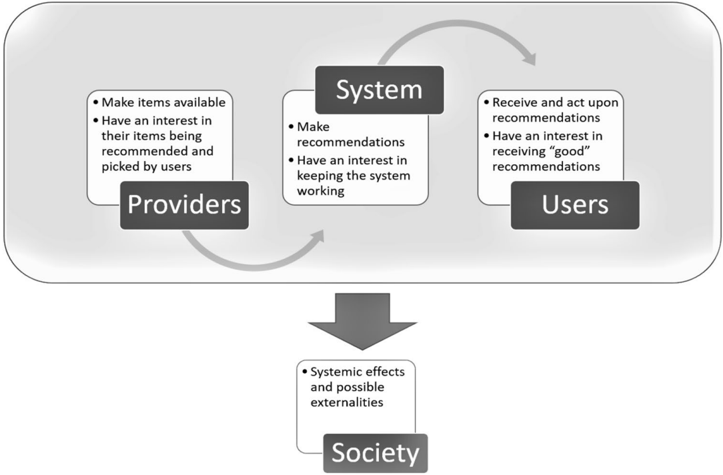
“Following Milano, Taddeo, and Floridi (2020), we distinguish the following stakeholders, each with their own intentions and interests: content producers ( “ providers ” ), the system itself, users, and society (while it should be noted that there exists an overlap between the latter two).”
BackgroundInfluentialThe MineRL BASALT Competition on Learning from Human FeedbackPreprint
Shah, R., Wild, C., Wang, S. H., Alex, N., Houghton, B., Guss, W. H., Mohanty, S., Kanervisto, A., Milani, S., Topin, N., et al. (2021) · arXiv.org · doi:10.48550/arxiv.2107.01969 · Cited by 32
“For example, some argue that recommender systems cause harm, such as by exacerbating political polarization and promoting extremist content [Milano et al., 2020] (though such concerns have been disputed [Orben and Przybylski, 2019]).”
BackgroundMykhailov, D. (2021) · Human Affairs · doi:10.1515/humaff-2021-0013 · Cited by 19
The ethics of scientific recommender systems
Polonioli, A. (2020) · Scientometrics · doi:10.1007/s11192-020-03766-1 · Cited by 23
Beg, S., Khan, S. U. R., & Anjum, A. (2021) · Library Hi Tech · doi:10.1108/lht-04-2021-0147 · Cited by 20
Gaysynsky, A., Heley, K. M., & Chou, W. S. (2022) · International Journal of Environmental Research and Public Health · doi:10.3390/ijerph192215073 · Cited by 18
Assessing deep learning: a work program for the humanities in the age of artificial intelligence
Segessenmann, J., Stadelmann, T., Davison, A., & Dürr, O. M. (2023) · AI and Ethics · doi:10.1007/s43681-023-00408-z · Cited by 24
The Ethical and Legal Challenges of Recommender Systems Driven by Artificial Intelligence
Magrani, E., & da Silva, P. G. F. (2023) · Law, governance and technology series · doi:10.1007/978-3-031-41264-6_8 · Cited by 29
Majjate, H., Bellarhmouch, Y., Jeghal, A., Yahyaouy, A., Tairi, H., & Zidani, K. A. (2024) · Education and Information Technologies · doi:10.1007/s10639-024-12979-3 · Cited by 24
“…these systems work and the personal data they rely on, concerns about privacy have emerged, sparking an ethical debate within educational technology literature and raising discussions about how best to interact with recommendation systems (Milano et al., 2020 ), especially when it comes to minors.”
Graph-based Extractive Explainer for Recommendations
Wang, P., Cai, R., & Wang, H. (2022) · International World Wide Web Conference (WWW) · doi:10.1145/3485447.3512168 · Cited by 26
“The same as Table 3, we report BLEU-{ 1, 2, 4 } and F1 score of ROUGE-{ 1,2,L } .”
MethodInfluentialModeling users’ preference changes in recommender systems via time-dependent Markov random fields
Pujahari, A., & Sisodia, D. S. (2023) · Expert Systems with Applications · doi:10.1016/j.eswa.2023.121072 · Cited by 19
Wang, Z., Yuan, R., & Li, B. (2024) · Journal of Consumer Behaviour · doi:10.1002/cb.2408 · Cited by 18
The Ethics of Rehabilitation in Virtual Reality: the role of Self-Avatars and Deep Learning
Soccini, A. M., & Cena, F. (2021) · IEEE International Conference on Artificial Intelligence and Virtual Reality (AIVR) · doi:10.1109/aivr52153.2021.00068 · Cited by 19
Algorithmic recommendations enabling and constraining information practices among young people
Jylhä, V., Hirvonen, N., & Haider, J. (2024) · Journal of Documentation · doi:10.1108/jd-05-2023-0102 · Cited by 22
ChatGPT in the field of scientific publication – Are we ready for it?
Subbaramaiah, M. T., & Shanthanna, H. (2023) · Indian Journal of Anaesthesia · doi:10.4103/ija.ija_294_23 · Cited by 16
Data identity: privacy and the construction of self
Søe, S. O., & Mai, J. (2022) · Synthese · doi:10.1007/s11229-022-03968-5 · Cited by 18
“As such, tracking of the individual is not necessarily conducted through “a pre-established user identity” (Milano et al., 2020 , p. 962) or in relation to how the individual would self-identify.”
BackgroundFabbri, M. (2023) · Proceedings of the AAAI/ACM Conference on AI Ethics and Society · doi:10.1145/3600211.3604717 · Cited by 19
“[21] propose an initial taxonomy of the ethical challenges posed by automated recommendations: among the social effects of RSs, they”
BackgroundLess is More: Towards Sustainability-Aware Persuasive Explanations in Recommender Systems
Tran, T. N. T., Erdeniz, S. P., Felfernig, A., Lubos, S., Mansi, M. E., & Le, V.-M. (2024) · ACM Conference on Recommender Systems (RecSys) · doi:10.1145/3640457.3691708 · Cited by 17
“In news recommendation, explanations could inform users about potential topic-wise biases with various social effects [18].”
Ethical considerations in AI-based user profiling for knowledge management: A critical review
Njiru, D. K., Mugo, D. M., & Musyoka, F. M. (2025) · Telematics and Informatics Reports · doi:10.1016/j.teler.2025.100205 · Cited by 20
Examining and Promoting Explainable Recommendations for Personal Sensing Technology Acceptance
Newn, J., Kelly, R., D’Alfonso, S., & Lederman, R. (2022) · Proceedings of the ACM on Interactive Mobile Wearable and Ubiquitous Technologies · doi:10.1145/3550297 · Cited by 16
“One of the main barriers affecting the acceptability of automated healthcare systems, especially those driven by artificial intelligence and personal data [55, 111], is the overall lack of transparency and understanding from the user’s perspective [12, 51, 97].”
BackgroundWhy People Skip Music? On Predicting Music Skips using Deep Reinforcement Learning
Meggetto, F., Revie, C. W., Levine, J., & Moshfeghi, Y. (2023) · Conference on Human Information Interaction and Retrieval · doi:10.1145/3576840.3578312 · Cited by 18
“This is leading to a strong research interest in building responsible systems and data collection procedures [45].”
BackgroundFortes, R. S., de Sousa, D. X., Coelho, D. G., Lacerda, A. M., & Gonçalves, M. A. (2021) · Information Sciences · doi:10.1016/j.ins.2021.05.037 · Cited by 16
Sentiment Analysis for E-commerce Product Reviews: Current Trends and Future DirectionsPreprint
Elzeheiry, S. A., Gab-Allah, W. A., Mekky, N. E., & Elmogy, M. M. (2023) · Preprints.org · doi:10.20944/preprints202305.1649.v1 · Cited by 22
Rethinking Health Recommender Systems for Active Aging: An Autonomy-Based Ethical Analysis
Tiribelli, S., & Calvaresi, D. (2024) · Science and Engineering Ethics · doi:10.1007/s11948-024-00479-z · Cited by 18
“Looking at the literature on the ethics of AI, such conditions are described to be undermined when AI and RS are used to manipulate individuals (Milano et al., 2020).”
BackgroundInfluentialHuman autonomy with AI in the loop
Catena, E., Tummolini, L., & Santucci, V. G. (2025) · Philosophical Psychology · doi:10.1080/09515089.2024.2448217 · Cited by 16
“…human autonomy posed by filtering and personalization algorithms, causing “hetero-determination”, manipulation, adaptive preferences, reduction of information diversity, etc (see e.g., Ananny, 2016; Bonicalzi et al., 2023; Milano et al., 2020; Pariser, 2011; Prunkl, 2022; Riva & Tiribelli, 2022).”
Toward an integrated and globally equitable understanding of political polarization
Falkenberg, M., Cinelli, M., Galeazzi, A., Bail, C. A., Benito, R. M., Bruns, A., Gruzd, A. A., Lazer, D., Lee, J. K., McCoy, J., et al. (2026) · Nature Communications · doi:10.1038/s41467-026-76110-5 · Cited by 16
“However, with AI-based recommendation systems optimizing for user engagement 161 , there are fears of a self-reinforcing cycle in which consumers are exposed to increasingly homogeneous content which – if the content is political in nature – may drivepolarization(althoughthisisnot…”
A Causal View for Item-level Effect of Recommendation on User Preference
Cai, W., Feng, F., Wang, Q., Tian, Y., Liu, Z., & Xu, C. (2023) · ACM International Conference on Web Search and Data Mining (WSDM) · doi:10.1145/3539597.3570461 · Cited by 17
“These works [8, 11, 27, 34, 50] argue that recommender systems intentionally or unintentionally nudge the preferences in a particular direction.”
BackgroundEvery word you say: algorithmic mediation and implications of data-driven scholarly communication
Monteiro-Krebs, L., Zaman, B., Geerts, D., & Caregnato, S. E. (2022) · AI & Society · doi:10.1007/s00146-022-01468-1 · Cited by 15
“This might be an attention point, as it attempts against individual users’ autonomy and agency (Koene et al. 2015; Milano et al. 2019).”
BackgroundDarani, M. M., & Aghaie, S. (2025) · Journal of Research in Interactive Marketing · doi:10.1108/jrim-04-2024-0198 · Cited by 20
Ethical Issues with Artificial Ethics Assistants
O’Neill, E., Klincewicz, M., & Kemmer, M. (2022) · Oxford University Press eBooks · doi:10.1093/oxfordhb/9780198857815.013.17 · Cited by 18
Sakieh, Y. (2023) · Social Network Analysis and Mining · doi:10.1007/s13278-023-01175-9 · Cited by 16
“They actively participate in creating our individual and collective tastes, and in the long run, they participate in shaping our identity with important ethical implications (Milano et al. 2020, 2021).”
Pham, H. V., Tuan, N. T., Tuan, L. M., & Moore, P. T. (2024) · Journal of Organizational Computing and Electronic Commerce · doi:10.1080/10919392.2024.2435111 · Cited by 13
“…where there is a very large body of published studies addressing RS from both a technological perspective and the societal and ethical perspective (Milano et al. 2020), where a systematic analysis of the ethical challenges posed by recommender systems is provided through a literature review.”
Beyond Algorethics: Addressing the Ethical and Anthropological Challenges of AI Recommender Systems
Machidon, O. M. (2025) · Journal of Media Ethics · doi:10.1080/23736992.2025.2584435 · Cited by 14
“Recommender systems construct detailed user profiles to predict engagement, but their opacity raises transparency and accountability concerns (Milano et al., 2020).”
Depolarization of opinions on social networks through random nudges
Pal, R., Kumar, A., & Santhanam, M. S. (2023) · Physical review. E · doi:10.1103/physreve.108.034307 · Cited by 18
Recommender System: A Comprehensive Overview of Technical Challenges and Social Implications
An, Y., Tan, Y., Sun, X. J., & Ferrari, G. (2024) · ICCK Transactions on Sensing Communication and Control · doi:10.62762/tscc.2024.898503 · Cited by 12
“RecSys can reinforce and exploit several cognitive biases, such as confirmation bias, availability heuristics, and status quo bias [131, 132].”
Rieder, B., Gordon, G., & Sileno, G. (2023) · Sociologica · doi:10.6092/issn.1971-8853/15910 · Cited by 15
On component interactions in two-stage recommender systems
Hron, J., Krauth, K., Jordan, M. I., & Kilbertus, N. (2021) · neural information processing systems · doi:10.48550/arxiv.2106.14979 · Cited by 37
“[70], recommender systems have been (partially) responsible for unfair treatment of disadvantaged groups, privacy leaks, political polarization, spread of misinforma-”
BackgroundTribal Knowledge Cocreation in Generative Artificial Intelligence Systems
Wang, Y.-F., Chen, Y.-C., Huang, Y.-C., Redwing, C., & Tsai, C.-H. (2024) · Proceedings of the 25th Annual International Conference on Digital Government Research · doi:10.1145/3657054.3657129 · Cited by 11
“The recommendations from generative AI systems can guide or nudge users in particular ways [9, 12].”
BackgroundArtajaya, H., Julieta, Giancarlos, J., Moniaga, J. V., & Chowanda, A. (2024) · IEEE International Conference on Artificial Intelligence and Mechatronics Systems (AIMS) · doi:10.1109/aims61812.2024.10512474 · Cited by 12
“A recommendation system is designed with a particular algorithm to offer suggestions or recommendations based on predictions of what users desire to view or search for [15].”
BackgroundHuman-Centered Recommender Systems
Portaz, M., Riesco, Á. M., & Santos, O. C. (2025) · Human-computer interaction series · doi:10.1007/978-3-031-61375-3_11 · Cited by 12
Fabbri, M., & Boratto, L. (2025) · ACM Conference on Recommender Systems (RecSys) · doi:10.1145/3705328.3748074 · Cited by 16
Deep learning-based privacy-preserving recommendations in federated learning
Kolli, C. S., Reddy, V. V. K., Reddy, T. S., Chandol, M. K., Dasari, D. B., & Reddy, M. R. K. (2024) · International Journal of General Systems · doi:10.1080/03081079.2024.2302605 · Cited by 12
“But these aspects are also associated with the possibility of data leakage and thus causing a “privacy-personalization trade-off problem” (Milano, Taddeo, and Floridi 2020; Zhang and Sundar 2019) in the current recommender systems (Qin, Liu, and Qian 2021).”
BackgroundMofokeng, T. E. (2021) · African Journal of Science Technology Innovation and Development · doi:10.1080/20421338.2021.1958987 · Cited by 12
Onitiu, D. (2021) · AI & Society · doi:10.1007/s00146-021-01235-8 · Cited by 11
Serendipity as a Design Principle of Personalization Systems—Theoretical Distinctions
Reviglio, U. (2023) · Springer eBooks · doi:10.1007/978-3-031-33529-7_8 · Cited by 12
Explaining Neural News Recommendation with Attributions onto Reading Histories
Möller, L., & Padó, S. (2025) · ACM Transactions on Intelligent Systems and Technology · doi:10.1145/3673233 · Cited by 15
“News recommendation is a technology of substantial practical impact [32, 34, 38, 58], and biases in news recommendation can cause serious social harm [16, 20, 21, 42, 46].”
BackgroundZhang, M., Dong, Q., & Wu, X. (2024) · IEEE Transactions on Computational Social Systems · doi:10.1109/tcss.2024.3502662 · Cited by 16
“In practice, the primary objective of algorithm de-sign in modern recommendation systems is to maximize user engagement and profit [35].”
Observed Correction: How We Can All Respond to Misinformation on Social Media
Bode, L., & Vraga, E. K. (2025) · doi:10.1093/oso/9780197565896.001.0001 · Cited by 10
Salles, J. (2025) · New Media & Society · doi:10.1177/14614448251385086 · Cited by 14
“Recent literature (Jones, 2022; Milano et al., 2020; Reviglio, 2019) emphasizes that to counter the risk of users being locked into narrow or compulsive cycles of interaction, one should design systems that balance personalization with transparency, enabling audiences to understand when and how…”
Akter, S. (2025) · American Journal of Scholarly Research and Innovation · doi:10.63125/j7tfr242 · Cited by 15
Recommender Systems, Autonomy and User Engagement
Krook, J., & Blockx, J. (2023) · International Symposium on Trustworthy Autonomous Systems (TAS) · doi:10.1145/3597512.3599712 · Cited by 13
“However, the use of recommender systems poses important questions about the extent to which algorithms are shaping our desires and influencing our decisions [2].”
BackgroundInfluentialGrisse, K. (2023) · The International library of ethics, law and technology · doi:10.1007/978-3-031-34804-4_6 · Cited by 10
Reasoning with Recommender Systems? Practical Reasoning, Digital Nudging, and Autonomy
Bartmann, M. (2023) · The International library of ethics, law and technology · doi:10.1007/978-3-031-34804-4_7 · Cited by 14
Artificial Intelligence and Human Rights
Quintavalla, A., & Temperman, J. (2023) · Oxford University Press eBooks · doi:10.1093/law/9780192882486.001.0001 · Cited by 16
Recommender Systems: Legal and Ethical Issues
Genovesi, S., Kaesling, K., & Robbins, S. (2023) · The International library of ethics, law and technology · doi:10.1007/978-3-031-34804-4 · Cited by 15
Khan, M. A., Muhammad, K., Smyth, B., & Coyle, D. (2021) · arXiv (Cornell University) · doi:10.48550/arxiv.2110.07045 · Cited by 13
To See or Not to See: Understanding the Tensions of Algorithmic Curation for Visual Arts
Srinivasan, R. (2024) · The 2024 ACM Conference on Fairness Accountability and Transparency · doi:10.1145/3630106.3658917 · Cited by 9
“Past studies have investigated issues of concern in algorithmic recommendation in high-stake domains such as healthcare [3], finance, and law [62].”
BackgroundHussain, W., & Merigó, J. M. (2021) · EAI/Springer Innovations in Communication and Computing · doi:10.1007/978-3-030-78303-7_5 · Cited by 9
A Unified Framework of Ethical Principles for AI
Floridi, L. (2023) · Oxford University Press eBooks · doi:10.1093/oso/9780198883098.003.0004 · Cited by 11
Self-citationGovernance Design of Collaborative Intelligence for Public Policy and Services
Chen, Y., Liu, H. K., & Wang, Y.-F. (2024) · Annual International Conference on Digital Government Research · doi:10.1145/3657054.3657075 · Cited by 10
“Some government use of AI, internally created by the collaboration between AI and government employees, can threaten personal autonomy by nudging citizens to behave in the way that enhances government control [38].”
BackgroundFair Sequential Recommendation without User Demographics
Zeng, H., He, Z., Yue, Z., McAuley, J., & Wang, D. (2024) · International ACM SIGIR Conference on Research and Development in Information Retrieval (SIGIR) · doi:10.1145/3626772.3657703 · Cited by 13
Travel itinerary recommendation using interaction-based augmented data
Otaki, K., & Baba, Y. (2024) · Expert Systems with Applications · doi:10.1016/j.eswa.2024.126294 · Cited by 10
Integrating Digital Food Nudges and Recommender Systems: Current Status and Future Directions
Majjodi, A. E., Starke, A. D., & Trattner, C. (2025) · IEEE Access · doi:10.1109/access.2025.3588663 · Cited by 11
“Future work must engage with these ethical dimensions to support the development of responsible, ethically aligned recommender systems [152].”
Sotero, J. M., Vicente, P. N., & Granado, A. (2026) · Technology in Society · doi:10.1016/j.techsoc.2026.103237 · Cited by 10
Davis, J. L. (2020) · Oxford University Press eBooks · doi:10.1093/oxfordhb/9780197510636.013.5 · Cited by 9
Ortiz-Viso, B., Morales-Garzón, A., Martín-Bautista, M. J., & Vila, M. A. (2023) · IEEE Access · doi:10.1109/access.2023.3290918 · Cited by 9
Bias, Privacy and Mistrust: Considering the Ethical Challenges of Artificial Intelligence
Benzie, A., & Montasari, R. (2023) · Advanced sciences and technologies for security applications · doi:10.1007/978-3-031-40118-3_1 · Cited by 12
Comparing and modeling the use of online recommender systems
Engström, E., Vartanova, I., Johansson, J. V., Persson, M. S., & Strimling, P. (2024) · Computers in Human Behavior Reports · doi:10.1016/j.chbr.2024.100449 · Cited by 11
Research Agenda of Ethical Recommender Systems based on Explainable AI
Guttmann, M., & Ge, M. (2024) · Procedia Computer Science · doi:10.1016/j.procs.2024.06.032 · Cited by 9
Recommendation system for financial decision-making using Artificial intelligence
Shuryhin, K. A., & Zinovatna, S. L. (2024) · Applied Aspects of Information Technology · doi:10.15276/aait.07.2024.24 · Cited by 9
Control search rankings, control the world: what is a good search engine?
Coghlan, S., Chia, H. X., Scholer, F., & Spina, D. (2025) · AI and Ethics · doi:10.1007/s43681-025-00695-8 · Cited by 10
“The field of IR has developed a wide array of methods to find information that a user is seeking, and to evaluate SE performance, but there has been relatively limited ethical consideration there about how SEs may affect users and society [ 21, 22, 46, 64].”
AI and Its New Winter: From Myths to Realities
Floridi, L. (2021) · Digital ethics lab yearbook · doi:10.1007/978-3-030-80083-3_6 · Cited by 9
Self-citationIntroduction – The Importance of an Ethics-First Approach to the Development of AI
Floridi, L. (2021) · Philosophical studies series · doi:10.1007/978-3-030-81907-1_1 · Cited by 9
Self-citationDoneda, D. C. M., & Wimmer, M. (2022) · Direito Público · doi:10.11117/rdp.v18i100.6119 · Cited by 21
Identifying and Addressing Ethical Challenges in Recommender Systems
Karakolis, E., Oikonomidis, P. F., & Askounis, D. (2022) · International Conference on Information, Intelligence, Systems & Applications (IISA) · doi:10.1109/iisa56318.2022.9904386 · Cited by 11
“However, in reality, modern RS are led mostly by the digital marketing, and emphasis is put on commercial goals instead of the end user [2].”
BackgroundInfluentialA Survey on Techniques and Methods of Recommender System
Raval, A. S., & Borisagar, K. (2022) · IFIP advances in information and communication technology · doi:10.1007/978-3-031-16364-7_8 · Cited by 9
Metadata
- Authors
- Milano, S., Taddeo, M., & Floridi, L.
- Affiliations
- University of Oxford (GB)
- Corresponding author
- Milano, Silvia
- Venue
- AI & SOCIETY
- Published
- 2020-02-27
- Volume
- 35
- Issue
- 4
- Pages
- 957-967
- ISSN
- 0951-5666 (ISSN-L)
- 1435-5655
- OpenAlex
- W2980951591
- Cited by
- 556
- References
- 44
- Citations by year
- 2026: 66 · 2025: 96 · 2024: 94 · 2023: 157 · 2022: 67 · 2021: 49 · 2020: 20
- FWCI
- 62.54
- Type
- journal article
- Language
- en
- Open access
- hybrid
- doi.org
- Licence
- cc-by
- creativecommons.org/licenses/by/4.0 (tdm)
- creativecommons.org/licenses/by/4.0 (vor)
- Locations
- AI & Society (publishedVersion, cc-by)
- SSRN Electronic Journal (publishedVersion)
- PhilPapers (PhilPapers Foundation) (submittedVersion)
- Funders
- Engineering and Physical Sciences Research Council (EP/N023013/1)
- Topics
- Physical Sciences › Computer Science › Artificial Intelligence › Ethics and Social Impacts of AI
- Physical Sciences › Computer Science › Information Systems › Recommender Systems and Techniques
- Social Sciences › Business, Management and Accounting › Organizational Behavior and Human Resource Management › Ethics in Business and Education
- Keywords
- recommender systems, user-centered design, stakeholder interests, algorithmic transparency, recommendation fairness
About these checks
Registry, retraction, Cites and statistics results are computed, not judged, with one exception: a printed reference that no index lists is read once by a model before it counts as a citation error. Claims are extracted by a model and kept only when their quote appears verbatim in the text; each cited source is then checked, with a model’s help, for whether it says what the claim relies on. Those verdicts can be wrong — read the claim’s quote and the cited source before relying on one.
Statistics and arithmetic are recomputed, not judged.
Confidence bands are shown only for fields calibrated on our annotated test set. None is calibrated yet, so no band is shown.
What counts as a claim ›How we measure confidence ›How we check this ›
Are you an author, or do you see a problem with this page? Request a review
Data sources
Bibliographic data: Semantic Scholar, OpenAlex, Crossref.
Contains information from the Semantic Scholar Academic Graph Datasets, made available under the ODC Attribution License (ODC-BY 1.0).
Semantic Scholar’s data is described in: Kinney, R., et al. (2023). The Semantic Scholar Open Data Platform. arXiv:2301.10140.
