

Recommender systems and their ethical challenges
Open accessThe DOI matches its Crossref record; 47 of the 47 references it cites were found in a registry or an index.
Abstract
This article presents the first, systematic analysis of the ethical challenges posed by recommender systems through a literature review. The article identifies six areas of concern, and maps them onto a proposed taxonomy of different kinds of ethical impact. The analysis uncovers a gap in the literature: currently user-centred approaches do not consider the interests of a variety of other stakeholders—as opposed to just the receivers of a recommendation—in assessing the ethical impacts of a recommender system.
Overview
The claims and statistics of this paper haven’t been checked yet.
Free: it reads the open-access text and checks the first 5 claims that cite a source we can check. Create a free account to check every claim.
Integrity signals
Registry
Cites
Statistics
Figures
Verification
Claims the paper makes
The claims and statistics of this paper haven’t been checked yet.
Free: it reads the open-access text and checks the first 5 claims that cite a source we can check. Create a free account to check every claim.
Claims other papers make about this one
Each is checked against this paper’s own text: does it say what the citing paper says it does?
The cited source says what the claim attributes to it.
In the citing paper
“While this poses a problem of inconclusive evidence, it also indicates that if group privacy (Taylor et al. 2017) is not ensured, it may be impossible for individuals to ever remove themselves from the process of algorithmic profiling and predictions (Milano et al. 2020).”
From The ethics of algorithms: key problems and solutions (2022) · cites this paper as Milano et al. 2020
In the citing paper
“Giving individuals the ability to contribute to the design of a recommender system can help create more accurate profiles that account for attributes and social categories that would have otherwise not been included in the labelling used by the system to categorise users (Milano et al. 2020).”
From The ethics of algorithms: key problems and solutions (2022) · cites this paper as Milano et al. 2020
Self-check
Percentages, sums and reported differences re-computed from the paper’s own numbers.
The self-check needs the paper’s full text.
Citations
Cites
Lecture Notes in Computer Science 1205
(1999) · Industrial Robot: An International Journal · doi:10.1108/ir.1999.04926fae.001 · Cited by 38,662
Adomavicius, G., & Tuzhilin, A. (2005) · IEEE Transactions on Knowledge and Data Engineering · doi:10.1109/tkde.2005.99 · Cited by 10,310 · cited 2×
“…the technology, which took off with the spread of internet-based services and the introduction of collaborative filtering techniques in the 1990s (Adomavicius and Tuzhilin 2005; Pennock et al. 2000); and the proprietary and privacy issues involved in the design and deployment of this class of…”
BackgroundRobust De-anonymization of Large Sparse Datasets
Narayanan, A., & Shmatikov, V. (2008) · 2008 IEEE Symposium on Security and Privacy (sp 2008) · doi:10.1109/sp.2008.33 · Cited by 2,372
Explaining collaborative filtering recommendations
Herlocker, J. L., Konstan, J. A., & Riedl, J. (2000) · Proceedings of the 2000 ACM conference on Computer supported cooperative work · doi:10.1145/358916.358995 · Cited by 1,731 · cited 1×
“As noted by Herlocker et al. (2000), recommendations generated by collaborative filtering techniques can, on a simple level, be conceptualised as analogous to “word of mouth” recommendations among users.”
BackgroundHow AI can be a force for good
Taddeo, M., & Floridi, L. (2018) · Science · doi:10.1126/science.aat5991 · Cited by 760 · cited 1×
“…individual users’ autonomy, by providing recommendations that nudge users in a particular direction, by attempting to “addict” them to some types of contents, or by limiting the range of options to which they are exposed (Burr et al. 2018; de Vries 2010; Koene et al. 2015; Taddeo and Floridi 2018).”
BackgroundSelf-citationBias in algorithmic filtering and personalization
Bozdag, E. (2013) · Ethics and Information Technology · doi:10.1007/s10676-013-9321-6 · Cited by 649 · cited 1×
“…biases and “filter bubbles” that are damaging to the normal functioning of public debate, group deliberation, and democratic institutions more generally (Bozdag 2013; Bozdag and van den Hoven, 2015; Harambam et al. 2018; Helberger et al. 2016; Koene et al. 2015; Reviglio 2017; Zook et al. 2017).”
BackgroundFloridi, L., & Taddeo, M. (2016) · Philosophical Transactions of the Royal Society A: Mathematical, Physical and Engineering Sciences · doi:10.1098/rsta.2016.0360 · Cited by 637 · cited 1×
“This is an approach that is able to consider specifically ethical problems related to data, algorithms, and practices, but also how the problems relate, depend on, and impact each other (Floridi and Taddeo 2016).”
BackgroundSelf-citationCaptivating algorithms: Recommender systems as traps
Seaver, N. (2019) · Journal of Material Culture · doi:10.1177/1359183518820366 · Cited by 492 · cited 1×
“The methodologies that they adopt are more varied, ranging from ethnographic study (Seaver 2018b), to hermeneutics (de Vries 2010), decision theory (Burr et al. 2018), and economics (Abdollahpouri et al. 2017).”
MethodBreaking the filter bubble: democracy and design
Bozdag, E., & van den Hoven, J. (2015) · Ethics and Information Technology · doi:10.1007/s10676-015-9380-y · Cited by 375 · cited 2×
“In this respect, Bozdag and van den Hoven (2015) argue that the design of algorithmic tools to combat informational segregation should be more sensitive to the democratic norms that are implicitly built into these tools.”
BackgroundExposure diversity as a design principle for recommender systems
Helberger, N., Karppinen, K., & D’Acunto, L. (2018) · Information, Communication & Society · doi:10.1080/1369118x.2016.1271900 · Cited by 366 · cited 2×
“…by several authors is that news recommendation systems, in particular, must reach a trade-off between the expected relevance to the user and diversity when generating personalised recommendations based on pre-specified user preferences or behavioural data (Helberger et al. 2016; Reviglio 2017).”
Background
Research works printed but not linked: 1
- Seaver N (2018b) Captivating algorithms: recommender systems as traps. J Mater Cult. https ://doi.org/10.1177/13591 83518 82036 · doi:10.1177/13591
Cited by
On the Opportunities and Risks of Foundation Models
Bommasani, R., Hudson, D. A., Adeli, E., Altman, R., Arora, S., von Arx, S., Bernstein, M. S., Bohg, J., Bosselut, A., Brunskill, E., et al. (2021) · arXiv · doi:10.48550/arxiv.2108.07258 · Cited by 2,676
The Ethics of Artificial Intelligence: Principles, Challenges, and Opportunities
Floridi, L. (2023) · doi:10.1093/oso/9780198883098.001.0001 · Cited by 507
Self-citationTowards a standard for identifying and managing bias in artificial intelligence
Schwartz, R., Vassilev, A., Greene, K., Perine, L., Burt, A., & Hall, P. (2022) · doi:10.6028/nist.sp.1270 · Cited by 548
“For example, the ML systems that underlie AI applications often model our implicit biases with the intent of creating positive experiences for online shopping or identifying content of interest [65, 66].”
BackgroundLeveraging Artificial Intelligence in Marketing for Social Good—An Ethical Perspective
Hermann, E. (2022) · Journal of Business Ethics · doi:10.1007/s10551-021-04843-y · Cited by 403
Six Human-Centered Artificial Intelligence Grand Challenges
Ozmen Garibay, O., Winslow, B., Andolina, S., Antona, M., Bodenschatz, A., Coursaris, C., Falco, G., Fiore, S. M., Garibay, I., Grieman, K., et al. (2023) · International Journal of Human–Computer Interaction · doi:10.1080/10447318.2022.2153320 · Cited by 501
“The recommender system is essential to the success of the social media website which raises a question regarding the privacy of monitored individuals and other ethical challenges (Milano et al., 2020).”
Ethical and social risks of harm from Language Models
Weidinger, L., Mellor, J., Rauh, M., Griffin, C., Uesato, J., Huang, P.-S., Cheng, M., Glaese, M., Balle, B., Kasirzadeh, A., et al. (2021) · arXiv · doi:10.48550/arxiv.2112.04359 · Cited by 477
“Different ethical and social risks have been identified in relation to existing recommender systems, including polarisation of users and reduced user well-being (Milano et al., 2020).”
BackgroundEthical framework for Artificial Intelligence and Digital technologies
Ashok, M., Madan, R., Joha, A., & Sivarajah, U. (2022) · International Journal of Information Management · doi:10.1016/j.ijinfomgt.2021.102433 · Cited by 469
The ethics of algorithms: key problems and solutions
Tsamados, A., Aggarwal, N., Cowls, J., Morley, J., Roberts, H., Taddeo, M., & Floridi, L. (2022) · AI & SOCIETY · doi:10.1007/s00146-021-01154-8 · Cited by 384
Self-citationArtificial intelligence in cyber physical systems
Radanliev, P., De Roure, D., Van Kleek, M., Santos, O., & Ani, U. (2021) · AI & SOCIETY · doi:10.1007/s00146-020-01049-0 · Cited by 199
“1 3 with taxonomy (Milano et al. 2020), in pursuit of narratives (O’Hara 2020).”
Hermann, E. (2022) · New Media & Society · doi:10.1177/14614448211022702 · Cited by 214
“…can arise (1) when data are gathered without informed consent of individuals, (2) after storage when they are leaked or de-anonymized (i.e. data breaches), (3) when AI systems draw inferences from both individual data (directly), or interaction data with others (indirectly; Milano et al., 2020).”
BackgroundMethodInfluentialLarge language models (LLM) and ChatGPT: what will the impact on nuclear medicine be?
Alberts, I. L., Mercolli, L., Pyka, T., Prenosil, G., Shi, K., Rominger, A., & Afshar-Oromieh, A. (2023) · European Journal of Nuclear Medicine and Molecular Imaging · doi:10.1007/s00259-023-06172-w · Cited by 207
“Nevertheless, we believe that the power of ChatGPT (or the lack thereof) shows an urgent need to address the ethical challenges of such systems in a systematic way [29–31].”
BackgroundAI and Its New Winter: from Myths to Realities
Floridi, L. (2020) · Philosophy & Technology · doi:10.1007/s13347-020-00396-6 · Cited by 174
Self-citationEthics and responsible AI deployment
Radanliev, P., Santos, O., Brandon-Jones, A., & Joinson, A. (2024) · Frontiers in Artificial Intelligence · doi:10.3389/frai.2024.1377011 · Cited by 163
“(Bengio et al., 2013; Milano et al., 2020).”
The Impossibility of Automating Ambiguity
Birhane, A. (2021) · Artificial Life · doi:10.1162/artl_a_00336 · Cited by 168
Gil de Zúñiga, H., Goyanes, M., & Durotoye, T. (2024) · Political Communication · doi:10.1080/10584609.2023.2290497 · Cited by 198
“This level of analysis provides a nuance on perceptions of the potential of AI-Human interaction and has been a debate in the literature (Hancock et al., 2020; Milano et al., 2020).”
BackgroundBuilding Human Values into Recommender Systems: An Interdisciplinary Synthesis
Stray, J., Halevy, A., Assar, P., Hadfield-Menell, D., Boutilier, C., Ashar, A., Bakalar, C., Beattie, L., Ekstrand, M., Leibowicz, C., et al. (2024) · ACM Transactions on Recommender Systems · doi:10.1145/3632297 · Cited by 122
“Previous work has explored the legal and human rights potentially impacted by recommender systems (Milano et al., 2020) and by AI in general (Donahoe and Metzger, 2019)”
BackgroundA Review of Modern Recommender Systems Using Generative Models (Gen-RecSys)
Deldjoo, Y., He, Z., McAuley, J., Korikov, A., Sanner, S., Ramisa, A., Vidal, R., Sathiamoorthy, M., Kasirzadeh, A., & Milano, S. (2024) · ACM SIGKDD Conference on Knowledge Discovery and Data Mining (KDD) · doi:10.1145/3637528.3671474 · Cited by 289
“Milano et al. [108] proposes six categories of harms associated with RS: content ; privacy violations and data misuse; threats to human autonomy and well-being; transparency and accountability ; harmful social effects such as filter bubbles, polarisation, and manipulability; and fairness .”
Self-citationThinking Outside the Black-Box: The Case for “Algorithmic Sovereignty” in Social Media
Reviglio, U., & Agosti, C. (2020) · Social Media + Society · doi:10.1177/2056305120915613 · Cited by 214
“While there have been discussions on the ethics of recommender systems and personalization (Bozdag & Timmermans, 2011; Helberger, 2019; Milano et al., 2020), and on how to fulfill main algorithmic principles such as fairness, transparency, accountability, accuracy, and privacy (algo:aware, 2018),…”
BackgroundHarms from Increasingly Agentic Algorithmic Systems
Chan, A., Salganik, R., Markelius, A., Pang, C., Rajkumar, N., Krasheninnikov, D., Langosco, L., He, Z., Duan, Y., Carroll, M., et al. (2023) · 2023 ACM Conference on Fairness Accountability and Transparency · doi:10.1145/3593013.3594033 · Cited by 149
Sustainable AI: An integrated model to guide public sector decision-making
Wilson, C., & van der Velden, M. (2022) · Technology in Society · doi:10.1016/j.techsoc.2022.101926 · Cited by 123
Himeur, Y., Sohail, S. S., Bensaali, F., Amira, A., & Alazab, M. (2022) · Computers & Security · doi:10.1016/j.cose.2022.102746 · Cited by 139
Jedličková, A. (2024) · AI & Society · doi:10.1007/s00146-024-02040-9 · Cited by 159
“These algorithms predict user choices to optimize platform offerings and reduce information overload, as noted by Milano et al. (2020).”
Achieving a ‘Good AI Society’: Comparing the Aims and Progress of the EU and the US
Roberts, H., Cowls, J., Hine, E., Mazzi, F., Tsamados, A., Taddeo, M., & Floridi, L. (2021) · Science and Engineering Ethics · doi:10.1007/s11948-021-00340-7 · Cited by 103
“to nudge an individual to a specific kind of content whilst limiting their exposure to others (Milano et al., 2020).”
BackgroundSelf-citationFilter bubbles in recommender systems: Fact or fallacy—A systematic review
Areeb, Q. M., Nadeem, M., Sohail, S. S., Imam, R., Doctor, F., Himeur, Y., Hussain, A., & Amira, A. (2023) · Wiley Interdisciplinary Reviews Data Mining and Knowledge Discovery · doi:10.1002/widm.1512 · Cited by 168
“[72] 2020 Analysis of social effects of filter bubble Analysis No”
BackgroundShi, X., Zhang, Y., Pujahari, A., & Mishra, S. K. (2024) · Expert Systems with Applications · doi:10.1016/j.eswa.2024.125423 · Cited by 130
Kirk, H. R., Vidgen, B., Röttger, P., & Hale, S. A. (2024) · Nature Machine Intelligence · doi:10.1038/s42256-024-00820-y · Cited by 122
“Autonomy may seem to be a counterintuitive benefit given the literature on the loss of autonomy from algorithmic nudges, tailored advertising and recommender systems 20 .”
The Ethics of Algorithms: Key Problems and Solutions
Tsamados, A., Aggarwal, N., Cowls, J., Morley, J., Roberts, H., Taddeo, M., & Floridi, L. (2021) · Philosophical Studies Series · doi:10.1007/978-3-030-81907-1_8 · Cited by 121
Self-citationEvolution and impact of bias in human and machine learning algorithm interaction
Sun, W., Nasraoui, O., & Shafto, P. (2020) · PLOS ONE · doi:10.1371/journal.pone.0235502 · Cited by 116
Benefits of Diverse News Recommendations for Democracy: A User Study
Heitz, L., Lischka, J. A., Birrer, A., Paudel, B., Tolmeijer, S., Laugwitz, L. L., & Bernstein, A. (2022) · Digital Journalism · doi:10.1080/21670811.2021.2021804 · Cited by 132
“Socially responsible designs of news recommender systems have increasingly become a focus in research (Harambam et al. 2019; Helberger 2019; Helberger et al. 2018; Milano et al. 2020; Nechushtai and Lewis 2019; Thurman et al. 2019).”
BackgroundInfluentialRecommender systems for mental health apps: advantages and ethical challenges
Valentine, L., D’Alfonso, S., & Lederman, R. (2023) · AI & SOCIETY · doi:10.1007/s00146-021-01322-w · Cited by 92
“Whilst by now, there is an emerging body of literature considering ethical and socio-technical aspects of recommender systems (Milano et al. 2020; Paraschakis 2017) and similarly, a body of such literature for digital mental health technologies (D’Alfonso et al. 2019; Gooding 2019), the novelty of…”
BackgroundInfluentialDecolonizing AI Ethics: Relational Autonomy as a Means to Counter AI Harms
Mhlambi, S., & Tiribelli, S. (2023) · Topoi · doi:10.1007/s11245-022-09874-2 · Cited by 82
“…and from the consistent corpus of literature focused on risks raised by AI on autonomy in AI ethics (Mittelstadt et al. 2016; Floridi et al. 2018; Milano et al. 2020; Calvo et al. 2020; Floridi and Cowls 2019; Tsamados et al. 2022) is its main understanding via the lens of the traditional (also…”
BackgroundInfluentialArtificial intelligence in the information ecosystem: Affordances for everyday information seeking
Hirvonen, N., Jylhä, V., Lao, Y., & Larsson, S. (2024) · Journal of the Association for Information Science and Technology · doi:10.1002/asi.24860 · Cited by 107
“Recommendation of content is suggested to shape users' preferences and choices (Milano et al., 2020), homog-enize exposure to information (Nechushtai et al., 2023) and taste (see Hesmondhalgh et al., 2023), reduce diversity in content consumption (Anderson et al., 2020), and narrow information…”
Human Autonomy at Risk? An Analysis of the Challenges from AI
Prunkl, C. (2024) · Minds and Machines · doi:10.1007/s11023-024-09665-1 · Cited by 138
“Milano et al. (2019) define recommender systems as “functions that take a user’s preferences (e.g. about movies) as an input, and output a prediction about the rating the user would give of the items under evaluation (e.g., new movies available)” (p. 2).”
BackgroundMethodHagendorff, T., Bossert, L. N., Tse, Y. F., & Singer, P. (2023) · AI and Ethics · doi:10.1007/s43681-022-00199-9 · Cited by 84
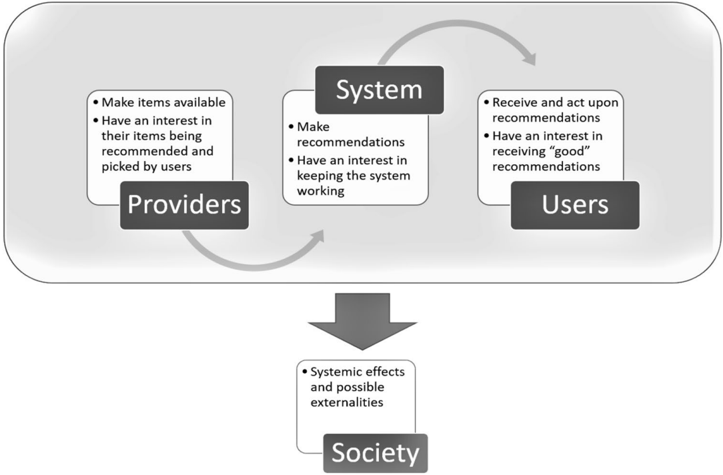
“However, due to their far-reaching ethical implications, negative externalities, as well as systemic effects [144], one has to put them into a broader context.”
BackgroundThe Digital Therapeutic Alliance and Human-Computer Interaction
D'Alfonso, S., Lederman, R., Bucci, S., & Berry, K. (2020) · JMIR Mental Health · doi:10.2196/21895 · Cited by 90
“Beyond the issues of ensuring safe, accurate recommendations possibly accompanied by explanation, recommendation systems can negatively encroach on a users’ autonomy by nudging them in a particular direction or limiting the range of options which could be presented to them, even possibly in extreme cases addicting the…”
BackgroundTwo types of AI existential risk: decisive and accumulative
Kasirzadeh, A. (2025) · Philosophical Studies · doi:10.1007/s11098-025-02301-3 · Cited by 115
“By acknowledging the interdependencies and potential for cascading effects within these systems, we can increase resilience and adaptability against x-catastrophic disruptions, leading to the development of more robust long-term strategies.”
Human autonomy in the age of artificial intelligence
Prunkl, C. (2022) · Nature Machine Intelligence · doi:10.1038/s42256-022-00449-9 · Cited by 105
Aligning AI Optimization to Community Well-Being
Stray, J. (2020) · International Journal of Community Well-Being · doi:10.1007/s42413-020-00086-3 · Cited by 115
“These challenges of collective action have been explored in the context of AI systems from the perspective of social choice theory (Baum 2020) and multi-stakeholder recommendation systems (Milano et al. 2019a).”
BackgroundTrust models and theories in human–computer interaction: A systematic literature review
Gulati, S., McDonagh, J., Sousa, S., & Lamas, D. (2024) · Computers in Human Behavior Reports · doi:10.1016/j.chbr.2024.100495 · Cited by 95
Ethical aspects of multi-stakeholder recommendation systems
Milano, S., Taddeo, M., & Floridi, L. (2020) · The Information Society · doi:10.1080/01972243.2020.1832636 · Cited by 96
Self-citationPsychology-informed Recommender Systems
Lex, E., Kowald, D., Seitlinger, P. C., Tran, T. N. T., Felfernig, A., & Schedl, M. (2021) · Foundations and Trends® in Information Retrieval · doi:10.1561/1500000090 · Cited by 99
What are you optimizing for? Aligning Recommender Systems with Human ValuesPreprint
Stray, J., Vendrov, I., Nixon, J., Adler, S., & Hadfield-Menell, D. (2021) · arXiv (Cornell University) · doi:10.48550/arxiv.2107.10939 · Cited by 90
“There sorts of issues are related to the classic economic problems of externalities and public goods, and are explicitly considered in multi-stakeholder recommendation research (Milano et al., 2019b).”
The Philosophy of Online Manipulation
Jongepier, F., & Klenk, M. (2022) · Routledge eBooks · doi:10.4324/9781003205425 · Cited by 92
Pathak, R., Spezzano, F., & Pera, M. S. (2023) · ACM Transactions on the Web · doi:10.1145/3616088 · Cited by 88
“Moreover, with RAs relying on ongoing user-system interactions (likes, shares, follows) to modify presented suggestions, their reach is far beyond individual users (i.e., they have a “transformative impact on society” [53]).”
BackgroundA Systematic Literature Review on AI-Based Recommendation Systems and Their Ethical Considerations
Masciari, E., Umair, A., & Ullah, M. H. (2024) · IEEE Access · doi:10.1109/access.2024.3451054 · Cited by 75
“After all, they shape user preferences and guide choices, both individually and socially [114].”
BackgroundCheng, X., Lin, X., Shen, X., Zarifis, A., & Mou, J. (2022) · Electronic Markets · doi:10.1007/s12525-022-00531-5 · Cited by 98
“Recommender systems harness the data we provide with our behaviour to focus sharply on what we want, discarding other alternatives (Deldjoo et al., 2020; Milano et al., 2020).”
BackgroundThe Ethics of AI for Information Professionals: Eight Scenarios
Cox, A. (2022) · Journal of the Australian Library and Information Association · doi:10.1080/24750158.2022.2084885 · Cited by 51
“Thus IFLA (2019) explains that there is the risk that, despite its potential bene fi ts, personalisation leads to echo chambers or fi lter bubbles, where recommendations reinforce existing beliefs, nudge behaviour or even seek to create addiction (Milano et al., 2020).”
BackgroundAI alignment: Assessing the global impact of recommender systems
Bojić, L. (2024) · Futures · doi:10.1016/j.futures.2024.103383 · Cited by 80
News recommender systems: a programmatic research review
Mitova, E., Blassnig, S., Strikovic, E., Urman, A., Hannák, A., de Vreese, C. H., & Esser, F. (2022) · Annals of the International Communication Association · doi:10.1080/23808985.2022.2142149 · Cited by 82
“Transparency, accountability and explicability of the employed algorithms have also mostly been discussed theoretically (e.g. Bastian et al., 2019; Descampe et al., 2022; Diakopoulos & Koliska, 2017; Helberger et al., 2018; Leerssen, 2020; Milano et al., 2020; Møller, 2022b).”
MethodAI-Empowered Recommender System for Renewable Energy Harvesting in Smart Grid System
Patel, R. K., Kumari, A., Tanwar, S., Hong, W., & Sharma, R. (2022) · IEEE Access · doi:10.1109/access.2022.3152528 · Cited by 66
“The author Chow et al. [22] employed 1128 high-quality data to train and test the presented model to predict the real-time energy generation [22].”
BackgroundHaroon, M., Wojcieszak, M., Chhabra, A., Liu, X., Mohapatra, P., & Shafiq, Z. (2023) · Proceedings of the National Academy of Sciences · doi:10.1073/pnas.2213020120 · Cited by 64
Ethics of Digital Well-Being: A Multidisciplinary Approach
Burr, C., & Floridi, L. (2020) · Philosophical studies series · doi:10.1007/978-3-030-50585-1 · Cited by 78
Self-citationThe Ethics of Digital Well-Being: A Multidisciplinary Perspective
Burr, C., & Floridi, L. (2020) · Philosophical studies series · doi:10.1007/978-3-030-50585-1_1 · Cited by 75
Self-citationHarnessing Artificial Intelligence for Personalized Learning: A Systematic Review
Rasheed, Z., Ghwanmeh, S., & Abualkishik, A. Z. (2023) · Data & Metadata · doi:10.56294/dm2023146 · Cited by 73
Wang, Q., Camacho, I., Jing, S., & Goel, A. K. (2022) · Proceedings of the ACM on Human-Computer Interaction · doi:10.1145/3512977 · Cited by 47
“This differs from prior research in AI-MC and recommender systems where issues regarding user agency have been repeatedly brought up yet could mostly be resolved by giving users as much agency during the decision-making process as possible [26, 27, 48, 63].”
BackgroundResultArtificial Intelligence and Autonomy: On the Ethical Dimension of Recommender Systems
Bonicalzi, S., De, M., & Giovanola, B. (2023) · Topoi · doi:10.1007/s11245-023-09922-5 · Cited by 76
“At the same time, by telling people who they are, these tags contribute to mediating and reshaping the subjective experience of one's own identity as defined by the background of social categories to which one is iteratively compared (Milano et al. 2020).”
BackgroundAli, W., Zhou, X., & Shao, J. (2025) · ACM Computing Surveys · doi:10.1145/3708982 · Cited by 71
The Ethics of Advanced AI Assistants
Gabriel, I., Manzini, A., Keeling, G., Hendricks, L. A., Rieser, V., Iqbal, H., Tomašev, N., Ktena, I., Kenton, Z., Rodriguez, M., et al. (2024) · arXiv · doi:10.48550/arxiv.2404.16244 · Cited by 57
Recommendation with generative models
Deldjoo, Y., He, Z., McAuley, J., Korikov, A., Sanner, S., Ramisa, A., Vidal, R., Sathiamoorthy, M., Kasrizadeh, A., Milano, S., et al. (2026) · Foundations and Trends® in Information Retrieval · doi:10.1108/ftinr-06-2025-0109 · Cited by 54
Self-citationUser Tampering in Reinforcement Learning Recommender Systems
Kasirzadeh, A., & Evans, C. (2023) · Proceedings of the AAAI/ACM Conference on AI Ethics and Society · doi:10.1145/3600211.3604669 · Cited by 61
Hutmacher, F., & Appel, M. (2023) · Review of General Psychology · doi:10.1177/10892680221105663 · Cited by 40
“…personalization relies on collecting an abundance of personal data has raised ethical and legal concerns regarding privacy, trust, and discrimination (e.g., Bozdag, 2013; Burr et al., 2018; Fast & Jago, 2020; Matz et al., 2020; Milano et al., 2020; Mittelstadt et al., 2016; Taddeo & Floridi, 2018).”
BackgroundInfluentialUsing the Veil of Ignorance to align AI systems with principles of justice
Weidinger, L., McKee, K. R., Everett, R., Huang, S., Zhu, T. O., Chadwick, M. J., Summerfield, C., & Gabriel, I. (2023) · Proceedings of the National Academy of Sciences · doi:10.1073/pnas.2213709120 · Cited by 43
Recommendation Unlearning via Influence Function
Zhang, Y., Hu, Z., Bai, Y., Wu, J., Wang, Q., & Feng, F. (2024) · ACM Transactions on Recommender Systems · doi:10.1145/3701763 · Cited by 74
“Recommender systems are widely deployed to perform personalized information filtering, shaping the individual experience of online activities [32], e.g., social interactions, shopping, and entertainment.”
Respect for Human Autonomy in Recommender SystemsPreprint
Varshney, L. R. (2020) · arXiv (Cornell University) · doi:10.48550/arxiv.2009.02603 · Cited by 48
“Given the strong impact that recommender systems have on human behavior, one may view them as causing a loss of human autonomy [11].”
BackgroundWhat Is Fair? Exploring the Artists’ Perspective on the Fairness of Music Streaming Platforms
Ferraro, A., Serra, X., & Bauer, C. (2021) · Lecture notes in computer science · doi:10.1007/978-3-030-85616-8_33 · Cited by 71
“A recent review [43] highlights that existing literature tends to consider the implications for the receivers of the recommendations (i.”
BackgroundAI-powered recommender systems and the preservation of personal autonomy
del Valle, J. I., & Lara, F. (2023) · AI & Society · doi:10.1007/s00146-023-01720-2 · Cited by 52
“(Milano et al. 2020).”
Evans, R., Jackson, D., & Murphy, J. (2022) · Digital Journalism · doi:10.1080/21670811.2022.2055596 · Cited by 52
“…bubbles and echo chambers can have potentially deleterious consequences for democracy by, for example, weak-ening viewpoint diversity, undermining the normal functioning of group deliberation and public debate, and contributing to political polarisation (Milano, Mariarosaria, and Luciano 2020).”
BackgroundAnalysing the Effect of Recommendation Algorithms on the Amplification of MisinformationPreprint
Fernández, M., Bellogín, A., & Cantador, I. (2021) · arXiv (Cornell University) · doi:10.48550/arxiv.2103.14748 · Cited by 49
“An important point to make while presenting this research is the need of ethical guidelines [80].”
BackgroundImproving Sequential Recommendations via Bidirectional Temporal Data Augmentation With Pre-Training
Jiang, J., Zhang, P., Luo, Y., Li, C., Kim, J. B., Zhang, K., Wang, S., Kim, S., & Yu, P. S. (2025) · IEEE Transactions on Knowledge and Data Engineering · doi:10.1109/tkde.2025.3546035 · Cited by 44
“Despite thesuccess,theeffectivenessofembeddingenrichmenthinges ontheavailabilityofdetailedmetadata,whichmaybesparse orentirelymissinginreal-worldscenarioswheredataprivacy matters [16].”
Guo, W., & Chen, Y. (2025) · Journal of Medical Internet Research · doi:10.2196/66760 · Cited by 47
“…comprehension in traditional patient-physician communication [10] and the black-box nature of AI that systematically ignores explanations for users [11], it is imperative to investigate whether providing explanations of the diagnostic decision-making process enhances effective communication…”
Information cocoons in online navigation
Hou, L., Pan, X., Liu, K., Yang, Z., Liu, J.-G., & Zhou, T. (2022) · iScience · doi:10.1016/j.isci.2022.105893 · Cited by 44
“Recent ethical studies (10,27,28) Different from known ethical suggestions and legal rules, our results indicate that IC-related problems can be largely solved inside the algorithmic framework, using the proposed flexible strategy or other alternatives (8,29,30).”
BackgroundAI Regulation Is (not) All You Need
Lucaj, L., van der Smagt, P., & Benbouzid, D. (2023) · 2023 ACM Conference on Fairness Accountability and Transparency · doi:10.1145/3593013.3594079 · Cited by 40
“Ethical challenges with the deployment of AI systems are not a new phenomenon and have been widely recognised in the literature [16, 43, 49].”
BackgroundWhere Are the Values? A Systematic Literature Review on News Recommender Systems
Bauer, C., Bagchi, C., Hundogan, O. A., & van Es, K. F. (2024) · ACM Transactions on Recommender Systems · doi:10.1145/3654805 · Cited by 48
“” Instead, these works typically (only) specify those values they are concentrating on (e.g., privacy [99], fairness [61], trust [34]) or subsume some values under other overlapping umbrella terms and concepts (e.g., ethics [150, 225]).”
Facebook’s Cyber–Cyber and Cyber–Physical Digital Twins
Ahlgren, J., Bojarczuk, K., Drossopoulou, S., Dvortsova, I., George, J., Gucevska, N., Harman, M., Lomelí, M., Lucas, S. M., Meijer, E., et al. (2021) · International Conference on Evaluation and Assessment in Software Engineering (EASE) · doi:10.1145/3463274.3463275 · Cited by 42
“and the prevalence of ‘click-bait’ headlines [40] [53].”
BackgroundWe’re in This Together: A Multi-Stakeholder Approach for News Recommenders
Smets, A., Hendrickx, J., & Ballon, P. (2022) · Digital Journalism · doi:10.1080/21670811.2021.2024079 · Cited by 50
“…foundations to incorporate objectives of multiple stakeholders in the operational design of recommender systems (Burke 2017; Mehrotra et al. 2018), it also allows researchers to study and model the broader socio-economic context of recommenders and its impact on their design (Milano et al. 2020).”
BackgroundWatch, Scroll, Repeat: How Interface Design Shapes Consumptive Curation Affordances on TikTok
Entrena-Serrano, C. (2025) · Social Media + Society · doi:10.1177/20563051251358529 · Cited by 44
“Furthermore, social media dynamically influence how users’ algorithmic identity is constructed by recommending content based on previous interactions with already person-alised content (Milano et al., 2020).”
Recommender Systems in Cybersecurity
Ferreira, L., Silva, D. C., & Uriarte, M. (2023) · Knowledge and Information Systems · doi:10.1007/s10115-023-01906-6 · Cited by 45
“Milano et al. [45] reflected upon the ethical challenges inherited by RSs, such as privacy, opacity, fairness, and other features.”
BackgroundWhen Stories Turn Institutional: How TikTok Users Legitimate the Algorithmic Sensemaking
Obreja, D. M. (2024) · Social Media + Society · doi:10.1177/20563051231224114 · Cited by 40
“Thus, controversies surrounding privacy and lack of transparency represent recurring problems for some TikTok users and are closely related to moral or ethical values (Magalhães, 2018; Milano et al., 2020).”
BackgroundMatamoros-Fernández, A., Bartolo, L., & Troynar, L. (2023) · Internet Policy Review · doi:10.14763/2023.1.1677 · Cited by 42
Citizens’ trust in AI-enabled government systems
Wang, Y.-F., Chen, Y., Chien, S.-Y. J., & Wang, P.-J. (2024) · Information Polity · doi:10.3233/ip-230065 · Cited by 45
“Moreover, the government can use AI to incentivize citizens’ actions and behaviors, but this application raises concerns about overly nudging (Milano et al., 2020): there are concerns that governments can misuse AI to guide citizens to follow their instructions even when their policy goals are…”
Measuring Automated Influence: Between Empirical Evidence and Ethical Values
Susser, D., & Grimaldi, V. (2021) · Proceedings of the AAAI/ACM Conference on AI Ethics and Society · doi:10.1145/3461702.3462532 · Cited by 45
“Similar worries have been raised about recommender systems [12, 60].”
BackgroundIntelligent environments for all: a path towards technology-enhanced human well-being
Burzagli, L., Emiliani, P. L., Antona, M., & Stephanidis, C. (2021) · Universal Access in the Information Society · doi:10.1007/s10209-021-00797-0 · Cited by 40
Wang, X., Lin, X., & Shao, B. (2024) · Journal of Business Ethics · doi:10.1007/s10551-024-05894-7 · Cited by 41
“One unique feature of AI is that it requires extremely massive amounts of data for its application and algorithm training (Milano et al., 2020).”
Morales, P. R., & Cointet, J. (2021) · ACM Conference on Recommender Systems (RecSys) · doi:10.1145/3460231.3478851 · Cited by 43
“The prevalence of RS in social platforms has raised public concern about undesired societal effects [23], with polarization becoming a notion of interest.”
BackgroundLindebaum, D., Möser, C., Ashraf, M., & Glaser, V. (2022) · Academy of Management Review · doi:10.5465/amr.2021.0159 · Cited by 38
Personalized recommendations and consumer trust: The role of perceived control and locus of control
Xu, Y., & Chen, L. (2025) · Acta Psychologica · doi:10.1016/j.actpsy.2025.105936 · Cited by 31
Dinnissen, K., & Bauer, C. (2023) · ACM Conference on User Modeling, Adaptation and Personalization (UMAP) · doi:10.1145/3565472.3592960 · Cited by 37
“However, even though RS may affect both user and item provider fairness, most research focuses on recommendation value for users [32, 45].”
BackgroundGunathilaka, T. M. A. U., Manage, P. D., Zhang, J., Li, Y., & Kelly, W. (2025) · Intelligent Systems with Applications · doi:10.1016/j.iswa.2024.200474 · Cited by 45
Promoting Bright PatternsPreprint
Sandhaus, H. (2023) · arXiv (Cornell University) · doi:10.48550/arxiv.2304.01157 · Cited by 35
“These threats are hard to judge normatively out of context [14, 17, 52]; the morality of technology depends on how the technology is crafted and put to use.”
BackgroundRegulating high-reach AI: On transparency directions in the Digital Services Act
Söderlund, K., Engström, E., Haresamudram, K., Larsson, S., & Strimling, P. (2024) · Internet Policy Review · doi:10.14763/2024.1.1746 · Cited by 45
“Such systems tend to go beyond simple ranking by leveraging user data to adapt and personalise suggestions over time (Milano et al., 2020), which can lead to dynamic changes in their function and behavioural impact.”
Garapati, R., & Chakraborty, M. (2025) · Knowledge and Information Systems · doi:10.1007/s10115-025-02453-y · Cited by 35
“Key ethical challenges include bias, transparency, user autonomy, and fairness [101, 102].”
Algorithmic Institutionalism: The Changing Rules of Social and Political Life
Mendonça, R. F., Almeida, V. A. F., & Filgueiras, F. D. B. (2023) · doi:10.1093/oso/9780192870070.001.0001 · Cited by 70
Wardatzky, K., Inel, O., Rossetto, L., & Bernstein, A. (2025) · ACM Transactions on Recommender Systems · doi:10.1145/3716394 · Cited by 35
“First, by providing the reasoning behind specific recommendations, explanations can mitigate issues dealing with users’ autonomy that can occur when recommendations nudge or persuade users in a particular direction that is not beneficial for them [90].”
AI and human autonomy: a literature review
Catena, E. (2026) · AI and Ethics · doi:10.1007/s43681-025-00958-4 · Cited by 20
“For similar reasons, recommender systems can also threaten personal autonomy by shaping personal identity [25, 79] since the latter provides an internal coherence that overlaps with authenticity conditions of personal autonomy [25].”
InfluentialAutonomous Vehicles: from Whether and When to Where and How
Floridi, L. (2019) · Philosophy & Technology · doi:10.1007/s13347-019-00384-5 · Cited by 28
“Today, we shop online, and the new selling agents are recommender systems (Milano et al. 2019), which canvass the space of information, or infosphere .”
BackgroundSelf-citationRueda, M. C., & Goyanes, M. (2022) · Journalism · doi:10.1177/14648849221114948 · Cited by 27
“Against this backdrop, it is hard for PSM to compete and move fast in this new landscape where lack of privacy, automated recommendations, and personalization play a key role and are designed to optimize user engagement regardless of quality or diversity (Milano et al., 2020).”
BackgroundDescampe, A., Massart, C., Poelman, S., Standaert, F., & Standaert, O. (2021) · AI & Society · doi:10.1007/s00146-021-01159-3 · Cited by 28
De-centering the (Traditional) user: Multistakeholder evaluation of recommender systems
Burke, R., Adomavičius, G., Bogers, T., Noia, T. D., Kowald, D., Neidhardt, J., Özgöbek, Ö., Pera, M. S., Tintarev, N., & Ziegler, J. (2025) · International Journal of Human-Computer Studies · doi:10.1016/j.ijhcs.2025.103560 · Cited by 30
Greene, T., Martens, D., & Shmueli, G. (2022) · Nature Machine Intelligence · doi:10.1038/s42256-022-00475-7 · Cited by 39
“Various researchers have expressed concern regarding the lack of operational transparency and unintended ethical, social and political effects of platform BMOD at scale 28–30 .”
BackgroundCan TikTok promote a healthier ageing paradigm? A case study of older digital celebrities from China
Yu, Y., & Zhao, B. (2022) · Area · doi:10.1111/area.12777 · Cited by 28
Metadata
- Authors
- Milano, S., Taddeo, M., & Floridi, L.
- Affiliations
- University of Oxford (GB)
- Corresponding author
- Milano, Silvia
- Venue
- AI & SOCIETY
- Published
- 2020-02-27
- Volume
- 35
- Issue
- 4
- Pages
- 957-967
- ISSN
- 0951-5666 (ISSN-L)
- 1435-5655
- OpenAlex
- W2980951591
- Cited by
- 556
- References
- 44
- Citations by year
- 2026: 66 · 2025: 96 · 2024: 94 · 2023: 157 · 2022: 67 · 2021: 49 · 2020: 20
- FWCI
- 62.54
- Type
- journal article
- Language
- en
- Open access
- hybrid
- doi.org
- Licence
- cc-by
- creativecommons.org/licenses/by/4.0 (tdm)
- creativecommons.org/licenses/by/4.0 (vor)
- Locations
- AI & Society (publishedVersion, cc-by)
- SSRN Electronic Journal (publishedVersion)
- PhilPapers (PhilPapers Foundation) (submittedVersion)
- Funders
- Engineering and Physical Sciences Research Council (EP/N023013/1)
- Topics
- Physical Sciences › Computer Science › Artificial Intelligence › Ethics and Social Impacts of AI
- Physical Sciences › Computer Science › Information Systems › Recommender Systems and Techniques
- Social Sciences › Business, Management and Accounting › Organizational Behavior and Human Resource Management › Ethics in Business and Education
- Keywords
- recommender systems, user-centered design, stakeholder interests, algorithmic transparency, recommendation fairness
About these checks
Registry, retraction, Cites and statistics results are computed, not judged, with one exception: a printed reference that no index lists is read once by a model before it counts as a citation error. Claims are extracted by a model and kept only when their quote appears verbatim in the text; each cited source is then checked, with a model’s help, for whether it says what the claim relies on. Those verdicts can be wrong — read the claim’s quote and the cited source before relying on one.
Statistics and arithmetic are recomputed, not judged.
Confidence bands are shown only for fields calibrated on our annotated test set. None is calibrated yet, so no band is shown.
What counts as a claim ›How we measure confidence ›How we check this ›
Are you an author, or do you see a problem with this page? Request a review
Data sources
Bibliographic data: Semantic Scholar, OpenAlex, Crossref.
Contains information from the Semantic Scholar Academic Graph Datasets, made available under the ODC Attribution License (ODC-BY 1.0).
Semantic Scholar’s data is described in: Kinney, R., et al. (2023). The Semantic Scholar Open Data Platform. arXiv:2301.10140.
