

Bacillus subtilis High Cell Density Fermentation Using a Sporulation-Deficient Strain for the Production of Surfactin
Open accessThe DOI matches its Crossref record; 42 of the 42 references it cites were found in a registry or an index.
Abstract
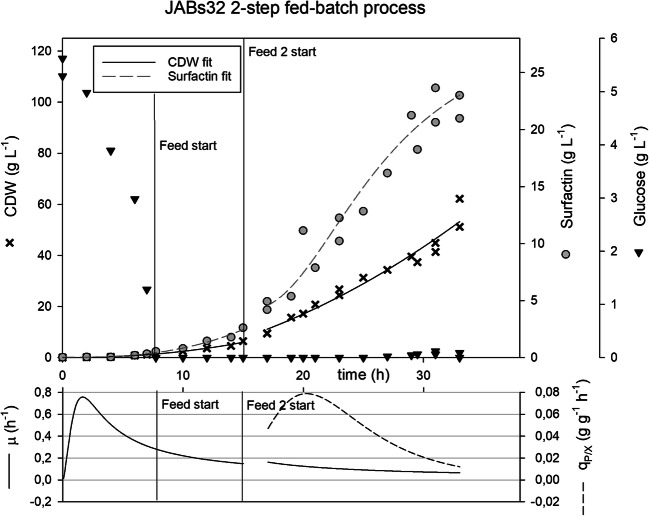
Bacillus subtilis 3NA is a strain capable of reaching high cell densities. A surfactin producing sfp+ variant of this strain, named JABs32, was utilized in fed-batch cultivation processes. Both a glucose and an ammonia solution were fed to set a steady growth rate μ of 0.1 h-1. In this process, a cell dry weight of up to 88 g L-1 was reached after 38 h of cultivation, and surfactin titers of up to 26.5 g L-1 were detected in this high cell density fermentation process, achieving a Y P/X value of 0.23 g g-1 as well as a q P/X of 0.007 g g-1 h-1. In sum, a 21-fold increase in surfactin titer was obtained compared with cultivations in shake flasks. In contrast to fed-batch operations using Bacillus subtilis JABs24, an sfp+ variant derived from B. subtilis 168, JABs32, reached an up to fourfold increase in surfactin titers using the same fed-batch protocol. Additionally, a two-stage feed process was established utilizing strain JABs32. Using an optimized mineral salt medium in this high cell density fermentation approach, after 31 h of cultivation, surfactin titers of 23.7 g L-1 were reached with a biomass concentration of 41.3 g L-1, thus achieving an enhanced Y P/X value of 0.57 g g-1 as well as a q P/X of 0.018 g g-1 h-1. The mutation of spo0A locus and an elongation of AbrB in the strain utilized in combination with a high cell density fed-batch process represents a promising new route for future enhancements on surfactin production. Key points: • Utilization of a sporulation deficient strain for fed-batch operations • High cell density process with Bacillus subtilis for lipopeptide production was established • High titer surfactin production capabilities confirm highly promising future platform strain
Overview
The claims and statistics of this paper haven’t been checked yet.
Free: it reads the open-access text and checks the first 5 claims that cite a source we can check. Create a free account to check every claim.
Integrity signals
Registry
Cites
Statistics
Figures


Verification
Claims the paper makes
The claims and statistics of this paper haven’t been checked yet.
Free: it reads the open-access text and checks the first 5 claims that cite a source we can check. Create a free account to check every claim.
Claims other papers make about this one
Each is checked against this paper’s own text: does it say what the citing paper says it does?
The source backs part of the claim, not all of it — or backs it for a different population, condition or comparison.
In the citing paper
“As a result of the lack of sporulation, a surfactin-producing 3NA strain achieved a 1.6-fold higher growth rate in shake flasks, which makes this strain attractive for fermentation processes with high cell density [5, 11, 12].”
From The influence of growth rate-controlling feeding strategy on the surfactin production in Bacillus subtilis bioreactor processes (2024) · cites this paper as [5]
Experimental — accuracy not yet measuredThe source backs part of the claim, not all of it — or backs it for a different population, condition or comparison.
In the citing paper
“NRPS gene expression is controlled by cell differentiation processes and in particular by the ComX-mediated quorum sensing mechanism, which enables biomass-related surfactin production [4–6].”
From The influence of growth rate-controlling feeding strategy on the surfactin production in Bacillus subtilis bioreactor processes (2024) · cites this paper as [5]
Experimental — accuracy not yet measuredThe cited source says what the claim attributes to it.
In the citing paper
“In previous studies on surfactin production, B. subtilis strains with established sporulation deficiency have proven to be favourable production organisms [5, 11].”
From The influence of growth rate-controlling feeding strategy on the surfactin production in Bacillus subtilis bioreactor processes (2024) · cites this paper as [5]
The cited source says what the claim attributes to it.
In the citing paper
“In bioreactor cultures with optimized mineral salt medium, biomass concentrations of 41.3 g/L and surfactin titers of 23.7 g/L were achieved after 31 h of cultivation [5].”
From The influence of growth rate-controlling feeding strategy on the surfactin production in Bacillus subtilis bioreactor processes (2024) · cites this paper as [5]
Self-check
Percentages, sums and reported differences re-computed from the paper’s own numbers.
The self-check needs the paper’s full text.
Citations
Cites
Modeling of the Bacterial Growth Curve
Zwietering, M. H., Jongenburger, I., Rombouts, F. M., & van 't Riet, K. (1990) · Applied and Environmental Microbiology · doi:10.1128/aem.56.6.1875-1881.1990 · Cited by 4,233 · cited 1×
“A logistic equation with four parameters was used to fit the data for the bacterial growth under limiting conditions (Zwietering et al. 1990).”
MethodCooper, D. G., Macdonald, C. R., Duff, S. J. B., & Kosaric, N. (1981) · Applied and Environmental Microbiology · doi:10.1128/aem.42.3.408-412.1981 · Cited by 591 · cited 4×
“lipopeptide produced by a wide range of Bacillus species (Cooper et al. 1981).”
BackgroundInfluentialThe SpoOA protein of Bacillus subtilis is a repressor of the abrB gene.
Strauch, M., Webb, V, Spiegelman, G., & Hoch, J. A. (1990) · Proceedings of the National Academy of Sciences · doi:10.1073/pnas.87.5.1801 · Cited by 350
GENETICS OF ENDOSPORE FORMATION IN BACILLUS SUBTILIS
Losick, R., Youngman, P., & Piggot, P. J. (1986) · Annual Review of Genetics · doi:10.1146/annurev.ge.20.120186.003205 · Cited by 346 · cited 4×
“…that when cell density reaches a threshold range, cell differentiation facilitated by a functional abrB-gene such as spore formation resulting in growth reduction and entering of stationary phase is the preferred strategy (Losick et al. 1986; Grossman and Losick 1988; Shank and Kolter 2011).”
BackgroundInfluentialThe transition state transcription regulator abrB of Bacillus subtilis is a DNA binding protein.
Strauch, M. A., Spiegelman, G. B., Perego, M., Johnson, W. C., Burbulys, D., & Hoch, J. A. (1989) · The EMBO Journal · doi:10.1002/j.1460-2075.1989.tb03546.x · Cited by 271 · cited 2×
“AbrB is a transcriptional regulator for several genes, which are important during transition state between exponential and stationary phase (Strauch et al. 1989).”
BackgroundWu, Q., Zhi, Y., & Xu, Y. (2019) · Metabolic Engineering · doi:10.1016/j.ymben.2018.11.004 · Cited by 215 · cited 6×
“production from these regulatory circuits by promoter exchanges (Sun et al. 2009; Willenbacher et al. 2016; Wu et al. 2019).”
BackgroundMethodInfluentialExtracellular control of spore formation in Bacillus subtilis.
Grossman, A. D., & Losick, R. (1988) · Proceedings of the National Academy of Sciences · doi:10.1073/pnas.85.12.4369 · Cited by 193 · cited 3×
“…that when cell density reaches a threshold range, cell differentiation facilitated by a functional abrB-gene such as spore formation resulting in growth reduction and entering of stationary phase is the preferred strategy (Losick et al. 1986; Grossman and Losick 1988; Shank and Kolter 2011).”
BackgroundLi, Y., Héloir, M., Zhang, X., Geissler, M., Trouvelot, S., Jacquens, L., Henkel, M., Su, X., Fang, X., Wang, Q., et al. (2019) · Molecular Plant Pathology · doi:10.1111/mpp.12809 · Cited by 188
Self-citationThe application of foaming for the recovery of Surfactin from B. subtilis ATCC 21332 cultures
Davis, D. A., Lynch, H. C., & Varley, J. (2001) · Enzyme and Microbial Technology · doi:10.1016/s0141-0229(00)00327-6 · Cited by 161 · cited 1×
“Many processes use the foaming capabilities of surfactin producing cultures for product enrichment (Davis et al. 2001; Willenbacher et al. 2014; Jiao et al. 2017).”
BackgroundTrach, K. A., & Hoch, J. A. (1993) · Molecular Microbiology · doi:10.1111/j.1365-2958.1993.tb01204.x · Cited by 145 · cited 2×
“Spores are unproductive hibernation-like cells and are usually the result of adverse conditions or nutrient limitation, as well as a product of cell density dependent differentiation control (Grossman and Losick 1988; Trach and Hoch 1993).”
Background
Cited by
Qiao, J., Borriss, R., Sun, K., Zhang, R., Chen, X., Liu, Y., & Liu, Y. (2024) · Microbial Cell Factories · doi:10.1186/s12934-024-02372-7 · Cited by 94
“Knock out of the spo0A gene enhances surfactin synthesis [49].”
BackgroundMethodMolecular genetics of surfactin and its effects on different sub-populations of Bacillus subtilis
Rahman, F. B., Sarkar, B., Moni, R., & Rahman, M. S. (2021) · Biotechnology Reports · doi:10.1016/j.btre.2021.e00686 · Cited by 88
“Different studies reported that deletion of spo0A gene results in absolutely no surfactin production [45, 46] Spo0A protein negatively regulates the gene abrB and thus the synthesis of AbrB protein.”
BackgroundGudiña, E. J., & Teixeira, J. A. (2022) · Biotechnology Advances · doi:10.1016/j.biotechadv.2022.108013 · Cited by 82
Put, H., Gerstmans, H., Capelle, H. V., Fauvart, M., Michiels, J. J., & Masschelein, J. (2024) · Natural Product Reports · doi:10.1039/d3np00065f · Cited by 85
Vahidinasab, M., Adiek, I., Hosseini, B., Akintayo, S. O., Abrishamchi, B., Pfannstiel, J., Henkel, M., Lilge, L., Voegele, R. T., & Hausmann, R. (2022) · Microorganisms · doi:10.3390/microorganisms10112225 · Cited by 72
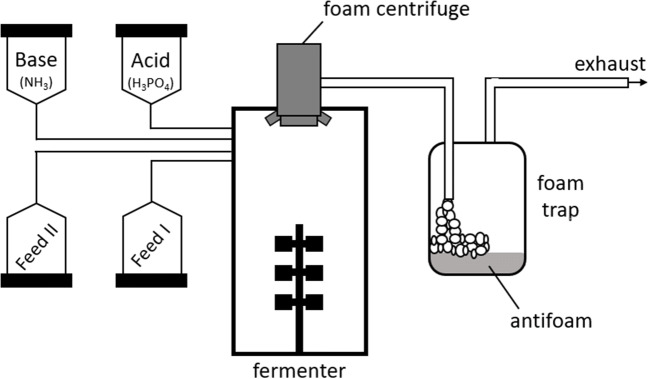
“[47] including the use of a foam centrifuge as well as the antifoam agent Contraspum A4050 (Zschimmer and Schwarz GmbH, Lahnstein, Germany).”
Self-citation
Metadata
- Authors
- Klausmann, P., Hennemann, K., Hoffmann, M., Treinen, C., Aschern, M., Lilge, L., Morabbi Heravi, K., Henkel, M., & Hausmann, R.
- Affiliations
- University of Hohenheim (DE)
- Corresponding author
- Henkel, Marius
- Venue
- Applied Microbiology and Biotechnology
- Published
- 2021-05
- Volume
- 105
- Issue
- 10
- Pages
- 4141-4151
- ISSN
- 0175-7598 (ISSN-L)
- 1432-0614
- PMC
- PMC8140969
- OpenAlex
- W3161958610
- Cited by
- 83
- References
- 42
- Citations by year
- 2026: 20 · 2025: 18 · 2024: 16 · 2023: 11 · 2022: 13 · 2021: 5
- FWCI
- 2.79
- Type
- journal article
- Language
- en
- Open access
- hybrid
- doi.org
- Licence
- cc-by
- creativecommons.org/licenses/by/4.0 (tdm)
- creativecommons.org/licenses/by/4.0 (vor, 14 d)
- Locations
- Applied Microbiology and Biotechnology (publishedVersion, cc-by)
- PubMed Central (publishedVersion, cc-by)
- PubMed (publishedVersion)
- Funders
- Bundesministerium für Bildung und Forschung (031B0469F)
- Topics
- Physical Sciences › Environmental Science › Pollution › Microbial bioremediation and biosurfactants
- Life Sciences › Biochemistry, Genetics and Molecular Biology › Molecular Biology › Microbial Metabolic Engineering and Bioproduction
- Life Sciences › Biochemistry, Genetics and Molecular Biology › Biotechnology › Enzyme Production and Characterization
- Keywords
- Bacillus subtilis, surfactin, high cell density fermentation, fed-batch fermentation, lipopeptide production, yield improvement
- MeSH terms
- Bacillus subtilis, Cell Count, Culture Media, Fermentation, Peptides, Cyclic, Lipopeptides
About these checks
Registry, retraction, Cites and statistics results are computed, not judged, with one exception: a printed reference that no index lists is read once by a model before it counts as a citation error. Claims are extracted by a model and kept only when their quote appears verbatim in the text; each cited source is then checked, with a model’s help, for whether it says what the claim relies on. Those verdicts can be wrong — read the claim’s quote and the cited source before relying on one.
Statistics and arithmetic are recomputed, not judged.
Confidence bands are shown only for fields calibrated on our annotated test set. None is calibrated yet, so no band is shown.
What counts as a claim ›How we measure confidence ›How we check this ›
Are you an author, or do you see a problem with this page? Request a review
How to cite
Cite CoChat for the checks on this page, and the paper for its own findings.
- This page
- CoChat. (2026). Citation check: Bacillus subtilis High Cell Density Fermentation Using a Sporulation-Deficient Strain for the Production of Surfactin. https://app.cochat.ai/papers/10.1007/s00253-021-11330-x
- The paper
- Klausmann, P., Hennemann, K., Hoffmann, M., Treinen, C., Aschern, M., Lilge, L., Morabbi Heravi, K., Henkel, M., & Hausmann, R. (2021). Bacillus subtilis High Cell Density Fermentation Using a Sporulation-Deficient Strain for the Production of Surfactin. Applied Microbiology and Biotechnology. https://doi.org/10.1007/s00253-021-11330-x
Data sources
Bibliographic data: Semantic Scholar, OpenAlex, Crossref.
Contains information from the Semantic Scholar Academic Graph Datasets, made available under the ODC Attribution License (ODC-BY 1.0).
Semantic Scholar’s data is described in: Kinney, R., et al. (2023). The Semantic Scholar Open Data Platform. arXiv:2301.10140.
