

The DOI matches its Crossref record; 314 of the 314 references it cites were found in a registry or an index.
Neutrophils in innate host defense against Staphylococcus aureus infections
Open accessAbstract
Staphylococcus aureus has been an important human pathogen throughout history and is currently a leading cause of bacterial infections worldwide. S. aureus has the unique ability to cause a continuum of diseases, ranging from minor skin infections to fatal necrotizing pneumonia. Moreover, the emergence of highly virulent, drug-resistant strains such as methicillin-resistant S. aureus in both healthcare and community settings is a major therapeutic concern. Neutrophils are the most prominent cellular component of the innate immune system and provide an essential primary defense against bacterial pathogens such as S. aureus. Neutrophils are rapidly recruited to sites of infection where they bind and ingest invading S. aureus, and this process triggers potent oxidative and non-oxidative antimicrobial killing mechanisms that serve to limit pathogen survival and dissemination. S. aureus has evolved numerous mechanisms to evade host defense strategies employed by neutrophils, including the ability to modulate normal neutrophil turnover, a process critical to the resolution of acute inflammation. Here we provide an overview of the role of neutrophils in host defense against bacterial pathogens and discuss strategies employed by S. aureus to circumvent neutrophil function.
Overview
The claims and statistics of this paper haven’t been checked yet.
Run the check — free, no account needed. It reads the open-access text and checks the sources it cites.
Integrity signals
Registry
Cites
Statistics
Figures
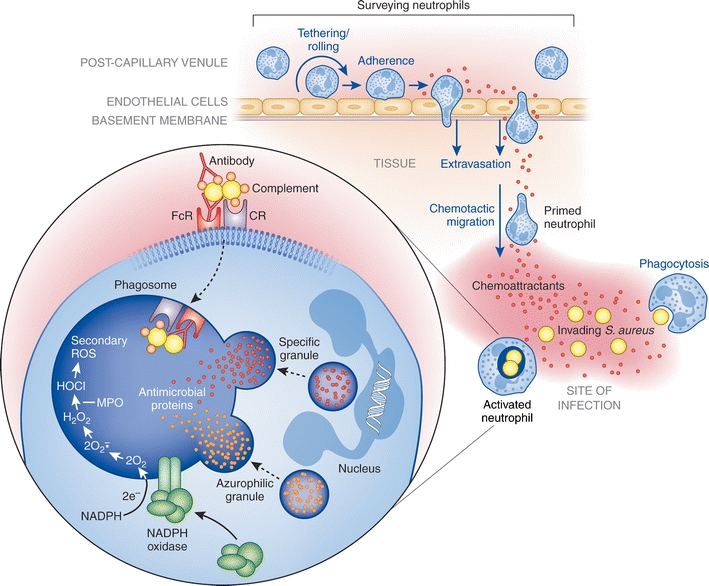
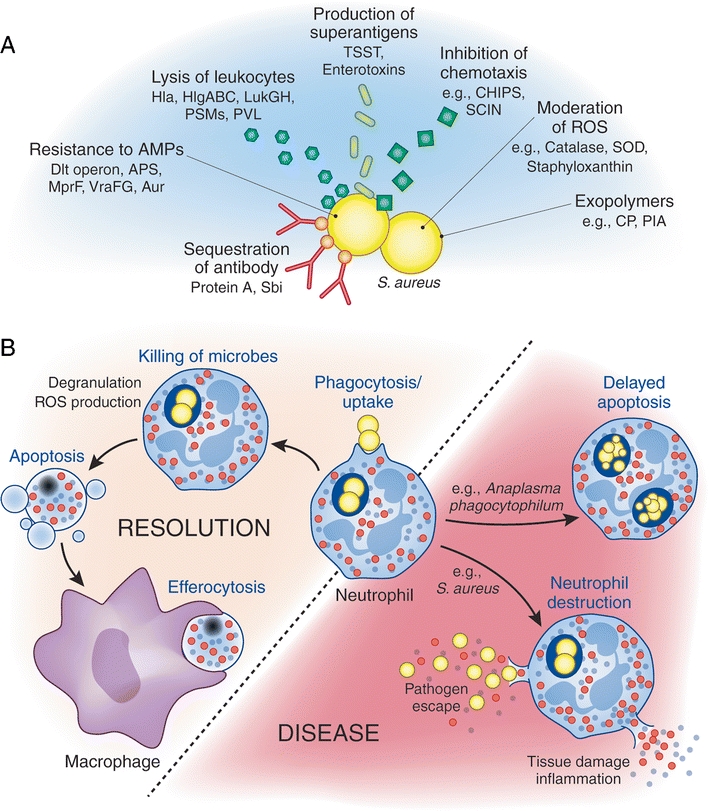
Verification
Claims the paper makes
The claims and statistics of this paper haven’t been checked yet.
Run the check — free, no account needed. It reads the open-access text and checks the sources it cites.
Claims other papers make about this one
Each is checked against this paper’s own text: does it say what the citing paper says it does?
In the citing paper
“At the site of infection, neutrophils bind and ingest the invading micro-organisms by phagocytosis.”
From Superoxide Anion Chemistry—Its Role at the Core of the Innate Immunity (2023) · cites this paper as [209]
Self-check
Percentages, sums and reported differences re-computed from the paper’s own numbers.
The self-check needs the paper’s full text.
Citations
Cites
Principles and Practice of Infectious Diseases.
(1991) · Annals of Internal Medicine · doi:10.7326/0003-4819-114-9-818_5 · Cited by 12,045
Neutrophil Extracellular Traps Kill Bacteria
Brinkmann, V., Reichard, U., Goosmann, C., Fauler, B., Uhlemann, Y., Weiss, D. S., Weinrauch, Y., & Zychlinsky, A. (2004) · Science · doi:10.1126/science.1092385 · Cited by 10,268
The L-Arginine-Nitric Oxide Pathway
Epstein, F. H., Moncada, S., & Higgs, A. (1993) · New England Journal of Medicine · doi:10.1056/nejm199312303292706 · Cited by 6,678
Staphylococcus aureus Infections
Lowy, F. D. (1998) · New England Journal of Medicine · doi:10.1056/nejm199808203390806 · Cited by 6,018
Getting to the site of inflammation: the leukocyte adhesion cascade updated
Ley, K., Laudanna, C., Cybulsky, M. I., & Nourshargh, S. (2007) · Nature Reviews Immunology · doi:10.1038/nri2156 · Cited by 4,354
Klevens, R. M. (2007) · JAMA · doi:10.1001/jama.298.15.1763 · Cited by 3,726
Novel cell death program leads to neutrophil extracellular traps
Fuchs, T. A., Abed, U., Goosmann, C., Hurwitz, R., Schulze, I., Wahn, V., Weinrauch, Y., Brinkmann, V., & Zychlinsky, A. (2007) · The Journal of Cell Biology · doi:10.1083/jcb.200606027 · Cited by 3,197
Fadok, V. A., Bratton, D. L., Konowal, A., Freed, P. W., Westcott, J. Y., & Henson, P. M. (1998) · Journal of Clinical Investigation · doi:10.1172/jci1112 · Cited by 3,166
Neutrophils in the activation and regulation of innate and adaptive immunity
Mantovani, A., Cassatella, M. A., Costantini, C., & Jaillon, S. (2011) · Nature reviews. Immunology · doi:10.1038/nri3024 · Cited by 3,159
Babior, B. M., Kipnes, R. S., & Curnutte, J. T. (1973) · Journal of Clinical Investigation · doi:10.1172/jci107236 · Cited by 2,931
Cited by
Sorted by citations
Pathogenicity and virulence of Staphylococcus aureus
Cheung, G. Y. C., Bae, J. S., & Otto, M. J. (2021) · Virulence · doi:10.1080/21505594.2021.1878688 · Cited by 1,554
Bacteria activate sensory neurons that modulate pain and inflammation
Chiu, I. M., Heesters, B. A., Ghasemlou, N., Von Hehn, C. A., Zhao, F., Tran, J., Wainger, B., Strominger, A., Muralidharan, S., Horswill, A. R., et al. (2013) · Nature · doi:10.1038/nature12479 · Cited by 949
Reactive Oxygen Species and Neutrophil Function
Winterbourn, C. C., Kettle, A. J., & Hampton, M. B. (2016) · Annual Review of Biochemistry · doi:10.1146/annurev-biochem-060815-014442 · Cited by 931
Skeletal infections: microbial pathogenesis, immunity and clinical management
Masters, E. A., Ricciardi, B. F., Bentley, K. L. D. M., Moriarty, T. F., Schwarz, E. M., & Muthukrishnan, G. (2022) · Nature Reviews Microbiology · doi:10.1038/s41579-022-00686-0 · Cited by 735
Staphylococcal Biofilm Development: Structure, Regulation, and Treatment Strategies
Schilcher, K., & Horswill, A. R. (2020) · Microbiology and Molecular Biology Reviews · doi:10.1128/mmbr.00026-19 · Cited by 762
Metadata
- Authors
- Rigby, K. M., & DeLeo, F. R.
- Affiliations
- National Institutes of Health (US)
- Corresponding author
- DeLeo, Frank R.
- ORCID
- DeLeo, Frank R.
- Venue
- Seminars in Immunopathology
- Published
- 2011-11-12
- Volume
- 34
- Issue
- 2
- Pages
- 237-259
- ISSN
- 1863-2297 (ISSN-L)
- 1863-2300
- PMC
- PMC3271231
- OpenAlex
- W1990621187
- Cited by
- 400
- References
- 311
- Citations by year
- 2026: 17 · 2025: 20 · 2024: 25 · 2023: 31 · 2022: 29 · 2021: 20 · 2020: 22 · 2019: 33 · 2018: 30 · 2017: 28 · 2016: 30 · 2015: 31 · 2014: 40 · 2013: 36 · 2012: 8
- FWCI
- 2.41
- Type
- journal article
- Language
- en
- Open access
- hybrid
- doi.org
- Licence
- cc-by-nc
- Locations
- Seminars in Immunopathology (publishedVersion, cc-by-nc)
- Europe PMC (PubMed Central) (publishedVersion, cc-by-nc)
- PubMed Central (publishedVersion, cc-by-nc)
- PubMed (publishedVersion)
- Funders
- National Institutes of Health
- National Institute of Allergy and Infectious Diseases
- Topics
- Life Sciences › Immunology and Microbiology › Immunology › Neutrophil, Myeloperoxidase and Oxidative Mechanisms
- Health Sciences › Medicine › Infectious Diseases › Antimicrobial Resistance in Staphylococcus
- Life Sciences › Immunology and Microbiology › Immunology › Inflammation biomarkers and pathways
- Keywords
- neutrophils, Staphylococcus aureus, innate immunity, host defense, methicillin-resistant Staphylococcus aureus, bacterial virulence, neutrophil turnover, oxidative killing, necrotizing pneumonia, skin infections
- MeSH terms
- Animals, Anti-Infective Agents, Humans, Immunity, Innate, Neutrophils, Staphylococcal Infections, Staphylococcus aureus, Virulence, Host-Pathogen Interactions, Methicillin-Resistant Staphylococcus aureus, Immune Evasion
About these checks
Registry, retraction, Cites and statistics results are computed, not judged, with one exception: a printed reference that no index lists is read once by a model before it counts as a citation error. Claims are extracted by a model and kept only when their quote appears verbatim in the text; each cited source is then checked, with a model’s help, for whether it says what the claim relies on. Those verdicts can be wrong — read the claim’s quote and the cited source before relying on one.
Statistics and arithmetic are recomputed, not judged.
Confidence bands are shown only for fields calibrated on our annotated test set. None is calibrated yet, so no band is shown.
What counts as a claim ›How we measure confidence ›How we check this ›
Are you an author, or do you see a problem with this page? Request a review
