

Nociceptors: a phylogenetic view
Open accessThe DOI matches its Crossref record; 195 of the 196 references it cites were found in a registry or an index.
Abstract
The ability to react to environmental change is crucial for the survival of an organism and an essential prerequisite is the capacity to detect and respond to aversive stimuli. The importance of having an inbuilt "detect and protect" system is illustrated by the fact that most animals have dedicated sensory afferents which respond to noxious stimuli called nociceptors. Should injury occur there is often sensitization, whereby increased nociceptor sensitivity and/or plasticity of nociceptor-related neural circuits acts as a protection mechanism for the afflicted body part. Studying nociception and nociceptors in different model organisms has demonstrated that there are similarities from invertebrates right through to humans. The development of technology to genetically manipulate organisms, especially mice, has led to an understanding of some of the key molecular players in nociceptor function. This review will focus on what is known about nociceptors throughout the Animalia kingdom and what similarities exist across phyla; especially at the molecular level of ion channels.
Overview
The claims and statistics of this paper haven’t been checked yet.
Free: it reads the open-access text and checks the first 5 claims that cite a source we can check. Create a free account to check every claim.
Integrity signals
Registry
Cites
Statistics
Figures
Verification
Claims the paper makes
The claims and statistics of this paper haven’t been checked yet.
Free: it reads the open-access text and checks the first 5 claims that cite a source we can check. Create a free account to check every claim.
Claims other papers make about this one
Each is checked against this paper’s own text: does it say what the citing paper says it does?
The source backs part of the claim, not all of it — or backs it for a different population, condition or comparison.
In the citing paper
“The peripheral nervous system of the lamprey has no myelinated nociceptive fibers, and recordings from spinal and brain dorsal cells that have a potential nociceptive role have achieved mixed results (Martin and Wickelgren, 1971; Rovainen and Yan, 1985; Smith and Lewin, 2009).”
From The evolutionary and genetic origins of consciousness in the Cambrian Period over 500 million years ago (2013) · cites this paper as Smith and Lewin, 2009
Experimental — accuracy not yet measuredThe cited source says what the claim attributes to it.
In the citing paper
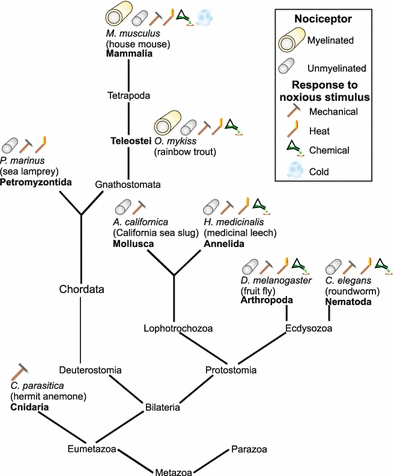
“nociceptors are actually quite ancient neural structures and are present in species of molluscs, nematode worms, and fruit flies (Smith and Lewin, 2009; Figure 4).”
From The evolutionary and genetic origins of consciousness in the Cambrian Period over 500 million years ago (2013) · cites this paper as Smith and Lewin, 2009
The cited source says what the claim attributes to it.
In the citing paper
“Thus, the pain experience seems to characterize teleost fish and presumably all other vertebrates with equally or more complex brains (except perhaps for the cartilaginous fish such as sharks, which may lack appreciable perception: Smith and Lewin, 2009; Sneddon, 2011).”
From The evolutionary and genetic origins of consciousness in the Cambrian Period over 500 million years ago (2013) · cites this paper as Smith and Lewin, 2009
Self-check
Percentages, sums and reported differences re-computed from the paper’s own numbers.
The self-check needs the paper’s full text.
Citations
Cites
The capsaicin receptor: a heat-activated ion channel in the pain pathway
Caterina, M. J., Schumacher, M. A., Tominaga, M., Rosen, T. A., Levine, J. D., & Julius, D. (1997) · Nature · doi:10.1038/39807 · Cited by 9,107 · cited 4×
“In terms of the molecular identity of a potential heat sensor in mammals, excitement abounded when the capsaicin receptor TRPV1 was cloned from rat DRGs and shown to have a threshold of »43°C (Caterina et al. 1997; Tominaga et al. 1998), very similar to the heat-”
BackgroundInfluentialDarwin, C., Burndy Library, Darwin, C., Edmonds & Remnants, & Henry Sotheran Ltd. (1859) · J. Murray eBooks · doi:10.5962/bhl.title.59991 · Cited by 6,984
Darwin, C., Murray, J., Sons, W. C. A., & Evans., B. &. (1859) · doi:10.5962/bhl.title.82303 · Cited by 5,608
Impaired nociception and pain sensation in mice lacking the capsaicin receptor
Caterina, M. J., Leffler, A., Malmberg, A. B., Martin, W. J., Trafton, J., Petersen-Zeitz, K. R., Koltzenburg, M., Basbaum, A. I., & Julius, D. (2000) · Science · doi:10.1126/science.288.5464.306 · Cited by 3,544 · cited 7×
“thermal hyperalgesia and is furthermore the only ion channel known to be activated by capsaicin (Caterina et al. 2000; Davis et al. 2000; Huang et al. 2006a).”
BackgroundInfluentialThe Cloned Capsaicin Receptor Integrates Multiple Pain-Producing Stimuli
Tominaga, M., Caterina, M. J., Malmberg, A. B., Rosen, T. A., Gilbert, H., Skinner, K., Raumann, B. E., Basbaum, A. I., & Julius, D. (1998) · Neuron · doi:10.1016/s0896-6273(00)80564-4 · Cited by 3,081 · cited 5×
“In terms of the molecular identity of a potential heat sensor in mammals, excitement abounded when the capsaicin receptor TRPV1 was cloned from rat DRGs and shown to have a threshold of »43°C (Caterina et al. 1997; Tominaga et al. 1998), very similar to the heat-”
BackgroundInfluentialIdentification of a cold receptor reveals a general role for TRP channels in thermosensation
McKemy, D. D., Neuhausser, W. M., & Julius, D. (2002) · Nature · doi:10.1038/nature719 · Cited by 2,709 · cited 1×
“A further candidate is the menthol-gated TRPM8 ion channel, although this is activated at cool (»26°C), rather than cold temperatures (McKemy et al. 2002) higher than the thresholds for nociceptor activation in mice (Cain et al. 2001) and cold pain in humans (Davis and Pope 2002).”
BackgroundANKTM1, a TRP-like Channel Expressed in Nociceptive Neurons, Is Activated by Cold Temperatures
Story, G. M., Peier, A. M., Reeve, A. J., Eid, S. R., Mosbacher, J., Hricik, T. R., Earley, T. J., Hergarden, A. C., Andersson, D. A., Hwang, S. W., et al. (2003) · Cell · doi:10.1016/s0092-8674(03)00158-2 · Cited by 2,486 · cited 2×
“Unlike painless, TRPA1 was initially described to be cold-activated (Story et al. 2003), however, this Wnding was not replicated by other groups (Jordt”
BackgroundResultTRPA1 Mediates the Inflammatory Actions of Environmental Irritants and Proalgesic Agents
Bautista, D. M., Jordt, S.-E., Nikai, T., Tsuruda, P. R., Read, A. J., Poblete, J., Yamoah, E. N., Basbaum, A. I., & Julius, D. (2006) · Cell · doi:10.1016/j.cell.2006.02.023 · Cited by 1,932 · cited 3×
“As discussed previously, there is an ongoing debate about the ability of noxious cold to activate TRPA1 (Caspani and Heppenstall 2009; Kwan and Corey 2009) and behavioral studies in knockout mice have produced conXicting results (Bautista et al. 2006; Kwan et al. 2006; Karashima et al. 2009).”
BackgroundResultMustard oils and cannabinoids excite sensory nerve fibres through the TRP channel ANKTM1
Jordt, S.-E., Bautista, D. M., Chuang, H.-H., McKemy, D. D., Zygmunt, P. M., Högestätt, E. D., Meng, I. D., & Julius, D. (2004) · Nature · doi:10.1038/nature02282 · Cited by 1,899 · cited 2×
“…not surprising that both of these ion channels are activated by isothioscyanate, which causes the burning associated with wasabi (a member of the Brassicaceae plant family, a paste of which is often served with sushi) and is a repellant for D. melanogaster (Jordt et al. 2004; Al-Anzi et al. 2006).”
BackgroundResultThe induction of pain: an integrative review
Millan, M. J. (1999) · Progress in Neurobiology · doi:10.1016/s0301-0082(98)00048-3 · Cited by 1,774 · cited 1×
“Pain in general and central nervous system aspects of pain/nociception are not the subject of this review and have been extensively discussed elsewhere (Millan 1999; Tracey 2005).”
Background
Research works printed but not linked: 3
- Bullock TH Horridge GA Structure and function in the nervous system of invertebrates 1965 San Francisco W. H. Freeman and Co.
- Goadby P Sharks and other predatory fish of Australia 1959 Brisbane Jacaranda Press
- Lynn B The fibre composition of cutaneous nerves and the classification and response properties of cutaneous afferents, with particular reference to nociception Pain Rev 1994 1 172 183
Cited by
Abraira, V. E., & Ginty, D. D. (2013) · Neuron · doi:10.1016/j.neuron.2013.07.051 · Cited by 1,648
Nociceptors: the sensors of the pain pathway
Dubin, A. E., & Patapoutian, A. (2010) · Journal of Clinical Investigation · doi:10.1172/jci42843 · Cited by 1,409
“Low BLOCKINthreshold BLOCKINA-fibers, sensory neurons that innervate nonneuronal Merkel cells (Aβ-LTM SA I), Meissner corpuscle (Aβ-LTM FA I), Ruffini corpuscle (sensitive to stretch; Aβ-LTM SA II), pacinian corpuscle (vibration; Aβ-LTM FAII), and hairs (hair movement; G1 hair (Aβ-LTM FA1), and Down (D-) hair (Aδ-LTM)…”
BackgroundInfluentialThe Role of Voltage-Gated Sodium Channels in Pain Signaling
Bennett, D. L., Clark, A. J., Huang, J., Waxman, S. G., & Dib-Hajj, S. D. (2019) · Physiological Reviews · doi:10.1152/physrev.00052.2017 · Cited by 730
Defining and assessing animal pain
Sneddon, L. U., Elwood, R. W., Adamo, S. A., & Leach, M. C. (2014) · Animal Behaviour · doi:10.1016/j.anbehav.2014.09.007 · Cited by 508
“The best studied of these receptors include transient receptor potential (TRP) channels such as the TRP channel ‘Painless’ (Tracey et al., 2003) which is an evolutionary homologue of the mammalian TRPA1 (Smith & Lewin, 2009).”
InfluentialProsthesis with neuromorphic multilayered e-dermis perceives touch and pain
Osborn, L. E., Dragomir, A., Betthauser, J. L., Hunt, C. L., Nguyen, H. H., Kaliki, R. R., & Thakor, N. V. (2018) · Science Robotics · doi:10.1126/scirobotics.aat3818 · Cited by 427
“Nociceptors are dedicated sensory afferents in both glabrous and nonglabrous skin responsible for conducting tactile stimuli that we perceive as painful (6).”
Background
Metadata
- Authors
- Smith, E. S. J., & Lewin, G. R.
- Affiliations
- Max Delbrück Center (DE)
- Corresponding author
- Smith, Ewan St. John
- Venue
- Journal of Comparative Physiology A
- Published
- 2009-10-11
- Volume
- 195
- Issue
- 12
- Pages
- 1089-1106
- ISSN
- 0340-7594 (ISSN-L)
- 1432-1351
- PMC
- PMC2780683
- OpenAlex
- W2141300182
- Cited by
- 271
- References
- 196
- Citations by year
- 2026: 11 · 2025: 26 · 2024: 12 · 2023: 20 · 2022: 12 · 2021: 20 · 2020: 19 · 2019: 25 · 2018: 20 · 2017: 9 · 2016: 9 · 2015: 9 · 2014: 12 · 2013: 24 · 2012: 17
- FWCI
- 1.63
- Type
- journal article
- Language
- en
- Open access
- hybrid
- doi.org
- Licence
- cc-by-nc
- creativecommons.org/licenses/by-nc/2.0 (tdm)
- Locations
- Journal of Comparative Physiology A (publishedVersion, cc-by-nc)
- PubMed Central (publishedVersion, cc-by-nc)
- PubMed (publishedVersion)
- MDC Repository (Max-Delbrueck-Center for Molecular Medicine) (acceptedVersion)
- Funders
- Alexander von Humboldt-Stiftung
- Topics
- Life Sciences › Neuroscience › Sensory Systems › Ion Channels and Receptors
- Health Sciences › Medicine › Physiology (medical) › Pain Mechanisms and Treatments
- Life Sciences › Neuroscience › Cellular and Molecular Neuroscience › Neurobiology and Insect Physiology Research
- Keywords
- nociceptors, nociception, phylogeny, pain detection, aversive stimuli, nociceptor sensitization, ion channels, molecular evolution, comparative physiology, invertebrates, model organisms, genetic engineering
- MeSH terms
- Animals, Humans, Ion Channels, Nerve Tissue Proteins, Nervous System Physiological Phenomena, Neural Conduction, Nociceptors, Pain, Phylogeny, Sodium Channels, Evolution, Molecular, Mechanotransduction, Cellular, Mice, Acid Sensing Ion Channels
About these checks
Registry, retraction, Cites and statistics results are computed, not judged, with one exception: a printed reference that no index lists is read once by a model before it counts as a citation error. Claims are extracted by a model and kept only when their quote appears verbatim in the text; each cited source is then checked, with a model’s help, for whether it says what the claim relies on. Those verdicts can be wrong — read the claim’s quote and the cited source before relying on one.
Statistics and arithmetic are recomputed, not judged.
Confidence bands are shown only for fields calibrated on our annotated test set. None is calibrated yet, so no band is shown.
What counts as a claim ›How we measure confidence ›How we check this ›
Are you an author, or do you see a problem with this page? Request a review
How to cite
Cite CoChat for the checks on this page, and the paper for its own findings.
- This page
- CoChat. (2026). Citation check: Nociceptors: a phylogenetic view. https://app.cochat.ai/papers/10.1007/s00359-009-0482-z
- The paper
- Smith, E. S. J., & Lewin, G. R. (2009). Nociceptors: a phylogenetic view. Journal of Comparative Physiology A. https://doi.org/10.1007/s00359-009-0482-z
Data sources
Bibliographic data: Semantic Scholar, OpenAlex, Crossref.
Contains information from the Semantic Scholar Academic Graph Datasets, made available under the ODC Attribution License (ODC-BY 1.0).
Semantic Scholar’s data is described in: Kinney, R., et al. (2023). The Semantic Scholar Open Data Platform. arXiv:2301.10140.
