

Nociceptors: a phylogenetic view
Open accessThe DOI matches its Crossref record; 195 of the 196 references it cites were found in a registry or an index.
Abstract
The ability to react to environmental change is crucial for the survival of an organism and an essential prerequisite is the capacity to detect and respond to aversive stimuli. The importance of having an inbuilt "detect and protect" system is illustrated by the fact that most animals have dedicated sensory afferents which respond to noxious stimuli called nociceptors. Should injury occur there is often sensitization, whereby increased nociceptor sensitivity and/or plasticity of nociceptor-related neural circuits acts as a protection mechanism for the afflicted body part. Studying nociception and nociceptors in different model organisms has demonstrated that there are similarities from invertebrates right through to humans. The development of technology to genetically manipulate organisms, especially mice, has led to an understanding of some of the key molecular players in nociceptor function. This review will focus on what is known about nociceptors throughout the Animalia kingdom and what similarities exist across phyla; especially at the molecular level of ion channels.
Overview
The claims and statistics of this paper haven’t been checked yet.
Free: it reads the open-access text and checks the first 5 claims that cite a source we can check. Create a free account to check every claim.
Integrity signals
Registry
Cites
Statistics
Figures
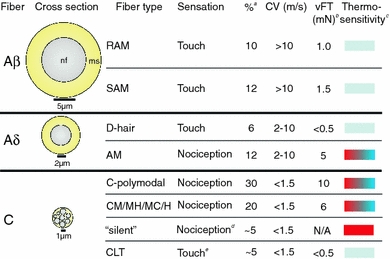
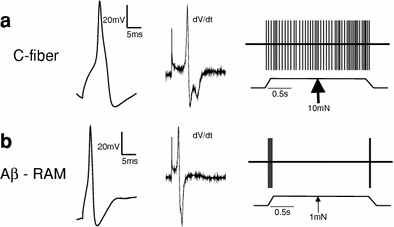
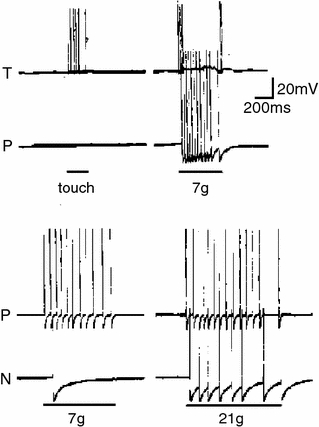
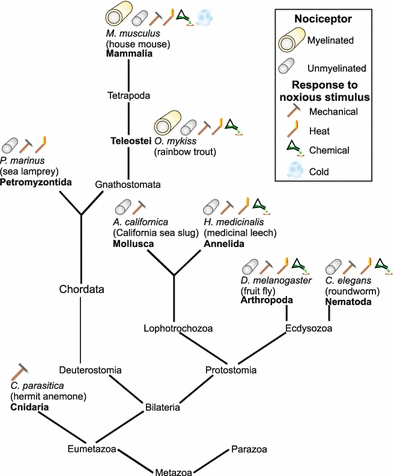
Verification
Claims the paper makes
The claims and statistics of this paper haven’t been checked yet.
Free: it reads the open-access text and checks the first 5 claims that cite a source we can check. Create a free account to check every claim.
Claims other papers make about this one
Each is checked against this paper’s own text: does it say what the citing paper says it does?
The source backs part of the claim, not all of it — or backs it for a different population, condition or comparison.
In the citing paper
“The peripheral nervous system of the lamprey has no myelinated nociceptive fibers, and recordings from spinal and brain dorsal cells that have a potential nociceptive role have achieved mixed results (Martin and Wickelgren, 1971; Rovainen and Yan, 1985; Smith and Lewin, 2009).”
From The evolutionary and genetic origins of consciousness in the Cambrian Period over 500 million years ago (2013) · cites this paper as Smith and Lewin, 2009
Experimental — accuracy not yet measuredThe cited source says what the claim attributes to it.
In the citing paper
“nociceptors are actually quite ancient neural structures and are present in species of molluscs, nematode worms, and fruit flies (Smith and Lewin, 2009; Figure 4).”
From The evolutionary and genetic origins of consciousness in the Cambrian Period over 500 million years ago (2013) · cites this paper as Smith and Lewin, 2009
The cited source says what the claim attributes to it.
In the citing paper
“Thus, the pain experience seems to characterize teleost fish and presumably all other vertebrates with equally or more complex brains (except perhaps for the cartilaginous fish such as sharks, which may lack appreciable perception: Smith and Lewin, 2009; Sneddon, 2011).”
From The evolutionary and genetic origins of consciousness in the Cambrian Period over 500 million years ago (2013) · cites this paper as Smith and Lewin, 2009
Self-check
Percentages, sums and reported differences re-computed from the paper’s own numbers.
The self-check needs the paper’s full text.
Citations
Cites
The capsaicin receptor: a heat-activated ion channel in the pain pathway
Caterina, M. J., Schumacher, M. A., Tominaga, M., Rosen, T. A., Levine, J. D., & Julius, D. (1997) · Nature · doi:10.1038/39807 · Cited by 9,107 · cited 4×
“In terms of the molecular identity of a potential heat sensor in mammals, excitement abounded when the capsaicin receptor TRPV1 was cloned from rat DRGs and shown to have a threshold of »43°C (Caterina et al. 1997; Tominaga et al. 1998), very similar to the heat-”
BackgroundInfluentialDarwin, C., Burndy Library, Darwin, C., Edmonds & Remnants, & Henry Sotheran Ltd. (1859) · J. Murray eBooks · doi:10.5962/bhl.title.59991 · Cited by 6,984
Darwin, C., Murray, J., Sons, W. C. A., & Evans., B. &. (1859) · doi:10.5962/bhl.title.82303 · Cited by 5,608
Impaired nociception and pain sensation in mice lacking the capsaicin receptor
Caterina, M. J., Leffler, A., Malmberg, A. B., Martin, W. J., Trafton, J., Petersen-Zeitz, K. R., Koltzenburg, M., Basbaum, A. I., & Julius, D. (2000) · Science · doi:10.1126/science.288.5464.306 · Cited by 3,544 · cited 7×
“thermal hyperalgesia and is furthermore the only ion channel known to be activated by capsaicin (Caterina et al. 2000; Davis et al. 2000; Huang et al. 2006a).”
BackgroundInfluentialThe Cloned Capsaicin Receptor Integrates Multiple Pain-Producing Stimuli
Tominaga, M., Caterina, M. J., Malmberg, A. B., Rosen, T. A., Gilbert, H., Skinner, K., Raumann, B. E., Basbaum, A. I., & Julius, D. (1998) · Neuron · doi:10.1016/s0896-6273(00)80564-4 · Cited by 3,081 · cited 5×
“In terms of the molecular identity of a potential heat sensor in mammals, excitement abounded when the capsaicin receptor TRPV1 was cloned from rat DRGs and shown to have a threshold of »43°C (Caterina et al. 1997; Tominaga et al. 1998), very similar to the heat-”
BackgroundInfluentialIdentification of a cold receptor reveals a general role for TRP channels in thermosensation
McKemy, D. D., Neuhausser, W. M., & Julius, D. (2002) · Nature · doi:10.1038/nature719 · Cited by 2,709 · cited 1×
“A further candidate is the menthol-gated TRPM8 ion channel, although this is activated at cool (»26°C), rather than cold temperatures (McKemy et al. 2002) higher than the thresholds for nociceptor activation in mice (Cain et al. 2001) and cold pain in humans (Davis and Pope 2002).”
BackgroundANKTM1, a TRP-like Channel Expressed in Nociceptive Neurons, Is Activated by Cold Temperatures
Story, G. M., Peier, A. M., Reeve, A. J., Eid, S. R., Mosbacher, J., Hricik, T. R., Earley, T. J., Hergarden, A. C., Andersson, D. A., Hwang, S. W., et al. (2003) · Cell · doi:10.1016/s0092-8674(03)00158-2 · Cited by 2,486 · cited 2×
“Unlike painless, TRPA1 was initially described to be cold-activated (Story et al. 2003), however, this Wnding was not replicated by other groups (Jordt”
BackgroundResultTRPA1 Mediates the Inflammatory Actions of Environmental Irritants and Proalgesic Agents
Bautista, D. M., Jordt, S.-E., Nikai, T., Tsuruda, P. R., Read, A. J., Poblete, J., Yamoah, E. N., Basbaum, A. I., & Julius, D. (2006) · Cell · doi:10.1016/j.cell.2006.02.023 · Cited by 1,932 · cited 3×
“As discussed previously, there is an ongoing debate about the ability of noxious cold to activate TRPA1 (Caspani and Heppenstall 2009; Kwan and Corey 2009) and behavioral studies in knockout mice have produced conXicting results (Bautista et al. 2006; Kwan et al. 2006; Karashima et al. 2009).”
BackgroundResultMustard oils and cannabinoids excite sensory nerve fibres through the TRP channel ANKTM1
Jordt, S.-E., Bautista, D. M., Chuang, H.-H., McKemy, D. D., Zygmunt, P. M., Högestätt, E. D., Meng, I. D., & Julius, D. (2004) · Nature · doi:10.1038/nature02282 · Cited by 1,899 · cited 2×
“…not surprising that both of these ion channels are activated by isothioscyanate, which causes the burning associated with wasabi (a member of the Brassicaceae plant family, a paste of which is often served with sushi) and is a repellant for D. melanogaster (Jordt et al. 2004; Al-Anzi et al. 2006).”
BackgroundResultThe induction of pain: an integrative review
Millan, M. J. (1999) · Progress in Neurobiology · doi:10.1016/s0301-0082(98)00048-3 · Cited by 1,774 · cited 1×
“Pain in general and central nervous system aspects of pain/nociception are not the subject of this review and have been extensively discussed elsewhere (Millan 1999; Tracey 2005).”
Background
Research works printed but not linked: 3
- Bullock TH Horridge GA Structure and function in the nervous system of invertebrates 1965 San Francisco W. H. Freeman and Co.
- Goadby P Sharks and other predatory fish of Australia 1959 Brisbane Jacaranda Press
- Lynn B The fibre composition of cutaneous nerves and the classification and response properties of cutaneous afferents, with particular reference to nociception Pain Rev 1994 1 172 183
Cited by
Items 201–295 of 295
Heul, A. V., & Kim, B. (2025) · Immunology and Allergy Clinics of North America · doi:10.1016/j.iac.2025.06.005 · Cited by 2
Pieroni, E. M., O'Connor, V. M., Holden-Dye, L. M., Imperadore, P., Fiorito, G., & Dillon, J. (2026) · Biology Open · doi:10.1242/bio.062268 · Cited by 2
Burrell, B. D. (2026) · eNeuro · doi:10.1523/eneuro.0480-25.2026 · Cited by 2
“…somatosensory system, Hirudo have fast-adapting touch-sensitive (T) neurons, slow-adapting pressure-sensitive (P) neurons, and mechanical and polymodal nociceptive (N) neurons (Nicholls and Baylor, 1968; Carlton and McVean, 1995; Pastor et al., 1996; Smith and Lewin, 2009; Summers et al., 2014).”
Akbar John, B., Sheikh, H. I., Shogar, I., Abdurezak, A. H., Kamaruzzaman, B. Y., Jalal, K. C. A., & Razali, A. (2018) · IIUM Medical Journal Malaysia · doi:10.31436/imjm.v17i2.950 · Cited by 2
“Annelids have nociceptors that respond to acid, capsaicin, and heat.(27) The snail (Cepaea nemoralis) responds to a hot plate at >40°C by lifting the anterior portion of its foot.”
BackgroundEffects of Endogenous Opioids on Pain Mechanism
Cansız, D., Emekli‐Alturfan, E., & Alturfan, A. A. (2021) · Experimed · doi:10.26650/experimed.2021.884254 · Cited by 3
“Nosiseptörler tarafından tespit edilen zararlı sinyaller işlenmek üzere beyine iletilir (6-9).”
CMOS compatible SiN-based memristive synapses for edge computing applications
Park, H., Noh, M., Cho, S., & Kim, S. (2025) · Journal of Alloys and Compounds · doi:10.1016/j.jallcom.2025.181398 · Cited by 2
Rahmani, N., Castaño, J. D., & Beaudry, F. (2025) · Canadian Journal of Physiology and Pharmacology · doi:10.1139/cjpp-2025-0243 · Cited by 2
Nociceptive signalling in the periphery and spinal cord
Walker, S. M., & Baccei, M. L. (2013) · Oxford University Press eBooks · doi:10.1093/med/9780199642656.003.0006 · Cited by 4
van den Bos, R. (2020) · Animal welfare · doi:10.1007/978-3-030-41675-1_8 · Cited by 4
Santos‐Silva, T., Lopes, C. F. B., Guimarães, J. D. S., Valer, F. B., Kuhn, G. C. S., Romero, T. R. L., Naves, L. A., & Duarte, I. D. G. (2022) · Research Results in Pharmacology · doi:10.3897/rrpharmacology.8.91390 · Cited by 2
Palillo, M. B., Palillo, J. A., Glon, M. G., White, M. E., Bidot, W. A., Pintor, L. M., Bergdall, V. K., & Malbrue, R. A. (2021) · Research Square · doi:10.21203/rs.3.rs-374739/v1 · Cited by 2
British Association for the Study of the Liver Meeting
Gardiner, A. B., & Duthie, G. S. (2000) · Gut · doi:10.1136/gut.46.6.e1 · Cited by 2
Perception of first and second pain during offset analgesia
Poehlmann, J., von Lemm, B., Luebke, L., Adamczyk, W. M., Luedtke, K., & Szikszay, T. M. (2025) · Experimental Brain Research · doi:10.1007/s00221-025-07176-8 · Cited by 2
“First, single brief noxious heat pulses will be presented to illustrate and familiarize participants with the distinction between first and second pain.”
Experience of Pain and Fear in Fish from the Neurocognitive Perspective
Urbaniak, M. (2025) · Zoophilologica · doi:10.31261/zoophilologica.2025.s.07 · Cited by 1
Kainate Receptors in Sensory Neurons: Molecular Identity and Functional Relevance to Pain
Degiorgi, S., & Lerma, J. (2026) · Neuroscience Bulletin · doi:10.1007/s12264-026-01594-6 · Cited by 1
The Sensory Basis of Planarian Behavior
Ascunce, K., Lopez, S. N., Carlson, J. R., & van Wolfswinkel, J. C. (2026) · Journal of Neuroscience · doi:10.1523/jneurosci.1158-25.2025 · Cited by 1
Guan, L. C., Liu, J., Luo, Z., Jiang, M., Zhang, J.-M., & Zheng, Q. (2026) · Pain · doi:10.1097/j.pain.0000000000004084 · Cited by 1
Bone cancer: current opinion in palliative care
Mantyh, P. W., Thompson, M. L., Chartier, S. R., & Fealk, M. N. (2014) · Elsevier eBooks · doi:10.1016/b978-0-12-416721-6.00048-0 · Cited by 1
GTL-1, a Calcium Activated TRPM Channel, Enhances Nociception
Cohen, E., Kumar, R., Zinger, T., Priel, A., & Treinin, M. (2020) · Frontiers in Pharmacology · doi:10.3389/fphar.2019.01567 · Cited by 1
“This response requires polymodal nociceptors, multi dendritic sensory neurons innervating the skin or internal organs and responding to high threshold thermal and mechanical stimuli and to noxious chemicals (Woolf and Ma, 2007; Smith and Lewin, 2009).”
BackgroundЧеретаев, И. В., Ravaeva, M. Y., & Chuyan, E. N. (2020) · IOP Conference Series Materials Science and Engineering · doi:10.1088/1757-899x/889/1/012029 · Cited by 1
Metal salicylates Co2+, Zn2+, Ni2+, Mn2+, Li+ and Mg2+: properties and effect on pain sensitivity
Ravaeva, M. Y., Черетаев, И. В., & Chuyan, E. N. (2021) · Journal of Physics Conference Series · doi:10.1088/1742-6596/1967/1/012033 · Cited by 1
EEG Decoding of Pain Perception for a Real-Time Reflex System in Prostheses
Tayeb, Z., Bose, R., Dragomir, A., Osborn, L. E., Thakor, N. V., & Cheng, G. (2021) · Springer briefs in electrical and computer engineering · doi:10.1007/978-3-030-79287-9_5 · Cited by 1
Uso da corrente catódica de alta voltagem sobre a dor em compressão nervosa experimental
Bertolini, G. R. F., do Nascimento, C. M., Cunha, D. M., Artifon, E. L., & Meireles, A. (2012) · Revista Brasileira de Reumatologia · doi:10.1590/s0482-50042012000200006 · Cited by 1
Kisipan, M. L., & Mwobobia, R. M. (2024) · Springer eBooks · doi:10.1007/978-981-97-0048-6_8 · Cited by 1
Life without substance P: The naked mole rat
Zhao, A., Lee, J., Gryszkiewicz, W., & Park, T. J. (2024) · Elsevier eBooks · doi:10.1016/b978-0-443-22194-1.00013-6 · Cited by 1
Dockendorf, E. R., & Burrell, B. D. (2025) · PLoS ONE · doi:10.1371/journal.pone.0326039 · Cited by 1
Hildebrandt, J., Bleckmann, H., & Homberg, U. (2021) · Springer eBooks · doi:10.1007/978-3-662-61595-9_22 · Cited by 1
Chase, J. E. (2018) · Mspace (University of Manitoba) · doi:10.17605/osf.io/3k879 · Cited by 2
Isoform-Specific Roles of Extracellular Signal-Regulated Kinases in Pain
Alter, B. J. (2012) · Open Scholarship Institutional Repository (Washington University in St. Louis) · doi:10.7936/k7th8jqx
DAMAGE-INDUCED INFLAMMATION AND NOCICEPTIVE HYPERSENSITIVITY IN DROSOPHILA LARVAE
Babcock, D. T. (2010) · Digital Commons-TMC (Texas Medical Center) · Cited by 1
Nerve Injury Induced Pain and Modulation by Spinal Cord Stimulation
Ultenius, C. (2010)
Vallverdú, J. (2015) · SpringerBriefs in statistics · doi:10.1007/978-3-662-48638-2_1
Philley, L. M. (2011) · OhioLink ETD Center (Ohio Library and Information Network)
Sensitivity studies of models of voltage-dependent conductance in neurons
Andersson, T. (2010)
Avaliações sedativa e analgésica da morfina em teiús (Salvator merianae)
Leal, W. P. (2016) · Digital Library of Theses and Dissertations (Universidade de São Paulo) · doi:10.11606/d.74.2016.tde-03022016-111036
Unto the Least of These: Animal Suffering and the Problem of Evil
Seacord, B. (2013) · CU Scholar (University of Colorado Boulder)
Odem, M. A. (2018) · Digital Commons-TMC (Texas Medical Center) · Cited by 1
Detecting the cold: Do innexins function in cold nociception?
Barborek, R. (2019) · JMU Scholoraly Commons (James Madison University)
Exploring interstitial mediators in burn injury
Friston, D. (2016) · Spiral (Imperial College London) · doi:10.25560/70114
Pain Analgesic Developments in the Genomic Era
Jesuthasan, A., Bullock, D., González‐Cano, R., & Costigan, M. (2020) · Springer eBooks · doi:10.1007/978-3-030-21657-3_16
LIGAND DISCOVERY AND FUNCTIONAL CHARACTERIZATION OF MRGPRX FAMILY ORPHAN GPCRS
Lansu, K. (2017) · Carolina Digital Repository (University of North Carolina at Chapel Hill) · doi:10.17615/p9r4-re19
Modeling mechanisms of nociception using the African mole-rat family
Debus, K. (2021) · Refubium (Universitätsbibliothek der Freien Universität Berlin) · doi:10.17169/refubium-29110
Andrade, M. P., & Santos, C. M. D. (2021) · bioRxiv (Cold Spring Harbor Laboratory) · doi:10.1101/2021.05.21.445182
“…a cerebral ganglion, glial cells, amiellinic nerve fibers (Sneddon 2003; Ashley et al. 2007; Crook et al. 2013; Walters 2018; Wong and Rankin 2019) and horizontal commissures between the nerve cords, corroborate previous work (e.g. Smith and Lewin 2009; Sneddon 2017; Feinberg and Mallat 2016).”
ResultFrings, S. (2021) · Springer eBooks · doi:10.1007/978-3-662-63233-8_14
Черетаев, И. В., Ravaeva, M. Y., Chuyan, E. N., & Шульгин, В. Ф. (2021) · Scientific Notes of V I Vernadsky Crimean Federal University Biology Chemistry · doi:10.37279/2413-1725-2020-6-3-262-274
Sharpness Recognition Based on Synergy between Bio-inspired Nociceptors and Tactile MechanoreceptorsPreprint
Parvizi-Fard, A., Salimi-Nezhad, N., Amiri, M., Falotico, E., & Laschi, C. (2021) · Research Square · doi:10.21203/rs.3.pex-1325/v1
Cai, Z.-J. (2022) · OALib · doi:10.4236/oalib.1108867
“Nociceptors or nociceptive neural transmission has been discovered throughout the Animalia kingdom, such as Annelida [22] [23], Mollusca including Aplysia [22] [23], Nematoda including C elegans [23] [24], Arthropoda including Drosophila [22] [23], Cephalochordata including amphioxus [25], Agnatha…”
InfluentialAntiorio, A. T. F. B. (2021) · Digital Library of Theses and Dissertations (Universidade de São Paulo) · doi:10.11606/t.10.2021.tde-18112022-102737
Konsman, J. P., & Straub, R. H. (2023) · Masterclass in neuroendocrinology · doi:10.1007/978-3-031-21358-8_13
de Oliveira, R. G., Serra, M., Urbinati, E. C., & Wolkers, C. P. B. (2023) · Acta Scientiarum Biological Sciences · doi:10.4025/actascibiolsci.v45i1.66656
“…observed in a wide range of animal groups, from invertebrates, that are capable of reacting to a noxious stimulus, to mammals, and the degree of mobilization of the organism in response to these stimuli varies according to the evolution of the nervous system (for a review see Smith & Lewin, 2009).”
BackgroundImpact antimigraineux de l’inhibiteur double des enképhalinases, PL37, chez le rat
Rossignol, J. (2023) · theses.fr (ABES) · doi:10.70675/1e9a968aza990z4aa5zb487z52ab6006680f
What is Sentience? From Definitions to Metaphors
Airoldi, G. (2024) · Global Philosophy · doi:10.1007/s10516-024-09735-0 · Cited by 1
“Snails show sensibility to anaesthetics (Culloty and Mulcahy 1992; Smith and Lewin 2009).”
Diggles, B. K. (2025) · Fisheries Management and Ecology · doi:10.1111/fme.12790
Heul, A. V. (2025) · Science · doi:10.1126/science.adv1573
EEG-Based Discrimination of Nociceptive Pain Levels Generated by Noxious Laser Stimulation
Reyes-Galaviz, R. S., & Villaseñor-Pineda, L. (2025) · World Congress on Medical Physics and Biomedical Engineering, September 7 - 12, 2009, Munich, Germany · doi:10.1007/978-3-031-89514-2_33
(2022) · CSIRO Publishing eBooks · doi:10.1071/9781486313457.bk07964_part3
The nociceptive system: molecular, cellular, and systemic mechanisms of pain perception
Surov, D. V., Konshakov, Y. O., & Венгерович, Н. Г. (2025) · Pharmacy Formulas · doi:10.17816/phf691215
Sensory afferents in the mammary papilla are eliminated during the lactation
Nakayama, K., Suzuki, K., Marunaka, Y., Kondo, M., Yokouchi, Y., Takeda, N., Yamamura, K., & Hasegawa, H. (2025) · Neuroscience Letters · doi:10.1016/j.neulet.2025.138441
Mott, R., Hedley, J. E., & Klaphake, E. (2025) · Journal of Herpetological Medicine and Surgery · doi:10.5818/jhms-d-25-00001
PVR, A Growth Factor Receptor, Plays A Role In Thermal Nociception
Chattopadhayay, I. (2023) · NC Digital Online Collection of Knowledge and Scholarship (The University of North Carolina at Greensboro) · doi:10.71889/5fylantbak.29868032
Exploring potential analgesic targets and tools for chronic pain treatment
Haroun, R. (2023) · UCL Discovery (University College London)
Modulation ascendante et descendante de l’intégration supraspinale d’inputs nociceptifs bilatéraux
Northon, S. (2022) · Le dépôt institutionnel (Université du Québec à Trois-Rivières) · doi:10.71781/28772
Coutinho Kullmann Duarte, F. (2019) · The Atrium (University of Guelph)
Smith, N. (2023) · Nottingham ePrints (University of Nottingham)
Pain in fish and other aquatic species-The case of cephalopods and lobsters/crayfish
Χριστακόπουλος, Α. Γ., & Χριστακόπουλος, Α. Γ. (2024) · University of Thessaly Institutional Repository (University of Thessaly)
Burn Selection: How Fire Injury Shaped Human Evolution
Cuddihy, J., Li, Y., Fisher, I., Takáts, Z., Friston, D., Collins, D. P., Vizcaychipi, M. P., Fumagalli, M., Nagy, I., & Leroi, A. M. (2026) · BioEssays · doi:10.1002/bies.70109
“Variations in thermosensation across species, including differences in the activation thresholds of transient receptor potential ion channel subfamily V member 1 (TRPV1) channels and post-injury thermal sensitivity, suggest species-specific adaptations to environmental conditions [96, 35, 21, 63].”
Mechanistic Dissection of The Attentional Modulation of Pain
Oliva, V. (2021) · Bristol Research (University of Bristol)
Pieroni, E. M., Baylis, H. A., O'Connor, V. M., Holden-Dye, L. M., Yañez-Guerra, L. A., Imperadore, P., Fiorito, G., & Dillon, J. (2026) · bioRxiv (Cold Spring Harbor Laboratory) · doi:10.64898/2026.03.27.714695
Distributions et fonctions du canal Calcique Cav3.2 dans les voies somatosensorielles
François, A. (2013) · theses.fr (ABES) · doi:10.70675/beb67c76z2e25z44feza3b2z59afcf689a5b
Rôle des canaux calciques Cav3.2 dans les interneurones de la lamina II de la moelle épinière
Candelas, M. (2017) · theses.fr (ABES) · doi:10.70675/0ef9ac69zb0dbz48adz8097za5c094d38525
“En effet, l’ablation des neurones exprimant le récepteur MRGPRD (MRGPRD : mas-related G proteincoupled receptor) modifie la mécano-nociception et ne change pas le comportement vis-à-vis des températures extrêmes, nociceptives.”
BackgroundInfluentialCanaux calciques de type T spinaux et sensibilité douloureuse
Fruquière, A. (2018) · theses.fr (ABES) · doi:10.70675/32fec4d2zc6fez49f4zbd6fz6ccbb5117f13
Megemont, M. (2019) · theses.fr (ABES) · doi:10.70675/c0dcb017z7bb2z46e9zb39azc730e2593a65
Contrôle peptidergique de la douleur : modulation des voies descendantes par les systèmes relaxine.
Abboud, C. (2021) · theses.fr (ABES) · doi:10.70675/d4d32122z1374z427ezae6dzda0f030e61ca
Caractérisation du comportement mécanique du disque intervertébral intact et fissuré
Deneuville, J.-P. (2021) · theses.fr (ABES) · doi:10.70675/db4be414zc9bbz4cabz8f11z0b245690e955
Mécanobiologie moléculaire et intégrative des canaux ioniques
Arhatte, M. (2022) · theses.fr (ABES) · doi:10.70675/a5e2a6fbzdca9z4320zb7f9za8a23fcfce93
Pasquini, E., Baracchi, D., Messina, A., & Frasnelli, E. (2026) · Animal Behaviour · doi:10.1016/j.anbehav.2026.123606
Cadiou, H., & Hugel, S. (2025) · Dunod eBooks · doi:10.3917/dunod.poisb.2025.01.0333
Üveges, B., Robinson, S. D., Schendel, V., Mizsei, E., Ćurić, A., Dimaki, M., Ferri, V., Petrovan, S. O., Pozzi, A. V., Radonjiċ, T., et al. (2026) · Functional Ecology · doi:10.1111/1365-2435.70414
Daily variation of nociceptive responses in Drosophila
Motoyoshi, M., Ishii, K., & Emoto, K. (2026) · Neuroscience Research · doi:10.1016/j.neures.2026.105116
Weeder, M. M. (2025) · K-State Research Exchange (Kansas State University)
Ancient somatosensory circuit architectures employ flexible molecular strategies
Lee, H., Frazel, P. W., Singer-Freeman, E., Cavanagh, A. E., Shin, H. D., Rice, K., Selvaraj, S., Alu, M., Kim, H., Loomis, C. A., et al. (2026) · iScience · doi:10.1016/j.isci.2026.117919
“33,35,36 Although pain is an affective state, distinct from the ability to detect potentially harmful stimuli, the absence of unmyelinated C-fibers in elasmobranchs has been cited as evidence for a limited capacity for pain perception.”
CHENG, Y., Pengfei, S. O. N. G., Guo, G., Zhiwei, W. U., Qingguang, Z. H. U., & Min, F. A. N. G. (2026) · PubMed Central · doi:10.19852/j.cnki.jtcm.2026.05.011
Burrell, B. D. (2026) · Journal of Neurophysiology · doi:10.1152/jn.90081.2026
Cockram, M. S. (2026) · CABI eBooks · doi:10.1079/9781789246766.0003
Metadata
- Authors
- Smith, E. S. J., & Lewin, G. R.
- Affiliations
- Max Delbrück Center (DE)
- Corresponding author
- Smith, Ewan St. John
- Venue
- Journal of Comparative Physiology A
- Published
- 2009-10-11
- Volume
- 195
- Issue
- 12
- Pages
- 1089-1106
- ISSN
- 0340-7594 (ISSN-L)
- 1432-1351
- PMC
- PMC2780683
- OpenAlex
- W2141300182
- Semantic Scholar
- b7813b1b2b322f143d00db4bff45fa4ae7aff238
- Cited by
- 271
- References
- 196
- Citations by year
- 2026: 11 · 2025: 26 · 2024: 12 · 2023: 20 · 2022: 12 · 2021: 20 · 2020: 19 · 2019: 25 · 2018: 20 · 2017: 9 · 2016: 9 · 2015: 9 · 2014: 12 · 2013: 24 · 2012: 17
- FWCI
- 1.63
- Type
- journal article
- Language
- en
- Open access
- hybrid
- doi.org
- Licence
- cc-by-nc
- creativecommons.org/licenses/by-nc/2.0 (tdm)
- Locations
- Journal of Comparative Physiology A (publishedVersion, cc-by-nc)
- PubMed Central (publishedVersion, cc-by-nc)
- PubMed (publishedVersion)
- MDC Repository (Max-Delbrueck-Center for Molecular Medicine) (acceptedVersion)
- Funders
- Alexander von Humboldt-Stiftung
- Topics
- Life Sciences › Neuroscience › Sensory Systems › Ion Channels and Receptors
- Health Sciences › Medicine › Physiology (medical) › Pain Mechanisms and Treatments
- Life Sciences › Neuroscience › Cellular and Molecular Neuroscience › Neurobiology and Insect Physiology Research
- Keywords
- nociceptors, nociception, phylogeny, pain detection, aversive stimuli, nociceptor sensitization, ion channels, molecular evolution, comparative physiology, invertebrates, model organisms, genetic engineering
- MeSH terms
- Animals, Humans, Ion Channels, Nerve Tissue Proteins, Nervous System Physiological Phenomena, Neural Conduction, Nociceptors, Pain, Phylogeny, Sodium Channels, Evolution, Molecular, Mechanotransduction, Cellular, Mice, Acid Sensing Ion Channels
About these checks
Registry, retraction, Cites and statistics results are computed, not judged, with one exception: a printed reference that no index lists is read once by a model before it counts as a citation error. Claims are extracted by a model and kept only when their quote appears verbatim in the text; each cited source is then checked, with a model’s help, for whether it says what the claim relies on. Those verdicts can be wrong — read the claim’s quote and the cited source before relying on one.
Statistics and arithmetic are recomputed, not judged.
Confidence bands are shown only for fields calibrated on our annotated test set. None is calibrated yet, so no band is shown.
What counts as a claim ›How we measure confidence ›How we check this ›
Are you an author, or do you see a problem with this page? Request a review
Data sources
Bibliographic data: Semantic Scholar, OpenAlex, Crossref.
Contains information from the Semantic Scholar Academic Graph Datasets, made available under the ODC Attribution License (ODC-BY 1.0).
Semantic Scholar’s data is described in: Kinney, R., et al. (2023). The Semantic Scholar Open Data Platform. arXiv:2301.10140.
