

The DOI matches its Crossref record; 183 of the 186 references it cites were found in a registry or an index.
The genetics and neuropathology of frontotemporal lobar degeneration
Open accessAbstract
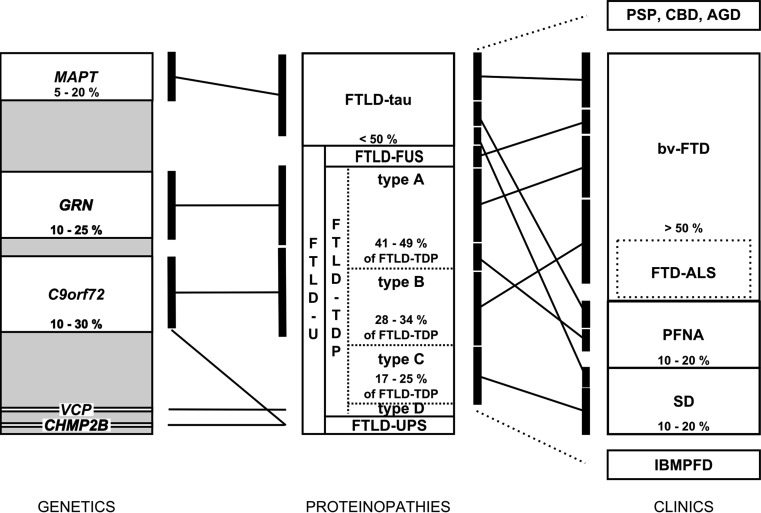
Frontotemporal lobar degeneration (FTLD) is a heterogeneous group of disorders characterized by disturbances of behavior and personality and different types of language impairment with or without concomitant features of motor neuron disease or parkinsonism. FTLD is characterized by atrophy of the frontal and anterior temporal brain lobes. Detailed neuropathological studies have elicited proteinopathies defined by inclusions of hyperphosphorylated microtubule-associated protein tau, TAR DNA-binding protein TDP-43, fused-in-sarcoma or yet unidentified proteins in affected brain regions. Rather than the type of proteinopathy, the site of neurodegeneration correlates relatively well with the clinical presentation of FTLD. Molecular genetic studies identified five disease genes, of which the gene encoding the tau protein (MAPT), the growth factor precursor gene granulin (GRN), and C9orf72 with unknown function are most frequently mutated. Rare mutations were also identified in the genes encoding valosin-containing protein (VCP) and charged multivesicular body protein 2B (CHMP2B). These genes are good markers to distinguish underlying neuropathological phenotypes. Due to the complex landscape of FTLD diseases, combined characterization of clinical, imaging, biological and genetic biomarkers is essential to establish a detailed diagnosis. Although major progress has been made in FTLD research in recent years, further studies are needed to completely map out and correlate the clinical, pathological and genetic entities, and to understand the underlying disease mechanisms. In this review, we summarize the current state of the rapidly progressing field of genetic, neuropathological and clinical research of this intriguing condition.
Overview
The claims and statistics of this paper haven’t been checked yet.
Run the check — free, no account needed. It reads the open-access text and checks the sources it cites.
Integrity signals
Registry
Cites
Statistics
Figures
Verification
Claims the paper makes
The claims and statistics of this paper haven’t been checked yet.
Run the check — free, no account needed. It reads the open-access text and checks the sources it cites.
Claims other papers make about this one
Each is checked against this paper’s own text: does it say what the citing paper says it does?
The cited source says what the claim attributes to it.
In the citing paper
“bvFTD is most often caused by frontotemporal lobar degeneration (FTLD) proteinopathies, namely tauopathies (of which microtubule-associated protein tau (MAPT) gene mutations are the most common genetic causes), TDP-43 proteinopathies (of which chromosome 9 open reading frame 72 (C9orf72) and progranulin (GRN) gene mutations, in order of frequency, are most common), and less frequently, fused in s”
From Diagnosing the frontal variant of Alzheimer’s disease: a clinician’s yellow brick road (2017) · cites this paper as [19]
Self-check
Percentages, sums and reported differences re-computed from the paper’s own numbers.
The self-check needs the paper’s full text.
Citations
Cites
Amyloid oligomers exacerbate tau pathology in a mouse model of tauopathy
Selenica, M.-L. B., Brownlow, M., Jimenez, J. P., Lee, D. C., Pena, G., Dickey, C. A., Gordon, M. N., & Morgan, D. (2013) · Neurodegenerative Diseases · doi:10.1159/000337230 · Cited by 10,359
Ubiquitinated TDP-43 in Frontotemporal Lobar Degeneration and Amyotrophic Lateral Sclerosis
Neumann, M., Sampathu, D. M., Kwong, L. K., Truax, A. C., Micsenyi, M. C., Chou, T. T., Bruce, J., Schuck, T., Grossman, M., Clark, C. M., et al. (2006) · Science · doi:10.1126/science.1134108 · Cited by 6,576
Sensitivity of revised diagnostic criteria for the behavioural variant of frontotemporal dementia
Rascovsky, K., Hodges, J. R., Knopman, D., Mendez, M. F., Kramer, J. H., Neuhaus, J., van Swieten, J. C., Seelaar, H., Dopper, E. G. P., Onyike, C. U., et al. (2011) · Brain · doi:10.1093/brain/awr179 · Cited by 5,221
Classification of primary progressive aphasia and its variants
Gorno-Tempini, M. L., Hillis, A. E., Weintraub, S., Kertesz, A., Mendez, M., Cappa, S. F., Ogar, J. M., Rohrer, J. D., Black, S., Boeve, B. F., et al. (2011) · Neurology · doi:10.1212/wnl.0b013e31821103e6 · Cited by 5,141
Frontotemporal lobar degeneration: A consensus on clinical diagnostic criteria
Neary, D., Snowden, J. S., Gustafson, L., Passant, U., Stuss, D., Black, S., Freedman, M., Kertesz, A., Robert, P. H., Albert, M., et al. (1998) · Neurology · doi:10.1212/wnl.51.6.1546 · Cited by 5,047
DeJesus-Hernandez, M., Mackenzie, I. R., Boeve, B. F., Boxer, A. L., Baker, M., Rutherford, N. J., Nicholson, A. M., Finch, N. A., Flynn, H., Adamson, J., et al. (2011) · Neuron · doi:10.1016/j.neuron.2011.09.011 · Cited by 4,936 · cited 16×
“The reported heritability of FTLD-ALS is high: approximately 50 % is considered familial [56, 132, 141].”
BackgroundInfluentialA Hexanucleotide Repeat Expansion in C9ORF72 Is the Cause of Chromosome 9p21-Linked ALS-FTD
Renton, A. E., Majounie, E., Waite, A., Simón-Sánchez, J., Rollinson, S., Gibbs, J. R., Schymick, J. C., Laaksovirta, H., van Swieten, J. C., Myllykangas, L., et al. (2011) · Neuron · doi:10.1016/j.neuron.2011.09.010 · Cited by 4,409
Association of missense and 5′-splice-site mutations in tau with the inherited dementia FTDP-17
Hutton, M., Lendon, C. L., Rizzu, P., Baker, M., Froelich, S., Houlden, H., Pickering-Brown, S., Chakraverty, S., Isaacs, A., Grover, A., et al. (1998) · Nature · doi:10.1038/31508 · Cited by 3,498
Weıntraub, S. (1990) · Archives of Neurology · doi:10.1001/archneur.1990.00530120075013 · Cited by 3,018
Appelhof, B., Bakker, C., den IJssel, J. C. L. V. D., Zwijsen, S. A., Smalbrugge, M., Verhey, F. R. J., de Vugt, M. E., Zuidema, S. U., & Koopmans, R. T. C. M. (2017) · Dementia and Geriatric Cognitive Disorders · doi:10.1159/000477087 · Cited by 2,774
Research works printed but not linked: 2
- Dickson D, Weller R (2011) Neurodegeneration: the molecular pathology of dementia and movement disorders, part 7. Wiley-Blackwell, West Sussex, pp 389–436 · DOI
- Ellison D, Love S, Chimelli L, Harding BN, Lowe J, Vinters HV (2004) A reference text of CNS pathology. In: Chapter 9: neurodegenerative diseases Elsevier Limited. ISBN: 0 7234 3239 2
Cited by
Sorted by citations
Converging Mechanisms in ALS and FTD: Disrupted RNA and Protein Homeostasis
Ling, S.-C., Polymenidou, M., & Cleveland, D. W. (2013) · Neuron · doi:10.1016/j.neuron.2013.07.033 · Cited by 1,811
Bang, J., Spina, S., & Miller, B. L. (2015) · The Lancet · doi:10.1016/s0140-6736(15)00461-4 · Cited by 1,144
Clinical Neurology and Epidemiology of the Major Neurodegenerative DiseasesPreprint
Erkkinen, M. G., Kim, M., & Geschwind, M. D. (2017) · Cold Spring Harbor Perspectives in Biology · doi:10.1101/cshperspect.a033118 · Cited by 1,231
Neuroinflammation as a common feature of neurodegenerative disorders
Guzman-Martinez, L., Maccioni, R. B., Andrade, V., Navarrete, L. P., Pastor, M. G., & Ramos-Escobar, N. (2019) · Frontiers in Pharmacology · doi:10.3389/fphar.2019.01008 · Cited by 702
The epidemiology of frontotemporal dementia
Onyike, C. U., & Diehl-Schmid, J. (2013) · International Review of Psychiatry · doi:10.3109/09540261.2013.776523 · Cited by 543
Metadata
- Authors
- Sieben, A., Van Langenhove, T., Engelborghs, S., Martin, J.-J., Boon, P., Cras, P., De Deyn, P.-P., Santens, P., Van Broeckhoven, C., & Cruts, M.
- Affiliations
- University of Antwerp (BE)
- Ghent University Hospital (BE)
- Corresponding author
- Cruts, Marc
- ORCID
- Venue
- Acta Neuropathologica
- Published
- 2012-08-14
- Volume
- 124
- Issue
- 3
- Pages
- 353-372
- ISSN
- 0001-6322 (ISSN-L)
- 1432-0533
- PMC
- PMC3422616
- OpenAlex
- W2167243829
- Cited by
- 280
- References
- 186
- Citations by year
- 2026: 7 · 2025: 10 · 2024: 2 · 2023: 20 · 2022: 20 · 2021: 16 · 2020: 11 · 2019: 20 · 2018: 21 · 2017: 21 · 2016: 33 · 2015: 32 · 2014: 33 · 2013: 30 · 2012: 3
- FWCI
- 4.40
- Type
- journal article
- Language
- en
- Open access
- hybrid
- doi.org
- Licence
- cc-by
- Locations
- Acta Neuropathologica (publishedVersion, cc-by)
- Europe PMC (PubMed Central) (publishedVersion, cc-by)
- PubMed Central (publishedVersion, cc-by)
- PubMed (publishedVersion)
- Ghent University Academic Bibliography (Ghent University) (submittedVersion, other-oa)
- University of Groningen research database (University of Groningen / Centre for Information Technology) (submittedVersion)
- VUBIR (Vrije Universiteit Brussel) (submittedVersion)
- Funders
- Belgian Federal Science Policy Office (P7/16)
- Fonds Wetenschappelijk Onderzoek
- Universiteit Antwerpen
- Vlaamse regering
- Instituut Born-Bunge
- Fondation Médicale Reine Elisabeth
- Bijzonder Onderzoeksfonds UGent
- Topics
- Health Sciences › Medicine › Clinical Neurology › Amyotrophic Lateral Sclerosis Research
- Life Sciences › Neuroscience › Cellular and Molecular Neuroscience › Alzheimer's disease research and treatments
- Health Sciences › Medicine › Psychiatry and Mental health › Dementia and Cognitive Impairment Research
- Keywords
- frontotemporal lobar degeneration, TDP-43, C9orf72, gene regulatory networks, MAPT, VCP, CHMP2B, proteinopathies, neurodegeneration, language impairment, motor neuron disease, parkinsonism, genetic biomarkers, disease heterogeneity
- MeSH terms
- Atrophy, Frontal Lobe, Humans, Mutation, tau Proteins, Genetic Predisposition to Disease, Frontotemporal Lobar Degeneration
About these checks
Registry, retraction, Cites and statistics results are computed, not judged, with one exception: a printed reference that no index lists is read once by a model before it counts as a citation error. Claims are extracted by a model and kept only when their quote appears verbatim in the text; each cited source is then checked, with a model’s help, for whether it says what the claim relies on. Those verdicts can be wrong — read the claim’s quote and the cited source before relying on one.
Statistics and arithmetic are recomputed, not judged.
Confidence bands are shown only for fields calibrated on our annotated test set. None is calibrated yet, so no band is shown.
What counts as a claim ›How we measure confidence ›How we check this ›
Are you an author, or do you see a problem with this page? Request a review
