

Plasma p-tau181 accurately predicts Alzheimer’s disease pathology at least 8 years prior to post-mortem and improves the clinical characterisation of cognitive decline
Open accessThe DOI matches its Crossref record; 36 of the 36 references it cites were found in a registry or an index.
Abstract
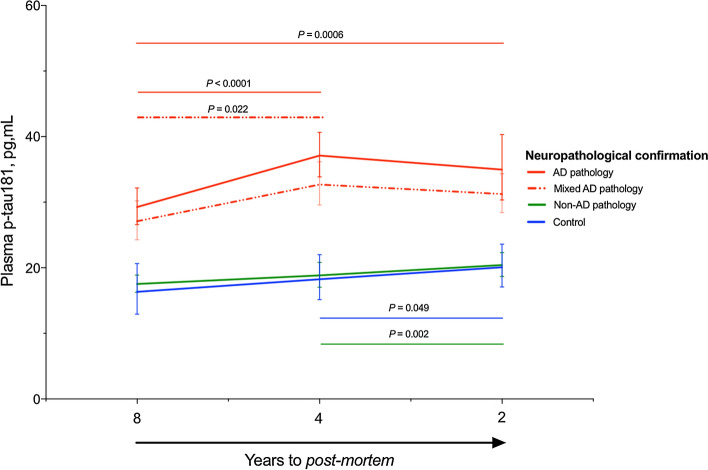
The neuropathological confirmation of amyloid-β (Aβ) plaques and tau neurofibrillary tangles (NFT) remains the gold standard for a definitive diagnosis of Alzheimer’s disease (AD). Nowadays, the in vivo diagnosis of AD is greatly aided by both cerebrospinal fluid (CSF) and positron emission tomography (PET) biomarkers. Although highly accurate, their broad implementation is restricted by high cost, limited accessibility and invasiveness. We recently developed a high-performance, ultrasensitive immunoassay for the quantification of tau phosphorylated at threonine-181 (p-tau181) in plasma, which identifies AD pathophysiology with high accuracy. However, it remains unclear whether plasma p-tau181, measured years before the death, can predict the eventual neuropathological confirmation of AD, and successfully discriminates AD from non-AD dementia pathologies. We studied a unique cohort of 115 individuals with longitudinal blood collections with clinical evaluation at 8, 4 and 2 years prior to neuropathological assessment at death. The results demonstrate that plasma p-tau181 associates better with AD neuropathology and Braak staging than a clinical diagnosis 8 years before post-mortem. Moreover, while all patients had a diagnosis of AD dementia during life, plasma p-tau181 proved to discriminate AD from non-AD pathologies with high accuracy (AUC = 97.4%, 95% CI = 94.1–100%) even 8 years before death. Additionally, the longitudinal trajectory of plasma p-tau181 was assessed in all patients. We found that the main increases in plasma p-tau181 occurred between 8 and 4 years prior to death in patients with AD neuropathology and later plateauing. In contrast, non-AD pathologies and controls exhibited minor, albeit significant, increases in p-tau181 up until death. Overall, our study demonstrates that plasma p-tau181 is highly predictive and specific of AD neuropathology years before post-mortem examination. These data add further support for the use of plasma p-tau181 to aid clinical management in primary care and recruitment for clinical trials.
Overview
The claims and statistics of this paper haven’t been checked yet.
Free: it reads the open-access text and checks the first 5 claims that cite a source we can check. Create a free account to check every claim.
Integrity signals
Registry
Cites
Statistics
Figures
Verification
Claims the paper makes
The claims and statistics of this paper haven’t been checked yet.
Free: it reads the open-access text and checks the first 5 claims that cite a source we can check. Create a free account to check every claim.
Claims other papers make about this one
Each is checked against this paper’s own text: does it say what the citing paper says it does?
The source backs part of the claim, not all of it — or backs it for a different population, condition or comparison.
In the citing paper
“Yet certain p-tau species, but not all, are also associated with neurofibrillary tangle pathology, the secondary AD pathological hallmark.15,16,17”
From Diagnostic Accuracy of a Plasma Phosphorylated Tau 217 Immunoassay for Alzheimer Disease Pathology (2024) · cites this paper as [17]
Experimental — accuracy not yet measuredThe source backs part of the claim, not all of it — or backs it for a different population, condition or comparison.
In the citing paper
“Plasma levels of p-tau are strongly associated with PET and CSF biomarkers of AD pathology19–25, neuropathological changes associated with AD20,23,26,27 and the subsequent development of AD dementia20,23,28.”
From Highly accurate blood test for Alzheimer's disease is similar or superior to clinical cerebrospinal fluid tests (2024) · cites this paper as [26]
Experimental — accuracy not yet measuredThe source backs part of the claim, not all of it — or backs it for a different population, condition or comparison.
In the citing paper
“Plasma measures of phosphorylated tau at Thr181 (p-tau181), Thr217 (p-tau217) and Thr231 (p-tau231) have high diagnostic accuracy in differentiating AD from other neurodegenerative disorders in clinical studies1–3, which are validated by postmortem neuropathological studies1,2,4.”
From Plasma p-tau231 and p-tau217 as state markers of amyloid-β pathology in preclinical Alzheimer’s disease (2022) · cites this paper as [4]
Experimental — accuracy not yet measured
Self-check
Percentages, sums and reported differences re-computed from the paper’s own numbers.
The self-check needs the paper’s full text.
Citations
Cites
Home visits: a strategy to improve newborn survival - Authors' reply
(2008) · Americanae (AECID Library) · doi:10.1016/s0140 · Cited by 22,524
McKhann, G. M., Knopman, D. S., Chertkow, H., Hyman, B. T., Jack, C. R., Kawas, C. H., Klunk, W. E., Koroshetz, W. J., Manly, J. J., Mayeux, R., et al. (2011) · Alzheimer's & Dementia · doi:10.1016/j.jalz.2011.03.005 · Cited by 18,657
NIA‐AA Research Framework: Toward a biological definition of Alzheimer's disease
Jack, C. R., Bennett, D. A., Blennow, K., Carrillo, M. C., Dunn, B., Haeberlein, S. B., Holtzman, D. M., Jagust, W., Jessen, F., Karlawish, J., et al. (2018) · Alzheimer's & Dementia · doi:10.1016/j.jalz.2018.02.018 · Cited by 10,537
Self-citationJack, C. R., Knopman, D. S., Jagust, W. J., Petersen, R. C., Weiner, M. W., Aisen, P. S., Shaw, L. M., Vemuri, P., Wiste, H. J., Weigand, S. D., et al. (2013) · The Lancet Neurology · doi:10.1016/s1474-4422(12)70291-0 · Cited by 4,396
Advancing research diagnostic criteria for Alzheimer's disease: the IWG-2 criteria
Dubois, B., Feldman, H. H., Jacova, C., Hampel, H., Molinuevo, J. L., Blennow, K., DeKosky, S. T., Gauthier, S., Selkoe, D., Bateman, R., et al. (2014) · The Lancet Neurology · doi:10.1016/s1474-4422(14)70090-0 · Cited by 3,321
Self-citationBraak, H., Alafuzoff, I., Arzberger, T., Kretzschmar, H., & Del Tredici, K. (2006) · Acta Neuropathologica · doi:10.1007/s00401-006-0127-z · Cited by 3,172
Blennow, K., de Leon, M. J., & Zetterberg, H. (2006) · The Lancet · doi:10.1016/s0140-6736(06)69113-7 · Cited by 3,134
Self-citationHigh performance plasma amyloid-β biomarkers for Alzheimer's disease
Nakamura, A., Kaneko, N., Villemagne, V. L., Kato, T., Doecke, J., Doré, V., Fowler, C., Li, Q.-X., Martins, R., Rowe, C., et al. (2018) · Nature · doi:10.1038/nature25456 · Cited by 1,681
World Alzheimer Report 2018: The state of the art of dementia research: New frontiers
Patterson, C. (2018) · Cited by 1,461
Karikari, T. K., Pascoal, T. A., Ashton, N. J., Janelidze, S., Benedet, A. L., Rodriguez, J. L., Chamoun, M., Savard, M., Kang, M. S., Therriault, J., et al. (2020) · The Lancet Neurology · doi:10.1016/s1474-4422(20)30071-5 · Cited by 1,316
Self-citation
Cited by
Items 301–348 of 348
Reducing unnecessary tau-PET scans in a memory clinic setting via blood-based biomarker screeningPreprint
Cullen, N. C., Janelidze, S., Stomrud, E., Palmqvist, S., Braum, W., Zetterberg, H., Frisoni, G. B., Ashton, N. J., Blennow, K., Mattsson, N., et al. (2022) · Research Square · doi:10.21203/rs.3.rs-1818516/v1
Self-citationHackenhaar, F. S., Josefsson, M., Adolfsson, A. N., Landfors, M., Kauppi, K., Porter, T., Milicic, L., Laws, S. M., Hultdin, M., Adolfsson, R., et al. (2022) · Research Square · doi:10.21203/rs.3.rs-2276882/v1 · Cited by 1
Research and Prospect of Blood Biomarkers for Alzheimer’s Disease
蓝, 萍. (2023) · Hans Journal of Biomedicine · doi:10.12677/hjbm.2023.131002
Hackenhaar, F. S., Josefsson, M., Adolfsson, A. N., Landfors, M., Kauppi, K., Porter, T., Milicic, L., Laws, S. M., Hultdin, M., Adolfsson, R., et al. (2023) · Research Square · doi:10.21203/rs.3.rs-2276882/v3
Hackenhaar, F. S., Josefsson, M., Adolfsson, A. N., Landfors, M., Kauppi, K., Porter, T., Milicic, L., Laws, S. M., Hultdin, M., Adolfsson, R., et al. (2023) · Research Square · doi:10.21203/rs.3.rs-2276882/v4
Potential Biomarkers for Early Diagnosis of Alzheimer’s Disease and Primary Open-Angle Glaucoma
Bogolepova, A. N., Makhnovich, E. V., Коваленко, Е. А., & Osinovskaya, N. A. (2023) · Neuroscience and Behavioral Physiology · doi:10.1007/s11055-023-01449-x
Emerging Biomarkers for Early Detection of Alzheimer’s Disease: A Systematic ReviewPreprint
Desai, C., Rathod, S., Daulti, T., Prajapati, M., Malkan, S., & Bhamwani, M. (2024) · medRxiv · doi:10.1101/2024.10.16.24315604 · Cited by 1
“According to Lantero Rodriguez et al. [40]. in patients with AD neuropathology, the primary rise in plasma P-tau181 happened between 8 and 4 years before death, while modest but substantial increases in P-tau181 were seen in patients without pathology and controls right up until death.”
MethodExploratory Blood Biomarker Patterns in a Mixed Dementia CohortPreprint
Gezegen, H., Alaylıoğlu, M., Şahin, E., Swann, O., Veleva, E., Güven, G., Yaman, Ü., Salih, D. A. M., Bılgıç, B., Hanağası, H. A., et al. (2024) · medRxiv · doi:10.1101/2024.11.07.24316927 · Cited by 1
Self-citationAdvances in fluid-based biomarkers
Zetterberg, H. (2025) · Elsevier eBooks · doi:10.1016/b978-0-12-822240-9.00008-9
Self-citationBarrett-Young, A., Cawston, E. E., Ryan, B., Abraham, W. C., Ambler, A. P., Anderson, T., Cheyne, K. R., Goodin, E. A., Hogan, S., Houts, R., et al. (2025) · medRxiv · doi:10.1101/2025.04.09.25325556
Marqueurs biologiques des maladies neurodégénératives
Vrillon, A., Aveneau, C., & Paquet, C. (2025) · Encyclopédie médico-chirurgicale. Neurologie · doi:10.1016/s0246-0378(25)48607-2
Ghahremani, M., Leon, R., Vellone, D. A., Guan, D. X., Hosseinpour, Z., Crockford, J. F. E., Azhar, S., Sharif, S. F., Warring, I., & Ismail, Z. (2025) · Springer eBooks · doi:10.1007/978-3-031-80849-4_17
Blood biomarkers for Alzheimer’s disease: Key challenges of clinical implementation
Franco, R. A., Hunter, T., & Felice, F. G. D. (2025) · Neural Regeneration Research · doi:10.4103/nrr.nrr-d-25-00569 · Cited by 2
“For instance, plasma p-tau181 is increased up to 8 years before death in patients with AD, and when combined with Aβ42 and neurofilament light chain, can anticipate AD onset up to 8 years before clinical symptoms appear (Lantero Rodriguez et al., 2020).”
Leal, G. C., Konuri, A., Young, A. L., Zebarjadi, N., Samantaray, T., Habich, A., Castellanos-Perilla, N., González, M. C., Taylor, J., Firbank, M., et al. (2025) · medRxiv · doi:10.1101/2025.10.03.25337171
“This is consistent with previous research in autopsy-confirmed studies in clinically diagnosed AD subjects later confirmed to have low levels of AD pathology (Janelidze et al., 2020; Lantero Rodriguez et al., 2020; Irwin et al., 2018).”
Self-citationTalyansky, S. D., Guen, Y. L., Kasireddy, N. M., Belloy, M. E., & Greicius, M. D. (2024) · Figshare · doi:10.6084/m9.figshare.26616934
Groot, C., Cicognola, C., Bali, D., Triana‐Baltzer, G., Dage, J. L., Pontecorvo, M. J., Kolb, H. C., Osssenkoppele, R., Janelidze, S., & Hansson, O. (2022) · Figshare · doi:10.6084/m9.figshare.19767974
Wilson, E. N., Young, C. B., Benitez, J. A. R., Swarovski, M. S., Feinstein, I., Vandijck, M. L. J., Guen, Y. L., Kasireddy, N. M., Shahid, M., Corso, N. K., et al. (2022) · Figshare · doi:10.6084/m9.figshare.21547387
Xiao, Z., Wu, X., Wu, W., Yi, J., Liang, X., Ding, S., Zheng, L., Luo, J., Gu, H., Zhao, Q., et al. (2021) · Figshare · doi:10.6084/m9.figshare.14913836
Nilsson, J., Ashton, N. J., Benedet, A. L., Montoliu‐Gaya, L., Gobom, J., Pascoal, T. A., Chamoun, M., Portelius, E., Jeromin, A., Mendes, M., et al. (2022) · Figshare · doi:10.6084/m9.figshare.20004645
Self-citationXiao, Z., Wu, X., Wu, W., Yi, J., Liang, X., Ding, S., Zheng, L., Luo, J., Gu, H., Zhao, Q., et al. (2021) · Figshare · doi:10.6084/m9.figshare.14913830
Wilson, E. N., Young, C. B., Benitez, J. A. R., Swarovski, M. S., Feinstein, I., Vandijck, M. L. J., Guen, Y. L., Kasireddy, N. M., Shahid, M., Corso, N. K., et al. (2022) · Figshare · doi:10.6084/m9.figshare.21547393
Murray, M. E., Moloney, C. M., Kouri, N., Syrjanen, J. A., Matchett, B. J., Rothberg, D. M., Tranovich, J. F., Sirmans, T. N. H., Wiste, H. J., Boon, B. D. C., et al. (2024) · Figshare · doi:10.6084/m9.figshare.26557766
Wilson, E. N., Young, C. B., Benitez, J. A. R., Swarovski, M. S., Feinstein, I., Vandijck, M. L. J., Guen, Y. L., Kasireddy, N. M., Shahid, M., Corso, N. K., et al. (2022) · Figshare · doi:10.6084/m9.figshare.21547396
Wilson, E. N., Young, C. B., Benitez, J. A. R., Swarovski, M. S., Feinstein, I., Vandijck, M. L. J., Guen, Y. L., Kasireddy, N. M., Shahid, M., Corso, N. K., et al. (2022) · Figshare · doi:10.6084/m9.figshare.21547390
Xiao, Z., Wu, X., Wu, W., Yi, J., Liang, X., Ding, S., Zheng, L., Luo, J., Gu, H., Zhao, Q., et al. (2021) · Figshare · doi:10.6084/m9.figshare.14913827
Alty, J., Bai, Q., Li, R., Lawler, K., St George, R. J., Hill, E., Bindoff, A. D., Garg, S., Wang, X., Huang, G., et al. (2022) · Figshare · doi:10.6084/m9.figshare.20336960
Self-citationDing, X., Zhang, S., Jiang, L., Wang, L., Li, T., & Lei, P. (2021) · Figshare · doi:10.6084/m9.figshare.14211689
Benedet, A. L., Brum, W. S., Hansson, O., Karikari, T. K., Zimmer, E. R., Zetterberg, H., Blennow, K., & Ashton, N. J. (2022) · Figshare · doi:10.6084/m9.figshare.19135820
Self-citationMundada, N. S., Rojas, J. C., Vandevrede, L., Thijssen, E. H., Iaccarino, L., Okoye, O., Shankar, R. P., Soleimani-Meigooni, D. N., Lago, A. L., Miller, B. L., et al. (2023) · Figshare · doi:10.6084/m9.figshare.24186176
Wilson, E. N., Young, C. B., Benitez, J. A. R., Swarovski, M. S., Feinstein, I., Vandijck, M. L. J., Guen, Y. L., Kasireddy, N. M., Shahid, M., Corso, N. K., et al. (2022) · Figshare · doi:10.6084/m9.figshare.21547384
Bayoumy, S., Verberk, I. M. W., den Dulk, B., Hussainali, Z., Zwan, M. D., van der Flier, W. M., Ashton, N. J., Zetterberg, H., Blennow, K., Vanbrabant, J., et al. (2021) · Figshare · doi:10.6084/m9.figshare.17126153
Self-citationXiao, Z., Wu, X., Wu, W., Yi, J., Liang, X., Ding, S., Zheng, L., Luo, J., Gu, H., Zhao, Q., et al. (2021) · Figshare · doi:10.6084/m9.figshare.14913824
Ding, X., Zhang, S., Jiang, L., Wang, L., Li, T., & Lei, P. (2021) · Figshare · doi:10.6084/m9.figshare.14211686
Gobom, J., Benedet, A. L., Mattsson, N., Montoliu‐Gaya, L., Schultz, N., Ashton, N. J., Janelidze, S., Servaes, S., Sauer, M., Pascoal, T. A., et al. (2024) · Figshare · doi:10.6084/m9.figshare.26553350
Self-citationMarcatori biologici delle malattie neurodegenerative
Vrillon, A., Aveneau, C., & Paquet, C. (2025) · EMC - Neurologia · doi:10.1016/s1634-7072(25)51074-7
Nakano, M., Kondo, K., Ishiki, K., Moniruzzaman, M., Mitsuishi, Y., KADOTA, A., Watanabe, S., Yamashita, K., Miura, M., Iwanaga, S., et al. (2025) · Journal of Alzheimer s Disease · doi:10.1177/13872877251409337
Phosphorylated peptide Tau-pT181 induced tau aggregation and cognitive dysfunction
Luo, Y., Wu, G., Liu, Y., Yin, A., Huang, Z., Wang, J., Liu, R., Wang, X., & Gui, Y. (2026) · Journal of Alzheimer s Disease · doi:10.1177/13872877251413719
Koenig, L. N., Huber, H., Chongtham, A., Molfetta, G. D., Andrews, R. D., Lukic, A., Shafiian, N., Fillit, H. M., Blennow, K., Ashton, N. J., et al. (2026) · Brain Communications · doi:10.1093/braincomms/fcag074
Self-citationVan, K. T. (2025) · theses.fr (ABES) · doi:10.70675/32a1a6cez5dd3z42c0za2eaz2e57807081a6
Siddique, I. A., Hong, M., & Bitan, G. (2026) · Topics in medicinal chemistry · doi:10.1007/7355_2026_189
Zafari, R., Kamroo, A., Taherkhani, T., Heidari‐Foroozan, M., Nabizdeh, F., & Aarabi, M. H. (2026) · Research Square · doi:10.21203/rs.3.rs-9382890/v1
Barrett-Young, A., Cawston, E. E., Ryan, B., Abraham, W. C., Ambler, A. P., Anderson, T., Cheyne, K. R., Goodin, E. A., Hogan, S., Houts, R., et al. (2026) · GeroScience · doi:10.1007/s11357-026-02282-z
He, X., Liu, W., Liu, R., Li, B., Xu, X., Cheng, Y. M., Li, Y., & Jiang, H. (2026) · Journal of Alzheimer s Disease · doi:10.1177/13872877261453611
“29,30 While previous longitudinal studies have shown that P-tau181 levels remain stable over several years in individuals and may plateau in advanced disease, 9,30 our data provide complementary cross-sectional evidence of progressive elevation across diagnostic groups.”
Circulating pTau181 and Genomic Background in Dogs: A Pilot Study on Neurobiological Aging
Gazzano, V., Fabbri, M. C., Capsoni, S., Cantile, C., Tinacci, L., Gazzano, A., Curadi, M. C., & Cecchi, F. (2026) · Veterinary Medicine International · doi:10.1155/vmi/7159552
“Whether peripheral pTau181 changes precede measurable behavioral or cognitive alterations, as suggested in some human studies [82, 83], remains untested in dogs and represents an important direction for future longitudinal, multimodal research combining biomarker and validated cognitive assessment.”
Dynamic contributions of astrocytes in Alzheimer’s disease
Guo, F., Li, T., & He, X. (2026) · Experimental Neurology · doi:10.1016/j.expneurol.2026.116032
Molecular and genetic basis of alzheimer’s disease and emerging treatment Modalities
Varshney, H., & Siddique, Y. H. (2026) · Neurodegenerative Disease Management · doi:10.1080/17582024.2026.2739332
STZ‑induced sporadic Alzheimer’s in rats: behavioral, histopathological, and MiRNA profiles
Moustafa, N., Gaballa, Z., Haiba, S., & Abdellatif, A. (2026) · Journal of Molecular Histology · doi:10.1007/s10735-026-10979-w
“Definitive diagnosis of Alzheimer's disease (AD) has tradi - tionally relied on the post-mortem detection of extracellular amyloid-beta (Aβ) plaques and intracellular hyperphosphor - ylated Tau (p-Tau) neurofibrillary tangles (NFTs) (Lantero Rodriguez et al. 2020 ).”
Quantitative Relationship Between Lumipulse G Measures of pTau217 in Plasma and the Temporal Cortex
Meyer, S. D., Tomé, S. O., Lahaije, B., Vanbrabant, J., Lambrechts, C., Goossens, J., Vanmechelen, E., Sleegers, K., Arnim, C. A. F. V., Tousseyn, T., et al. (2026) · Neurology · doi:10.1212/wnl.0000000000218598
Metadata
- Authors
- Lantero Rodriguez, J., Karikari, T. K., Suárez-Calvet, M., Troakes, C., King, A., Emersic, A., Aarsland, D., Hye, A., Zetterberg, H., Blennow, K., & Ashton, N. J.
- Affiliations
- University of Gothenburg (SE)
- King's College London (GB)
- Sahlgrenska University Hospital (SE)
- Corresponding author
- Ashton, Nicholas J.
- ORCID
- Venue
- Acta Neuropathologica
- Published
- 2020-07-27
- Volume
- 140
- Issue
- 3
- Pages
- 267-278
- ISSN
- 0001-6322 (ISSN-L)
- 1432-0533
- PMC
- PMC7423866
- OpenAlex
- W3044633524
- Cited by
- 350
- References
- 33
- Citations by year
- 2026: 22 · 2025: 58 · 2024: 55 · 2023: 63 · 2022: 79 · 2021: 63 · 2020: 9
- FWCI
- 39.04
- Type
- journal article
- Language
- en
- Open access
- hybrid
- doi.org
- Licence
- cc-by
- creativecommons.org/licenses/by/4.0 (tdm)
- creativecommons.org/licenses/by/4.0 (vor)
- Locations
- Acta Neuropathologica (publishedVersion, cc-by)
- PubMed Central (publishedVersion, cc-by)
- PubMed (publishedVersion)
- UCL Discovery (University College London) (submittedVersion)
- Research Portal (King's College London) (submittedVersion, cc-by)
- Repositori digital de la UPF (Universitat Pompeu Fabra) (submittedVersion, cc-by)
- Funders
- BrightFocus Foundation (AF-930627, A2020812F)
- South London and Maudsley NHS Foundation Trust
- Gun och Bertil Stohnes Stiftelse
- Demensförbundet
- Ministerio de Ciencia, Innovación y Universidades (IJC2018‐037478‐I)
- Alzheimer's Society
- National Institute for Health and Care Research
- King's College London
- European Commission (HORIZON2020, 752310)
- Royal Swedish Academy of Sciences (2017-00915)
- Hjärnfonden (FO2017‑0243, FO2017, ALFGBG-715986, #FO2020-0240)
- Vetenskapsrådet (2017-00915, (#ALFGBG-715986, PI19/00155, FO2017-0243)
- Göteborgs Universitet
- Alzheimerfonden (#AF-930627, -742881, AF-742881, -715986, -0243, FO2017-0243)
- Medical Research Council (MR/L016397/1)
- Instituto de Salud Carlos III (PI19/00155, IJC2018-037478-I)
- Wallenberg Centre for Molecular and Translational Medicine
- Topics
- Health Sciences › Medicine › Psychiatry and Mental health › Dementia and Cognitive Impairment Research
- Life Sciences › Neuroscience › Cellular and Molecular Neuroscience › Alzheimer's disease research and treatments
- Health Sciences › Medicine › Clinical Neurology › Cerebrospinal fluid and hydrocephalus
- Keywords
- Alzheimer's disease, tau phosphorylation, early diagnosis, neurofibrillary tangles, amyloid plaques, Braak staging, differential diagnosis of dementia, cognitive decline, longitudinal biomarker trajectories, blood-based biomarkers
- MeSH terms
- Alzheimer Disease, Humans, Biomarkers, Amyloid beta-Peptides, Neurofibrillary Tangles, tau Proteins, Disease Progression, Early Diagnosis
About these checks
Registry, retraction, Cites and statistics results are computed, not judged, with one exception: a printed reference that no index lists is read once by a model before it counts as a citation error. Claims are extracted by a model and kept only when their quote appears verbatim in the text; each cited source is then checked, with a model’s help, for whether it says what the claim relies on. Those verdicts can be wrong — read the claim’s quote and the cited source before relying on one.
Statistics and arithmetic are recomputed, not judged.
Confidence bands are shown only for fields calibrated on our annotated test set. None is calibrated yet, so no band is shown.
What counts as a claim ›How we measure confidence ›How we check this ›
Are you an author, or do you see a problem with this page? Request a review
Data sources
Bibliographic data: Semantic Scholar, OpenAlex, Crossref.
Contains information from the Semantic Scholar Academic Graph Datasets, made available under the ODC Attribution License (ODC-BY 1.0).
Semantic Scholar’s data is described in: Kinney, R., et al. (2023). The Semantic Scholar Open Data Platform. arXiv:2301.10140.
