

Invasive placentation and uterus preserving treatment modalities: a systematic review
Open accessThe DOI matches its Crossref record; 75 of the 75 references it cites were found in a registry or an index.
Abstract
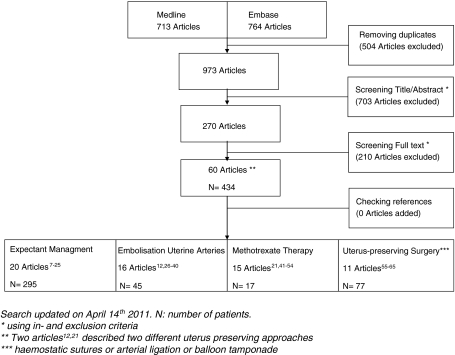
PURPOSE: We present a systematic review to evaluate failure rates (secondary hysterectomy or maternal mortality) and success rates (subsequent menstruation or pregnancy) after different uterus preserving treatment modalities in women with invasive placentation. METHODS: A review of English, German or Dutch language-published research, using Medline and Embase databases, was performed. Studies of any design were included. RESULTS: Ten cohort studies and 50 case series or case reports were included. Expectant management reported a secondary hysterectomy in 55/287 (19%), maternal mortality in 1/295 (0.3%), a subsequent menstruation in 44/49 (90%) and a subsequent pregnancy in 24/36 (67%). Embolization of the uterine arteries described a secondary hysterectomy in 8/45 (18%), a subsequent menstruation in 8/13 (62%) and a subsequent pregnancy in 5/33 (15%). Methotrexate therapy presented a secondary hysterectomy in 1/16 (6%), a subsequent menstruation in 4/5 (80%) and a subsequent pregnancy in 1/2 (50%). Uterus preserving surgery showed a secondary hysterectomy in 24/77 (31%), maternal mortality in 2/55 (4%), a subsequent menstruation in 28/34 (82%) and a subsequent pregnancy in 19/26 (73%). CONCLUSIONS: This review indicates that different uterus preserving treatment modalities may be effective in managing invasive placentation. Despite the extensive review of the literature, no conclusions about the superiority of any modality can be drawn.
Overview
The claims and statistics of this paper haven’t been checked yet.
Free: it reads the open-access text and checks the first 5 claims that cite a source we can check. Create a free account to check every claim.
Integrity signals
Registry
Cites
Statistics
Figures
Verification
Claims the paper makes
The claims and statistics of this paper haven’t been checked yet.
Free: it reads the open-access text and checks the first 5 claims that cite a source we can check. Create a free account to check every claim.
Claims other papers make about this one
Each is checked against this paper’s own text: does it say what the citing paper says it does?
The cited source says what the claim attributes to it.
In the citing paper
“A systematic review found that uterus preserving surgery resulted in a secondary hysterectomy in 24/77 women (31%), maternal mortality in 2/55 women (4%), subsequent menstruation in 28/34 women (82%) and subsequent pregnancy in 19/26 women (73%).180”
From Placenta Praevia and Placenta Accreta: Diagnosis and Management: Green‐top Guideline No. 27a (2019) · cites this paper as [180]
Self-check
Percentages, sums and reported differences re-computed from the paper’s own numbers.
The self-check needs the paper’s full text.
Citations
Cites
Clinical risk factors for placenta previa–placenta accreta
Miller, D. A., Chollet, J. A., & Goodwin, T. M. (1997) · American Journal of Obstetrics and Gynecology · doi:10.1016/s0002-9378(97)70463-0 · Cited by 1,106
Case Report and Literature Review
Spoden, J. E., Bumsted, R. M., & Warner, E. D. (1980) · Annals of Otology, Rhinology & Laryngology · doi:10.1177/000348948008900320 · Cited by 1,094
Understanding and Managing Methotrexate Nephrotoxicity
Widemann, B. C., & Adamson, P. C. (2006) · The Oncologist · doi:10.1634/theoncologist.11-6-694 · Cited by 730 · cited 1×
“Other speciWc adverse eVects are methotrexate-related pancytopenia and nephrotoxicity [ 71 , 72].”
BackgroundThe management of placenta percreta: Conservative and operative strategies
O'Brien, J. M., Barton, J. R., & Donaldson, E. S. (1996) · American Journal of Obstetrics and Gynecology · doi:10.1016/s0002-9378(96)70117-5 · Cited by 625
Eller, A. G., Bennett, M. A., Sharshiner, M., Masheter, C., Soisson, A. P., Dodson, M., & Silver, R. M. (2011) · Obstetrics & Gynecology · doi:10.1097/aog.0b013e3182051db2 · Cited by 556 · cited 2×
“However, the proliferation of trophoblasts in the later stages of pregnancy has been shown to have no role in placental growth [67].”
BackgroundMaternal Outcome After Conservative Treatment of Placenta Accreta
Sentilhes, L., Ambroselli, C., Kayem, G., Provansal, M., Fernandez, H., Perrotin, F., Winer, N., Pierre, F., Benachi, A., Dreyfus, M., et al. (2010) · Obstetrics & Gynecology · doi:10.1097/aog.0b013e3181d066d4 · Cited by 515 · cited 1×
“Prophylactic antibiotics are generally administrated to prevent infection [18].”
BackgroundUterine artery embolization for symptomatic uterine fibroids
Gupta, J. K., Sinha, A., Lumsden, M. A., & Hickey, M. (2006) · Cochrane Database of Systematic Reviews · doi:10.1002/14651858.cd005073.pub2 · Cited by 350
Conservative Management of Abnormally Invasive Placentation
Timmermans, S., van Hof, A. C., & Duvekot, J. J. (2007) · Obstetrical & Gynecological Survey · doi:10.1097/01.ogx.0000271133.27011.05 · Cited by 270 · cited 2×
“[6] reported 60 cases with abnormally invasive placentation.”
BackgroundPlacenta accreta: changing clinical aspects and outcome.
Read, J. A., Cotton, D. B., & Miller, F. C. (1980) · PubMed · Cited by 236
Management of placenta accreta: Morbidity and outcome
Bretelle, F., Courbière, B., Mazouni, C., Agostini, A., Cravello, L., Boubli, L., Gamerre, M., & D’Ercole, C. (2007) · European Journal of Obstetrics & Gynecology and Reproductive Biology · doi:10.1016/j.ejogrb.2006.07.050 · Cited by 232
Cited by
Placenta Praevia and Placenta Accreta: Diagnosis and Management: Green‐top Guideline No. 27a
Jauniaux, E., Alfirevic, Z., Bhide, A., Belfort, M., Burton, G., Collins, S., Dornan, S., Jurkovic, D., Kayem, G., Kingdom, J., et al. (2019) · BJOG: An International Journal of Obstetrics & Gynaecology · doi:10.1111/1471-0528.15306 · Cited by 506
FIGO consensus guidelines on placenta accreta spectrum disorders: Conservative management,
Sentilhes, L., Kayem, G., Chandraharan, E., Palacios‐Jaraquemada, J., Jauniaux, E., & Panel, F. T. F. P. A. D. A. M. E. C. (2018) · International Journal of Gynecology & Obstetrics · doi:10.1002/ijgo.12410 · Cited by 322
Hecht, J. L., Baergen, R., Ernst, L. M., Katzman, P. J., Jacques, S. M., Jauniaux, E., Khong, T. Y., Metlay, L. A., Poder, L., Qureshi, F., et al. (2020) · Modern Pathology · doi:10.1038/s41379-020-0569-1 · Cited by 263
Silver, R. M., & Barbour, K. D. (2015) · Obstetrics and Gynecology Clinics of North America · doi:10.1016/j.ogc.2015.01.014 · Cited by 230
Schaap, T. P., Bloemenkamp, K. W. M., Deneux‐Tharaux, C., Knight, M., Langhoff‐Roos, J., Sullivan, E. A., van den Akker, T., & INOSS (2017) · BJOG An International Journal of Obstetrics & Gynaecology · doi:10.1111/1471-0528.14833 · Cited by 113
Self-citationWhat we know about placenta accreta spectrum (PAS)
Liu, X., Wang, Y., Wu, Y., Zeng, J., Yuan, X., Tong, C., & Qi, H. (2021) · European Journal of Obstetrics & Gynecology and Reproductive Biology · doi:10.1016/j.ejogrb.2021.02.001 · Cited by 122
Duan, X., Wang, Y.-L., Han, X., Chen, Z.-M., Chu, Q., Wang, L., & Hai, D. V. (2015) · Clinical Radiology · doi:10.1016/j.crad.2015.03.008 · Cited by 77
Surgical management of placenta accreta: to leave or remove the placenta?
Perez‐Delboy, A., & Wright, J. (2014) · BJOG: An International Journal of Obstetrics & Gynaecology · doi:10.1111/1471-0528.12524 · Cited by 69
Chen, M., Liu, X., You, Y., Wang, X., Li, T., Luo, H., Qu, H., & Xu, L. (2020) · Obstetrics and Gynecology · doi:10.1097/aog.0000000000003792 · Cited by 68
Lee, P. S., Kempner, S., Miller, M., Dominguez, J., Grotegut, C., Ehrisman, J., Previs, R., Havrilesky, L. J., Broadwater, G., Ellestad, S. C., et al. (2017) · Gynecologic Oncology Research and Practice · doi:10.1186/s40661-017-0049-6 · Cited by 43
Updates on the management of placenta accreta spectrum
Mascio, D. D., Calì, G., & D’Antonio, F. (2019) · Minerva Obstetrics and Gynecology · doi:10.23736/s0026-4784.18.04333-2 · Cited by 47
Systematic review of uterus-preserving treatment modalities for abnormally invasive placenta
Mei, J., Wang, Y., Zou, B., Hou, Y., Ma, T., Chen, M., & Xie, L. (2015) · Journal of Obstetrics and Gynaecology · doi:10.3109/01443615.2015.1011106 · Cited by 41
Bai, Y., Luo, X., Li, Q., Yin, N., Fu, X., Zhang, H., & Qi, H. (2016) · Ultrasound in Obstetrics & Gynecology · doi:10.1002/uog.14867 · Cited by 33
“8 Pregnant following treatment† 2 (17) Pain score following treatment‡ ≤3 12 >3 0”
Shetty, M. K., & Dryden, D. K. (2015) · Seminars in Ultrasound CT and MRI · doi:10.1053/j.sult.2015.05.007 · Cited by 32
The sonographic appearance and obstetric management of placenta accreta
Cheung, C. S.-Y., & Chan, C.-P. (2012) · International Journal of Women s Health · doi:10.2147/ijwh.s28853 · Cited by 31
“A recent systematic review of uterus-preserving treatment modalities 1 revealed that uterine artery embolization for placenta accreta could achieve a subsequent menstruation rate of 62% and pregnancy rate of 15%, and secondary hysterectomy rate of 18%.”
Liu, C., Yang, D., Qu, H., Guo, Y., & Liu, L.-J. (2021) · Clinical Imaging · doi:10.1016/j.clinimag.2021.06.020 · Cited by 28
Placenta accreta spectrum: a non-oncologic challenge for gynecologic oncologists
Touhami, O., Allen, L. M., Mendoza, H. F., Murphy, M., & Hobson, S. R. (2022) · International Journal of Gynecological Cancer · doi:10.1136/ijgc-2021-003325 · Cited by 32
Management of Abnormal Placenta Implantation with Methotrexate: A Review of Published Data
Farasatinasab, M., Moghaddas, A., Dashti-Khadivaki, S., Raoofi, Z., & Nasiripour, S. (2016) · Gynecologic and Obstetric Investigation · doi:10.1159/000447556 · Cited by 26
Surgical Management of the Placenta Accreta Spectrum: An Institutional Experience
Mitric, C., Desilets, J., Balayla, J., & Ziegler, C. (2019) · Journal of Obstetrics and Gynaecology Canada · doi:10.1016/j.jogc.2019.01.016 · Cited by 28
Berhan, Y., & Urgie, T. (2020) · Ethiopian Journal of Health Sciences · doi:10.4314/ejhs.v30i2.16 · Cited by 36
Emergency Peripartum Hysterectomy: A 13-Year Review at a Tertiary Center in Kuwait
Wani, R. V., Abu-Hudra, N. M. S., & Al-Tahir, S. I. (2014) · The Journal of Obstetrics and Gynecology of India · doi:10.1007/s13224-014-0554-z · Cited by 23
“[26] in their systematic review of ten cohort studies and 50 case series or case reports conclude that different uterus preserving treatment modalities may be effective in managing invasive placentation.”
Placenta Accreta Spectrum: A Comprehensive Review of Guidelines
Giouleka, S., Tsakiridis, I. G., Chanioti, E.-R., Ladas, K., Liberis, A., Mamopoulos, A. M., Kalogiannidis, I. A., Athanasiadis, A. P., & Dagklis, T. (2024) · Obstetrical & Gynecological Survey · doi:10.1097/ogx.0000000000001274 · Cited by 24
Li, X., Wang, Z., Chen, J., Shi, H.-B., Zhang, X., Pan, J., Liu, W., Yang, N., Jin, Z., & Lang, J. (2012) · Clinical Radiology · doi:10.1016/j.crad.2012.07.021 · Cited by 20
Takeda, A., & Koike, W. (2017) · Archives of Gynecology and Obstetrics · doi:10.1007/s00404-017-4528-0 · Cited by 16
Bajwa, S. K., Singh, A. P., & Bajwa, S. S. (2013) · International Journal of Critical Illness and Injury Science · doi:10.4103/2229-5151.119197 · Cited by 19
“[52] 53-55] However, a slightly better success rate with these modalities does not mandate the routine practice of such techniques in developing nations like India.”
Urological Manifestations of Placenta Percreta
Ibrahim, M. A., Liu, A. H.-C., Dalpiaz, A., Schwamb, R., Warren, K., & Khan, S. A. (2015) · Current Urology · doi:10.1159/000365691 · Cited by 21
Symbol “&” suture to control atonic postpartum hemorrhage with placenta previa accreta
Li, G. T., Li, X. F., Liu, Y. J., Li, W., & Xu, H. M. (2014) · Archives of Gynecology and Obstetrics · doi:10.1007/s00404-014-3502-3 · Cited by 16
Tanaka, Y., Kanagawa, T., Nakayama, M., Matsuzaki, S., Kinugasa-Taniguchi, Y., Endo, M., Kimura, T., & Mimura, K. (2014) · American Journal of Perinatology Reports · doi:10.1055/s-0034-1370354 · Cited by 15
Kim, T., Lee, H., & Kwak, J. J. (2013) · Acta Obstetricia Et Gynecologica Scandinavica · doi:10.1111/aogs.12171 · Cited by 16
“It is immunosuppressive, induces pancytopenia and nephrotoxicity, and has no effect on abnormal placentation (4).”
Placenta accreta : dépistage, prise en charge et complications
Héquet, D., Ricbourg, A., Sebbag-Sfez, D., Rossignol, M., Lubrano, S., & Barranger, E. (2013) · Gynécologie Obstétrique & Fertilité · doi:10.1016/j.gyobfe.2012.11.001 · Cited by 23
“Une revue de la littérature parue en 2011 reprenant 60 articles incluant 434 patientes ayant bénéficié d’un traitement conservateur, dont 97 suivies à long terme, a référencé 49 grossesses dont les issues ne sont pas connues [61].”
BackgroundRisk of hemorrhage in abnormally invasive placenta according to its management
Pinto, P. V., Machado, A. P., & Montenegro, N. A. M. D. M. (2016) · The Journal of Maternal-Fetal & Neonatal Medicine · doi:10.1080/14767058.2016.1240163 · Cited by 15
Babaei, M. R., Kian, M., Naderi, Z., Khodaverdi, S., Raoofi, Z., Javanmanesh, F., Mohseni, I., Nasiripour, S., & Farasatinasab, M. (2019) · Clinical Radiology · doi:10.1016/j.crad.2019.01.006 · Cited by 13
Hemorragia del postparto. Principales etiologías, su prevención, diagnóstico y tratamiento
Solari, A., Solari, G. C., Wash, F. A., Guerrero, G. M., & Enríquez, G. I. (2014) · Revista Médica Clínica Las Condes · doi:10.1016/s0716-8640(14)70649-2 · Cited by 66
“Una revisión sistemática (12) reportó los siguientes resultados:”
He, S., Xue, M., & Jiang, J. (2021) · International Journal of Hyperthermia · doi:10.1080/02656736.2021.1887943 · Cited by 8
Roulot, A., Barranger, E., Morel, O., Soyer, P. A., & Héquet, D. (2014) · Journal de gynécologie, obstétrique et biologie de la reproduction. Supplément/Journal de gynécologie obstétrique et biologie de la reproduction · doi:10.1016/j.jgyn.2014.02.007 · Cited by 9
Conservative multidisciplinary management of placenta percreta following in vitro fertilization
Shim, J., Hong, S. Y., Won, H., Lee, P. R., & Kim, A. (2013) · Obstetrics & Gynecology Science · doi:10.5468/ogs.2013.56.3.194 · Cited by 7
“The findings of a recent systemic review suggest that various uterus-preserving treatment modalities may be effective in such cases [10].”
Morbidly Adherent Placenta (MAP): Lessons learnt
Wadhwa, L., Gupta, S., Gupta, P., Satija, B., & Khanna, R. (2013) · Open Journal of Obstetrics and Gynecology · doi:10.4236/ojog.2013.31a040 · Cited by 12
Antepartum and Postpartum Hemorrhage
Francois, K. E., & Foley, M. R. (2017) · Elsevier eBooks · doi:10.1016/b978-0-323-32108-2.00018-4 · Cited by 14
A Case of Placenta Percreta Managed with Sequential Embolisation Procedures
Armstrong-Kempter, S., Kapurubandara, S., Trudinger, B., Young, N., & Arrage, N. (2018) · Case Reports in Obstetrics and Gynecology · doi:10.1155/2018/7213689 · Cited by 6
“the range of 4–12 months as reported by other similar case studies in the literature [5, 8, 35, 37, 38].”
InfluentialKi-67 proliferation index in patients with placenta previa percreta in the third trimester
Hilali, N. G., Koçarslan, S., Vural, M., İncebıyık, A., Camuzcuoğlu, A., & Camuzcuoğlu, H. (2014) · Wiener klinische Wochenschrift · doi:10.1007/s00508-014-0634-1 · Cited by 6
Panaitescu, A. M., Peltecu, G. C., Botezatu, R., Iancu, G., & Gică, N. (2022) · Medicina · doi:10.3390/medicina58050678 · Cited by 6
Salman, M. C., Çalış, P. T., & Deren, Ö. (2013) · Case Reports in Obstetrics and Gynecology · doi:10.1155/2013/906351 · Cited by 6
Management Placenta Percreta Succesfully With Total Abdominal Hysterectomy. A Case Review :
Rajuddin, R., Roziana, R., Munawar, M., & Iqbal, M. (2019) · AVERROUS Jurnal Kedokteran dan Kesehatan Malikussaleh · doi:10.29103/averrous.v5i1.1628 · Cited by 8
Cui, R., Lu, J., Zhang, Z., & Bai, H. (2017) · Gynecologic and Obstetric Investigation · doi:10.1159/000452667 · Cited by 4
Framarino‐dei‐Malatesta, M. (2016) · Journal of Clinical Case Reports · doi:10.4172/2165-7920.1000706 · Cited by 4
“The Steins Bishop et al systematic review reported in 17 patients receiving methotrexate therapy as conservative treatment of invasive placentation an hysterectomy rate of 6% whereas it was 18% after embolization of the uterine arteries and 19% in expectant management [42].”
MethodThe Management of Placenta Accreta Spectrum Disorder
Donovan, B. M., & Zuckerwise, L. C. (2025) · Clinical Obstetrics & Gynecology · doi:10.1097/grf.0000000000000942 · Cited by 4
Heinze, S., Filsinger, B., Kastenholz, G., & Schröder, R. J. (2016) · RöFo - Fortschritte auf dem Gebiet der Röntgenstrahlen und der bildgebenden Verfahren · doi:10.1055/s-0042-113614 · Cited by 2
A RETROSPECTIVE STUDY ON ADHERENT PLACENTA- ITS MANAGEMENT, MATERNAL AND PERINATAL OUTCOME
Dandapat, A. B., Pande, B., Dora, S. K., Mohapatra, K. C., & Nayak, L. (2017) · Journal of Evolution of Medical and Dental Sciences · doi:10.14260/jemds/2017/600 · Cited by 2
Lersten, I. L., Rodriguez Christina, E., Gilroy Jamie, R., Fink Dina, M., & Guntupalli, S. R. (2021) · Annals of Gynecology and Obstetrics · doi:10.36959/468/475 · Cited by 2
Lago, V., Cortés, L. M., Martín, A. B. L., Martínez, V. O., Fernández, T. M., Sierra, A. Y. R., & Hita, A. M. M. (2014) · Progresos de Obstetricia y Ginecología · doi:10.1016/j.pog.2014.05.008 · Cited by 3
Khosravi, D., Arab, M., Ghavami, B., Shokrpour, M., Sheibani, S., & Saraeian, S. (2017) · Iranian Red Crescent Medical Journal · doi:10.5812/ircmj.41813 · Cited by 1
Plazentabedingte Blutungen: Pathophysiologie, Diagnostik, Management
Braun, T., Henrich, W., Knabl, J., Kainer, F., Faber, R., Pauluschke‐Fröhlich, J., Kagan, K. O., Abele, H., & Horn, L. (2018) · Springer eBooks · doi:10.1007/978-3-662-55622-1_8 · Cited by 1
Progressive Devascularization: A Novel Surgical Approach for Placenta Previa
Saad, A. F., Kirsch, N., Saade, G. A., & Hankins, G. (2018) · American Journal of Perinatology Reports · doi:10.1055/s-0038-1673373 · Cited by 1
Placenta-Related Hemorrhage: Pathophysiology, Diagnostics, Management
Braun, T., Henrich, W., Knabl, J., Kainer, F., Faber, R., Pauluschke‐Fröhlich, J., Kagan, K. O., Abele, H., & Horn, L. (2023) · Springer eBooks · doi:10.1007/978-3-662-66256-4_8 · Cited by 2
Teymoordash, S. N., Ghahari, S., Movahedi, S., Safkhani, Z., Mesgarha, M. G., & Khalili, S. (2024) · International Journal of Surgery Case Reports · doi:10.1016/j.ijscr.2024.109774 · Cited by 1
Endo, T., Baba, T., 杉尾, 明., 森下, 美., Takahashi, M., Akashi, Y., Ishioka, S., Tachi, N., Imai, T., Tamakawa, M., et al. (2012) · Archives of Gynecology and Obstetrics · doi:10.1007/s00404-012-2472-6 · Cited by 1
Effect of a Combined Hemostatic Technique during Cesarean Section in Placenta Previa
Lee, D. H., Choi, W. K., Park, D. J., Jeong, Y. J., & Lee, J. H. (2020) · Perinatology · doi:10.14734/pn.2020.31.1.20 · Cited by 3
Şahin, E., Madendağ, Y., Şahin, M. E., Madendağ, İ. Ç., & Kırlangıç, M. M. (2021) · European Journal of Obstetrics & Gynecology and Reproductive Biology · doi:10.1016/j.ejogrb.2021.11.006 · Cited by 1
Placenta increta in an unscarred and bicornute uterus
Nazir, N., Khan, D., Nasrullah, F. D., & Jaleel, R. (2022) · Pakistan Journal of Medical Sciences · doi:10.12669/pjms.39.1.6164 · Cited by 2
Surgical Management of Placenta Accreta
Giri, V., & Kumar, M. (2016) · Wiley eBooks · doi:10.1002/9781118298565.ch160 · Cited by 1
Khodaverdi, S., Babaei, M. R., Mohseni, I., & Farasatinasab, M. (2019) · Clinical Radiology · doi:10.1016/j.crad.2019.05.006 · Cited by 1
Endovascular management of postpartum hemorrhage of placental origin
Seif, H. M. A. H., & Khalaf, L. M. R. (2015) · The Egyptian Journal of Radiology and Nuclear Medicine · doi:10.1016/j.ejrnm.2015.08.012
Conservative management of adherent retained placenta: report of 4 cases
Rohilla, M., Pramya, N., Prasad, G. R. V., Jain, V. D., & Kalra, J. (2015) · European Journal of Biological Research
Biener, A., & Klünder, N. (2012) · Geburtshilfe und Frauenheilkunde · doi:10.1055/s-0032-1327941
Conservative Management of Morbidly-Adherent Placenta Following Vaginal Deliveries: A Case Series
O, A. L. A. O. S. (2014) · Gynecology & Obstetrics · doi:10.4172/2161-0932.1000207
“The mode of conservative measures chosen depends on the available facilities and expertise as there is no clear superior advantage of one method over another [13].”
BackgroundResultInfluentialMatsubara, M., Takamatsu, S., Onuma, T., Tsuji, T., Tajima, K., & Shimada, H. (2013) · JAPANESE JOURNAL OF GYNECOLOGIC AND OBSTETRIC ENDOSCOPY · doi:10.5180/jsgoe.29.94
Chen, G., Chen, J., Wang, Y., Zheng, S., Liu, H., Liu, G., Zhou, H., & Zhong, M. (2017) · Biomedical Research-tokyo
Plazentaretention – Management mit Fokus auf die Fertilität
Fluhr, H. (2018) · Gynäkologische Endokrinologie · doi:10.1007/s10304-018-0203-1
Yu, J., McCracken, J., Zhang, J., & Wang, A. (2018) · Journal of Clinical Case Reports · doi:10.4172/2165-7920.10001148
Successful Multimodality Life-saving Management of Placenta Percreta with Hemoperitoneum in Shock
Jain, K., Chopra, S., Aggarwal, N., Kumar, N., Siwatch, S., & Gorsi, U. (2016) · Journal of Postgraduate Medicine Education and Research · doi:10.5005/jpmer-50-4-201
Wiemers, F., Lorey, A., Boekhoff, J., Keil, C. N., Wagner, U. A. G., & Köhler, S. (2020) · Zeitschrift für Geburtshilfe und Neonatologie · doi:10.1055/s-0040-1709343
Other HIFU Ablation Applications in Gynecology and Related to Obstetrics
Wong, F., Zhang, L., & Wang, Z. (2021) · Springer eBooks · doi:10.1007/978-981-16-0939-8_9
Ambreen, A., Ahmed, F. U. A., Zafar, S., Saeed, A., Mushtaq, S., & Arsalan, M. (2018) · The Professional Medical Journal · doi:10.29309/tpmj/18.4325 · Cited by 1
Александрович, Б. Э., Yashchuk, A. G., Musin, I. I., & Fatkullina, Y. N. (2021) · Obstetrics Gynecology and Reproduction · doi:10.17749/2313-7347/ob.gyn.rep.2021.184
Jauniaux, E. R. M., Bhidé, A., & Wright, J. D. (2017) · Elsevier eBooks · doi:10.1016/b978-0-323-32108-2.00021-4 · Cited by 2
(2013) · Progresos de Obstetricia y Ginecología · doi:10.1016/j.pog.2013.04.004 · Cited by 1
van Beekhuizen, H. J., & van Leeuwen, J. H. S. (2017) · Bohn Stafleu van Loghum eBooks · doi:10.1007/978-90-368-1744-8_9
Nguyễn, X. H., Lê, V. K., Nguyễn, D. T., Hoàng, N. T., & Nguyễn, H. T. (2022) · Vietnamese Journal of Radiology and Nuclear Medicine · doi:10.55046/vjrnm.47.134.2022
Adjunctive Treatment of Placenta Accreta Spectrum
Shah, S. C., Fox, K. A., & Nassr, A. A. (2022) · Springer eBooks · doi:10.1007/978-3-031-10347-6_9
Evidence-Based Management of Placenta Accreta Spectrum
Shazly, S. A., Radwan, A. A., AlMahdy, A. M., Ateya, M. I., Abouzeid, M. H., Sayed, E. G., & Elassall, G. M. (2022) · Springer eBooks · doi:10.1007/978-3-031-10347-6_11
Update on Placenta Accreta Spectrum Diagnosis and Management Challenges
Alalfy, M., Elgazzar, A., Samy, A., & Said, A. (2023) · Current Women s Health Reviews · doi:10.2174/1573404820666230525121727
Placenta Succenturiata (Tripartita), Asociada a Placenta Previa y Acreta
Sosa, M. D. L. L., Marines, D. R., Campuzano, M. D. R. S., Aguirre, M. V., & Carranza, A. R. P. (2023) · Ciencia Latina Revista Científica Multidisciplinar · doi:10.37811/cl_rcm.v7i4.7507
UTERUS PRESERVING TREATMENT MODALITIES FOR ABNORMAL INVASIVE PLACENTA: A SYSTEMATIC REVIEW
Aromatika, L., Nofriyadi, T., & Juliana, M. (2023) · Journal of Advance Research in Medical & Health Science · doi:10.53555/md0b1z50
“Preventive embolisation with an AIP caesarean section may be useful.(23) Occlusion balloons have been implanted from the aorta to the anterior division of the internal iliac arteries.”
İncebıyık, A. (2023) · Mevlana Medical Sciences · doi:10.56752/mevmedsci.2023.49
Enquête nationale sur la stratégie de prise en charge du placenta accreta en France
Lauroy, A., Buffeteau, A., Vidal, F., Parant, O., & Guerby, P. (2024) · Gynécologie Obstétrique Fertilité & Sénologie · doi:10.1016/j.gofs.2024.03.008
Pathologische Plazenta und Nabelschnur
Wertaschnigg, D., & Henrich, W. (2025) · Springer eBooks · doi:10.1007/978-3-662-67373-7_14
Steri, L., Barbieri, P., Gigante, L., & Posa, A. (2025) · World Journal of Radiology · doi:10.4329/wjr.v17.i7.107737
Conservative management of placenta accreta spectrum disorders: a retrospective cohort study
Dubé, S. B., Nguyen, D. B., Rocca, C. D., Smith, J. P., Mansour, F., Krishnamurthy, S., Brown, R. N., & Zakhari, A. (2026) · BMC Pregnancy and Childbirth · doi:10.1186/s12884-026-09085-2
“Fertility after conservative treatment has been demonstrated after successful conservative management [10, 11], but at the potential cost of an increased risk of post-partum hemorrhage, sepsis, and the need for delayed hysterectomy in those cases where this is unsuccessful [12, 13].”
Metadata
- Authors
- Steins Bisschop, C. N., Schaap, T. P., Vogelvang, T. E., & Scholten, P. C.
- Affiliations
- Diakonessenhuis hospital (NL)
- Venue
- Archives of Gynecology and Obstetrics
- Published
- 2011-06-03
- Volume
- 284
- Issue
- 2
- Pages
- 491-502
- ISSN
- 0003-9128 (ISSN-L)
- 0932-0067
- 1432-0711
- PMC
- PMC3133648
- OpenAlex
- W1980363745
- Cited by
- 88
- References
- 74
- Citations by year
- 2026: 1 · 2025: 3 · 2024: 3 · 2023: 5 · 2022: 6 · 2021: 7 · 2020: 5 · 2019: 5 · 2018: 8 · 2017: 10 · 2016: 6 · 2015: 8 · 2014: 8 · 2013: 9 · 2012: 4
- FWCI
- 1.01
- Type
- journal article
- Language
- en
- Open access
- hybrid
- doi.org
- Licence
- cc-by-nc
- Locations
- Archives of Gynecology and Obstetrics (publishedVersion, cc-by-nc)
- Europe PMC (PubMed Central) (publishedVersion, cc-by-nc)
- PubMed Central (publishedVersion, cc-by-nc)
- PubMed (publishedVersion)
- Topics
- Health Sciences › Medicine › Pediatrics, Perinatology and Child Health › Maternal and fetal healthcare
- Health Sciences › Medicine › Obstetrics and Gynecology › Uterine Myomas and Treatments
- Health Sciences › Medicine › Obstetrics and Gynecology › Gestational Trophoblastic Disease Studies
- Keywords
- invasive placentation, expectant management, uterine artery embolization, methotrexate, maternal mortality, subsequent pregnancy, treatment failure rate
- MeSH terms
- Female, Folic Acid Antagonists, Humans, Hysterectomy, Methotrexate, Placenta Accreta, Pregnancy, Uterus, Uterine Artery Embolization
About these checks
Registry, retraction, Cites and statistics results are computed, not judged, with one exception: a printed reference that no index lists is read once by a model before it counts as a citation error. Claims are extracted by a model and kept only when their quote appears verbatim in the text; each cited source is then checked, with a model’s help, for whether it says what the claim relies on. Those verdicts can be wrong — read the claim’s quote and the cited source before relying on one.
Statistics and arithmetic are recomputed, not judged.
Confidence bands are shown only for fields calibrated on our annotated test set. None is calibrated yet, so no band is shown.
What counts as a claim ›How we measure confidence ›How we check this ›
Are you an author, or do you see a problem with this page? Request a review
Data sources
Bibliographic data: Semantic Scholar, OpenAlex, Crossref.
Contains information from the Semantic Scholar Academic Graph Datasets, made available under the ODC Attribution License (ODC-BY 1.0).
Semantic Scholar’s data is described in: Kinney, R., et al. (2023). The Semantic Scholar Open Data Platform. arXiv:2301.10140.
