

Invasive placentation and uterus preserving treatment modalities: a systematic review
Open accessThe DOI matches its Crossref record; 75 of the 75 references it cites were found in a registry or an index.
Abstract
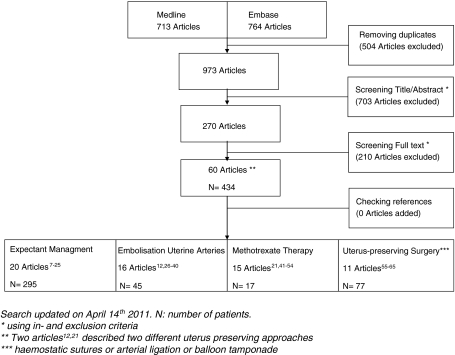
PURPOSE: We present a systematic review to evaluate failure rates (secondary hysterectomy or maternal mortality) and success rates (subsequent menstruation or pregnancy) after different uterus preserving treatment modalities in women with invasive placentation. METHODS: A review of English, German or Dutch language-published research, using Medline and Embase databases, was performed. Studies of any design were included. RESULTS: Ten cohort studies and 50 case series or case reports were included. Expectant management reported a secondary hysterectomy in 55/287 (19%), maternal mortality in 1/295 (0.3%), a subsequent menstruation in 44/49 (90%) and a subsequent pregnancy in 24/36 (67%). Embolization of the uterine arteries described a secondary hysterectomy in 8/45 (18%), a subsequent menstruation in 8/13 (62%) and a subsequent pregnancy in 5/33 (15%). Methotrexate therapy presented a secondary hysterectomy in 1/16 (6%), a subsequent menstruation in 4/5 (80%) and a subsequent pregnancy in 1/2 (50%). Uterus preserving surgery showed a secondary hysterectomy in 24/77 (31%), maternal mortality in 2/55 (4%), a subsequent menstruation in 28/34 (82%) and a subsequent pregnancy in 19/26 (73%). CONCLUSIONS: This review indicates that different uterus preserving treatment modalities may be effective in managing invasive placentation. Despite the extensive review of the literature, no conclusions about the superiority of any modality can be drawn.
Overview
The claims and statistics of this paper haven’t been checked yet.
Free: it reads the open-access text and checks the first 5 claims that cite a source we can check. Create a free account to check every claim.
Integrity signals
Registry
Cites
Statistics
Figures
Verification
Claims the paper makes
The claims and statistics of this paper haven’t been checked yet.
Free: it reads the open-access text and checks the first 5 claims that cite a source we can check. Create a free account to check every claim.
Claims other papers make about this one
Each is checked against this paper’s own text: does it say what the citing paper says it does?
The cited source says what the claim attributes to it.
In the citing paper
“A systematic review found that uterus preserving surgery resulted in a secondary hysterectomy in 24/77 women (31%), maternal mortality in 2/55 women (4%), subsequent menstruation in 28/34 women (82%) and subsequent pregnancy in 19/26 women (73%).180”
From Placenta Praevia and Placenta Accreta: Diagnosis and Management: Green‐top Guideline No. 27a (2019) · cites this paper as [180]
Self-check
Percentages, sums and reported differences re-computed from the paper’s own numbers.
The self-check needs the paper’s full text.
Citations
Cites
Clinical risk factors for placenta previa–placenta accreta
Miller, D. A., Chollet, J. A., & Goodwin, T. M. (1997) · American Journal of Obstetrics and Gynecology · doi:10.1016/s0002-9378(97)70463-0 · Cited by 1,106
Case Report and Literature Review
Spoden, J. E., Bumsted, R. M., & Warner, E. D. (1980) · Annals of Otology, Rhinology & Laryngology · doi:10.1177/000348948008900320 · Cited by 1,094
Understanding and Managing Methotrexate Nephrotoxicity
Widemann, B. C., & Adamson, P. C. (2006) · The Oncologist · doi:10.1634/theoncologist.11-6-694 · Cited by 730 · cited 1×
“Other speciWc adverse eVects are methotrexate-related pancytopenia and nephrotoxicity [ 71 , 72].”
BackgroundThe management of placenta percreta: Conservative and operative strategies
O'Brien, J. M., Barton, J. R., & Donaldson, E. S. (1996) · American Journal of Obstetrics and Gynecology · doi:10.1016/s0002-9378(96)70117-5 · Cited by 625
Eller, A. G., Bennett, M. A., Sharshiner, M., Masheter, C., Soisson, A. P., Dodson, M., & Silver, R. M. (2011) · Obstetrics & Gynecology · doi:10.1097/aog.0b013e3182051db2 · Cited by 556 · cited 2×
“However, the proliferation of trophoblasts in the later stages of pregnancy has been shown to have no role in placental growth [67].”
BackgroundMaternal Outcome After Conservative Treatment of Placenta Accreta
Sentilhes, L., Ambroselli, C., Kayem, G., Provansal, M., Fernandez, H., Perrotin, F., Winer, N., Pierre, F., Benachi, A., Dreyfus, M., et al. (2010) · Obstetrics & Gynecology · doi:10.1097/aog.0b013e3181d066d4 · Cited by 515 · cited 1×
“Prophylactic antibiotics are generally administrated to prevent infection [18].”
BackgroundUterine artery embolization for symptomatic uterine fibroids
Gupta, J. K., Sinha, A., Lumsden, M. A., & Hickey, M. (2006) · Cochrane Database of Systematic Reviews · doi:10.1002/14651858.cd005073.pub2 · Cited by 350
Conservative Management of Abnormally Invasive Placentation
Timmermans, S., van Hof, A. C., & Duvekot, J. J. (2007) · Obstetrical & Gynecological Survey · doi:10.1097/01.ogx.0000271133.27011.05 · Cited by 270 · cited 2×
“[6] reported 60 cases with abnormally invasive placentation.”
BackgroundPlacenta accreta: changing clinical aspects and outcome.
Read, J. A., Cotton, D. B., & Miller, F. C. (1980) · PubMed · Cited by 236
Management of placenta accreta: Morbidity and outcome
Bretelle, F., Courbière, B., Mazouni, C., Agostini, A., Cravello, L., Boubli, L., Gamerre, M., & D’Ercole, C. (2007) · European Journal of Obstetrics & Gynecology and Reproductive Biology · doi:10.1016/j.ejogrb.2006.07.050 · Cited by 232
Anterior placenta percreta: surgical approach, hemostasis and uterine repair
Jaraquemada, J. M. P., Pesaresi, M., Nassif, J. C., & Hermosid, S. (2004) · Acta Obstetricia et Gynecologica Scandinavica · doi:10.1080/j.0001-6349.2004.00517.x · Cited by 229 · cited 1×
“Uterus preserving surgery Uterine compression sutures function in a manner similar to manual compression and are placed to prevent uterine relaxation due to the retained placenta [73].”
BackgroundTan, C. H., Tay, K. H., Sheah, K., Kwek, K., Wong, K., Tan, H. K., & Tan, B. S. (2007) · American Journal of Roentgenology · doi:10.2214/ajr.07.2417 · Cited by 195
Methotrexate-induced pancytopenia: serious and under-reported? Our experience of 25 cases in 5 years
Lim, A. Y. N., Gaffney, K., & Scott, D. G. I. (2005) · Rheumatology · doi:10.1093/rheumatology/keh685 · Cited by 164 · cited 1×
“In addition, non-target embolization can cause ischaemic damage to other organs [70].”
BackgroundThird stage of labor: Analysis of duration and clinical practice
Dombrowski, M. P., Bottoms, S. F., Saleh, A. A., Hurd, W. W., & Romero, R. J. (1995) · American Journal of Obstetrics and Gynecology · doi:10.1016/0002-9378(95)91493-5 · Cited by 126 · cited 1×
“Invasive placentation aVects »2% of all singleton deliveries [3].”
BackgroundAlanis, M., Hurst, B. S., Marshburn, P. B., & Matthews, M. L. (2006) · Fertility and Sterility · doi:10.1016/j.fertnstert.2006.02.128 · Cited by 121 · cited 1×
“In the current literature, diVerent uterus preserving treatment modalities are described: expectant management, embolization of the uterine arteries, methotrexate therapy and uterus preserving surgery [2, 5, 6].”
BackgroundSivan, E., Spira, M., Achiron, R., Rimon, U., Golan, G., Mazaki-Tovi, S., & Schiff, E. (2010) · American Journal of Perinatology · doi:10.1055/s-0030-1247599 · Cited by 102
Nonsurgical management of placenta percreta: a case report.
Legro, R. S., Price, F. V., Hill, L. M., & Caritis, S. N. (1994) · PubMed · Cited by 98
Irving, F. C., & Hertig, A. T. (1937) · Cited by 93
Management of placenta praevia and accreta
Allahdin, S., Voigt, S., & Htwe, T. T. (2011) · Journal of Obstetrics and Gynaecology · doi:10.3109/01443615.2010.532248 · Cited by 85
Committee opinion #266: placenta accreta
ACOG Committee on Obstetric Practice (2002) · Obstetrics & Gynecology · doi:10.1016/s0029-7844(01)01748-3 · Cited by 82
Failure of methotrexate and internal iliac balloon catheterization to manage placenta percreta
Butt, K. (2002) · Obstetrics & Gynecology · doi:10.1016/s0029-7844(02)02020-3 · Cited by 74
Fertility and obstetric outcome after conservative management of placenta accreta
Provansal, M., Courbiere, B., Agostini, A., D'Ercole, C., Boubli, L., & Bretelle, F. (2010) · International Journal of Gynecology & Obstetrics · doi:10.1016/j.ijgo.2009.12.011 · Cited by 70
Fertility after conservative treatment of placenta accreta
Kayem, G., Pannier, E., Goffinet, F., Grangé, G., & CABROL, D. (2002) · Fertility and Sterility · doi:10.1016/s0015-0282(02)03292-2 · Cited by 70
Henrich, W., Fuchs, I., Ehrenstein, T., Kjos, S., Schmider, A., & Dudenhausen, J. W. (2002) · Ultrasound in Obstetrics & Gynecology · doi:10.1046/j.1469-0705.2002.00691.x · Cited by 65
Conservative treatment of placenta percreta: a safe alternative
Clément, D., Kayem, G., & CABROL, D. (2004) · European Journal of Obstetrics & Gynecology and Reproductive Biology · doi:10.1016/j.ejogrb.2003.06.008 · Cited by 58
Arduini, M., Epicoco, G., Clerici, G., Bottaccioli, E., Arena, S., & Affronti, G. (2010) · International Journal of Gynecology & Obstetrics · doi:10.1016/j.ijgo.2009.10.007 · Cited by 58
Conservative treatment of placenta accreta
Hatfield, J. L. W., Brumsted, J. R., & Cooper, B. C. (2006) · Journal of Minimally Invasive Gynecology · doi:10.1016/j.jmig.2006.06.013 · Cited by 51 · cited 2×
“Taylor [16] Case report 13 weeks 1 39 Vaginally 0 0 0 0 1 NR HatWeld [ 17 ] Case series 6 weeks”
BackgroundTwo cases of placenta accreta managed conservatively
Komulainen, M. H., Väyrynen, M. A., Kauko, M., & Saarikoski, S. (1995) · European Journal of Obstetrics & Gynecology and Reproductive Biology · doi:10.1016/0301-2115(95)02141-s · Cited by 50
Bennett, M. J., & Sen, R. C. (2003) · Australian and New Zealand Journal of Obstetrics and Gynaecology · doi:10.1046/j.0004-8666.2003.00067.x · Cited by 47 · cited 1×
“Placenta percreta Clement [ 32 ] Case series 4 months”
BackgroundMatsumura, N., Inoue, T. K., Fukuoka, M., Sagawa, N., & Fujii, S. (2000) · Journal of obstetrics and gynaecology research · doi:10.1111/j.1447-0756.2000.tb01288.x · Cited by 47 · cited 1×
“When conservative management is successful, it results in gradual resorption of the placenta or delayed delivery of the placenta [15, 17, 29].”
BackgroundKayem, G., Anselem, O., Schmitz, T., Goffinet, F., Davy, C., Mignon, A., & CABROL, D. (2007) · Journal de gynécologie, obstétrique et biologie de la reproduction. Supplément/Journal de gynécologie obstétrique et biologie de la reproduction · doi:10.1016/j.jgyn.2007.05.002 · Cited by 45
Teo, S., Kanagalingam, D., Tan, H., & Tan, L. (2008) · BJOG: An International Journal of Obstetrics & Gynaecology · doi:10.1111/j.1471-0528.2008.01681.x · Cited by 41
Shahin, A. Y., Farghaly, T. A., Mohamed, S. A., Shokry, M., Abd‐El‐Aal, D. M., & Youssef, M. A. (2010) · International Journal of Gynecology & Obstetrics · doi:10.1016/j.ijgo.2009.08.035 · Cited by 39 · cited 1×
“In some cases, a combination of both techniques was used [59].”
MethodDescargues, G., Clavier, E., Lemercier, E., & Sibert, L. (2000) · Obstetrics and Gynecology · doi:10.1016/s0029-7844(00)00985-6 · Cited by 39
Surgical Intervention in the Management of Postpartum Hemorrhage
Shah, M. M., & Wright, J. D. (2009) · Seminars in Perinatology · doi:10.1053/j.semperi.2008.12.006 · Cited by 35 · cited 1×
“Other speciWc adverse eVects are methotrexate-related pancytopenia and nephrotoxicity [71, 72].”
BackgroundSurgical uterine devascularization for placenta accreta: immediate and long-term follow-up
Verspyck, E., Resch, B., Sergent, F., & Marpeau, L. (2005) · Acta Obstetricia et Gynecologica Scandinavica · doi:10.1080/j.0001-6349.2005.00504.x · Cited by 34
Panoskaltsis, T. A., Ascarelli, A., de Souza, N., Sims, C. D., & Edmonds, K. (2000) · BJOG An International Journal of Obstetrics & Gynaecology · doi:10.1111/j.1471-0528.2000.tb13345.x · Cited by 33
Takeda, A., Koyama, K., Imoto, S., Mori, M., Nakano, T., & Nakamura, H. K. (2009) · Archives of Gynecology and Obstetrics · doi:10.1007/s00404-009-1238-2 · Cited by 30 · cited 2×
“Placenta increta Breathnach [ 29 ] Case report 12 weeks”
BackgroundConservative treatment of placenta increta with methotrexate
Raquel Crespo, E., Moros, M. L., & Madani, B. (2005) · International Journal of Gynecology & Obstetrics · doi:10.1016/j.ijgo.2005.06.028 · Cited by 30 · cited 1×
“Morken [42] Case report 14 days 1 30 CS 0 0 0 0 NR NR Cole [ 43 ] Case report 6 h”
BackgroundNonoperative Treatment of Placenta Percreta: Value of MR Imaging
Sonin, A. H. (2001) · American Journal of Roentgenology · doi:10.2214/ajr.177.6.1771301 · Cited by 28
Failure of conservative management of placenta previa-percreta
Luo, G., Perni, S. C., Jean-Pierre, C., Baergen, R. N., & Predanic, M. (2005) · Journal of Perinatal Medicine · doi:10.1515/jpm.2005.101 · Cited by 27
Septic Shock after Conservative Management for Placenta Accreta
Chiang, Y., Shih, J., & Lee, C. (2006) · Taiwanese Journal of Obstetrics and Gynecology · doi:10.1016/s1028-4559(09)60194-7 · Cited by 26
Percutaneous Treatment of Placenta Percreta Using Coil Embolization
Dinkel, H., Dürig, P., Schnatterbeck, P., & Triller, J. (2003) · Journal of Endovascular Therapy · doi:10.1177/152660280301000130 · Cited by 26
Successful conservative management of placenta percreta with rectal involvement in a primigravida
Lee, L., Lin, H., Wang, C., Cheng, W., & Huang, S. (1995) · Acta Obstetricia Et Gynecologica Scandinavica · doi:10.3109/00016349509021209 · Cited by 25 · cited 1×
“O’Brien [ 23 ] Retr cohort 8 NR NR 0/8 NR NR 0/8 NR NR”
BackgroundWang, L., Wang, P., Chen, C., Au, H., Yen, Y.-K., & Liu, W. (2009) · Journal of obstetrics and gynaecology research · doi:10.1111/j.1447-0756.2008.00936.x · Cited by 25 · cited 1×
“Read [ 62 ] Retr cohort 18 days 22 NR CS, vaginally |”
MethodFerrazzani, S., Guariglia, L., Triunfo, S., Caforio, L., & Caruso, A. (2009) · Fetal Diagnosis and Therapy · doi:10.1159/000236154 · Cited by 24
Recurrence following conservative management of placenta accreta
Kayem, G., Clément, D., & Goffinet, F. (2007) · International Journal of Gynecology & Obstetrics · doi:10.1016/j.ijgo.2007.05.035 · Cited by 23
Placenta increta; conservative management – a successful outcome. Case report and literature review
Adair, S., Elamin, D., & Tharmaratnam, S. (2004) · The Journal of Maternal-Fetal & Neonatal Medicine · doi:10.1080/14767050410001668699 · Cited by 21 · cited 1×
“Wehbe [45] Case report 2 months 1 NR Vaginally NR NR 0 0 NR NR Zepiridis [ 46 ] Case series 12 weeks”
BackgroundPlacenta Percreta: Methotrexate Treatment and MRI Findings
Heiskanen, N., Kröger, J., Kainulainen, S., & Heinonen, S. T. (2008) · American Journal of Perinatology · doi:10.1055/s-2007-1004831 · Cited by 21
Persistent placenta increta: A complication of conservative management of presumed placenta accreta
DAVIS, J., & CRUZ, A. (1996) · Obstetrics and Gynecology · doi:10.1016/0029-7844(96)00121-4 · Cited by 20 · cited 1×
“Davis [ 7 ] Case report 5 months 1 NR CS NR NR 1 (hemorrhage, pain) 0 0 0”
BackgroundRetroperitoneal Fibrosis Secondary to Actinomycosis With No Intrauterine Device
Milam, M. R., Schultenover, S. J., Crispens, M. A., & Parker, L. P. (2004) · Obstetrics and Gynecology · doi:10.1097/01.aog.0000144118.90772.a1 · Cited by 18
Successful Conservative Management of Placenta Previa Totalis and Extensive Percreta
Yee, Y.-H., Kung, F., Yu, P.-C., Hsu, T., & Cheng, Y. (2008) · Taiwanese Journal of Obstetrics and Gynecology · doi:10.1016/s1028-4559(09)60011-5 · Cited by 18
Diop, A. N., Bros, S., Chabrot, P., Gallot, D., & Boyer, L. (2009) · American Journal of Obstetrics and Gynecology · doi:10.1016/j.ajog.2009.08.040 · Cited by 17 · cited 1×
“Tan [ 34 ] Retr cohort 1 month 5 NR CS 3/5 NR 1/5 (hemorrhage) 0/5 NR NR”
BackgroundPersistent retained placenta percreta: methotrexate treatment and Doppler flow characteristics
Nijman, R. G. W., Mantingh, A., & Aarnoudse, J. G. (2002) · BJOG An International Journal of Obstetrics & Gynaecology · doi:10.1111/j.1471-0528.2002.01040.x · Cited by 17
Tseng, S.-H., Lin, C., Hwang, J. I., Chen, W.-C., Ho, E. S., & Chou, M. (2006) · Taiwanese Journal of Obstetrics and Gynecology · doi:10.1016/s1028-4559(09)60214-x · Cited by 17
Post partum intra-abdominal hemorrhage due to placenta percreta
Veenstra, M. J., Spinder, T., Dekker, G., & van Geijn, H. P. (1995) · European Journal of Obstetrics & Gynecology and Reproductive Biology · doi:10.1016/0301-2115(95)02183-8 · Cited by 16 · cited 1×
“Lee [ 24 ] Case report 15 days 1 17 CS/laparotomy 1 0 0 0 NR NR”
Placenta accreta and methotrexate treatment
Morken, N., & Kahn, J. A. (2006) · Acta Obstetricia Et Gynecologica Scandinavica · doi:10.1080/00016340500486891 · Cited by 15 · cited 1×
“Case report 1 year 1 36 CS NR NR 0 0 1 0 Butt [ 41 ] Case report 15 days”
BackgroundExpectant management of placenta accreta following stillbirth at term: a case report
Taylor, A., Sanusi, F. A., & Riddle, A. F. (2001) · European Journal of Obstetrics & Gynecology and Reproductive Biology · doi:10.1016/s0301-2115(00)00472-3 · Cited by 14
Coping with placenta praevia and accreta in a DGH setting and words of caution
Sinha, P., Oniya, O., & Bewley, S. (2005) · Journal of Obstetrics and Gynaecology · doi:10.1080/01443610500119739 · Cited by 13
Thierry, B., & Tabrizian, M. (2003) · Journal of Endovascular Therapy · doi:10.1583/1545-1550(2003)010<0158:ptoppu>2.0.co;2 · Cited by 13
Conservative Management of a Case of Placenta Praevia Percreta
Otsubo, Y., Shinagawa, T., Chihara, H., & Araki, T. (1999) · Australian and New Zealand Journal of Obstetrics and Gynaecology · doi:10.1111/j.1479-828x.1999.tb03151.x · Cited by 12
Alternative management of placenta accreta
Mechery, J., & Burch, D. (2005) · Gynecological Surgery · doi:10.1007/s10397-005-0154-0 · Cited by 11
Spontaneous rupture of the uterus caused by placenta percreta at 28 weeks of twin pregnancy
Nagy, P. S. (2003) · European Journal of Obstetrics & Gynecology and Reproductive Biology · doi:10.1016/s0301-2115(03)00206-9 · Cited by 11
Gupta, A., Nanda, S., Dahiya, P., Chauhan, M. B., & Sangwan, K. (2003) · Australian and New Zealand Journal of Obstetrics and Gynaecology · doi:10.1046/j.0004-8666.2003.00093.x · Cited by 10
Breathnach, F., Tuite, D. J., McEniff, N. J., Byrne, P., & Geary, M. P. (2007) · Journal of Obstetrics and Gynaecology · doi:10.1080/01443610601137879 · Cited by 10
Conservative management of placenta accreta
Jwarah, E., & Wilkin, D. (2006) · Journal of Obstetrics and Gynaecology · doi:10.1080/01443610600618705 · Cited by 9
Conservative management of clinically diagnosed placenta accreta following vaginal delivery
Bennett, M. J., & Townsend, L. (2009) · Australian and New Zealand Journal of Obstetrics and Gynaecology · doi:10.1111/j.1479-828x.2009.01090.x · Cited by 8 · cited 1×
“Bennett [ 8 ] Case series 4 years 1 28 Breech extr 1 NR 0 0 NR 1”
BackgroundFailure of Conservative Treatment for Placenta Increta
Liao, C., & Ding, D. (2009) · Taiwanese Journal of Obstetrics and Gynecology · doi:10.1016/s1028-4559(09)60310-7 · Cited by 7
Successful Uterus-Preserving Surgery for Treatment of Chemotherapy-Resistant Placenta Increta
Endo, T., Hayashi, T., Shimizu, A., Matsuura, M., Mizuuchi, M., Nagasawa, K., Ezaka, Y., Baba, T., Ishioka, S., & Saito, T. (2009) · Gynecologic and Obstetric Investigation · doi:10.1159/000262320 · Cited by 7 · cited 1×
“1 NR NR 1 NR 0 0 NR NR Adair [ 47 ] Case report 16 weeks”
BackgroundZepiridis, L. I., Zafrakas, Μ., Theodoridis, T. D., Assimakopoulos, E., Tzevelekis, P., Athanatos, D., Bontis, J. N., & Tarlatzis, B. C. (2009) · Archives of Gynecology and Obstetrics · doi:10.1007/s00404-009-1045-9 · Cited by 7 · cited 1×
“Wehbe [ 45 ] Case report 2 months 1 NR Vaginally NR NR 0 0 NR NR”
BackgroundWehbe, S. A., Ghulmiyyah, L., Carroll, K. T., Perloe, M., Schwartzberg, D. G., & Sills, E. S. (2003) · BioMagnetic Research and Technology · doi:10.1186/1477-044x-1-3 · Cited by 7 · cited 1×
“Panoskaltsis [22] Case report 12 months 1 34 Vaginally 0 0 0 0 1 NR Crespo [ 44 ] Case report 7 months”
BackgroundUsing Methotrexate to Treat Placenta Accreta: One Nurse’s Clinical Perspective
Cole, M. D. (2002) · AWHONN Lifelines · doi:10.1177/1091592302239619 · Cited by 6
A case of placenta percreta with bladder involvement managed conservatively
Valayatham, V., Rao, S., Nath, R., Raju, S. E., Maxwell, D. J., & Oteng‐Ntim, E. (2005) · Journal of Obstetrics and Gynaecology · doi:10.1080/01443610500135669 · Cited by 6
Conservative surgical management of placenta percreta: two cases with an emphasis on tubal patency
Çalışkan, E., Vural, B., Türköz, E., & Tan, O. (2005) · Gynecological Surgery · doi:10.1007/s10397-004-0081-5 · Cited by 4 · cited 1×
“Placenta percreta Wang [ 63 ] Case report 6 months 1 31 CS”
BackgroundPregnancy Complicated with Maternal Pulmonary Hypertension and Placenta Accreta
Hung, J. (2007) · Journal of the Chinese Medical Association · doi:10.1016/s1726-4901(09)70370-3 · Cited by 4
Cited by
Placenta Praevia and Placenta Accreta: Diagnosis and Management: Green‐top Guideline No. 27a
Jauniaux, E., Alfirevic, Z., Bhide, A., Belfort, M., Burton, G., Collins, S., Dornan, S., Jurkovic, D., Kayem, G., Kingdom, J., et al. (2019) · BJOG: An International Journal of Obstetrics & Gynaecology · doi:10.1111/1471-0528.15306 · Cited by 506
FIGO consensus guidelines on placenta accreta spectrum disorders: Conservative management,
Sentilhes, L., Kayem, G., Chandraharan, E., Palacios‐Jaraquemada, J., Jauniaux, E., & Panel, F. T. F. P. A. D. A. M. E. C. (2018) · International Journal of Gynecology & Obstetrics · doi:10.1002/ijgo.12410 · Cited by 322
Hecht, J. L., Baergen, R., Ernst, L. M., Katzman, P. J., Jacques, S. M., Jauniaux, E., Khong, T. Y., Metlay, L. A., Poder, L., Qureshi, F., et al. (2020) · Modern Pathology · doi:10.1038/s41379-020-0569-1 · Cited by 263
Silver, R. M., & Barbour, K. D. (2015) · Obstetrics and Gynecology Clinics of North America · doi:10.1016/j.ogc.2015.01.014 · Cited by 230
Schaap, T. P., Bloemenkamp, K. W. M., Deneux‐Tharaux, C., Knight, M., Langhoff‐Roos, J., Sullivan, E. A., van den Akker, T., & INOSS (2017) · BJOG An International Journal of Obstetrics & Gynaecology · doi:10.1111/1471-0528.14833 · Cited by 113
Self-citation
Metadata
- Authors
- Steins Bisschop, C. N., Schaap, T. P., Vogelvang, T. E., & Scholten, P. C.
- Affiliations
- Diakonessenhuis hospital (NL)
- Venue
- Archives of Gynecology and Obstetrics
- Published
- 2011-06-03
- Volume
- 284
- Issue
- 2
- Pages
- 491-502
- ISSN
- 0003-9128 (ISSN-L)
- 0932-0067
- 1432-0711
- PMC
- PMC3133648
- OpenAlex
- W1980363745
- Cited by
- 88
- References
- 74
- Citations by year
- 2026: 1 · 2025: 3 · 2024: 3 · 2023: 5 · 2022: 6 · 2021: 7 · 2020: 5 · 2019: 5 · 2018: 8 · 2017: 10 · 2016: 6 · 2015: 8 · 2014: 8 · 2013: 9 · 2012: 4
- FWCI
- 1.01
- Type
- journal article
- Language
- en
- Open access
- hybrid
- doi.org
- Licence
- cc-by-nc
- Locations
- Archives of Gynecology and Obstetrics (publishedVersion, cc-by-nc)
- Europe PMC (PubMed Central) (publishedVersion, cc-by-nc)
- PubMed Central (publishedVersion, cc-by-nc)
- PubMed (publishedVersion)
- Topics
- Health Sciences › Medicine › Pediatrics, Perinatology and Child Health › Maternal and fetal healthcare
- Health Sciences › Medicine › Obstetrics and Gynecology › Uterine Myomas and Treatments
- Health Sciences › Medicine › Obstetrics and Gynecology › Gestational Trophoblastic Disease Studies
- Keywords
- invasive placentation, expectant management, uterine artery embolization, methotrexate, maternal mortality, subsequent pregnancy, treatment failure rate
- MeSH terms
- Female, Folic Acid Antagonists, Humans, Hysterectomy, Methotrexate, Placenta Accreta, Pregnancy, Uterus, Uterine Artery Embolization
About these checks
Registry, retraction, Cites and statistics results are computed, not judged, with one exception: a printed reference that no index lists is read once by a model before it counts as a citation error. Claims are extracted by a model and kept only when their quote appears verbatim in the text; each cited source is then checked, with a model’s help, for whether it says what the claim relies on. Those verdicts can be wrong — read the claim’s quote and the cited source before relying on one.
Statistics and arithmetic are recomputed, not judged.
Confidence bands are shown only for fields calibrated on our annotated test set. None is calibrated yet, so no band is shown.
What counts as a claim ›How we measure confidence ›How we check this ›
Are you an author, or do you see a problem with this page? Request a review
Data sources
Bibliographic data: Semantic Scholar, OpenAlex, Crossref.
Contains information from the Semantic Scholar Academic Graph Datasets, made available under the ODC Attribution License (ODC-BY 1.0).
Semantic Scholar’s data is described in: Kinney, R., et al. (2023). The Semantic Scholar Open Data Platform. arXiv:2301.10140.
