

The effect of caffeine on cognitive performance is influenced by CYP1A2 but not ADORA2A genotype, yet neither genotype affects exercise performance in healthy adults
Open accessThe DOI matches its Crossref record; 36 of the 36 references it cites were found in a registry or an index.
Abstract
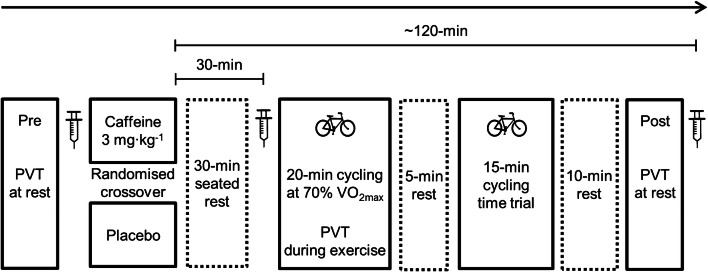
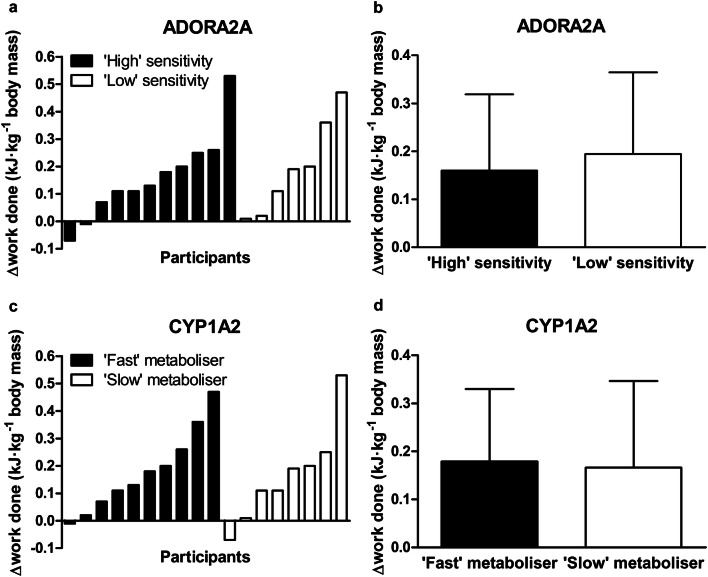
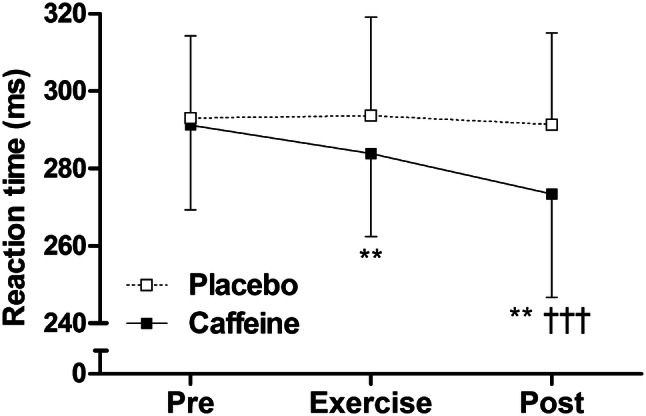
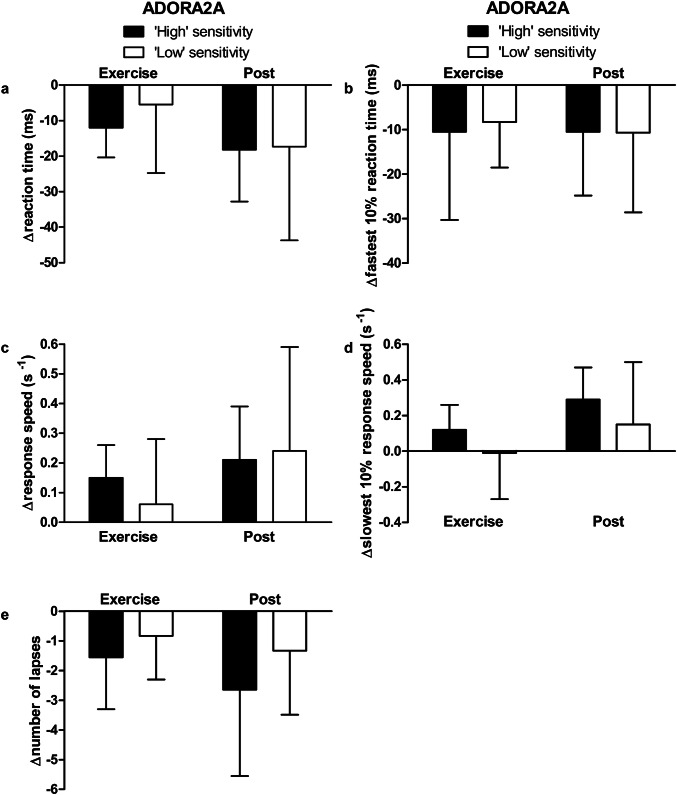
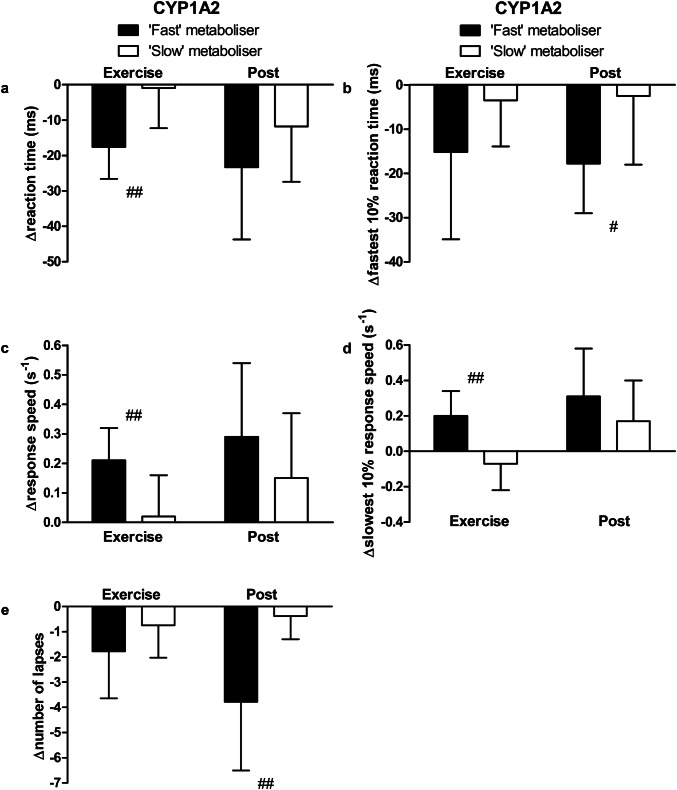
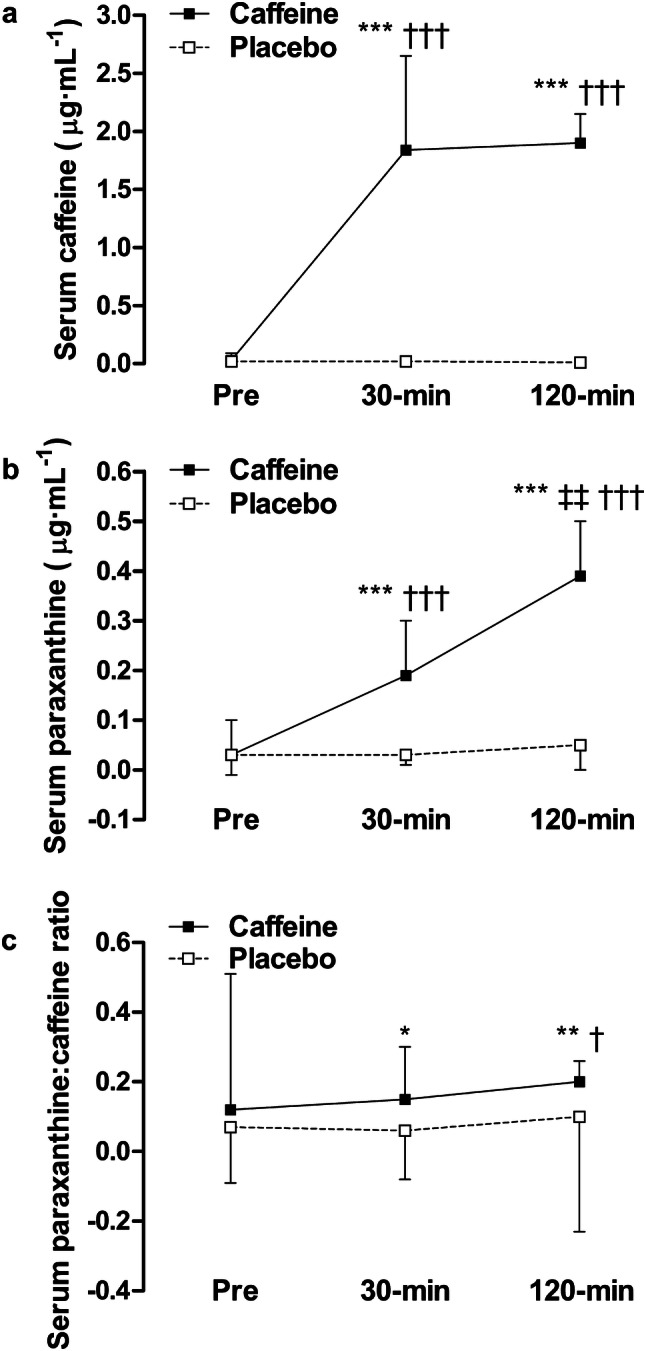
Purpose: To determine the influence of two commonly occurring genetic polymorphisms on exercise, cognitive performance, and caffeine metabolism, after caffeine ingestion. Methods: Eighteen adults received caffeine or placebo (3 mg kg−1) in a randomised crossover study, with measures of endurance exercise (15-min cycling time trial; 70-min post-supplementation) and cognitive performance (psychomotor vigilance test; PVT; pre, 50 and 95-min post-supplementation). Serum caffeine and paraxanthine were measured (pre, 30 and 120-min post-supplementation), and polymorphisms in ADORA2A (rs5751876) and CYP1A2 (rs762551) genes analysed. Results: Caffeine enhanced exercise performance (P < 0.001), but effects were not different between participants with ADORA2A ‘high’ (n = 11) vs. ‘low’ (n = 7) sensitivity genotype (+ 6.4 ± 5.8 vs. + 8.2 ± 6.8%), or CYP1A2 ‘fast’ (n = 10) vs. ‘slow’ (n = 8) metabolism genotype (+ 7.2 ± 5.9 vs. + 7.0 ± 6.7%, P > 0.05). Caffeine enhanced PVT performance (P < 0.01). The effect of caffeine was greater for CYP1A2 ‘fast’ vs. ‘slow’ metabolisers for reaction time during exercise (− 18 ± 9 vs. − 1.0 ± 11 ms); fastest 10% reaction time at rest (− 18 ± 11 vs. − 3 ± 15 ms) and lapses at rest (− 3.8 ± 2.7 vs. + 0.4 ± 0.9) (P < 0.05). There were no PVT differences between ADORA2A genotypes (P > 0.05). Serum caffeine and paraxanthine responses were not different between genotypes (P > 0.05). Conclusion: Caffeine enhanced CYP1A2 ‘fast’ metabolisers’ cognitive performance more than ‘slow’ metabolisers. No other between-genotype differences emerged for the effect of caffeine on exercise or cognitive performance, or metabolism.
Overview
The claims and statistics of this paper haven’t been checked yet.
Free: it reads the open-access text and checks the first 5 claims that cite a source we can check. Create a free account to check every claim.
Integrity signals
Registry
Cites
Statistics
Figures
Verification
Claims the paper makes
The claims and statistics of this paper haven’t been checked yet.
Free: it reads the open-access text and checks the first 5 claims that cite a source we can check. Create a free account to check every claim.
Claims other papers make about this one
Each is checked against this paper’s own text: does it say what the citing paper says it does?
The cited source says what the claim attributes to it.
In the citing paper
“Subsequently, 1 study showed that caffeine improved sustained attention performance in A-allele homozygotes compared to C-allele carriers, but no effect of genotype on the paraxanthine-to-caffeine ratio was observed.88”
Self-check
Percentages, sums and reported differences re-computed from the paper’s own numbers.
The self-check needs the paper’s full text.
Citations
Cites
Statistical Power Analysis for the Behavioral Sciences
Muller, K. (1989) · Technometrics · doi:10.1080/00401706.1989.10488618 · Cited by 99,167
Statistical power analysis for the behavioral sciences
(1990) · Computers, Environment and Urban Systems · doi:10.1016/0198-9715(90)90050-4 · Cited by 65,269
Sleep Deprivation and Vigilant Attention
Lim, J., & Dinges, D. F. (2008) · Annals of the New York Academy of Sciences · doi:10.1196/annals.1417.002 · Cited by 1,213
IOC Consensus Statement: Dietary Supplements and the High-performance Athlete
Maughan, R. J., Burke, L. M., Dvorak, J., Larson-Meyer, D. E., Peeling, P., Phillips, S. M., Rawson, E. S., Walsh, N. P., Garthe, I., Geyer, H., et al. (2018) · British Journal of Sports Medicine · doi:10.1136/bjsports-2018-099027 · Cited by 1,004
A Review of Caffeine’s Effects on Cognitive, Physical and Occupational Performance
McLellan, T. M., Caldwell, J. A., & Lieberman, H. R. (2016) · Neuroscience & Biobehavioral Reviews · doi:10.1016/j.neubiorev.2016.09.001 · Cited by 840
Caffeine and Exercise: Metabolism, Endurance and Performance
Graham, T. E. (2001) · Sports Medicine · doi:10.2165/00007256-200131110-00002 · Cited by 819 · cited 2×
“Importantly, caffeine concentrations measured up to an hour after ingestion may be more reflective of caffeine absorption than metabolism (Graham 2001).”
BackgroundSachse, C., Brockmöller, J., Bauer, S., & Roots, I. (1999) · British Journal of Clinical Pharmacology · doi:10.1046/j.1365-2125.1999.00898.x · Cited by 751
Interindividual Differences in Caffeine Metabolism and Factors Driving Caffeine Consumption
Nehlig, A. (2018) · Pharmacological Reviews · doi:10.1124/pr.117.014407 · Cited by 632 · cited 3×
“…single-nucleotide polymorphism (SNP) in the ADORA2A gene which encodes for the adenosine A2A receptor has been used to categorise individuals as having a ‘high’ (TT genotype) or ‘low’ (CT or CC genotype) sensitivity to caffeine, and may account, in part, for some of this variability (Nehlig 2018).”
MethodResultInfluentialCoffee, CYP1A2 genotype, and risk of myocardial infarction
Cornelis, M. C., El-Sohemy, A., Kabagambe, E. K., & Campos, H. (2006) · JAMA · doi:10.1001/jama.295.10.1135 · Cited by 490
Caffeine and sports performance
Burke, L. M. (2008) · Applied Physiology Nutrition and Metabolism · doi:10.1139/h08-130 · Cited by 442 · cited 3×
“The efficacy of caffeine supplementation is affected by the dose, method and timing of ingestion, training status, and the performance measures examined (Burke 2008; McLellan et al.”
BackgroundMethodInfluential
Cited by
Caffeine as a factor influencing the functioning of the human body-friend or foe?
Rodak, K., Kokot, I., & Kratz, E. M. (2021) · Nutrients · doi:10.3390/nu13093088 · Cited by 188
Caffeine and Exercise Performance: Possible Directions for Definitive Findings
Martins, G. L., Guilherme, J. P. L. F., Ferreira, L. H. B., de Souza-Junior, T. P., & Lancha, A. H. (2020) · Frontiers in Sports and Active Living · doi:10.3389/fspor.2020.574854 · Cited by 79
Gutiérrez-Hellín, J., & Varillas-Delgado, D. (2021) · Nutrients · doi:10.3390/nu13030715 · Cited by 67
Barreto, G., Grecco, B. H., Merola, P., Reis, C. E. G., Gualano, B., & Saunders, B. (2021) · European Journal of Applied Physiology · doi:10.1007/s00421-020-04571-7 · Cited by 78
Muñoz, A., López-Samanes, Á., Aguilar-Navarro, M., Varillas-Delgado, D., Rivilla-García, J., Moreno-Pérez, V., & Del Coso, J. (2020) · Genes · doi:10.3390/genes11080933 · Cited by 54
Mental Performance and Sport: Caffeine and Co-Consumed Bioactive Ingredients
Kennedy, D. O., & Wightman, E. L. (2022) · Sports Medicine · doi:10.1007/s40279-022-01796-8 · Cited by 50
“A recent single study also found that attention task performance was improved both during and after exercise following 3 mg/kg caffeine, with greater effects seen for CYP1A2 ‘fast’ metabolisers [85].”
BackgroundEffects of Acute Ashwagandha Ingestion on Cognitive Function
Xing, D., Yoo, C., Gonzalez, D. E., Jenkins, V. M., Nottingham, K., Dickerson, B. L., Leonard, M., Ko, J., Faries, M. B., Kephart, W. C., et al. (2022) · International Journal of Environmental Research and Public Health · doi:10.3390/ijerph191911852 · Cited by 64
Grgić, J., Pickering, C., Coso, J. D., Schoenfeld, B. J., & Mikulić, P. (2020) · European Journal of Nutrition · doi:10.1007/s00394-020-02427-6 · Cited by 52
Kapellou, A., King, A., Graham, C., Pilić, L., & Mavrommatis, Y. (2023) · Nutrition Reviews · doi:10.1093/nutrit/nuad029 · Cited by 46
Ozan, M., Buzdağlı, Y., Eyipınar, C. D., Baygutalp, N. K., Yüce, N., Öget, F., Kan, E., & Baygutalp, F. (2022) · Nutrients · doi:10.3390/nu14204399 · Cited by 36
Caffeine, CYP1A2 Genotype, and Exercise Performance: A Systematic Review and Meta-Analysis
BARRETO, G., ESTEVES, G. P., MARTICORENA, F., OLIVEIRA, T. N., GRGIC, J., & SAUNDERS, B. (2024) · Medicine & Science in Sports & Exercise · doi:10.1249/mss.0000000000003313 · Cited by 27
Yoo, C., Xing, D., Gonzalez, D. E., Jenkins, V. M., Nottingham, K., Dickerson, B. L., Leonard, M., Ko, J., Faries, M. B., Kephart, W. C., et al. (2021) · Nutrients · doi:10.3390/nu13113980 · Cited by 30
Główka, N., Malik, J., Podgórski, T., Stemplewski, R., Maciaszek, J., Ciążyńska, J., Zawieja, E. E., Chmurzyńska, A., Nowaczyk, P. M., & Durkalec‐Michalski, K. (2024) · Journal of the International Society of Sports Nutrition · doi:10.1080/15502783.2023.2301384 · Cited by 36
Caffeine Timing Improves Lower-Body Muscular Performance: A Randomized Trial
Harty, P. S., Zabriskie, H. A., Stecker, R. A., Currier, B. S., Tinsley, G. M., Surowiec, K., Jagim, A. R., Richmond, S. R., & Kerksick, C. M. (2020) · Frontiers in Nutrition · doi:10.3389/fnut.2020.585900 · Cited by 33
Caffeine, exercise physiology, and time-trial performance: no effect of ADORA2A or CYP1A2 genotypes
Glaister, M., Chopra, K., Pereira De Sena, A. L., Sternbach, C., Morina, L., & Mavrommatis, Y. (2021) · Applied Physiology, Nutrition, and Metabolism · doi:10.1139/apnm-2020-0551 · Cited by 23
Silva, H., Del Coso, J., & Pickering, C. (2025) · Sports Medicine · doi:10.1007/s40279-025-02245-y · Cited by 21
“Specifically, the ADORA2A gene has been used to categorize individuals as “high” (TT genotype) or “low” (CC/CT genotype or C-allele carriers) responders to caffeine [116].”
Wang, J., Dewi, L., Peng, Y., Hou, C., Song, Y., & Condello, G. (2023) · Journal of sport and health science/Journal of Sport and Health Science · doi:10.1016/j.jshs.2023.12.005 · Cited by 31
The Effects of Caffeine on Blood Platelets and the Cardiovascular System through Adenosine Receptors
Marcinek, K., Luzak, B., & Różalski, M. (2024) · International Journal of Molecular Sciences · doi:10.3390/ijms25168905 · Cited by 28
Erblang, M., Sauvet, F., Drogou, C., Quiquempoix, M., Beers, P. V., Guillard, M., Rabat, A., Trignol, A., Bourrilhon, C., Erkel, M.-C., et al. (2021) · Genes · doi:10.3390/genes12040555 · Cited by 21
Bedrač, L., Deutsch, L., Terzić, S., Červek, M., Šelb, J., Ašič, U., Verstraeten, L. M. G., Kuščer, E., & Cvetko, F. (2024) · Nutrients · doi:10.3390/nu16223943 · Cited by 23
Payne, E. R., Aceves-Martins, M., Dubost, J., Greyling, A., & de Roos, B. (2025) · Nutrition Reviews · doi:10.1093/nutrit/nuaf054 · Cited by 19
“88 The current review revealed that the difference between the effects of theanine plus caffeine, and placebo, on alertness was not as conclusive as has been suggested before.”
Pinto, M. P., Spineli, H., dos Santos, B. P., Lima‐Silva, A. E., Gitaí, D. L. G., Bishop, D. J., & de Araújo, G. G. (2022) · European Journal of Nutrition · doi:10.1007/s00394-022-03045-0 · Cited by 18
Hemmat, M., Nazemzadegan, G., Niknam, A., Daryanoosh, F., & Jahromi, M. K. (2025) · Journal of the International Society of Sports Nutrition · doi:10.1080/15502783.2025.2541010 · Cited by 13
Saunders, B., da Costa, L. R., de Souza, R. A. S., Barreto, G., & Marticorena, F. M. (2023) · Advances in food and nutrition research · doi:10.1016/bs.afnr.2023.03.002 · Cited by 15
Stazi, M., Zampar, S., Nadolny, M., Büschgens, L., Meyer, T., & Wirths, O. (2022) · European Archives of Psychiatry and Clinical Neuroscience · doi:10.1007/s00406-022-01431-7 · Cited by 9
Effects of Different Sources of Low-Dose Caffeine on Mood/Arousal and Cognitive Performance
Irwin, C. G., McCartney, D., Grant, G. D., Delang, N., Bartrim, K., Cox, G. R., & Desbrow, B. (2022) · Perceptual and Motor Skills · doi:10.1177/00315125221124369 · Cited by 13
Kazan, H. H., Bulğay, C., Zorba, E., Dalıp, M., Ceylan, H. İ., Semenova, E. A., Larin, A. K., Kulemin, N. A., Generozov, E. V., Ahmetov, I. I., et al. (2024) · Molecular Biology Reports · doi:10.1007/s11033-024-09800-2 · Cited by 9
Influence of acute and chronic therapeutic cooling on cognitive performance and well-being
Knill-Jones, J., Shadwell, G., Hurst, H. T., Mawhinney, C., SINCLAIR, J. K., & Allan, R. (2024) · Physiology & Behavior · doi:10.1016/j.physbeh.2024.114728 · Cited by 8
Rahimi, R., Semenova, E. A., John, G., Fallah, F., Larin, A. K., Generozov, E. V., & Ahmetov, I. I. (2024) · Nutrients · doi:10.3390/nu16121803 · Cited by 10
Whitfield, J., Egan, B., Coso, J. D., Derave, W., Saunders, B., & Burke, L. M. (2025) · International Journal of Sport Nutrition and Exercise Metabolism · doi:10.1123/ijsnem.2025-0111 · Cited by 12
Habitual caffeine intake, genetics and cognitive performance
Kapellou, A., Pilić, L., & Mavrommatis, Y. (2024) · Journal of Psychopharmacology · doi:10.1177/02698811241303601 · Cited by 7
Montalvo‐Alonso, J. J., del Val‐Manzano, M., Martín‐Rivas, I., Ferragut, C., Valadés, D., & Pérez‐López, A. (2026) · Scandinavian Journal of Medicine & Science in Sports · doi:10.1111/sms.70214 · Cited by 5
Pharmacological Strategies to Improve Mental Performance
Cutsem, J. V., & Pattyn, N. (2024) · Routledge eBooks · doi:10.4324/9781003378969-8 · Cited by 4
Aji, Y. G., Melita, S., Dijaya, R., Subali, D., Kartawidjajaputra, F., & Suwanto, A. (2023) · Reports of Biochemistry and Molecular Biology · doi:10.52547/rbmb.11.4.663 · Cited by 6
Zawieja, E. E., Chmurzyńska, A., Anioła, J., Zawieja, B. E., & Cholewa, J. M. (2023) · Nutraceuticals · doi:10.3390/nutraceuticals3020022 · Cited by 4
Genetic Influence in Exercise Performance
Coso, J. D., & Lucía, A. (2021) · Genes · doi:10.3390/genes12050651 · Cited by 8
The Fundamentals of Second-Language Teaching.
LeBlanc, J.-M. (1997) · Cited by 4
Moreno, A. M. (2020) · UPM Digital Archive (Technical University of Madrid) · doi:10.20868/upm.thesis.65780 · Cited by 5
Guthrie, O. W., & Li, Y. (2023) · Human Psychopharmacology Clinical and Experimental · doi:10.1002/hup.2885 · Cited by 3
Messenburger, G. P., Nuñez, F. F., Porepp, O. D. S. C., Collares, L. F., Delpino, F. M., Barros, C. C., & Pieniz, S. (2025) · Nutrition Research · doi:10.1016/j.nutres.2025.10.005 · Cited by 6
Kocatürk, R. R., Karagöz, İ., YANIK, E., Özcan, Ö. Ö., Erguzel, T. T., Karahan, M., & Tarhan, N. (2022) · Baltic Journal of Health and Physical Activity · doi:10.29359/bjhpa.14.3.08 · Cited by 7
Davison, G., Carswell, A. T., Baron, P., & Martinez‐Gonzalez, B. (2025) · Physiological Reports · doi:10.14814/phy2.70673 · Cited by 3
Self-citationde Assis, R. L., de Assis, C. S., Diniz, T. G., de Sousa, B. R. V., Minervino, C. A. D. S. M., de Paiva, M. L., Martins, V. J. B., Gomes, E. R. D. M., da Silva, M. F. R., do Nascimento, Y. M., et al. (2024) · Journal of Functional Foods · doi:10.1016/j.jff.2024.106101 · Cited by 2
Whole Genome Interpretation for a Family of Five
Corpas, M., Mégy, K., Mistry, V., Metastasio, A., & Lehmann, E. (2021) · Frontiers in Genetics · doi:10.3389/fgene.2021.535123 · Cited by 2
Dündar, S. T. (2022) · Akdeniz Spor Bilimleri Dergisi · doi:10.38021/asbid.1199261 · Cited by 1
Domaszewski, P., Konieczny, M., Pakosz, P., Poliwoda, A., & Skorupska, E. (2025) · Health Problems of Civilization · doi:10.5114/hpc.2025.152431 · Cited by 3
Inter-individual Differences in Response to Caffeine
Baron, N., & Osadnik, T. (2025) · Springer eBooks · doi:10.1007/978-3-031-93459-9_34 · Cited by 2
Stable interindividual differences in modafinil’s effect on vigilance during sleep deprivation
Cutsem, J. V., Puyvelde, M. V., van den Berg, N., Dessy, E., Detaille, F., Rompay, A. V., Maîresse, O., Drogou, C., Sauvet, F., Neyt, X., et al. (2025) · Frontiers in Pharmacology · doi:10.3389/fphar.2025.1607444 · Cited by 2
Efeitos cardiovasculares da ingestão de cafeína durante o exercício físico: Uma revisão sistemática
Paraguassu, L. T. V., Junior, A. M. A. F., Rodrigues, W. C. C., Junior, C. C. P. P., & da Silva, L. M. C. (2026) · Research Society and Development · doi:10.33448/rsd-v15i1.50547 · Cited by 1
Drogou, C., Sauvet, F., Erblang, M., Léger, D., Thomas, C., Chennaoui, M., Gomez-Mérino, D., & Investigators group (2023) · Lifestyle Genomics · doi:10.1159/000529897 · Cited by 1
Varillas‐Delgado, D., Coso, J. D., Muñoz, A., Aguilar‐Navarro, M., & Gutiérrez‐Hellín, J. (2024) · European Journal of Nutrition · doi:10.1007/s00394-024-03454-3 · Cited by 1
The Neural Correlates of Expectations Effects
Wicht, C. A. (2022) · doi:10.51363/unifr.sth.2022.003
Giorgio, R. D. (2023) · Infarma - Ciências Farmacêuticas · doi:10.14450/2318-9312.v35.e2.a2023.pp133-147 · Cited by 1
Cutting–edge innovations in caffeine research: Enhancing sports performance
Tedeschi, R. (2025) · Indian Journal of Physiology and Pharmacology · doi:10.25259/ijpp_492_2024
Djordjevic, N. (2025) · Royal Society of Chemistry eBooks · doi:10.1039/9781839166853-00341
Zeng, Z., Ye, X., He, H., & Li, L. (2025) · Journal of Applied Gerontology · doi:10.1177/07334648251395359
Chudasama, M. H., Khan, A., & Pradhan, R. C. (2026) · Current Food Science and Technology Reports · doi:10.1007/s43555-026-00080-4
Influence de polymorphismes génétiques sur le sommeil et l'efficacité de la caféine
Erblang, M. (2020) · theses.fr (ABES) · doi:10.70675/10d39c5czed91z47dez802cz926b956f3874 · Cited by 1
Amjad, G., Saif, R., & Hussain, M. G. (2026) · Futuristic Biotechnology · doi:10.54393/fbt.v6i1.225 · Cited by 2
Karayiğit, R., Mitat, K. O. Z., Goodall, S., & Esen, Ö. (2026) · Research Square · doi:10.21203/rs.3.rs-9178733/v1
Baron, P. (2023) · theses.fr (ABES) · doi:10.70675/d24294fdz30a1z42eezae8ez00ac4cfb8be8
Self-citation
Metadata
- Authors
- Carswell, A. T., Howland, K., Martinez-Gonzalez, B., Baron, P., & Davison, G.
- Affiliations
- University of Kent (GB)
- Corresponding author
- Davison, Glen
- Venue
- European Journal of Applied Physiology
- Published
- 2020-04-30
- Volume
- 120
- Issue
- 7
- Pages
- 1495-1508
- ISSN
- 0020-9376 (ISSN-L)
- 1439-6319
- 1439-6327
- PMC
- PMC7295849
- OpenAlex
- W3021620141
- Cited by
- 61
- References
- 36
- Citations by year
- 2026: 5 · 2025: 12 · 2024: 10 · 2023: 10 · 2022: 9 · 2021: 7 · 2020: 7
- FWCI
- 4.95
- Type
- journal article
- Language
- en
- Open access
- hybrid
- doi.org
- Licence
- cc-by
- creativecommons.org/licenses/by/4.0 (tdm)
- creativecommons.org/licenses/by/4.0 (vor)
- Locations
- European Journal of Applied Physiology (publishedVersion, cc-by)
- PubMed Central (publishedVersion, cc-by)
- PubMed (publishedVersion)
- Kent Academic Repository (University of Kent) (acceptedVersion)
- UEA Digital Repository (University of East Anglia) (acceptedVersion)
- Archivio istituzionale della ricerca (Alma Mater Studiorum Università di Bologna) (submittedVersion)
- Topics
- Health Sciences › Medicine › Pharmacology (medical) › Coffee research and impacts
- Life Sciences › Biochemistry, Genetics and Molecular Biology › Genetics › Genetics and Physical Performance
- Life Sciences › Pharmacology, Toxicology and Pharmaceutics › Pharmacology › Pharmacogenetics and Drug Metabolism
- Keywords
- caffeine, CYP1A2, adenosine A2A receptor, genetic polymorphism, caffeine metabolism, exercise performance, cognitive performance, psychomotor vigilance, paraxanthine, endurance cycling, caffeine sensitivity, healthy adults
- MeSH terms
- Adult, Caffeine, Female, Genotype, Humans, Male, Exercise, Cytochrome P-450 CYP1A2, Receptor, Adenosine A2A, Young Adult, Performance-Enhancing Substances
About these checks
Registry, retraction, Cites and statistics results are computed, not judged, with one exception: a printed reference that no index lists is read once by a model before it counts as a citation error. Claims are extracted by a model and kept only when their quote appears verbatim in the text; each cited source is then checked, with a model’s help, for whether it says what the claim relies on. Those verdicts can be wrong — read the claim’s quote and the cited source before relying on one.
Statistics and arithmetic are recomputed, not judged.
Confidence bands are shown only for fields calibrated on our annotated test set. None is calibrated yet, so no band is shown.
What counts as a claim ›How we measure confidence ›How we check this ›
Are you an author, or do you see a problem with this page? Request a review
Data sources
Bibliographic data: Semantic Scholar, OpenAlex, Crossref.
Contains information from the Semantic Scholar Academic Graph Datasets, made available under the ODC Attribution License (ODC-BY 1.0).
Semantic Scholar’s data is described in: Kinney, R., et al. (2023). The Semantic Scholar Open Data Platform. arXiv:2301.10140.
