

The effect of caffeine on cognitive performance is influenced by CYP1A2 but not ADORA2A genotype, yet neither genotype affects exercise performance in healthy adults
Open accessThe DOI matches its Crossref record; 36 of the 36 references it cites were found in a registry or an index.
Abstract
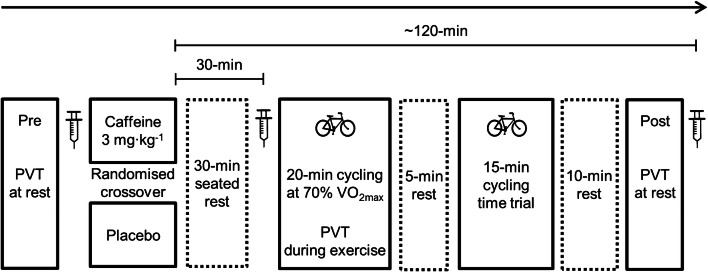
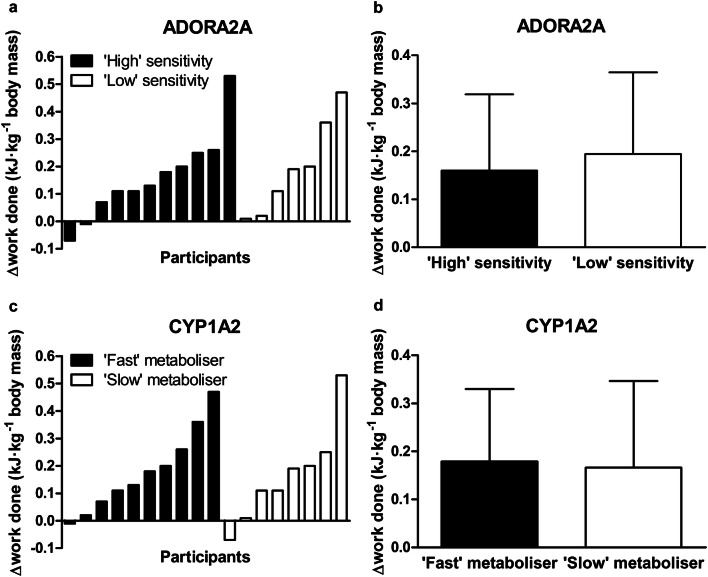
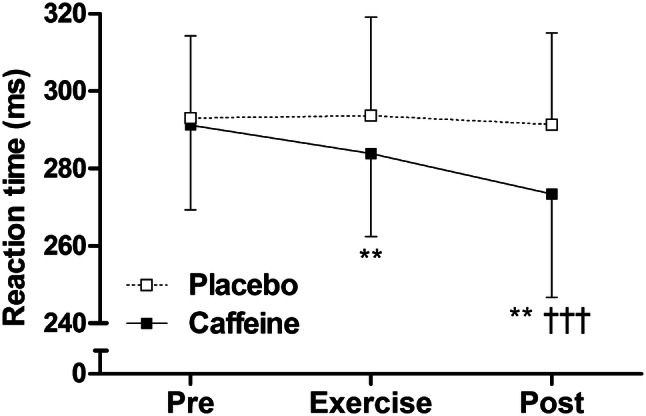
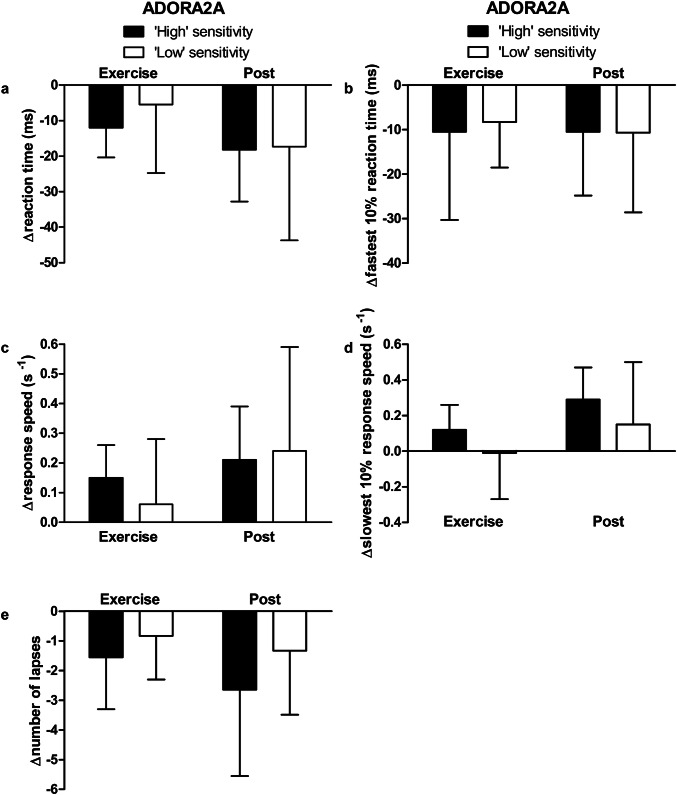
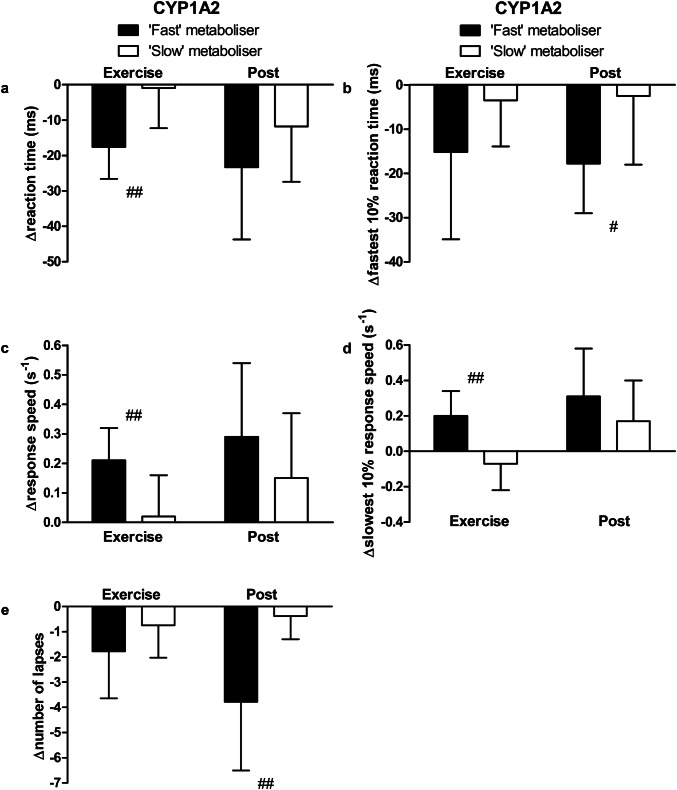
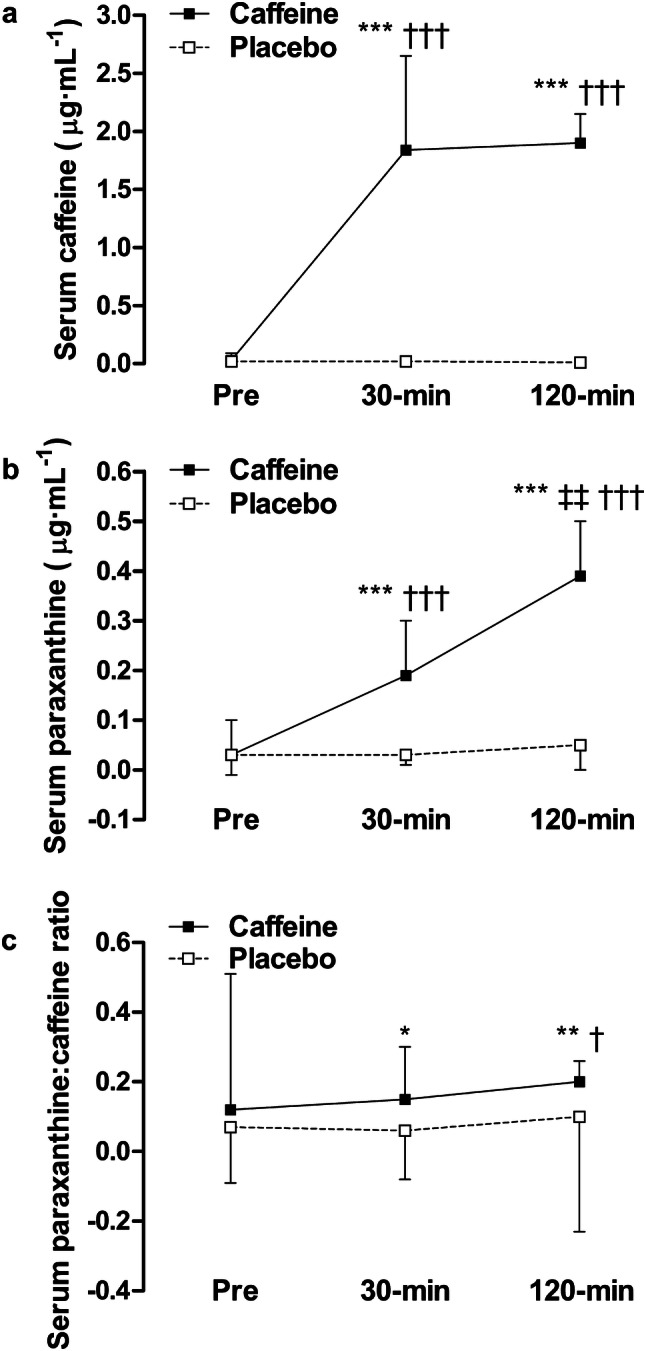
Purpose: To determine the influence of two commonly occurring genetic polymorphisms on exercise, cognitive performance, and caffeine metabolism, after caffeine ingestion. Methods: Eighteen adults received caffeine or placebo (3 mg kg−1) in a randomised crossover study, with measures of endurance exercise (15-min cycling time trial; 70-min post-supplementation) and cognitive performance (psychomotor vigilance test; PVT; pre, 50 and 95-min post-supplementation). Serum caffeine and paraxanthine were measured (pre, 30 and 120-min post-supplementation), and polymorphisms in ADORA2A (rs5751876) and CYP1A2 (rs762551) genes analysed. Results: Caffeine enhanced exercise performance (P < 0.001), but effects were not different between participants with ADORA2A ‘high’ (n = 11) vs. ‘low’ (n = 7) sensitivity genotype (+ 6.4 ± 5.8 vs. + 8.2 ± 6.8%), or CYP1A2 ‘fast’ (n = 10) vs. ‘slow’ (n = 8) metabolism genotype (+ 7.2 ± 5.9 vs. + 7.0 ± 6.7%, P > 0.05). Caffeine enhanced PVT performance (P < 0.01). The effect of caffeine was greater for CYP1A2 ‘fast’ vs. ‘slow’ metabolisers for reaction time during exercise (− 18 ± 9 vs. − 1.0 ± 11 ms); fastest 10% reaction time at rest (− 18 ± 11 vs. − 3 ± 15 ms) and lapses at rest (− 3.8 ± 2.7 vs. + 0.4 ± 0.9) (P < 0.05). There were no PVT differences between ADORA2A genotypes (P > 0.05). Serum caffeine and paraxanthine responses were not different between genotypes (P > 0.05). Conclusion: Caffeine enhanced CYP1A2 ‘fast’ metabolisers’ cognitive performance more than ‘slow’ metabolisers. No other between-genotype differences emerged for the effect of caffeine on exercise or cognitive performance, or metabolism.
Overview
The claims and statistics of this paper haven’t been checked yet.
Free: it reads the open-access text and checks the first 5 claims that cite a source we can check. Create a free account to check every claim.
Integrity signals
Registry
Cites
Statistics
Figures
Verification
Claims the paper makes
The claims and statistics of this paper haven’t been checked yet.
Free: it reads the open-access text and checks the first 5 claims that cite a source we can check. Create a free account to check every claim.
Claims other papers make about this one
Each is checked against this paper’s own text: does it say what the citing paper says it does?
The cited source says what the claim attributes to it.
In the citing paper
“Subsequently, 1 study showed that caffeine improved sustained attention performance in A-allele homozygotes compared to C-allele carriers, but no effect of genotype on the paraxanthine-to-caffeine ratio was observed.88”
Self-check
Percentages, sums and reported differences re-computed from the paper’s own numbers.
The self-check needs the paper’s full text.
Citations
Cites
Statistical Power Analysis for the Behavioral Sciences
Muller, K. (1989) · Technometrics · doi:10.1080/00401706.1989.10488618 · Cited by 99,167
Statistical power analysis for the behavioral sciences
(1990) · Computers, Environment and Urban Systems · doi:10.1016/0198-9715(90)90050-4 · Cited by 65,269
Sleep Deprivation and Vigilant Attention
Lim, J., & Dinges, D. F. (2008) · Annals of the New York Academy of Sciences · doi:10.1196/annals.1417.002 · Cited by 1,213
IOC Consensus Statement: Dietary Supplements and the High-performance Athlete
Maughan, R. J., Burke, L. M., Dvorak, J., Larson-Meyer, D. E., Peeling, P., Phillips, S. M., Rawson, E. S., Walsh, N. P., Garthe, I., Geyer, H., et al. (2018) · British Journal of Sports Medicine · doi:10.1136/bjsports-2018-099027 · Cited by 1,004
A Review of Caffeine’s Effects on Cognitive, Physical and Occupational Performance
McLellan, T. M., Caldwell, J. A., & Lieberman, H. R. (2016) · Neuroscience & Biobehavioral Reviews · doi:10.1016/j.neubiorev.2016.09.001 · Cited by 840
Caffeine and Exercise: Metabolism, Endurance and Performance
Graham, T. E. (2001) · Sports Medicine · doi:10.2165/00007256-200131110-00002 · Cited by 819 · cited 2×
“Importantly, caffeine concentrations measured up to an hour after ingestion may be more reflective of caffeine absorption than metabolism (Graham 2001).”
BackgroundSachse, C., Brockmöller, J., Bauer, S., & Roots, I. (1999) · British Journal of Clinical Pharmacology · doi:10.1046/j.1365-2125.1999.00898.x · Cited by 751
Interindividual Differences in Caffeine Metabolism and Factors Driving Caffeine Consumption
Nehlig, A. (2018) · Pharmacological Reviews · doi:10.1124/pr.117.014407 · Cited by 632 · cited 3×
“…single-nucleotide polymorphism (SNP) in the ADORA2A gene which encodes for the adenosine A2A receptor has been used to categorise individuals as having a ‘high’ (TT genotype) or ‘low’ (CT or CC genotype) sensitivity to caffeine, and may account, in part, for some of this variability (Nehlig 2018).”
MethodResultInfluentialCoffee, CYP1A2 genotype, and risk of myocardial infarction
Cornelis, M. C., El-Sohemy, A., Kabagambe, E. K., & Campos, H. (2006) · JAMA · doi:10.1001/jama.295.10.1135 · Cited by 490
Caffeine and sports performance
Burke, L. M. (2008) · Applied Physiology Nutrition and Metabolism · doi:10.1139/h08-130 · Cited by 442 · cited 3×
“The efficacy of caffeine supplementation is affected by the dose, method and timing of ingestion, training status, and the performance measures examined (Burke 2008; McLellan et al.”
BackgroundMethodInfluentialEffects of caffeine intake on muscle strength and power: a systematic review and meta-analysis
Grgic, J., Trexler, E. T., Lazinica, B., & Pedisic, Z. (2018) · Journal of the International Society of Sports Nutrition · doi:10.1186/s12970-018-0216-0 · Cited by 362
Effect of Caffeine on Sport-Specific Endurance Performance: A Systematic Review
Ganio, M. S., Klau, J. F., Casa, D. J., Armstrong, L. E., & Maresh, C. M. (2009) · Journal of Strength and Conditioning Research · doi:10.1519/jsc.0b013e31818b979a · Cited by 310
Exercise endurance 1, 3, and 6 h after caffeine ingestion in caffeine users and nonusers
Bell, D. G., & McLellan, T. M. (2002) · Journal of Applied Physiology · doi:10.1152/japplphysiol.00187.2002 · Cited by 288
Rétey, J. V., Adam, M., Khatami, R., Luhmann, U. F. O., Jung, H. H., Berger, W., & Landolt, H.-P. (2007) · Clinical Pharmacology & Therapeutics · doi:10.1038/sj.clpt.6100102 · Cited by 278
Carbohydrate-Electrolyte Feedings Improve 1 h Time Trial Cycling Performance
Jeukendrup, A., Brouns, F., Wagenmakers, A., & Saris, W. (1997) · International Journal of Sports Medicine · doi:10.1055/s-2007-972607 · Cited by 271
Southward, K., Rutherfurd-Markwick, K. J., & Ali, A. (2018) · Sports Medicine · doi:10.1007/s40279-018-0939-8 · Cited by 254
Caffeine, CYP1A2 Genotype, and Endurance Performance in Athletes
GUEST, N., COREY, P., VESCOVI, J., & EL-SOHEMY, A. (2018) · Medicine & Science in Sports & Exercise · doi:10.1249/mss.0000000000001596 · Cited by 231
CYP1A2 genotype modifies the association between coffee intake and the risk of hypertension
Palatini, P., Ceolotto, G., Ragazzo, F., Dorigatti, F., Saladini, F., Papparella, I., Mos, L., Zanata, G., & Santonastaso, M. (2009) · Journal of Hypertension · doi:10.1097/hjh.0b013e32832ba850 · Cited by 230
Genetic polymorphism of the adenosine A2A receptor is associated with habitual caffeine consumption
Cornelis, M. C., El-Sohemy, A., & Campos, H. (2007) · The American Journal of Clinical Nutrition · doi:10.1093/ajcn/86.1.240 · Cited by 230
Pickering, C., & Kiely, J. (2018) · Sports Medicine · doi:10.1007/s40279-017-0776-1 · Cited by 209
The influence of a CYP1A2 polymorphism on the ergogenic effects of caffeine
Womack, C. J., Saunders, M. J., Bechtel, M. K., Bolton, D. J., Martin, M., Luden, N. D., Dunham, W., & Hancock, M. (2012) · Journal of the International Society of Sports Nutrition · doi:10.1186/1550-2783-9-7 · Cited by 178
Ergogenic Effects of Low Doses of Caffeine on Cycling Performance
Jenkins, N. T., Trilk, J. L., Singhal, A., O’Connor, P. J., & Cureton, K. J. (2008) · International Journal of Sport Nutrition and Exercise Metabolism · doi:10.1123/ijsnem.18.3.328 · Cited by 155
The influence of caffeine supplementation on resistance exercise: a review
Grgic, J., Mikulic, P., Schoenfeld, B. J., Bishop, D. J., & Pedisic, Z. (2019) · Sports Medicine · doi:10.1007/s40279-018-0997-y · Cited by 153
Number of Lapses during the Psychomotor Vigilance Task as an Objective Measure of Fatigue
Lee, I.-S., Bardwell, W. A., Ancoli‐Israel, S., & Dimsdale, J. E. (2010) · Journal of Clinical Sleep Medicine · doi:10.5664/jcsm.27766 · Cited by 122
Bodenmann, S., Hohoff, C., Freitag, C., Deckert, J., Rétey, J. V., Bachmann, V, & Landolt, H. (2012) · British Journal of Pharmacology · doi:10.1111/j.1476-5381.2011.01689.x · Cited by 119
Caffeine and 3‐km cycling performance: Effects of mouth rinsing, genotype, and time of day
Pataky, M. W., Womack, C. J., Saunders, M. J., Goffe, J. L., D'Lugos, A. C., El‐Sohemy, A., & Luden, N. D. (2016) · Scandinavian Journal of Medicine & Science in Sports · doi:10.1111/sms.12501 · Cited by 105
Caffeine, Exercise and the Brain
Meeusen, R., Roelands, B., & Spriet, L. L. (2013) · Nestlé Nutrition Institute Workshop Series · doi:10.1159/000350223 · Cited by 101
The action of caffeine on the capacity for muscular work
Rivers, W. H. R., & Webber, H. (1907) · The Journal of Physiology · doi:10.1113/jphysiol.1907.sp001215 · Cited by 101
Caffeine reduces myocardial blood flow during exercise
Higgins, J. P., & Babu, K. M. (2013) · The American Journal of Medicine · doi:10.1016/j.amjmed.2012.12.023 · Cited by 85
Salinero, J., Lara, B., Ruiz-Vicente, D., Areces, F., Puente-Torres, C., Gallo-Salazar, C., Pascual, T., & Del Coso, J. (2017) · Nutrients · doi:10.3390/nu9030269 · Cited by 82
Assessing caffeine intake in the United Kingdom diet
Fitt, E., Pell, D., & Cole, D. (2013) · Food Chemistry · doi:10.1016/j.foodchem.2012.07.092 · Cited by 74
Holland, D. T., Godfredsen, K. A., Page, T., & Connor, J. D. (1998) · Journal of Chromatography B Biomedical Sciences and Applications · doi:10.1016/s0378-4347(97)00590-2 · Cited by 63
Loy, B. D., O'Connor, P. J., Lindheimer, J. B., & Covert, S. F. (2015) · Journal of Caffeine Research · doi:10.1089/jcr.2014.0035 · Cited by 62
Algrain, H. A., Thomas, R. M., Carrillo, A. E., Ryan, E. J., Kim, C.-H., Lettan, R. B., & Ryan, E. J. (2016) · Journal of Caffeine Research · doi:10.1089/jcr.2015.0029 · Cited by 44
Renda, G., Committeri, G., Zimarino, M., Nicola, M. D., Tatasciore, A., Ruggieri, B., Ambrosini, E., Viola, V., Antonucci, I., Stuppia, L., et al. (2015) · European Neuropsychopharmacology · doi:10.1016/j.euroneuro.2015.03.001 · Cited by 43
Giersch, G. E. W., Boyett, J. C., Hargens, T. A., Luden, N. D., Saunders, M. J., Daley, H., Hughey, C. A., El-Sohemy, A., & Womack, C. J. (2018) · Journal of Caffeine and Adenosine Research · doi:10.1089/caff.2017.0028 · Cited by 27
Cited by
Caffeine as a factor influencing the functioning of the human body-friend or foe?
Rodak, K., Kokot, I., & Kratz, E. M. (2021) · Nutrients · doi:10.3390/nu13093088 · Cited by 188
Caffeine and Exercise Performance: Possible Directions for Definitive Findings
Martins, G. L., Guilherme, J. P. L. F., Ferreira, L. H. B., de Souza-Junior, T. P., & Lancha, A. H. (2020) · Frontiers in Sports and Active Living · doi:10.3389/fspor.2020.574854 · Cited by 79
Gutiérrez-Hellín, J., & Varillas-Delgado, D. (2021) · Nutrients · doi:10.3390/nu13030715 · Cited by 67
Barreto, G., Grecco, B. H., Merola, P., Reis, C. E. G., Gualano, B., & Saunders, B. (2021) · European Journal of Applied Physiology · doi:10.1007/s00421-020-04571-7 · Cited by 78
Muñoz, A., López-Samanes, Á., Aguilar-Navarro, M., Varillas-Delgado, D., Rivilla-García, J., Moreno-Pérez, V., & Del Coso, J. (2020) · Genes · doi:10.3390/genes11080933 · Cited by 54
Metadata
- Authors
- Carswell, A. T., Howland, K., Martinez-Gonzalez, B., Baron, P., & Davison, G.
- Affiliations
- University of Kent (GB)
- Corresponding author
- Davison, Glen
- Venue
- European Journal of Applied Physiology
- Published
- 2020-04-30
- Volume
- 120
- Issue
- 7
- Pages
- 1495-1508
- ISSN
- 0020-9376 (ISSN-L)
- 1439-6319
- 1439-6327
- PMC
- PMC7295849
- OpenAlex
- W3021620141
- Cited by
- 61
- References
- 36
- Citations by year
- 2026: 5 · 2025: 12 · 2024: 10 · 2023: 10 · 2022: 9 · 2021: 7 · 2020: 7
- FWCI
- 4.95
- Type
- journal article
- Language
- en
- Open access
- hybrid
- doi.org
- Licence
- cc-by
- creativecommons.org/licenses/by/4.0 (tdm)
- creativecommons.org/licenses/by/4.0 (vor)
- Locations
- European Journal of Applied Physiology (publishedVersion, cc-by)
- PubMed Central (publishedVersion, cc-by)
- PubMed (publishedVersion)
- Kent Academic Repository (University of Kent) (acceptedVersion)
- UEA Digital Repository (University of East Anglia) (acceptedVersion)
- Archivio istituzionale della ricerca (Alma Mater Studiorum Università di Bologna) (submittedVersion)
- Topics
- Health Sciences › Medicine › Pharmacology (medical) › Coffee research and impacts
- Life Sciences › Biochemistry, Genetics and Molecular Biology › Genetics › Genetics and Physical Performance
- Life Sciences › Pharmacology, Toxicology and Pharmaceutics › Pharmacology › Pharmacogenetics and Drug Metabolism
- Keywords
- caffeine, CYP1A2, adenosine A2A receptor, genetic polymorphism, caffeine metabolism, exercise performance, cognitive performance, psychomotor vigilance, paraxanthine, endurance cycling, caffeine sensitivity, healthy adults
- MeSH terms
- Adult, Caffeine, Female, Genotype, Humans, Male, Exercise, Cytochrome P-450 CYP1A2, Receptor, Adenosine A2A, Young Adult, Performance-Enhancing Substances
About these checks
Registry, retraction, Cites and statistics results are computed, not judged, with one exception: a printed reference that no index lists is read once by a model before it counts as a citation error. Claims are extracted by a model and kept only when their quote appears verbatim in the text; each cited source is then checked, with a model’s help, for whether it says what the claim relies on. Those verdicts can be wrong — read the claim’s quote and the cited source before relying on one.
Statistics and arithmetic are recomputed, not judged.
Confidence bands are shown only for fields calibrated on our annotated test set. None is calibrated yet, so no band is shown.
What counts as a claim ›How we measure confidence ›How we check this ›
Are you an author, or do you see a problem with this page? Request a review
Data sources
Bibliographic data: Semantic Scholar, OpenAlex, Crossref.
Contains information from the Semantic Scholar Academic Graph Datasets, made available under the ODC Attribution License (ODC-BY 1.0).
Semantic Scholar’s data is described in: Kinney, R., et al. (2023). The Semantic Scholar Open Data Platform. arXiv:2301.10140.
