

Modelling inter-individual variability in acute and adaptive responses to interval training: insights into exercise intensity normalisation
Open accessThe DOI matches its Crossref record; 58 of the 58 references it cites were found in a registry or an index.
Abstract
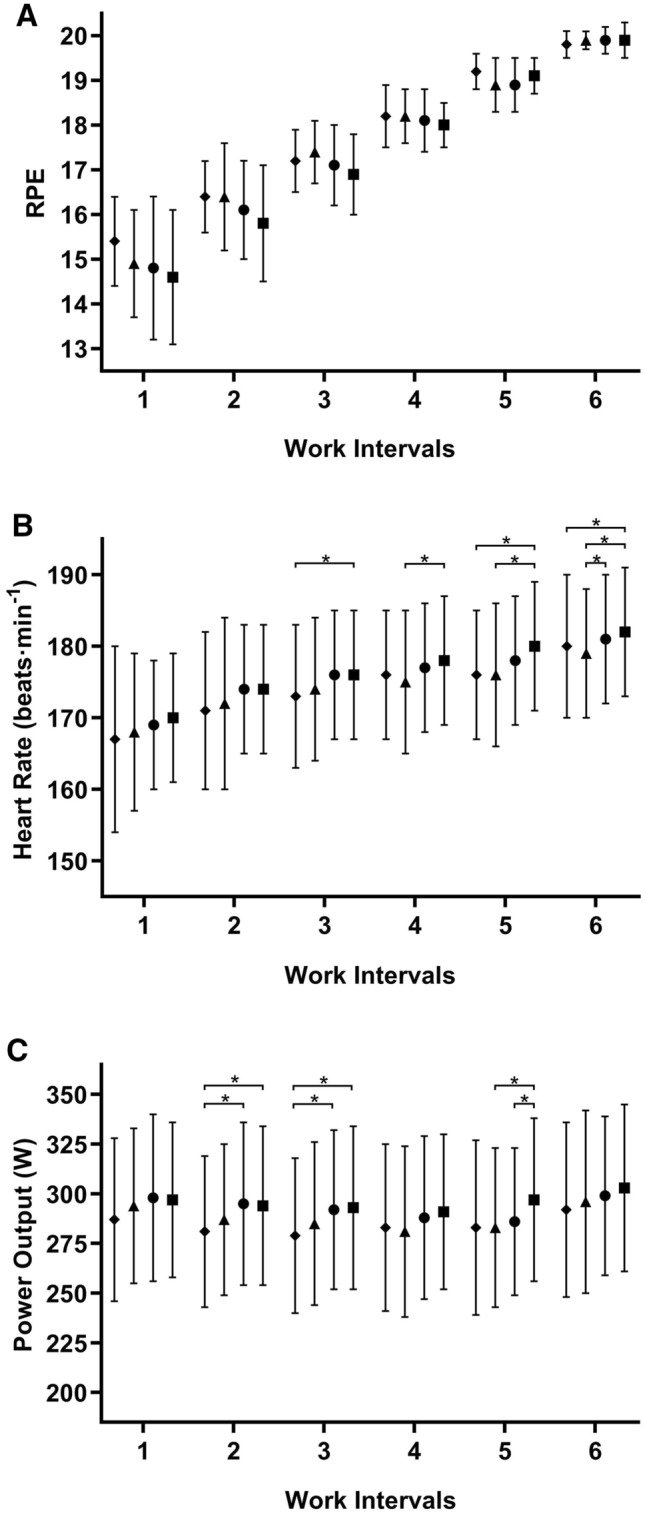
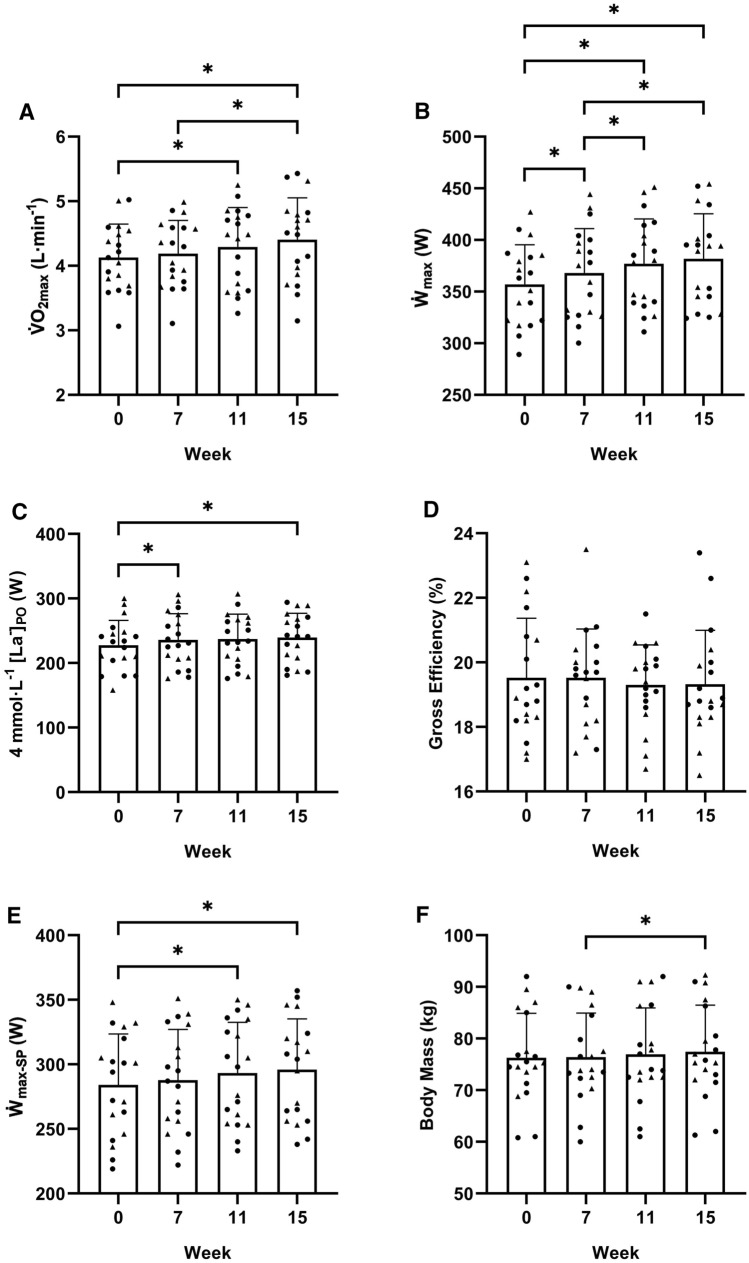
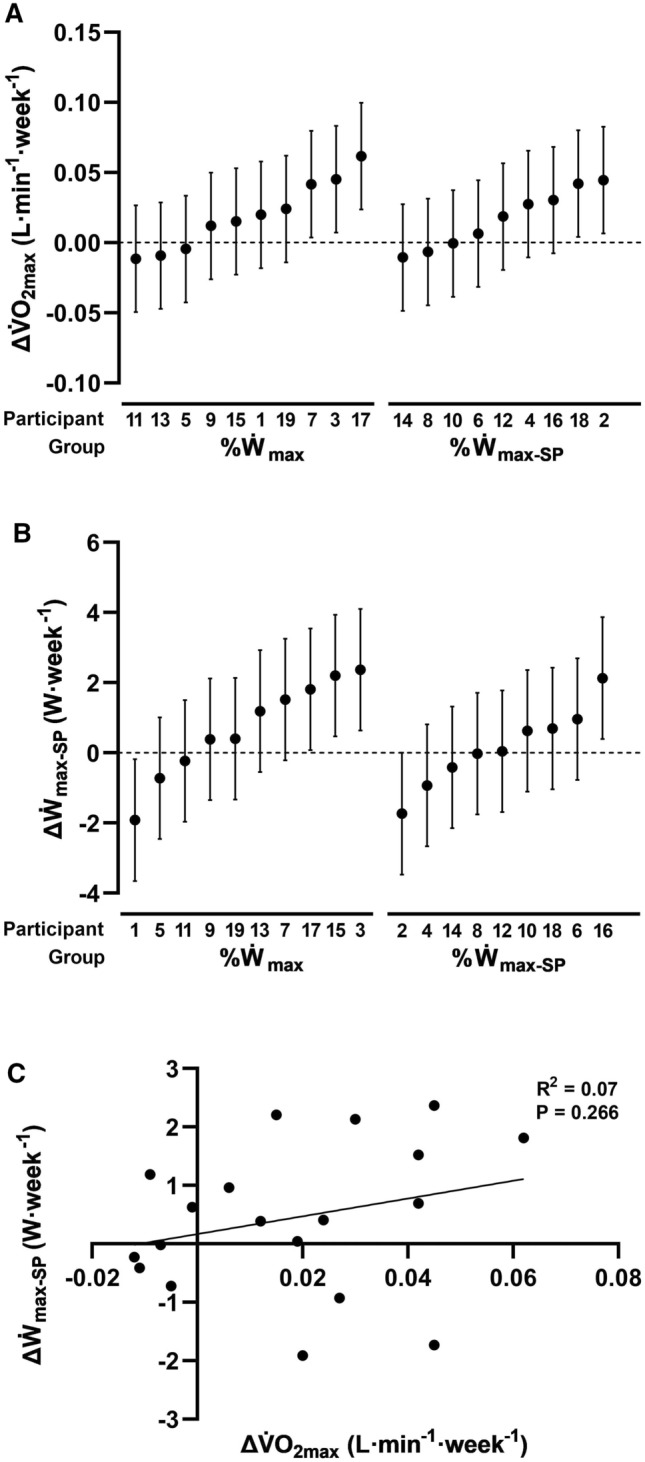
Purpose: To investigate the influence of exercise intensity normalisation on intra- and inter-individual acute and adaptive responses to an interval training programme. Methods: Nineteen cyclists were split in two groups differing (only) in how exercise intensity was normalised: 80% of the maximal work rate achieved in an incremental test (%$$\dot{\text{W}}$$ W ˙ max) vs. maximal sustainable work rate in a self-paced interval training session (%$$\dot{\text{W}}$$ W ˙ max-SP). Testing duplicates were conducted before and after an initial control phase, during the training intervention, and at the end, enabling the estimation of inter-individual variability in adaptive responses devoid of intra-individual variability. Results: Due to premature exhaustion, the median training completion rate was 88.8% for the %$$\dot{\text{W}}$$ W ˙ max group, but 100% for the %$$\dot{\text{W}}$$ W ˙ max-SP the group. Ratings of perceived exertion and heart rates were not sensitive to how intensity was normalised, manifesting similar inter-individual variability, although intra-individual variability was minimised for the %$$\dot{\text{W}}$$ W ˙ max-SP group. Amongst six adaptive response variables, there was evidence of individual response for only maximal oxygen uptake (standard deviation: 0.027 L·min−1·week−1) and self-paced interval training performance (standard deviation: 1.451 W·week−1). However, inter-individual variability magnitudes were similar between groups. Average adaptive responses were also similar between groups across all variables. Conclusions: To normalise completion rates of interval training, %$$\dot{\text{W}}$$ W ˙ max-SP should be used to prescribe relative intensity. However, the variability in adaptive responses to training may not reflect how exercise intensity is normalised, underlining the complexity of the exercise dose–adaptation relationship. True inter-individual variability in adaptive responses cannot always be identified when intra-individual variability is accounted for.
Overview
The claims and statistics of this paper haven’t been checked yet.
Free: it reads the open-access text and checks the first 5 claims that cite a source we can check. Create a free account to check every claim.
Integrity signals
Registry
Cites
Statistics
Figures
Verification
Claims the paper makes
The claims and statistics of this paper haven’t been checked yet.
Free: it reads the open-access text and checks the first 5 claims that cite a source we can check. Create a free account to check every claim.
Claims other papers make about this one
Each is checked against this paper’s own text: does it say what the citing paper says it does?
In the citing paper
“Similarly, there is significant variability in the physiological, performance, and health-related adaptations of individuals undergoing the same exercise training program [595].”
From Global consensus on optimal exercise recommendations for enhancing healthy longevity in older adults (ICFSR) (2025) · cites this paper as [595]
Self-check
Percentages, sums and reported differences re-computed from the paper’s own numbers.
The self-check needs the paper’s full text.
Citations
Cites
Psychophysical bases of perceived exertion
BORG, G. A. V. (1982) · Medicine & Science in Sports & Exercise · doi:10.1249/00005768-198205000-00012 · Cited by 16,580 · cited 1×
“RPE was assessed based on the 6–20 Borg’s scale (Borg 1982).”
MethodMixed-Effects Models in Sand S-PLUS
Pinheiro, J. C., & Bates, D. M. (2000) · Statistics and Computing · doi:10.1007/978-1-4419-0318-1 · Cited by 11,187
Exercise Metabolism and the Molecular Regulation of Skeletal Muscle Adaptation
Egan, B., & Zierath, J. R. (2013) · Cell Metabolism · doi:10.1016/j.cmet.2012.12.012 · Cited by 2,084 · cited 1×
“This theory draws upon molecular biology evidence that chronic adaptations to training originate from the cumulative effects of transient homeostatic perturbations associated with each exercise session (Perry et al. 2010; Egan and Zierath 2013).”
BackgroundEndurance exercise performance: the physiology of champions
Joyner, M. J., & Coyle, E. F. (2008) · The Journal of Physiology · doi:10.1113/jphysiol.2007.143834 · Cited by 1,307 · cited 1×
“Interestingly, modelled gains in ̇ V O 2max and ̇ W resulting from the training intervention did not correlate, despite ̇ V O 2max being generally considered the main endurance performance determinant (Joyner and Coyle 2008).”
BackgroundMixed-Effects Models in S and S-PLUS
(2000) · Statistics and Computing · doi:10.1007/b98882 · Cited by 930
Bouchard, C., An, P., Rice, T., Skinner, J. S., Wilmore, J. H., Gagnon, J., Pérusse, L., Leon, A. S., & Rao, D. C. (1999) · Journal of Applied Physiology · doi:10.1152/jappl.1999.87.3.1003 · Cited by 875 · cited 9×
“A major factor behind this phenomenon is suggested to be genetics (Mann et al. 2014; Meyler et al. 2021), estimated to account for approximately 50% of the changes in maximal oxygen uptake ( ̇ V O 2max ) (Bouchard et al. 1999, 2011).”
BackgroundMethodInfluentialAn Introduction to Linear Mixed-Effects Modeling in R
Brown, V. A. (2021) · Advances in Methods and Practices in Psychological Science · doi:10.1177/2515245920960351 · Cited by 576 · cited 1×
“The reader unfamiliarised with linear mixed models is referred to Brown (2021), Naumova et al. (2001), and Pinheiro and Bates (2020).”
Perry, C. G. R., Lally, J., Holloway, G. P., Heigenhauser, G. J. F., Bonen, A., & Spriet, L. L. (2010) · The Journal of Physiology · doi:10.1113/jphysiol.2010.199448 · Cited by 559 · cited 1×
“This theory draws upon molecular biology evidence that chronic adaptations to training originate from the cumulative effects of transient homeostatic perturbations associated with each exercise session (Perry et al. 2010; Egan and Zierath 2013).”
BackgroundOnset of Blood Lactate Accumulation and Marathon Running Performance
Sjödin, B., & Jacobs, I. (1981) · International Journal of Sports Medicine · doi:10.1055/s-2008-1034579 · Cited by 518 · cited 1×
“Power output associated with 4 mmol·L −1 [La − ], sometimes referred to as the onset of blood lactate accumulation (Sjödin and Jacobs 1981), was calculated for each cyclist from the relationship between [La − ] and power output in the last two stages.”
MethodAn Examination and Critique of Current Methods to Determine Exercise Intensity
Jamnick, N. A., Pettitt, R. W., Granata, C., Pyne, D. B., & Bishop, D. J. (2020) · Sports Medicine · doi:10.1007/s40279-020-01322-8 · Cited by 424 · cited 5×
“…exercise intensity normalisation may vary depending on target population, intensity domain of training (i.e. moderate, heavy, very heavy, or severe; see Rossiter (2011) for review), and exercise pattern (i.e. continuous or intermittent) (Mann et al. 2013; Jamnick et al. 2020; Meyler et al. 2023).”
BackgroundMethodResultInfluential
Cited by
Izquierdo, M., de Souto Barreto, P., Arai, H., Bischoff-Ferrari, H. A., Cadore, E. L., Cesari, M., Chen, L.-K., Coen, P. M., Courneya, K. S., Duque, G., et al. (2025) · The Journal of nutrition, health and aging · doi:10.1016/j.jnha.2024.100401 · Cited by 273
Revisiting the ‘Whys’ and ‘Hows’ of the Warm-Up: Are We Asking the Right Questions?
Afonso, J. R., Brito, J., Abade, E., Rendeiro-Pinho, G., Baptista, I., Figueiredo, P., & Nakamura, F. Y. (2023) · Sports Medicine · doi:10.1007/s40279-023-01908-y · Cited by 82
Different categories of VO 2 kinetics in the ‘extreme’ exercise intensity domain
Özkaya, Ö., JONES, A. M., Burnley, M., As, H., & Balcı, G. A. (2023) · Journal of Sports Sciences · doi:10.1080/02640414.2024.2316504 · Cited by 13
“…high-intensity interval training (HIIT), sprint interval training (SIT) and repeated sprint training (RST) lacks a clear scientific foundation and can result in heterogeneous physiological and performance responses between individuals (Bossi, Cole, et al., 2023; Bossi, Naumann, et al., 2023).”
BackgroundSupramaximal interval training using anaerobic speed reserve or sprint interval training in rowers
Yu, T., Jinghui, Z., Chuanwei, D., Zijian, Z., & Yuxiong, X. (2025) · Frontiers in Physiology · doi:10.3389/fphys.2025.1516268 · Cited by 9
Afonso, P., Forte, P. M., Branquinho, L., Ferraz, R. M. P., Garrido, N. D., & Teixeira, J. E. (2026) · Frontiers in Sports and Active Living · doi:10.3389/fspor.2025.1720353 · Cited by 5
Metadata
- Authors
- Bossi, A. H., Naumann, U., Passfield, L., & Hopker, J.
- Affiliations
- University of Kent (GB)
- University of Calgary (CA)
- Corresponding author
- Bossi, Arthur Henrique
- Venue
- European Journal of Applied Physiology
- Published
- 2023-11-15
- Volume
- 124
- Issue
- 4
- Pages
- 1201-1216
- ISSN
- 0020-9376 (ISSN-L)
- 1439-6319
- 1439-6327
- PMC
- PMC10954971
- OpenAlex
- W4388695228
- Semantic Scholar
- 736377d2f8c71db7e081bf9a2c5ecf457ebbe13e
- Cited by
- 13
- References
- 57
- Citations by year
- 2026: 6 · 2025: 4 · 2024: 1 · 2023: 2
- FWCI
- 3.85
- Type
- journal article
- Language
- en
- Open access
- hybrid
- doi.org
- Licence
- cc-by
- creativecommons.org/licenses/by/4.0 (tdm)
- creativecommons.org/licenses/by/4.0 (vor)
- Locations
- European Journal of Applied Physiology (publishedVersion, cc-by)
- PubMed (publishedVersion)
- Edinburgh Napier Research Repository (Edinburgh Napier University) (acceptedVersion, cc-by)
- PUBLISSO (German National Library of Medicine) (submittedVersion, cc-by)
- Kent Academic Repository (University of Kent) (submittedVersion, cc-by)
- Funders
- Conselho Nacional de Desenvolvimento Científico e Tecnológico (200700/2015-4)
- Topics
- Health Sciences › Medicine › Orthopedics and Sports Medicine › Sports Performance and Training
- Health Sciences › Medicine › Physiology (medical) › Cardiovascular and exercise physiology
- Health Sciences › Medicine › Physiology (medical) › Exercise and Physiological Responses
- Keywords
- interval training, interindividual variability, within-person variability, adaptive response, acute exercise response, self-paced exercise, VO2max, cyclists, exercise prescription
- MeSH terms
- High-Intensity Interval Training, Exercise Test, Heart Rate, Humans, Oxygen Consumption, Exercise
About these checks
Registry, retraction, Cites and statistics results are computed, not judged, with one exception: a printed reference that no index lists is read once by a model before it counts as a citation error. Claims are extracted by a model and kept only when their quote appears verbatim in the text; each cited source is then checked, with a model’s help, for whether it says what the claim relies on. Those verdicts can be wrong — read the claim’s quote and the cited source before relying on one.
Statistics and arithmetic are recomputed, not judged.
Confidence bands are shown only for fields calibrated on our annotated test set. None is calibrated yet, so no band is shown.
What counts as a claim ›How we measure confidence ›How we check this ›
Are you an author, or do you see a problem with this page? Request a review
Data sources
Bibliographic data: Semantic Scholar, OpenAlex, Crossref.
Contains information from the Semantic Scholar Academic Graph Datasets, made available under the ODC Attribution License (ODC-BY 1.0).
Semantic Scholar’s data is described in: Kinney, R., et al. (2023). The Semantic Scholar Open Data Platform. arXiv:2301.10140.
